 ManualGo.com
UMF1600 - Saw SCHEPPACH - Free user manual and instructions
Find the device manual for free UMF1600 SCHEPPACH in PDF.



Download the instructions for your Saw in PDF format for free! Find your manual UMF1600 - SCHEPPACH and take your electronic device back in hand. On this page are published all the documents necessary for the use of your device. UMF1600 by SCHEPPACH.
USER MANUAL UMF1600 SCHEPPACH
Sliding cross-cut mitre saw | Translation of the original operating instructions...................... 24
- Gabelschlüssel SW 13 mm*
- Gabelschlüssel SW 13 mm*
- Non-compliance with the operating manual
- Repairs carried out by third parties, unauthorised spe- cialists
- Installing and replacing non-original spare parts
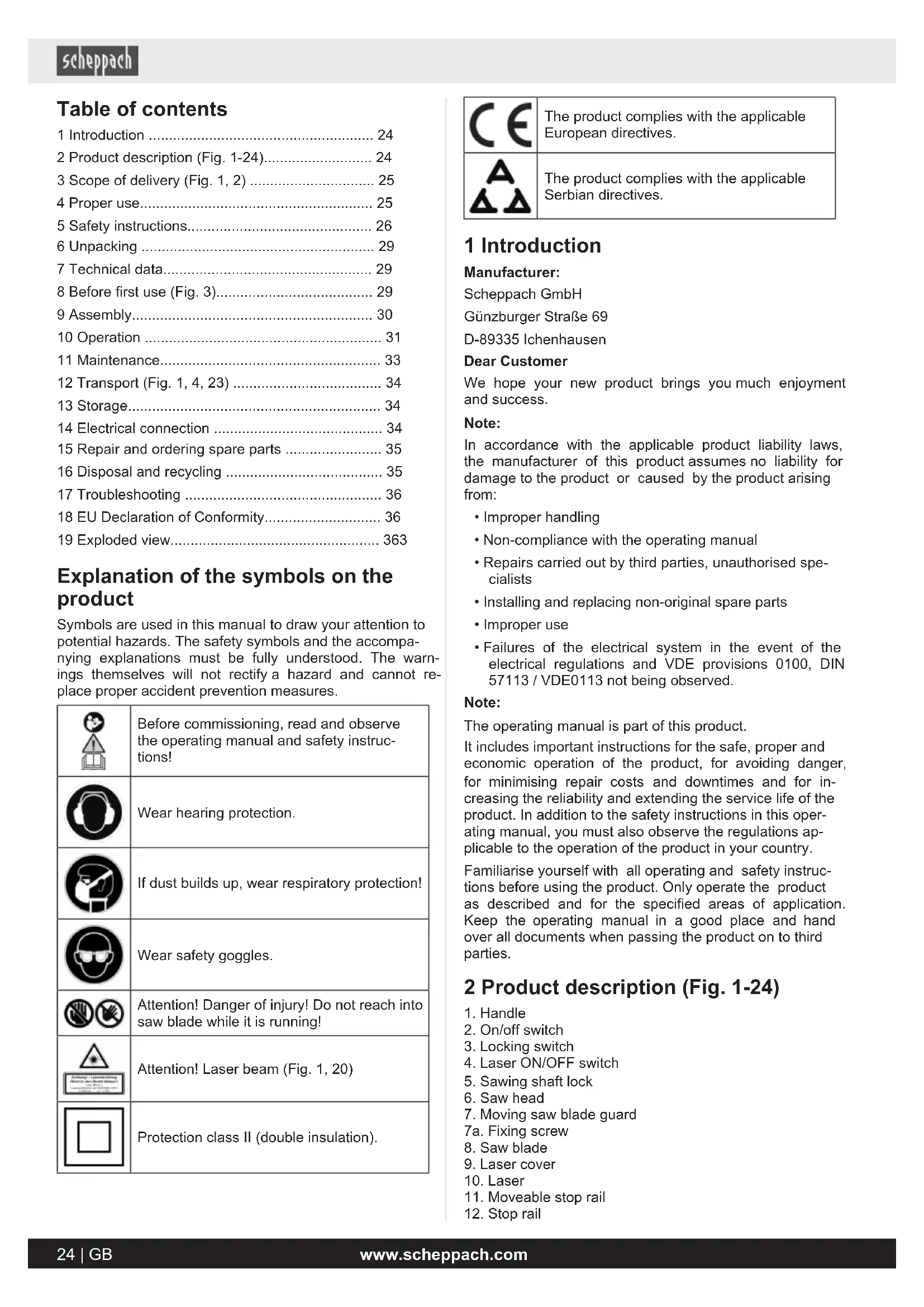
- Failures of the electrical system in the event of the electrical regulations and VDE provisions 0100, DIN 57113 / VDE0113 not being observed. Note: The operating manual is part of this product. It includes important instructions for the safe, proper and economic operation of the product, for avoiding danger, for minimising repair costs and downtimes and for in- creasing the reliability and extending the service life of the product. In addition to the safety instructions in this oper- ating manual, you must also observe the regulations ap- plicable to the operation of the product in your country. Familiarise yourself with all operating and safety instruc- tions before using the product. Only operate the product as described and for the specified areas of application. Keep the operating manual in a good place and hand over all documents when passing the product on to third parties. 2 Product description (Fig. 1-24)
7. Moving saw blade guard
11. Moveable stop rail
15. Adjustment screw
20. Locking screw for workpiece support
21. Workpiece support
22. Longitudinal stop
23. Set screw for the sliding stop rail
25a. Locking screw for clamping device height adjustment 25b. Knurled screw for clamping device height adjustment 25c. Locking screw for clamping device
32. Stop for cutting depth limiting
35. Adjustment screw (90°)
36. Adjustment screw (45°)
40. Laser cover Philips screw
43. LED work light (not shown)
C. 1 x Allen key, 6mm D. 1 x Allen key, 3mm 1 x Sliding cross-cut mitre saw 1 x Operating manual
- = may not be included in the scope of delivery! 4 Proper use The saw is used for the cutting of wood and plastic, ac- cording to the machine size. The saw is not suitable for cutting firewood. WARNING Do not use the product to cut materials other than those described in the operating manual. WARNING The supplied saw blade is only intended for the sawing of wood! Do not use this blade for sawing firewood! Only suitable saw blades may be used for the product. The use of any type of cutting wheels is prohibited. The product may only be used in the intended manner. Any use beyond this is improper. The user, not the manu- facturer, is responsible for damages or injuries of any type resulting from this. An element of the intended use is also the observance of the safety instructions, as well as the assembly instruc- tions and operating information in the operating manual. Persons who operate and maintain the product must be familiar with the manual and must be informed about po- tential dangers. The liability of the manufacturer and resulting damages are excluded in the event of modifications of the product. The product may only be operated with original parts and original accessories from the manufacturer. The safety, operating and maintenance specifications of the manufacturer, as well as the dimensions specified in the technical data, must be observed. Despite use as intended, specific risk factors cannot be entirely eliminated. Due to the design and layout of the product, the following risks remain:
- Contact with the saw blade in the exposed sawing ar- ea.
- Reaching into the running saw blade (cutting injury).
- Kick-back of workpieces and workpiece parts.
- Ejection of faulty carbide parts of the saw blade.
- Hearing damage when the necessary hearing protec- tion is not used.
- Harmful emissions of wood dusts during use in en- closed areas. Please note that our products were not designed with the intention of use for commercial or industrial purposes. We assume no guarantee if the product is used in commercial or industrial applications, or for equivalent work. Explanation of the signal words in the operating manual DANGER Signal word to indicate an imminently haz- ardous situation which, if not avoided, will re- sult in death or serious injury. WARNING Signal word to indicate a potentially hazard- ous situation which, if not avoided, could re- sult in death or serious injury. GB | 25www.scheppach.comCAUTION Signal word to indicate a potentially hazard- ous situation which, if not avoided, could re- sult in minor or moderate injury. ATTENTION Signal word to indicate a potentially hazard- ous situation which, if not avoided, could re- sult in product or property damage. 5 Safety instructions General power tool safety warnings WARNING Read all safety warnings, instructions, illus- trations and specifications provided with this power tool. Failure to follow all instructions listed below may result in electric shock, fire and/or serious injury. Save all warnings and instructions for future reference. The term “power tool” in the warnings refers to your mains-operated (corded) power tool or battery-operated (cordless) power tool.
a) Keep your work area clean and well-lit. Cluttered or dark areas invite accidents. b) Do not operate power tools in explosive atmo- spheres, such as in the presence of flammable liq- uids, gases or dust. Power tools create sparks which may ignite the dust or fumes. c) Keep children and bystanders away while operat- ing a power tool. Distractions can cause you to lose control.
2) Electrical safety
a) Power tool plugs must match the outlet. Never modify the plug in any way. Do not use any adapt- er plugs with earthed (grounded) power tools. Un- modified plugs and matching outlets will reduce risk of electric shock. b) Avoid body contact with earthed or grounded sur- faces, such as pipes, radiators, ranges and refrig- erators. There is an increased risk of electric shock if your body is earthed or grounded. c) Do not expose power tools to rain or wet condi- tions. Water entering a power tool will increase the risk of electric shock. d) Do not abuse the cord. Never use the cord for car- rying, pulling or unplugging the power tool. Keep cord away from heat, oil, sharp edges or moving parts. Damaged or entangled cords increase the risk of electric shock. e) When operating a power tool outdoors, use an ex- tension cord suitable for outdoor use. Use of a cord suitable for outdoor use reduces the risk of elec- tric shock. f) If operating a power tool in a damp location is un- avoidable, use a residual current device (RCD) protected supply. Use of an RCD reduces the risk of electric shock.
a) Stay alert, watch what you are doing and use com- mon sense when operating a power tool. Do not use a power tool while you are tired or under the influence of drugs, alcohol or medication. A mo- ment of inattention while operating power tools may result in serious personal injury. b) Use personal protective equipment. Always wear eye protection. Protective equipment such as a dust mask, non-skid safety shoes, hard hat or hearing pro- tection used for appropriate conditions will reduce per- sonal injuries. c) Prevent unintentional starting. Ensure the switch is in the off-position before connecting to power source and/or battery pack, picking up or carrying the tool. Carrying power tools with your finger on the switch or energising power tools that have the switch on invites accidents. d) Remove any adjusting key or wrench before turn- ing the power tool on. A wrench or a key left at- tached to a rotating part of the power tool may result in personal injury. e) Do not overreach. Keep proper footing and bal- ance at all times. This enables better control of the power tool in unexpected situations. f) Dress properly. Do not wear loose clothing or jew- ellery. Keep your hair and clothing away from moving parts. Loose clothes, jewellery or long hair can be caught in moving parts. g) If devices are provided for the connection of dust extraction and collection facilities, ensure these are connected and properly used. Use of dust col- lection can reduce dust-related hazards. h) Do not let familiarity gained from frequent use of tools allow you to become complacent and ignore tool safety principles. A careless action can cause severe injury within a fraction of a second.
4) Power tool use and care
a) Do not force the power tool. Use the correct power tool for your application. The correct power tool will do the job better and safer at the rate for which it was designed. b) Do not use the power tool if the switch does not turn it on and off. Any power tool that cannot be con- trolled with the switch is dangerous and must be re- paired. c) Disconnect the plug from the power source and/or remove the battery pack, if detachable, from the power tool before making any adjustments, changing accessories, or storing power tools. Such precautionary measures reduce the risk of start- ing the power tool accidentally. d) Store idle power tools out of the reach of children and do not allow persons unfamiliar with the pow- er tool or these instructions to operate the power tool. Power tools are dangerous in the hands of un- trained users. 26 | GB www.scheppach.come) Maintain power tools and accessories. Check for misalignment or binding of moving parts, break- age of parts and any other condition that may af- fect the power tool’s operation. If damaged, have the power tool repaired before use. Many accidents are caused by poorly maintained power tools. f) Keep cutting tools sharp and clean. Properly main- tained cutting tools with sharp cutting edges are less likely to bind and are easier to control. g) Use the power tool, accessories and tool bits etc. in accordance with these instructions, taking into account the working conditions and the work to be performed. Use of the power tool for operations different from those intended could result in a hazard- ous situation. h) Keep handles and grasping surfaces dry, clean and free from oil and grease. Slippery handles and grasping surfaces do not allow for safe handling and control of the tool in unexpected situations.
a) Have your power tool serviced by a qualified re- pair person using only identical replacement parts. This will ensure that the safety of the power tool is maintained.
5.1 Safety instructions for chop and
mitre saws a) Mitre saws are intended to cut wood or woodlike products, they cannot be used with abrasive cut- off wheels for cutting ferrous material such as bars, rods, studs, etc. Abrasive dust causes moving parts such as the lower protective cover to jam. Sparks from abrasive cutting will burn the lower pro- tective cover, the kerf insert and other plastic parts. b) Use clamps to support the workpiece whenever possible. If supporting the workpiece by hand, you must always keep your hand at least 100 mm from either side of the saw blade. Do not use this saw to cut pieces that are too small to be securely clamped or held by hand. If your hand is placed too close to the saw blade, there is an increased risk of in- jury from blade contact. c) The workpiece must be stationary and clamped or held against both the fence and the table. Do not feed the workpiece into the saw blade or cut “free- hand” in any way. Unrestrained or moving workpiec- es could be thrown at high speeds, causing injury. d) Push the saw through the workpiece. Do not pull the saw through the workpiece. To make a cut, raise the saw head and pull it out over the work- piece without cutting. Start the motor, press the saw head down and push the saw through the workpiece. Cutting on the pull stroke is likely to cause the saw blade to climb on top of the workpiece and vi- olently throw the blade assembly towards the opera- tor. e) Never cross your hand over the intended line of cutting either in front or behind the saw blade. Supporting the workpiece “cross handed” i.e. holding the workpiece to the right of the saw blade with your left hand or vice versa is very dangerous. f) Do not reach behind the fence while the saw blade is spinning. Observe the 100 mm safety distance between hands and the rotating saw blade (this applies to both sides of the saw blade, e.g. also when removing waste pieces of wood). The prox- imity of the spinning saw blade to your hand may not be obvious and you may be seriously injured. g) Inspect your workpiece before cutting. If the work- piece is bowed or warped, clamp it with the out- side bowed face toward the fence. Always make certain that there is no gap between the work- piece, fence and table along the line of the cut. Bent or warped workpieces can twist or shift and may cause binding on the spinning saw blade while cutting. There should be no nails or foreign objects in the workpiece. h) Do not use the saw until the table is clear of all tools, wood scraps, etc., except for the workpiece. Small debris or loose pieces of wood or other objects that contact the revolving blade can be thrown with high speed.
i) Only cut one workpiece at a time. Stacked multiple
workpieces cannot be adequately clamped or braced and may bind on the blade or shift during cutting. j) Ensure the mitre saw is mounted or placed on a level, firm work surface before use. A level and firm work surface reduces the risk of the mitre saw becom- ing unstable. k) Plan your work. Every time you adjust the bevel or mitre angle setting, make sure the adjustable fence is set correctly to support the workpiece and will not interfere with the blade or the protec- tive cover. Without turning the machine “ON” and with no workpiece on the table, move the saw blade through a complete simulated cut to assure there will be no interference or danger of cutting the fence. l) Provide adequate support such as table exten- sions, saw horses, etc. for a workpiece that is wid- er or longer than the table top. Workpieces that are longer or wider than the table of the chop and mitre saw can tip if they are not properly supported. If the cut-off piece or workpiece tips, it can lift the lower pro- tective cover or be thrown by the spinning blade. m) Do not use another person as a substitute for a ta- ble extension or as additional support. Unstable support of the workpiece can lead to the blade becom- ing jammed. Also, the workpiece could shift during the cutting process, pulling you or your assistant into the rotating blade. n) The cut-off piece must not be jammed or pressed by any means against the spinning saw blade. If confined, i.e. using length stops, the cut-off piece could get wedged against the blade and thrown vio- lently. o) Always use a clamp or a fixture designed to prop- erly support round material such as rods or tub- ing. Rods have a tendency to roll while being cut, causing the blade to “bite” and pull the work with your hand into the blade. p) Let the blade reach full speed before contacting the workpiece. This will reduce the risk of the work- piece being thrown. GB | 27www.scheppach.comq) If the workpiece or blade becomes jammed, turn the mitre saw off. Wait for all moving parts to stop and disconnect the mains plug from the power source and/or remove the rechargeable battery. Then, remove the jammed material. Continued saw- ing with a jammed workpiece could cause loss of con- trol or damage to the mitre saw. r) After finishing the cut, release the switch, hold the saw head down and wait for the blade to stop be- fore removing the cut-off piece. Reaching with your hand near the coasting blade is dangerous. s) Hold the handle firmly when making an incom- plete cut or when releasing the switch before the saw head is completely in the down position. The braking action of the saw may cause the saw head to be suddenly pulled downward, causing a risk of injury.
5.2 Safety instructions for the use of
- Avoid uncontrolled release of the saw unit in the lower end position.
- Do not use damaged or deformed saw blades.
- Do not use saw blades with cracks. Separate cracked saw blades. Repairs are not permitted.
- Do not use saw blades made of high speed steel.
- Check the condition of the saw blades before using saws.
- Make sure that a suitable saw blade for the material to be cut is selected.
- Only use saw blades recommended by the manufac- turer. Saw blades designed to cut wood and similar materi- als must comply with EN 847-1.
- Do not use saw blades made of high-speed alloy steel (HSS steel).
- Only use saw blades for which the maximum permis- sible speed is not lower than the maximum spindle speed of the saw and which are suitable for the mate- rial to be cut.
- Observe the direction of rotation of the saw blade.
- Only use saw blades if you have mastered their use.
- Observe the maximum speed. The maximum speed specified on the saw blade may not be exceeded. If specified, observe the speed range.
- Clean dirt, grease, oil and water off of the clamping surfaces.
- Do not use any loose reducing rings or bushes for the reducing of holes on saw blades.
- Make sure that fixed reducer rings for securing the saw blade have the same diameter and have at least 1/3 of the cutting diameter.
- Make sure that fixed reducer rings are parallel to each other.
- Handle saw blade with caution. They are ideally stored in the originally package or special containers. Wear protective gloves in order to improve grip and to further reduce the risk of injury.
- Prior to the use of saw blades, make sure that all pro- tective devices are properly fastened.
- Prior to use, make sure that the saw blade meets the technical requirements of this saw and is properly fas- tened.
- Only use the supplied saw blade for cutting wood, never for the processing of metals.
- Use only a saw blade with a diameter that matches the specifications on the saw.
- Use additional workpiece supports, if required for workpiece stability.
- Workpiece support extensions must always be se- cured and used during work.
- Replace table inlays when worn!
- Avoid overheating the saw teeth.
- When sawing plastic, avoid melting of the plastic. Use the correct saw blades for the material to be cut. Replace damaged or worn saw blades immediately. When the saw blade overheats, stop the machine. Al- low the saw blade to cool down before using the ma- chine again.
- Use only saw blades that are marked with an equal or higher rotational speed than the rotational speed specified on the electric tool.
- Always ensure that the saw is stable and secure.
Attention: Laser beam Do not look into the beam Laser class 2 Protect yourself and you environment from accidents using suitable precautionary measures!
- Do not look directly into the laser beam with unpro- tected eyes.
- Never look into the path of the beam.
- Never point the laser beam towards reflecting surfac- es and persons or animals. Even a laser beam with a low output can cause damage to the eyes. CAUTION Methods other than those specified here can result in dangerous radiation exposure.
- Never open the laser module. Unexpected exposure to the beam can occur.
- If the product is not used for an extended period of time, the batteries should be removed.
- The laser may not be replaced with a different type of laser.
- Repairs of the laser may only be carried out by the la- ser manufacturer or an authorised representative. 28 | GB www.scheppach.com6 Unpacking WARNING The product and the packaging material are not children's toys! Do not let children play with plastic bags, films or small parts! There is a danger of choking or suffo- cating!
- Open the packaging and carefully remove the product.
- Remove the packaging material, as well as the pack- aging and transport safety devices (if present).
- Check whether the scope of delivery is complete.
- Check the product and accessory parts for transport damage. Immediately report any damage to the trans- port company that delivered the Product. Later claims will not be recognised.
- If possible, keep the packaging until the expiry of the warranty period.
- Familiarise yourself with the product by means of the operating manual before using for the first time.
- With accessories as well as wearing parts and re- placement parts use only original parts. Spare parts can be obtained from your specialist dealer.
- When ordering please provide our article number as well as type and year of manufacture for the product. 7 Technical data AC motor 220 - 240 V~/ 50 Hz Nominal power S1 1700 Watts Operating mode S6 25%* 2000 W Idle speed n
- = may not be included in the scope of delivery! Operating mode S6 Uninterrupted periodic operation. The mode comprises of a start-up period, a time with constant load and an idle time. The operating time is 10 mins, the relative duty cy- cle is 25% of the operating time. The workpiece must have a minimum height of 3mm and a minimum width of 10mm. Make sure that the workpiece is always secured with the clamping de- vice. Noise data WARNING Noise can have serious effects on your health. If the machine noise exceeds 85 dB, please wear suitable hearing protection for you and persons in the vicinity. The noise and vibration values have been determined in accordance with EN 62841-1. Sound pressure level L
3 dB The specified noise emission values have been measured in accordance with a standardised test procedure and can be used to compare one power tool with another. The specified device emissions values can also be used for an initial estimation of the load. WARNING The noise emission values can vary from the specified values during the actual use of the power tool, depending on the type and the manner in which the electric tool is used, and in particular the type of workpiece being pro- cessed. Try to keep the stress as low as possible. For example: Limit working time. In doing so, all parts of the operating cycle must be taken into account (such as times in which the power tool is switched off or times in which it is switched on, but is not running under a load). 8 Before first use (Fig. 3)
1. Loosen the pre-installed tilt protection (33) on the un-
derside of the saw, pull it out completely and secure it again using the Allen key (D).
2. The product must be securely installed. Fasten the
product to a workbench, machine stand or similar. In- sert 4 screws (not included in the scope of delivery) into the holes on the fixed saw table (19). Tighten up the screws.
3. Set the adjustment screw (15) to the level of the table-
top to prevent the product from tipping over.
- Prior to commissioning, all covers and safety devices must be mounted correctly.
- The saw blade must be able to run freely.
- In case of previously machined wood, be aware of any foreign bodies, such as nails or screws, etc.
- Before pressing the on/off switch, make sure that the saw blade is correctly fitted, and that moving parts run smoothly.
- Before connecting of the product, make certain that the data on the type plate matches with the mains power data. GB | 29www.scheppach.com8.1 Checking the safety equipment of the saw blade guard (7) (Fig. 4) The saw blade guard protects against accidental contact with the saw blade and against flying chips. Check function To do this, fold the saw down:
- The saw blade guard must expose the saw blade when it is swung down without touching other parts.
- When the saw is folded up to the initial position, the saw blade guard must automatically cover the saw blade. 9 Assembly
9.1 Assembling the product
1. Loosen the rotary table (18) by turning the handle (14)
2. Operate the locking lever (14a) to release the lock.
3. Use the handle (14) to adjust the rotary table (18) to
4. Release the locking lever (14a) to lock the locking de-
5. Re-tighten the handle (14) by turning it clockwise, to
fix the rotary table in place.
6. Lock the adjusting screw (15) against the table* to se-
cure the product against tipping over.
7. The saw is unlocked from the lower position by gently
pressing down on the saw head (6) and, at the same time, pulling out the locking pin (34) from the engine mount.
8. Turn the locking pin (34) 90 degrees to lock it in the
9. Swivel the saw head (6) upwards.
10. The clamping devices (25) can be attached to both
sides of the fixed saw table (19). Insert a clamping de- vice (25) into the bore provided for this purpose at the rear side of the stop bar (12) and secure it by means of the locking screw (25c). For mitre cuts 0°- 45°, the clamping fixture (25) is to be mounted on one side only (right) (see Fig. 11-12).
11. The saw head (6) can be tilted to the left to max. 45°
by loosening the locking screw (24).
12. The workpiece supports (21) must always be attached
and used during work. Set the desired projection by loosening the locking screw (20). Then retighten the locking screw (20).
- = may not be included in the scope of delivery!
9.2 Dust bag (30) (Fig.1, 24)
The saw is equipped with a dust bag (30) for chips. Squeeze the wings of the metal ring on the dust bag (30) together and slide it over the discharge port near the mo- tor. The dust bag (30) can be emptied via the zip on the underside.
9.2.1 Connection to an external dust
1. Connect the suction hose to the dust extraction.
2. The dust extraction system must be suitable for the
material to be processed.
3. Use a special extraction device to extract dusts that
are particularly harmful to health or carcinogenic.
9.3 Fine adjustment of the stop for 90°
chop cut (Fig.1, 7) Tool required:
- 90° engineers square (A)*
- Phillips screwdriver*
- Open-ended spanner, size 13 mm*
- = not included in the scope of delivery!
1. Lower the saw head (6) and fix it with the locking pin
3. Place 90° engineers square (A) between saw blade
5. Adjust the adjustment screw (35) until the angle be-
tween the saw blade (8) and the rotary table (18) is 90°.
sary, loosen the pointer (16) with a Phillips screw- driver, set the scale (17) to 0° position and re-tighten.
9.4 Fine adjustment of the stop for 45°
mitre cut (Fig. 1, 8) Tool required:
- 45° engineers square (B)*
- Open-ended spanner, size 13 mm*
- Phillips screwdriver*
- = may not be included in the scope of delivery!
1. Lower the saw head (6) and fix it with the locking pin
2. Fix the rotary table (18) in the 0° position.
ATTENTION For mitre cuts (inclined saw head), the moveable stop rail must be fixed in the outer position (left side).
3. Loosen the locking screw (23) on the moveable stop
rails (11) and slide the sliding stop rails (11) outwards to create a 45° stop angle (B) between the saw blade (8) and the rotary table (18).
4. The moveable stop rails (11) must be locked in a posi-
tion that the distance between the stop rails (11) and the saw blade (8) is at least 8 mm.
5. The sliding stop rail (11) must be in the inner position
6. Before making the cut, check that no collision could
occur between the moveable stop rails (11) and the saw blade (8).
7. Loosen the locking screw (24) and tilt the saw head
(6) to the left, to 45°, using the handle (14). 30 | GB www.scheppach.com8. Place 45° engineers square (B) between saw blade (6) and rotary table (18).
9. Loosen the counternut (36a) and adjust the adjusting
screw (36) until the angle between the saw blade (8) and the rotary table (18) is exactly 45°.
10. Tighten the counternut (36a) again.
11. Then check the position of the angle display. If neces-
sary, loosen the pointer (16) with a Phillips screw- driver, set the scale (17) to 45° position and re-tighten. 10 Operation
10.1 Operating the clamping device (25)
(Fig. 1) The height of the clamping device (25) can be adjusted via the locking screw (25a).
1. Lower the clamping device (25) onto the workpiece.
2. Tighten the locking screw (25c).
3. Turn the knurled screw (25b) clockwise to clamp the
4. In order to loosen the workpiece, proceed in reverse
(Fig. 1, 9) WARNING Risk of kick-back! When making grooves, it is particularly important that no lateral pressure is exerted on the saw blade. Other- wise the saw head could suddenly kick up! – Use a clamping device when making grooves. Avoid lateral pressure on the saw head.
1. The cutting depth can be seamlessly adjusted with the
screw (31). Loosen the knurled nut (31a) on the screw for this. Set the desired cutting depth by screwing in or unscrewing the screw (31). Then retighten the knurled nut (31a) on the screw (31).
2. Check the setting with a test cut.
1. Press the laser ON/OFF switch (4) 1x. A laser line is
projected onto the workpiece to be cut, indicating the exact cutting path. Switching off:
1. Press the laser ON/OFF switch (4) again.
LED work light on/off switch (43) (Applies only to article number: 59012159953) Press the laser on/off switch (4) repeatedly to switch be- tween the laser (10) and the LED work light (43): Press 1 x Laser (10) ON/LED (43) OFF Press 2 x Laser (10) OFF/LED (43) ON Press 3 x Laser (10) ON/LED (43) ON Press 4 x Laser (10) OFF/LED (43) OFF
10.4 Serial cuts (Fig. 1, 10)
For repeated cuts of the same length, the length stop (22) can be opened. You can use the length stop (22) on the right and on the left.
1. Fold up the length stop (22).
2. Loosen the locking screw for the workpiece support
3. Pull out the workpiece support (21).
4. Set the required dimension between saw blade (8)
and length stop (22).
5. Re-tighten the locking screw for the workpiece support
6. Carry out the cuts as described in 10.5, 10.6, 10.7 and
(Fig. 1, 11, 12) At cutting widths of up to approx. 100 mm, it is possible to use the locking screw (28a) to secure the saw’s sliding function in the rear position. In this position the saw can be operated in chop cutting mode. If the cutting width is over 100 mm, ensure that the locking screw (28a) is loose and that the saw head (6) can move (Fig. 4). ATTENTION For 90° chop cuts, the moveable stop rail must be fixed in the inner position. Hints for clamping:
- Do not work with workpieces that are to small to be clamped in place.
- Reinforce very thin workpieces by sawing through them together with an additional bar. Very thin work- pieces may “flutter” or break when sawing
1. Loosen the locking screw (23) for the moveable stop
rail (11) and push the moveable stop rail (11) inwards.
2. The moveable stop rail (11) must be locked in a posi-
tion far enough from the inner position that the dis- tance between the moveable stop rail (11) and the saw blade (8) is no more than 8mm.
3. Before making the cut, check that no collision could
occur between the moveable stop rail (11) and the saw blade (8).
4. Tighten the set screw (23) again.
5. Move the saw head (6) to the upper position.
6. Use the handle (1) to push back the saw head (6) and
fix it in this position if required (dependent on the cut- ting width).
7. Place the wood to be cut against the stop rail (12) and
on the rotary table (18).
8. Secure the material with the clamping device (25) on
the fixed saw table (19) to prevent it from shifting during the cutting process.
9. Unlock the locking switch (3) and press the on/off
switch (2) to switch the motor on.
10. Move the saw head (6) with the handle (1) evenly and
with light pressure downwards until the saw blade (8) has cut through the workpiece. GB | 31www.scheppach.com11. When the sawing process is finished, return the saw head (6) to the upper resting position and release the ON/OFF switch (2). ATTENTION The return spring automatically raises the product. Do not release the handle after finishing cutting but allow the saw head to move upwards slowly and with a little counterpressure.
10.5.1 With the slide rail fixed (28) (Fig. 4)
1. Fix the saw’s sliding function with the locking screw
for slide rail (28a) in rear position.
2. Move the saw head (6) with the handle (1) evenly and
with light pressure downwards until the saw blade (8) has cut through the workpiece.
10.5.2 With the slide rail (28) not fixed in
- Pull the saw head (6) all the way to the front. Lower the handle (1) to the very bottom by applying steady and light downward pressure. Now push the saw head (6) slowly and steadily to the very back until the saw blade (8) has completely cut through the work piece.
10.6 90° chop cut and rotary table
0°- 47° (Fig. 1, 11, 13) The cross-cut mitre saw can be used for angled cuts of 0°-47° to the left and right. ATTENTION For 90° chop cuts, the moveable stop rail must be fixed in the inner position.
1. Loosen the locking screw (23) for the moveable stop
rail (11) and push the moveable stop rail (11) inwards.
2. The moveable stop rail (11) must be locked in a posi-
tion far enough from the inner position that the dis- tance between the moveable stop rail (11) and the saw blade (8) is no more than 8mm.
3. Before making the cut, check that no collision could
occur between the moveable stop rail (11) and the saw blade (8).
4. Tighten the set screw (23) again.
5. Loosen the rotary table (18) by turning the handle (14)
6. Operate the locking lever (14a) to release the lock.
7. Use the handle (14) to adjust the rotary table (18) to
8. Release the locking lever (14a) to lock the locking de-
9. Tighten the handle (14) by turning it clockwise, to fix
the rotary table (18) in place.
10. Lock the adjusting screw (15) against the table* to se-
cure the product against tipping over.
11. Carry out the cut as described below 10.5.
- = may not be included in the scope of delivery!
10.7 0°-45° mitre cut and rotary table 0°
(Fig.1, 11, 14) Mitre cuts of 0° - 45° to the working surface can be car- ried out to the left using the saw. ATTENTION For mitre cuts (inclined saw head), the moveable stop rail must be fixed in the outer position. ATTENTION For 0°- 45° mitre cuts, only the clamping device (work- piece clamp) on the right must be mounted.
1. Loosen the locking screw (23) on the moveable stop
rails (11) and push the moveable stop rails (11) out- wards (left side).
2. The moveable stop rail (11) must be locked in a posi-
tion far enough from the inner position that the dis- tance between the moveable stop rails (11) and the saw blade (8) is no more than 8mm (right side).
3. Before making the cut, check that no collision could
occur between the moveable stop rail (11) and the saw blade (8).
4. Tighten the set screw (23) again.
5. Move the saw head (6) to the upper position.
6. Fix the rotary table (18) in the 0° position.
7. Loosen the locking screw (24) and tilt the saw head
(6) to the left with the handle (1) until the angle pointer (27) points to the desired angle on the angle scale (26).
8. Retighten the locking screw (24).
9. Perform the cut as described under 10.5.
10.8 0°- 45° mitre cut and rotary table
0°- 47° (Fig.1, 11, 15) The saw can be used for mitre cuts of 0°- 45° to the left of the work surface and of 0°- 47° to the stop rail (double mi- tre cut). ATTENTION For mitre cuts (inclined saw head), the moveable stop rail must be fixed in the outer position. With a cross-cut saw tilted to 31.6° and a unit tilt of 33.9°, isosceles triangular strips and profiles such as stucco edge profiles can be mitred with the profile side down. This is particularly advantageous for large profiles that ex- ceed the maximum cutting height with normal insertion. It also makes it easy to solve problems with the angle at the corners, which is often not right-angled. ATTENTION For 0°- 45° mitre cuts, only the clamping device (work- piece clamp) on the right must be mounted.
1. Loosen the locking screw (23) on the moveable stop
rails (11) and push the moveable stop rails (11) out- wards. 32 | GB www.scheppach.com2. The moveable stop rail (11) must be locked in a posi- tion far enough from the inner position that the dis- tance between the moveable stop rail (11) and the saw blade (8) is no more than 8mm.
3. Before making the cut, check that no collision could
occur between the moveable stop rail (11) and the saw blade (8).
4. Tighten the set screw (23) again.
5. Move the saw head (6) to the upper position.
6. Loosen the rotary table (18) by turning the handle (14)
7. Operate the locking lever (14a) to release the lock.
8. Tilt the saw head (18) to the left to the desired angle
using the handle (14) (see 10.6).
9. Release the locking lever (14a) to lock the locking de-
10. Tighten the handle (14) by turning it clockwise, to fix
the rotary table (18) in place.
11. Lock the adjusting screw (15) against the table* to se-
cure the product against tipping over.
12. Loosen the locking screw (24).
13. Use the handle (1) to tilt the saw head (6) to the left to
15. Carry out the cut as described below 10.5.
- = may not be included in the scope of delivery! 11 Maintenance WARNING Pull out the mains plug before carrying out any setting, servicing or repair work!
11.1 General maintenance tasks
- Keep protective devices, air vents and the motor housing as free of dust and dirt as possible. Rub the product clean with a clean cloth* or blow it off with compressed air* at low pressure. We recommend that you clean the product directly after every use.
- Oil all moving parts once a month.
- Clean the product at regular intervals using a damp cloth* and a little soft soap. Do not use any cleaning products or solvents; they could attack the plastic parts of the product. Make sure that no water can pen- etrate the product interior.
11.2 Replacing the saw blade (8)
(Fig.1, 16 - 18) WARNING Pull out the mains plug before carrying out any setting, servicing or repair work! ATTENTION Wear protective gloves when changing the saw blade! Danger of injury! Tool required:
- Phillips screwdriver*
- = not included in the scope of delivery!
1. Swivel the saw head (6) upwards and lock it with the
2. Loosen the fixing screw (7a) of the cover with a Phil-
3. Fold the saw blade guard (7) up sufficiently that the
saw blade guard (7) is above the flange screw (37).
4. With one hand, fit the 6mm Allen key (C) to the flange
5. Firmly press the saw shaft lock (5), and slowly turn the
flange screw (37) clockwise. After max. one turn, the saw shaft lock (5) engages.
6. Then undo the flange screw (37), by applying a slight-
ly greater force in a clockwise direction.
7. Fully unscrew the flange screw (37) and remove the
8. Remove the saw blade (8) from the inner flange (39)
and pull it out downwards.
9. Carefully clean the flange screw (37), outer flange
(38) and inner flange (39).
10. Insert the new saw blade (8) in the reverse sequence
11. Fold the saw blade guard (7) downwards until the saw
blade guard (7) engages in the fixing screw (7a).
12. Re-tighten the fixing screw (7a).
ATTENTION The cutting angle of the teeth, i.e. the direction of rota- tion of the saw blade, must correspond to the direction of the arrow on the housing.
13. Before continuing work, check that the safety devices
are functioning properly (Fig. 5). ATTENTION After each saw blade change, check that the saw blade runs freely in the table inlay in vertical position as well as when tilted to 45°. ATTENTION Changing and aligning the saw blade must be carried out properly.
11.3 Cleaning the safety equipment of
the saw blade guard (7) (Fig. 1) Check the saw blade guard for dirt before each start-up. Remove old shavings and wood splinters using a brush or similar suitable tool. Make sure the guide bar (29) moves smoothly.
11.4 Calibrating the laser (10) (Fig.20)
ATTENTION Never press the ON/OFF switch when adjust- ing the laser. Danger of injury! GB | 33www.scheppach.comIf the laser (10) is no longer showing the correct cutting line, it can be readjusted. Tool required:
- Phillips screwdriver*
- = not included in the scope of delivery!
1. To do so, loosen the laser cover Philips screw (40)
and remove the laser cover (9). Set the laser by mov- ing sideways until the laser beam strikes the teeth of the saw blade (8).
2. After you have calibrated the laser (10) and fastened it
in place, fit the laser cover (9) and fasten this hand- tight with the Philips screw for the laser cover (40).
3. The saw must be connected to the mains in order to
(Fig. 1, 21) WARNING With a damaged table inlay there is a risk of small parts jamming between table inlay and saw blade, blocking the saw blade. Immediately replace damaged table inlays! Tool required:
- Phillips screwdriver*
- = not included in the scope of delivery!
Remove the Phillips screw (41) on the table inlay (13). If necessary, rotate the rotary table (18) and angle the saw head (6) to be able to reach the Phillips screw (41).
If the product is new, check the carbon brushes after the first 50 operating hours or if a new brush has been mount- ed. After the initial check, check every 10 operating hours.
- If the carbon is worn down to a length of 6 mm, or the spring or the shunt wire is burnt or damaged, both brushes must be replaced.
- If the brushes are found to be usable after removal, they can be reinstalled.
- To maintain the carbon brushes, open both locks anti- clockwise. Then remove the carbon brushes.
- Re-insert the carbon brushes in reverse order. 12 Transport (Fig. 1, 4, 23)
1. Tighten the handle / locking screw for the rotary table
(14) to lock the rotary table (18).
2. Push the saw head (6) downwards and lock it with the
locking pin (34). The saw is now locked in the lower position.
3. Fix the saw’s sliding function with the locking screw
for slide rail (28a) in rear position.
4. Carry the product by the transport handle (42).
5. To reassemble the product, proceed as described in
8, 9, 10. 13 Storage Store the product and its accessories in a dark, dry and frost-free place that is inaccessible to children. The optimum storage temperature is between 5°C and 30˚C. Store the product in its original packaging. Cover the product to protect it from dust or moisture. Store the operating manual with the product. 14 Electrical connection The electrical motor installed is connected and ready for operation. The connection complies with the ap- plicable VDE and DIN provisions. The customer's mains connection as well as the extension cable used must also comply with these regulations.
14.1 Important information
In the event of overloading, the motor will switch itself off. After a cool-down period (time varies) the motor can be switched back on again. WARNING The maximum permissible mains impedance Zmax of the product is 0.443Ω. As a user of this product, you must determine, in consultation with the power supply company if necessary, that the product is only connect- ed to a supply whose impedance is less than or equal to Zmax!
14.2 Special connection conditions
- The product fulfils the requirements of EN 61000-3-11 and is subject to special connection requirements. This means that use at any freely selectable connec- tion points is not permitted.
- The product can cause temporary voltage fluctuations in unfavourable mains conditions.
- The product is intended exclusively for use at connec- tion points which a) do not exceed a maximum permitted mains imped- ance “Z” (Zmax. = 0.443 Ω), or b) have a continuous current carrying capacity of the mains of at least 100 A per phase.
- As the user, you are required to ensure that the con- nection point at which you wish to operate the product fulfils one of the requirements mentioned, a) or b). If necessary, consult with your energy supplier in this re- gard.
14.3 Damaged electrical connection
cables The insulation on electrical connection cables is often damaged. This may have the following causes:
- Pressure points, where connection cables are passed through windows or doors,
- Kinks where the connection cable has been improper- ly fastened or routed,
- Places where the connection cables have been cut due to being driven over,
- Insulation damage due to being ripped out of the wall socket, 34 | GB www.scheppach.com• Cracks due to the insulation ageing. Such damaged electrical connection cables must not be used and are life-threatening due to the insulation dam- age. Check the electrical connection cables for damage regu- larly. Ensure that the connection cables are disconnected from electrical power when checking for damage. Electrical connection cables must comply with the appli- cable VDE and DIN provisions. Only use connection ca- bles of the same designation. The printing of the type designation on the connection ca- ble is mandatory. Safety information for replacing damaged or defective mains connection cables Connection type X If the mains connection cable of this product is damaged, it must be replaced by a specially prepared mains con- nection cable which can be obtained from the manufactur- er or its service department.
Connections and repair work on the electrical equipment may only be carried out by electricians.
- The mains voltage must be 220 V - 240V~.
- Extension cables up to 25 m long must have a cross- section of 1.5 mm². 15 Repair and ordering spare parts After repairs or maintenance, make sure that all safety-re- lated parts are installed and are in perfect condition. All parts which may cause injury must be kept where they are inaccessible to children or others. ATTENTION According to the German Product Liability Act, no liabili- ty is accepted for damage caused by improper repairs or by not using original spare parts. Such work should be performed by a customer service centre or an authorised specialists. The same applies to accessory parts. Spare parts and accessories can be obtained from our Service Centre. To do this, scan the QR code on the front page. Connections and repairs Connections and repair work on the electrical equipment may only be carried out by electricians.
15.1 Ordering spare parts
Please provide the following information when ordering spare parts:
With this product, it is necessary to note that the following parts are subject to natural or usage-related wear, or that the following parts are required as consumables. Wearing parts*: carbon brushes, saw blade, table inlay, saw dust bag
- = may not be included in the scope of delivery! 16 Disposal and recycling Notes for packaging The packaging materials are recy- clable. Please dispose of packag- ing in an environmentally friendly manner. Notes on the electrical and electronic equipment act (ElektroG) Waste electrical and electronic equipment does not belong in household waste, but must be collected and disposed of separately!
- Used batteries or rechargeable batteries that are not installed permanently in the old device must be re- moved non-destructively before disposal! Their dis- posal is regulated by the battery act.
- Owners or users of electrical and electronic devices are legally obliged to return them after use.
- The end user is responsible for deleting their personal data from the old device being disposed of!
- The symbol of the crossed-out dustbin means that waste electrical and electronic equipment must not be disposed of with household waste.
- Waste electrical and electronic equipment can be handed in free of charge at the following places: – Public disposal or collection points (e.g. municipal works yards) – Points of sale of electrical appliances (stationary and online), provided that dealers are obliged to take them back or offer to do so voluntarily. – Up to three waste electrical devices per type of de- vice, with an edge length of no more than 25 centi- metres, can be returned free of charge to the man- ufacturer without prior purchase of a new device from the manufacturer or taken to another autho- rised collection point in your vicinity. – Further supplementary take-back conditions of the manufacturers and distributors can be obtained from the respective customer service.
- If the manufacturer delivers a new electrical device to aprivate household, the manufacturer can arrange for the free collection of the old electrical device upon re- quest from the end user. Please contact the manufac- turer’s customer service for this.
- These statements only apply to devices installed and sold in the countries of the European Union and which are subject to the European Directive 2012/19/EU. In countries outside the European Union, different regu- lations may apply to the disposal of waste electrical and electronic equipment. GB | 35www.scheppach.com17 Troubleshooting The following table shows fault symptoms and describes remedial measures in the event of your product failing to work properly. If you cannot localise and rectify the problem with this, please contact your service workshop. Fault Possible cause Remedy Motor does not work Engine, cable or connector defective, mains fuses blown. Arrange for inspection of the product by a special- ist. Never repair the motor yourself. Danger! Check mains fuses and replace as necessary The engine runs slowly and does not reach the operating speed. Voltage too low, coils damaged, ca- pacitor burnt. Have an electrician check the voltage. Arrange for inspection of the motor by a specialist. Arrange for replacement of the capacitor by a specialist. Engine producing excessive noise. Coils damaged, motor defective. Arrange for inspection of the motor by a special- ist. The engine does not reach full power. Circuits in the network are overloaded (lamps, other motors, etc.). Do not use any other products or motors on the same circuit. Motor overheats easily. Overloading of the motor, insufficient cooling of the motor. Avoid overloading the motor while cutting, remove dust from the motor in order to ensure optimal cooling of the motor. Saw cut is rough or wavy. Saw blade dull, tooth shape not ap- propriate for the material thickness. Resharpen saw blade and/or use suitable saw blade. Workpiece pulls away and/or splinters. Excessive cutting pressure and/or saw blade not suitable for use. Insert suitable saw blade. 18 EU Declaration of Conformity Translation of the original Declaration of Conformity Manufacturer: Scheppach GmbH Günzburger Straße 69 D-89335 Ichenhausen We declare under our sole responsibility that the product described here complies with the applicable directives and standards. Brand: SCHEPPACH Art. designation: SLIDING CROSS-CUT MITRE SAW -
- The object of the declaration described above fulfils the regulations of the directive 2011/65/EU of the European Parliament and Council from 8th June 2011, on the re- striction of the use of certain hazardous substances in electrical and electronic equipment. Applied standards: EN 62841-1:2015/A11:2022; EN IEC 62841-3-9:2020/A11:2020; EN IEC 55014-1:2021; EN IEC 55014-2:2021; EN IEC 61000-3-2:2019/A1:2021;
Directives UE: 2014/30/UE, 2006/42/CE, 2011/65/UE*
Direttive UE: 2014/30/UE, 2006/42/CE, 2011/65/UE*