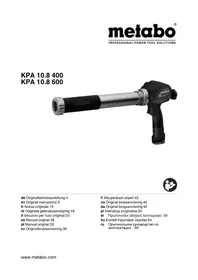
KPA 10.8 600 - Hot glue gun METABO - Free user manual and instructions
Find the device manual for free KPA 10.8 600 METABO in PDF.



| Brand | Metabo |
| Model | KPA 10.8 600 |
| Product Type | Cordless hot glue gun |
| Power Supply | 10.8 V Li-Ion battery pack (Metabo batteries) |
| Intended Use | Dispensing sealants or adhesives from cartridges or film bags |
| Feed Speed | Adjustable via thumbwheel (8) |
| Anti-drip function | Automatic rack retraction after releasing trigger (except for intervals < 1 s) |
| Automatic shut-off | When cartridge or bag is empty |
| Battery protection | Multifunctional monitoring system: shut-off in case of deep discharge, overload, or excessive temperature |
| Nozzle | For film bag (not included) |
| Capacity | Standard cartridges or film bags (400 ml conversion kit available as accessory) |
| Safety | Wear safety goggles mandatory; do not touch the rack; follow the adhesive manufacturer's instructions |
| Maintenance | Clean without solvents or aggressive products; maintenance by qualified repair person |
| Spare parts | Lists available at www.metabo.com; repairs by Metabo representative |
| Weight | Approx. 0.6 kg (with smallest battery pack) |
| Dimensions | Approx. 250 x 200 x 60 mm (estimated) |
Frequently Asked Questions - KPA 10.8 600 METABO
User questions about KPA 10.8 600 METABO
0 question about this device. Answer the ones you know or ask your own.
Ask a new question about this device
Download the instructions for your Hot glue gun in PDF format for free! Find your manual KPA 10.8 600 - METABO and take your electronic device back in hand. On this page are published all the documents necessary for the use of your device. KPA 10.8 600 by METABO.
USER MANUAL KPA 10.8 600 METABO

Original instructions
1. Declaration of Conformity
We declare under our sole responsibility: These cordless cartridge guns, identified by type and serial number *1), comply with all relevant requirements of the directives *2) and standards *3). Technical file at *4) - see page 3.
2. Specified Use
The device is designed to extrude sealant or adhesive from cartridges or plastic bags.
It is not designed for foodstuffs or for medical/veterinary purposes. It should not be used with pressurized cartridges. The caulking gun should also not be used as a lifting/spreading tool.
The user bears sole responsibility for any damage caused by improper use.
Generally accepted accident prevention regulations and the enclosed safety information must be observed.
3. General Safety Instructions

For your own protection and for the protection of your electrical tool, pay attention to all parts of the text that are marked with this symbol!

WARNING – Reading the operating instructions will reduce the risk of injury.
Pass on your electrical tool only together with these documents.
General Power Tool Safety Warnings

WARNING – Read all safety warnings and all instructions. Failure to follow the warnings
and instructions may result in electric shock, fire and/or serious injury.
Save all warnings and instructions for future reference! The term "power tool" in the warnings refers to your mains-operated (corded) power tool or battery-operated (cordless) power tool.
3.1 Work area safety
a) Keep work area clean and well lit. Cluttered or dark areas invite accidents.
b) Do not operate power tools in explosive atmospheres, such as in the presence of flammable liquids, gases or dust. Power tools create sparks which may ignite the dust or fumes.
c) Keep children and bystanders away while operating a power tool. Distractions can cause you to lose control.
3.2 Electrical safety
a) Power tool plugs must match the outlet. Never modify the plug in any way. Do not use any adapter plugs with earthed (grounded)
power tools. Unmodified plugs and matching outlets will reduce risk of electric shock.
b) Avoid body contact with earthed or grounded surfaces, such as pipes, radiators, ranges and refrigerators. There is an increased risk of electric shock if your body is earthed or grounded.
c) Do not expose power tools to rain or wet conditions. Water entering a power tool will increase the risk of electric shock.
d) Do not abuse the cord. Never use the cord for carrying, pulling or unplugging the power tool. Keep cord away from heat, oil, sharp edges or moving parts. Damaged or entangled cords increase the risk of electric shock.
e) When operating a power tool outdoors, use an extension cord suitable for outdoor use. Use of a cord suitable for outdoor use reduces the risk of electric shock.
f) If operating a power tool in a damp location is unavoidable, use a residual current device (RCD) protected supply. Use of an RCD reduces the risk of electric shock.
3.3 Personal safety
a) Stay alert, watch what you are doing and use common sense when operating a power tool. Do not use a power tool while you are tired or under the influence of drugs, alcohol or medication. A moment of inattention while operating power tools may result in serious personal injury.
b) Use personal protective equipment. Always wear eye protection. Protective equipment such as dust mask, non-skid safety shoes, hard hat, or hearing protection used for appropriate conditions will reduce personal injuries.
c) Prevent unintentional starting. Ensure the switch is in the off-position before connecting to power source and/or battery pack, picking up or carrying the tool. Carrying power tools with your finger on the switch or energising power tools that have the switch on invites accidents.
d) Remove any adjusting key or wrench before turning the power tool on. A wrench or a key left attached to a rotating part of the power tool may result in personal injury.
e) Do not overreach. Keep proper footing and balance at all times. This enables better control of the power tool in unexpected situations.
f) Dress properly. Do not wear loose clothing or jewellery. Keep your hair, clothing and gloves away from moving parts. Loose clothes, jewellery or long hair can be caught in moving parts.
g) If devices are provided for the connection of dust extraction and collection facilities, ensure these are connected and properly used. Use of dust collection can reduce dust-related hazards.
ENGLISHen
3.4 Power tool use and care
a) Do not force the power tool. Use the correct power tool for your application. The correct power tool will do the job better and safer at the rate for which it was designed.
b) Do not use the power tool if the switch does not turn it on and off. Any power tool that cannot be controlled with the switch is dangerous and must be repaired.
c) Disconnect the plug from the power source and/or the battery pack from the power tool before making any adjustments, changing accessories, or storing power tools. Such preventive safety measures reduce the risk of starting the power tool accidentally.
d) Store idle power tools out of the reach of children and do not allow persons unfamiliar with the power tool or these instructions to operate the power tool. Power tools are dangerous in the hands of untrained users.
e) Maintain power tools. Check for misalignment or binding of moving parts, breakage of parts and any other condition that may affect the power tool's operation. If damaged, have the power tool repaired before use. Many accidents are caused by poorly maintained power tools.
f) Keep cutting tools sharp and clean. Properly maintained cutting tools with sharp cutting edges are less likely to bind and are easier to control.
g) Use the power tool, accessories and tool bits etc. in accordance with these instructions, taking into account the working conditions and the work to be performed. Use of the power tool for operations different from those intended could result in a hazardous situation.
3.5 Battery tool use and care
a) Recharge only with the charger specified by the manufacturer. A charger that is suitable for one type of battery pack may create a risk of fire when used with another battery pack.
b) Use power tools only with specifically designated battery packs. Use of any other battery packs may create a risk of injury and fire.
c) When battery pack is not in use, keep it away from other metal objects, like paper clips, coins, keys, nails, screws or other small metal objects, that can make a connection from one terminal to another. Shorting the battery terminals together may cause burns or a fire.
d) Under abusive conditions, liquid may be ejected from the battery; avoid contact. If contact accidentally occurs, flush with water. If liquid contacts eyes, additionally seek medical help. Liquid ejected from the battery may cause irritation or burns.
3.6 Service
a) Have your power tool serviced by a qualified repair person using only identical replacement parts. This will ensure that the safety of the power tool is maintained.
4. Special Safety Instructions

Slightly acidic, flammable fluid may leak from defective li-ion battery packs!

If battery fluid leaks out and comes into contact with your skin, rinse immediately with plenty of water. If battery fluid leaks out
and comes into contact with your eyes, wash them with clean water and seek medical attention immediately.
If the machine is defective, remove the battery pack from the machine.

Protect battery packs from water and moisture!
Do not use faulty or deformed battery packs!

Do not expose battery packs to naked flame!
Do not open battery packs!
Do not touch or short-circuit battery packs!
Remove the battery pack from the machine before any adjustments, conversions or servicing are performed.
Before fitting the battery pack, make sure that the machine is switched off.
Do not use frozen or set adhesive or sealant.
Do not overload the motor! If the motor is overloaded, switch off the device and remove the battery pack. Determine the cause of the problem and resolve it.
Refer to the instructions for assembling the device. Ensure that the front cap, tube and threaded ring are correctly fitted and securely fastened.
Always wear protective goggles.
Danger of crushing! Do not take hold of the toothed rod (5)! Ensure that nothing is caught by the toothed rod.
Follow national requirements for the materials you want to work with.
Refer to the glue or adhesive manufacturers' instructions and also the safety data sheet for the consumable material.
Adhesives and sealants can be dangerous. For this reason, you should always carefully read any instructions on the container or other information provided by the manufacturer about the material to be used. Do not use materials without knowing what risks they entail.
Do not use any solvent, acidic or other abrasive cleaning agents.
Store the device and its components in a safe place (e.g. ensure that the dismantled tube (3) is not allowed to roll away).
Transport of li-ion battery packs:
The shipping of li-ion battery pack is subject to laws related to the carriage of hazardous goods (UN 3480 and UN 3481). Inform yourself of the currently
valid specifications when shipping li-ion battery packs. If necessary, consult your freight forwarder. Certified packaging is available from Metabo.
Only send the battery pack if the housing is intact and no fluid is leaking. Remove the battery pack from the machine for sending. Prevent the contacts from short-circuiting (e.g. by protecting them with adhesive tape).
5. Overview
See page 2.
1 Front cap
2 Nozzle (for plastic bag) *
3 Tube
4 Threaded ring for fastening the tube
5 Toothed rod
6 Rod knob
7 Trigger switch for switching the device on and off
8 Adjusting wheel for setting feed rate
9 Battery pack release button
10 Battery pack
11 Plastic bag *
12 Screw
13 Extruder plate for plastic bags
14 Extrusion plate for cartridges
15 Cartridge *
* not included in scope of delivery
6. Initial Operation
6.1 Battery pack
Charge the battery pack before use.
If performance diminishes, recharge the battery pack.
The ideal storage temperature is between 10° C and 30° C.
To remove the battery pack: Press the battery pack release button (9) and remove the battery (10) pack.
To fit the battery pack: Slide in the battery pack (10) until it engages.
6.2 Fitting plastic bags

Attach the extruder plate for plastic bags (13) as illustrated. (To do this, (3) unscrew
the tube and then refasten it securely). See page 2, fig. A.
- Unscrew the front cap (1) from the tube (3).
- Snip the top of the nozzle (2) as required for the work to be carried out.
- Insert the plastic bag in the tube (3) (thus pushing back the toothed rod (5)).
- Trim the plastic bag (11) as recommended by the plastic bag manufacturer.
- Insert the nozzle in the front cap (2) and secure the front cap (1) tightly.
- Now gently press the rod knob (6) to advance the toothed rod until it comes in contact with the plastic bag.
6.3 Fitting the cartridge

Remove the extruder plate for plastic bags (13) as illustrated. (To do this, (3) unscrew
the tube and then refasten it securely). See page 2, fig. B.
- Unscrew the front cap (1) from the tube (3).
- Open the cartridge (15) as per the cartridge manufacturer's instructions.
- Snip the top of the cartridge nozzle as required for the work to be carried out.
- Now insert the cartridge (15), with the attached cartridge nozzle, into the tube (3) (thus pushing back the rod (5)).
- Screw on the front cap (1) tightly.
- Now gently press the rod knob (6) to advance the toothed rod until it comes in contact with the cartridge.
7. Use
7.1 Multifunctional monitoring system

If the device switches off automatically, the machine electronics have activated automatic ection mode.
Causes and remedies:
- Battery pack almost flat (the electronics prevent the battery pack from discharging totally and avoid irreparable damage).
If the battery pack is almost flat, it must be recharged.
- Long continuous overloading of the machine will activate the temperature cut-out.
Leave the machine or battery pack to cool.
- If the current is too high (for example, during extended periods of overloading) the device is switched off.
Using the trigger switch, turn off the device (7) and remove the battery pack. Determine the cause of the problem and resolve it.
7.2 Setting the feed rate
Set the feed rate using the adjusting wheel (8).
7.3 Switching on and off
Switching on: press the trigger switch (7).
Switching off: release the trigger switch (7). Note: The toothed rod is automatically retracted slightly to avoid dripping.
However, if you activate the trigger switch at brief intervals (shorter than 1 second), the rod is not automatically retracted. This allows precise dosage of volumes.
Note: The motor switches off automatically if either the cartridge or the plastic bag is empty.
8. Accessories
Only use original Metabo battery packs and Metabo accessories.
ENGLISHen
Conversion kit 400 ml Order no.: 6.30148
Comprising a short toothed rod (5) and 400 ml tube (3) for replacing parts.
See page 2, fig. C.
- Unscrew the tube (3).
- Extract the screw from the rod knob (6) and pull the rod knob back from (6) the rod (5).
- Pull the toothed rod forwards from the motor housing.
-
Extract the screw and dismantle the components (12) to (14) from the rod.
-
Insert the rod from the conversion kit towards the front.
- Attach the rod knob (6) on top and fasten it in place with a screw.
- Fit components (12) to (14) on the other rod and fasten in place with a screw.
- Screw the tube from the conversion kit together tightly.
For a complete range of accessories, see www.metabo.com or the accessories catalogue.
9. Repairs

Repairs to electrical tools must be carried out by qualified electricians ONLY!
If you have Metabo electrical tools that require repairs, please contact your Metabo service centre. For addresses see www.metabo.com.
You can download spare parts lists from www.metabo.com.
10. Environmental Protection
Observe national regulations on environmentally compatible disposal and on the recycling of disused machines, packaging and accessories.
Battery packs must not be disposed of with regular waste. Return faulty or used battery packs to your Metabo dealer!
Do not allow battery packs to come into contact with water!

Only for EU countries: Never dispose of power tools in your household waste! In accordance with European Guideline 2002/ 96/EC on used electronic and electric equipment and its implementation in national legal systems, used power tools must be collected separately and handed in for environmentally compatible recycling. Before disposal, discharge the battery pack in the power tool. Prevent the contacts from short-circuiting (e.g. by protecting them with adhesive tape).
11. Technical Specifications
Explanatory notes on the specifications on page 3.
Changes due to technological progress reserved.
U = Voltage of battery pack v = Feed rate F = Extrusion force m = Weight (with smallest battery pack)
Measured values determined in conformity with EN 60745.
--- Direct current
The technical specifications quoted are subject to tolerances (in compliance with the relevant valid standards).

Emission values
Using these values, you can estimate the emissions from this power tool and compare these with the values emitted by other power tools. The actual values may be higher or lower, depending on the particular application and the condition of the tool or power tool. In estimating the values, you should also include work breaks and periods of low use. Based on the estimated emission values, specify protective measures for the user - for example, any organisational steps that must be put in place.
Vibration total value (vector sum of three directions) determined in accordance with EN 60745:
a_ h amp; = Vibration emission level K_ h amp; = Uncertainty(vibration)
Typical A-effective perceived sound levels:
L _ pA = Sound pressure level
L _ WA = Acoustic power level
K _ pA, K _ WA = Uncertainty
Wear ear protectors!
Notice originale
Transport van Li-ion-occupacks:
--- Corriente continua
LpA =äänenpainetaso
LWA =äänentehotaso
6.2 Sette inn foliepose

Plasser presskiven for folieposen (13) som vist (skru ut røret (3), skru det deretter godt på igjen)! Se bilde A på side 2.
6.3 Sette inn patron

ah = Vibrationsemission Kh = Usikkerhed (vibration)
- ORIGINAL INSTRUCTIONS
- DECLARATION OF CONFORMITY
- SPECIFIED USE
- GENERAL SAFETY INSTRUCTIONS
- GENERAL POWER TOOL SAFETY WARNINGS
- 3.1 WORK AREA SAFETY
- 3.2 ELECTRICAL SAFETY
- 3.3 PERSONAL SAFETY
- ENGLISHEN
- 3.4 POWER TOOL USE AND CARE
- 3.5 BATTERY TOOL USE AND CARE
- 3.6 SERVICE
- SPECIAL SAFETY INSTRUCTIONS
- TRANSPORT OF LI-ION BATTERY PACKS
- OVERVIEW
- INITIAL OPERATION
- 6.1 BATTERY PACK
- 6.2 FITTING PLASTIC BAGS
- 6.3 FITTING THE CARTRIDGE
- USE
- 7.1 MULTIFUNCTIONAL MONITORING SYSTEM
- CAUSES AND REMEDIES
- 7.2 SETTING THE FEED RATE
- 7.3 SWITCHING ON AND OFF
- ACCESSORIES
- CONVERSION KIT 400 ML ORDER NO.: 6.30148
- REPAIRS
- ENVIRONMENTAL PROTECTION
- TECHNICAL SPECIFICATIONS
- EMISSION VALUES
- NOTICE ORIGINALE
- TRANSPORT VAN LI-ION-OCCUPACKS
- 6.2 SETTE INN FOLIEPOSE
- 6.3 SETTE INN PATRON
Brand : METABO
Model : KPA 10.8 600
Category : Hot glue gun