WX - Binoculars NIKON - Free user manual and instructions
Find the device manual for free WX NIKON in PDF.



| Type | Roof prism binoculars, individual focus |
| Magnification | 7× (WX 7×50) / 10× (WX 10×50) |
| Effective objective diameter | 50 mm |
| Angular field of view (real) | 10.7° (7×50) / 9° (10×50) |
| Angular field of view (apparent) | 66.6° (7×50) / 76.4° (10×50) |
| Field of view at 1000 m | 188 m (7×50) / 157 m (10×50) |
| Exit pupil | 7.1 mm (7×50) / 5.0 mm (10×50) |
| Brightness | 50.4 (7×50) / 25.0 (10×50) |
| Eye relief | 17.7 mm (7×50) / 15.3 mm (10×50) |
| Minimum focusing distance | 12.3 m (7×50) / 20.0 m (10×50) |
| Length | 272 mm (7×50) / 291 mm (10×50) |
| Width | 171 mm |
| Thickness | 80 mm |
| Weight | 2420 g (7×50) / 2505 g (10×50) |
| Interpupillary distance adjustment | 58-78 mm (7×50) / 58.5-78 mm (10×50) |
| Waterproofing structure | Waterproof up to 5 m for 10 min, nitrogen filled |
| Supplied accessories | Eyepiece cap, objective caps, anti-loss cord, strap, case, case strap, tripod adapter TRA-5 |
| Cleaning and maintenance | Use a soft cloth, pure alcohol or lens cleaner; blower and soft brush; avoid benzene or thinner |
| Safety | Never look directly at the sun; keep out of reach of young children; do not disassemble |
| Repairability | Repairs only by an authorized Nikon representative |
Frequently Asked Questions - WX NIKON
User questions about WX NIKON
0 question about this device. Answer the ones you know or ask your own.
Ask a new question about this device
Download the instructions for your Binoculars in PDF format for free! Find your manual WX - NIKON and take your electronic device back in hand. On this page are published all the documents necessary for the use of your device. WX by NIKON.
USER MANUAL WX NIKON
Thank you for purchasing these Nikon binoculars.
Strictly observe the following guidelines in order to use the equipment properly and avoid potentially dangerous accidents.
1 Before use, thoroughly read the "SAFETY PRECAUTIONS", "OPERATION PRECAUTIONS", and "Usage Procedures" for the binoculars and supplied items in this Instruction Manual for correct use.
2 Keep these instructions within easy reach for reference.
In order to protect you and third parties from possible injury and/or property damage or loss, you are kindly requested to pay close attention to all instructions, warnings and cautions regarding the use and care of this product.
WARNING
This indication alerts you to the fact that any improper use ignoring the contents described herein can result in potential death or serious injury.
CAUTION
This indication alerts you to the fact that any improper use ignoring the contents described herein can result in potential injury or may cause only physical damage.
OPERATION PRECAUTIONS
The items contained in this section alert you to the fact that any improper use ignoring the contents described herein may negatively affect product performance and functionality.
SAFETY PRECAUTIONS
About the binoculars
WARNING!
Never look at the sun directly while using binoculars.
Looking directly at the sun or intense light may seriously damage the eyes or cause blindness.
CAUTION!
- Do not leave the binoculars in an unstable place. They may fall and cause injury.
- Do not look through the binoculars while walking. You may walk into unexpected objects and get hurt.
- Do not swing the binoculars by their straps. They may hit someone and cause injury.
- The case, strap, and external materials utilized on binoculars and eyecups may deteriorate due to aging and stain clothes. To prevent this, check their condition before each use, and consult with a Nikon authorized service representative if such deterioration is found.
- If you use the eyecups for a long period of time, you may suffer skin inflammation. If you develop any symptoms, stop use and consult a doctor immediately.
- Be careful not to pinch your finger when adjusting interpupillary distance or diopter. Be particularly careful if you let small children use the binoculars.
- Do not leave the polyethylene bag used for packaging within small children's reach. Children may put it on their mouths and suffocate.
- Be careful that small children do not inadvertently swallow the cap or eyecup. If it does happen, consult a doctor immediately.
- Do not disassemble the binoculars. Repair should be referred to a Nikon authorized service representative.
About the loss prevention cord for the caps
CAUTION!
When moving from one place to another, hold the binoculars instead of holding by the loss prevention cord for the caps.
About the tripod adapter
CAUTION!
- Securely attach to the tripod by firmly tightening the locking screw of the tripod mount. Be sure to also check that the locking screw is not loose during use.
- Use only after securely tightening the attachment screw. If it is loose, parts may become detached and cause damage to the binoculars.
- Do not remove the screw on the top side of the tripod adapter. Also check that the screw is not loose every time before using the binoculars.
- You can store the tripod adapter in the case while it is attached to the binoculars. When moving from one place to another, remove the tripod adapter from the tripod, and store it in the case while it is attached to the binoculars.
When storing for long periods, remove the tripod adapter from the binoculars and store it in the specified location in the case. - We do not recommend that you move places while the binoculars are mounted on the tripod because this may cause unexpected accidents.
- When moving with the tripod adapter attached to the binoculars, be sure to hold the binoculars, not the tripod adapter.
OPERATION PRECAUTIONS
About the binoculars
- Do not open the right and left binocular tubes beyond their limits. Also, do not rotate the "diopter rings" past their limit.
- Avoid rain, water splashes, sand and mud. Furthermore, this product's performance is not affected even if it is exposed to light rain or sprays of water due to its waterproof capability. However, make sure to wipe off water drops as quickly as possible.
- Always protect binoculars from shock. If you cannot obtain a normal image after dropping or getting the binoculars wet, take them immediately to a Nikon authorized service representative.
- When exposed to sudden temperature changes, water condensation may occur on lens surfaces. In this case, thoroughly dry the binoculars at room temperature.
STORAGE
- Water condensation or mold may occur on lens surfaces because of high humidity. Therefore, store the binoculars in a cool, dry place. After use on a rainy day or at night, thoroughly dry them at room temperature, then store in a cool, dry place.
- For long term storage, keep binoculars in a plastic bag or an airtight container with a desiccant. If this is not possible, store in a clean, well-ventilated place, separate from the case, as they are easily affected by moisture.
- Do not leave the binoculars in a car on a hot or sunny day, or near heat generating equipment. This may damage or negatively affect them.
- Make sure that sand or debris do not enter the rotating parts of the "diopter rings", etc.
- After having removed dust with a blower, clean the body surface using a soft, clean cloth. After use at the seaside, lightly soak a soft, clean cloth with water and wipe off salt that may be on the body surface. Then wipe the body surface with a dry cloth. Do not use benzene, thinner, or other organic solvent.
- After lightly blowing away debris or dust on the lens surface with a blower or aerosol spray, remove the rest of the dust with a soft, greaseless brush.
- When removing stains or smudges like fingerprints from the lens surfaces, wipe the lenses very gently with a soft clean cotton cloth. Use a small quantity of pure alcohol (ethanol) or lens cleaner available in stores to wipe stubborn smudges, from the center of the lens to the outside in a circular motion. Do not use anything hard as it may scratch the lens surface.
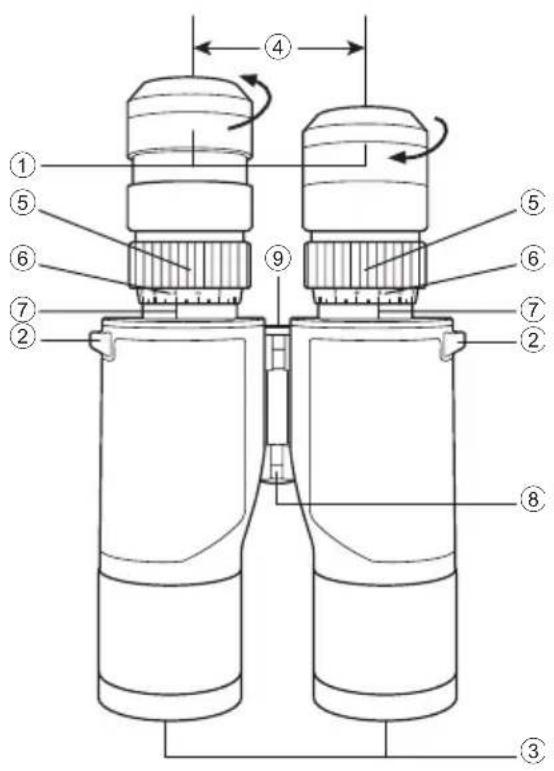
Nomenclature
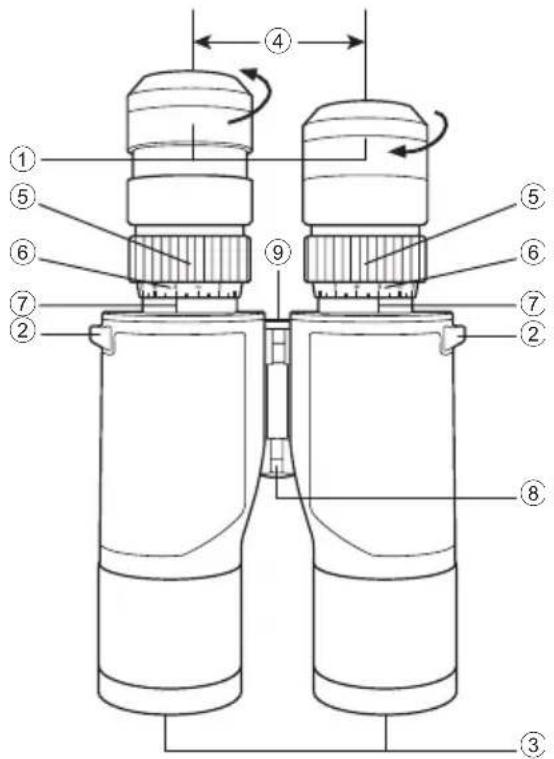
① Eyecup
② Neck strap eyelet
③ Objective lens
④ Interpupillary distance
⑤ Diopter ring
⑥ 0 (zero) diopter position
⑦ Diopter index
⑧ Central shaft
9 Interpupillary distance scale
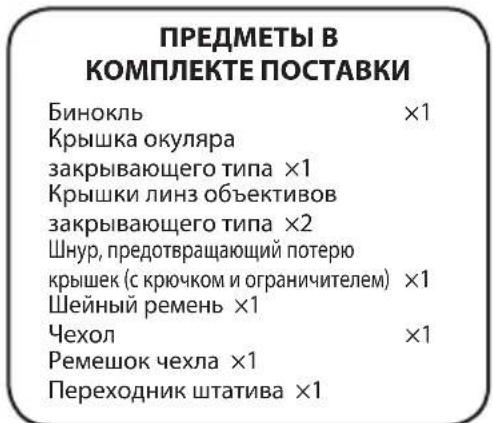
ITEMS SUPPLIED
Binoculars × 1
Cover-type eyepiece cap × 1
Cover-type objective
lens caps × 2
Loss prevention cord for the
caps (with hook and stopper) × 1
Neck strap × 1
Case X1
Case strap × 1
Tripod adapter × 1
Usage procedures for the binoculars
Eyecups
For directions in which to turn the eyecups, please refer to the image on page 21.
- For eyeglass wearers, use fully retracted. To accurately adjust your view, you can also use either of the click stops before reaching the fully retracted position.
- For non-eyeglass wearers, use fully extended. To accurately adjust your eye position, you can also use either of the click stops before reaching the fully extended position.
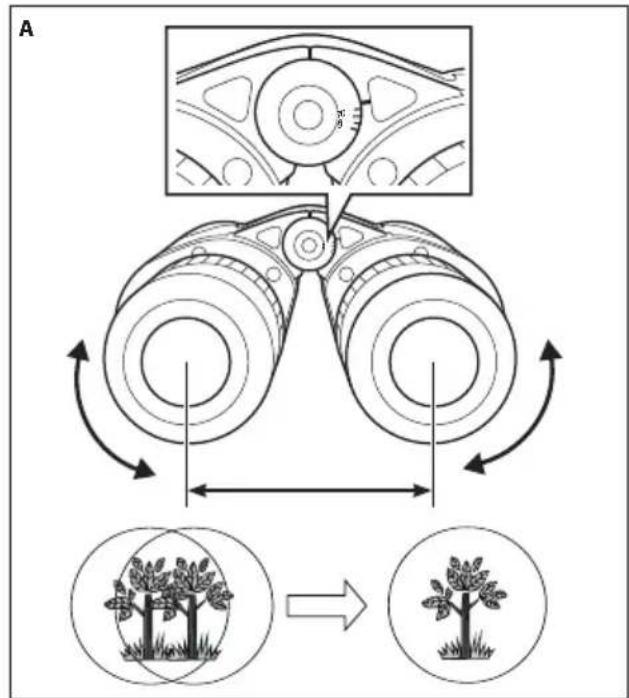
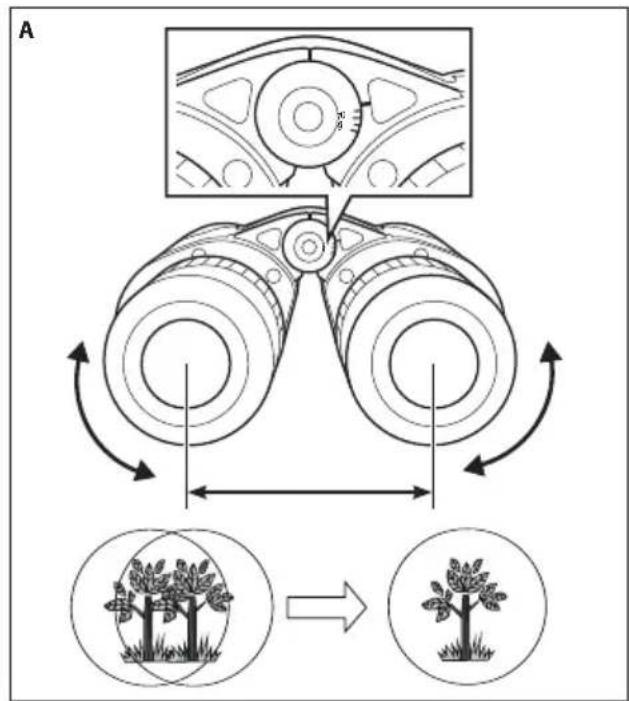
Adjusting the interpupillary distance
- Look into the eyepieces, open and close the main body as shown in the arrows in (A), and adjust so that your view becomes a single circle.
About the interpupillary distance scale
- This is useful for taking note of the adjusted interpupillary distance value when re-adjusting the interpupillary distance.
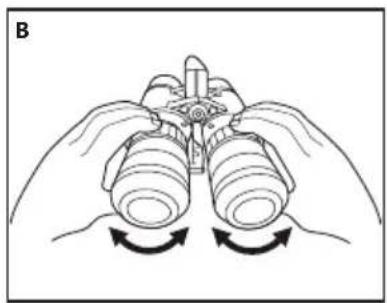
Adjusting the focus (diopter adjustment)
- These binoculars are the individual focusing type.
- Adjust the focus on the target for each eye (B).
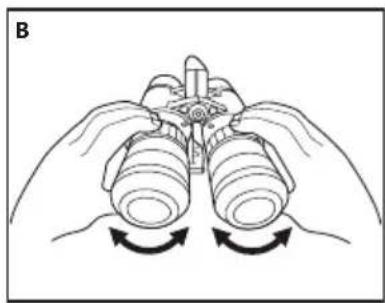
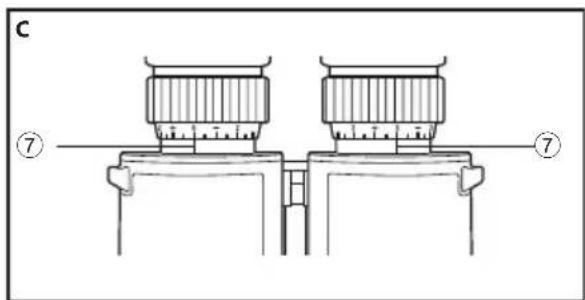
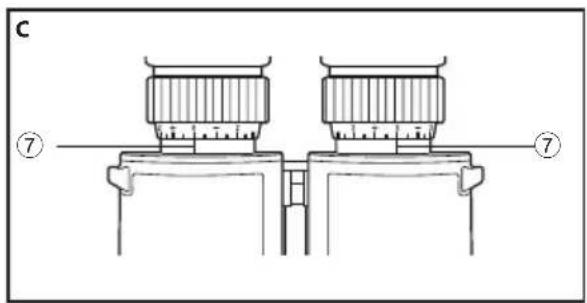
About the scale on the diopter rings
These are useful for taking note of the scale value indicated on the index (7) when the focus is adjusted, and re-adjusting the focus (C).
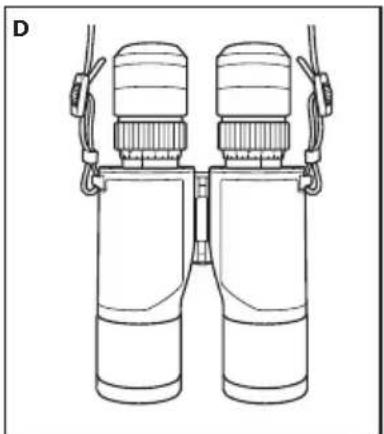
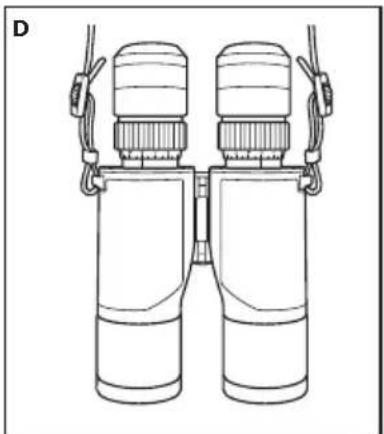
Usage Procedures for neck strap
Attach the neckstrap as illustrated (D), paying special attention to avoid twisting the strap.
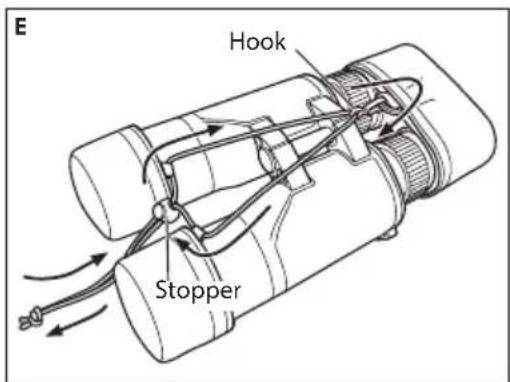
Usage procedures for the cover-type eyepiece cap, cover-type objective lens caps, and loss prevention cord for the caps
Attach the loss prevention cord for the caps in the following order to fasten the caps to the binoculars and prevent losing them.
1) Attach the hook, supplied with the loss prevention cord for the caps, to the cover-type eyepiece cap.
2) Pass the cord as shown in the arrows in (E). If you have difficulty passing the cord through the stopper, please use tweezers, etc.
3) Tie both ends of the cord and slide the stopper to fasten the caps.
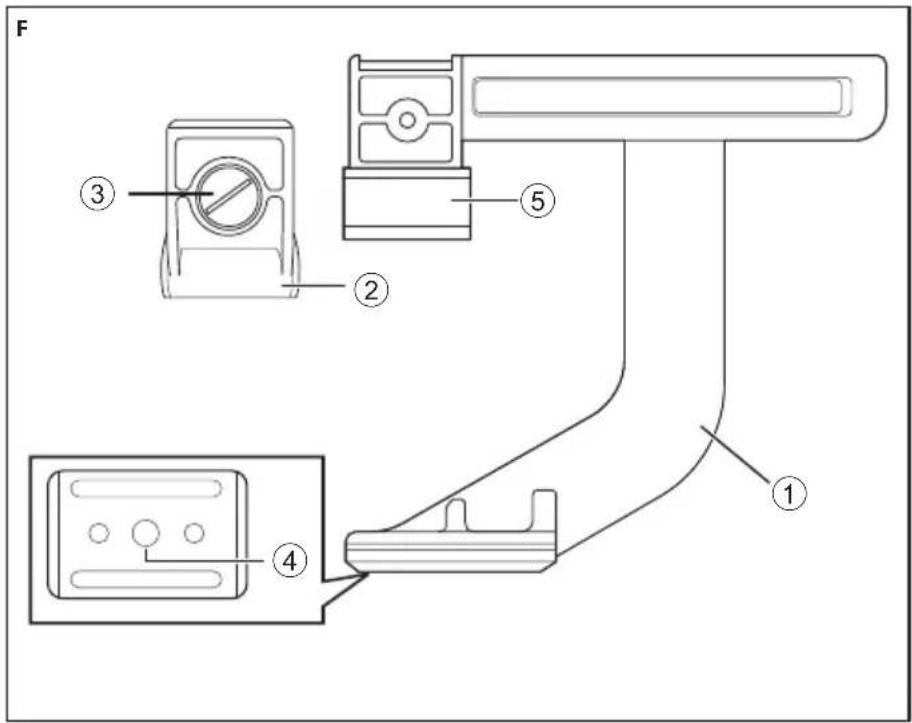
Usage procedures for tripod adapter TRA-5
Nomenclature
① Tripod adapter body
② Clamp
③ Attachment screw
④ Tripod screw hole
⑤ Central shaft holder
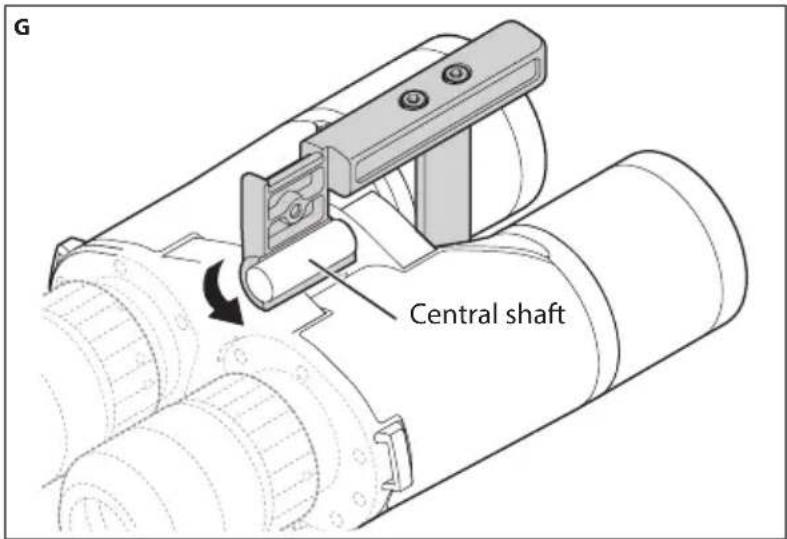
Attaching tripod adapter TRA-5 to the binoculars
- Make sure not to drop the binoculars because they are heavy.
-
②, ③, and ⑤ refer to the parts indicated in (F).
1) Open the interpupillary distance on the binoculars.
2) Rotate the attachment screw ( 3 ) of the clamp ( 2 ) on the tripod adapter counter-clockwise using a coin, etc. to remove the clamp.
3) Insert the tripod adapter from the objective lens side of the binoculars. -
Set the central shaft of the binoculars into the central shaft holder (5) of the tripod adapter (G).
Make sure not to damage the binoculars.
4) Attach the clamp ( ②) to the tripod adapter, and rotate the attachment screw (③) clockwise to fasten the binoculars to the tripod adapter.
After tightening using your fingers, tighten using a coin, etc.
5) Finely adjust the interpupillary distance on the binoculars.
For adjusting the interpupillary distance, please refer to the image on page 22.
Attachment is finished as shown in (H). You can also store it in the case while the tripod adapter is attached.

Specifications
| Type: Dach prism individual focusing type | ||
| Model | 7×50 10×50 | |
| Magnification (×) | 7 | 10 |
| Effective diameter of objective lens (mm) | 50 50 | |
| Angular field of view (real) (°) | 10.7 9 | |
| Angular field of view (apparent) (°)* | 66.6 76.4 | |
| Field of view at 1,000 m/yd. (m/ft.) | 188/563 157/472 | |
| Exit pupil (mm) | 7.1 5.0 | |
| Brightness | 50.4 25.0 | |
| Eye relief (mm) | 17.7 15.3 | |
| Close focusing distance (m/ft.) | 12.3/40.4 20.0/65.6 | |
| Length (mm/in.) | 272/10.7 291/11.5 | |
| Width (mm/in.) | 171/6.7 171/6.7 | |
| Depth (mm/in.) | 80/3.1 80/3.1 | |
| Weight (g/oz.) | 2420/85.4 2505/88.4 | |
| Interpupillary distance adjustment (mm/in.) | 58-782.3-3.1 | 58.5-782.3-3.1 |
| Structure Waterproof (up to 5 metre for 10 minutes) and nitrogen gas filled | ||
- The number calculated by the formula [ ' = × ] : Apparent field of view: 2' , Magnification: , Real field of view: 2
About waterproof and defogging:
- All models shown are waterproof, and will suffer no damage to the optical system if submerged or dropped in water to a maximum depth of 5 meter for up to 10 minutes.
- Can be used in conditions of high humidity, dust and rain without risk of damage.
- Nitrogen-filled design makes them resistant to condensation and mold.
Observe the following when using these products:
- As the unit does not have a perfectly sealed structure, it should not be operated nor held in running water.
- Any moisture should be wiped off before adjusting movable parts of these products to prevent damage and for safety reasons.
To keep your binoculars in excellent condition, Nikon Vision recommends regular servicing by an authorized dealer.
Cleaning lens
When cleaning the binoculars' objective lenses using an aerosol-type dust cleaner, make sure to hold the can upright at least 30cm from the lens surface while moving the can to avoid focusing the vaporized liquid gas on one point.
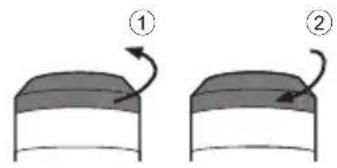
- When cleaning the binoculars' eyepieces, remove the black part of the eyecups by rotating in the direction of the arrow indicated in (①). Doing so will make the eyepieces easier to clean.
When attaching the eyecups, firmly fasten them by rotating in the direction of the arrow indicated in (②).
- Specifications and design are subject to change without notice.
- No reproduction in any form of this "Instruction Manual," in whole or in part (except for brief quotation in critical articles or reviews), may be made without written authorization from NIKON VISION CO., LTD.
PRECAUCIONES
VOORZORGSGMAATREGELEN
HnB KOem cnyuae He cMOtpnte npraMo Ha coJIHue uepe3 6HOKlb.
Ha6IIOJeHHe HEnOcpeIcTBeHHo 3a CoHNcE M IpyrIMN NCTouHnKaMn JpKOrO CBeTA MoKeT cepBe3HO NOBpeIITb rna3a nn Bbl3BaTb CIneOTy.

BHIMAHHE!
He octabnTe 6nHOKlb Ha HeyctOuNBOI NOBepxHOCTn. OH MoKet ynaCTb n npunHHTb TpaBMY.
He cmOTpnte B6HnOKJIb npn XOdb6e. Bbl MoKeTe HaToJIKHyTbCra Ha BHe3aHbIe IppeIaTcBnI INoJIyUHTb TpaBMy.
He pa3maxuBaTe 6nHoknem,epka er0 3a pemewoK. OH moKeT ydaPntb KOro-Hn6ydb n3 Okpykaounx npuHHHTb TpaBMy.
Mrkn yexon, pemeok n hapkHbme MaepnaJIbHa 6nHOKJe, a TaKHe Harna3HKn Moryt n3HaunBaTcR C TeueHEm BpeMeHH N OCTabJIrTa Ha TKAHN PRTHa. Bo n36eXaHne 3TOrO npOBepyTe nx COCToHHe nepei KaKdbim NcNOJb3ObaHmE m npBbIbHeHH yxDWeHHa COCToHn npOKOHcyblTnpuYTEcb y ABTopn3ObaHHOr npeclTabnteKOMnHn Nikon.
- IpoIOnJxTeIbHoe NOIb3OBAHHe HaIa3HnKaMn B HeKOTOpbIX CnyaX MoKeT PpNBecTI K BoCnJIeHNIO KoxN. B CNYaae BO3HKnHOBeHn KaNX-JINBO CmNTOMOB IpeKpaTNe IOnb3OBAHne N HEmdJIeHHO 6paTntEcB 3a KOHCyIbTaUneN K BpaUy.
- Bydte octopoxhbl, yTo6bl He 3aueMntb naIbIpyn BbINOnHeHm perylnpOBKn Mek3paKOBORO paCCToHnN nnIOHTpnHnHn HAcTpoKn. Bydte Oco6eHHO OCTOpOXhbl, ecnn Bbl pa3peWaeTe NOlb3OBaTbCnHOKlEM MaJIeHbKIM DeTAM.
He octabnIte noHn3TnIeHObBni nakeT, nCNoJIb3yEmbI ynaKOBKn, B MeCTax, OcctynhIX MaIeHbKIM dETM. DeTI MOrTy npINoXnTB erO KO pTu n 3aDOxHyTbcR.
- Bydte BHNMaTeNbHbI, YTo6bI dEtN HeuayHHo He npOrIoTnN KpbIaKy nIN HaRa3Hk. EcIn 3TO npOn3OJTe, HEmeJeHHo O6paTntEcB 3a KOHCyIbTaUne K Bpaay.
- He pa36npaTe 6uHoklb. PemOH dOJIxKeH npOBoHTbcra TOnbKO aBTOpN3OBaHHbIM ppeCTaBtTeJEM KOMNaHn Nikon.
O shhype, npedotBpaaoue m noTepeK pblweK
BHUMAHNE!
Iepemea np6op n3 oHoro MeCTa B pyroe, dpeKnte cam 6nHOKlb, a He sHyp, ppeoTbpaauoi ni notepi Kpbieek.
O nepexoHnke wTaTnBa
BHUMAHNE!
- Hadekhno npinkpenite npin60p K wtaTBy, nIoTHo 3aTaryb nkCpyuOuN BnHT KpeIeHn IwTaTnBa. Kpome TOrO, BO Bpemr EKcnnyataun npOBepraTe pNOtHOCTb 3aTAAKn nkCpyUoero BNHTa.
- IcnoB3yIte TOnbKO nOcne HaedXHO 3aTJxKn KpeNEXHOro BuHTa. Ecnn BuHT Ocna6,OTcoeHHeHne DeTaJIe MoKeT Bbl3BaTb NobpeXDeHne 6uHOKJIA.
He BbIKpyuINBaIte nonHocTbU BNHT n3 BepxHe yactn nepexOHNka WtATnBa.Ipeed KaKdbIM NCNoJIb3OBaHnEM 6HOKJy6eDNTecb, YTO BNHT 3aTAYT DOCTaTOHNO. - PepexoHnK WtATnBa MoXHO XpaHnTB B YexNe, KOrJa OH npncOeHHeH K 6HokNIO. Pnp nepemeueHn n3 Ondoro MeCTa B Dpyroe CHmnte PepexoHnK WtATnBa CO WtATnBa u XpaHnTe erO B YexNe, KOrJa OH npncOeHnHeH K 6HokNIO. Pnp dInTeBHom XpaHnHn CHmnte PepexoHnK WtATnBA C 6HokNra XpaHnTe erO B YexNe.
He pekomeHnyeTcN3MeHrTb MeCTOnOLOXeHne, KOrda 6uHOKlb yCTaHOBNeH Ha uTaTnB, NCKoJIbKy 3TO MOKeT pInBeCTN K HeCuaCTHbIM ClyUaM.
-Припегемшени 6инокля,К.KOTOPOMу пикpenлен nepexoDHNK wTaTnBa,Держnte 6инokль,a He nepexoDnK wTaTnBa.
MEpbI PPEIOCTOPOXHOCTN PPN PABOTE C PIPNBOPOM
O6mHokLe
PABOTA C INPUNBOPOM N OPGAHbI YNPABJIEHNIA
- He pa3BODInTe npabBn I neBbI Ty6ycbl 6HOKJra 3a nx npedeJIb. Kpome TOrO, He nobopauBaIte «KoJIbca dIOONTPnIH HoCTPOIKN» 3a nx npedeJIb.
He IOnyckaIte nonaHaHn DOxJr, BOaHbX 6pb3r, neCa n rpa3n. Ha pa6oue xapaKTePncTKn DaHHoro n3dJIeH He OKa3bIbAeT HeraTHBHO BO3deNCTBn H6ObnWo JdoxDb nII N 6pb3rN BODbl 6NaorOapraero BOHOENpOHnuaemocn. Ondako CneNyET CTnpaTB nonabWne Ha npnbop kaJIIN BODk KaK MoXHo CKopee. - ObeperaTe 6HOKb OT cInbHbIX COtpcEHH. Ecn He ydaetcnoyUHTb HopMaIbHOe 3O6paKeHne nocne naHeHn nn HAMOKaHn 6HOKJI, HeMeJeHHO DOCTaBbTe np6Op aBTOpN3OBaHHOMy npedctabTeIO KOMNaHn Nikon.
Korda npnbop noBepraetcpekomy nepenady TemnepaTp,Ha nobepxHOCTN INH3 MoKeT npocxoqntb KOHeHcaun BnaRn. B 3tOM cnyae TuaTeNbHO npocyuHte 6HHOKJb npn KOMHaTHOH TemnepaType.
XPAHEHNE
BbICOKa BnJXHOCTb MOKeT npNBecTu K KOHdeHcau BoDbI IIN O6pa3OBaHIO pIeEHn Ha NOBepxHOCTu IIN3. IOnToMy XpaHInTe 6NHOKlb B cyXOM npOxAaHOM MeCTe. Iocne NcNoB3OBaHn npi6opa B DoXdIIIBbI DeHb IIN HOyBu TuaTeNbHO npocyuHr erO npN KOMHaTHo TEMpepaType, a 3aTEM y6epnte Ha xpaHeHne B CyXoe npoxlaHoe MecTo.
- Pn npoJOnKnteHbOM xpaHeHn DePxNte 6HOKNB pIaCTNKOBm nakeTe NIN B repMeTnHOM KOHTeHpe C BnaIorONrIOTnTeJeM. EcIn 3TO HeBO3MOXHO, XpaHNTe np6Op OTdJIbHO OT YexJa B YICTOM, XopoIo IPOBETpNbAEMOM MecTe, NCKOJIbKY OH JERKO NODBepraeTcH HeratNBHOMY BO3DeNCTBnIO BlaRn.
He octablaIte 6HOKlb BAbTOMo6nne B JapKn IIN COJHeuHbI DeH bN B6n3n O6OpyObaHna, rHeepnpuyUoTeNo.3To MoKeT NOBpeDntb Pn6Op NIn OKa3aTb Ha Hero HeRaTNBHOe BO3dECTBne.
YXOD IN XPAHEHNE
- CneIte 3a Tem, yTo6bI BO BpaauoJnecraCTN «KolbuO DnONTPnHOn HAcTpoIKN» He nonadani neCOK, MeKne qactuB I T.I.
- YdaJIbNbIb c nOmoBIO pe3HOBo rpyuIN, npOTpnte NOBepxHOCTb KOpnyCa MrgKo uCToT kHaHbIO. Nocne IcNoIb30BaHnI np6Opa y Mopr CnERka CMOHTe MArKyIO uNCTyIO TKAHb B BOte I npOTpnte HAnET coJIN, KOToPbMOR OCTaTbcra Ha NOBepXHOCTn KOpnyCa. 3aTeM BbITpNTe NOBepxHOCTb KOpnyCa cyXOIH KaHbIO. 3aIpeuaetc INcNoIb30BaTb 6EH3HN, pa36abnteIb nnDpyroI opraHueckn pAcTBOpNTeIb.
- Octopoxho cdyb 3aqrpa3HeHne nn nbilb c nobepxHOCTn HnHc nmoOsbpe3nHOBO rpyu nn a3po3oJbHOro nbIeouncntTeJe, ydaJIte OCTabUyOcR nbILb MrgKo o6e3XnpeHHo KNCTOcko.
4.ДЯ удалеляпгггнлгггнлгггнлгггнлгггнлгггнлгgнлгgнлгgнлгgнлгgнлгgнлгgнлгgнлгgнлгgнлгgнлгgнлгgнлгgнлгgнлгgнлгgнлгgнлгgнлгgнлгgнлгgнлгgнлгgнлгgнлг gngnlaHnH3bI MrgKoN uCTO XlONuTobMajHO TKAHbIO. NcNoJIb3yIte He6OJIbwoe KOINueCTBO cInrTO CnnpTa (3aHOna) nIi CpeDCTBa dIra OUHCTKn IINH, KOTOpOE MOxHO npno6pctn B mArzIHax, dIra ydaIeHnI pNOxo POnDAUxXcA OUYCTKe IYTeH; ydaIeHne BblONHJrTe KpyROBbIM DvIXKeHNem OT ueHTpa IINH3bl K hapxHOMy KpaIO. HcNoJIb3yIte TBePdIe NpeMeTbI, NocKOBk Ky 3TO MoXET NpUBeCTN K NOBLeHnIO qapAnHH Ha NOBepXHOCTN IINH3.
Cneunkaua
①HaHnA3NnK
② Uшко Дя Крелпеняшейногремня
③ЛинзаобьektиBa
④ Mek3paKOBoe pacctOAHne
⑤ Kolbdo DNONTPnHOn HactpoKu
⑥ПОJOKeHnE0(HoJIb) IIOONTpHnHOHaCTPOINK
⑦ Ⅲkana dnoontpnHoh HacptponK
⑧ LéHTpaIbHbI WapHnP
⑨ⅢkanapeynpobKn Mek3paaykoBOro paCCTOHN
TopaOK uCnoIb3ObaHn6MHOKJIA
Hara3nKu
HanpaBHeHnIOBOpOHa HrIa3HKnOB cm. Ha pncyHKe Ha cTp. 119.
- IINI NOIb3OBATEJH, HOCaIUX OUYKIN: INCNOJIb3yIe B NIOHOCTbIO CIOJOKEHHOM NIOJOKEHHN. IINI TOHHOHACHTPOIKMOXHO TAKKHe NCIOJIb3OBATb IIO6OE NIOJOKEHHe UeJIYka DO IOCTNJKEHHN NOIHOCCTbIO CIOJOKEHHORIO JIOJOKEHHIA.
- JIINIOJIb3OBaTeJe, He HOCAUx OUYK: ICNIOJb3yIe T B NOJIHOCTbIO BbIDBHyTOM NOLOXeHn. JIINTOUHOH HAcTPOIK NIOJOXeHn rJa3 TaKKe MOXHO NCIOJb3OBaTb IIO6oe NIOJOXeHne UeJIYKa Do IOCTNUKeHn POJIHOCTbIO BbIDBHyTOrO NOJOXeHn.
PerynpoBka MeK3paQkoBOro pacCTOHHN
IyBaBOKyIpaBcBnraTe npa3DbnraTe OCHOBHO6NOK, BHaNPaBHeHn CTrpeNOK Ha pncyHke (A) n BbINOnHte perynipOBky TaKm 06pa3OM, yTO6bl 6bl BNdeH NOHbI Kpyr.
O shkane perynipOBKn MeK3pa4KObo
pacctoHn
- 3Ta shkaJna no3BOJnEe 3aONMHHTb 3HaueHne OTperyIuPobAHHO Mek3paQKOBOro paCCTOHH, UTO ydo6Ho npn erO NOBtOPHOYCTaHOBKe.
PerynnpobKaΦokycnpobKn(dONTpniHaHaCTpoiKa)
*3To6nHOKlb cHa6KeH nHdNbUaJbHoH OKcnpOBkoI.
- OTPerynnyte φokucropobky ha obbeke TЯ kajdo rna3a (B).
O shkane Ha konbuax dnonTpniHoi NaCTpOKn
- 3Ta ⅢKala nO3B0JIaOT 3aONMHHTb 3HaueHHe, yKa3aHHoe Ha MeTke (7), npn peryNIpOBKe _OKCUPOBKN nICNoJIb3OBaTb 3TO 3HaueHne npn NOBtOpHOJ _OKCIPOBKE (C).
Popjok nCnoJb3ObaHnI ueHoro peHnI
PpKpeHne Hne Horo pemn npounnoctnpupobaoHa pnc. (D). Oco6oe BnMaHne cneNyet ydeNtB oTCyTcTBIO nepeKpyuBaHna peMHra.
Iopraok nCnoB3OBAHnK kpbiHKn OkyJepa 3akpbBaIOJero Tnna, KpbIeK IINH3 o6bekTnBOB 3aKpbBaIOJero Tnna n shypa, npedOTBpaauoJooero noTepeIO KpbIeK
PnKpEnIte Hhyp, npedotBpaaiou nnoTepKpbIweK, B CJeDyIOeM nopAKe IJn KpeNHeN KpbIweK Ha 6Hokne n npedotBpaueHn IX noTeRn.
VEDLIKEHOLD OG OPPBEVARING
- Sorg for at det bereits kommer sand aller smuss inn i de roterende delene til "diopterringene" osv.
- Etter at du har fjernet stovet med en blaser, kan du rengjore kikkerkthuset med en myk, ren klut. Hvis du har brukt kikkerten pa sjoen ell er stranden, kan du fukte en myk, ren klut lett og torke bort salt pa kikkerkthuset. Ikke bruk benzen, tynner ell andre organiske lsemidler.
- Etter at du har forsiktig blast bort smuss ell stov fra objektivets overflate med en blasebørste ell aerosolspray, fjerner du resten av stovet med en myk, fettfri bostre.
- Nár du skal fjerne flekker eller smuss som f.eks. fingeravtrykk fra objektivets overflate, tørker du objektivet svært forsiktig med en myk, ren bomullsklut eller oljefritt linsepapir av høy kvalitet. Bruk litt ren alkohol (etanol) eller linsepapir som kan kjopes i butikker, for a tørke bort vanskelige flekker, fra midten av objektivet og utover i en sirkelbevegelse. Du ma ikke bruke noe hardt fordi det kan lage riper på objektivets overflate.