KFMPB 1510 F - Milling machine METABO - Free user manual and instructions
Find the device manual for free KFMPB 1510 F METABO in PDF.



| Product type | Edge trimming router (flush trim router) for chamfering edges |
| Brand | Metabo |
| Model | KFMPB 1510 F |
| Category | Milling machine |
| Intended use | Edge milling on steel, stainless steel, aluminum and aluminum alloys (professional use) |
| Power supply | 230 V ~, 50 Hz (mains) |
| Power input (P1) | 1510 W |
| Power output (P2) | ~ 1200 W (estimate) |
| No-load speed (n) | 7800 - 12200 rpm (adjustable in 6 positions) |
| Electronic speed control | Yes, VTC (Constant speed even under load) |
| Chamfer angle | Adjustable (scale graduation) |
| Max chamfer height | Variable depending on angle (e.g., 6 mm per pass at 45° for KFM 15-10 F) |
| Min pipe diameter | Adjustable (guide cylinder) |
| Weight (without cable) | ~ 5.5 kg |
| Dimensions (L x W x H) | ~ 350 x 200 x 250 mm |
| Protection class | II (double insulation) |
| Safety devices | Anti-restart protection, safety switch (paddle or sliding), chip protection sheets |
| Included accessories | Stirrup handle, side handle, guide rail, guide cylinder, clamping key |
| Indexable inserts | Type: HM Universal (ref. 6.23564), reversible (4 edges) |
| Maintenance | Regular cleaning of ventilation slots, replacement of indexable inserts, recommended lubrication (stick ref. 6.23443) |
| Repairability | Spare parts available via Metabo (www.metabo.com), repairs by authorized electrician |
| Standards | EN 60745 |
| Sound level (LpA) | Above 80 dB(A) – wear ear protection |
Frequently Asked Questions - KFMPB 1510 F METABO
User questions about KFMPB 1510 F METABO
0 question about this device. Answer the ones you know or ask your own.
Ask a new question about this device
Download the instructions for your Milling machine in PDF format for free! Find your manual KFMPB 1510 F - METABO and take your electronic device back in hand. On this page are published all the documents necessary for the use of your device. KFMPB 1510 F by METABO.
USER MANUAL KFMPB 1510 F METABO
KFM 15-10 F
KFMPB 15-10 F
KFM 16-15 F

KFM 17....(bei 45° )
Aluminium, Kupfer, Messing. 4-6
Original Instructions
1. Declaration of Conformity
We hereby declare that these bevellers, identified by type and serial number 1 ), meet all relevant requirements of directives 2 and standards 3 . Technical documents for 4 - see page 4.
2. Specified Use
The beveller is intended for the milling of edges of steel, stainless steel, aluminium and aluminium alloys in the professional sector.
For processing aluminium, aluminium alloys and stainless steel, a suitable lubricant (item no.: 6.23443) must be used.
This lubricant is also recommended when processing steel as it extends the tool life and the machine glides more easily over the workpiece.
The user bears sole responsibility for any damage caused by inappropriate use.
Generally accepted accident prevention regulations and the enclosed safety information must be observed.
3. General Safety Instructions

For your own protection and for the protection of your power tool, pay attention to all parts of the text that are marked with this symbol!

WARNING - Reading the operating instructions will reduce the risk of injury.

WARNING Read all safety warnings and instructions. Failure to follow all safety ings and instructions may result in electric k, fire and/or serious injury.
Keep all safety instructions and information for future reference.
Pass on your power tool only together with these documents.
4. Special Safety Instructions
a) Do not use accessories that are not specifically designed and recommended for this power tool by the manufacturer. Just because the accessory can be attached to your power tool, it does not assure safe operation.
b) Do not use damaged power tools. Before use, check the indexable inserts for chipping, cracks or signs of severe wear and tear. If a power tool or accessory is dropped, inspect for damage or install an undamaged accessory.
c) Wear personal protective equipment. Use a face shield, safety goggles or safety goggles depending on the application. As appropriate, wear a dust mask, hearing protectors, gloves and a workshop apron capable of stopping small abrasive or workpiece fragments. The eye
protection must be capable of stopping flying debris generated by various operations. The dust mask or respirator must be capable of filtering particles generated by your operation. Prolonged exposure to high intensity noise may cause hearing loss.
d) Keep bystanders a safe distance away from work area. Anyone entering the work area must wear personal protective equipment. Fragments of a workpiece or broken accessory may fly away and cause injury beyond the immediate area of operation.
e) Always hold the tool firmly in your hands during the start-up. The reaction torque of the motor as it accelerates to full speed can cause the tool to twist.
f) Use clamps to support the workpiece whenever practical. Never hold a small workpiece in one hand and the tool in the other hand while in use. Clamping a small workpiece allows you to use your hands to control the tool.
g) Never lay the power tool down until the accessory has come to a complete stop. The rotating accessory may grab the surface and pull the power tool out of your control.
h) Do not run the power tool while carrying it at your side. Accidental contact with the rotating accessory could snag your clothing, pulling the accessory into your body.
i) Regularly clean the power tool's air vents. The motor's fan will draw the dust inside the housing and excessive accumulation of powdered metal may cause electrical hazards.
j) Do not operate the power tool near flammable materials. Sparks and hot chips can ignite these materials.
k) Do not use accessories that require liquid coolants. Using water or other liquid coolants may result in electrocution or shock.
4.1 Kickback and related warnings
Kickback is the sudden response to an accessory pinching or jamming while rotating. Pinching or snagging causes rapid stalling of the rotating accessory. This causes the uncontrolled power tool to be forced in the direction opposite of the accessory's rotation at the point of the binding.
For example, if an indexable insert is snagged or pinched by the workpiece, the edge of the insert that is entering into the pinch point can dig into the surface of the material causing the insert to climb out or kick out. The indexable insert may either jump towards or away from the operator depending on direction of the indexable insert holder at the point of pinching. Indexable inserts may also break under these conditions.
Kickback is the result of power tool misuse and/or incorrect operating procedures or conditions. It can be prevented if suitable precautionary measures are taken as described below.
ENGLISHen
a) Maintain a firm grip on the power tool and position your body and arm to allow you to resist kickback forces. The operator can control kickback forces if proper precautions are taken.
b) Use special care when working in corners, on sharp edges etc. Avoid bouncing and snagging the accessory. Corners, sharp edges or bouncing have a tendency to snag the rotating accessory and cause loss of control or kickback.
c) Always feed the accessory into the material in the same direction as the cutting edge is exiting from the material (which is the same direction as the chips are thrown). Feeding the power tool in the wrong direction causes the cutting edge of the accessory to move out of the workpiece and pull the tool in the direction of this feed.
d) Prevent any jamming of the indexing insert or excessive pressure. Do not set the chamfer height greater than the permitted maximum.
Overstressing the indexable insert increases the loading and susceptibility to twisting or binding of the disc in the cut and the possibility of kickback or breakage of the indexable insert.
e) Do not position your hand in line with and behind the indexable insert. When the indexable insert is moving away from your body at the point of operation, the possible kickback may propel the rotating indexable insert and the power tool directly at you.
Turn/replace blunt indexable inserts or inserts where the coating is worn in due time. Blunt indexable inserts increase the risk of the machine getting jammed and breaking.
4.2 Additional safety instructions:
Hold the power tool by the insulated gripping surfaces because the milling cutter may hit its own cord. Contact with a live lead may also make metal power tool parts "live" and lead to an electric shock.
Keep the work area clean and well lit. Cluttered or dark areas invite accidents.

WARNING - Always wear protective goggles.

Wear ear protectors.

Pull the plug out of the socket before making any adjustments, changing tools, carrying out maintenance or cleaning.

Wear suitable work clothes.

Ensure that nobody gets injured by catapulted foreign bodies.

Keep persons nearby and pets at a safe distance to the device.

Keep away hair, loose clothing, fingers and other body parts. They can get caught and sucked in. Use a hair net for long hair.

Warning of rotating tools
Always wear protective goggles, gloves and sturdy shoes when working with this tool.
Danger of injury from sharp edges. Wear protective gloves.
Indexable inserts, holders for indexable inserts, the workpiece and chips can be hot after work. Wear protective gloves.
A damaged or cracked additional handle must be replaced. Never operate the machine with a defective additional handle.
Pull the plug out of the socket before making any adjustments, changing tools, carrying out maintenance or cleaning.
Use of a fixed extractor system is recommended. Always install an RCD with a maximum trip current of 30mA upstream. When the machine is shut down by the RCD, it must be checked and cleaned. See chapter 10. Cleaning.
Wear ear protectors when working for long periods of time. High noise levels over a prolonged period of time may damage your hearing. Use only sharp, undamaged indexable blades.
The workpiece must lay flat and be secured against slipping, e.g. using clamps. Large workpieces must be sufficiently supported.
Ensure that sparks produced during work do not constitute a risk to the user or others and are not able to ignite flammable substances. Areas at risk must be protected with flame-resistant covers.
Always keep a fire extinguisher on hand when working in areas prone to fire risk.
Always hold the machine with both hands on the designated handles, take a secure stance and concentrate on the work.
Keep your hands away from the milling area and from the tool.
Do not touch the rotating accessory! Remove chips and similar material only with the machine at a standstill. Pull the mains plug out of the socket.
Damaged, eccentric or vibrating tools must not be used.
Do not work overhead.
Never use an incomplete tool or one on which an unauthorised modification has been made.
Reducing dust exposure:
Some dust created by using this power tool may contain chemicals known to cause cancer, allergic reaction, respiratory disease, birth defects or other reproductive harm. Some of these substances include: lead (in paint containing lead), mineral dust (from bricks, concrete etc.), additives used for wood treatment (chromate, wood preservatives), some wood types (such as oak or beech dust), metals, asbestos.
The risk from exposure to such substances will depend on how long you or people nearby are exposed to them.
Do not let particles enter the body.
Do the following to reduce exposure to these substances: ensure good ventilation of the workplace and wear appropriate protective equipment, such as respirators able to filter microscopically small particles.
Observe the relevant guidelines for your material, staff, application and place of application (e.g. occupational health and safety regulations, disposal).
Collect the generated particles at the source, avoid deposits in the surrounding area.
Reduce dust exposure with the following measures:
- Do not direct the escaping particles and the exhaust air stream at yourself or nearby persons or on dust deposits.
- Use an extraction unit and/or air purifiers
- Ensure good ventilation of the workplace and keep clean using a vacuum cleaner Sweeping or blowing stirs up dust
- Vacuum or wash protective clothing Do not blow, beat or brush.
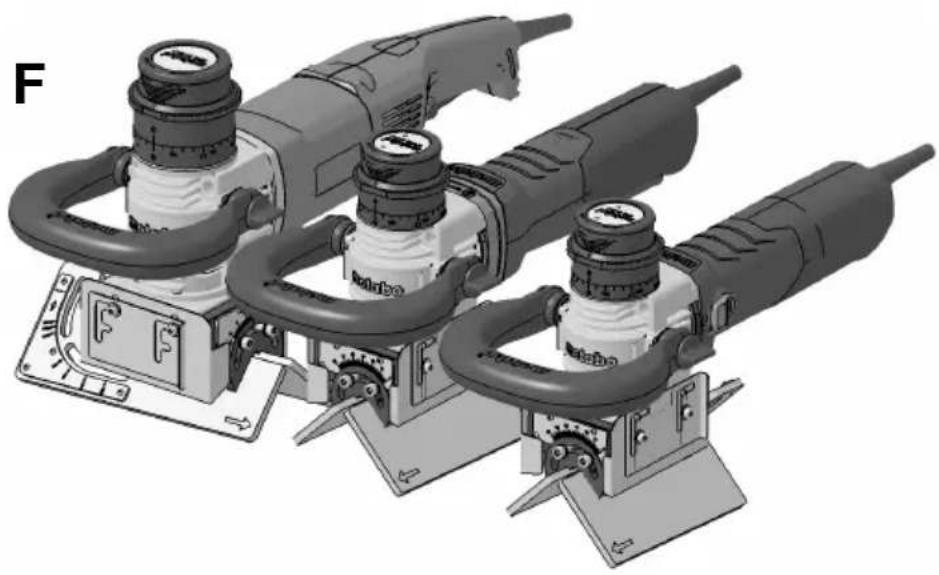
5. Overview
See pages 2 and 3.
1 B o w h a n d l e
2 Locking discs
3 Th u m b s c r e w s
4 Threaded holes on gear housing
5 Side handle
6 Scale (chamfer height)
7 Adjusting ring (chamfer height)
8 Clamping screws on scale ring
9 Scale ring (chamfer height)
10 Speed adjustment wheel *
11 Electronic signal indicator
12 Handle
13 Chip protection plate screws
14 Chip protection plates
15 Guide rail
16 Arrow = prescribed working direction
17 Scale (chamfer angle)
18 Screws (chamfer angle)
19 Indexable insert holder / milling head
20 Indexable insert
21 Fastening screw for indexable insert
22 Slide switch *
23 Paddle switch *
24 Lock*
25 Trigger*
26 Guide roller
27 Scale (pipe diameter)
*equipment-specific
6. Commissioning

Before commissioning, check that the rated mains voltage and mains frequency, as stated in the type plate match your power supply.

Always install an RCD with a maximum trip current of 30mA upstream.
6.1 Attaching the additional handle

Only work with attached bow handle (1) or side handle (5) (depending on equipment)! Attach handle as shown (see page 2, Fig. A).
Attach bow handle (1)
- Fit locking discs (2) to the left and right of the handle (1).
- Move the handle (1) with the locking discs (2) from the front to the gear housing.
- Insert the thumb screws (3) to the left and right of the handle (1) and turn gently.
- Adjust the handle (1) to the required angle.
- Firmly tighten the thumb screws (3) to the left and right manually.
Attach side handle (5) (depending on equipment, only for KFM 15-10 F, KFMPB 15-10 F):

When milling edges of small angles (setting θ < 30° ) depending on the working conditions it is to be advantageous to use the side handle (5) rather than the bow handle (1). For larger angles, they use the bow handle (1) so that you can hold a machine securely.
- Attach the side handle (5) on the right or left side of the machine and secure.
7. Setting

Pull the plug out of the socket before making any adjustments, changing tools, carrying out maintenance or cleaning.

Indexable inserts, holders for indexable inserts, the workpiece and chips can be hot work. Wear protective gloves.

Danger of crushing! Wear protective gloves.
7.1 Setting the chamfer angle
- Read the set angle on the scale (17).
- Loosen the screws (13) and slide both chip protection plates (14) (on the left and right of the machine) upwards.
- Loosen the screws (18) (front and back) and set the chamfer angle to the desired angle by turning the guide rail (15). Read the set chamfer angle on the scale (17).
- Firmly tighten the screws (18) (front and back).
- Slide both chip protection plates (14) (on the left and right of the machine) all the way down. Tighten the screws (13) (on the left and right of the machine).
- Changing the chamfer angle also changes the chamfer height (due to the design). Therefore, also set the chamfer height again every time you adjust the chamfer angle. See chapter 7.2
7.2 Setting the chamfer height
Set the chamfer angle first:
- First check that the desired chamfer angle is set: read the set chamfer angle on the scale (17). Adjust if necessary. See chapter 7.1
ENGLISHen
Determining the setting value:
Note: always produce large chamfer heights in several milling operations (at least 3). Hard materials require more milling operations. This has the following advantages: a higher indexable insert service life, work results with a higher surface quality, more pleasant working conditions.

Do not exceed the "maximum chamfer height per milling operation" specified below.
KFM 15... (at 45° ):
1st milling operation: max. 6 mm
2nd +3rd milling operation: max. 2 mm
KFM 17... (at 45° )
1st milling operation: max. 9 mm
2nd +3rd milling operation: max. 3 mm
Do not exceed the maximum permitted chamfer height (hmax) (see the Technical Specifications chapter).
It is recommended that very little material is removed during the last milling operation to ensure an optimum surface quality.
- Select the diagram that applies to your machine (see back).
- Select the line that applies to the set chamfer angle (see back).
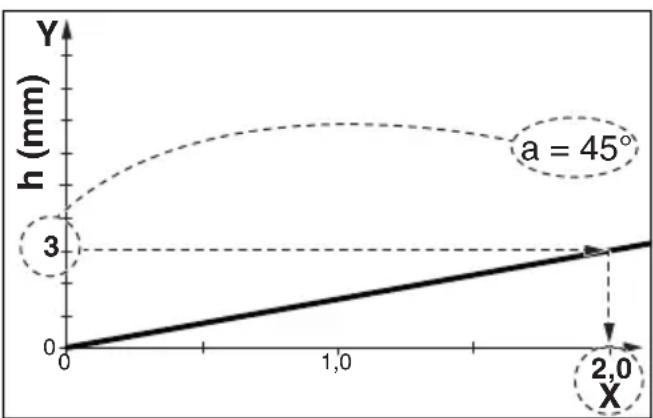
- Example for a chamfer angle of 45° and a desired chamfer height of 3mm (see figure below). Result: setting value = 2.0
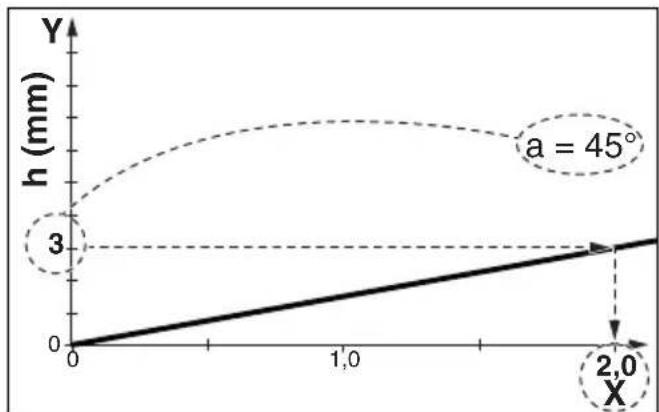
Select the chamfer height that you want to set on the Y-axis. Draw a horizontal line to the intersection with the line. Draw a vertical line from this intersection to the X-axis. Read the value on the X-axis. You must now set this "X" value as follows on the machine.
Note: The diagram is based on sharp-edged workpieces. For workpieces with rounded edges, the milling height must be taken into account during setting.
Setting the chamfer height:
- Pull the adjusting ring (7) upwards and turn it so that the "X" value from the diagram is set on the scale (9). See figure (below): set "X" value = 2.0 . (One revolution corresponds to "X" = 3 . For large X values: perform several revolutions. The scale (6) is used for rough orientation during the setting process).

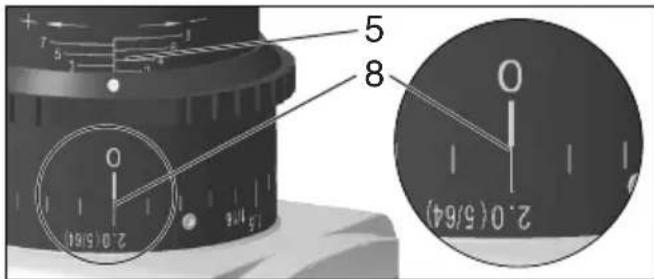
- Carry out a trial cut.
- Proceed as follows if the chamfer height should be set very accurately for the last milling operation: Carry out a trial cut. Measure the cut chamfer height and adjust it by one scale mark if necessary by turning the adjusting ring (7): clockwise rotation = larger chamfer height. Anticlockwise rotation = lower chamfer height. Carry out another trial cut. Repeat this step if necessary.
8. Use
8.1 Switching on and off

Always guide the machine with both hands.

Switch on first, then guide the accessory towards the workpiece.

Avoid inadvertent starts: always switch the tool off when the plug is removed from the socket or if there has been a power cut.

In continuous operation, the machine continues running if it is forced out of your.
s.Therefore, always hold the machine with
hands using the handles provided, stand
rely and concentrate.

Avoid the machine swirling up or taking in dust and chips. After switching off the machine, place it down when the motor has come to a stand.
KFM 15-10 F (see page 3, Fig. B):
Switching on: push the sliding switch (22) forwards. For continuous operation, now tilt it downwards until it engages.
Switching off: press the rear end of the slide switch (22) and release it.
KFMPB 15-10 F (see page 3, Fig. B):
Switching on: slide the paddle switch (23) in the direction of the arrow and then press the paddle switch (23).
Switching off: release the paddle switch (23).
KFM 16-15 F (see page 3, Fig. B):
Torque activation:
Switching on: press in the lock (24) and then press the trigger switch (25). Release the lock (24).
Switching off: release the trigger switch (25).
Continuous operation:
Switching on: press in the lock (24) and hold it in place. Press and hold in the trigger switch (25). The machine is now switched on. Now press in the lock (24) once more to lock the trigger (25) (continuous operation).
Switching off: press the trigger switch (25) and release.
8.2 Setting speed (KFM 15-10 F)
The speed can be preset via the speed adjustment wheel (10) and is infinitely variable.
Positions 1-6 correspond approximately to the following no-load speeds:
1.7800/min 4.10200/min
2.8600/min 5.11100/min
3.9400/min 6.12200/min
The VTC electronics make material-compatible work possible and an almost constant speed, even under load.
Speed recommendations for different materials:
Aluminium, copper, brass 4-6
Steel up to 400 N/mm2. 4-6
Steel up to 600 N/mm2.3-5
Steel up to 900 N/mm2.2-4
Stainless steel. 1-3
The best way to determine the ideal setting is through a practical trial.
8.3 General working instructions
- Check the indexable inserts (20). Change damaged or worn indexable inserts.
- Fix workpiece without vibrations using clamping devices.
- Pay attention to chapter 8.4 when working on pipes.
- Set the chamfer angle (see chapter 7.1).
- Set the chamfer height (see chapter 7.2).
- Always hold the machine with both hands on the designated handles, take a secure stance and concentrate on the work.
- The indexable inserts (20) do not touch the workpiece. First switch on, then place the machine with the guide rail (15) onto the workpiece and only then put the tool close to the workpiece.
- Slide the machine only in the direction specified by an arrow on the machine (16).

Slide the machine only in the direction of the arrow (16). Otherwise there is the risk
of kickback. Guide the machine evenly at a speed suitable for the material being processed. Do not tilt, apply excessive force or sway from side to side.
- Guide the machine in such a way that the guide rail (15) is in contact with the workpiece.
- Finishing the work: remove the tool from the workpiece, switch off machine. Let motor come to a stop, put down machine.
8.4 Working on the outer edge of pipes
- Determine the diameter of the pipe to be worked on.
- See page 3, Fig. C: attach the guide roller (26) to the guide rail (15) as shown. Move the guide roller (26) and adjust on the scale (27) on the pipe diameter. Tighten the guide roller nut with a spanner and thus tighten the guide roller.
- Pay attention to the general working instructions (chapter 8.3).
- Always hold the machine with both hands on the designated handles, take a secure stance and concentrate on the work.
- Place the machine with the guide roller (26) on the outer surface of the pipe. Then place the guide rail on the surface of the pipe end.
- The indexable inserts (20) do not yet touch the workpiece. First switch on, then slowly tilt the machine around the guide roller (26) to move the milling head close to the workpiece.
- Pay attention to the general working instructions (chapter 8.3).
8.5 KFM 16-15 F: Possibility for rotating the guide rail (15)
The guide rail (15) of the KFM 16-15 is installed transversely. This permits better absorption of high forces and permits low-fatigue working for most tasks.
If you prefer to install the guide rail (15) in a longitudinal manner, the Metabo customer service will provide you with conversion instructions on request.
9. Maintenance
9.1 Changing indexable inserts

Pull the plug out of the socket before making any adjustments, changing tools, carrying out maintenance or cleaning.

Indexable inserts, holders for indexable inserts, the workpiece and chips can be hot work. Wear protective gloves.
Regularly check the indexable insert holder (19). Repair/replace damaged or worn holders for the indexable inserts.
Regularly check all indexable inserts (20). Change damaged or worn indexable inserts.

Turn/replace blunt indexable inserts or inserts where the coating is worn in due time. Blunt
indexable inserts increase the risk that the machine will catch and breaks loose or that the indexable insert plate holder (19) is damaged.
ENGLISHen
Do not use heavily worn or defective indexable insert plates.
Always turn or replace all indexable inserts.
Use only indexable inserts approved by Metabo. See the Accessories Section.

Figure A: Normal wear: turn / replace indexable insert.
Figure B: Wear after working on hard materials: turn / replace turning plate. In the event of heavier wear, do not use the indexable insert plate and instead replace.
- Loosen the screws (13) and slide one chip protection plate (14) upwards.
- Turn the indexable insert holder (19) manually if necessary.
- Unscrew the fastening screw (21) and remove the indexable insert (20).
- Clean indexable insert (20) and clamping surfaces on the indexable insert holder (19).
- Turn the indexable insert or, if all blades are blunt, replace the indexable inserts.
- Fix again the indexable insert (20) with a fastening screw (21). Torque: 3.5 Nm.
- Slide the chip protection plate (14) all the way down. Tighten the screws (13).
Note: Causes for indexable inserts with broken corners or, in extreme cases, for broken indexable inserts, can include:

- Impacts on the indexable insert due to incorrect use: See chapter 8.3.
- Workpiece vibrations: Fix workpiece without vibrations using clamping devices.
- Indexable insert not correctly fastened: Always clean clamping surfaces and note torque.
- Indexable insert not correctly fastened: Strongly worn Indexable inserts do not have sufficient contact surfaces and therefore may not be fastened sufficiently. Replace the strongly worn indexable inserts.
10. Cleaning
Pull the mains plug out of the socket.
Chips and particles can deposit at the milling head (19). This can lead to blockage of the milling head.
Regularly clean the milling head and its surroundings and remove chips and particles.
It is possible that particles deposit inside the power tool during operation. This impairs the cooling of the power tool. Conductive build-up can impair the protective insulation of the power tool and cause electrical hazards.
The power tool should be cleaned regularly, often and thoroughly through all front and rear air vents using a vacuum cleaner. Prior to this operation, separate the power tool from the power source and wear protective goggles and a dust mask.
11. Troubleshooting
KFM 15-10 F, KFMPB 15-10 F:
The electronic signal indicator (11) lights up and the load speed decreases. There is too much load on the machine! Run the machine in idling until the electronic signal indicator switches off.
- The machine does not start. The electronic signal indicator (11) flashes (depending on the model). The restart protection is active. If the mains plug is inserted with the machine switched on or if the power supply is restored following an interruption, the machine does not start up. Switch the machine off and on again.
KFM 16-15 F:
- Restart protection: if the mains plug is inserted with the machine switched on or if the power supply is restored following an interruption, the machine does not start up. Switch the machine off and on again.
- Overload protection: there is a reduction in load speed. The coil temperature is too high! Allow the machine to run at idle speed until it has cooled down.
- Switching on the machine briefly reduces the voltage. Unfavourable mains power conditions may have a detrimental effect on other machines. Power impedances less than 0.4 ohm should not cause malfunctions.
12. Accessories
Use only genuine Metabo accessories.
Use only accessories that fulfil the requirements and specifications listed in these operating instructions.
Fit accessories securely. If the machine is operated in a holder: secure the machine well. Loss of control can cause personal injury.
A 10 HM universal inserts. .6.23564
B Fastening screw for inserts .6.23566
C Cooling lubrication stick .6.23443
For a complete range of accessories, see www.metabo.com or the catalogue.
13. Repairs

Repairs to power tools must only be carried out by qualified electricians!
Contact your local Metabo representative if you have Metabo power tools requiring repairs. See www.metabo.com for addresses.
You can download a list of spare parts from www.metabo.com.
14. Environmental Protection
Observe national regulations on environmentally compatible disposal and on the recycling of disused tools, packaging and accessories.

Only for EU countries: never dispose of power tools in your household waste! Used power tools must be collected separately and used in for environmentally compatible recycling accordance with European Directive 2012/19/EU waste electrical and electronic equipment and its implementation in national legal systems.
15. Technical Specifications
Explanatory notes regarding the specifications on page 4. Subject to change in accordance with technical progress.
n = No-load speed (maximum speed)
P1 =Rated input power
P2 =Power output
hmax =Max. chamfer height
b max =Max. chamfer width
a = Chamfer angle
dmin =Minimum pipe diameter
m = Weight without mains cable
Measured values determined in conformity with EN 60745.
Machine in protection class II
AC power
The technical specifications quoted are subject to tolerances (in compliance with the relevant valid standards).
A Emission values
These values make it possible to assess the emissions from the power tool and to compare different power tools. The actual load may be higher or lower depending on the operating conditions, the condition of the power tool or the accessories. Please allow for breaks and periods when the load is lower for assessment purposes. Arrange protective measures for the user, such as organisational measures based on the adjusted estimates.
Vibration total value (vector sum of three directions) determined in accordance with EN 60745:
ah,SG = Vibration emission value
Kh,SG = Uncertainty (vibration)
Typical A-weighted sound levels:
LpA =Sound pressure level
The noise level can exceed 80 dB(A) during operation.

Wear ear protectors!
Electromagnetic disturbances:
In individual cases, the speed may fluctuate temporarily if the machine is exposed to extreme external electromagnetic disturbances or the electronic restart protection may respond. In this case, switch the machine off and on again.
FRANÇAISfr
Notice originale
20 Plaquette amovable
21 Vis de fixation de la plaquette amovible
25 Bouton-poussoir *
26 Cylindre de guidage
Kh,SG = incertitude (vibration)
WAARSCHUWING - Lees de
WAARSCHUWING Lees alle
KFM 15... (a 45° ):
KFM 17....(a 45°
LpA =aanen painetaso
LWA =aenthenotaso
KpA , KWA = epävarmuus
KFM 15...(ved 45° ):
- Freseforlop: Maks. 6 mm
2.+3. Freseforlp: Maks. 2 mm
KFM 17... (ved 45° )
- Freseforlop: Maks. 9 mm
2.+3. Freseforlop: Maks. 3 mm
Maksimal tillatt fasehoyde (h) ma ikke overskrides (se kapittel Tekniske data).
Aluminium, kobber, messing 4-6
Stal til 400 N/mm2 4-6
KFM 15...(ved 45° ):
KFM 17....(ved 45°
KFM 16-15 F (Se side 3, ill. B):
Midlertidig tilkobling:
Tilkobling: Tryk spærren (24) ind, og tryk sa pa afbryderen (25). Slip spærren (24).
Frakobling: Slip afbrydergrebet (25).
Fast tilkobling:
Aluminium, kobber, messing. 4-6
Stal op til 400 N/mm2. 4-6
Stal op til 600 N/mm2. 3-5
Stal op til 900 N/mm2.2-4
Rustfrit stal. 1-3
Reservedslsister kan downloads pa www.metabo.com.
ah,SG = vibrationsemission
Kh,SG = Usikkerhed (vibration)
KFM 17...(Otic 45°
Pouion uous loEotunons:
-06paabaBaiTe nbIeCOCOM nIN CTpaIte 3aunTHyIO OdeJy. He npOdyBaIte ODeJy BO3dYxOM, He BbIbNAITE N He CMeTaIte C Hee PbIb.
5.0630p
CM.c.2n3.
1 PykoTka B VnDe DyHKn
2 5a6b6b-ΦnKcaTopb
3BapaaKOBbIe BnHTbl
4 Pe3b6OBoBle OTBepCTnB KOpnyce peyKTopa
5 BoKOBa pyKoTka
6 Ⅲkaana (BbIcoTaΦaCKn)
7 PerylnpoBouHoe Kobluo (BbICota fackn)
83aKHMHOB BHT JIM6a
9JIIM6 INHINKaUN(BbICOTaΦaCHN)
10 YctaHOBOUHoe KOleecnKO dIpyyInpOBKn YactOTbIBpaueHn
11 ΘлектpoHHbI CNHbHbI INHДИKaTOp*
12 Pykoartha
13 BnHTbI uNTKOB dIa 3aunTbI OT cTpYKKN
14 ⅢnTknIa3aunIbOTctpyKKn
15 Hapablaioa
16 CtrpeIka = npednicaHoe pa6ooyeHa npaBLeHne
17 Ⅲkaana (yroIΦaCKn)
18 BnHbI (yroIΦaCKn)
19 DepeHaTeIb peKyuIe IIOBOpOTHOINlaCTINHb/ fpe3epHa rOLOBka
20 PeKyuzaI NOBOPOTHa IlaCTnHa
21 KpeHKnBnHT peKyuuei noBOPoTHoI nlaCTnHbl
22 PpeeknioaTeIb
23 IenecKOBbI nepeKIIouaTeIb*
24БлонираТор*
25 HaHMMHO nepeKIOUOaTeIb
26 HanpaBraIoum poJIrk
27 Lkaana (dnaameTp rpy6bl)
B 3aBnCmOCTN OT KOMJIeKtauIN
6. BBOD B 3KcnpnyatauHIO

Ipeed BBOOMB 3KcNlyaTaunIO npOBepbTe, COBnaaOT Jn yKa3aHHbIe Ha 3aBOdckO
Ta6nue 3NaHeHn HaPnKeHn N YaCTOTbI CeTNC npaMeTpamN 3JeKTPocETN.

IpepeHnCTpyMeHTOM BcERda NODKJIouaTeYyCTPOINCTBO 3aUHTHO OTKIOUeHn (Y3O) C. TOKOM OTKIOUeHn 30 mA.
6.1 YctaHObKa dOnoJIHHTeJIbHOpyKoRTKn

Pa6oTaTb CneIyET ToJIbKO C yCTaHOBLeHHOpykoTko B BVNe DyKNN (1) nIc 60KOBOI
pyKoTko(5) (B 3aBnCmOCTn OT KOMnJIeKTaun)! YCTaHOBnTE pyKoTky, KaK NOKa3aHo Ha pncyHke (cm. cTp. 2, pnc. A).
YctaHOBb pyKoTn B BVne DyHn (1)
- BCTaBbTe CJIeBa n Cnpaba DnCKn C 3aueJkoi (2) Ha pyKoIrKe (1).
CdbnHbTe pyKoTky (1) BMeCTe C dNcAmn C 3aueJkamn (2) Ha Kopnyc peDyKTopa.
- BctabBe cIeBa n cnpaba 6apaWkoBbIe BNHTbl (3)ВpyKoTky(1)и cIeRka BBepHnTe.
- OTPerynpyyTe Heo6xOaMbI yroI paCnoLoXeHn pyKoTKn (1).
-Почно 3атунгел руков брашковые виHTы (3) слеви и срара.
YCTAHOBHa 6OKOBOI pyKoTHN (5) (B 3aBnCHMOCTN OT KOMJIeHTaUN, TOJbHO Ha KFM 15-10 F, KFMPB 15-10 F):
IpnΦpe3epoBaHn KpOMOK NOMaJIeHbKIM yrIOM (perylnpoBka < 30° )6yJeT LyUwe(B 3aBNCIMOCTH OT pa6OuHX ycIOBn) NcNoJIb3OBaTb 6OKOBYIO pyKOATky (5) BmecTO pyKOATKN B BVNe dyHHN (1).Ha 6OJIbXnx yrrax Bcerda NcNoJIb3yInTe pyKOATky B BVne DyHHN (1) dnn 6OJee yBepenHoro XBata.
-Прочно ппВNTte 60KOBую pyKoTky (5) спразьоилл leBOI CTopoHbI MaWInHbl.
7. Perylnopobha

IpeepnpoBeHnemKaKnx-Jn6oHaCTpoeK, nepeoChaueHn,TexHnueCKoro
OBCnyKINBaHnI INN OYNCTHN N3BLeKaIte CeTeByIO BnIKy N3 pO3ETKn.

Iocne pa60tbpeKyuune nobOpOThbIe nlaactnHbI, INx depKaTeN, 3aROTOBKN I
CTpyKHa MOryT 6bITb rOpRyHMn. HadeBaIte 3aunTHbIe nepaATKn.

Onachoctb 3aueemleHnnaIbueB!
HaedeBaIte 3aunTHbIe npuatKn.
7.1 HactpoHa yrJa fackn
- CHTaIte HacTpoEHbIyroJ fackn Ha shkaJe (17).
- Ocna6bTe BnHTbl (13) n CdbnHbTe o6a uNTka dIy 3aunTbI OT ctpyKnn (14) (CneBa n Cnpaba OT INHCTpyMeHTa) BBepx.
3.Ocna6bTe BnHTbl (18) (Cpeepn n c3aHn) n HacTpoTe JKeJaaEMbI yroJ fackn, NOBopauBaHanpaBraIOyUo (15).CHTaTe HacTpoEHbI yroJ fackn Ha shKaJe (17).
4.Почно 3aTЯнITE BnHTbI (18) (cpepen n c3aDn). - Плноctью сдвинь Te BnH3 оba uNTka ДЯ 3auntbI OT ctpyKKn (14) (cIeBa n cnpaba OT INHCTpyMeHTa). 3aTaNHe Tbe HHTbI (13) (cIeBa n cnpaba OT INHCTpyMeHTa).
- B pe3yIbTaTe n3MeHEnr yrIa fackn n3MeHReTc TaKHe ee BBICota (B 3aBNCIMOCTH OT KOHCTpykUn). N03tOMy NocJe KaJdoi peYInpOBKn yrIa fackn TaKHe 3aHOBO HactpanBaIte ee BBICOTy. Cm. rIaby 7.2
7.2 HactpoHa BbICOTbl fachn
Chayana HactpoTe yrol fackn:
- Chaujia npOBepbTe, HAcTpoe JIn JeJaembl yroJ fackn: cHTaTe HAcTpoEHbIy rOJ fackn Ha uKaJe (17). Ppi Heo6xOdmoctnn HacTpoiTe erO. Cm. rIaby 7.1
OnpeJeHHe 3HaueHn HaCTpoKn:
Yka3aHHe:BoIb7aBbICotaΦachN BcERda
DOCTnraeTc3a HeCHoIbKO npOXoOB φpe3bl (He
Mehee 3).ДЯ TBepdbIX MaTePnaIOB Tpe6yeTc
eEe BoIbwe npOXoOB φpe3bl.3To daet
CleNyUOuNe npeMmyEcTBA:60lee
PpOdoJIHNtBJhBI cPoK CnyJbPeKHySei
NOBOPOTHOIIactHHBI,60lee BBICOKOE KaueCTBO
NoBepxHOCTn KaK pe3yIbTaT pa6oTbI, KOMΦopT
PnI 3KcPiyaTaun.
He npebblaIte yka3aHHoe Hnke 3HaueHne "MaKcImaJIbHaB BbICOTa fackN 3a OIN npoxoD φpe3bl".
KFM 15...(noДуглom 45°
1- npoxoD 0pe3bl: MaKc.6 MM
2-и+3-н рохов Фрзbl:MaHC.2 MM
KFM 17... (noДуглOM 45°)
1-ⅡnpoxoIΦpe3bl:MaKc.9MM
2-и+3-и npoxoД Фpe3bl: MaHC. 3 MM
He BbIXoNDte 3a npeIebl MaKcImMaJIbHO
DOnyCTHMOB BbICOTbl fachn (hmax) (CM. rJaBy
TexHueckne daHHble).
IOnTnMaJIbHOrO KaueCTBa NOBepxHOCTn peKOMeHNyEeTc npn NocJeHem npoxoJe ppe3bl CHIMaTb COBCeM HEMHO MaTePnAJa.
- BbIbePnte DeIcTBnTeJbHyIO dJI BAWeRo HhCTpyMeHTa DnaIrpamMy (CM. 6paTHyIO CTOpOHy).
- BbIbePte IHHIO, DeIcTBNTeJIbHyIO dIa HacTpoEHHO rYra foACKn (CM. o6paTHyIO cToPOHy).
- Пимер дя угла Фаск 45° и Нением ВьсOTы Фаск 3 MM (CM.pnc.BHn3y). Peультат:уrolн actpoн =2,0.
BbI6epHTe Ha OCN Y BbICOTy fachN, KOTOPYIO Bbl XOTNTe HAcTPOINb. NotAHnte rOpH3OHTaJIbHyIO LInHIO Do TOUKN Pepeceeyen C LInHne. N3 3TOI ToKn Nepeceeyen NotAHnte BEpTKaJIbHyIO LInHIO Do OCN X.CuHTaIte 3NaueHne Ha OCN X.Tenepb Bam HyHXo HAcTPOINb 3TO 3NaueHne "X" Ha INHCTpyMeHTE cJeDyUOzIM o6pa3OM.
PnmeHne:HaarpMaKacaeTc3aROTOBOKC0CTpbIMN KpaAMN.3TO HxHHOyHTbIBaTb PnHaCTpOHe BbICOTbl PaACKn Ha3aROTOBkax C 3aKpyIeHHbIMN KpOMKaMn.
HactpoKa BblCOTbl faCHN:
- Notarynte perylnpoBouHoe KoIbIoo (7) BBepx nIOBopauBaIte Do Tex nop, noka Ha wkaJIe (9) He HAcTpOHTc3HaueHHe "X" n3 dInarpaMMbl. CM. pncyHok (BHN3y): HAcTpoEHnOe 3HaueHHe "X" = 2,0.
(OdINH o6oPOT COOTBeTCTByET "X" 3.Для Болee BBICOKHX 3HaueHn X: cdeIaTb Heckolbko o6oPoTOB.ШkaJa (6) cnyKHT dЯ rpy6oB opneHTaCn npn HacTpOKe.


- BbInoJHnTe npo6Hoe ppe3epoBaHne.
- Ecln dIy nocJeHero npoxoJa ppe3bl Heo6xOJIMO OueHb TOUHO HAcTPONTb BbICOTy fackn, DeiCTByuTE CJIeDyUOuM O6pa3OM: BbIOJNHTe np6HOe ppe3epOBaHne. NImepbTe cHrTyIO BbICOTy fackn I, BpauaerpeYIpOBOOHoe KOnecO (7), npn Heo6xOJIMOCtI nepeMeCTIte INdIKaTOP Ha WkaJIe Ha ODHO DeJIeHHe: BpaUeHne No YacOBJ CTpeJIke = yBELNuEHne BbICOTbl fackn. BpaUeHne PpOTnB YacOBJ CTpeJIke = yMeHbUeHne BbICOTbl fackn. BbIOJNHTe eIe OINn npoxoJ ppe30J. Ppr Heo6xOJIMOCtI NOBTOPIte 3TOT war.
8. Исторбоваиме
8.1 BkIIOUeHne N BbIKIOUeHne
HCTpyMeHT Heo6xOIMo Bcerda DepeKaTb 06eIMn pykamn.
IIOBDOINTE HNCTpyMeHT K3aROTOBKe TOJIbKO BO BKHIOUeHHOM COCTOHN.
He donyckaTe HenpeHaMepeHHoro 3ayncKa: Bcerda BbIKIOuAte HNCTpyMeHT, ecn BNka 6bla N3BLeyeHa N3 PO3ETKN, nIeCN npOn30weJ c6oB N OJaue 3JeKTPo3HepRnN.
BpeKHe HeHpepbIBHOpaOtbl HNCTpyMeHT npoDoJIHaet BpaUaTbcra,daKe ecn OH BbIPBeTcH3 pyKn. PoToMBy BcerDa KpenKO depKHTe HNCTpyMeHT DByMa pyKaAMN 3a pyKoRTKn, 3aIMNTe yCTOuHBOE NOLOKeHne I NOHOCTbIO CHOHCHTpHiTeCb Ha BbINOJIHReMOI pa6Ote.
PYCCHNru
He donyckaTe 3aBuxpeHnI hIN BCacbBaHnIHCTpyMeHTOM nbIIN CTpyKKn. He KlaDnte IHCTpyMeHT Do nOJIHOJ OCTaHOBKn DBNrAteJIa.
KFM 15-10 F (CM, cTp. 3, pnc. B):
BknoueHne: Cdbnhte nepeKIOaTeIb (22) Bnepd. Ira HnppepbIBHO pa6OtbI HaKMITE nepeKIOaTeIb BHN3 do fHKcaun.
BbIKIIOueHne:HaKmTe Ha 3aHn KOHeu nepeKIOUaTeTn (22), a 3aTeM OTNyCTnTe erO.
KFMPB 15-10 F (CM. cTp. 3. pnc. B):
BkIoueHne: IpeEbnbTe IeneCTKOBBI nepeKIOUaTeJIb (23) B HappaBLeHN CTpeJIKN, Nocle Yero HaKMITE IeneCTKOBBI nepeKIOUaTeJIb (23).
BbIKIOUeHHe: OTnycHTte IeNEcTKOBbi nepeKIOUoateIb (23).
KFM 16-15 F (Cm. ctp. 3, pnc. B):
HpaTHOBpeMeHHoe BKNIOUeHHe:
BkIIOUeHHe: BbIKMnte 6IoKnapaTop (24), a 3aTeM HaKMnte HaKHMHOI nepeKIOuHaTeIb (25). Otnyctnte 6IoKnapaTop (24).
BbIKIOUeHne: OTnycTnTe HaXIMHOI nepeKIIIOuataJIb (25).
ДиTeьhoe BkIIOyHne:
BkIIOUeHne: BbIXMITE 6IoKnpaTOp (24) n ydepKnBaIte ero haxaTbIM. HaxMMTe n ydepKnBaIte HaXHMHOI nepeKIOuataJIb (25). 3JeHTponHCTpyMeHT BkIOUeH. Tenepb HaXMIte 6IoKnpaTOp (24) eue pa3, YTO6bl 3a6loKnpoBaTb HaXHMHOI nepeKIOUaTeJIb (25) (dInTeJIbHoe BkIOUeHne).
BbIKIOUeHHe:HaKMITE n OTnycTnTe HaKIMHOI nepeKIOuOaTeIb (25).
8.2 PerylnpoBbHa YacTObI BpaueHnA (KFM 15-10 F)
Kolcno (10) no3BoJnEY yCTaHaBnBaTb n nnabHo peryInpoBaTb YactOTy BpaueHn.
IIOJOKeHn 1-6 COOTBeTCTByIOT CJIeDyUOuM 3HaueHnMaHcTObI BpaUeHn 6e3 Harpy3Kn:
1.7800 6/MH 4.10200 6/MH
-
8600 o6/MnH 5. 11100 o6/MnH
-
9400 o6/MnH 6. 12200 o6/MnH
3JIeHTPOHHbI 6JOK VTC 06ecneuBaET ONTImaJIbHyIO pa6Ory B 3aBNCIMOCTH OT 6Obpa6aTbIBaEMORo MaTePnAJa N NOCTN NOCTOHHyU YaCTOTy BpaUeHn DaKe npn Harpy3Ke.
PekomeHdaunno Qncny o6oTOB dna pa3nHybIX MaTePnaIOB:
AIIOMHHM,MeB,b,LaTyHb 4-6
Ctajbdo400H/MM 4-6
Ctajbdo600H/MM 3-5
Ctajbdo900H/MM2 2-4
HepkaBeouaCtaIb. 1-3
OnTnMaJIbHbIe 3HaueHnJyUWe BCero OnpeJeIaOTc ONbITbIM NyTEM.
8.3 O6uHne yHa3aHHn no 3KcNlyatauHn
- Поверпге ржуне NOВОТньгпл actны (20). Поврждэнны Или Из窝шени NOВОТньгпл actны сд endet 3amehntb.
- 3aФИКсИpyTe 3aROTOBky C nOMOцьIO 3aKIMOB TaK, YTO6bl OHa He Bn6pnpoBaJa.
- Пию obpaBOTKe Tpy6 co6JIouaTe rIaNBy 8.4.
- HactpoTe yroJ fackn (cm. rnaBy 7.1).
- YCTaHOBInTe BBICOTy faCHN (CM. rnaBy 7.2).
- Bcerda kpenko Deepknte HNCTpyMeHT DBymnyakuMn 3a pyKoTKn, npMNte 6OleeyCTOnuHBOE NOLOKeHne N 6yDbTeBHIMaTeJbHbI Pn BBINOJIHeHH pa60Tbl.
- PeKyuIe NOBOpOTHbI IJIaCTINHbI (20) He KacaIOrTc3arOTOBKn.ChaIaI npOn3BOdHTcR BKNIOUeHne, 3aTEM INHCTpyMeHT HAnpaBIAHOUsEi (15) yKlaIbIBaEtCra Ha 3arOTOBKy, INIIuMbIOTOM pa6OuN INHCTpyMeHT MeDJIeHHo NODBOIDITcR K 3arOTOBKe.
- Перемаитейнстумент Толбов Напральен, указаHHOM Ha hem CTpeлков (16).
HCTpyMeHT nepemeuzaeTcra Tolbko B HappaBHeHH, yKa3aHHOM cTeJHoN (16).
B npotnbHom clyuae cyueCTbyeT onaChoctb OTdauH. Cne dyet pa6oTaT b cymepeHHOn IOdaueH, COOTBeTcTByIOUeI O6pa6aTbIBaEMOMy MaTePnAly. He donyckaHte nepeKoca, He HaXIMaTe H He paackaHbaiTe INHCTpyMeHT.
- BeINTe INHCTpymeHT TaK, YTO6bl HAnpaBIAIOUaA (15) npInerala K 3aROToBHe.
10.3aBepseHne pa6oTbI:OTBeHnTe pa6oHn HNCTpyMeHT OT 3aROTOBKn, BbIKIOUHTe 3JIeKTPoHnHCTpyMeHT. DaHTe DBNrAteJIIO OCTaHOBnTBcR, OTJIOHNTE 3JIeKTPoHnHCTpyMeHT.
8.4 O6pa6oTHa BHeUHeN KpOMHn Tpy6
- OnpeJeIte dHaMeTp o6pa6aTbIbAemOn Tpy6bl.
- Cm. ctp. 3, pnc. C: PacnoJoxHnTe HnnpabJIooIPOIIK (26) Ha nHa npabJIIOUeI (15), kak noKa3aHO ha pncyHke. IepemecHTne HnnpabJIIOUoi POIIK (26) n HacTpOIIte Ha shkaJIe (27) dnaMetp Tpy6bl. 3aTaNITE raIKy HnnpabJIIOUeRO POIIKA raeuHbIM KJIIOUOM C OTHpbITbIM 3EBOM m 3aKpeINTE TaKIM Obpa3OM HnnpabJIIOUoi POIIK.
- Co6IIOdaIte o6Iune yKa3aHnno əKcIIyatau nn (rJaba 8.3).
- Bcerda kpenko depknte nHCTpymEnT DBymnyKaAMN 3a pyKoRTKn, npMnTe 6OJee yCTOnuHBOE NOLOXHeHne N 6yDbTe BHIMaTeIbHbI PnBblNOJIHeHN pa6OTbl.
- Пложиные ИсторгICAL рolyддмп Великий ролikom (26) на велемпю NOBepxHOCtь Тубbl. 3aTeMuПLOжиTe HANpABJIQUOук NOBepxHOCTN KOHca Tpybbl.
- Pekyune nobopoTHbIe nlaCTnHbI (20) eue He KacaIOToC3aROTOBKn. Chauana BkIIouHTe HhCTpyMeH, a 3aTEM MeJIeHHO OTKINHbTe
HNCtpymeHT 3a Ha npablaIoun poIHK (26) n TaKIM o6pa3OM NOMECTUte fpe3epHyIO TOLOBky Ha 3aTOTOBky.
- Co6IIOdaIte o6Une yKa3aHnna no 3KcNlyatau (rnaBa 8.3).
8.5 KFM 16-15 F: BO3MOxHOCt b NOBOpTa HnnpaBnaIoue (15)
B moJen KFM 16-15 HanpaBnaOua (15) yCTaHOBHeHa nonpeK. Pn BbIOJIneHn IIOaBIAIooIe 6oJIbUINHCtBa pa6OuX 3aDaY 3TO IO3BOJIaET LyUWe yJaBInBaTb 6oJIbUWe ycIIINr I DOJIbWe pa6OtaTb 6e3 yCTaIOCTn.
EcnIyBbINOJIHeHnOpeJeIeHHbIXpa6OT Bbl XOTnte yCTaHOBNTb HApBaJIIOUyU (15) BDoJIb, cepBcHnaClyK6a Metabo no 3anpocy npedocTabNt Bam INHCTpyKuIN NO nepeCTaHOBKe.
9. TexHnuechoe o6cIyJHHBaHne
9.1 3aMeHa peKyuIx NOBOPOTbIX IJaCTINH
Ipeep npoBeHnem KaKnx-Jn6o HacTpoE, nepeoChaueHnra, TexHnuecKOro 06CnyHnBaHnna nnOuNCTKn n3BnKeKaaTe CeTeByIO BnKy n3 pO3eTKn.
Iocne pa6oTbpeKyuue noBOPOTbIe nlaCTnHbI,IX depKaTeJI,3aROTOBKn N ctpyKaMoRyT 6bITb ropAumn. HadeBaTe 3aunTHbIe nepuATkn.
CleyuET peryIrpno npOBeprTb depKaTeJIb peKyuIX nobOpOThBIX nlaCTnH (19). NobpeXdEHHbIe IIN N3HOWeHHbIe peKyuIe NOBOPOTbIe IIaCTnHbI OTnpaBJIrTb Ha peMOHT/Ha 3aMeHy.
CleNyET peryIrpHNO npOBepaTb BCE peKyuIe NOBOPOTbIe IlaCTnHbI (20).IOBpeJKeHHbIe NII IN3HOWeHHbIe NOBOPOTbIe IlaCTnHbI cLeNyET 3aMeHHTb.
CBoeBpeMeHNOOBaHbAteNJI 3aMeHnTe 3aTyNBwneCe peKyuIe NOBOPOTHbIE PIACTINbI, INI Te peKyuIe NOBOPOTHbIE PIACTINbI, NOKpbITHe KOTOpbIX NCTePIOCb. 3aTyNBwneCe peKyuIe NOBOPOTHbIE PIACTINbI NOBIIaIOT PnCK 3aBnCaHnMaUNHbI, BblAmbIBaHnI INI NOBpeKdEHNr DEpKaTeJIpeKyuIe NOBOPOTHOINPACTINbI (19).
He nCnoJIb3yIte CnJIbHO n3HOWeHHBIE nII NOBpeKJdeHHBIE peKyuIe NOBOPOTHbI eNlaCTnHbl.
Heo6xoJIMO Bcerda NOBOPaHbTa Hnn 3ameHrTb peKyuune NOBOPOTbIe NlaCTNHbl.
IOnyCTHMO HcnoJb3OBAtB TOJIbKO Te peKyuIe NOBOPOTbIe NlaCTINbI, KOTOpbIe IOnyueHbI KOMnHaHneI Metabo. Cm. rnaBy PpHaJaJeKHOCTN.

Pnc.A:HopmaJIbHbI N3HOC: NOBepHyTb/3aMeHHTb peKyuIO NOBOPOTHyIO pIACTnHy.
Pnc.B:N3Hoc npn o6pa60Tke TBepdbix MaTePnaIob: NOBepHyb/3aMeHnTb peKyuIIO NobOPoTHyIO pIacTHNy. Ppn 6OJIe cNJIbHOM N3HOce HeJIb3r IPODoJHaTb IOJIb3OBA TbcRpeKyuIeN NobOPoTHoN pIacTHnoE. Ee CJIeDyET 3aMeHnTb.
1.OcIa6bTe BnHTbI (13) INpeMeCTHTE uHTOK DnA 3auNTbI OT cTpYKKn (14) BBepx.
2. Пин Heo6xOdHmOCTn NOBepHnTe DepeKaTeIb peKyuSeN nobOpOTHO nlaCTnHbI (19) BpyHyIO.
3. BbIeHnTe KpeEnKHBi BNHT (21) IIOCTaHbTe peKyuIO NOBOPOTHyIO pIACTHy (20).
4. OuHCTnTe peKyuTO NOBOPOTHyIO nlaCTnHy (20) n NobepxHOCTn 3aKIma Ha depKaTeJe (19).
5. NOBepHnTe peKyuIyIO NOBOPOTHyIOJIaCTnHy nI, ecJN BCE peKyuIe YAcTn 3aTyIINICb, yCTaHOBnTE HOByIO peKyuIyIO NOBOPOTHyIO INaCTnHy.
6. 3aKpeHnTe peKyuIyIO NOBOPOTHyIO nlaCTnHy (20) KpeEeKHBIM BnHTOM (21). KpyTuaN MomeHT: 3,5 Hm.
7.ПОЛHOCTbIO CdBnHbTe UHTOK IЯ 3aUNTbI OT cTpyKKn (14) BHN3. 3aTaNHTe BNHTbl (13).
PpmeHn: PnHHaMn OTJOMaHHbIX yrIOB HIN NOHOn POJOMKn peKyuX IOBOPOTbIX PJIaCTIn MOyT 6bITb:

- YdapbI NO peKyuuei NOBOPOTHINIIaCTnHe H3-3a He npabNlBHorO cnocoba pa6oTbI: co6JIIOdaTe rIaby 8.3.
-Bn6pnpuyo7a 3arotOBh:3aΦnKcnpynte 3arotOBky c nOMOu bIO 3aHIMOB TaK, YTObI OHa He Bn6pnpoBaI. - HenpaBnIbHoe KpeIeHne peKyuIe IIOBOPOTHOIIaCTINbI: BcERda OChIaIte IOBepxHOCTN 3aKIMa I CO6JIoDaIte KpyTauIIMOMEHT.
- HenpaBnIbHoe KpeIeHne peJyuei nIaCTnHbl: Ha cnIbHO n3HoWeHHbIX peKyuux IOBOPOTbIX nIaCTnHax OTCyTCTByET DOCTaTOUHaN NOBepxHOCTb IIpIeRAHn, PO3OMy OHn He MOrYt6bITb 3aKpeIeHbI HaJIeKaUM o6pa3OM. 3aMeHnte CnIbHO n3HoWeHHbIe peKyuue IOBOPOThble nlaCTnHbl.
10. OuHcTka
I3BJIeKHTe CeTeByIO BnIKy I3 pO3ETKn.
CtpyKa n uactuBIMORY oceDaTb Ha ppe3epHOn roIobHe (19). 3To MoKeT npNBecTu K 6IoHnpOBHe ppe3epHOn roIobKn. CneDuET peryJnRPHO OunTaB ppe3epHyU rOlOBky N 3OHy NO6n3OCTN OT Hee, ydaJIaY Prn 3TOM CtpyKHy n uactuBl.
PYCCKHru
Pn pa6oTe BO3MOxHcKOnJIeHHe yactNuc
O6pa6aTbIbAemoro MaTePnIa BHyTpN
3JIeKTponHCTpyMeHTa. 3To yxydwaet
OXlaXDeHne 3JIeKTponHCTpyMeHTa.
TokonpoBODaIe cKoJIeHnMOryT HApuyNTb 3aUHTHyU N3OJIaCIO 3JIeKTpOnHCTpyMeHTa, YTO COnpJKeHO C ONaCHOCTaMn BO3dEJICTBNI TOKa.
PerylaepHo, qacto n TuaTeIbHO ydaJIaIYe 3aqr3HeHnI N3 BcEx nepEdHnx I 3aDnHX BeHTnlaUOnHHbx UeJeIeJ 3JIeKTPoHNCTpyMeHTa.
Ipeed 3TMMOTCOeHNHTe 3JIeKTPoHnHCTpyMeHT OT NCTOCHNkA NITaHnN HOCHTe PpN 3TOM 3aunTHbIE OCHN n peCnnpaTop.
11. YcTpaHHe HeNCnPaBHOcteI
KFM 15-10 F, KFMPB 15-10 F:

3JIeKTHpOHbI CNrHaJIbHbI HNdNKaTOp (11) 3aropaetc, n qactota BpaueHnnoHarpy3kO yMeHbwaetc. CNIuWKOM
BbICOKa Harpy3ka Ha IHCTpyMeHT! DaIte Nopap60TaTb IHCTpyMeHTy Ha XOIOCTOM XOdy, NOKa 3JIeKtpoHHbI CNHbHbI INHdNKaTOP He NORachET.

-3LeHTponHCTpyMeHT He pa6oTaet. 3LeHTPOHHbI CNrHaJIbHbI INHdNKaTOp (11) (B 3aBnCHMOCTN OT KOMnJIeKTAuIN)
Mnraet. Cpa6oTaIa 3aunTa OT nobTopHoro 3anycka.Ecn npBKnIOUeHHOM INHCTpymente CeTeBa BnIka BCTaBnRETCB PO3ETKy,INNPOCLe c60R BOCCTaHOBNeHa NOdAa 3JeKTPoNTaHn, INHCTpymENT He 3anyckaeTc.BbIKIOUHTe n ChOba BKNIOUHTe INHCTpymENT.
KFM 16-15 F:
- 3aunTa OT NOBTOPO NcKa: Ecn npn BkIIOUeHHom INCTpyMeTe CeTeBaN BnIka BCTaBJIeTcR B PO3ETK, INN PocLe C6oR BOCCTaHOBJeHa NOdaa 3JeKTPoNtAHn, INCTpyMeHT He 3anyCHeTcR. BbIKIOuHTe n CHOBA BkIOUHTe INCTpyMeHT.
-3aunta ot neperpy3ok: Yactota BpaueHnnoharpy3kO yMeHbwaetc. NobbiueneHHaTe mnepatypo 6mOtHN! DaIte npapobatbHNCtpymeHTy Ha xOIOCTOM XOdy, poka OH HeOCTbIHET. - Ppoeccbi BkIIOUeHnBbI3bIBAIoT KpaKocpOuHbIe NaJeHn HAnpJKeHn. Ppi He6laorponrTHbIX NapaMeTpax CETn MOryT BbiInn 3CTPOr dpyrHe np6Opbl. Ppi NOJIHOM COIpOTNbIeHN Cetn MeHee O,4 OM NOBpeKdEHN MaIOBepoarThbl.
12. Ппнадлжноctи
IcnoJb3yIe ToJIbKO opnHaJIbHbIe npHaJaJIeKHOCTN KOMNaHm Metabo.
IcnoJb3yIe ToJIbKO TaKHe npHaJaTeXHOCTN, KOtOpBIE OTBeuHOT Tpe6OBAHm I npaMeTpam, nepeuNCleHHbIM B DaHHOM pyKOBOdCTBe NO 3KcNlyaTaUIN.
HaedKHO φHKcnpyTe OChactKy. EcI np6op 3KcNlyaTnpyeTcB DepeKaTeJe: HaedKHO 3aKpEnIte np6Op. PToepn KOHTpoJ MoKeT npUBeCTN K TpaBMe.
A 10 yHnBepcaIbHbIX TBepIOcPJIaBHBIX peKyuix NOBOPOTbIX INaCTINH.....6.23564
B KpeeKhBn BnHT dIy IOBOPOTbIX nlaCTnH 6.23566
C Cma3oHNo-oxJaXdaHouuN KapaHdaa.. 6.23443
Полны accopTmEHT npHaJneKHOCTe CM. Ha caIte www.metabo.com ИИВ KaTaIore.
13. PemoHT

PemOH TJIeKTPoHnCTpyMeHTOB DOJIHHbI BbIOJIHrTb TOJbKO KBaJIINΦUncIpOBAHHbIE MaJIInCTbl-JIeKTPnKN!
Дя ремонта щелковпострум entob Metabo obpaцайтесь в ретионалhoe npedctabintelbctbo Metabo.Адраса CM.на сaite www.metabo.com.
IpeyuH3aNaChbix YacTeM MoKHO 3aRpy3ntb C caTa www.metabo.com.
14. 3auntata OKpykaioe cpebl
Co6IIOJaTe HaunOHaJIbHbIe npaBnla 3KoIOrnueChn 6e3OnacHOy TnIn3aunn IN nepepa6OTKn OTCnyKBUnx IHCTpyMeHTOB, yNaKOBKn I npuHaJNeJHKocTei.

ToIbKO dIaCTpaH EC: He BbIbpaCbIbAaTe 3JIeKTpOINHCTpyMeHTbI BMecTe C bItOBbIMN OTXoJAM! CornacHO eBponeiCKo JnpeH-
TnBe 2012/19/EU no OTxOdAm 3JeKtpnueckoro n 3JeKtpoHOrO o6OpyDobAHn H ee npImeHeHIO B paMkax HaunOHaIbHOrO 3aKHOdaTeJIbCTBa 6bIBWne B yNoTppe6JleHNn 3JeKtpoHnCTpyMeHTbl POnLeKaT pa3dEJIbHOMy C6OpCy C cIeJIbIO IN NocJeDyuOuSeN 3KoIorNuEcKn 6e3OnaChn Nepepa-6OTKn.
15. Texnuechne xapaHTepncTNH
IOnaCHENHnK DaHHbIM, PnBBeDeHHbIM Ha cTp.4.
OCTabJIaEM 3a CO6oJ npABo HA n3MeHENr C
UeJIbTO TexHNueCKOrO yCOBepWeHCTBOBaHnR.
n =YactOTa BpaSeHnR 6e3 Harpy3Kn (MaKcImaJIbHaN aCTOTa BpaSeHnR)
P1 =HOMHaJIbHaN oTpe6JIeMaR MoUHOCTb
P2 =BbIXOHaN MaOuHOCtB
hmax =MaKC. BbICota fackn
bmax =MaKc. uHpNa h fackn
a = yroI fackn
dmin =HaIMeHbShn DnAmETp Tpy6bl
m =Macca 6e3 CeTeBOrO Ka6eJIa
Pe3yIbTaTbI N3MepeHn NOJyueHbIB COOTBeTCTBnC OCTaHapTom EN 60745.
HctpMeHT Klacca 3aunTbI II
nepemehhbiTOK
Ha yka3aHHbIe TexHnueckne xapaKTepcntKN paacnpocTpaHryIOcTc DOnyCKN (PpeDyCMOTpeHHbIE DeiCTByUOUMN CTaHdApTaM).
3HaueHnnaMnccnn yMa
3TN 3HaueHn PO3BOJAIOT OeHnBaTbN
cpaBnBaTb 3MnCCnIO Wyma pa3nIHybIX
3JIeKTPoHnCTpyMeHTOB.B 3aBnCmOcTH OTCIOBNI 3KcNlyaTaUIN, COCTOHNJ
3JIeKTPoHnCTpyMeHTA NIN NCNOJb3yEmo
IHCTpyMeHTaJIbHOI OChACTKN aKTNUeCKa
HaRpy3Ka MoKeT 6bITb BblIe NII HNKe.ДЯ
OueHKn pPIMepHOrO yPoBHr 3MnCCnI yuHTbIBaIte
pepepbIBb I Ba6OTE nFa3bl pa6OTbIC
NoHHKeHHo WymOBoH aRpy3KO. OnpeJeNTe
pepeYeHb MEP, HApnpMEp, oprAnH3aCUNOHbIX
MepOpnIaTn, NO 3aunTe NOJIb3OBATeJI C yYeTOM
Tex NII INhBX 3NaueHIn 3MnCCnI Wyma.
06uee 3NaueHne Bn6paunn (BeKTopHa CymmaB Tpex HanpaBLeHnx), paccuTaHHoe corlaCHO EN 60745:
ah.SG =3HaueHHe Bn6paun
K,SG =Ko3ΦΦnUneHT nOprpeuHocTN (Bn6paun)
TnHbI amnHTyHO-B3BeueHHbI ypOBeHb
3BYKOBOO DaBHeHnA:
LpA =ypOBeHb 3ByKOBOr DaBJIeHnIa
LwA =yPOBHeb 3ByKOBO MOUHOCTH
KpA, KWA=HO3ΦΦnueHT norgpeuHoctn
BoBpemrapoBtbyypoBeHbUymaMOKeT npebbiwAtb80dA).

HcnoIb3yIte cpeICTBa 3aunIbI opraHOB cnlyxa!
3NeKtpomarHHTbIe NOMEXN:
Iod BO3dJeCTBnEM CNJbHbIX 3JIeKTPOMaHTNbIX NOMEX BO3MOXHHb IBPemEHbIE KOJIe6aHIN YAcTOTbI BpaueHIN NIN Cpa6aTbIBaHne 3aUHTbl OT NOBTOPHORO Nycka. B 3tOM Clyuae 3JIeKTPoIHCTpyMeHT HaJIeKHT BbIKJIIOHTb I CHOBA BKIIQUHTb.
EAC
HΦopmaζηДЯ NOkynatela:
CeptnnKHaT COOTBeTCTBnA:
No TC RU C-DE.BJ08.B.00995, cpoK DeiCTBnIc 27.11.2017 no 26.11.2022 r., BbIaH opraHom nO ceptnФикauu npoDyKuun «INBAHOBO-CEPTNΦHKAT» OOO «INbaHOBCnI ΦOnd CeptnФикauu; AApEc(Iop.ИФaKT.): 153032, Pocchckay Φepeaun, INaHOBCKaJ o6I., r. INbaHOBO, yI. CtaHKOcTPOnteJIe, d. 1; TeJI. (4932)77-34-67; phc (4932)77-34-67; E-mail: ivfs@mail.ru; ATTecTaT aKKpeDiTuau NRe RA.RU.11BJ08 ot 24.03.16 r., BblaH ΦepealbHoC sljXboi no aKKpeDiTuau
CtpaHa n3rOToBLeHn: FepMaHnI
Пожибовпел: "Metabowerke GmbH", Metaboallee 1, D-72622 Nuertingen, Германь.
Импорту в Росси:
OOO"MeTa6o EBa3nra Poccn,127273,MockBa
yI. Bepe3oBa aIJIe, I 5 a, cTp 7, oΦIc 106
TeI.: +7 495 980 78 41
Data npo3BODCTBa 3aunHpOBAHa B 10-3NaHOM cepnHOM Homepe INHCTpyMeHTa, yKa3aHHOM Ha
ero shnIbDnke.1 r uΦpa o6o3Haayet roD, HanpImep «4» o6o3HaayeT, yTO n3DeJne npOn3BeDeHO B 2014 roy.2 rN 3 ruΦpbI o6o3HaayaiOT Homep MecaB rOdy npOn3BOdCTBa, HanpImep «05» - MaI
Cpok cIyK6bI n3dJIINn COCTaBnIeT 7 let. He peKOMeHdyETcR K 3KcNlyaTaUIN NO nCTeUeHN 5 let XpaHeHH C DaTb I N3ROTOBLeHH 6e3 npEdBaPHTeJbHOI pOBepHn (daTy n3rTOBLeHH cm. Ha aTNIkeTKe).

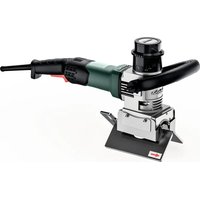
KFM 15-10 F / KFMPB 15-10 F

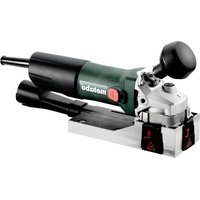
KFM 16-15 F
- ORIGINAL INSTRUCTIONS
- DECLARATION OF CONFORMITY
- SPECIFIED USE
- GENERAL SAFETY INSTRUCTIONS
- SPECIAL SAFETY INSTRUCTIONS
- 4.1 KICKBACK AND RELATED WARNINGS
- ENGLISHEN
- 4.2 ADDITIONAL SAFETY INSTRUCTIONS
- REDUCING DUST EXPOSURE
- OVERVIEW
- COMMISSIONING
- 6.1 ATTACHING THE ADDITIONAL HANDLE
- ATTACH BOW HANDLE (1)
- ATTACH SIDE HANDLE (5) (DEPENDING ON EQUIPMENT, ONLY FOR KFM 15-10 F, KFMPB 15-10 F)
- SETTING
- 7.1 SETTING THE CHAMFER ANGLE
- 7.2 SETTING THE CHAMFER HEIGHT
- SET THE CHAMFER ANGLE FIRST
- USE
- 8.1 SWITCHING ON AND OFF
- KFM 15-10 F (SEE PAGE 3, FIG. B)
- MAINTENANCE
- CLEANING
- TROUBLESHOOTING
- KFM 15-10 F, KFMPB 15-10 F
- KFM 16-15 F
- ACCESSORIES
- REPAIRS
- ENVIRONMENTAL PROTECTION
- TECHNICAL SPECIFICATIONS
- A EMISSION VALUES
- ELECTROMAGNETIC DISTURBANCES
- FRANÇAISFR
- NOTICE ORIGINALE
- KFM 16-15 F (SE SIDE 3, ILL. B)
- MIDLERTIDIG TILKOBLING
- FAST TILKOBLING
- 5.0630P
- BBOD B 3KCNPNYATAUHIO
- 6.1 YCTAHOBKA DONOJIHHTEJIBHOPYKORTKN
- YCTAHOBB PYKOTN B BVNE DYHN (1)
- YCTAHOBHA 6OKOBOI PYKOTHN (5) (B 3ABNCHMOCTN OT KOMJIEHTAUN, TOJBHO HA KFM 15-10 F, KFMPB 15-10 F)
- PERYLNOPOBHA
- 7.1 HACTPOHA YRJA FACKN
- 7.2 HACTPOHA BBICOTBL FACHN
- CHAYANA HACTPOTE YROL FACKN
- ONPEJEHHE 3HAUEHN HACTPOKN
- ИСТОРБОВАИМЕ
- 8.1 BKIIOUEHNE N BBIKIOUEHNE
- PYCCHNRU
- KFM 15-10 F (CM, CTP. 3, PNC. B)
- KFMPB 15-10 F (CM. CTP. 3. PNC. B)
- KFM 16-15 F (CM. CTP. 3, PNC. B)
- HPATHOBPEMEHHOE BKNIOUEHHE
- ДИTEЬHOE BKIIOYHNE
- 8.2 PERYLNPOBBHA YACTOBI BPAUEHNA (KFM 15-10 F)
- 8.3 O6UHNE YHA3AHHN NO 3KCNLYATAUHN
- 8.4 O6PA6OTHA BHEUHEN KPOMHN TPY6
- 8.5 KFM 16-15 F: BO3MOXHOCT B NOBOPTA HNNPABNAIOUE (15)
- TEXHNUECHOE O6CIYJHHBAHNE
- 9.1 3AMEHA PEKYUIX NOBOPOTBIX IJACTINH
- OUHCTKA
- PYCCKHRU
- YCTPAHHE HENCNPABHOCTEI
- ППНАДЛЖНОCTИ
- PEMOHT
- 3AUNTATA OKPYKAIOE CPEBL
- TEXNUECHNE XAPAHTEPNCTNH
- 3NEKTPOMARHHTBIE NOMEXN
- EAC
- HΦOPMAΖΗДЯ NOKYNATELA
Brand : METABO
Model : KFMPB 1510 F
Category : Milling machine