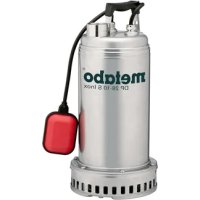
DP 2810 S Inox - Pump METABO - Free user manual and instructions
Find the device manual for free DP 2810 S Inox METABO in PDF.



| Product type | Submersible pump for clean and wastewater |
| Brand | Metabo |
| Model | DP 2810 S Inox |
| Application | Drainage on construction sites, agriculture, domestic and garden |
| Permitted liquids | Clean or wastewater (pH 6-9, particle size ≤ max grain size) |
| Power supply | 230 V ~ 50 Hz |
| Motor power | 1100 W |
| Residual current protection | Residual current device (RCD) 30 mA max |
| Max delivery head | 10 m |
| Max flow rate | 280 l/min |
| Max liquid temperature | 35 °C (domestic use), 50 °C (others) |
| Housing material | Stainless steel |
| Float switch | Yes, adjustable |
| Weight | Approximately 8 kg |
| Maintenance | Rinse with clean water, clean deposits with a brush |
| Safety | Do not lift by cable, protect from frost, disconnect before maintenance |
| Repairability | Repairs by a qualified electrician with Metabo spare parts |
Frequently Asked Questions - DP 2810 S Inox METABO
User questions about DP 2810 S Inox METABO
0 question about this device. Answer the ones you know or ask your own.
Ask a new question about this device
Download the instructions for your Pump in PDF format for free! Find your manual DP 2810 S Inox - METABO and take your electronic device back in hand. On this page are published all the documents necessary for the use of your device. DP 2810 S Inox by METABO.
USER MANUAL DP 2810 S Inox METABO
Original instructions
1. Component Overview
See illustration on page 2.
1 Power cable with plug
2 Handle / lifting eye
3 Pressure connection
4 Pump casing
5 Suction inlets
6 Float switch
7 Float switch level control
2. Please Read First!
- Read these instructions in full before operating. Pay special attention to the safety instructions.
- These instructions are intended for persons with basic technical knowledge in handling tools such as the one described here. If you have no experience with this type of tool we strongly recommend that you seek the advice of an experienced person before operating this tool.
- If you notice transport damage while unpacking, notify your supplier immediately. Do not operate the tool!
- Dispose of the packaging in an environmentally friendly manner. Take to a proper collection point.
- Keep all documents supplied with the tool for future reference. Retain your proof of purchase for any future warranty claims.
- If you lend or sell this tool, be sure to include the documents supplied with the tool.
- The equipment manufacturer is not liable for any damage arising from failure to observe these instructions.
Information in these operating instructions is categorised as shown below:

Danger!
Risk of personal injury or environmental damage.
Risk of electric shock!
Risk of personal injury from electric shock.
Caution!
Risk of material damage

Note:
Additional information.
3. Safety
3.1 Specified conditions of use
The submersible pumps are designed for draining purposes on construction sites, in agriculture and in domestic homes and gardens.
SP 24-46 SG and SP 28-50 S Inox are also intended for draining wastewater both in industrial and domestic environments.
Approved pumping media
Clean or dirty water
- The particle sizes of the solids in the dirty water must not exceed the maximum particle size specified in the technical data.
- The liquid must have a pH value of between 6 and 9.
Any other use is considered to be not as specified and therefore not allowed.
Typical application areas
draining of building pits, ponds, flooded areas; also for draining basements. pumping out of tanks, water basins, swimming pools or soakaways.
- continuous circulation (pond).
Unspecified use
The pump is not intended for:
- DP 18-5 SA, SP 24-46 SG: pumping of liquids at temperatures >35^ .
- DP 28-10 S Inox, SP 28-50 S Inox: pumping of liquids at temperatures >35^ for household purposes; pumping of liquids at temperatures >50^ for other purposes.
supplying drinking water or pumping liquid food; - pumping salt water;
- pumping explosive, inflammable, corrosive or health-damaging substances or human waste;
The pump should not be used by people who:
have physical and/or mental impairments;
have impaired senses;
- do not have adequate experience and/or knowledge in handling the pump; or
have not read and understood the operating instructions.
Children should be supervised to ensure that they do not play with the device.
This device is not designed for use by persons (including children) with physical, sensory or mental disabilities, or with insufficient experience and/or knowledge, unless they are supervised by a person responsible for their safety, or have received instructions on how to use the device by this person.
The manufacturer assumes no liability for damage caused by unspecified use. Unspecified use, modification of the pump or use of parts that have not been tested and approved by the manufacturer can cause unforeseeable damage!
3.2 General safety instructions
- When using this pump, observe the following safety instructions to exclude the risk of personal injury or material damage.
- Never allow children to use the machine.
- Children should be supervised to ensure that they do not play with the tool.
- Follow the legal guidelines or accident prevention regulations for using submersible pumps.
- When the pump is being used in swimming pools, garden ponds and in the protected areas around them, the regulations must be observed in accordance with IEC 60364-7-702.
All national regulations relating to the safe operation of submersible pumps must also be followed.
- The pump must be protected by a residual current device (RCD) with a trip current of max 30 mA.
General danger! Do not operate the pump if anyone is in contact with the pumping media (e.g. in a swimming pool or garden pond)!
The following residual risks essentially remain when operating submersible pumps and cannot be fully eliminated - even by employing safety devices.
Danger from the environment!
Do not use the pump in hazardous locations or near inflammable liquids and gases!
Danger! Risk of electric shock!
Do not touch the plug with wet hands! To disconnect, always pull on the plug, not the power cable.
Connect only to an earthed outlet that is properly installed, earthed and tested. Mains voltage and fuse protection must correspond to those stated in the 'Technical Specifications'.
Always lift and transport the pump by the handle, never by the power cable or discharge hose.
Extension cables must have sufficient conductor cross sections. Unroll cable reels fully.
Do not buckle, squeeze, drag or drive over power cable or extension cables; protect from sharp edges, oil and heat.
Place extension cable so that it cannot get into the fluid to be pumped.
Always unplug before servicing the pump.
Risk of electric shock from pump faults!
Before each use, check the equipment - especially the power and extension cables, power plug
ENGLISHen
and float switch - for possible damage. Risk of fatal electric shock! Do not attempt to repair the pump yourself! When repaired inexpertly, there is a risk of liquid entering the electrical parts of the pump.

Caution!
To avoid water damage, e.g.
flooded rooms, caused by
pump malfunctions or defects: provide for suitable safety measures such as the following:
- a l a r m o r
collection tank with monitoring.
The manufacturer is not liable for any damage caused by:
- improper use of the pump;
- failure to operate and store the pump in a frost-free environment;
- unauthorised modification of the pump (repairs to electrical equipment may only be carried out by qualified electricians!);
- use of spare parts which have not been tested and approved by the manufacturer; or
- use of unsuitable installation materials (fittings, connection lines etc.).
Suitable installation materials:
-pressure-resistant (min. 10 bar)
- heat-resistant (min. 100^ ).
4. Assembly and Installation
4.1 Connecting the discharge line
Connecting thread details: see Technical Specifications.

Note:
The optimum pump capacity is
achieved by selecting the largest dis
charge line diameter.
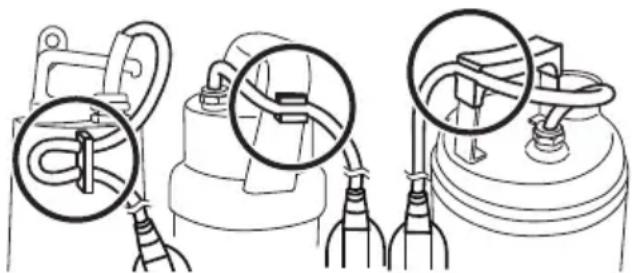
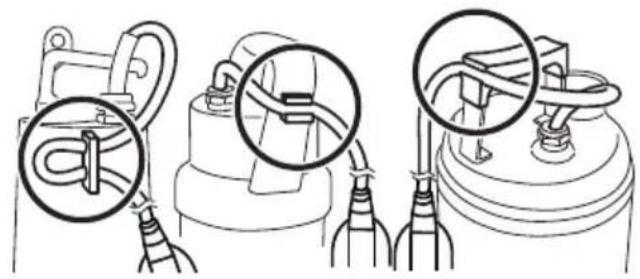
4.2 Fixing the float switch cable
- How the float switch cable is fixed to the device depends on the particular device model. If necessary, insert the float switch cable in the cable clip of the handle.
The following illustration shows the fixed float switch cable.

Caution!
The float switch cable may be damaged. Never pull on the float switch
cable to change its position in the cable holder!
4.3 Installation instructions
- For the float switch to function properly, it must be able to move freely.
Space requirement for DP 18-5 SA, DP 28-10 S Inox: approx. 60cm× 60cm Space requirement for SP 24-46 SG, SP 28-50 S Inox: approx. 70cm× 70cm . - Submerge the pump to no more than the maximum immersion depth specified in the technical data.
- Install the pump such that the suction inlets cannot be blocked by foreign objects. If necessary place the pump on a support surface.
- Ensure sufficient upright stability.

Risk of electric shock from severed cables!
Do not lift or transport the pump by the cables or the discharge hose! The cables and the discharge hose are not designed to withstand the tensile stress produced by the weight of the pump.
4.4 Installing the pump
- Submerge pump at a slight angle to avoid creating an air cushion on the underside, which would prevent priming. Once the pump is submerged, it can be placed upright.
- Lower pump to the bottom of the fluid container.
Use a strong rope fastened to the lifting
eye to lower the pump.
The pump can also be operated when suspended by a rope.
- Before operating the pump again, ensure that the pump line has been completely emptied.
5. Operation
5.1 Switching ON and OFF
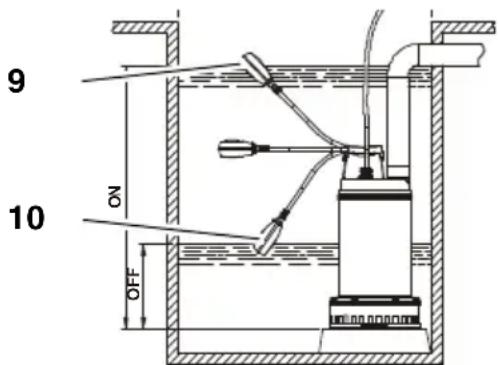
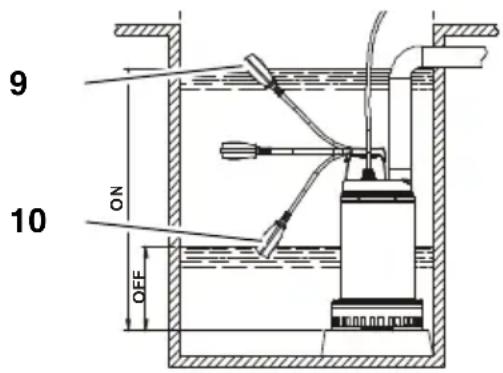
After you have connected the pump to the mains, it will be switched on (9) and off (10) automatically by the float switch. The point in time at which switching occurs depends on the water level.
Adjusting the ON and OFF times for the pump
The position of the float switch cable in the cable holder can be changed. The time interval between pump switch-on and switch-off is thereby adjusted:
- 'Short' float switch cable: ON and OFF positions are close together.
- 'Long' float switch cable: ON and OFF positions are far apart.

Caution!
Attach the float cable so that the OFF position is at least 150mm above the
base of the pump. The pump may run dry and thereby be damaged.

Caution!
The float switch must always be able to move up and down to allow the
pump to be switched on and off.

Caution!
The pump must not be activated more than 20 times an hour, as this could the motor to overheat.

Danger from faulty pump!
Take appropriate measures to ensure that pump faults do not cause consequence.
quential damage through flooding of rooms. This must be ensured, for example, through installation of an alarm system or a reserve pump.

Danger!
Do not let the pump run against a closed pump line.
5.2 Minimum water level
Continuous operation:
The pump must be completely submerged for continuous operation to take place.
Restricted operation:
Only restricted operation is possible if the pump is not fully submerged. Note the following restrictions:

Risk of material damage from dry running of pump!
The pump can overheat and become
damaged as the cooling function of the pumped medium is reduced. The thermal switch will react.
- Suction operation for a short period only (2-3 mins).
Monitor the pump's operation during suctioning.
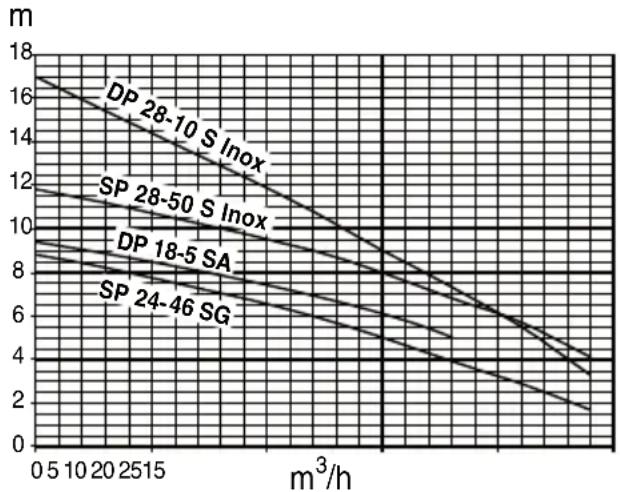
5.3 Pump capacity curve
The pump capacity curve indicates the flow volume, depending on the delivery head.
6. Device care, maintenance

Danger!
Unplug before maintaining or cleaning.
Repair and maintenance work other than described in this section should only be carried out by qualified specialists.
ENGLISHen
6.1 Regular care
Regular care is required for the pump to function perfectly at all times. This also applies if the pump is not switched on for extended periods of time (e.g. during operation in soakaways).
Cleaning the pump
- Rinse pump with clean water. Remove persistent marks, e.g. algae deposits, with brush and dishwashing liquid.
- To rinse the inside of the pump: dip pump into a container of clean water and switch on briefly.
6.2 Pump storage

Caution!
Frost damages the pump and accessories as both always contain
water!
- If there is a danger of frost, disassemble pump and accessories and store in frost-free conditions.
6.3 Device maintenance (only for SP 28-50 S Inox, DP 28-10 S Inox)

Caution!
Lubricant may leak from the pump if the seals are defective, causing contion of the liquid being pumped.
Although the lubricant contained in the submersible pump for dirty water is non-toxic, it can alter the water properties.

Danger!
Maintenance work must only ever be carried out by qualified, specia
ly trained staff. After 4,000 to max. 8,000 hours of operation, and in any case at least once a year, the quantity and quality of the oil in the oil reservoir must be checked.
7. Troubleshooting

Danger!
Prior to all servicing: Unplug.
7.1 Troubleshooting guide
Pump does not run:
- No mains voltage.
- Check cables, plug, outlet and mains fuse.
-
Mains voltage too low.
-
Use an extension cable with sufficient conductor diameter.
-
Motor overheated; motor protection relay tripped.
- Eliminate the cause of overheating (pump blocked by foreign objects?).
- Float switch does not switch pump ON when water level rises.
- Make sure the float switch can move unrestrictedly. If, despite sufficient mobility of the float switch, the pump does not switch ON: send the pump to the service centre in your country.
Motor hums, but does not start:
- Pump blocked by foreign objects.
- Clean impeller.
Pump runs, but does not pump properly:
- Delivery head too high.
- Observe max delivery head (see 'Technical Specifications').
- Discharge hose kinked.
- Straighten discharge hose.
- Discharge hose leaky.
- Seal discharge hose; tighten screw fittings.
Pump runs very noisily:
- Pump is sucking air.
- Ensure there is a sufficient water supply.
Foreign objects are present (clean pump). - Manual mode has been set (shallow water suctioning).
- Hold pump at an angle when submerging.
Pump runs continuously:
- Float switch does not reach cut-out position.
- Make sure the float switch can move freely.
8. Repairs
Danger! To avoid risks, only have repairs carried out by qualified electricians using original Metabo spare parts.
If you have Metabo electrical tools that require repairs, please contact your Metabo service centre. For addresses see www.metabo.com.
9. Disposal
Observe national regulations on environmentally compatible disposal and on the recycling of disused machines, packaging and accessories.

Power tools do not belong in the household rubbish. According to European Directive 2002/96/EC on waste electrical and electronic equipment, electrical waste must be collected separately and taken
to an environmentally friendly recycling ?facility.
10. Declaration of Conformity
We declare under our sole responsibility: These construction and waste water pumps, identified by type and serial number 1 , comply with all relevant requirements of the directives 2 and standards 3 . Technical file at 4 - see page 3.
5.2 Minimale waterstand
Continubedrijf:
Skicka in apparaten pa service.
Adresser vindes pa www.metabo.com.
9. Bortskaffelse
Anaitnon xwpou DP 18-5 SA, DP 28-10 S
Pn 3Kcnpyaatau nprgyKhbIX Hacocob cyueCTbYOT cJeDyUoIe OCTaTOUHbIE ONaCHOCTN, KOTOpbIe
PYCCHNru
Helenb3a NOIHOCTbIO yCTpaHNTb Da-Ke pInnB HadJIeJkaUne MepbI 6e3OpaCHOCTN.

Onachoctb, CBa3aHna C OKpykaIooe cpeo!
He nCnoJb3yIte HaCoc BO B3pblBOONaChbIX NOMeUeHnX NlNB6In3n rOpOuNX JnDkoCTeNnIra3OB!

He donyckaTb 3aJOMOB, 3aKIMaHnHa nn Hae3da Ha CeTeBOu ydIHHnteBHyi Ka6eJIb; 6epeyb OT KOHTaKTa C OCTpbIMN KpOMKaMn, MaclOM N BblCOHOI TempeatypoI.
IpoKlaIbIbTaB ydIINHITeIbHbI Ka6eIb TaK, YTO6bl OH He MOr IOnaCTb B IpeKaUHaEMyIO JnIDKOCTb.
Ipeed npoBeDeHnem pa60T ha Hacoce OTKJIIOHTb CeTeByIO BnI- Ky.

Onachoctb nopajehnnaJIeKtpnuechHM TOHOM,
obycnoBHeHHa HenoJaHamn Hacoca!
Ipeed KaJdbIM NcNoJIb3OBAHHeM npOBepaTe HaCOC Ha HAIuYe NOBpeJdeHn. Oco6eHNO 3TO KaCAeTcA cTeBOrO n ydInHtEJIb-Horo Ka6eI, cTeBOI BILKn I NONaBKOBO r BbIKIOUaTeIb.
Jyua npo3BOntelbHOCTb DOCTnraetc npn BbOpe Hn60JIbIeero DN
ametpaHarHeTaTeIbHOro TpyBonpoBoVa.
4.2 HpenleHne Ka6eI nonlaBHOBOrO BbIHIOuHaTeJIa
Cnoc6fHKcauH Ka6eI NOJaBKOBO BbIKIOaTeHa yCTpOJCTBe MOKeT pa3- IuHaTbcR B 3aBNCMOCTn OT MoJeI. Ppi Heo6XODMOCTn BLOKHTe Ka6eJIb NOJaBKOBO R BbIKIOUaTeI B 3aHIM Ha pykoarHe.
Ha pncyHke HnKe noka3aH npaBnIbHo 3a-ΦHKcnpoBaHHb KabeIb nonlaBKOBO BblKIOUaTeJI.

BHHMaHHe!
Ha6eIb nonlaBkoBO BblKIOuataTeMa MoKeT nobpeDntbCra. Hn B Koem Cny-
Yae He TAHNTe 3a Ka6eIb NONJIaBKOBOrO BblKIOUcATEIg IIN3MeHEnI NIOJOKeHnKa-6eJeepKaTeIg!
4.3 yka3aHnno yctaHOBHe
Дябурно pa60ы nonlaBkoBOrOBbIIOyateHOndoJIKeH CBO6OdHOBnIraTbC!
Cbo6oHoe npocTpaHCTBO dJa DP 18-5 SA,DP28-10S Inox:npim.60cmx60cm Cbo6oHoe npocTpaHCTBO dJa SP 24-46 SG,SP28-50S Inox:npim.70cmx70cm
IorpyKaTb npH6Op B BOdy MOxHo cAmoe 6oJIbUeHe Na npBedeHnyo B TexHnuecknx XapaKTepeNCTnKax pa6Ouyo rLy6nHy.
- YctaHaBnBaTb Haoc TaK, YTO6bI BCacbIBAIOUne OTBepCTnA He MOrJN 6bITb 3a-6LOHnPOBaHbI NOCTOPOHnMn PpeDmTaMn. Ppr Heo6xOIMOCtN yCTaHOBnTb HaCOC Ha NoCTaBky.
- Obecneyte yctOnuHBOe noJIOKeHHe Ha-cocca.

Onachoctb nopajehnna 3neKtpnuechHM TOHOM n3-3a OTcoeHHHeHHoro Ka6eI!
He noDHnMaTb n He nepeHocntb yCTpoiCtBO 3a Ka6eIb nn 3a HanopHbI ShaHr! Ka6eIu HAnOpHbI ShaHr He paCCHTaHbI HaHa- rpy3ky MaccOHaCoca.
4.4 YctaHOBKa Hacoca
- Norpuy3nTb HAcOC C He6oJbWIM HaKIOHOM B IpeKeaHbAeMyIO JHKIOCTb, YTO6bl C HIXHe CTOpOHbI He O6pa3OBAcra BO3yHbI Ny3bIPb. B 3Tom cIyue BCacbIBaHne 6blIO 6bl 3aTpUdHeHO. KaK ToJIbKO HAcOC NOrpyKeH, eR0 MoXHO BbIpOBHrTb.
- Onyctntb hacoc ha dHO pe3epByapa c HNDKOCTbIO.
NcnoJIb3yIe dIa ONyCKaHnI npOuHbI TpOc, 3aKpeINB erO Ha nOdBecHO npoyUHNHe HacOca.
PYCCKHrRu
Hacoc TaKHe MoKHo 3KcNllyaTnpoBaTb B NOBWeEHHom Ha TpOce COCToHn.
- Пи NOBTOPOM BBODE B ᵋΚΝΥΑΤΑΝΟ СледITE 3a Tem, УТБы ПОДАЮЙТPyбо- нровOD 6bl ПОЛНOCТьО ONOPОЖHeH.
5.Зкплуataця
5.1 BkIIOUeHne I BBIKIOUeHne
IocLe BkIoUeHnHaCocA B CeTb, OH aBToMaTHueCKn BkIoUoHaETcra (9) N BbIKIoUoHaETcra (10)cNOMOuIbIO NonlaBKOBOrOBbIKIoUaTeJI. MOMENT BkIoUeHn3aBNCHT OT ypOBHn BOdbl.
PerylnpoBHa MOMeHTa BkIIOUeHnI N BbIKIOUeHnHaCOCOB
IolooHeHne Ka6eJI nonJaBKOBOrO BbIKIO- ChaTeJI B Ka6eJIbHOM DepeKaTeJIe MOxHO N3-MeHTb. 3a CHT eT OTO peYJInpyeTn HTEpBAJI MeKdy MOMENTOM BKNIOUeHry N BbIKIO-ueHry HaCOca:
-ПОЛЯВКOBБИ ВБИКЛЮЧАТь Ha"KOPOT-KOM Ka6eJIe":МомeHT BKNIOчЕняи ВblKIOчЕня HaxOДЯТСЯ 6ЛИЗКО ДPyг OТ dpyra.
-ПОЛТАВКOBБИ ВБИКПЮЧАТЕЛБ HA "ДИNHOM Ka6eJIe":МомERTВКПЮЧЕНЯ N ВБИКПЮЧЕня HAXODЯТСДаJIeKO Dpyr O TДpyra.

BHHMaHHe!
3aФИСИРУТЕ Ka6eIb nonlaBkoBOrO BbIKHIOUaTeIraTakIM O6pa3OM,
YTO6bI TOUHa BbIKIOUeHn HaXODINAcb Ha BBICOTe MHN.150 MM OT dHnua Hacoca.Cy-CTByET ONaCHOCTb paOToBt HACoca BCyXu, YTO pInBeTe K eRo NOBpeKDeHnO.

BHHMaHHe!
PonlaBHObI BblKJIIOaTeIb DOJIKeH BCerda OCTaBaTbCra NOdBNIHHbIM
BBePx N BHN3, YTO6bI BKNIOuHaTb N BbIKIOuHaTb HAcOC.

BHHMaHHe!
Bo n36eKaHne nepepeBa 3JIeKTpOaBnIraTeJ3anpeuaeTcB KJIIOUaTbycTroPocTBO Yaue 20 pa3 B yac.

Onachoctb n3-3a HenoJaOyctpoiCTBa!
ПпIMITE COOTBETCTBYIOUme Меры,чTO6blnpH HeNCnpaBHOCTx HAcOca NCKIIOuHTb npNHNHeHne KOCBeHHORO yUepe6a,OB-CLOBHeHHORO 3aTOnJIeHnEM NOMEueHn.HanpIMep,3TO MOJHo OBeCneHTb NyTeM yCTaHOBN CnHaJIIN3aUIN ININ 3aNaCHORO HaOcA.

Onachoctb!
He donyckaiaTe pa6oTbI hacocac 3a-KpbITbIM Tpy60npOBODOM.
5.2 MnH. ypoBHeB BODbl
Hn HnpepbBHO 3KcnpyaTaun Haoc OJHeH 6bITb NOHOCbIO NOrpyKeH BBOy.
3KcnIyataaC orpaHnueHnA M:
EcnHacoc norpuyKeH B Body He noJHoCTbIO, BO3MOxHa 3KcNlyaTaunC ONpeDeJIeHHbIMN OrpaHnueHnA M. O6paTte BnMaHne Ha CJeDyUoIee:

B pe3yIbTaTe pa6oTbI Hacoca BcyxUO BO3MOHbI erO NOBpeHdEHHa!
Hacoc MoKeT nepepeTbCn noJyUHTb NOBpeKdEHHa, TaK KaK OTCyTCTByET FyHNcN OxJaXdEHHa nepeKauNbAeMoN cpebl. TepMOBbIKIIOuHaTeJIpearnpyeT.
- OTKaUNBaHHe BO3MOxHo TOIbKO B TeueHHe KOpOTKOrO BpeMeHH (2-3 MmH).
Bo Bpemr OTKaHbAHnHe octabTne Hacoc 6e3 npncMOtpa.
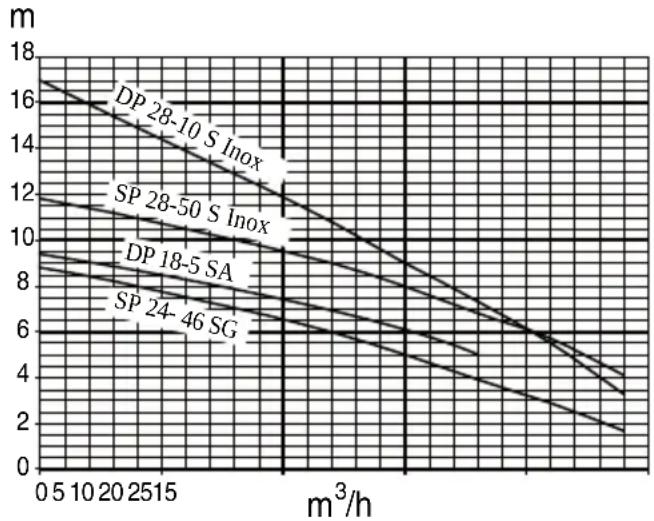
5.3 TpaHn eHaXapaHTepnCTnKa Hacoca
IpaHuecka XapaKTepeNtHa HAcOca NOKa3bIBaeT eRo IpOn3BODNTeJIbHOCTb B 3aBNCHMOCTN OT Hanopa.
6. Yxod n TexHnuechoe o6cIy- HnBaHne Haocca

Onachoctb!
Ipeed BbINOJIHeHEm IIO6bIX pa-60T yXOdy N OCHCThe BblTaunTb
ceTeByIO BnIky I3 po3eTKN.
Onncahhbie B hactoJem pa3dene pa60TbI NO TexO6cnyKHBaHIO n peMOHTy DOJIHHbI BBINOJIHrTbCnToJbKO CneUHaJIHCTaMn.
6.1 PerylnpHbIyXoD
Дя obecneueHЯ 6e3ynpueHNo pa6oTocnoC6HocTN HacOca Tpe6yeTcpeYJrHbI yXoJ.3To paCnpoCTpaHReTcN Ha Te HacoCbI, KOtOpBie He BkJIouaOTcN DOJIROe BpEma (Ha npimep, npn 3KcnIyaTaunB nOrlouaUxix K0IoDax).
OuInCTHa Hacoca
1.Помыть haboc устон BODо.3aTBeP-DeBwne 3aRpa3HeHn,HaPpIMep OTIO-JxEHn BOOpOcNe, ydaJIHTb C NOMOuI0UeKN MOUSeRo cpeDCTBa.
2.ДЯ npOMbIBKN HAcOCA n3HyTpN: NOrpyKHTb HaCOC B EMcKoCTb YHCTOy BO-DoI N HeHaDoJIo BkJIIOHTb.
6.2 XpaHeHne Hacoca

BHHMaHHe!
Mopo3 oka3bIbaet pa3pywaIOuopee Ha hacoc N npHaJneKHOCTN, TaK
HAN B HNX NOCTOAHNO COepeHHTcB Oda!
- Пи onасноCTM Mopo3OB CHIMITE HACOC И ринадлеснocTN I y6eRte INB 3aun-шениоEOT Mopo3a MeCTO.
6.3 TexHHecHoe o6cIyJHHBaHHe Hacoca (ToIbHO dIy MoJe- IeN SP 28-50 S Inox, DP 28- 10 S Inox)

BHHMaHHe!
B clyae nobpeKdEHHy yNIOHTHeHHcMa3ka MOKeT BbITEyh3 HaCOca,
TO npBedeT K 3aIpa3HeHIO nepeKaunBaemo HNDKCTN.
HcnoJb3yeMaB rpr3eBbIX NorpyHHbIX HAcocax Cma3Ha HeTOKCnHa, OdHaKO npN NOJaDaHN B BODY OHa MOKeT Bbl3BaTb N3MeHeHne ee CBOICTB.

Onachoctb!
Bce pa6oTbI no TexHnueChomy 06ClyHHBaHNIO DOJHHbI BblON-
HATbCToTolbKO KBaJIHΦHnIPOBaHHbIMN CneuaJIHcTAMN. Ype3 4000-8000 yacob 3KcIIyatauH (HO He peKe OJHOro pa3a B rOd) CLEdyET POBePHTb KOJIHcCTBO N Ka- cEcTBo MacLaB MaCIAHON KaMepe.
CtpaHa n3roTOBHeHn: ItaJIIn
ПОНЗВОДИТЕЛ: "Metabowerke GmbH", Metaboallee 1, D-72622 Nuertingen, Германя
HmnpTeB Pocnn:
OOO"MeTa6oEBypa3n
Pocn,127273,MockBa
yI. Bepe3oBaA aIle, 5 a, cTp 7, oΦnc 106
TeI.: +7 495 980 78 41
6. Ierices kopsana,apkope

Bistami!
6.1 Regulara kopsana
Lai iekarta jebkura bridiarbotos bez traucejumiem,to ir nepieiesams regulari kopt.Tas attiecas ari uz gadijumiem,ja iekarta ilgaku laiku netiek ieslegta (piem., izmantojot to drenazas bedres).
Iekartas tirisana
- Noskalot sukni ar tiru udeni. Piekaltusus netirumus, piem., algu nogulsnejumus, notirar suku un trauku mazgajamo lidzekli.
- Lai sukni izskalotu no iekspuses: iegremdet sukni tvertne, kurarir tirs udens un uz isu bridi iesegt.
6.2 lekartas uzglabašana

Uzmanibu!
Motors duc, bet nesak darbodies:
-
Rotoru nosprostojis sveškermenis.
-
I z t irit rotoru.
Sūknis darbojas, bet neveic sūknešanu pareizi:


- Original instructions
- Component Overview
- Please Read First!
- Danger!
- Risk of electric shock!
- Caution!
- Note:
- Safety
- Specified conditions of use
- Approved pumping media
- Typical application areas
- Unspecified use
- General safety instructions
- Danger from the environment!
- Danger! Risk of electric shock!
- Risk of electric shock from pump faults!
- ENGLISHen
- Assembly and Installation
- Connecting the discharge line
- Fixing the float switch cable
- Installation instructions
- Risk of electric shock from severed cables!
- Installing the pump
- Operation
- Switching ON and OFF
- Adjusting the ON and OFF times for the pump
- Danger from faulty pump!
- Minimum water level
- Continuous operation:
- Restricted operation:
- Risk of material damage from dry running of pump!
- Pump capacity curve
- Device care, maintenance
- Unplug before maintaining or cleaning.
- Regular care
- Cleaning the pump
- Pump storage
- water!
- Device maintenance (only for SP 28-50 S Inox, DP 28-10 S Inox)
- Troubleshooting
- Troubleshooting guide
- Pump does not run:
- Motor hums, but does not start:
- Pump runs, but does not pump properly:
- Pump runs very noisily:
- Pump runs continuously:
- Repairs
- Danger! To avoid risks, only have repairs carried out by qualified electricians using original Metabo spare parts.
- Disposal
- Declaration of Conformity
- Minimale waterstand
- Continubedrijf:
- Bortskaffelse
- PYCCHNru
- Onachoctb, CBa3aHna C OKpykaIooe cpeo!
- Onachoctb nopajehnnaJIeKtpnuechHM TOHOM,
- obycnoBHeHHa HenoJaHamn Hacoca!
- HpenleHne Ka6eI nonlaBHOBOrO BbIHIOuHaTeJIa
- BHHMaHHe!
- yka3aHnno yctaHOBHe
- Onachoctb nopajehnna 3neKtpnuechHM TOHOM n3-3a OTcoeHHHeHHoro Ka6eI!
- YctaHOBKa Hacoca
- PYCCKHrRu
- 5.Зкплуataця
- BkIIOUeHne I BBIKIOUeHne
- PerylnpoBHa MOMeHTa BkIIOUeHnI N BbIKIOUeHnHaCOCOB
- Onachoctb n3-3a HenoJaOyctpoiCTBa!
- Onachoctb!
- MnH. ypoBHeB BODbl
- 3KcnIyataaC orpaHnueHnA M:
- B pe3yIbTaTe pa6oTbI Hacoca BcyxUO BO3MOHbI erO NOBpeHdEHHa!
- TpaHn eHaXapaHTepnCTnKa Hacoca
- Yxod n TexHnuechoe o6cIy- HnBaHne Haocca
- PerylnpHbIyXoD
- OuInCTHa Hacoca
- XpaHeHne Hacoca
- TexHHecHoe o6cIyJHHBaHHe Hacoca (ToIbHO dIy MoJe- IeN SP 28-50 S Inox, DP 28- 10 S Inox)
- Ierices kopsana,apkope
- Regulara kopsana
- Iekartas tirisana
- lekartas uzglabašana
- Motors duc, bet nesak darbodies:
- Sūknis darbojas, bet neveic sūknešanu pareizi:
Brand : METABO
Model : DP 2810 S Inox
Category : Pump