UC 9SF - Battery charger HITACHI - Free user manual and instructions
Find the device manual for free UC 9SF HITACHI in PDF.



User questions about UC 9SF HITACHI
0 question about this device. Answer the ones you know or ask your own.
Ask a new question about this device
Download the instructions for your Battery charger in PDF format for free! Find your manual UC 9SF - HITACHI and take your electronic device back in hand. On this page are published all the documents necessary for the use of your device. UC 9SF by HITACHI.
USER MANUAL UC 9SF HITACHI
Read through carefully and understand these instructions before use.
| English Deutsch Français | |||
| ① | Rechargeable battery Akkumulator (EB912S, EB9S, FEB9S, EB914, (EB912S, EB9S, FEB9S, EB914, (EB912S, EB914S, EB9B, EB924, BCC912) EB914S, EB9B, EB924, BCC912) EB914S, EB9B, EB924, BCC912) EB914S, EB9B, EB924, BCC912) | ||
| ② | Rechargeable battery Akkumulator (EB12S, FEB12S, EB12B, EB1224) (EB12S, FEB12S, EB12B, EB1224) (EB12S, FEB12S, EB12B, EB1224) | ||
| ③ | Rechargeable battery Akkumulator (EB1212S, EB1214L, EB1214S, (EB1212S, EB1214L, EB1214S, (EB1212S, CC1212) EB1220BL, BCC1212) EB1220BL, BCC1212) | ||
| ④ | Rechargeable battery Akkumulator (EB1412S, EB1414, EB1414S, (EB1412S, EB1414S, (EB1414S, EB1414, EB1414S, EB1414, EB1414, EB1414, EB1414, EB1414, EB1414, EB1414, EB1414, EB1414, EB1414, EB1414, EB1414, EB1414, EB1414, EB1414, EB1414, EB1414, EB1812S, EB1820) (EB1812S, EB1820) | ||
| ⑤ | Rechargeable battery Akkumulator (EB1812S, EB1820) (EB1812S, EB1820) | ||
| ⑥ | Rechargeable battery Akkumulator (EB1814SL, EB1820L, EB1824L, (EB1814SL, EB1820L, EB1824L (EB1814SL, EB1820L, EB1824L BCC1812) BCC1812) BCC1812) | ||
| ⑦ | Battery set lamp Akkusatzanzeige | Voyant indiquant que la batterie est installée | |
| ⑧ | Hole for connecting the rechargeable battery | Anschlußloch für Akkumulator batterie rechargeable | Orifice de raccordement de la |
| ⑨ | Nameplate | Typenschild | Plaque signalétique |
| Italiano | Nederland | Espanol | |
| ① | Batteria ricaricabile (EB912S, EB9S, FEB9S, EB914, (EB9)12S, EB9S, FEB9S, EB914, (EB912S, EB914S, EB9B, EB924, BCC912) EB914S, EB9B, EB924, BCC912) | Oplaadbare batterij (EB912S, EB9S, FEB9S, EB914, (EB912S, EB914S, EB9B, EB924, BCC912) EB914S, EB9B, EB924, BCC912) | Batería recargable EB9S, FEB9S, EB914, EB9B, EB924, BCC912) |
| ② | Batteria ricaricabile (EB12S, FEB12S, EB12B, EB1224) | Oplaadbare batterij (EB12S, FEB12S, EB12B, EB1224) | Batería recargable 2S, FEB12S, EB12B, EB1224) |
| ③ | Batteria ricaricabile (EB1212S, EB1214L, EB1214S, (EB1212S, EB1220BL, BCC1212) EB1220BL, BCC1212) | Oplaadbare batterij 212S, EB1214L, EB1214S, (EB1212S, BCC1212) EB1220BL, BCC1212) | Batería recargable EB1214L, EB1214S, |
| ④ | Batteria ricaricabile (EB1412S, EB1414, EB1414S, (EB1412S, EB1414S, EB1414S, (EB1412S, EB1414S, EB1414S, EBB14B, EB1424, BCC1412) EB14B, EB1424, BCC1412) | Oplaadbare batterij 12S, EB1414, EB1414S, (EB1412S, EB1414S, EB1414, EB1414S, EBB14B, EB1424, BCC1412) | Batería recargable EB1414, EB1414S, |
| ⑤ | Batteria ricaricabile (EB1812S, EB1820) | Oplaadbare batterij 20) (EB1812S, EB1820) | Batería recargable |
| ⑥ | Batteria ricaricabile (EB1814SL, EB1820L, EB1824L, (EB1814SL, EB1820L, EB1824L, (EB1814SL, EB1820L, EB1824L, BCC1812) BCC1812) BCC1812) | Oplaadbare batterij 1814SL, EB1820L, EB1824L, (EB1814SL, EB1820L, EB1824L, BCC1812) | Batería recargable Lámpara del Conjunto de baterías |
| ⑦ | Spia bacteria | Indicatielampje accugroep | Lámpara del Conjunto de baterías |
| ⑧ | Foro di collegamento della bacteria ricaricabile | Aansluiting voor oplaadbare batterij | Agujero para conectar la bateria recargable |
| ⑨ | Etichetta del nome | Naamplaatje | Placa de charactrística |
| Português EλληνικÀ Sveiska | |||
| ① | Bateria recarregavel (EB912S, EB9S, FEB9S, EB914, (EB912S, EB9S, FEB9S, EB914, (EB912S, EB914S, EB9B, EB924, BCC912) EB914S, EB9B, EB924, BCC912) EB914S, EB9B, EB924, BCC912) | Eπαναφορτιζόμενη μηαταρία (EB912S, EB9S, FEB9S, EB914, (EB912S, EB9S, FEB9S, EB914, (EB912S, EB914S, EB9B, EB924, BCC912) EB914S, EB9B, EB924, BCC912) | Upladdningsbart batteri (EB912S, EB9S, FEB9S, EB914, (EB912S, EB9B, EB924, BCC912) |
| ② | Bateria recarregavel (EB12S, FEB12S, EB12B, EB1224) (EB12S, FEB12S, EB12B, EB1224) (EB12S, FEB12S, EB12B, EB1224) | Eπαναφορτιζόμενη μηαταρία (EB12S, FEB12S, EB12B, EB1224) (EB12S, FEB12S, EB12B, EB1224) | Upladdningsbart batteri (EB12S, FEB12S, EB12B, EB1224) |
| ③ | Bateria recarregavel (EB1212S, EB1214L, EB1214S, (EB1212S, EB1214L, EB1214S, (EB1212S, EB1220BL, BCC1212) EB1220BL, BCC1212) | Eπαναφορτιζόμενη μηαταρία (212S, EB1214L, EB1214S, (EB1212S, EB1214L, EB1214S, (EB1212S, EB1214S, (EB1212S, EB1214S, (EB1212S, EB1214S, (EB1212S, EB1214S, (EB1212S, EB1214S, (EB1212S, EB1214S, (EB1212S, EB1214S, (212S, EB1214L, EB1214S, (EB1212S, EB1214S, (EB1212S, EB1214S, (EB1212S, EB1214S, (EB1212S, EB1214S, (EB1212S, EB1214S, (EB1214S, EB1214S, (EB1212S, EB1214S, (EB1212S, EB1214S, (EB1212S, EB1214S, (EB1212S, EB1214S, (EB1212S, EB1214S, (EB1212S, EB1214S, EB1214S, (EB1212S, EB1214S, (EB1212S, EB1214S, (EB1212S, EB1214S, (EB1212S, EB1214S, (EB1212S, EB1214S, (EB1212S, EB1220BL, BCC1212) EB1220BL, BCC1212) | Upladdningsbart batteri (EB1214L, EB1214S, |
| ④ | Bateria recarregavel (EB1412S, EB1414, EB1414S, (EB1412S, EB1414, EB1414S, (EB1414, EB1414, EB1414S, (EB1414, EB1414S, (EB1414, EB1414S, (EB1414, EB1414S, (EB1414, EB1414S, (EB1414, EB1414S, (EB1414, EB1414S, (EB1414, EB1414S, (EB1212S, EB1214L, EB1214S, (EB1212S, EB1214S, (EB1212S, EB1214S, (EB1212S, EB1214S, (EB1212S, EB1214S, (EB1212S, EB1214) | Eπαναφορτιζόμενη μηαταρία (20) (EB1812S, EB1820) | Upladdningsbart batteri (EB1812S, EB1820) |
| ⑤ | Bateria recarregavel (EB1812S, EB1820) (EB1812S, EB18) | Eπαναφορτιζόμενη μηαταρία (20) (EB1812S, EB1820) | Upladdningsbart batteri |
| ⑥ | Bateria recarregavel (EB1814SL, EB1820L, EB1824L, (EB1814SL, EB1820L, EB1824L, (EB1814SL, EB1820L, EB1824L, (EB1814SL, EB1820L, EB1824L, (EB1814SL, EB1820L, EB1824L, (EB1814SL, EB1814SL, EB1820L, EB1824L, (EB1814SL, EB1820L, EB1824L, (EB1814SL, EB1820L, EB1824L, (EB1814SL, EB1820L, EB1824L, (EB1814SL, EB1820) | Eπαναφορτιζόμενη μηαταρία (1814SL, EB1820L, EB1824L, (EB1814SL, EB1820L, EB1824L, (EB1814SL, EB1820L, EB1824L, (EB1814SL, EB1820) | Upladdningsbart batteri (EB1814SL, EB1820L, EB1824L, (EB1814SL, EB1820L, EB1824L, (EB1814SL, EB1820) |
| ⑦ | Luz indicatora da bateria | Λυχvia ρύθμιασς μηαταρίας | Batteriuppsättningslampa |
| ⑧ | Orício para conectar a bateria recarregavel | Τρύπα για ηυδεση της επαναφορτιζόμενης μηαταρίας | Hál für iläggning av det uppladd- ningsbara batteriet |
| ⑨ | Placa de identificação | Πινακίδα χαρακτηριστικών | Namnplàt |
| Dansk | Norsk | Suomi | ||
| ① | Genopladeligt batteri(EB912S, EB9S, FEB9S, EB914, (EB912S, EB9S, FEB9S, EB914, (EB912S, EB9S, FEB9S, EB914, EB914S, EB9B, EB924, BCC912) EB914S, EB9B, EB924, BCC912) EB914S, EB9B, EB924, BCC912) | Oppladbart batteri(EB912S, EB9S, FEB9S, EB914, (EB912S, EB9S, FEB9S, EB914, EB914S, EB9B, EB924, BCC912) EB914S, EB9B, EB924, BCC912) | Ladattava paristo(EB9S, FEB9S, EB914, EB9B, EB924, BCC912) | |
| ② | Genopladeligt batteri(EB12S, FEB12S, EB12B, EB1224) (EB12S, FEB12S, EB12B, EB1224) (EB12S, FEB12S, EB12B, EB1224) | Oppladbart batteri(EB12S, FEB12S, EB12B, EB1224) (EB12S, FEB12S, EB12B, EB1224) | Ladattava paristo2S, FEB12S, EB12B, EB1224) | |
| ③ | Genopladeligt batteri(EB1212S, EB1214L, EB1214S, (EB1212S, EB1214L, EB1214S, (EB1212S, EB1220BL, BCC1212) EB1220BL, BCC1212) | Oppladbart batteri212S, EB1214L, EB1214S, (EB1212S, EB1214L, EB1214S, BCC1212) EB1220BL, BCC1212) | Ladattava paristoEB1214L, EB1214S, | |
| ④ | Genopladeligt batteri(EB1412S, EB1414, EB1414S, (EB1414S, EB1414S, (EB1414S, EB1414S, (EB1414S, EB1414S, (EB1414S, EB1414S, (EB1414S, (EB1414S, (EB1414S, (EB1414S, (EB1414S, (EB1414S, (EB1414S, (EB1414S, (EB1414S, (EB1414S, (EB1414S, (EB1414S, (EB1415, (EB1415, (EB1415, (EB1415, (EB1415, (EB1415, (EB1415, (EB1415, (EB1415, (EB1415, (EB1415, (EB1415, (EB1415, (EB1415, (EB1415, EBC1812) BCC1812) BCC1812) | Oppladbart batteri12S, EB1414, EB1414S, (EB1414S, EB1414S, (EB1414S, EB1414S, (EB1414S, (EB1414S, (EB1414S, (EB1414S, (EB1414S, (EB1414S, (EB1414S, (EB1415, (EB1415, (EB1415, (EB1415, (EB1415, (EBI81415, (EB1820L, EB1820L, EB1820L, (EB1820L, (EB1820L, (EB1820L, (EB1820L, (EB1820L, (EB1820L, (EB1820L, (EB1820L, (EB1820L, (EB1820L, (EB1820L, (EB1820L, (EB18212) BCC1812) BCC1812) | Ladattava paristoLadattava paristoLadattava paristoLadattava paristoLadattava paristoLadattava paristoLadattava paristoLadattava paristoLadattava paristoLadattava paristoLadattava paristoLadattava paristoLadattava paristoLadattava paristoLadattava paristoLadattava paristoLadattava paristoLadattiva paristoLadattava paristoLadattava paristoLadattava paristoLadattava paristoLadattava paristoLadattava paristoLadattava paristoLadattava paristoLadattava paristoLadattava paristoLadattava paristoLadattava paristoLadattava paristoLadattava paristoLadattava paristoLadattava paristoLladattava paristoLadattava paristoLadattava paristoLadattava paristoLadattava paristoLadattava paristoLadattava paristoLadattava paristoLadattava paristoLadattava paristoLadattava paristoLadattava paristoLadattava paristoLadattava paristoLadattava paristoLadattava paristoLadattava paristaLadattava paristaLadattava paristaLadattava paristaLadattava paristaLadattava paristaLadattava paristaLadattava paristaLadattava paristaLadattava paristaLadattava paristaLadattava paristaLadattava paristaLadattava paristaLadattava paristaLadattava paristaLadattava paristaLadatt Vale | |
| ⑤ | Genopladeligt batteri(EB1812S, EB1820) (EB1812S, EB1820) (EB1812S, EB1820) (EB1812S, EB1820) (EB1812S, EB1820) (EB1812S, EB1820) (EB1812S, EB1820) (EB1812S, EB1820) (EB31812) (BCC1812) (BCC1812) (BCC1812) | Oppladbart batteri1814SL, EB1820L, EB1824L, (EB1814SL, EB1820L, EB1824L, (EB1814SL, EB1820L, EB1824L, (EB1814SL, EB1820L, EB1824L, (EB1814SL, EB1820L, EB1824L, (EB1814SL, EB1820) | Ladattava paristaLadattava paristaLadattava paristaLadattava paristaLadattava paristaLadattava paristaLadattava paristaLadattava paristaLadattava paristaLadattava paristaLadattava paristaLadattava paristaLadattava paristaLadattava paristaLadattava paristaLadattava paristaLadattiva paristaLadattava paristaLadattava paristaLadattava paristaLadattava paristaLadattava paristaLadattava paristaLadattava paristaLadattava paristaLadattava paristaLadattava paristaLadattava paristaLadattava paristaLadattava paristaLadattava paristaLadattava paristaLadattava paristaLuditeänstting | |
| ⑥ | Hamil til tilslutning af det opladelige batteri | Hull for tilkoling av det opplad-bare batteriet | Ladattavan pariston liitäntäukko | |
| ⑨ | Mærkeplade | Navneplate | Nimilaata | |
| Symbols WARNING The following show symbols used for the machine. Be sure that you understand their meaning before use. | Symbole WARNING Die folgenden Symbole werden für diese Maschine verwendet. Achten Sie darauf auf, diese vor der Verwendung zu verstehen. | Symboles AVERTISSEMENT Les symboles suivants sont utilisés pour l'util. Bien se familiarisier avec leur signification avant d'utiliser l'util. | Simboli AVVERTENZA Di seguito nostriamo i simboli usati per la macchina. Assicurarsi di comprendire il significato prima dell'uso. | |
| Read all safety warnings and all instructions. Failure to follow the warnings and instructions may result in electric shock, fire and/or serious injury. | Lesen Sie s'amtliche Sicherheitschinweise und Anweisungen durch. Wenn die Warnungen und Anweisungen nicht befolgt werden, kann es zu Stromschlag, Brand und/oder ernsthaften Verletzungenkommen. | Lire tous les avertissements de sécurité et toutes les instructions. Tout manquement à observer ces avertissements et instructions peut engender des chocs électriques, des incendies et/ou des blessures graves. | Leggere tutti gli avertimenti di sicurezza e tutte le istruzioni. La mancata osservanza degli avertimenti e delle istruzioni potrebè esserecause di scosse elettriche, incendi e/o gravi lesioni. | |
| Only for EU countries Do not dispose of electric tools together with household waste material! In observance of European Directive 2002/96/EC on waste electrical and electronic equipment and its implementation in accordance with national law, electric tools that have reached the end of their life must be collected separately and returned to an environmentally compatible recycling facility. | Nur für EU-Länder Werfen Sie Elektrowerkzeuge nicht in den Hausmüll! Gemäss Europäischer Richtlinie 2002/96/EG über Elektro- und Elektronik-Altergeäne und Umsetzung in nationales Recht müssen verbrauchte Elektrowerkzeuge getrennet gesammelt und einer umweltgerechten Wiederververting zugeführten werden. | Pour les pays europeens uniquement Ne pas jeter les apparilés électriques dans les ordres menagères! Conformément à la directive européen 2002/96/EG relative aux déchets d'équipements électriques ou électroniques (DEEE), et à sa transposition dans la législation nationale, les apparilés électriques doivent être collectés à part et être soumis à un recyclage respectueaux de l'environnement. | Solo per Paesi UE NonGPCIe Nongettarele apparecchiae elettriche tra i rifiuti domestici. Secondo la Direttiva Europea 2002/96/CE sui rifiuti di apparecchiae elettriche ed elettroniche e la sua attuazione in conformità alle norme nazionali, le apparecchiae elettriche esastuste devono essere raccolte separamente, al fine di essere reimpiegate in modo eco-compatible. | |
| Symbolen WAARSCHUUNG Hieronder staan symbolem afgebeeld die van toepassing zich op dele machine. U moet de betekenis hiervan begrijpen voor gebruik. | Simbolos ADVERTENCIA A continuación se muestran los simbolos usados para la这其中a. Asegürese de comprehender su significado antes del uso. | Simbolos AVISO A seguir aparecem os simbolos realizados pela这其中a. Assimile bem seu'significados antes do uso. | Σύμδολa ΠΟΞOXH Ta napakātw δείνουν τα συβολa nou χρημοποιόνται στο μχήνημα. BeβαωβεITE οτι κατανεITE τι Μαμαδίας τους πριν τι χρησι. | |
| Lees alle waarschuingen en instructies aandachtig door. Nalating om de waarschuingen en instructies op te volgen kan in een elektrische schok, brand en/of ernstig letsel resulteren. | Lea todas las instruetiones y advertencias de seguridad. Si no se diguen las advertencias e instructiones, podra producirse una descarga electrica, un incidio y/o daños graves. | Leia todas as instruetiones e visios de segura. Se não seguir todas as instruetiones e os visios, pode provocar um choque eletrico, incidio e/ou ferimentos graves. | Διαδαθετέλες τέλες τι ποεδοποηειες αφαραλείας καλεδες τι Μβαγίες. H μη τήροστων πων ποεδοποηειεν καλεγίενν μορείανην καλεγίενν μορείανην καλεγίενν Μλεκτροπλίαξ, πριραγίανι καλεγίενν Μαβαρό τραμαπίαρό. | |
| Alleen voor EU-landen Geef elektrisch gereedschap Niet met het huisvuiil mee! Volgens de Europese richtig in 2002/96/EG inzake oude elektrische en elektronische apparaten en de toepassing waarvan binnen de nationale wetgeving, dissent gebruikt elektrisch gereedschapgeschaden te worden ingezameld en te worden afgevoerd maar een recycle bedrijf dat voldoot aan de geldende millieu-eisen. | Sólo para paises de la Unión Europea No deseche los aparatos electricos+junto con los residuos domesticos! De conformidad con la Electriva Europa 2002/96/CE sobre residuos de aparatos electricos y electrónicos y su aplicación de acuerdo con la legislación nacional, las herraminas electricas cuya vidautility haga a su fin sedeferán recoger por separado y trasladar a una planta de reciclaje que cumpla con las exigencias ecologicas. | Apenas para paises da UE Não deite ferramentas electricas no lixo dométrico! De acordo com a directiva europeia 2002/96/CE sobre ferramentas electricas e electrónicas usadas e a transposión para as leis naciais, as ferramentas electricas usadas devem ser recolhidas em separado e encaminadas a uma instalação de reciclagem dos materiais ecologica. | Mòvo γiua tix χωρες tnc EE Mmν πétáte ta ηλεκτρίας εργαλεία στον káδο oikιακών atopρμιαμτων! Σμφννα με την ευρωπαίκη Μλεκτρίακω κα ηλεκτρίακω πρέπειν συμλενονται Ελεκριαίστα καιν απιστρονταν τι γιανακλωση με τρόπο φιλκό προς το περιβάλνον. | |
| Symboler ▲ VARNING Nedan visas de symboler som används für maskinen. Se till att du förstär vad de betyder innan verktyget används. | Symboler ▲ ADVARSEL Det følgende viser symboler, som anvendes for maskinen. Vær sikker på, at du forstå deres betydning, inden du begynder at bruge maskinen. | Symboler ▲ ADVARSEL Følgende symboler brukes for maskinen. Sørg for Å forstå betydningen av disse symbolene før maskinen tas iBruk. | Symbolit ▲ VARIOITUS Seuraavassa on näytety koneessa køytetyt symbolit. Varmista, etta ymmärrät niiden merkityksen ennen kuin aloitat koneen køytn. | |
| Läs alla sakerhetsvarningar och alla instruktioner. Underlætenhet att folja varningarna och instruktionerna nedan kan resultera i elstötar, brand och/eller allvarlga skador. | Læs alle sikkerhedsadversler og instruktioner. Det kan medføre elektrisk stød, brand og/eller alvorlig personskade, hvis alle adverslerne og instruktionerne nedenfor ikke overholds. | Les alle advarsler og sikkerhetsinstruksjoner. Hvis du ikke fjelger alle advarsler og instruktjoner kan bruk av utstyret resultere i elektrisk støt, brann og/ eller alvorlig personskade. | Lue kaikki turvallisuutta koskevat varoitukset ja kaikki ohjeet. Jos varoituksia ja ohjeita ei noudateta, on olemassa sähköiskun, tulipalon ja/tai vakavan henkilövahingon vaara. | |
| Gäller endast EU-länder Elektriska verktyg fær inte kastes i hushållssoporna! Enligt direktivet 2002/ 96/EG som avser äldre elektrisk och elektronisk utrustning och dess tillämpning enligt nationell lagstiftting ska uttjänta elektriska verktyg sorteras separat och lämnas till miljövänlig Återvinning. | Kun for EU-lande Elværktøj må ikke bortskaffes som almindeltigt affald! I henhold til det europeanke direktiv 2002/96/EF om bortskaffelse af elektriske og elektroniskeprodukter og gældende national lovgivning skal brugt elværktøj andersamles separat og bortskaffes pærønne, der skåner miljøet mest muligt. | Kun for EU-land Kast aldri elektroverktøy i husholdningsavfallet! I henhold til EU-direktiv 2002/96/EF om kasserte elektriske og elektroniskeprodukter og direktivets iverksetting i nasjonal rett, mæ elektroverktøy som ikke longer skal brukes, samles separat og returneres til et miljøvennlig gjenvinningsanlegg. | Koskee vain EU-maita Alä havità sähkötyokalua tavallisen kotitalousjatteen mukana! Vanhoja sähkö- ja elektroniikkalaitteita koskevan EU-direktiivin 2002/96/ETY ja sen maakohtaisten sovellusten mukaisesti køytetyt sähkötyokalut on toimitettava ongelmajätteen keräyspisteseen ja ohjattava ympäristöystävällisen kierräkykseen. |
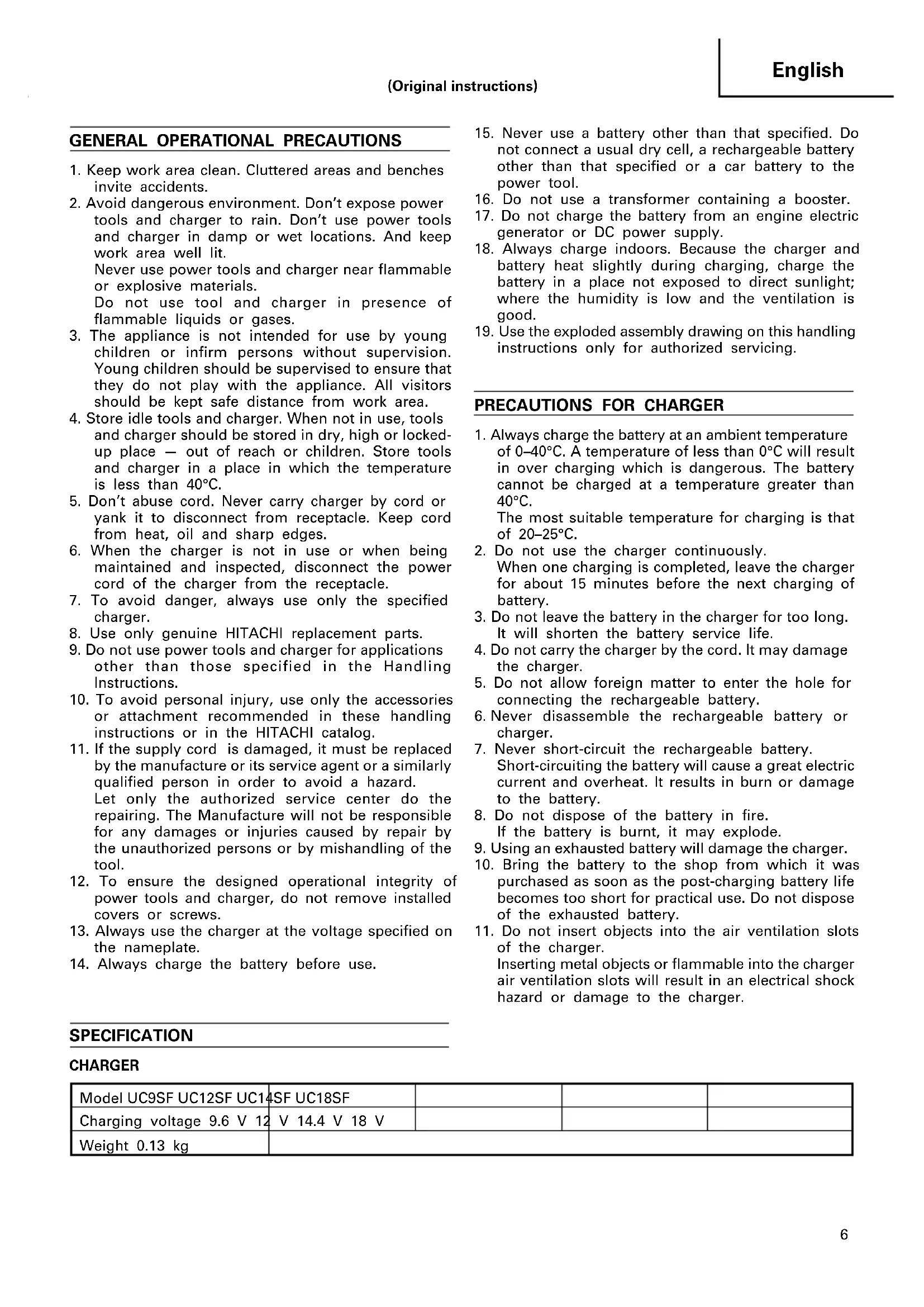
GENERAL OPERATIONAL PRECAUTIONS
- Keep work area clean. Cluttered areas and benches invite accidents.
- Avoid dangerous environment. Don't expose power tools and charger to rain. Don't use power tools and charger in damp or wet locations. And keep work area well lit.
Never use power tools and charger near flammable or explosive materials.
Do not use tool and charger in presence of flammable liquids or gases.
3. The appliance is not intended for use by young children or infirm persons without supervision. Young children should be supervised to ensure that they do not play with the appliance. All visitors should be kept safe distance from work area.
4. Store idle tools and charger. When not in use, tools and charger should be stored in dry, high or locked-up place - out of reach or children. Store tools and charger in a place in which the temperature is less than 40^ .
5. Don't abuse cord. Never carry charger by cord or yank it to disconnect from receptacle. Keep cord from heat, oil and sharp edges.
6. When the charger is not in use or when being maintained and inspected, disconnect the power cord of the charger from the receptacle.
7. To avoid danger, always use only the specified charger.
8. Use only genuine HITACHI replacement parts.
9. Do not use power tools and charger for applications other than those specified in the Handling Instructions.
10. To avoid personal injury, use only the accessories or attachment recommended in these handling instructions or in the HITACHI catalog.
11. If the supply cord is damaged, it must be replaced by the manufacture or its service agent or a similarly qualified person in order to avoid a hazard. Let only the authorized service center do the repairing. The Manufacture will not be responsible for any damages or injuries caused by repair by the unauthorized persons or by mishandling of the tool.
12. To ensure the designed operational integrity of power tools and charger, do not remove installed covers or screws.
13. Always use the charger at the voltage specified on the nameplate.
14. Always charge the battery before use.
SPECIFICATION
CHARGER
| Model UC9SF UC12SF UC14SF UC18SF | ||||
| Charging voltage 9.6 V 12 | V 14.4 V 18 V | |||
| Weight 0.13 kg | ||||
- Never use a battery other than that specified. Do not connect a usual dry cell, a rechargeable battery other than that specified or a car battery to the power tool.
- Do not use a transformer containing a booster.
- Do not charge the battery from an engine electric generator or DC power supply.
- Always charge indoors. Because the charger and battery heat slightly during charging, charge the battery in a place not exposed to direct sunlight; where the humidity is low and the ventilation is good.
- Use the exploded assembly drawing on this handling instructions only for authorized servicing.
PRECAUTIONS FOR CHARGER
- Always charge the battery at an ambient temperature of 0 - 40^ . A temperature of less than 0^ will result in over charging which is dangerous. The battery cannot be charged at a temperature greater than 40^ .
The most suitable temperature for charging is that of 20 - 25^ - Do not use the charger continuously.
When one charging is completed, leave the charger for about 15 minutes before the next charging of battery. - Do not leave the battery in the charger for too long. It will shorten the battery service life.
- Do not carry the charger by the cord. It may damage the charger.
- Do not allow foreign matter to enter the hole for connecting the rechargeable battery.
- Never disassemble the rechargeable battery or charger.
- Never short-circuit the rechargeable battery.
Short-circuiting the battery will cause a great electric current and overheat. It results in burn or damage to the battery.
- Do not dispose of the battery in fire.
If the battery is burnt, it may explode. - Using an exhausted battery will damage the charger.
- Bring the battery to the shop from which it was purchased as soon as the post-charging battery life becomes too short for practical use. Do not dispose of the exhausted battery.
- Do not insert objects into the air ventilation slots of the charger.
Inserting metal objects or flammable into the charger air ventilation slots will result in an electrical shock hazard or damage to the charger.
CHARGING
Before using the power tool, charge the battery as follows.
1. Connect the charger's power cord to the receptacle.
2. Insert the battery into the charger.
Insert the battery firmly while observing its direction, until it contacts the bottom of the charger (See Figs. 1, 2, 3 and 4)(the battery set lamp lights up). Inserting the battery will turn on the charger (the pilot lamp lights up).
CAUTION:
If the battery set lamp does not light up, pull out the power cord from the receptacle and check the battery mounting condition.
CAUTION:
If the battery is heated due to direct sunlight, etc., just after operation, the charger pilot lamp may not light. At that time cool the battery first, then start charging.
Regarding recharging time
Table 1 shows the recharging time required according to the type of battery.
Table 1 Recharging time (at 20^ )
| Battery capacity | Model | Recharging time | |||
| UC9SF | UC12SF | UC14SF | UC18SF | ||
| 1.2Ah | BCC912 | BCC1212 | BCC1412 | BCC1812 | Approx. 180 min. (at Under 0°C: Approx. 240 - 360 min.) |
| EB912S | EB1212S | EB1412S | EB1812S | ||
| EB9S | EB12S | (12 cells) | (15 cells) | ||
| (8 cells) | (10 cells) | ||||
| 1.4Ah | EB914S | EB1214S | EB1414S | EB1814SL | Approx. 210 min. (at Under 0°C: Approx. 280 - 420 min.) |
| FEB9S | EB1214L | EB1414 | (15 cells) | ||
| (8 cells) | FEB12S | (12 cells) | |||
| (10 cells) | |||||
| 2.0Ah | EB9B | EB12B | EB14B | EB18B | Approx. 300 min. (at Under 0°C: Approx. 400 - 600 min.) |
| (8 cells) | EB1220BL | (12 cells) | EB1820L | ||
| (10 cells) | (15 cells) | ||||
| 2.4Ah | EB924 | EB1224 | EB1424 | EB1824L | Approx. 360 min. (at Under 0°C: Approx. 470 - 720 min.) |
| (8 cells) | (10 cells) | (12 cells) | (15 cells) | ||
NOTE: With the above recharging time as a guide, remove the battery from the charger. The battery set lamp goes off when the battery is removed.
When the battery temperature is low (below 0^ ) or supply voltage is low, the battery capacity after a charge will become smaller.
If you feel the operating time of the tool is short, recharge the battery longer than the above time.
3. Disconnect the charger's power cord from the receptacle.
4. Hold the battery firmly and pull out the charger. NOTE
Be sure to pull out the battery from the charger after use, and then keep it.
Regarding electric discharge in case of new batteries, etc.
As the internal chemical substance of new batteries and batteries that have not been used for an extended period is not activated, the electric discharge might be low when using them the first and second time. This is a temporary phenomenon, and normal time required for recharging will be restored by recharging the batteries 2-3 times.
How to make the batteries perform longer.
(1) Recharge the batteries before they become completely exhausted.
When you feel that the power of the tool becomes weaker, stop using the tool and recharge its battery.
If you continue to use the tool and exhaust the electric current, the battery may be damaged and its life will become shorter.
(2) Avoid recharging at high temperatures.
A rechargeable battery will be hot immediately after use. If such a battery is recharged immediately after use, its internal chemical substance will deteriorate, and the battery life will be shortened. Leave the battery and recharge it after it has cooled for a while.
MAINTENANCE AND INSPECTION
1. Inspecting the mounting screws:
Regularly inspect all mounting screws and ensure that they are properly tightened. Should any of the screws be loose, retighten them immediately. Failure to do so could result in serious hazard.
2. Cleaning of the charger
When the charger is stained, wipe with a soft dry cloth or a cloth moistened with soapy water. Do not use chloric solvents, gasoline or paint thinner, for they melt plastics.
3. Store idle charger
When not in use, the charger should be stored in dry, high or locked-up place - out of reach of children.
4. Service parts list
CAUTION:
Repair, modification and inspection of Hitachi Power Tools must be carried out by a Hitachi Authorized Service Center.
This Parts List will be helpful if presented with the tool to the Hitachi Authorized Service Center when requesting repair or other maintenance.
In the operation and maintenance of power tools, the safety regulations and standards prescribed in each country must be observed.
MODIFICATIONS:
Hitachi Power Tools are constantly being improved and modified to incorporate the latest technological advancements.
Accordingly, some parts may be changed without prior notice.
NOTE
Due to HITACHI's continuing program of research and development, the specifications herein are subject to change without prior notice.
MANUTENÇAO E INSPEÇAO
NPOΦYΛΑKTΙΚA METPA ΓΙA TO ΦΟPTΙΣΤH
- NaVTote optie Te nV mntapia oe eepokpaoia ava0a 0-40°C. Mia eepokpaoia mikpotepn ano 0^ Ta npokaeei Tnv unepoption nou evai eikivuvn. H mntapia dev mnpei va optioe i e eepokpaoia eyaalutepn ano 40^
H nio kataaan aneepokpaoia yia opion ivai autn twv 20-25°C. - Mny xpnouonoiite tov oporiot ouvexia.
Otau n iia option oloknpw0e i, afoTe to optioi yia 15 aeTnpiiv ano Tnv enoev n option natapiaac. - Mny apnveT n unatapia oToV optiOny ia noLu. Ta eioeT n diapkeia aeitoupyiac nC unatapiaac.
- Mny etaepeteTov oTioTn ano to kaawio. Mnopei va Tov oTPOI.
5.Mnv aipnoeTe Eeva uika va unouv otny truna ouvdeo nC enavaopoptoevnc npataiac. - Noté μην aσούναρολογησετε ηπαναφορτιζόμενη μηαταρία και το φορτιστή.
- Noté μην βραχukukλωετε τήν επαναφοτιζόμενη μηατapia μηατapia. To βραχukukλωμa τής μηατapiaσ θα προκαλεσι ενα εγλο ηλεκτρικό ρεύμα και unερθερμανη. Προκαλει το καψιμο ἡ τήν unερθερμανη τής μηατapiaσ.
- Mny netaeTe Tnu maTApia oTn qwiia Av n nuTatapia kaei mnpoi va ekpayi.
- H xnpoimoinon mia eaoeynmuataipac th a npokaeei baa nto optio
- Nyaivete tvn natapia oTo katotma ano to onio tvnyapaoate otav n diapkeia zomega tnc matapiaac e Ta no tv npotion exi yivei nou miipn ia npaktikxpon. Mny netaeTe tv TELIOWevn natapia.
- Mny aTc KavevaavtkeiEvoo eo a otic tpune 2 Eaeipou tou optioTn.
H eioooc uetaikov avtkeiuevwo n eupkewu lukov otic tpune c eepou tou optiotn th npokaoleoi tov kivduvo nektponlnc tnv kataotpoqn tou optiotn.
TEXNIKA XAPAKTHPISTIKA
OPTIETHE
| Movélo UC9SF UC12SF UC14SF UC18SF | |||
| Tàon φόρτιος 9,6 V 12 V 14,4 V 18 V | |||
| Báρος 0,13 kg | |||
ΦOPTIeH
Piv xpooiouoet To nEKTpiKo epyaaleio, optioTe Tn unatapia wC akoIoUOwC.
4. Listed over reservedele
FORSIGTIG:
VEDLIKEHOLD OG INSPEKSJON
4. Listed over servicedeler
OBS:
Siemensring 34, 47877 willich 1, F. R. Germany
Tel: +49 2154 49930
Fax: +49 2154 499350
URL: http://www.hitachi-powertools.de
Hitachi Power Tools Netherlands B. V.
Brabanthaven 11,3433 PJ Nieuwegein, The Netherlands
Tel: +31 30 6084040
Fax: +31 30 6067266
URL: http://www.hitachi-powertools.nl
Hitachi Power Tools (U. K.) Ltd.
Precedent Drive, Rooksley, Milton Keynes, MK 13, 8PJ, United Kingdom
Tel: +44 1908 660663
Fax: +44 1908 606642
URL: http://www.hitachi-powertools.co.uk
Hitachi Power Tools France S. A. S.
Prac del' Eglantier 22, rue des Crerisiers Lisses, C. E.
1541, 91015 EVRY CEDEX, France
Tel: +33 169474949
Fax: +33 160861416
URL: http://www.hitachi-powertools.fr
Hitachi Power Tools Belgium N.V. / S.A.
Koningin Astridlaan 51, 1780 Wemmel, Belgium
Tel: +32 2 460 1720
Fax: +32 2 460 2542
URL http://www.hitachi-powertools.be
Hitachi Fercad Power Tools Italia S.p.A
Via Retrone 49-36077, Altavilla Vicentina (VI), Italy
Tel: +39 0444 548111
Fax: +39 0444 548110
URL: http://www.hitachi-powertools.it
Hitachi Power Tools Iberica, S.A.
C / Migjorn, s/n, Poligono Norte, 08226 Terrassa,
Barcelona, Spain
Tel: +34 93 735 6722
Fax: +34 93 735 7442
URL: http://www.hitachi-powertools.es
Postboks 124, 2007 Kjeller, Norway
Tel: (+47) 6692 6600
Fax: (+47) 6692 6650
URL: http://www_mark.tno
Hitachi Power Tools Sweden AB
Rotebergsvagen 2B
SE-192 78 Sollentuna, Sweden
Tel: (+46) 8598 999 00
Fax: (+46) 859899940
URL: http://www-markt.se
Hitachi Power Tools Denmark AS
Lillebaeltsvej 90
DK-6715 Esbjerg N, Denmark
Tel: (+45) 75 14 32 00
Fax: (+45) 75 14 36 66
URL: http://www-markt.dk
Hitachi Power Tools Finland OY
Tupalankatu 9
FIN-15680 Lahti, Finland
Tel: (+358) 207431530
Fax: (+358) 207431531
URL: http://www_mark.fi
| English | Portugues | DECLARação DE CONFORMIDADE CE Declaramos, sob{nossaunjicae inteira responsabuldade,que este produits estadé acordo com as normas oudocuments normativos EN60335, EN55014 e EN61000 emconformidade com as Diretrizes 2006/95/CE e 2004/108/CEdo Conselho.Esta declaração se aplica aos produits designados CE. |
| EC DECLARATION OF CONFORMITY We declare under our sole responsibility that this productis in conformity with standards or standardized documents EN60335, EN55014 and EN61000 in accordancewith Council Directives 2006/95/EC and 2004/108/EC.This declaration is applicable to the product affixed CEmarking. | ||
| Deutsch | Eλληνικα | EK έHA-ΣH ENAPMONIΣMOYΔλωνομε με απλυτη μειευθυνότητα στι αυτο το προίνεινειανρονισενο με τα πρότιηα μη τα εύραφαπροιτιων EN60335, EN55014 και EN61000 σε συμεωνίαμε τις Εδηγες του Σμβουλίου 2006/95/ΕK και 2004/108/EK.Autήη δηλωση σαχύει στο προίν με το σημάδι CE. |
| ERKLÄRUNG ZUR KONFORMITÄT MIT CE-REGELNWir erklaren mit alleiniger Verantwortung, daß dieseProdukt den Standards oder standardisierten Dokumenten EN60335, EN55014 und EN61000 inUbeinstimmung mit den Direktiven des Europarats 2006/95/CE und 2004/108/CE entspricht.Diese Erläung gilt für Produkte, die die CE-Markierungtragen. | Eλληνικα | |
| Français | Svenska | EF-DEKLARATION BETRAFFANDE LIKFORMIGHTENtilkännagivr med eget ansvar attenna produitöverensstämmer med standarderStandardiserat dokumentEN60335, EN55014 och EN61000 i enlightem med ràddirektiven2006/95/EF och 2004/108/EF.Denna déclaration gäller für CE-märkningen på produits. |
| DICHiarAZIONE DI CONFORMITÀCESi dichiarare sous notre seule et entière responsabilitéque ce produit est conforme aux normes ou documentsnormalisés EN60335, EN55014 et EN61000 en accord avecles Directives 2006/95/CE et 2004/108/CE du Conseil.Cette déclaration s'applique aux produits désignés CE. | Dansk | EF-OVERENSS TEMMELSESERKLÄRINGVi erklær os fuldstændige ansvallige for, at dette produitmodsvarer gældende standard ellser de standardisereddokument ER60335, EN55014 og EN61000 i overensstammelse med EF-direktiver 2006/95/EF og 2004/108/EF.Denne erklæringsøelder producer, der er mørket med CE. |
| Italiano | Norsk | EF's ERKLÄRING OM OVERENSSTEMMELSEVi erklær herved at vi pâtar osseneansvaret for at detteprodukt er i overensstammelse med normer ellersstandardiserte dokument ER60335, EN55014 og EN61000 i samsvar med Rådsdirektiver 2006/95/EF og 2004/108/EF.Denne erklæringsgjelder produitsets pasklrestede CE-verming. |
| DICHIARAZIONE DI CONFORMITÀCESi dichiarare sous notre autre responsabilità che"ThisProduto è conforme agli standard o ai documentistandardizzati EN60335, EN55014 e EN61000 conforme alledirivative 2006/95/CE e 2004/108/CE del concilio.Questa dichiarazione è applicabile ai prodotti cui sonoapplicati i marchi CE. | Norsk | |
| Nederlands | EC VERKLARING VAN CONFORMITEITWij verwlassen onderigen verantwoordelijkheid dat ditprodukt conform de richtlijnen of gestandardsierdedocumenten EN60335, EN55014 en EN61000 voldoet aande eisen van EEG Bepalingen 2006/95/EC en 2004/108/EC.Deze verwklaring is van toepassing op produits voorzienvan de CE-marketeringen. | EF's ERKLÄRING OM OVERENSSTEMMELSEVi erklær herved at vi pâtar osseneansvaret for at detteprodukt er i overensstammelse med normer ellersstandardiserte dokument ER60335, EN55014 og EN61000 i samsvar med Rådsdirektiver 2006/95/EF og 200 4/108/EF.Denne erklæringsgjelder produitsets pasklrestede CE-verming. |
| Espanol | Suomi | UYILMOITUS YHDENMUKAISUUDESTAYksinomainella vastuudella vakuutamme,ettatāmätuotevastaa normeja tai normitettuja dokumenttejia EN60335,EN55014 ja EN61000 yhteison ohjeiden 2006/95/EY ja 2004/108/EY mukaisesti.Tämä ilmoitus solvelletaan tuotekohtaiseen CE-merkintään. |
| DECLARACION DE CONFORMIDAD DE LA CEDeclaramos bajo esta una responsabilitad queeste produit está de accord con las normas o con losdocumentos de normalização EN60335, EN55014 yEN61000 según indican las Diretrices del Consejo 2006/95/CE y 2004/108/CE.Esta déclaration se aplica a los produits con marcas dela CE. | ||
| Representative office in EuropeHitachi Power Tools Europe GmbHSiemensring 34, 47877 Willich 1, F. R. GermanyHead office in JapanHitachi Koki Co., Ltd.Shinagawa Intercity Tower A, 15-1, Konan 2-chome,Minato-ku, Tokyo, Japan | CE26.2.2010R.H.RatoK.KatoBoard Director | |