
GP2S2 - Grinder HITACHI - Free user manual and instructions
Find the device manual for free GP2S2 HITACHI in PDF.


| Product Type | Straight Grinder (Die Grinder) |
| Brand | Hitachi |
| Model | GP2S2 |
| Supply Voltage | 120 V - 60 Hz |
| Rated Current | 4.7 A |
| No Load Speed | 29,000 rpm |
| Max Wheel Diameter | 1 inch (25 mm) |
| Collet Chuck Capacity | 1/4 inch (6.35 mm) |
| Weight (without cord) | 1.7 kg |
| Motor Type | Single-phase series motor with commutator |
| Double Insulation | Yes |
| Side Handle | Included, removable |
| Applications | Finishing, internal grinding, tool sharpening |
| Standard Accessories | 2 wrenches, side handle |
| Optional Accessories | Collet chuck for 1/8 in. shaft, case |
| Routine Maintenance | Inspect carbon brushes, clean vents |
| Noise Level | Hearing protection recommended |
| Safety | Safety goggles, dust mask |
| Repairability | Hitachi authorized service centers only |
Frequently Asked Questions - GP2S2 HITACHI
User questions about GP2S2 HITACHI
0 question about this device. Answer the ones you know or ask your own.
Ask a new question about this device
Download the instructions for your Grinder in PDF format for free! Find your manual GP2S2 - HITACHI and take your electronic device back in hand. On this page are published all the documents necessary for the use of your device. GP2S2 by HITACHI.
USER MANUAL GP2S2 HITACHI
natural_image
Technical line drawing of a mechanical power tool with cylindrical body and threaded shaft (no text or symbols)SAFETY INSTRUCTIONS AND INSTRUCTION MANUAL

WARNING
IMPROPER OR UNSAFE use of this power tool can result in death or serious bodily injury!
This manual contains important information about product safety. Please read and understand this manual BEFORE operating the power tool. Please keep this manual available for other users and owners before they use the power tool.
This manual should be stored in safe place.
INSTRUCTIONS DE SECURITE ET MODE D'EMPLOI

AVERTISSEMENT
IMPORTANT SAFETY INSTRUCTIONS .... 3
MEANINGS OF SIGNAL WORDS ...... 3
SAFETY 3
GENERAL POWER TOOL SAFETY WARNINGS .... 3
SPECIFIC SAFETY RULES AND SYMBOLS..... 4
DOUBLE INSULATION FOR SAFER OPERATION .... 5
FUNCTIONAL DESCRIPTION ...... 7
NAME OF PARTS 7
SPECIFICATIONS 7
Page
ASSEMBLY AND OPERATION 8
APPLICATIONS 8
IMPORTANT SAFETY INSTRUCTIONS
Read and understand all of the safety precautions, warnings and operating instructions in the Instruction Manual before operating or maintaining this power tool.
Most accidents that result from power tool operation and maintenance are caused by the failure to observe basic safety rules or precautions. An accident can often be avoided by recognizing a potentially hazardous situation before it occurs, and by observing appropriate safety procedures.
Basic safety precautions are outlined in the "SAFETY" section of this Instruction Manual and in the sections which contain the operation and maintenance instructions.
Hazards that must be avoided to prevent bodily injury or machine damage are identified by WARNINGS on the power tool and in this Instruction Manual.
NEVER use this power tool in a manner that has not been specifically recommended by HITACHI.
MEANINGS OF SIGNAL WORDS
WARNING indicates a potentially hazardous situations which, if ignored, could result in death or serious injury.
CAUTION indicates a potentially hazardous situations which, if not avoided, may result in minor or moderate injury, or may cause machine damage.
NOTE emphasizes essential information.
SAFETY
GENERAL POWER TOOL SAFETY WARNINGS
WARNING:
Read all safety warnings and instructions.
Failure to follow the warnings and instructions may result in electric shock, fire and/or serious injury.
Save all warnings and instructions for future reference.
The term “power tool” in the warnings refers to your mains-operated (corded) power tool or battery-operated (cordless) power tool.
1) Work area safety
a) Keep work area clean and well lit.
Cluttered or dark areas invite accidents.
b) Do not operate power tools in explosive atmospheres, such as in the presence of flammable liquids, gases or dust.
Power tools create sparks which may ignite the dust of fumes.
c) Keep children and bystanders away while operating a power tool.
Distractions can cause you to lose control.
2) Electrical safety
a) Power tool plugs must match the outlet.
Never modify the plug in any way.
Do not use any adapter plugs with earthed (grounded) power tools.
Unmodified plugs and matching outlets will reduce risk of electric shock.
b) Avoid body contact with earthed or grounded surfaces such as pipes, radiators, ranges and refrigerators.
There is an increased risk of electric shock if your body is earthed or grounded.
c) Do not expose power tools to rain or wet conditions.
Water entering a power tool will increase the risk of electric shock.
d) Do not abuse the cord. Never use the cord for carrying, pulling or unplugging the power tool. Keep cord away from heat, oil, sharp edges or moving parts.
Damaged or entangled cords increase the risk of electric shock.
e) When operating a power tool outdoors, use an extension cord suitable for outdoor use. Use of a cord suitable for outdoor use reduces the risk of electric shock.
f) If operating a power tool in a damp location is unavoidable, use a residual current device (RCD) protected supply.
Use of an RCD reduces the risk of electric shock.
3) Personal safety
a) Stay alert, watch what you are doing and use common sense when operating a power tool. Do not use a power tool while you are tired or under the influence of drugs, alcohol or medication.
A moment of inattention while operating power tools may result in serious personal injury.
b) Use personal protective equipment. Always wear eye protection.
Protective equipment such as dust mask, non-skid safety shoes, hard hat, or hearing protection used for appropriate conditions will reduce personal injuries.
c) Prevent unintentional starting. Ensure the switch is in the off-position before connecting to power source and/or battery pack, picking up or carrying the tool.
Carrying power tools with your finger on the switch or energising power tools that have the switch on invites accidents.
d) Remove any adjusting key or wrench before turning the power tool on.
A wrench or a key left attached to a rotating part of the power tool may result in personal injury.
e) Do not overreach. Keep proper footing and balance at all times.
This enables better control of the power tool in unexpected situations.
f) Dress properly. Do not wear loose clothing or jewellery. Keep your hair, clothing and gloves away from moving parts.
Loose clothes, jewellery or long hair can be caught in moving parts.
g) If devices are provided for the connection of dust extraction and collection facilities, ensure these are connected and properly used.
Use of dust collection can reduce dust-related hazards.
4) Power tool use and care
a) Do not force the power tool. Use the correct power tool for your application.
The correct power tool will do the job better and safer at the rate for which it was designed.
b) Do not use the power tool if the switch does not turn it on and off.
Any power tool that cannot be controlled with the switch is dangerous and must be repaired.
c) Disconnect the plug from the power source and/or the battery pack from the power tool before making any adjustments, changing accessories, or storing power tools.
Such preventive safety measures reduce the risk of starting the power tool accidentally.
d) Store idle power tools out of the reach of children and do not allow persons unfamiliar with the power tool or these instructions to operate the power tool.
Power tools are dangerous in the hands of untrained users.
e) Maintain power tools. Check for misalignment or binding of moving parts, breakage of parts and any other condition that may affect the power tools' operation.
If damaged, have the power tool repaired before use.
Many accidents are caused by poorly maintained power tools.
f) Keep cutting tools sharp and clean.
Properly maintained cutting tools with sharp cutting edges are less likely to bind and are easier to control.
g) Use the power tool, accessories and tool bits etc. in accordance with these instructions, taking into account the working conditions and the work to be performed.
Use of the power tool for operations different from those intended could result in a hazardous situation.
5) Service
a) Have your power tool serviced by a qualified repair person using only identical replacement parts.
This will ensure that the safety of the power tool is maintained.
SPECIFIC SAFETY RULES AND SYMBOLS
- Accessories must be rated for at least the speed recommended on the tool warning label. Wheels and other accessories running over rated speed can fly apart and cause injury.
- Hold tools by insulated gripping surfaces when performing an operation where the cutting tool may contact hidden wiring or its own cord. Contact with a "live" wire will make exposed metal parts of the tool "live" and shock the operator.
- ALWAYS wear ear protectors when using the tool for extended periods.
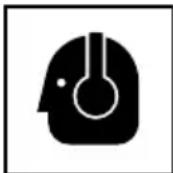
Prolonged exposure to high intensity noise can cause hearing loss.
- NEVER touch moving parts.
NEVER place your hands, fingers or other body parts near the tool's moving parts.
- NEVER operate without all guards in place.
NEVER operate this tool without all guards or safety features in place and in proper working order. If maintenance or servicing requires the removal of a guard or safety feature, be sure to replace the guard or safety feature before resuming operation of the tool.
- Use right tool.
Don't force small tool or attachment to do the job of a heavy-duty tool.
Don't use tool for purpose not intended —for example— don't use circular saw for cutting tree limbs or logs.
- NEVER use a power tool for applications other than those specified.
NEVER use a power tool for applications other than those specified in the Instruction Manual.
- Handle tool correctly.
Operate the tool according to the instructions provided herein. Do not drop or throw the tool. NEVER allow the tool to be operated by children, individuals unfamiliar with its operation or unauthorized personnel.
- Keep all screws, bolts and covers tightly in place.
Keep all screws, bolts, and plates tightly mounted. Check their condition periodically.
- Do not use power tools if the plastic housing or handle is cracked.
Cracks in the tool's housing or handle can lead to electric shock. Such tools should not be used until repaired.
- Blades and accessories must be securely mounted to the tool.
Prevent potential injuries to yourself or others. Blades, cutting implements and accessories which have been mounted to the tool should be secure and tight.
- Keep motor air vent clean.
The tool's motor air vent must be kept clean so that air can freely flow at all times. Check for dust build-up frequently.
- Operate power tools at the rated voltage.
Operate the power tool at voltages specified on its nameplate.
If using the power tool at a higher voltage than the rated voltage, it will result in abnormally fast motor revolution and may damage the unit and the motor may burn out.
- NEVER use a tool which is defective or operating abnormally.
If the tool appears to be operating unusually, making strange noises, or otherwise appears defective, stop using it immediately and arrange for repairs by a Hitachi authorized service center.
- NEVER leave tool running unattended. Turn power off.
Don't leave tool until it comes to a complete stop.
- Carefully handle power tools.
Should a power tool be dropped or struck against hard materials inadvertently, it may be deformed, cracked, or damaged.
- Do not wipe plastic parts with solvent.
Solvents such as gasoline, thinner benzine, carbon tetrachloride, and alcohol may damage and crack plastic parts. Do not wipe them with such solvents. Wipe plastic parts with a soft cloth lightly dampened with soapy water and dry thoroughly.
- ALWAYS
wear eye protection that meets the requirement of the latest revision of ANSI Standard Z87.1.
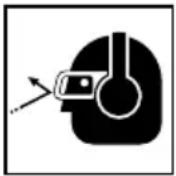
- ALWAYS be careful with buried object such as an underground wiring.
Touching live wiring or electric cable with this tool may result in electric shock.
Confirm before use whether hidden objects are present, such as electric cables within the wall, floor or ceiling.
- Definitions for symbols used on this tool
V ...... volts
Hz ...... hertz
A ...... amperes
n_0 ...... no load speed
W ...... watt
☐ ...... Class II Construction
---/min ..... revolutions per minute
\~ ...... Alternating current
To ensure safer operation of this power tool, HITACHI has adopted a double insulation design. "Double insulation" means that two physically separated insulation systems have been used to insulate the electrically conductive materials connected to the power supply from the outer frame handled by the operator. Therefore, either the symbol "6 or the words "Double insulation" appear on the power tool or on the nameplate. Although this system has no external grounding, you must still follow the normal electrical safety precautions given in this Instruction Manual, including not using the power tool in wet environments.
To keep the double insulation system effective, follow these precautions:
○ Only HITACHI AUTHORIZED SERVICE CENTER should disassemble or assemble this power tool, and only genuine HITACHI replacement parts should be installed.
○ Clean the exterior of the power tool only with a soft cloth moistened with soapy water, and dry thoroughly.
Never use solvents, gasoline or thinners on plastic components; otherwise the plastic may dissolve.
SAVE THESE INSTRUCTIONS
AND
MAKE THEM AVAILABLE TO OTHER USERS
AND
OWNERS OF THIS TOOL!
FUNCTIONAL DESCRIPTION
NOTE:
The information contained in this Instruction Manual is designed to assist you in the safe operation and maintenance of the power tool.
NEVER operate, or attempt any maintenance on the tool unless you have first read and understood all safety instructions contained in this manual.
Some illustrations in this Instruction Manual may show details or attachments that differ from those on your own power tool.
NAME OF PARTS
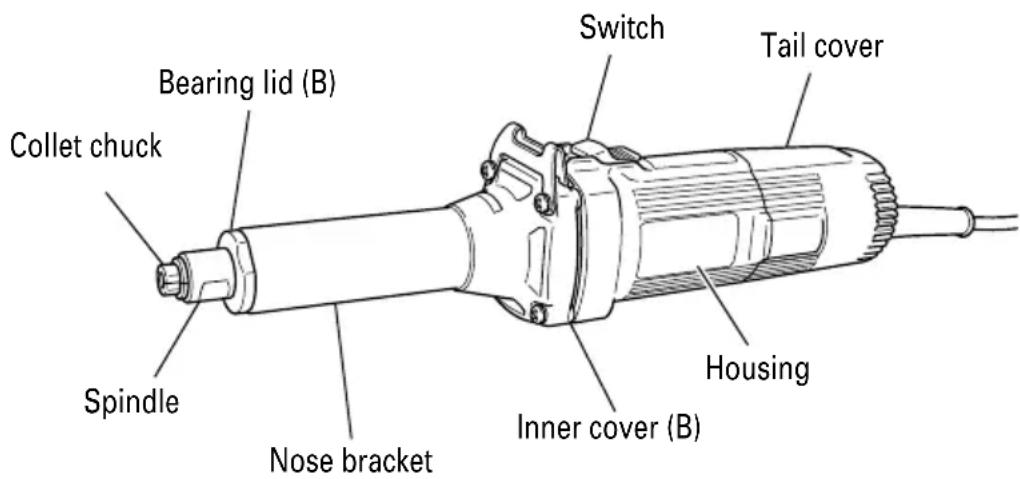
Fig. 1
SPECIFICATIONS
| Motor Single-Phase, Series Commutator Motor | |
| Power Source Single-Phase, 120 V AC 60 Hz | |
| Current 4.7 A | |
| No-Load Speed 29,000 / min | |
| Max. Wheel Diam. 1" (25 mm) | |
| Collet Check Capacity 1/4" (6.35 mm) | |
| Weight (without cord) 3.7 lbs (1.7 kg) | |
WARNING:
NEVER use an abrasive wheel, cutting wheel, or any wheel greater than 1" in diameter. Using such wheels can result in wheel breakage, and will otherwise increase the risk of bodily injury from contact with the wheel or wheel fragments.
ASSEMBLY AND OPERATION
APPLICATIONS
○ Finishing of dies for press working, die casting and moulding.
○ Finishing of thread cutting dies, tools and other small parts.
○ Internal grinding of tools and machine parts.

WARNING:
To avoid the risk of serious injury, NEVER use this grinder with abrasive wheels, cut-off wheels and/or saw blades.
PRIOR TO OPERATION
- Power source Ensure that the power source to be utilized conforms to the power source requirements specified on the product nameplate.
- Power switch Ensure that the switch is in the OFF position. If the plug is connected to a receptacle while the switch is in the ON position, the power tool will start operating immediately and can cause serious injury.
- Extension cord When the work area is far away from the power source, use an extension cord of sufficient thickness and rated capacity. The extension cord should be kept as short as practicable.

WARNING:
Damaged cord must be replaced or repaired.
- Check the receptacle
If the receptacle only loosely accepts the plug, the receptacle must be repaired. Contact a licensed electrician to make appropriate repairs. If such a faulty receptacle is used, it may cause overheating, resulting in a serious hazard. - Check the work site and surrounding area
Be sure that the work area has been thoroughly checked and prepared to avoid any unsafe conditions. Review the SAFETY section of this manual. - Installing a wheel

WARNING:
USING A WRONG SIZED WHEEL CAN CAUSE WHEEL BREAKAGE AND RESULTING SERIOUS INJURY.
In order to avoid this hazard, refer to the following illustration to determine the proper dimensions(s) of your wheel. Some guidelines:
(a) Dimension should always be less than 1/2" (13 mm). Longer lengths can result in excess vibration, wheel breakage, and the chance for serious injury.
(b) When dimension d is 1/4" (6.35 mm), the diameter of the wheel (dimension D) should be less than 1" (25 mm). NEVER use a longer diameter wheel.
(c) When dimension d is 1/8" (3.175 mm), the diameter of the wheel (dimension D) should be less than 3/8" (10 mm).
(d) Dimension L varies according to the dimension D. Dimension L can be longer as dimension D increase. Refer to the following table:
(When = 1 / 2'' (13mm))
| d | 1/8"(3.175mm) 1/4"(6.35mm) | |||||||
| D | 3/16" 1/4"(5mm) (6mm) (8mm) (10mm) (13mm) (16mm) (20mm) (25mm) | |||||||
| L | 1/2" 3/4"(13mm) (20mm) (20mm) (20mm) (38mm) (25mm) (25mm) (20mm) | |||||||
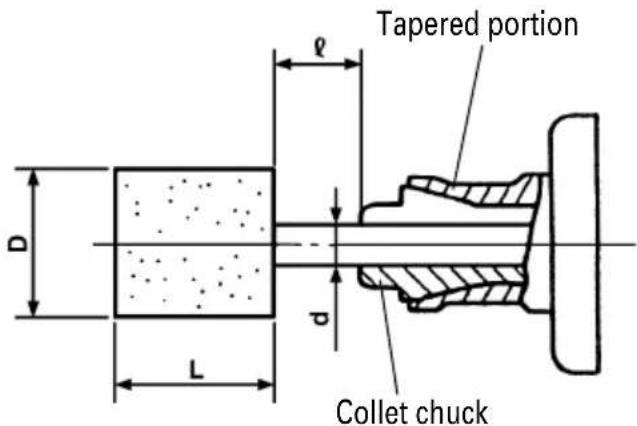
Fig. 2
Wheels can be simply attached and detached by using two wrenches. (Fig. 3)
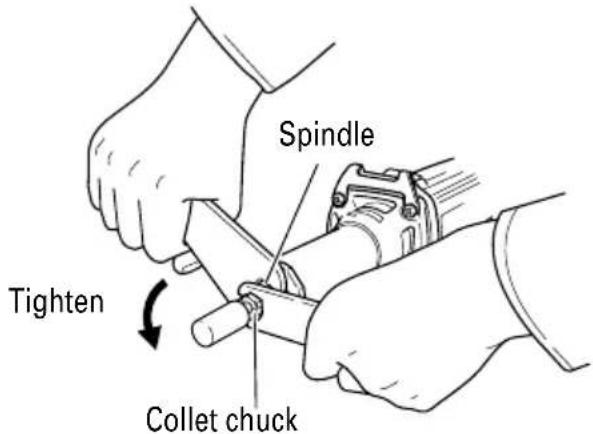
Fig. 3
NOTE:
- Do not tighten the collet chuck by inserting a shaft thinner than the regular shaft diameter (1/4" (6.35mm)) in the chuck or in an empty condition. This practice will damage the collet chuck.
- When installing a wheel with shaft, tighten the collet chuck after applying a small quantity of spindle oil (or sewing machine oil) to the tapered portion indicated in Fig. 2.
7. Using the side handle (Fig. 4)
Be sure to use the side handle to avoid the risk of severe electrical shock.
Attach the side handle to the machine as follows.
(1) Loosen the side handle grip and insert the side handle to the nose bracket part of the machine from the flange part of the side handle sleeve.
(2) Set the side handle to a position that is suited to the operation and then securely tighten the side handle grip.
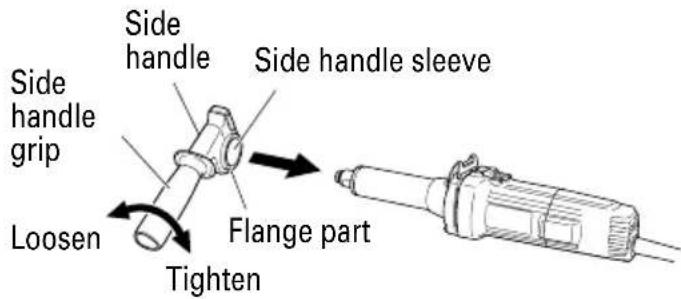
Fig. 4
GRINDER OPERATION
1. Switching operation (Fig. 5)
(1) When throwing the switch lever to the ON side, power is applied; when throwing it to the OFF side, power is switched off.
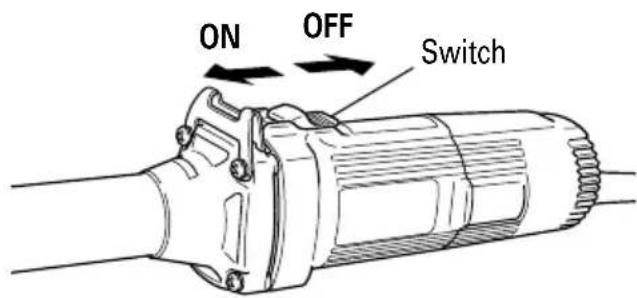
Fig. 5
(2) After installing a new wheel, "test" the condition of the wheel by allowing the grinder to operate for 180 seconds while the wheel is pointed away from you. Keep your hands and body away from the wheel at all times.
2. Precautions on operation
(1) Lightly press the wheel to the material to be ground when grinding materials, high-speed revolution is necessary. Use a hand grinder with high-speed revolution, minimizing the pressing force.
(2) Dressing the wheel
After attaching a wheel, adjust deflection of the wheel center by using a dresser.
If the wheel center is eccentric, not only precise finishing cannot be achieved but also grinder vibration increases, lowering grinder accuracy and durability.
A clogged or worn wheel will soil the finishing surface or lower grinding efficiency. Occasionally dress the wheel by applying the dresser.
MAINTENANCE AND INSPECTION
WARNING:
● Be sure to switch power OFF and disconnect the plug during maintenance and inspection.
● Using cracked, deformed or damaged wheels can lead to wheel breakage and resulting serious injury.
- Inspecting the wheel
Ensure that the wheel is free of cracks and surface defects.
- Inspecting the mounting screws
Regularly inspect all mounting screws and ensure that they are properly tightened. Should any of the screws be loose, retighten them immediately.
WARNING:
Using this portable grinder with loosened screws is extremely dangerous.
- Inspecting the carbon brushes (Fig. 6)
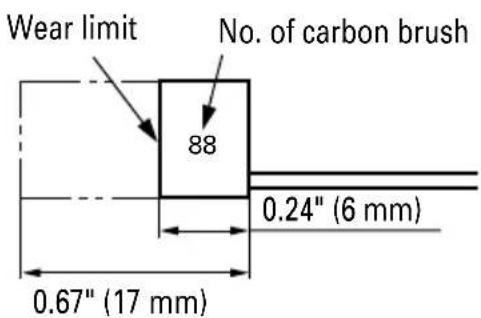
The motor employs carbon brushes which are consumable parts. Replace the carbon brush with a new one when it becomes worn to its wear limit. Always keep carbon brushes clean and ensure that they slide freely within the brush holders.
CAUTION
● Using this portable grinder with a carbon brush which is worn in excess of the wear limit will damage the motor.
NOTE:
● Use HITACHI carbon brush No. 88 indicated in Fig. 6.
- Replacing carbon brushes (Fig. 7):
(1) Loosen the D4 tapping screw retaining the tail cover and remove tha tail cover.
(2) Use the auxiliary hexagonal wrench or small screwdriver to pull up the edge of the spring that is holding down the carbon brush. Remove the edge of the spring toward the outside of the brush holder.
(3) Remove the end of the pig-tail on the carbon brush from the terminal section of brush holder and then remove the carbon brush from the brush holder.
(1) Insert the end of the pi-tail of the carbon brush in the terminal section of brush holder.
(2) Insert the carbon brush in the brush holder.
(3) Use the auxiliary hexagonal wrench or small screwdriver to return the edge of the spring to the head of the carbon brush.
(4) Mount the tail cover and tighten the D4 tapping screw.
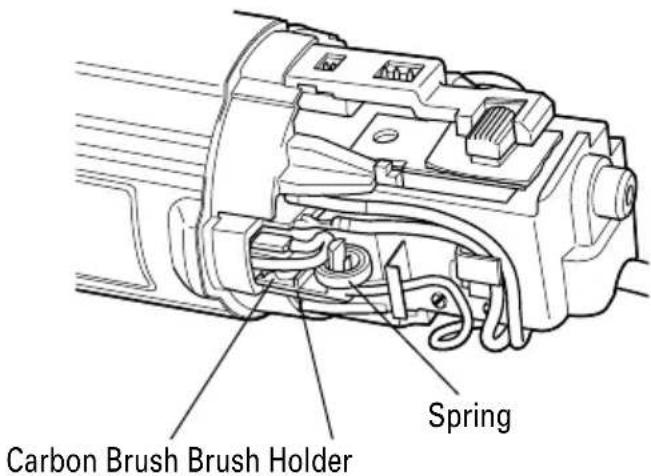
Fig. 7
- Service and repairs
All quality power tools will eventually require servicing or replacement of parts because of wear from normal use. To assure that only authorized replacement parts will be used, all service and repairs must be performed by a HITACHI AUTHORIZED SERVICE CENTER, ONLY.
- Service parts list
CAUTION
● Repair, modification and inspection of Hitachi Power Tools must be carried out by a Hitachi Authorized Service Center.
● This Parts List will be helpful if presented with the tool to the Hitachi Authorized Service Center when requesting repair or other maintenance. In the operation and maintenance of power tools, the safety regulations and standards prescribed in each country must be observed.
MODIFICATIONS:
Hitachi Power Tools are constantly being improved and modified to incorporate the latest technological advancements.
Accordingly, some parts may be changed without prior notice.
ACCESSORIES
⚠ WARNING: ALWAYS use Only authorized HITACHI replacement parts and accessories. NEVER use replacement parts or accessories which are not intended for use with this tool. Contact HITACHI if you are not sure whether it is safe to use a particular replacement part or accessory with your tool. The use of any other attachment or accessory can be dangerous and could cause injury or mechanical damage.
NOTE: Accessories are subject to change without any obligation on the part of the HITACHI.
STANDARD ACCESSORIES
(1) Wrench (43/64''(17 mm)) (Code No. 936638) ..... 1
(2) Wrench (15/32''(12 mm)) (Code No. 936553) ..... 1
(3) Side Handle (Code No. 329758) ...... 1
OPTIONAL ACCESSORIES
...... sold separately
○ Collet chuck (for 1/8''(3.175 mm) shaft)
Dimensions and handling methods other than the shaft hole are the same as those for the 1/4''(6 mm) collet chuck.
Case
NOTE:
- Specifications are subject to change without any obligation on the part of the HITACHI.
CONSIGNES DE SÉCURITÉ IMPORTANTES
Fig. 5
natural_image
Line drawing of a quill pen in an inkwell (no text or symbols)WARNING:
Some dust created by power sanding, sawing, grinding, drilling, and other construction activities contains chemicals known to the State of California to cause cancer, birth defects or other reproductive harm. Some examples of these chemicals are:
- Lead from lead-based paints,
●Crystalline silica from bricks and cement and other masonry products, and
●Arsenic and chromium from chemically-treated lumber.
Your risk from these exposures varies, depending on how often you do this type of work. To reduce your exposure to these chemicals: work in a well ventilated area, and work with approved safety equipment, such as those dust masks that are specially designed to filter out microscopic particles.
AVERTISSEMENT :
Minato-ku, Tokyo 108-6020, Japan
Distributed by

Hitachi Koki U.S.A., Ltd.
3950 Steve Reynolds Blvd.
Norcross, GA 30093

Hitachi Koki Canada Co.
450 Export Blvd. Unit B,
Mississauga ON L5T 2A4
909
Code No. C99182461 M
Printed in Malaysia
