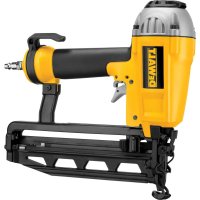
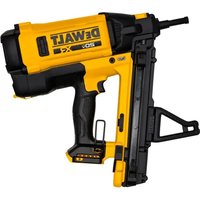
D51257K - Stapler DEWALT - Free user manual and instructions
Find the device manual for free D51257K DEWALT in PDF.

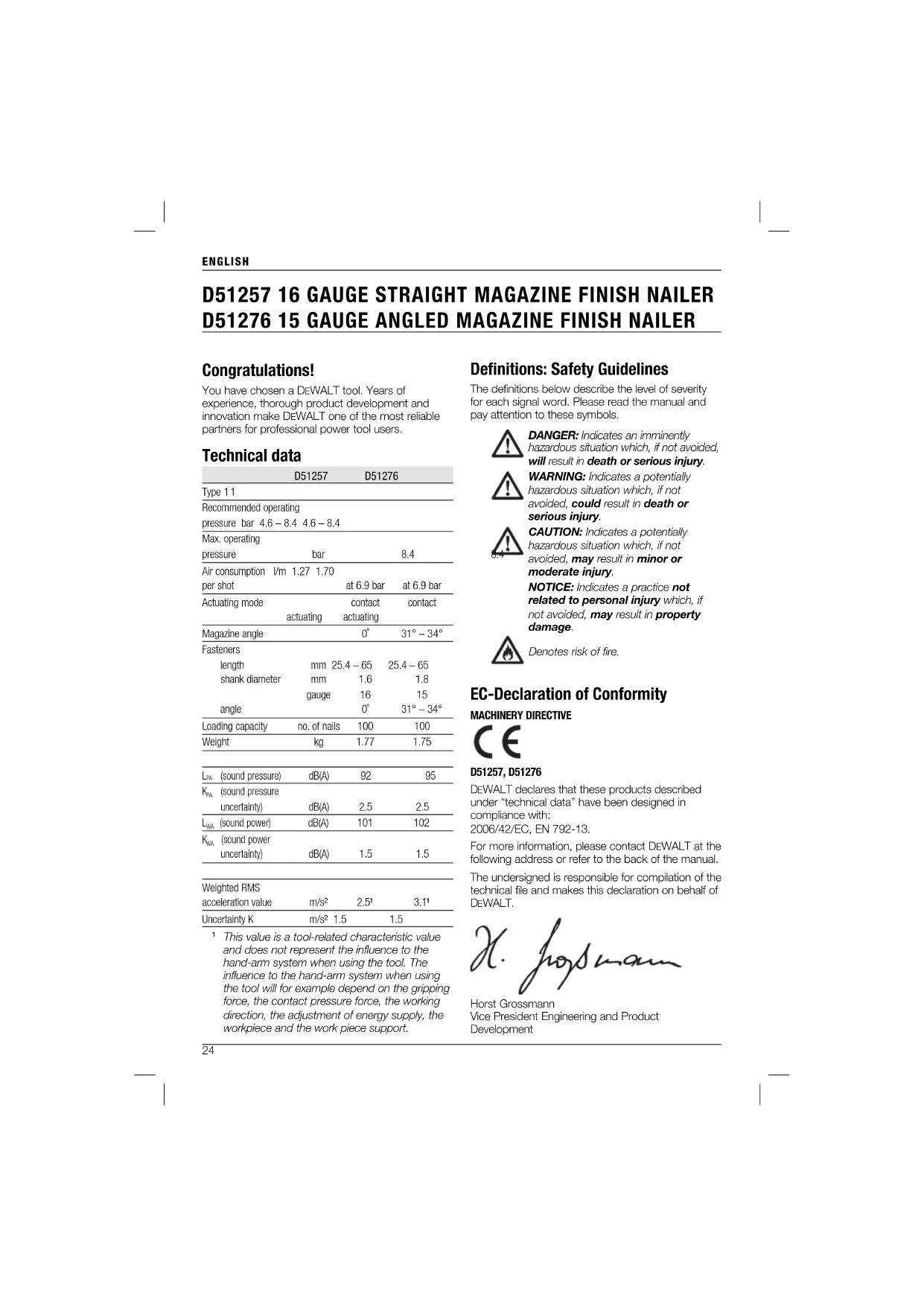


| Product Type | Pneumatic Stapler |
| Brand | DeWalt |
| Model | D51257K |
| Category | Stapler |
| Recommended Air Pressure | 4.6 to 8.4 bar |
| Maximum Air Pressure | 8.4 bar |
| Air Consumption per Stroke | 1.27 l at 6.9 bar |
| Activation Mode | Contact trip / sequential trip |
| Magazine Angle | 0° |
| Fastener Length | 25.4 to 65 mm |
| Shank Diameter | 1.6 mm |
| Gauge | 16 |
| Fastener Angle | 0° |
| Magazine Capacity | 100 nails |
| Weight | 1.77 kg |
| Sound Pressure Level (L_PA) | 92 dB(A) |
| Sound Power Level (L_WA) | 101 dB(A) |
| Vibration (weighted rms) | 2.51 m/s² |
| Trigger Type | Sequential trip trigger and contact trip trigger (interchangeable) |
| Power Source | Compressed air |
| Housing Material | Reinforced plastic |
| Main Functions | Finish nailing, depth adjustment, belt hook, dual-load magazine |
| Maintenance and Cleaning | Clean magazine and trigger mechanism regularly, drain air tanks, lubricate with pneumatic oil if necessary |
| Safety | Trigger lock, mandatory eye and ear protection, do not use on scaffold or ladder |
| Spare Parts and Repairability | Repair by DeWalt authorized center, spare parts available |
| Warranty | 1 year (full), 30 days satisfaction, 1 year free maintenance |
Frequently Asked Questions - D51257K DEWALT
User questions about D51257K DEWALT
0 question about this device. Answer the ones you know or ask your own.
Ask a new question about this device
Download the instructions for your Stapler in PDF format for free! Find your manual D51257K - DEWALT and take your electronic device back in hand. On this page are published all the documents necessary for the use of your device. D51257K by DEWALT.
USER MANUAL D51257K DEWALT
English (original instructions)
Figure 2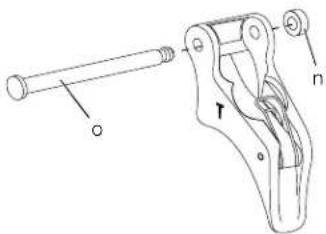 | Figure 3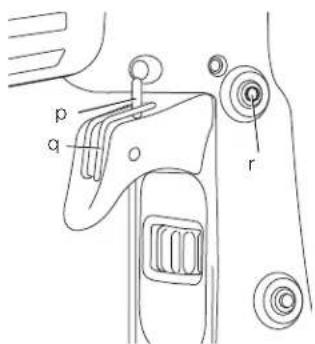 |
Figure 4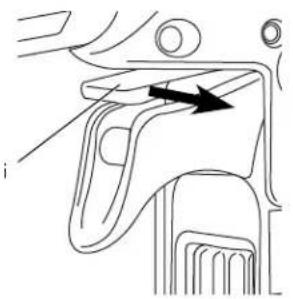 | Figure 5[A]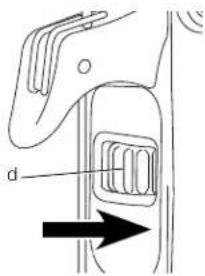 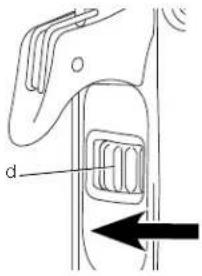 |
Figure 6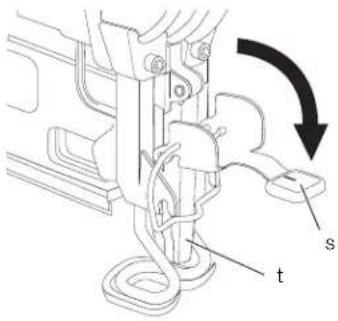 | Figure 7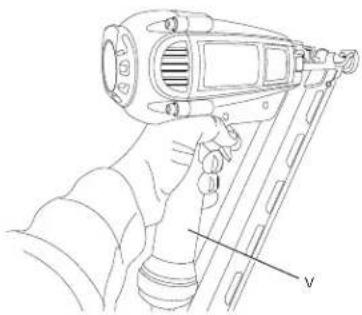 |
D51257 16 DYKKERPISTOL MED LIGE MAGASIN D51276 15 DYKKERPISTOL MED SKRÅTSTILLET MAGASIN
Tillykke!
LÅS OG PÅFYLD-METODEN
D-65510, Idstein, Germany
31.12.2009
You have chosen a DEWALT tool. Years of experience, thorough product development and innovation make DEWALT one of the most reliable partners for professional power tool users.
Technical data
| D51257 | D51276 | ||
| Type 11 | |||
| Recommended operating pressure bar 4.6 – 8.4 4.6 – 8.4 | |||
| Max. operating pressure | bar | 8.4 | |
| Air consumption per shot | l/m 1.27 1.70 | at 6.9 bar | at 6.9 bar |
| Actuating mode | actuating | contact actuating | contact |
| Magazine angle | 0° | 31° – 34° | |
| Fasteners | |||
| length | mm 25.4 – 65 | 25.4 – 65 | |
| shank diameter | mm | 1.6 | 1.8 |
| gauge | 16 | 15 | |
| angle | 0° | 31° – 34° | |
| Loading capacity | no. of nails | 100 | 100 |
| Weight | kg | 1.77 | 1.75 |
| L_PA | (sound pressure) | dB(A) | 92 | 95 |
| K_PA | (sound pressure uncertainty) | dB(A) | 2.5 | 2.5 |
| L_VA | (sound power) | dB(A) | 101 | 102 |
| K_VA | (sound power uncertainty) | dB(A) | 1.5 | 1.5 |
| Weighted RMS | |||
| acceleration value | m/s2 | 2.51 | 3.11 |
| Uncertainty K | m/s2 1.5 | 1.5 | |
1 This value is a tool-related characteristic value and does not represent the influence to the hand-arm system when using the tool. The influence to the hand-arm system when using the tool will for example depend on the gripping force, the contact pressure force, the working direction, the adjustment of energy supply, the workpiece and the work piece support.
Definitions: Safety Guidelines
The definitions below describe the level of severity for each signal word. Please read the manual and pay attention to these symbols.

DANGER: Indicates an imminently hazardous situation which, if not avoided, will result in death or serious injury.

WARNING: Indicates a potentially hazardous situation which, if not avoided, could result in death or serious injury.

CAUTION: Indicates a potentially hazardous situation which, if not avoided, may result in minor or moderate injury.
NOTICE: Indicates a practice not related to personal injury which, if not avoided, may result in property damage.

Denotes risk of fire.
EC-Declaration of Conformity
MACHINERY DIRECTIVE

D51257, D51276
DEWALT declares that these products described under "technical data" have been designed in compliance with:
2006/42/EC, EN 792-13.
For more information, please contact DEWALT at the following address or refer to the back of the manual.
The undersigned is responsible for compilation of the technical file and makes this declaration on behalf of DEWALT.
Horst Grossmann
Vice President Engineering and Product Development
D-65510, Idstein, Germany
31.12.2009
Safety Instructions
When using tools, always observe the safety regulations applicable in your country to reduce the risk of personal injury. Read the following safety instructions before attempting to operate this product.
Keep these instructions in a safe place!

READ ALL SAFETY WARNINGS AND ALL INSTRUCTIONS
General
- Keep work area clean.
Cluttered areas and benches can cause accidents.
- Consider work area environment.
Do not expose tools to humidity. Keep work area well lit. Do not use tools in the presence of flammable liquids or gases.
- Keep children away.
Do not let children or visitors come into contact with the tool. Supervision is required for those under 16 years of age.
- Store idle tools.
When not in use, tools must be stored in a dry place and locked up securely, out of reach of children.
- Dress properly.
Do not wear loose clothing or jewellery. They can be caught in moving parts. Preferably wear rubber gloves and non-slip safety footwear. Wear protective hair covering to keep long hair out of the way.
- Do not overreach.
Keep proper footing and balance at all times.
- Stay alert.
Watch what you are doing. Use common sense. Do not operate the tool when you are tired.
- Use appropriate tool.
The intended use is described in this instruction manual. Do not force small tools or attachments to do the job of a heavy-duty tool. The tool will do the job better and safer at the rate for which it was intended.
WARNING! The use of any accessory or attachment or performance of any operation with this tool, other than those recommended in this instruction manual may present a risk of personal injury.
- Maintain tools with care.
Keep the tools in good condition and clean for better and safer performance. Follow the instructions for maintenance and changing accessories. Keep all controls dry, clean and free from oil and grease.
- Check for damaged parts.
Before using the tool, carefully check it for damage to ensure that it will operate properly and perform its intended function. Check for misalignment and seizure of moving parts, breakage of parts and any other conditions that may affect its operation. Have damaged guards or other defective parts repaired or replaced as instructed.
- Have your tool repaired by an authorised DEWALT repair agent.
This tool is in accordance with the relevant safety regulations. To avoid danger, tools must only be repaired by qualified technicians.
Additional Safety Instructions for Pneumatic Nailers
• ALWAYS wear safety glasses.
• ALWAYS wear ear protection.
- Only use fasteners of the type specified in the manual.
- Do not use any stands for mounting the tool to a support.
- NEVER use the tool for any other purpose than specified in this manual.
- NEVER use this tool on scaffolds, stairs, ladders or similar workplaces.
- Don't use the tool to close cases or crates.
- Don't use the tool for attaching transportation safety devices, e.g., on vehicles and carriages.
- Before use check proper function of contact trip. Never use this tool when either trigger switch or contact trip is damaged.
- Use quick-action couplings for connection to the compressed air system. The non-sealable nipple must be fitted to the tool in such a way that no compressed air remains in the tool after disconnection.
ENGLISH
- ALWAYS use clean, dry compressed air. Do not use oxygen or combustible gases as an energy source for this tool.
- The maximum allowable air pressure of the tool shall NEVER be exceeded.
- Only connect this tool to an air supply where the maximum allowable pressure of the tool cannot be exceeded by more than 10%. In case of higher pressures, a pressure reducing valve including a downstream safety valve shall be built into the compressed air supply.
- Only use hoses with a rating exceeding the maximum operating pressure of the tool.
- To prevent an unnecessarily high noise level, increased wear and resulting failures, the nailer should be operated with the lowest pressure required for the work process.
- DO NOT use oxygen, combustible gases or any other reactive gases for operating compressed air. Danger of explosion and/or serious personal injury may result.
- Before transporting the tool, disconnect it from the compressed air system, especially where ladders are used or where unusual physical posture is adopted while moving.
- Disconnect the tool from the air supply when it is not in use.
- Avoid weakening or damaging the tool, for example by:
- punching or engraving
– modifications not authorised by the manufacturer
– guiding against templates made of hard material such as steel
- dropping or pushing across the floor
– applying excessive force of any kind - Do not use the equipment as a hammer.
⚠ WARNING! Keep the nailer, loaded or unloaded, pointed away from yourself and others. Serious personal injury may result.
- While working, hold the tool in such a way that no injuries can be caused to the head or to the body in the event of a possible recoil due to a disruption in the energy supply or hard areas within the workpiece.
- NEVER actuate the fastener driving tool into free space.
-
In the work area, carry the tool at the workplace using only one handle, and NEVER with the trigger actuated.
-
Consider the conditions in the work area. Fasteners can penetrate thin workpieces or slip off corners and edges of the workpiece, and thus put people at risk. The length of the nails used should be no longer than the thickness of the workpieces. If the nails are longer than the workpiece thickness this could cause a rebound of the nails if the workpiece is placed on a hard surface, e.g., concrete, steel.
- Do not drive fasteners close to the edge of the workpiece. ALWAYS keep a distance of at least 25 mm from the edge of the workpiece so nails will not destroy the workpiece.
- Do not drive fasteners on top of other fasteners.
- Only use spare parts specified by the manufacturer or his authorised agents.
- Have repairs carried out only by the manufacturer or authorised agents having due regard to the information given in the manual and using the appropriate tools and equipment.
- Replacement of contact trip spring is recommended every 3-4 years to ensure personal safety.
- Do not disassemble or block any parts of the fastener driving tool such as the safety yoke.
- Have the tool serviced properly and at regular intervals.
- ALWAYS wear safety gloves to reduce the risk of personal injuries.
Residual Risks
- The following risks are inherent to the use of these machines:
– Injuries caused by improper handling of the tool.
- Loss of control due to not gripping tool firmly.
- Muscle strain of arms and hands, especially when working overhead. Always take regular breaks when working for long periods of time.
- Do not use the tool while you are tired or under influence of drugs, alcohol or medication. A moment of inattention while operating may result in serious personal injury.
- In spite of the application of the relevant safety regulations and the implementation of safety devices, certain residual risks cannot be avoided.
These are:
- Impairment of hearing. Under some
conditions and duration of use, noise from this product may contribute to hearing loss.
— Loss of control caused by recoil.
- Risk of injury caused by pinch points, sharp edges and improper handling of workpiece.
- Risk of injury caused by sharp edges when changing nails or inserting nail sticks.
- Discomfort to hand and arms. Vibration caused by the operating action of this tool may cause permanent injury to fingers, hands, and arms. Use gloves to provide extra cushion, take frequent rest periods, and limit daily time of use.

Nail length.

Max. operating pressure.
DATE CODE POSITION (FIG. 1)
Date Code (u), which also includes the year of manufacture, is printed into the housing surface above the trigger switch.
Example:
2010 XX XX
Year of Manufacture
Markings on Tool
The following pictograms are shown on the tool:

Pneumatic tool with safety yoke.

Do not use on scaffoldings and ladders.

Read instruction manual before use.

Wear ear protection.

Wear eye protection.

Compatible nail angles (D51257).

Compatible nail angles (D51276).

Maximum number of nails in magazine.

Nail diameter (D51257).

Nail diameter (D51276).
Package Contents
The package contains:
1 nailer
1 sequential action trigger
1 instruction manual
1 exploded drawing
- Check for damage to the tool, parts or accessories which may have occurred during transport.
• Take the time to thoroughly read and understand this manual prior to operation.
Description (fi g. 1)

WARNING: Never modify the power tool or any part of it. Damage or personal injury could result.
a. trigger switch
b. belt hook
c. nail pusher
d. depth adjustment wheel
e. dual load magazine
f. no mar pad
g. contact trip
h. jam clearing latch
i. trigger lock-off
j. exhaust
k. air fitting
1. end cap
ENGLISH
INTENDED USE
The D51257 and D51276 pneumatic nailers have been designed for driving fasteners into wooden workpieces.
DO NOT use under humid conditions or in presence of flammable liquids or gases.
These pneumatic nailers are professional power tools. DO NOT let children come into contact with the tool. Supervision is required when inexperienced operators use this tool.
ASSEMBLY AND ADJUSTMENTS

WARNING: Prior to assembly and adjustment, ALWAYS lock-off trigger, disconnect air line from tool and remove fasteners from the magazine before making any adjustments or personal injury may result.
Trigger

JING: Keep fingers AWAY from trigger when not driving fasteners to avoid accidental firing. Never carry tool with finger on trigger. In Contact Bump Actuation Mode tool will fire a fastener if safety is bumped while trigger is depressed.
These tools are assembled with a bump action trigger. A sequential action trigger is also included with the original packaging. For definitions of "bump action" and "sequential action", see below.
The gray trigger with /imprinted on the side is the single sequential action trigger and causes the tool to operate in this mode.
The black trigger with printed on the side is the bump action trigger and permits the tool to be actuated in this manner.
For defining the use of the sequential action trigger and bump action trigger, see Actuating the Tool.
TRIGGER REMOVAL (FIG. 2)
- Remove rubber grommet (n) from the end of the dowel pin (o).
- Remove dowel pin.
- Remove trigger assembly from trigger cavity under the handle of the tool housing.
TRIGGER INSTALLATION (FIG. 2, 3)
- Select either the sequential or bump action trigger to be installed on the tool. Both triggers are included in the tool packaging.
-
Insert the trigger kit into trigger cavity.
-
Ensure that trigger spring (q) is placed around the trigger valve stem (p).
- Align the holes of the trigger with the housing holes (r), then insert the dowel pin (o) through the entire assembly as shown.
- Push the rubber grommet (n) onto the end of the dowel pin as shown.
Air Fitting (fi g. 1)
These tools have a standard 3/8" pipe thread for the air fitting (k). The tool is assembled with a 3/8" to 1/4" adapter installed in the end cap.
- Wrap the male end of the fitting with Teflon tape to prevent air leaks.
- To install a 1/4" fitting, screw the fitting into the 3/8" to 1/4" adapter in the end cap and tighten firmly.
- To install a 3/8" fitting, remove the 3/8" to 1/4" adapter, if present. Screw the fitting into the end cap and tighten firmly.
OPERATION
Instructions for Use

NING: ALWAYS observe the safety instructions and applicable regulations.

NING: ALWAYS place workpiece safely.
Proper Hand Position (fi g. 7)

NG: To reduce the risk of serious personal injury, ALWAYS use proper hand position as shown.

NG: To reduce the risk of serious personal injury, ALWAYS hold securely in anticipation of a sudden reaction.
Proper hand position requires one hand on the main handle (v).
Preparing the Tool (fi g. 1)

JING: To reduce the risk of personal injury, disconnect tool from air supply before performing maintenance, clearing a jammed fastener, leaving work area, moving tool to another location or handing the tool to another person.

WARNING: Wear proper eye, hearing and respiratory protection.
NOTE: These nailers are designed to be used without oil. If preferred, 5–7 drops of oil may be used on o-rings, rubber parts and can be applied to the air fittings.
- Drain all condensation from the air compressor tanks and hoses.
- Remove all nails from the magazine.
- Lock the nail pusher (c) in the back position.
- Check if the contact trip (g) and nail pusher (c) can move freely.

WARNING: Do not use the tool if the contact trip or nail pusher cannot move freely.

NING: Avoid the same work position or stance for long periods of time, e.g., overhead. Avoid long work periods without enough rest time.
- Check that the pressure of the air supply is below the maximum recommended operating pressure.
- Connect the air hose to the fitting on the tool.
- Check for audible leaks around valves and gaskets.
- Set the air pressure to the minimum recommended operating pressure.

NING: NEVER use a tool that leaks or has damaged parts.

NING: DO NOT connect to air supply unless the tool preparation is completed.
Cold Weather Operation
When operating tools at temperatures below freezing:
- Make sure compressor tanks have been properly drained prior to use.
- Keep the tool as warm as possible before use.
- Make certain all fasteners have been removed from magazine.
- Disconnect the airline from the tool.
- Set the air pressure to a maximum of 5.5 bar.
- Connect the air hose to the fitting on the tool.
- Load nails into the magazine as described below.
- Increase the air pressure to the normal operating level.
- Use the tool in the normal manner.
• Always drain the compressor tanks at least once daily.
NOTE: Please refer to Preparing the Tool under Operation if choosing to use oil.
Hot Weather Operation
The tool should operate normally. Avoid the heat of direct sunlight to avoid damage to the bumpers, o-rings and other rubber parts.
Belt Hook (fi g. 1)
The DEWALT nailers include an integrated belt hook (b) that can be rotated to either side of the tool to accommodate left- or right-handed users. It can also be rotated out of the way when not in use.
If the hook is not desired at all, it can be removed from the tool.
TO REMOVE BELT HOOK
- Lock off trigger.
- Disconnect the tool from air supply.
- Using the appropriate hex wrench, remove the end cap screws from the end cap (I) of the tool.
- Remove the belt hook (b).
- Replace end cap and gasket. Ensure that the end cap screws are tight.
- Replace and tighten air fitting.
Using the Lock-off (fi g. 1, 4)

NING: Do not keep trigger depressed when tool is not in use. Keep the lock-off switch rotated to the right (OFF) when the tool is not in use. Serious personal injury may result.

WARNING: Lock-off trigger, disconnect airline from tool and remove fasteners from magazine before making adjustments. Serious personal injury may result.
Each DEWALT nailer is equipped with a trigger lock-off switch (i). To engage the lock-off switch, rotate it to the right. To disengage the lock-off switch, center it. The trigger should always be locked off whenever any adjustments are made or when tool is not in use.
Actuating the Tool

NING: To reduce the risk of serious personal injury, ALWAYS wear proper eye and hearing protection when operating this tool.
The tool can be actuated using one of two modes: single sequential action trigger mode and bump
ENGLISH
action trigger mode. The trigger installed on the tool as described in the Trigger section of this manual determines the mode of operation.
SEQUENTIAL ACTION TRIGGER - (GRAY)
The sequential action trigger's intended use is for intermittent nailing where very careful and accurate placement is desired.
To operate the nailer in sequential action mode:
- Depress the contact trip firmly against the work surface.
- Depress the trigger.

CAUTION: A nail will fire each time the trigger is depressed as long as the contact trip remains depressed.
BUMP ACTION TRIGGER - (BLACK)
The bump action trigger's intended use is for rapid nailing on flat, stationary surfaces.
Using the bump action trigger, two methods are available: place actuation and bump actuation
To operate the tool using the place actuation method:
- Depress the contact trip against the work surface.
- Depress the trigger.
To operate the tool using the bump actuation method:
- Depress the trigger.
- Push the contact trip against the work surface. As long as the trigger is depressed, the tool will fire a nail every time the contact trip is depressed. This allows the user to drive multiple nails in sequence.

ION: Do not keep trigger depressed when tool is not in use. Keep the lock-off switch rotated to the right (OFF) when the tool is not in use.
Loading the Tool (fi g. 1)

WARNING: Keep tool pointed in a safe direction when loading nails.

ING: Keep the tool pointed away from yourself and others. Serious personal injury may result.

ING: Never load nails with the contact trip or trigger activated. Personal injury may result.
The DEWALT finish nailers are equipped with dual load magazines. The fasteners can be loaded using one of two methods:
LOAD AND LOCK METHOD
- Lock off trigger.
- Insert fasteners into the rear of the magazine (e).
- Pull nail pusher (c) back until the nail follower falls behind the nails.
LOCK AND LOAD METHOD
- Lock off trigger.
- Pull pusher back until it locks in the pusher latch.
- Insert fasteners into the rear of the magazine.
- Press the pusher button (m) to release and allow the nail follower to fall behind the nails.
Depth Setting (fi g. 5)

WARNING: To reduce risk of serious injury from accidental actuation when attempting to adjust depth, ALWAYS:
- Lock OFF trigger.
• Disconnect air supply. - Avoid contact with trigger during adjustments.
Fastener driving depth can be adjusted using the depth adjustment on the nosepiece of the tool.
- To drive the nail shallower, rotate the depth adjustment wheel (d) to the right (fig. 5A).
- To drive a nail deeper, rotate the depth adjustment wheel (d) to the left (fig. 5B).
Clearing a Jammed Nail (fi g. 6)
If a nail becomes jammed in the nosepiece, keep the tool pointed away from you and follow these instructions to clear:
- Lock off trigger.
- Disconnect air supply from tool and lock trigger.
- Release pusher from behind nails.
- Push down front latch (s) then pull up to open front door (t).
- Remove bent nail, using pliers if necessary.
- If driver blade is in the down position, insert screwdriver or other rod into nosepiece and push driver blade back in position.
- Remove rod and close front door.
- Lift latch to secure door to nosepiece.
-
Reattach air supply.
-
Reinsert nails into magazine.
- Release pusher.
- Unlock the trigger.
NOTE: Should nails continue to jam frequently in nosepiece, have tool serviced by an authorised DEWALT service center.
MAINTENANCE
Your DEWALT power tool has been designed to operate over a long period of time with a minimum of maintenance. Continuous satisfactory operation depends upon proper tool care and regular cleaning.

WARNING: To reduce the risk of injury, lock off trigger, disconnect air line from tool and remove fasteners from magazine before making adjustments or personal injury may result.
Perform the following maintenance operations every day:
Drain all condensation from the air compressor tanks and hoses
- Open petcocks or other drain valves on the compressor tanks.
- Allow any accumulated water to drain from hoses.

Cleaning
CLEAN MAGAZINE, PUSHER AND CONTACT TRIP MECHANISM

WARNING: Blow dirt and dust out of the main housing with dry air as often as dirt is seen collecting in and around the air vents. Wear proper eye protection when performing this procedure.

ING: When cleaning, use only mild soap and a damp cloth on plastic parts. Many household cleaners contain chemicals which could seriously damage plastic. Also, do not use gasoline, turpentine, lacquer or paint thinner, dry cleaning fluids or similar products which may seriously damage plastic parts. NEVER let any liquid get inside the tool; NEVER immerse any part of the tool into a liquid.
Ensure that all fasteners on the tool are tight and undamaged
Tighten loose fasteners using the appropriate tool.
TROUBLESHOOTING
If your tool seems not to operate properly, follow the instructions below. If this does not solve the problem, please contact your repair agent.
Tool does not work
- Check the air supply.
- If the temperature is low, warm the tool up.
Tool has insufficient power
- Check the air supply.
- Check if the air exhaust is clear.
- Lubricate the tool.
Tool cap leaks air
- Tighten the cap screws.
Tool skips nails
- Check the air supply.
- Clean the magazine and nosepiece.
- Check that the magazine latch is holding the magazine firmly.
Fasteners jam in tool
- Make sure only to use fasteners of the type specified.
- Check that the magazine latch is holding the magazine firmly.
- Tighten the nosepiece screws.
Optional Accessories

WARNING: Since accessories, other than those offered by DEWALT, have not been tested with this product, use of such accessories with this tool could be hazardous. To reduce the risk of injury, only DEWALT recommended accessories should be used with this product.
Consult your dealer for further information on the appropriate accessories.
ENGLISH
Protecting the Environment
Separate collection. This product must not be disposed of with normal household waste.
Should you find one day that your DEWALT product needs replacement, or if it is of no further use to you, do not dispose of it with household waste. Make this product available for separate collection.

Separate collection of used products and packaging allows materials to be recycled and used again. Re-use of recycled materials helps prevent environmental pollution and reduces the demand for raw materials.
Local regulations may provide for separate collection of electrical products from the household, at municipal waste sites or by the retailer when you purchase a new product.
DEWALT provides a facility for the collection and recycling of DEWALT products once they have reached the end of their working life. To take advantage of this service please return your product to any authorised repair agent who will collect them on our behalf.
You can check the location of your nearest authorised repair agent by contacting your local DEWALT office at the address indicated in this manual. Alternatively, a list of authorised DEWALT repair agents and full details of our after-sales service and contacts are available on the Internet at: www.2helpU.com.
GUARANTEE
DEWALT is confident of the quality of its products and offers an outstanding guarantee for professional users of the product. This guarantee statement is in addition to and in no way prejudices your contractual rights as a professional user or your statutory rights as a private non-professional user. The guarantee is valid within the territories of the Member States of the European Union and the European Free Trade Area.
• 30 DAY NO RISK SATISFACTION GUARANTEE •
If you are not completely satisfied with the performance of your DEWALT tool, simply return it within 30 days, complete with all original components, as purchased, to the point of purchase, for a full refund or exchange. The product must have been subject to fair wear and tear and proof of purchase must be produced.
• ONE YEAR FREE SERVICE CONTRACT •
If you need maintenance or service for your DEWALT tool, in the 12 months following purchase, you are entitled to one service free of charge. It will be undertaken free of charge at an authorised DEWALT repair agent. Proof of purchase must be produced. Includes labour. Excludes accessories and spare parts unless failed under warranty.
• ONE YEAR FULL WARRANTY •
If your DEWALT product becomes defective due to faulty materials or workmanship within 12 months from the date of purchase, DEWALT guarantees to replace all defective parts free of charge or – at our discretion – replace the unit free of charge provided that:
• The product has not been misused;
- The product has been subject to fair wear and tear;
• Repairs have not been attempted by unauthorised persons;
• Proof of purchase is produced;
- The product is returned complete with all original components.
If you wish to make a claim, contact your seller or check the location of your nearest authorised DEWALT repair agent in the DEWALT catalogue or contact your DEWALT office at the address indicated in this manual. A list of authorised DEWALT repair agents and full details of our after-sales service is available on the Internet at: www.2helpU.com.
VEILIGHEIDSWAARSCHUWINGEN EN ALLE INSTRUCTIES
Algemeen
PLAATS VAN DATUMCODE (AFB. [FIG.] 1)
D51257 DYKKERTPISTOL MED RETT MAGASIN FOR DYKKERT NR. 16 D51276 DYKKERTPISTOL MED RETT MAGASIN FOR DYKKERT NR. 15
Gratulerer!
JAKSOITTAISEN TOIMINNAN LIIPAISIN - (HARMAA)

- D51257 16 DYKKERPISTOL MED LIGE MAGASIN D51276 15 DYKKERPISTOL MED SKRÅTSTILLET MAGASIN
- Tillykke!
- LÅS OG PÅFYLD-METODEN
- Definitions: Safety Guidelines
- EC-Declaration of Conformity
- MACHINERY DIRECTIVE
- D51257, D51276
- Safety Instructions
- READ ALL SAFETY WARNINGS AND ALL INSTRUCTIONS
- General
- Additional Safety Instructions for Pneumatic Nailers
- ENGLISH
- Residual Risks
- DATE CODE POSITION (FIG. 1)
- Markings on Tool
- Package Contents
- Description (fi g. 1)
- INTENDED USE
- ASSEMBLY AND ADJUSTMENTS
- Trigger
- TRIGGER REMOVAL (FIG. 2)
- TRIGGER INSTALLATION (FIG. 2, 3)
- Air Fitting (fi g. 1)
- OPERATION
- Instructions for Use
- Proper Hand Position (fi g. 7)
- Preparing the Tool (fi g. 1)
- Cold Weather Operation
- Hot Weather Operation
- Belt Hook (fi g. 1)
- TO REMOVE BELT HOOK
- Using the Lock-off (fi g. 1, 4)
- Actuating the Tool
- SEQUENTIAL ACTION TRIGGER - (GRAY)
- BUMP ACTION TRIGGER - (BLACK)
- To operate the tool using the place actuation method:
- To operate the tool using the bump actuation method:
- Loading the Tool (fi g. 1)
- LOAD AND LOCK METHOD
- LOCK AND LOAD METHOD
- Depth Setting (fi g. 5)
- Clearing a Jammed Nail (fi g. 6)
- MAINTENANCE
- Perform the following maintenance operations every day:
- Drain all condensation from the air compressor tanks and hoses
- Cleaning
- Ensure that all fasteners on the tool are tight and undamaged
- TROUBLESHOOTING
- Tool does not work
- Tool has insufficient power
- Tool cap leaks air
- Tool skips nails
- Fasteners jam in tool
- Optional Accessories
- Protecting the Environment
- GUARANTEE
- • 30 DAY NO RISK SATISFACTION GUARANTEE •
- • ONE YEAR FREE SERVICE CONTRACT •
- • ONE YEAR FULL WARRANTY •
- VEILIGHEIDSWAARSCHUWINGEN EN ALLE INSTRUCTIES
- Algemeen
- PLAATS VAN DATUMCODE (AFB. [FIG.] 1)
- D51257 DYKKERTPISTOL MED RETT MAGASIN FOR DYKKERT NR. 16 D51276 DYKKERTPISTOL MED RETT MAGASIN FOR DYKKERT NR. 15
- Gratulerer!
- JAKSOITTAISEN TOIMINNAN LIIPAISIN - (HARMAA)
Brand : DEWALT
Model : D51257K
Category : Stapler