
EY4542 - Saw PANASONIC - Free user manual and instructions
Find the device manual for free EY4542 PANASONIC in PDF.



| Product Type | Cordless Circular Saw |
| Brand | Panasonic |
| Model | EY4542 |
| Motor Voltage | 14.4 V DC |
| No-Load Speed | 3600 min⁻¹ (rpm) |
| Blade Diameter | 135 mm (5-3/8") |
| Blade Arbor | 20 mm (25/32") |
| Maximum Cutting Depth | 0 - 46 mm (0" - 1-13/16") |
| Total Length | 329 mm (12-61/64") |
| Weight (with battery EY9L40/EY9L41) | 2.65 kg (5.7 lbs) |
| Battery Type | Rechargeable Li-ion |
| Compatible Battery Capacities | EY9L40 (3 Ah) / EY9L41 (3.3 Ah) |
| Charger | EY0L80 |
| Cut Materials | Wood, non-hardened ferrous metals, non-ferrous metals, plastic |
| Recommended Blade Types | Carbide for metal (EY9PM13C), wood (EY9PW13A), plastic (EY9PP13B) |
| Dust Collection | Integrated dust box + vacuum adapter (EY9X012E) |
| Lighting | Integrated LED light |
| Protections | Automatic lower blade guard, blade brake, overheat and over-discharge protection |
| Maintenance | Clean with a dry cloth; have repairs done at an authorized center |
| Warranty | See included warranty card |
Frequently Asked Questions - EY4542 PANASONIC
User questions about EY4542 PANASONIC
0 question about this device. Answer the ones you know or ask your own.
Ask a new question about this device
Download the instructions for your Saw in PDF format for free! Find your manual EY4542 - PANASONIC and take your electronic device back in hand. On this page are published all the documents necessary for the use of your device. EY4542 by PANASONIC.
USER MANUAL EY4542 PANASONIC
Before operating this unit, please read these instructions completely and save this manual for future use.
English: Page 6 Dansk: Side 109
Deutsch: Seite 24 Svenska: Sidan 126
Français: Page 41 Norsk: Side 143
Italiano: Pagina 58 Suomi: Sivu 160
YkpaHcbKa: CtopiHa 193
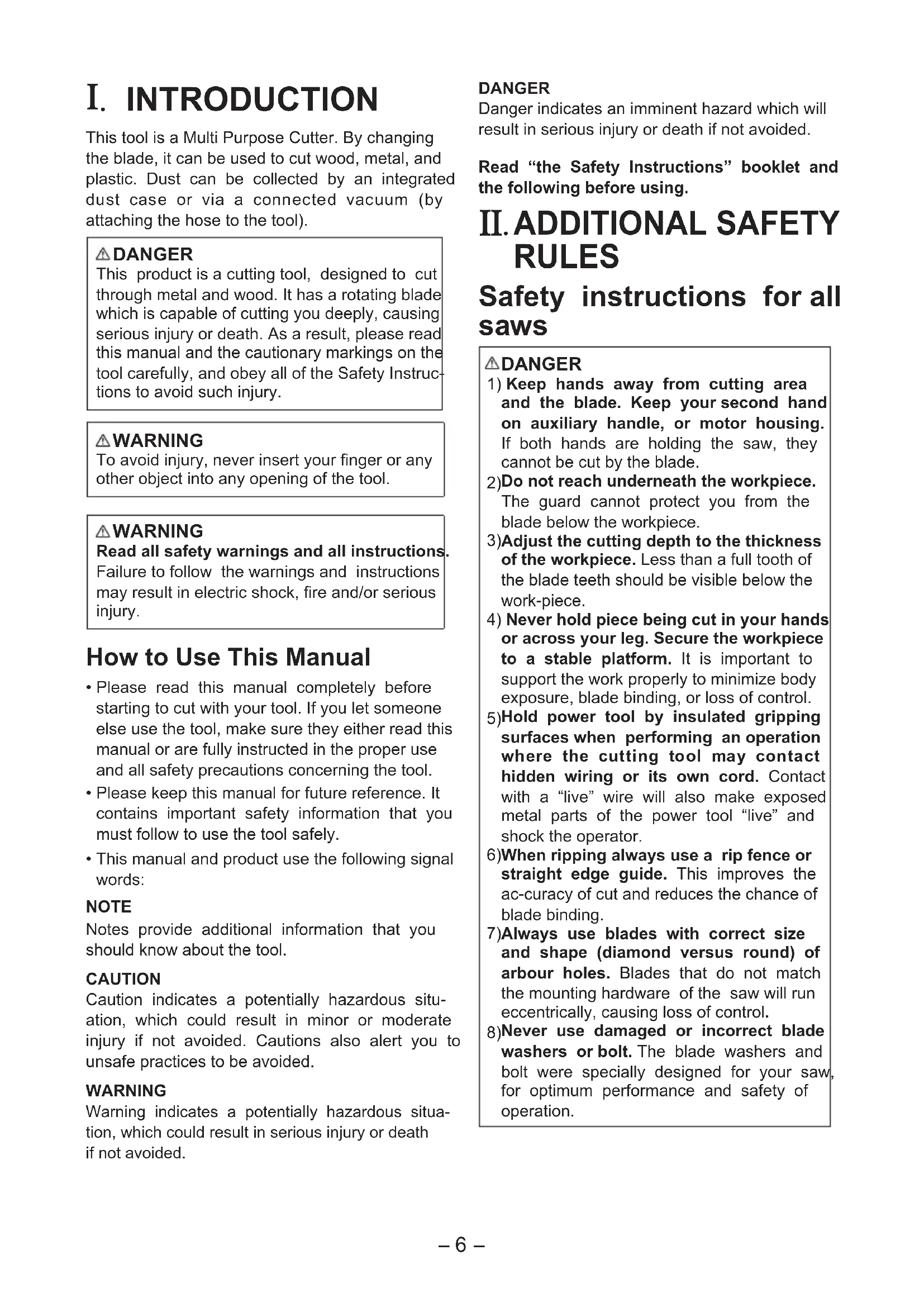
This tool is a Multi Purpose Cutter. By changing the blade, it can be used to cut wood, metal, and plastic. Dust can be collected by an integrated dust case or via a connected vacuum (by attaching the hose to the tool).
DANGER
This product is a cutting tool, designed to cut through metal and wood. It has a rotating blade which is capable of cutting you deeply, causing serious injury or death. As a result, please read this manual and the cautionary markings on the tool carefully, and obey all of the Safety Instructions to avoid such injury.
WARNING
To avoid injury, never insert your finger or any other object into any opening of the tool.
WARNING
Read all safety warnings and all instructions.
Failure to follow the warnings and instructions may result in electric shock, fire and/or serious injury.
How to Use This Manual
- Please read this manual completely before starting to cut with your tool. If you let someone else use the tool, make sure they either read this manual or are fully instructed in the proper use and all safety precautions concerning the tool.
- Please keep this manual for future reference. It contains important safety information that you must follow to use the tool safely.
- This manual and product use the following signal words:
NOTE
Notes provide additional information that you should know about the tool.
CAUTION
Caution indicates a potentially hazardous situation, which could result in minor or moderate injury if not avoided. Cautions also alert you to unsafe practices to be avoided.
WARNING
Warning indicates a potentially hazardous situation, which could result in serious injury or death if not avoided.
DANGER
Danger indicates an imminent hazard which will result in serious injury or death if not avoided.
Read "the Safety Instructions" booklet and the following before using.
II. ADDITIONAL SAFETY RULES
Safety instructions for all saws
DANGER
1) Keep hands away from cutting area and the blade. Keep your second hand on auxiliary handle, or motor housing. If both hands are holding the saw, they cannot be cut by the blade. 2) Do not reach underneath the workpiece. The guard cannot protect you from the blade below the workpiece. 3) Adjust the cutting depth to the thickness of the workpiece. Less than a full tooth of the blade teeth should be visible below the workpiece. 4) Never hold piece being cut in your hands or across your leg. Secure the workpiece to a stable platform. It is important to support the work properly to minimize body exposure, blade binding, or loss of control. 5) Hold power tool by insulated gripping surfaces when performing an operation where the cutting tool may contact hidden wiring or its own cord. Contact with a "live" wire will also make exposed metal parts of the power tool "live" and shock the operator. 6) When ripping always use a rip fence or straight edge guide. This improves the accuracy of cut and reduces the chance of blade binding. 7) Always use blades with correct size and shape (diamond versus round) of arbor holes. Blades that do not match the mounting hardware of the saw will run eccentrically, causing loss of control. 8) Never use damaged or incorrect blade washers or bolt. The blade washers and bolt were specially designed for your saw for optimum performance and safety of operation.
Further safety instructions for all saws
Causes and operator prevention of kickback:
- Kickback is a sudden reaction to a pinched, bound or misaligned saw blade, causing an uncontrolled saw to lift up and out of the workpiece toward the operator;
- When the blade is pinched or bound tightly by the kerf closing down, the blade stalls and the motor reaction drives the unit rapidly back toward the operator;
- If the blade becomes twisted or misaligned in the cut, the teeth at the back edge of the blade can dig into the top surface of the wood causing the blade to climb out of the kerf and jump back toward the operator.
Kickback is the result of saw misuse and/or incorrect operating procedures or conditions and can be avoided by taking proper precautions as given below.
1) Maintain a firm grip with both hands on the saw and position your arms to resist kickback forces. Position your body to either side of the blade, but not in line with the blade.
Kickback could cause the saw to jump backwards, but kickback forces can be controlled by the operator, if proper precautions are taken.
2) When blade is binding, or when interrupting a cut for any reason, release the trigger and hold the saw motionless in the material until the blade comes to a complete stop. Never attempt to remove the saw from the work or pull the saw backward while the blade is in motion or kickback may occur.
Investigate and take corrective actions to eliminate the cause of blade binding.
3) When restarting a saw in the workpiece, center the saw blade in the kerf and check that saw teeth are not engaged into the material.
If saw blade is binding, it may walk up or kickback from the workpiece as the saw is restarted.
4) Support large panels to minimize the risk of blade pinching and kickback.
Large panels tend to sag under their own weight. Supports must be placed under the panel on both sides, near the line of cut and near the edge of the panel.
5) Do not use dull or damaged blades.
Unsharpened or improperly set blades produce narrow kerf causing excessive friction, blade binding and kickback.
6) Blade depth and bevel adjusting locking levers must be tight and secure before making cut. If blade adjustment shifts while cutting, it may cause binding and kickback. 7) Use extra caution when making a "plunge cut" into existing walls or other blind areas. The protruding blade may cut objects that can cause kickback.
Safety instructions for this saw
1) Check lower guard for proper closing before each use. Do not operate the saw if lower guard does not move freely and close instantly. Never clamp or tie the lower guard into the open position. If saw is accidentally dropped, lower guard may be bent. Raise the lower guard with the retracting handle and make sure it moves freely and does not touch the blade or any other part, in all angles and depths of cut. 2) Check the operation of the lower guard spring. If the guard and the spring are not operating properly, they must be serviced before use. Lower guard may operate sluggishly due to damaged parts, gummy deposits, or a buildup of debris. 3) Lower guard should be retracted manually only for special cuts such as "plunge cuts" and "compound cuts." Raise lower guard by retracting handle and as soon as blade enters the material, the lower guard must be released. For all other sawing, the lower guard should operate automatically. 4) Always observe that the lower guard is covering the blade before placing saw down on bench or floor. An unprotected, coasting blade will cause the saw to walk backwards, cutting whatever is in its path. Be aware of the time it takes for the blade to stop after switch is released. 5) Do not use any abrasive wheels. 6) Wear a dust mask, if the work causes dust. 7) Use saw blades recommended by Manufacture. 8) Wear ear protectors when using the tool for extended periods.
9) The risk of kickback increases as the battery pack discharges. 10) Be sure to inspect the material. Avoid cutting other different materials. 11) Be careful not to drop the tool. 12) Never swing the tool. 13) Never cover the ventilation slots, and keep them free from dust or other material. 14) Do not clamp the tool in a vise. Never cut with the tool held upside down in a vise. This is extremely dangerous and can lead to serious accidents. 15) Never wear knitted gloves. 16) Be sure no one is below when using the tool in high locations. 17) Do not touch the blade immediately after operation. It may be hot and could burn your skin. 18) Do not touch material after it has been cut. Cut material may be very hot. 19) Do not use cutting oil. This use of cutting oil may cause a fire. 20) Do not cut workpieces covered or stained with gas, oil, solvents, thinners, etc.
Exposure to these materials may damage the transparent guard.
21) Do not remove the transparent and lower guards. If the transparent and lower guards are damaged or missing, return the tool to an authorized service center for replacement. 22) Do not start the blade when it is in contact with the workpiece. Wait for the blade to reach full speed before beginning the cut.
Symbol
| Symbol | Meaning |
| V | Volts |
| Direct current | |
| n0 | No load speed |
| ... min-1 | Revolutions or reciprocations |
| A | Amperes |
WARNING
- Do not use other than the Panasonic battery packs that are designed for use with this rechargeable tool.
- Do not dispose of the battery pack in a fire, or expose it to excessive heat.
- Do not drive nails or similar objects into the battery pack, subject it to shocks, dismantle it, or attempt to modify it.
- Do not allow metal objects to touch the battery pack terminals.
- Do not carry or store the battery pack in the same container as nails or similar metal objects.
- Do not charge the battery pack in a high-temperature location, such as next to a fire or in direct sunlight. Otherwise, the battery may overheat, catch fire, or explode.
- Never use other than the dedicated charger to charge the battery pack. Otherwise, the battery may leak, overheat, or explode.
- After removing the battery pack from the tool or the charger, always reattach the pack cover. Otherwise, the battery contacts could be shorted, leading to a risk of fire.
III. ASSEMBLY
Attaching or Removing Battery Pack
CAUTION:
Before inserting battery pack, check that the power switch in the tool actuates properly and returns to the "OFF" position when released.
- To connect the battery pack (See Fig. 2)
Line up the alignment marks and attach the battery pack.
- Slide the battery pack until it locks into position.
Fig. 2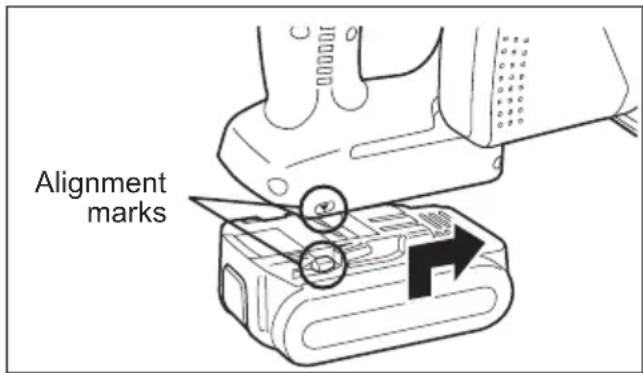
- To remove the battery pack (See Fig. 3) Push on the button from the front to release the battery pack.
Fig. 3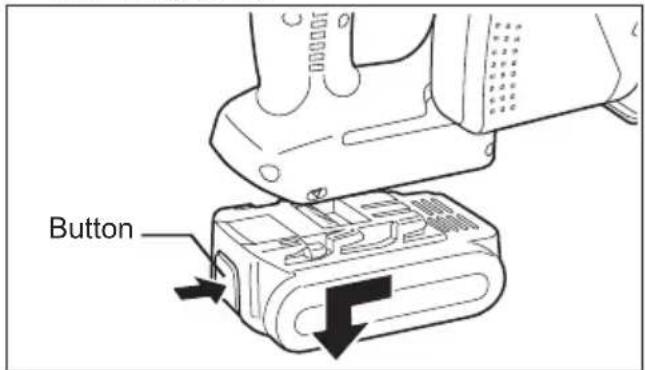
IV. OPERATION Before Using the Tool
This tool is intended to cut unhardened ferrous metal, nonferrous metal, wood, and plastic. Refer to the "Accessories" section for a list of blades to be used for the proper applications of this tool. The following precautions must be followed to reduce the risk of injury;
- Do not cut stacked materials. Cut one piece at a time.
- Do not cut hardened steel.
- Cut materials with the wider edge of the shoe over the clamped side of the material.
- Do not touch the saw blade, workpiece, or cutting chips with bare hands immediately after cutting; they may be hot and could burn skin.
Each time you use the tool, you must make sure it is in good operating condition.
Use the following checklist:
- Is the blade installed in the correct direction? The arrow on the blade must point in the same direction as the arrow on the upper blade cover.
- Is the blade installed properly? Make sure the hex bolt is tightened securely. (See Fig. 6)
- Does the blade look alright? Replace the blade immediately if there are any cracks in it or if any teeth are broken.
- Does the lower guard close properly?
WARNING
To avoid injury, do not use the tool if the lower guard does not close quickly over the blade.
- Is the transparent guard securely installed?
- Is the battery pack charged and inserted firmly to the tool?
- Is the depth adjustment nut for cutting securely tightened?
- Is the workpiece securely clamped on a saw horse or bench?
- Is the dust case or front cover clogged with dust?
Disengage the front cover lock button and remove any dust that has become clogged inside the cover. If the cover is clogged, use a long object such as a manual screwdriver to unclog it. After doing so, close the front cover. (See Fig. 4)
Fig. 4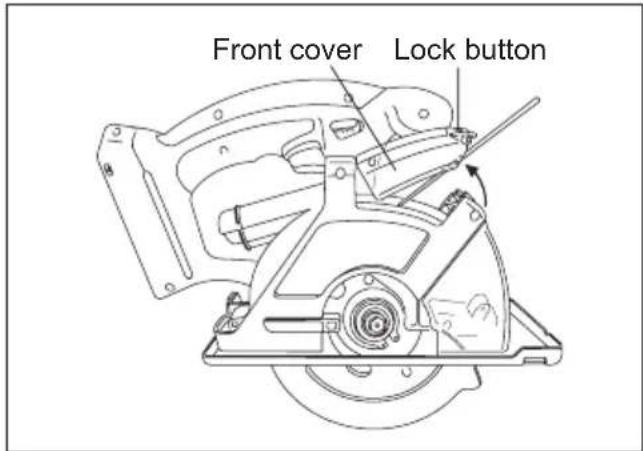
If there is dust inside the dust case, disengage the dust case lock button, detach the dust case, and remove the dust. After doing so, reattach the dust case. (See Fig. 5)
Fig. 5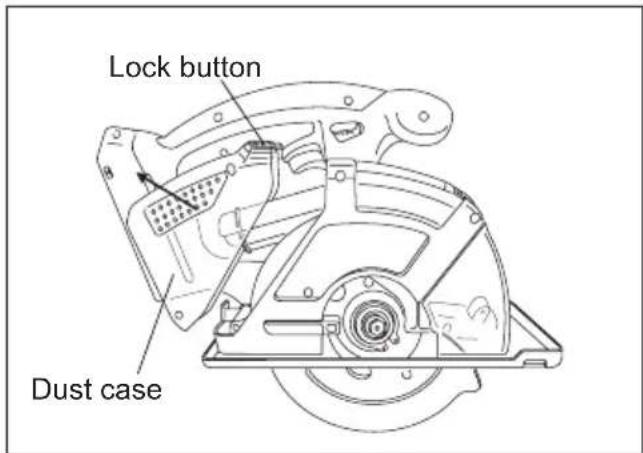
Installing Blade
Follow these steps:
- Remove the battery pack from the tool.
- Remove any cutting debris from blade area.
- Use the retracting handle to retract (open) the lower guard.
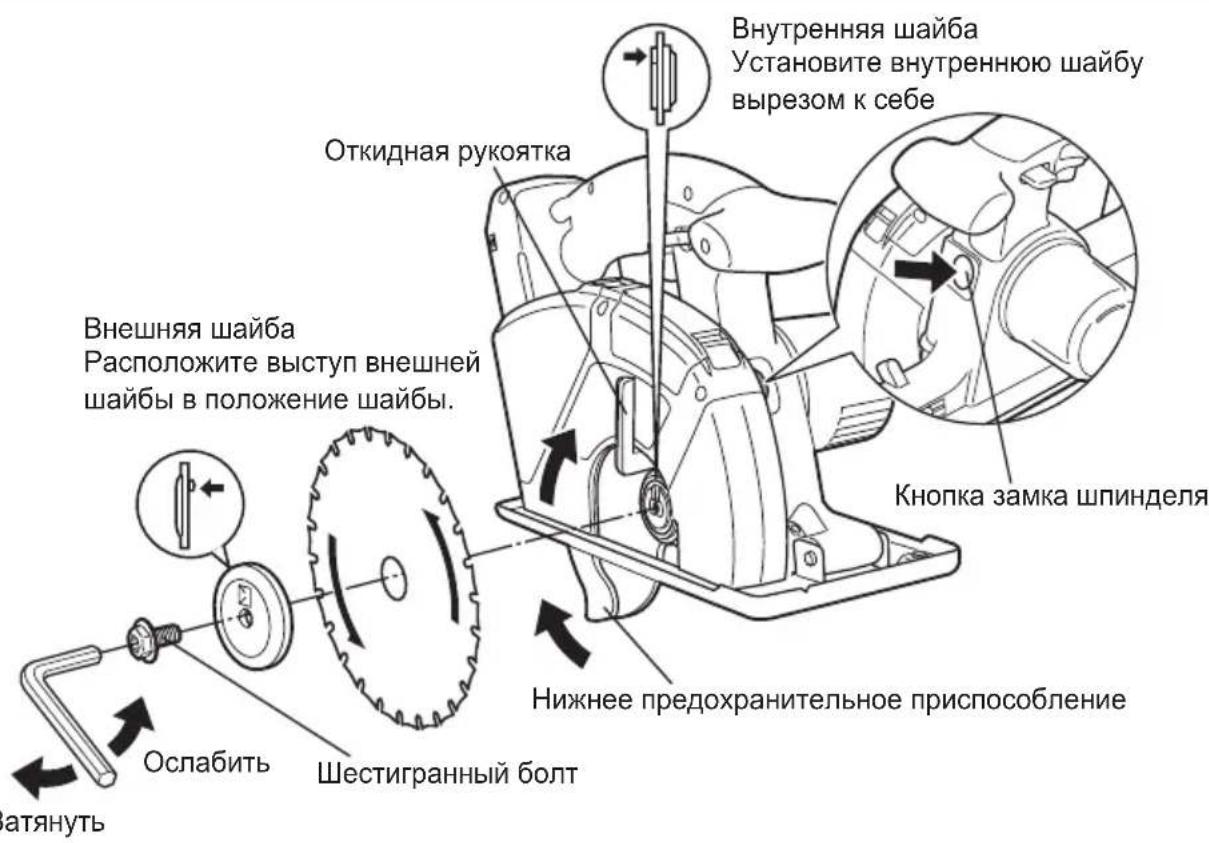
- Install the blade as illustrated. (See Fig. 6) Make sure that both the direction arrow on the blade and the direction arrow on the transparent guard point in the same direction.
- Set the outer washer in place.
- Insert the hex bolt.
- Hold the spindle lock button down. This prevents the blade from rotating.
- Tighten the hex bolt securely with the provided hex wrench. Store the hex wrench.
NOTE:
Keep the hex wrench in the storage slot on the tool's body when not using it.
WARNING
Failure to follow these instructions can result in serious personal injury.
Removing Blade
CAUTION:
The blade will be hot right after cutting. Be sure to let the blade cool down before removing it.
Follow these steps:
- Remove the battery pack from the tool.
- Hold the spindle lock button down. This prevents the blade from rotating.
- Use the provided hex wrench to loosen the hex bolt.
NOTE:
Keep the hex wrench in the storage slot on the tool's body when not using it.
- Remove the hex bolt and outer washer.
- Use the retracting handle to retract (open) the lower guard.
- Carefully remove the blade.
- Clean the tool if necessary.
CAUTION:
Be careful to avoid cutting your hands on the blade.
- When disposing of a blade, secure it inside heavy or corrugated paper. This will help prevent anyone from being cut by the discarded blade.
Fig. 6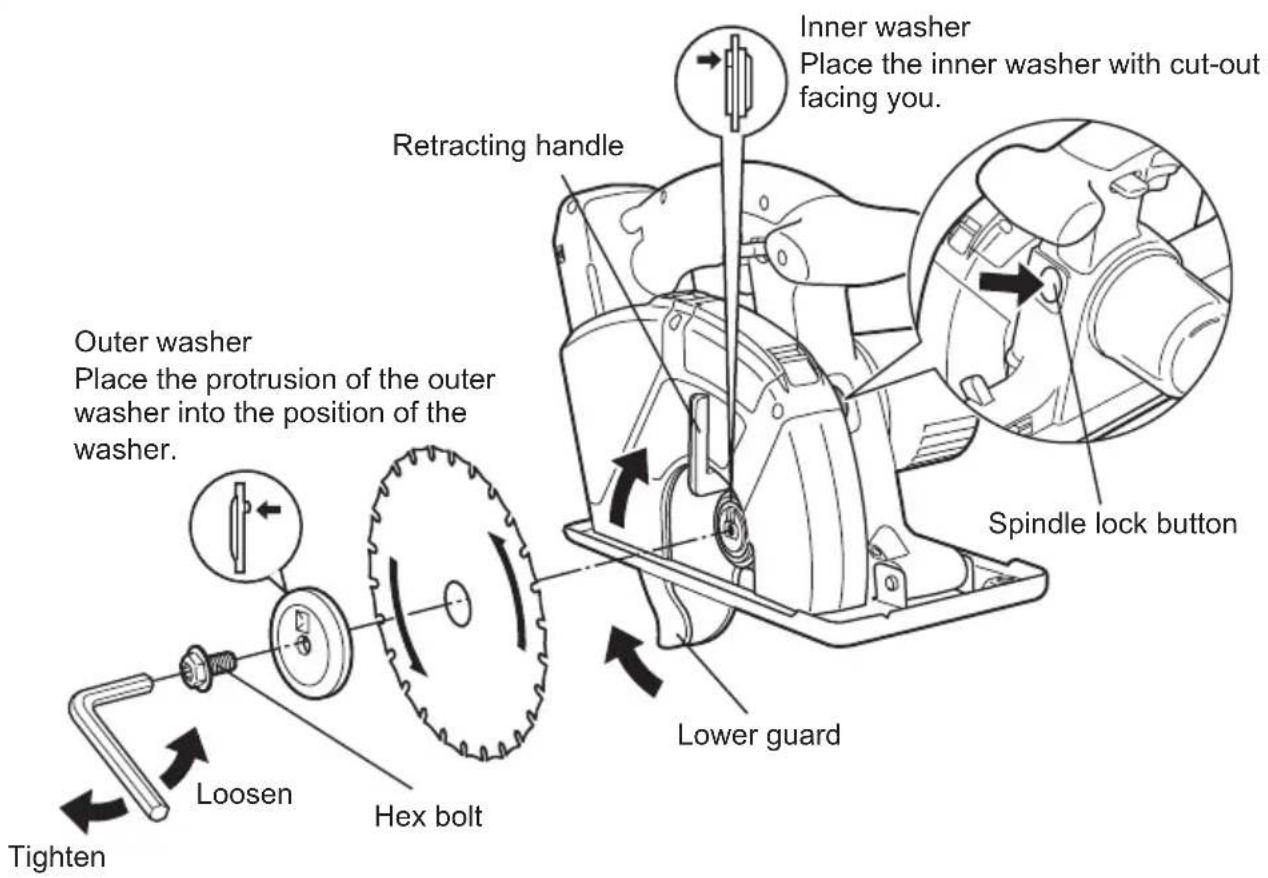
Using the Tool
CAUTION:
To reduce the risk of injury, read the Safety Instructions at the front of this manual before using the tool.
WARNING
To reduce the risk of injury, wear safety goggles or glasses with side shields while using the tool. Additionally, wear a dust mask when cutting materials that generate excessive particulate matter. Do not use the tool in the rain. Doing so may result in electric shock or cause the tool to emit smoke.
Do not cut materials on which there is any paint thinner, gasoline, oil, or similar build-up. Doing so may cause the dust case to crack, resulting in injury.
Follow these steps:
Hold the tool with both hands. (See Fig. 8) Do not attempt to remove cut material when the blade is moving.
- Line up the sight line on the shoe with your cutting line. (See Fig. 7)
Alignment with cutting line
- Position the notch on the shoe over the cutting line, aligning the top and bottom corners of the diamond-shaped opening with the line. As the cutting position may differ depending on the blade, do a trial cut beforehand.
Fig. 7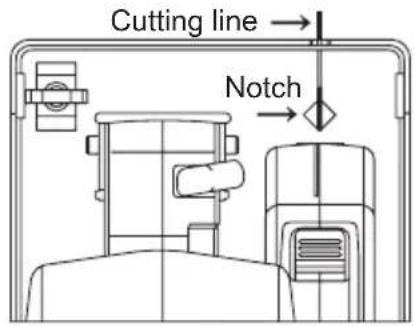
- Press the switch lock lever down, then squeeze the power switch to start the motor, and then release the switch lock lever.
Fig. 8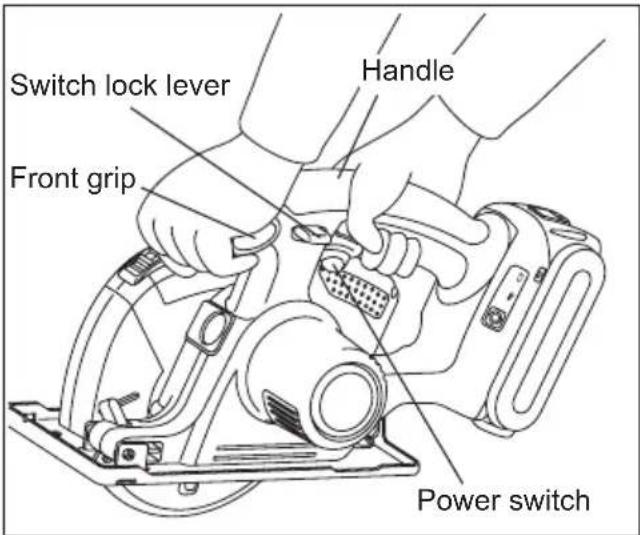
CAUTION:
- Check that the switch lock lever works. If power switch can be activated without depressing the switch lock lever, discontinue use immediately. Take the tool to an authorized service center. Always hold the handle with one hand and the front grip with the other. (See Fig. 8) Maintain a firm grip and depress the switch fully.
- The blade should not touch the cutting material before you start the motor. Wait until the blade reaches full speed before starting a cut.
- This tool has no provision to lock the power switch in the "ON" position, and you must not attempt to secure it in the "ON" position.
- Start cutting when the blade reaches full speed.
- During cutting, keep your cutting line straight. Move the tool forward at a steady speed, while looking at the tip of the blade through the transparent guard.
WARNING
- To prevent dangerous kickback, keep the shoe of the tool flat on the surface of the material being cut.
- Never force the tool. Use light and continuous pressure.
- If the motor becomes too warm, stop cutting. Let the tool cool down before continuing work.
- It is always a safe practice to remove the battery pack after use and before storing the tool.
Cutting depth adjustment
- Remove battery pack.
- Loosen the depth adjustment nut and adjust the cutting depth, using the graduations on the lower guard to gauge the depth. Once finished adjusting the depth, tighten the depth adjustment nut securely.
- When wood material is 10 mm (3/8") or less thick, adjust the cutting depth so that the blade protrudes approx. 5 mm (3/16") from the bottom of the material.
Fig. 9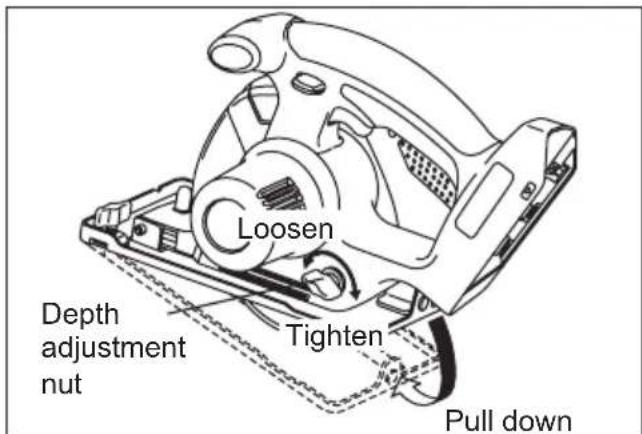
Rip fence (EY3500B7727)
(Available as an accessory, not included) Rip fence is convenient for rip cuts and repeated cuts of uniform width.
- Remove battery pack.
- Insert rip fence and adjust cutting width. (See Fig. 10)
- Fasten screw securely to fix rip fence.
Fig. 10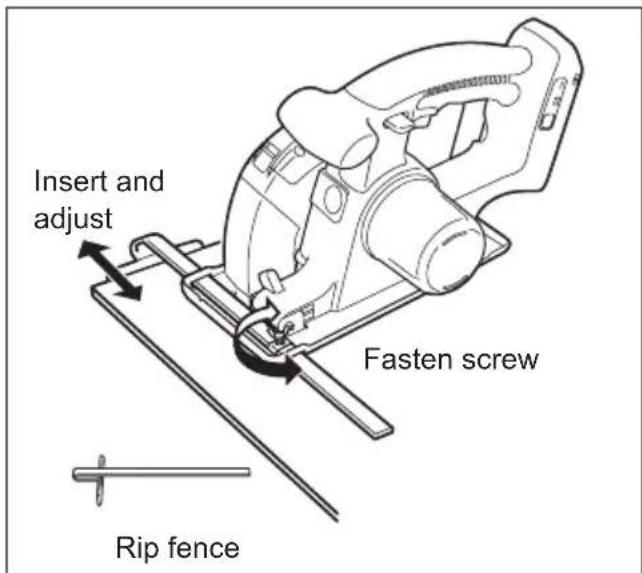
Collecting Dust
WARNING
- Before cutting metal materials, always empty the dust case, open the front cover and remove the dust.
- Use the tool with the dust case attached when cutting metal materials to prevent fire.
- When cutting metal materials, always use the tool with the dust case attached.
- Flying sparks and metal chips may cause injury.
- When cutting metal materials, do not attach a vacuum cleaner.
Sparks and hot metal chips may cause the vacuum to catch fire. Operate the vacuum cleaner in accordance with its instructions.
(1) Collect dust in the dust case.
- Empty the dust case when it is filled up with dust.
- Empty the dust case before storing the tool.
- Dust case capacity
- When cutting electrical conduit with a diameter of 25 mm (1"), approximately 130 cuts
- When cutting 45 mm (1-25/32") x 45 mm (1-25/32") lumber, approximately 150 cuts
NOTE:
Some materials may cause dust to become clogged inside the front cover when cutting those materials.
Fig. 11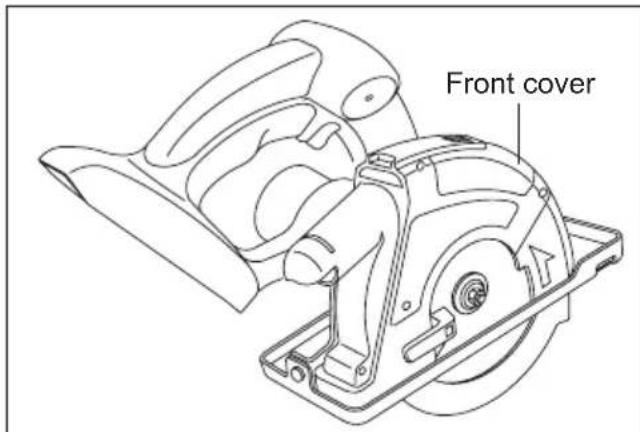
(2) Use with vacuum cleaner to collect dust.
- Connect the tool to the hose using the EY9X012E vacuum cleaner hose adapter (sold separately). Compatible hose inner diameter: 25 mm (1") to 38 mm (1-1/2")
- Operate the vacuum cleaner obeying its instructions.
Fig. 12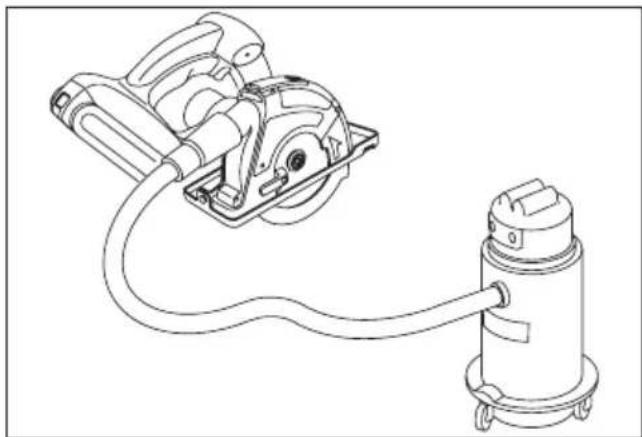
NOTE:
When the tool has difficulty in ejecting or collecting dust, the dust outlet may be clogged with dust. Open the front cover and remove any dust.
Control Panel
(1) (2) (3)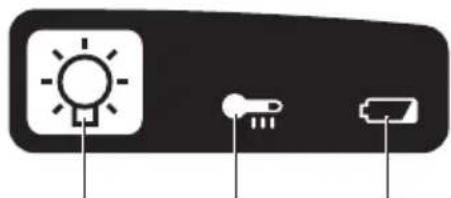
(1) LED light
Fig. 13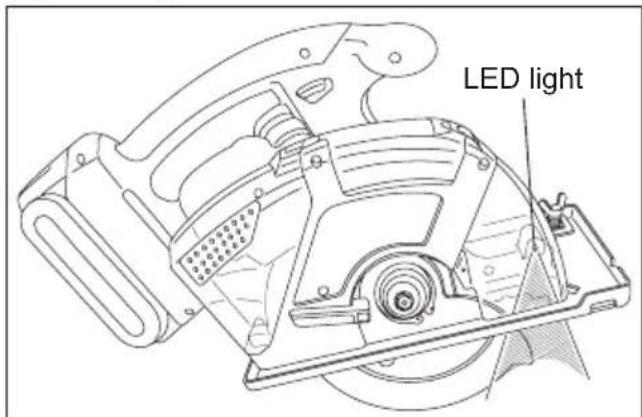
Before the use of LED light, always pull the power switch once.
Press the LED light on button.
The light illuminates with very low current, and it does not adversely affect the performance of the tool during use or its battery capacity.
CAUTION:
- The built-in LED light is designed to illuminate the small work area temporarily.
- Do not use it as a substitute for a regular flashlight, since it does not have enough brightness.
- LED light turns off when the tool has not been used for 5 minutes.
Caution: DO NOT STARE INTO BEAM.
Use of controls or adjustments or performance of procedures other than those specified herein may result in hazardous radiation exposure.
(2) Overheat warning lamp
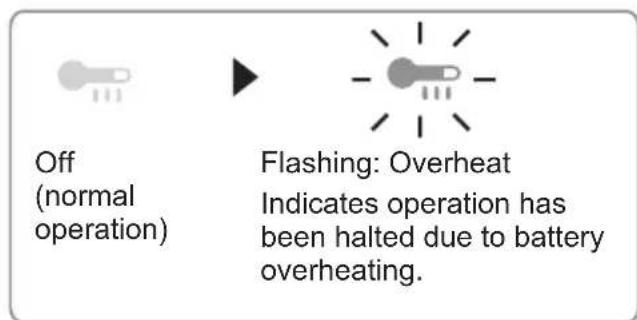
The overheating protection feature halts tool operation to protect the battery pack in the event of overheating. The overheat warning lamp on the control panel flashes when this feature is active.
- If the overheating protection feature activates, allow the tool to cool thoroughly (at least 30 minutes). The tool is ready for use when the overheat warning lamp goes out.
- Avoid using the tool in a way that causes the overheating protection feature to activate repeatedly.
(3) Battery low warning lamp
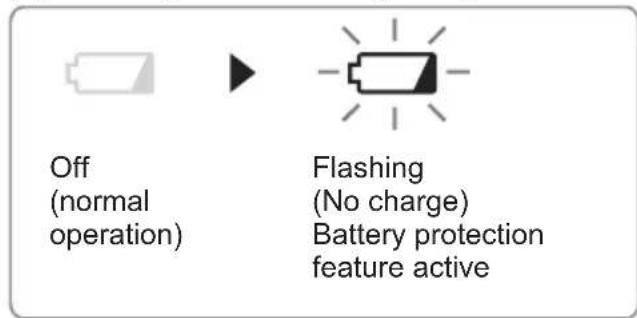
Excessive (complete) discharging of lithium ion batteries shortens their service life dramatically. The tool includes a battery protection feature designed to prevent excessive discharging of the battery pack.
The battery protection feature activates immediately before the battery loses its charge, causing the battery low warning lamp to flash. If you notice the battery low warning lamp flashing, charge the battery pack immediately.
For Proper Use (Further Detail)
WARNING
To prevent the risk of serious personal injury: It is important to use an appropriate device to hold the material being cut properly, and to hold the tool firmly with both hands to prevent loss of control which could cause personal injury. Figure 14 shows proper cutting position. Note that hands are kept away from cutting area. - Make sure bystanders are away from work area and from underneath of workpiece. - When cutting, do not try to hold the material with your hand.
Cutting large sheets;
Support large sheets. Be sure to set the depth of the cut so that you only cut through the workpiece, not through the supports. (See Fig. 15)
Large sheets sag or bend if they are not correctly supported. If you attempt to cut without levelling and properly supporting the workpiece, the blade will tend to bind, causing kickback. (See Fig. 16)
- Don't support the material away from the cut.
Cutting thin or corrugated materials;
Cut thin and corrugated materials at least 25 mm (1") from the edge of the workpiece to avoid injury or damage to the tool caused by thin strips of metal being pulled into the upper guard.
- Use sharp blades only. Clean and sharp blades minimize stalling and kickback.
Fig. 14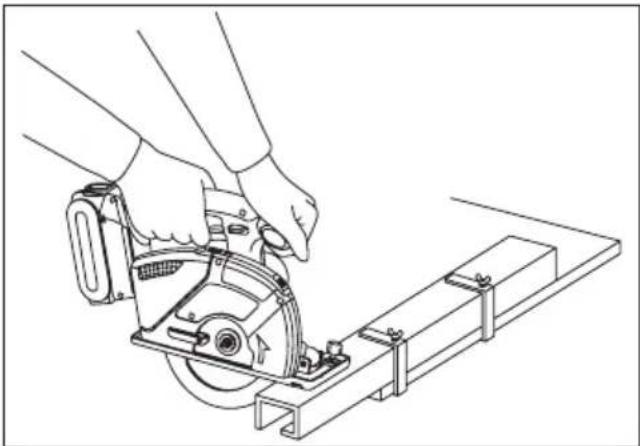
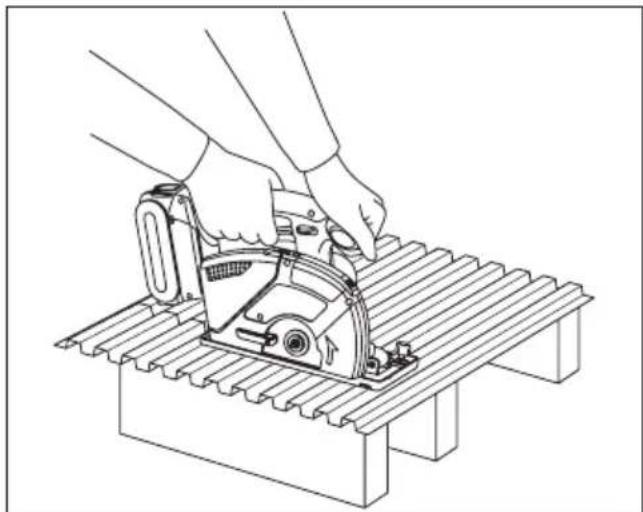
Fig. 15 Fig. 16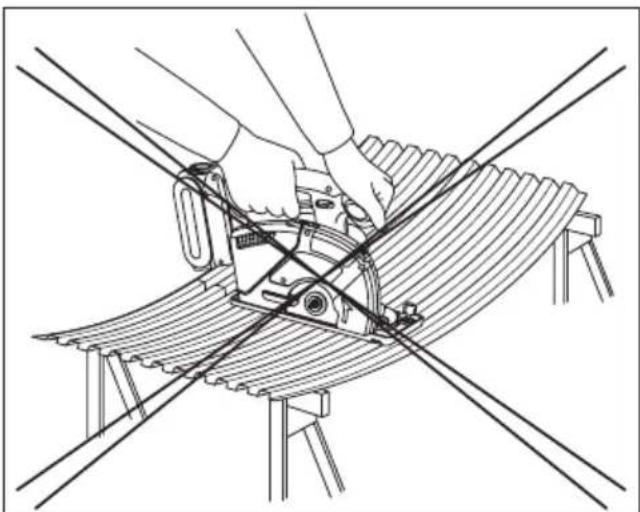
WARNING
To prevent the risk of serious personal injury:
- When making an incomplete cut or cutting is interrupted, or blade is binding or tool is stalling; release the power switch immediately and hold the tool motionless in the material until the blade comes to a complete stop.
- To avoid kickback, never attempt to remove the tool from the work or pull the tool backward while the blade is in motion. Make sure the blade has come to a complete stop, then remove tool from cut.
- To resume cutting, start tool, allow the blade to reach full speed, reenter the cut slowly and resume cutting.
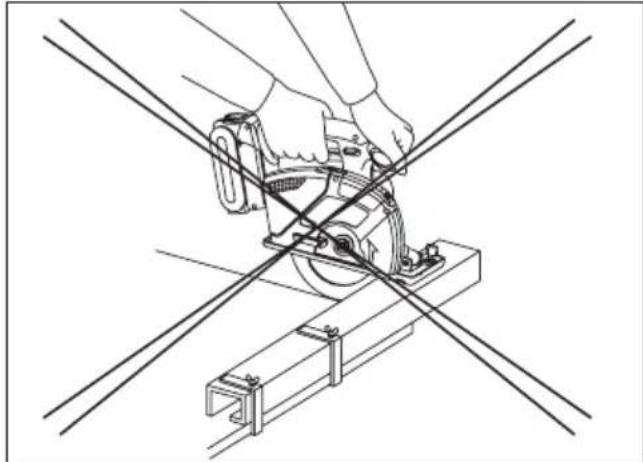
- Place the wider part of the shoe on the part of the work piece which is solidly supported (See Fig. 17), never on the section that will fall off when the cut is made. (See Fig. 18)
Hold the tool firmly to prevent loss of control. Working carelessly can cause severe personal injury.
Fig. 17 Fig. 18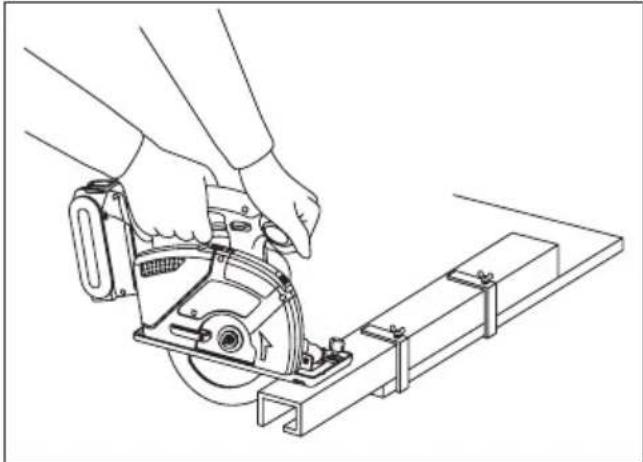
- Make sure the blade stops.
Even though your tool has a brake, before setting the tool down, make sure the blade has come to a complete stop and the lower guard has closed.
- Do not use if anything seems unusual. Remove battery pack immediately.
If the tool body becomes very hot, or does not work properly, remove the battery pack and do not use. Have it checked by an authorized service center.
WARNING
To prevent the risk of serious personal injury or fire, do not try to repair the tool by yourself. Never disassemble or modify the tool body. There are no user-repairable parts inside.
- NEVER ALLOW THE TOOL TO COME IN CONTACT WITH YOUR BODY.
After completing a cut, do not allow the tool to brush against your leg or side.
Since the lower guard is retractable, it could catch on your clothing and expose the blade. Keep clothing away from tool. Be aware of the exposed blade sections that exist in both the upper and lower guard areas.
WARNING
Because cutting metal creates sparks;
Always use safety goggles. Do not use the tool near any flammable substance or in an area where flammable substances are used. Fire and burn injury could result.
- Never engage the spindle lock while the blade is running, or engage it in an effort to stop the tool. Never turn the switch on when the spindle lock is engaged. Serious damage to your tool will result.
[Battery Pack]
For Appropriate Use of Battery Pack
Li-ion Battery Pack (EY9L40/ EY9L41)
- For optimum battery life, store the Li-ion battery pack after use without charging it.
- When charging the battery pack, confirm that the terminals on the battery charger are free of foreign substances such as dust and water, etc. Clean the terminals before charging the battery pack if any foreign substances are found on the terminals.
The life of the battery pack terminals may be affected by foreign substances such as dust and water, etc., during operation.
- When the battery pack is not in use, keep it away from other metal objects like paper clips, coins, keys, nails, screws, or other small metal objects that can make a connection from one terminal to another.
Shorting the battery terminals together may cause sparks, burns, or a fire.
- When operating the battery pack, make sure the work place is well ventilated.
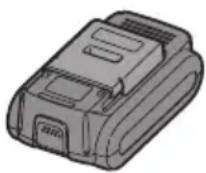
- When the battery pack is removed from the main body of the tool, replace the battery pack cover immediately in order to prevent dust or dirt from contaminating the battery terminals and causing a short circuit.
Battery Pack Life
The rechargeable batteries have a limited life. If the operation time becomes extremely short after recharging, replace the battery pack with a new one.
Battery Recycling
ATTENTION:
For environmental protection and recycling of materials, be sure that it is disposed of at an officially assigned location, if there is one in your country.
[Battery Charger]
Charging
Cautions for the Li-ion Battery Pack
- If the temperature of the battery pack falls approximately below -10°C (14°F), charging will automatically stop to prevent degradation of the battery.
Common Cautions for the Li-ion/Ni-MH/Ni-Cd Battery Pack
The ambient temperature range is between 0°C (32°F) and 40°C (104°F). If the battery pack is used when the battery temperature is below 0°C (32°F), the tool may fail to function properly. - When charging a cool battery pack (below 0°C (32°F)) in a warm place, leave the battery pack at the place and wait for more than one hour to warm up the battery to the level of the ambient temperature. - Cool down the charger when charging more than two battery packs consecutively. - Do not insert your fingers into contact hole, when holding charger or any other occasions.
CAUTION:
To prevent the risk of fire or damage to the battery charger.
- Do not use power source from an engine generator.
- Do not cover vent holes on the charger and the battery pack.
- Unplug the charger when not in use.
Li-ion Battery Pack
NOTE:
Your battery pack is not fully charged at the time of purchase. Be sure to charge the battery before use.
Battery charger (EY0L80)
- Plug the charger into the AC outlet.
NOTE:
Sparks may be produced when the plug is inserted into the AC power supply, but this is not a problem in terms of safety.
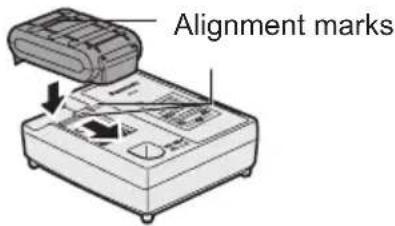
- Insert the battery pack firmly into the charger.
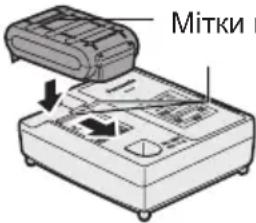
1 Line up the alignment marks and place the battery onto the dock on the charger.
2 Slide forward in the direction of the arrow.
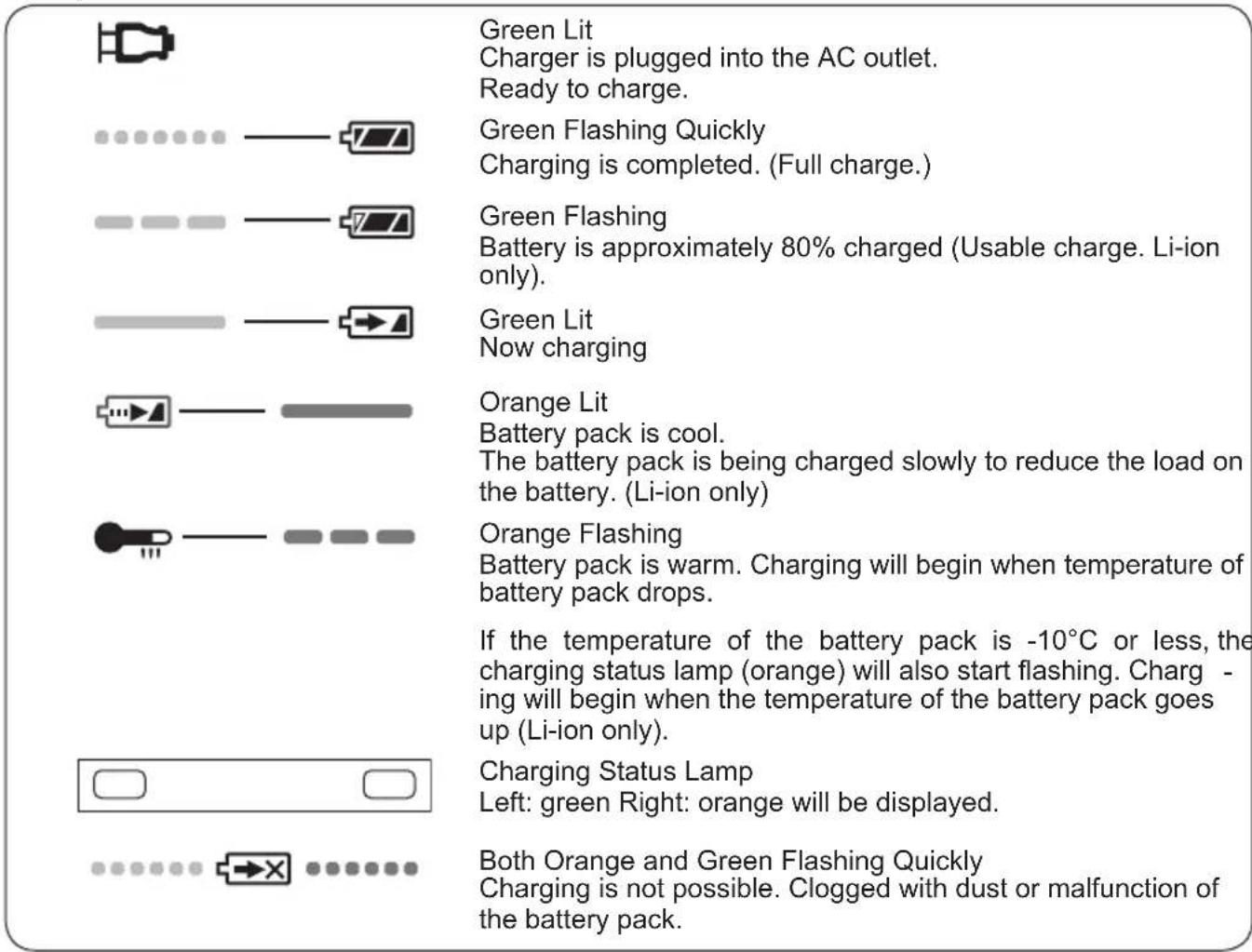
- During charging, the charging lamp will be lit. When charging is completed, an internal electronic switch will automatically be triggered to prevent overcharging.
- Charging will not start if the battery pack is warm (for example, immediately after heavy-duty operation).
The orange standby lamp will be flashing until the battery cools down.
Charging will then begin automatically.
- The charge lamp (green) will flash slowly once the battery is approximately 80% charged.
- When charging is completed, the charging lamp will start flashing quickly in green color.
- If the temperature of the battery pack is 0°C or less, charging takes longer to fully charge the battery pack than the standard charging time.
Even when the battery is fully charged, it will have approximately 50% of the power of a fully charged battery at normal operating temperature.
- If the power lamp does not light immediately after the charger is plugged in, or if after the standard charging time the charging lamp does not flash quickly in green, consult an authorized dealer.
- If a fully charged battery pack is inserted into the charger again, the charging lamp lights up. After several minutes, the charging lamp may flash quickly to indicate the charging is completed.
Ni-MH/Ni-Cd Battery Pack
NOTE:
When you charge the battery pack for the first time, or after prolonged storage, charge it for about 24 hours to bring the battery up to full capacity.
Battery charger (EY0L80)
- Plug the charger into the AC outlet.
NOTE:
Sparks may be produced when the plug is inserted into the AC power supply, but this is not a problem in terms of safety.
- Insert the battery pack firmly into the charger.
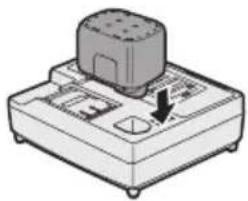
- During charging, the charging lamp will be lit. When charging is completed, an internal electronic switch will automatically be triggered to prevent overcharging.
- Charging will not start if the battery pack is warm (for example, immediately after heavy-duty operation).
The orange standby lamp will be flashing until the battery cools down. Charging will then begin automatically.
- When charging is completed, the charging lamp will start flashing quickly in green color.
- If the charging lamp does not light immediately after the charger is plugged in, or if after the standard charging time the charging lamp does not flash quickly in green, consult an authorized dealer.
- If a fully charged battery pack is inserted into the charger again, the charging lamp lights up. After several minutes, the charging lamp may flash quickly to indicate the charging is completed.
Lamp Indications
Information for Users on Collection and Disposal of Old Equipment and used Batteries
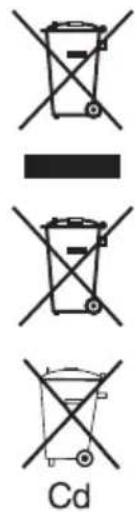
These symbols on the products, packaging, and/or accompanying documents mean that used electrical and electronic products and batteries should not be mixed with general household waste.
For proper treatment, recovery and recycling of old products and used batteries, please take them to applicable collection points, in accordance with your national legislation and the Directives 2002/96/EC and 2006/66/EC.
By disposing of these products and batteries correctly, you will help to save valuable resources and prevent any potential negative effects on human health and the environment which could otherwise arise from inappropriate waste handling.
For more information about collection and recycling of old products and batteries, please contact your local municipality, your waste disposal service or the point of sale where you purchased the items.
Penalties may be applicable for incorrect disposal of this waste, in accordance with national legislation.
For business users in the European Union
If you wish to discard electrical and electronic equipment, please contact your dealer or supplier for further information.
[Information on Disposal in other Countries outside the European Union]
These symbols are only valid in the European Union. If you wish to discard these items, please contact your local authorities or dealer and ask for the correct method of disposal.
Note for the battery symbol (bottom two symbol examples):
This symbol might be used in combination with a chemical symbol. In this case it complies with the requirement set by the Directive for the chemical involved.
V. MAINTENANCE
WARNING
To avoid severe personal injury, always remove the battery pack from the tool before starting any maintenance procedure.
CAUTION:
To assure product SAFETY and RELIABILITY, servicing should be performed by an authorized service center. Always insist on genuine Panasonic replacement parts.
Cleaning Tool
Keep your tool clean for good cutting performance, and to help keep it safe to use.
Follow these steps:
- Remove the battery pack from the tool.
- Wipe the tool with a dry, soft cloth. Do not use a wet cloth or cleaning liquids.
They could damage the tool's finish.
- Be sure to rub off any oil or grease which could make the tool slippery or hard to handle.
- Remove the blade and brush off any dust.
CAUTION:
To avoid injury or damage to the unit, never immerse any part of the tool in a liquid.
Transparent Guard
WARNING
If the guard is cracked or broken, take the tool to an authorized service center for replacement.
Do not attempt to operate the tool. It could result in serious personal injury.
Never use your tool with a damaged transparent
guard or without the transparent guard installed.
Flying chips could result in serious injury.
VI. ACCESSORIES
WARNING
- The use of any accessories not specified in this manual may result in fire, electric shock, or personal injury. Use recommended accessories only.
- Use of a blade on material that is thicker or thinner than that recommended for that blade will result in a rough cut, and could increase the risk of "kickback" or other injury.
Carbide-tipped Blade for Metal
- EY9PM13C
For cutting unhardened ferrous material
Thickness of material
0.5 mm - 6.0 mm (1/32" - 1/4")
Carbide-tipped Blade for Thin Metal (Optional accessory)
- EY9PM13D
For cutting unhardened thin ferrous material that requires a clean cutting edge
Thickness of material
0.5mm - 6.0mm (1 / 32 - 1 / 4 )
Carbide-tipped Blade for Wood (Optional accessory)
- EY9PW13A
For cutting wood in general
Carbide-tipped Blade for Thin Wood (Optional accessory)
- EY9PW13B
For cutting thin wood that requires a clean cutting edge
Recommended material thickness up to 12 mm
Carbide-tipped Blade for Plastic (Optional accessory)
- EY9PP13B
For cutting plastic
Recommended material thickness for acrylic and vinyl chloride plates:
2.0 mm - 5.0 mm (5/64" - 3/16")
corrugated plates, pipes
0.8 mm - 5.0 mm (1/32" - 3/16")
Vacuum hose adaptor (Optional accessory)
- EY9X012E
Rip Fence (Optional accessory)
- EY3500B7727
For convenience of rip cuts and repeated cuts of uniform width
VII. SPECIFICATIONS
| Motor voltage 14.4 V DC | |
| Blade speed 3600 min | -1 (rpm) |
| Blade size Outside diameter 135 mm (5-3/8") Arbor size 20 mm (25/32") | |
| Maximum cutting depth 0 – 46 mm (0" – 1- | 13/16") (φ135 mm blade) |
| Overall length 329 mm (12-61/64") | |
| Weight (with battery pack: EY9L40/EY9L41) | 2.65 kg (5.7 lbs) |
| Noise Vibration | See the included sheet. |
BATTERY PACK
| Model EY9L40 EY9L41 | ||
| Storage battery Li-ion Battery | ||
| Battery voltage 14.4 V DC (3.6 V × 4 cells) | ||
| Capacity | 3 Ah | 3.3 Ah |
BATTERY CHARGER
| Model | EY0L80 |
| Rating | See the rating plate on the bottom of the charger. |
| Weight 0.95 kg (2.1 lbs) |
[Li-ion battery pack]
| Charging time | 3 Ah | 14.4 V | 21.6 V | 28.8 V |
| EY9L40 | EY9L60 | EY9L80 | ||
| Usable: 35 min. | Usable: 45 min. | Usable: 55 min. | ||
| Full: 50 min. | Full: 60 min. | Full: 70 min. |
| Charging time | 3.3 Ah | 14.4 V | ||
| EY9L41 | ||||
| Usable: 45 min. | ||||
| Full: 60 min. |
[Ni-Cd/Ni-MH battery pack]
| Charging time | 7.2 V | 9.6 V 12 | V 15.6 V 18 | V 24 V | |||
| 1.2 Ah | EY9065 | EY9080 | EY9001 | ||||
| EY9066 | EY9086 | ||||||
| 20 min. | |||||||
| 1.7 Ah | EY9180 | EY9101 | |||||
| EY9182 | EY9103 | ||||||
| 25 min. | |||||||
| 2 Ah | EY9168 E | Y9188 | EY9106 | EY9136 | EY9116 | ||
| EY9107 | EY9117 | ||||||
| 30 min. | 60 min. | ||||||
| 3 Ah | EY9200 | EY9230 | EY9210 | ||||
| 45 min. | 90 min. | ||||||
| 3.5 Ah | EY9201 | EY9231 | EY9251 | ||||
| 55 min. | 65 min. | ||||||
NOTE: This chart may include models that are not available in your area. Please refer to the latest general catalogue.
NOTE: For the dealer name and address, please see the included warranty card.
ONLY FOR U.K.
VIII ELECTRICAL PLUG INFORMATION
FOR YOUR SAFETY PLEASE READ THE FOLLOWING TEXT CAREFULLY
This appliance is supplied with a moulded three pin mains plug for your safety and convenience.
A 3 amp fuse is fitted in this plug.
Should the fuse need to be replaced please ensure that the replacement fuse has a rating of 3 amp and that it is approved by ASTA or BSI to BS1362.
Check for the ASTA mark or the BSI mark on the body of the fuse.
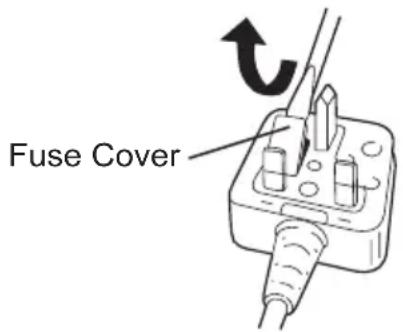
If the plug contains a removable fuse cover you must ensure that it is refitted when the fuse is replaced.
If you lose the fuse cover the plug must not be used until a replacement cover is obtained.
A replacement fuse cover can be purchased from your local Panasonic Dealer.
IF THE FITTED MOULDED PLUG IS UNSUITABLE FOR THE SOCKET OUTLET IN YOUR HOME THEN THE FUSE SHOULD BE REMOVED AND THE PLUG CUT OFF AND DISPOSED OF SAFELY.
THERE IS A DANGER OF SEVERE ELECTRICAL SHOCK IF THE CUT OFF PLUG IS INSERTED INTO ANY 13 AMP SOCKET.
If a new plug is to be fitted please observe the wiring code as shown below.
If in any doubt please consult a electrician.
IMPORTANT:
The wires in this mains lead are coloured in accordance with the following code:
Blue: Neutral
Brown: Live
As the colours of the wire in the mains lead of this appliance may not correspond with the coloured markings identifying the terminals in your plug, proceed as follows.
The wire which is coloured BLUE must be connected to the terminal in the plug which is marked with the letter N or coloured BLACK.
The wire which is coloured BROWN must be connected to the terminal in the plug which is marked with the letter L or coloured RED.
Under no circumstances should either of these wires be connected to the earth terminal of the three pin plug, marked with the letter E or the Earth Symbol.
How to replace the fuse: Open the fuse compartment with a screwdriver and replace the fuse and fuse cover if it is removable.
This apparatus was produced to BS800.
qualified
I. INTRODUCTION
0.5 mm - 6.0 mm (1/32"-1/4")
0.5 mm - 6.0 mm (1/32"-1/4")
2.0 mm - 5.0 mm (5/64" - 3/16")
Corrugated sheets, pipes
0.8 mm - 5.0 mm (1/32" - 3/16")
2.0 mm - 5.0 mm (5/64" - 3/16")
Li-ion battery pack
NOTE:
2.0 mm - 5.0 mm (5/64" - 3/16")
sheets, corrugated pipes
0.8 mm - 5.0 mm (1/32" - 3/16")
[Li-ion battery pack]
| Tempo di caricamento | 3 Ah | 14,4 V 21,6 V 28,8 V | ||
| EY9L40 | EY9L60 | EY9L80 | ||
| Utilizzabile: 35 min. | Utilizzabile: 45 min. | Utilizzabile: 55 min. | ||
| Completa: 50 min. | Completa: 60 min. | Completa: 70 min. | ||
| Tempo di caricamento | 3,3 Ah | 14,4 V | ||
| EY9L41 | ||||
| Utilizzabile: 45 min. | ||||
| Completa: 60 min. |
[Ni-MH/Ni-Cd battery pack]
| Tempo di caricamento | 7,2 V | 9,6 V 12 | V 15,6 V 18 | V 24 V | |||
| 1,2 Ah | EY9065 | EY9080 | EY9001 | ||||
| EY9066 | EY9086 | ||||||
| 20 min. | |||||||
| 1,7 Ah | EY9180 | EY9101 | |||||
| EY9182 | EY9103 | ||||||
| 25 min. | |||||||
| 2 Ah | EY9168 EY9188 | EY9106 | EY9136 | EY9116 | |||
| EY9107 | EY9117 | ||||||
| 30 min. | EY9108 | 60 min. | |||||
| 3 Ah | EY9200 | EY9230 | EY9210 | EY9210 | |||
| 45 min. | 90 min. | ||||||
| 3,5 Ah | EY9201 | EY9231 | EY9251 | EY9251 | |||
| 55 min. | 65 min. | ||||||
2.0 mm - 5.0 mm (5/64" - 3/16")
How to use this manual
2.0 mm - 5.0 mm (5/64" - 3/16")
2.0 mm - 5.0 mm (5/64" - 3/16")
2.0 mm - 5.0 mm (5/64" - 3/16")
Recommended material thickness for corrugated plates or pipes:
0.8 mm - 5.0 mm (1/32" - 3/16")
Hose adapter for vacuum cleaner (optional accessory)
- EY9X012E
Backing pad (optional accessory)
·EY3500B7727
2.0 mm - 5.0 mm (5/64" - 3/16")
corrugated plates, pipes
0.8 mm - 5.0 mm (1/32" - 3/16")
Hose connection for vacuum cleaner (accessory)
- EY9X012E Rip fence (accessory)
- EY3500B7727
2.0 mm - 5.0 mm (5/64" - 3/16")
corrugated sheets, pipes
0.8 mm - 5.0 mm (1/32" - 3/16")
Kickback is the result of improper use of the saw or incorrect operating procedures or conditions.
Kickback can be avoided by taking proper precautions as given below.
1) Maintain a firm grip with both hands on the saw and position your body and arm to allow you to resist kickback forces. Always stand to either side of the blade, never in line with the blade. Kickback could cause the saw to jump backwards, but kickback forces can be controlled by the operator, if proper precautions are taken. 2) When the blade is binding, or when interrupting a cut for any reason, release the trigger and hold the saw motionless in the material until the blade comes to a complete stop. Never attempt to remove the saw from the work or pull the saw backward while the blade is moving, as kickback may occur. Investigate and take corrective actions to eliminate the cause of blade binding. 3) When restarting a saw in the workpiece, center the saw blade in the kerf and check that the teeth are not engaged in the material. If the blade binds, it may cause kickback when the saw is restarted. 4) Support large panels to minimize the risk of blade pinching and kickback.
Large panels tend to sag under their own weight. Supports must be placed under the panel on both sides, near the line of cut and near the edge of the panel.
5) Do not use dull or damaged blades.
Unsharpened or improperly set blades produce narrow kerf, causing excessive friction, blade binding, and kickback.
6) Blade depth and bevel adjusting locking levers must be tight and securely locked before making the cut.
If the blade adjustment shifts while cutting, it may cause binding and kickback.
7) Use extra caution when making a "plunge cut" into existing walls or other blind areas. The protruding blade may cut objects that could cause kickback.
1) Before starting the saw, check the correct closing of the lower guard every time. Do not operate the saw if the lower guard does not move freely and close instantly. Never clamp the lower guard in the open position with clamps or clamps. In case of a fall, the lower guard may bend. Raise the lower guard with the retracting handle and make sure that it moves freely at any cutting depth and does not touch the blade or any other part. 2) Check the functioning of the lower guard spring. If the guard and the spring do not function reliably, they must be repaired before use. The lower guard may function too slowly due to damaged parts, accumulated dirt, or debris. 3) The lower guard must be opened manually only for special cuts, such as "plunge cuts" and "compound cuts". Raise the lower guard with the retracting handle and release it as soon as the blade enters the material. For all other cuts, the lower guard must operate automatically. 4) Do not forget to check that the lower guard covers the blade tightly before placing the saw on the workbench or floor. An unprotected blade that continues to rotate by inertia will become a hazard, as the saw will cut everything that comes in its path when moving in the reverse direction.
Remember that it takes some time for the blade to stop after switching off.
5) Do not use any abrasive discs. 6) Wear a protective mask if cutting parts produces dust. 7) The history of the saw is lost. 8) Wear safety glasses when using the tool for an extended period of time. 9) The risk of injury increases when the battery pack is discharged. 10) Carefully follow the material. Avoid cutting other materials. 11) Be careful not to drop the tool. 12) Never suspend the tool. 13) Never block the ventilation openings and keep them free from dust and other materials. 14) Do not clamp the tool in a vise. Never perform cutting with the tool clamped in a vise in an inverted position. This is extremely dangerous and can lead to serious accidents. 15) Never wear loose-fitting gloves. 16) When using at height, make sure no one is below. 17) Do not touch the sole plate immediately after use. It may be hot and burn the skin. 18) Do not touch the material after it has been cut. The cut material may be very hot. 19) Do not use emulsion oil. Such use of emulsion oil may cause a fire. 20) Do not cut workpieces coated with or containing benzene, oil, solvents, thinners, etc. The effect of these materials may damage the transparent protective device. 21) Do not remove the transparent protective device. If the transparent protective device is damaged or missing, return the tool to an authorized service center for replacement.
22) Do not switch on the tool if the blade touches the workpiece. Wait until the blade reaches full speed before starting to cut. 23) In accordance with the Federal Law of Russia "On Protection of Consumer Rights", the service life for this product is 7 years, 1200 charges (only for the battery pack) from the date of manufacture, provided that the product is used strictly in accordance with this instruction manual and applicable technical standards. Panasonic Electric Works Co., Ltd.
Symbols
Be careful not to cut your hands with the blade.
When disposing of the blade, wrap it in paper or cardboard. This will help prevent cuts to anyone who handles the discarded blade.
C
Adjusting the cutting depth
Remove the battery pack. Loosen the depth adjustment knob and adjust the cutting depth using the graduations for depth measurement on the lower protective device. After completing the depth adjustment, tighten the depth adjustment knob. * If the thickness of the wood is 10 mm (3/8 inch) or less, adjust the cutting depth so that the blade protrudes approximately 5 mm (3/16 inch) from the underside of the material.
Fig.9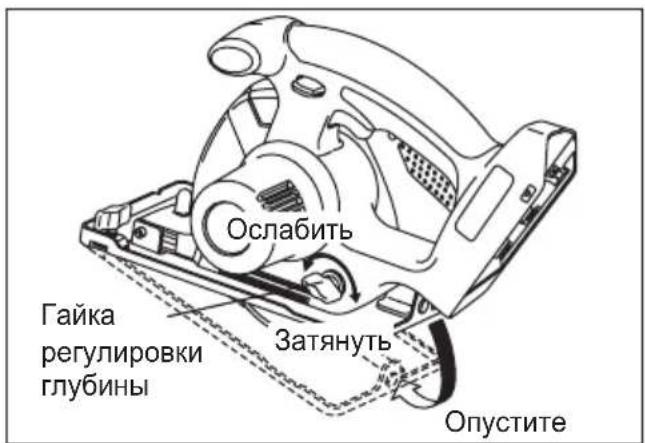
(With the exception of the blade, not included in the kit)
The guide plate for cutting is adjusted to the cutting depth.
- Remove the battery pack. Insert the correct guide plate and adjust the cutting depth. (See Fig. 10) Securely tighten the screw to fix the guide plate.
Fig. 10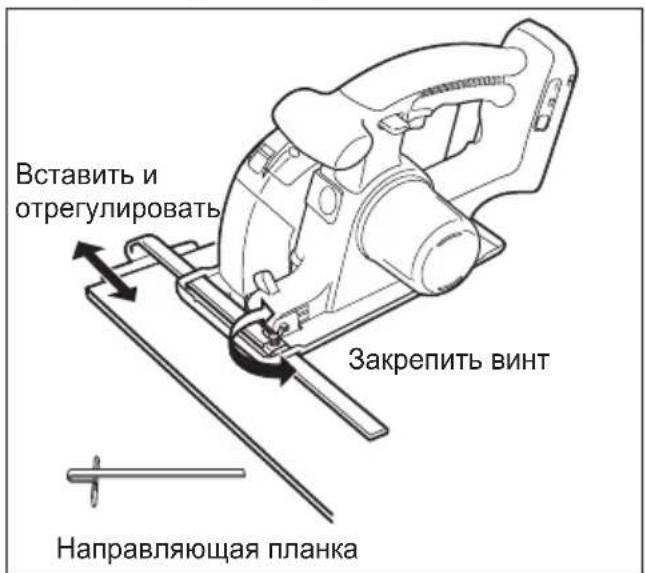
Dust collection
CAUTION
*Always empty the dust collector before cutting metal. Open the front protective device and remove the dust. Using the saw with flammable materials in the dust collector during metal cutting may cause a fire.
- When cutting metal, always use a saw with the dust collector attached.
- Flying sparks and metal chips can cause injury.
- Do not connect the vacuum cleaner when cutting metal.
Sparks and hot metal chips can cause the vacuum cleaner to catch fire. When working with the vacuum cleaner, follow all its instructions.
(1) Collect dust with the dust collector.
- Fill the dust bag completely.
- Empty the dust bag before storage.
- Dust bag capacity
- When cutting an electric conduit with a diameter of 25 mm (1 inch), approximately 130 cuts - When cutting a wooden beam with dimensions 45 mm (1-25/32 inches) x 45 mm (1-25/32 inches), approximately 150 cuts
NOTE:
When cutting certain materials, dust may accumulate on the inner surfaces of the front cover.
Fig. 11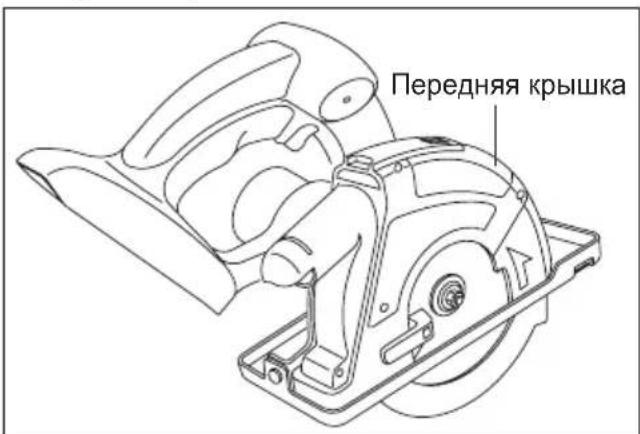
(2) Using the vacuum cleaner to collect dust.
* Connect the cutting tool to the vacuum cleaner using the adapter EY9X012E for the vacuum cleaner hose (sold separately).
Inner diameter of compatible hose: from 25 mm (1 inch) to 38 mm (1-1/2 inches)
- When working with the vacuum cleaner, follow all its instructions.
Fig. 12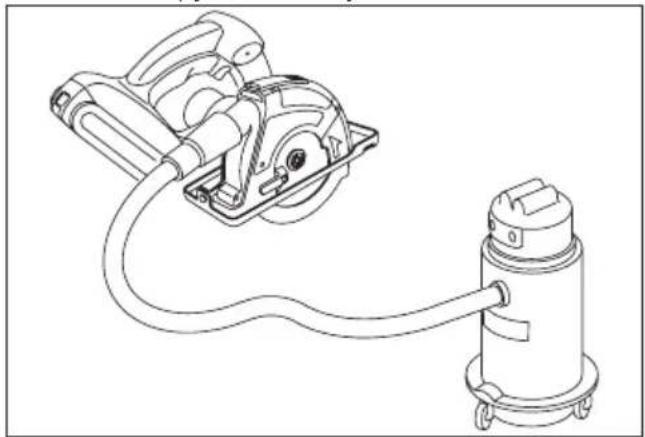
NOTE:
When replacing the blade or collecting dust, difficulties may arise. It is possible that the dust extraction hole is clogged with dust. Open the front cover completely and remove the dust.
Control panel
(1) (2) (3)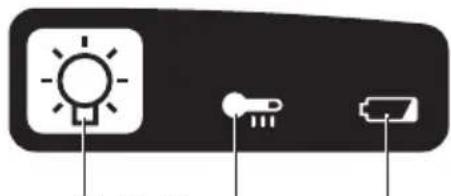
(1) Work light
Fig. 13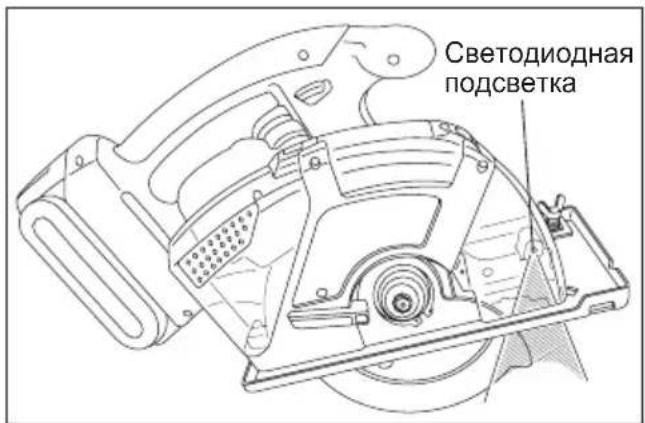
Always press the trigger switch before using the work light. Press the switch to turn the work light on/off. The light operates at a low current and does not adversely affect the tool's performance or battery capacity during operation.
CAUTION:
The work light is intended for temporary illumination of a small work area.
Do not use it as a substitute for a permanent light, as it is not bright enough. - If the tool is not used for 5 minutes, the work light will turn off.
Caution: Do not look into the light beam.
Using the control panel for adjustments, as described in this manual, may result in exposure to hazardous radiation.
(2) Overheat warning lamp
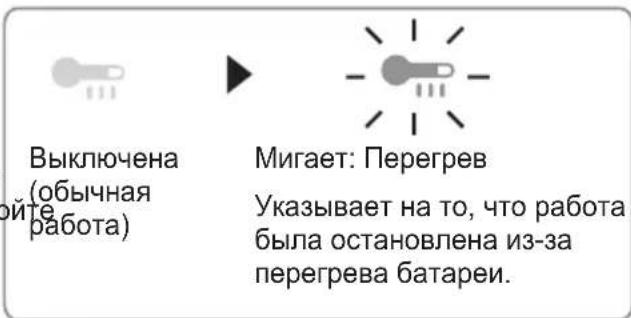
The overheat protection function stops the tool to protect the battery block in case of overheating. During operation of this function, the overheat warning lamp on the control panel will blink.
If the overheat protection function is activated, let the tool cool down completely (at least for 30 minutes). The tool will be ready for operation when the warning lamp goes off. - Avoid using the tool in a way that frequently triggers the overheat protection function.
Use only sharp blades. Clean and sharp blades reduce clogging and improve performance.
Fig. 14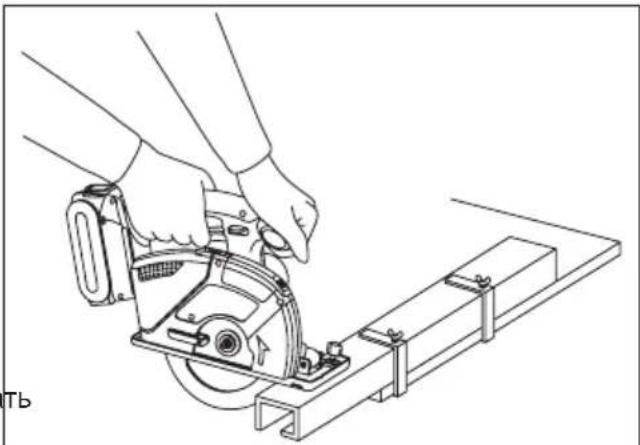
Fig. 15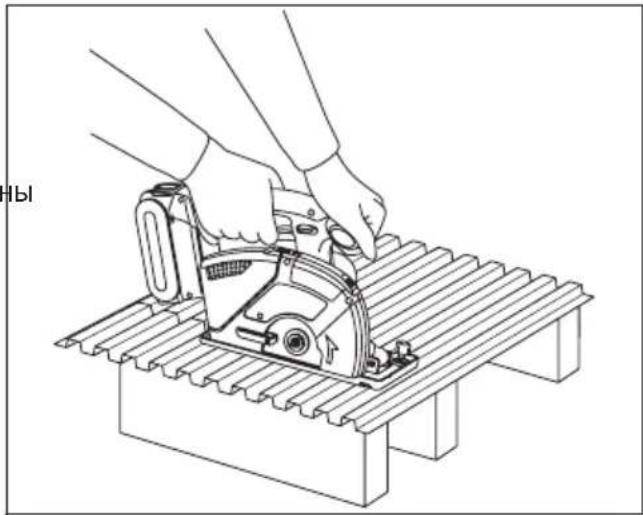
Fig. 16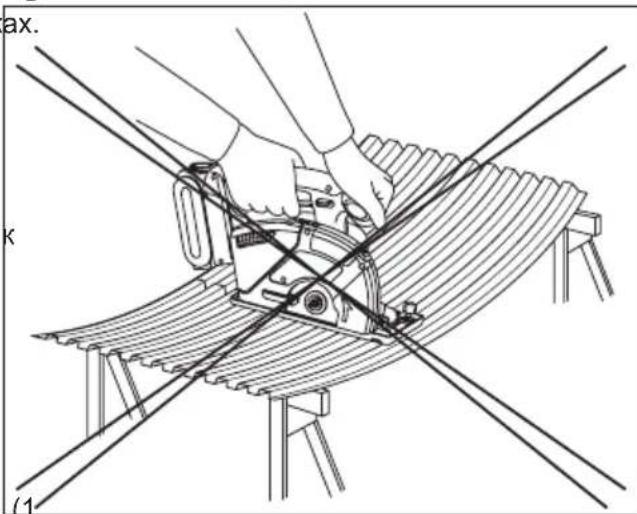
WARNING
Procedure for turning the saw seriously injured:
- If cutting is not completed or is interrupted, or the blade binds, or the cut stalls; immediately release the power switch and hold the blade stationary in the material until the blade has completely stopped.
- To avoid kickback, never attempt to pull the blade out of the workpiece or pull the blade backwards while it is still rotating. Make sure the blade has completely stopped, then remove the blade from the cut.
- To resume cutting, turn on the saw, let the blade reach full speed, then slowly re-enter the cut and resume cutting.
- Place the wider part of the base on the part of the workpiece that is firmly supported (see Fig. 17), never place it on the part that will fall off when the cut is made (see Fig. 18). Hold the saw firmly to prevent loss of control. Careless handling may result in serious injury.
Fig. 17 Fig. 18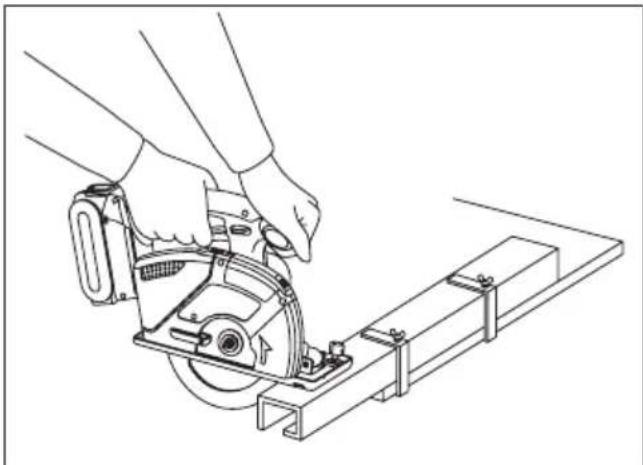
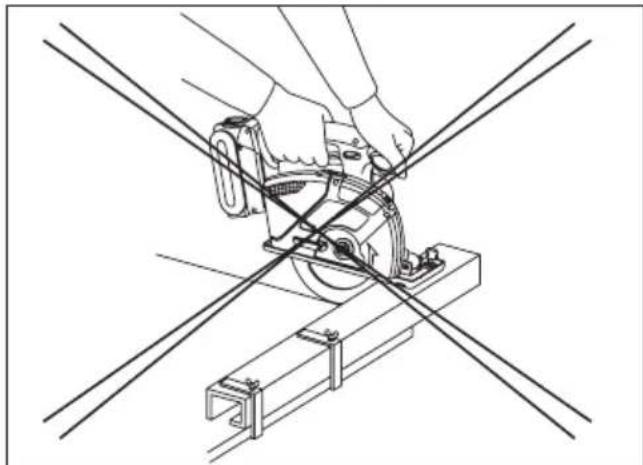
- Make sure the blade has completely stopped.
Although this tool is equipped with a brake, before putting the tool down, make sure the blade has completely stopped and the lower guard is closed.
- Do not use the tool if anything seems unusual. Immediately remove the battery block.
If the tool body heats up strongly and the tool does not work properly, remove the battery pack and do not use it. Contact the service center for inspection.
CAUTION
To prevent the risk of serious injury or fire, do not attempt to repair the tool yourself. Never disassemble or modify the tool body. There are no parts inside that are intended for user repair.
- NEVER ALLOW THE SAW BLADE TO COME INTO CONTACT WITH YOUR BODY.
After finishing cutting, do not allow the saw blade to come into contact with your leg or your side.
Since the lower protective device is a retractable type, it may get caught on clothing and pull the fabric. Keep the tool away from clothing. Do not forget about the exposed parts of the fabric in the area of both the upper and lower protective devices.
CAUTION
Since cutting metal is accompanied by sparks;
Always wear protective glasses. Do not use the tool near any flammable substances or in places where flammable materials are used. This can lead to fire and burns.
- Never press on the blade lock during the movement of the saw blade or try to stop the tool in this way. Never turn on the switch with the blade lock engaged. This will lead to serious damage to the tool.
[Battery packs]
- If the battery pack is not in use, keep it away from metal objects such as paper clips, coins, keys, nails, screws, or other small metal objects that can make a connection from one terminal to another.
Storing battery packs together can be a cause of sparks, burns, or fire.
During work with the battery pack, make sure the work area is well ventilated. - When removing the battery pack from the main body of the tool, immediately replace the cover of the battery pack to prevent contamination of the terminals with dust, which can cause a short circuit.
![PANASONIC EY4542 - [Battery packs] - 1](/content/2026/03/454645/images/2325f8bc930e08561e62cebf3221d34b68bae354c2fe03412bd69a0c0713df63.jpg)
Service life of the battery pack
Rechargeable batteries have a limited service life. If the operating time becomes excessively short after charging, replace the battery pack with a new one.
Battery disposal
WARNING:
To protect the environment and dispose of materials properly, make sure to dispose of the battery at an officially designated location, if such facilities exist in your country.
[Charging device] Charging
Precautions for the lithium-ion battery pack
- If the temperature of the battery pack drops below approximately -10°C (14°F), charging will automatically stop to prevent deterioration of battery characteristics.
Precautions for the lithium-ion/nickel-metal hydride/nickel-cadmium battery pack
The ambient temperature range is from 0°C (32°F) to 40°C (104°F).
If the battery pack will be used at temperatures below 0°C (32°F), the tool may not function properly.
- When charging a cold battery pack (with a temperature below 0°C (32°F)) in a warm place, leave the battery pack in that place and wait for more than one hour until the battery warms up to the ambient temperature level. - Cool the charging device after charging more than two battery packs in succession. Do not insert your fingers into the contact holes when holding the charging device, and also in other situations.
WARNING:
To prevent the risk of fire or damage to the charging device.
Do not use a generator or power supply as a power source. Do not block the ventilation holes on the charging device and battery pack. - Unplug the charging device from the electrical outlet if it is not in use.
Lithium-ion battery pack NOTE:
The battery block may not be charged at the time of purchase. Do not forget to charge it before use.
Charging device (EY0L80)
- Plug the charging device into a household AC outlet.
C
Indicator lights
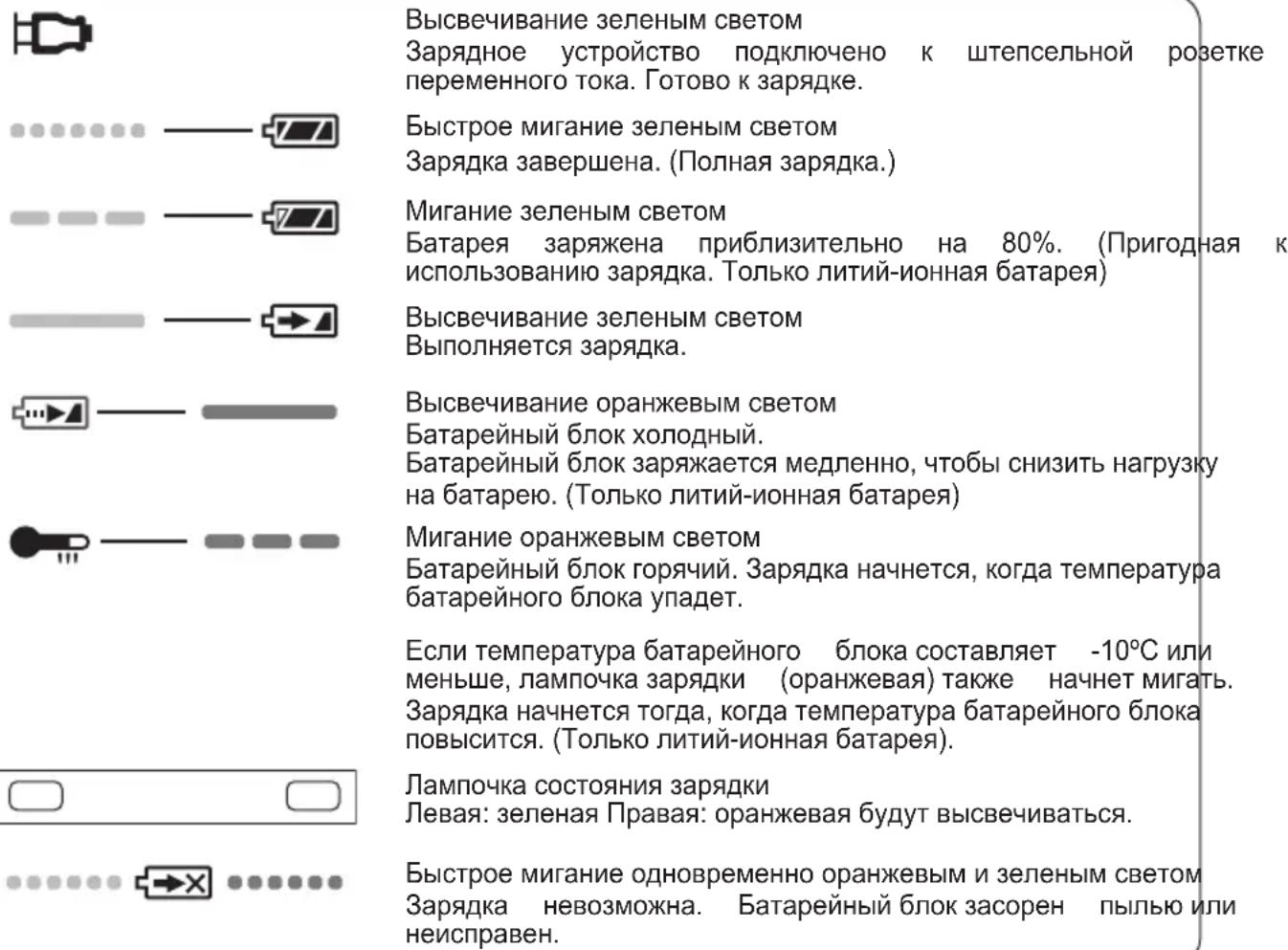
Information on disposal for countries not in the European Union
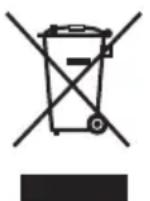
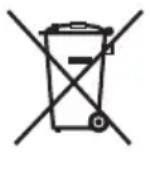
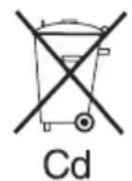
The effect of these symbols applies only to the European Union.
If you intend to dispose of these elements, contact local authorities or dealers to learn how to dispose of this type of waste.
V. MAINTENANCE
CAUTION
To avoid risk of injury, always remove the battery block from the tool before any maintenance procedure.
NOTE:
For continued safety and reliability, maintenance should be performed by an authorized service center. Always insist on the use of genuine Panasonic spare parts.
Cleaning the tool
Keep the tool clean to maintain good cutting performance and safe operation.
Follow the instructions:
- Remove the battery block from the instrument.
- Wipe the instrument with a dry, soft cloth. Do not use a damp cloth or cleaning liquids.
They may damage the blade coating.
- Be sure to remove all lubricants or oil that could make the instrument slippery or heavy for handling.
- Remove the blade and wipe off dust.
WARNING:
To avoid damage or injury, never immerse any part of the instrument in liquids.
Transparent protective guard
CAUTION
In case of cracks or breakage of the protective guard, contact an authorized service center for its replacement. Do not attempt to work with the blade. This may lead to serious injury. Never use the blade with a damaged transparent protective guard or without the protective guard installed. Loose parts may lead to serious injury.
Accessories
CAUTION
- Use of accessories not listed in this manual may lead to fire, electric shock, or injury. Use only recommended accessories.
- Use of a cutting mat that is not recommended for the intended material may lead to uneven cuts, increase the risk of kickback, or cause other injury.
Solid carbide saw blade for cutting metal - EY9PM13C
Cutting hardened black metal, material thickness
0.5mm-6.0mm (1/32 inch - 1/4 inch)
Solid carbide saw blade for cutting thin metal (accessory) - EY9PM13D
Cutting thin hardened black metal, if a clean edge is required, material thickness
0.5mm-6.0mm (1/32 inch - 1/4 inch)
Solid carbide saw blade for cutting wood (accessory)
- EY9PW13A mainly for cutting wood
Solid carbide saw blade for cutting thin wood (accessory) - EY9PW13B
Cutting thin wood, if a clean edge is required
Recommended material thickness - 1 to 12 mm
Solid carbide saw blade for cutting plastic (accessory)
- EY9PP13B
For cutting plastic, recommended thickness of acrylic sheets and corrugated sheets: 2.0 mm - 5.0 mm (5/64 inch - 3/16 inch), corrugated sheets, pipes 0.8 mm - 5.0 mm (1/32 inch - 3/16 inch)
Dust extraction adapter (accessory) - EY9X012E
Spare blade (additional accessory)
·EY3500B7727
For convenient cutting of grooves and repeated cuts of the same width
VII. TECHNICAL SPECIFICATIONS
Battery block contents, when not in use
Fig. 2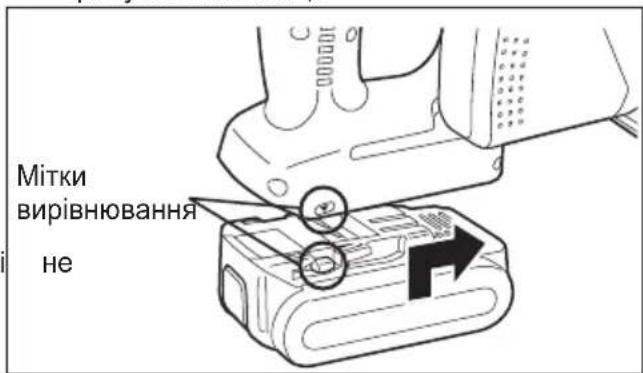
2. To remove the battery block (Fig. 3), press the button on the front, then pull out the battery block.
Fig. 3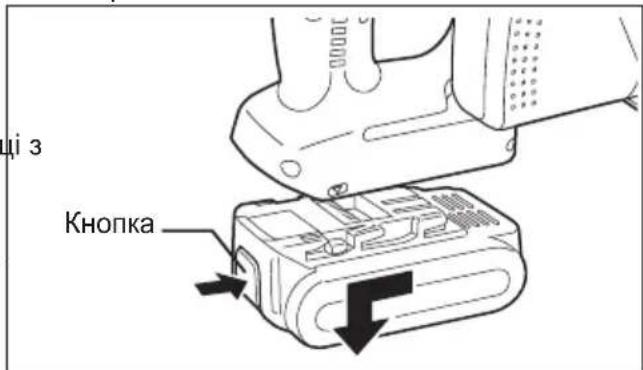
IV. FUNCTION
Before using the instrument
The instrument is designed for cutting workpieces made of non-ferrous metal, colored metal, wood, and plastic. For a list of materials that can be used for safe operation of this instrument, refer to the "Accessories" section. To reduce the risk of injury, it is necessary to follow the specified safety measures:
Do not cut multi-wire materials. Cut one piece at a time. - Do not cut hardened steel. - Cut material so that the side of the base is pressed against the material side. Do not touch the blade, material, workpiece, or cut parts with bare hands immediately after cutting; they may be hot.
Each time before using the instrument, it is necessary to check that it is in good working condition.
Use the specified control checklist:
- Is the blade installed in the correct rotation position? The arrow on the blade should point in the same direction as the arrow on the upper blade cover.
- Is the blade installed securely?
We recommend that you check the blade before starting work. (Fig. M, No. 6)
- Is the blade worn out? Replace the blade immediately if there are any cracks or if any tooth is damaged.
- Does the protective guard close and lock securely?
Fig. 4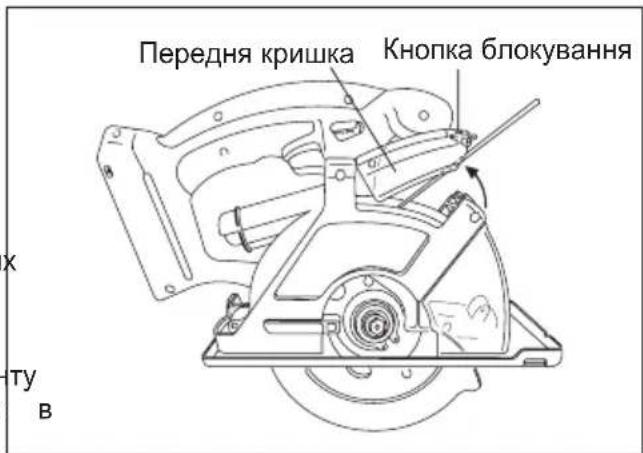
To replace the saw blade, press the blade lock button, remove the saw blade, and then install the new saw blade in place. (Fig. M, No. 5)
Fig. 5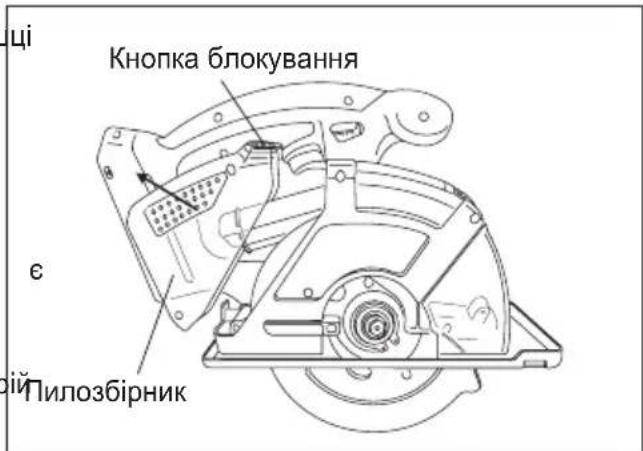
SURFACE
To avoid injury, do not use the tool if the protective guard does not close securely over the blade.
- Is the transparent protective guard installed?
- Is the battery pack charged and inserted into the tool?
- Is the blade dull or damaged?
- Is the workpiece to be processed properly secured on the workbench or in a vise?
- Don't forget to remove the saw blade and the wrench before starting.
Press the blade lock button, turn the wrench, and remove it as you did with the previous wrench.
Close the front cover, making sure it is securely closed, for example, by turning the knob. Then close the front cover completely. (INB.Man.4)
Installing the belt
Perform the following steps:
- Insert the battery pack into the tool.
- Remove all debris from the belt area.
- Use the release lever to open (or close) the belt tensioner.
- Install the belt as shown in the illustration. (INB.Man.6)
Make sure that the direction of the belt arrows and the direction of the arrows on the transparent belt tensioner point in the same direction.
- Install the outer cover in place.
- Insert the hex bolt.
- Press the lock button while holding the tool in position. This will release the belt tension.
- Tighten the hex bolt with the hex wrench provided. Then tighten the hex wrench.
NOTE:
Store the hex wrench in the storage slot in the tool body when not in use.
SURFACE
HeDToPImaHnHn BkA3iBOK MoKe npN3BeCTn Do BaxKnx TpaBM.
3HЯTTT NOJOTHa
YBAGA:
Bidpa3y nicna pi3aHH noTNO 6yde rapyHm. IpekoHaTeCra, 0o noTHO oxoJHO, nepeD TUM, k3Himatn Joro.
BnkoHaTe 3a3HaeHi HxKYe II:
- BuTgHiIb 6aTapeHmN 6nok 3 iHcTpymEnty.
- YtpmyTe KHOKky 6NOKyBaHHa HnHdJI B HaHaTNCHTOMy NOXeHHI. LcB iDBepeoepTaHHa noToHa.
- BnKOpncToBnyTe 8eCTnIpaHHN KJIOI, 10noCTaBnEbCra, 106 ocna6ntu WeeTnIpaHHN 6oNT.
ПРИMITKA:
B 36epiraTe WectnprHnn KInouy BiDciKy dna 36epiraHH, KOIN BIN He BnKOpNCTOByeTbcra.
- BntarHitb WectnurpaHHn 6oTt i 3OBHIu Hua6y.
- CkopnctaTtecb BiKnHOIO pyKOaTkoIO, 0o6 BiKNHyTN (BiKnPHTN) HxHHi 3axNCHI npncptpi.
- O6epeKHO 3HIMiTb NOJIoTHO NINJN.
- OuHCTiB IHCTpyMeHT B pa3i HEO6xIDHOCTI.
YBAGA:
BybTe oBepexHi, 06 He npiaTn Bawi pyKoIOTHom.
Bnndaoun noToH, 3arOpHitb noro B iJbHn a6o rofoBaHn nanip. Lc dOnomOKe BiDBepuTu npiN KOro-HeSyb BNKHyTM NIOOTHOM.
Man.6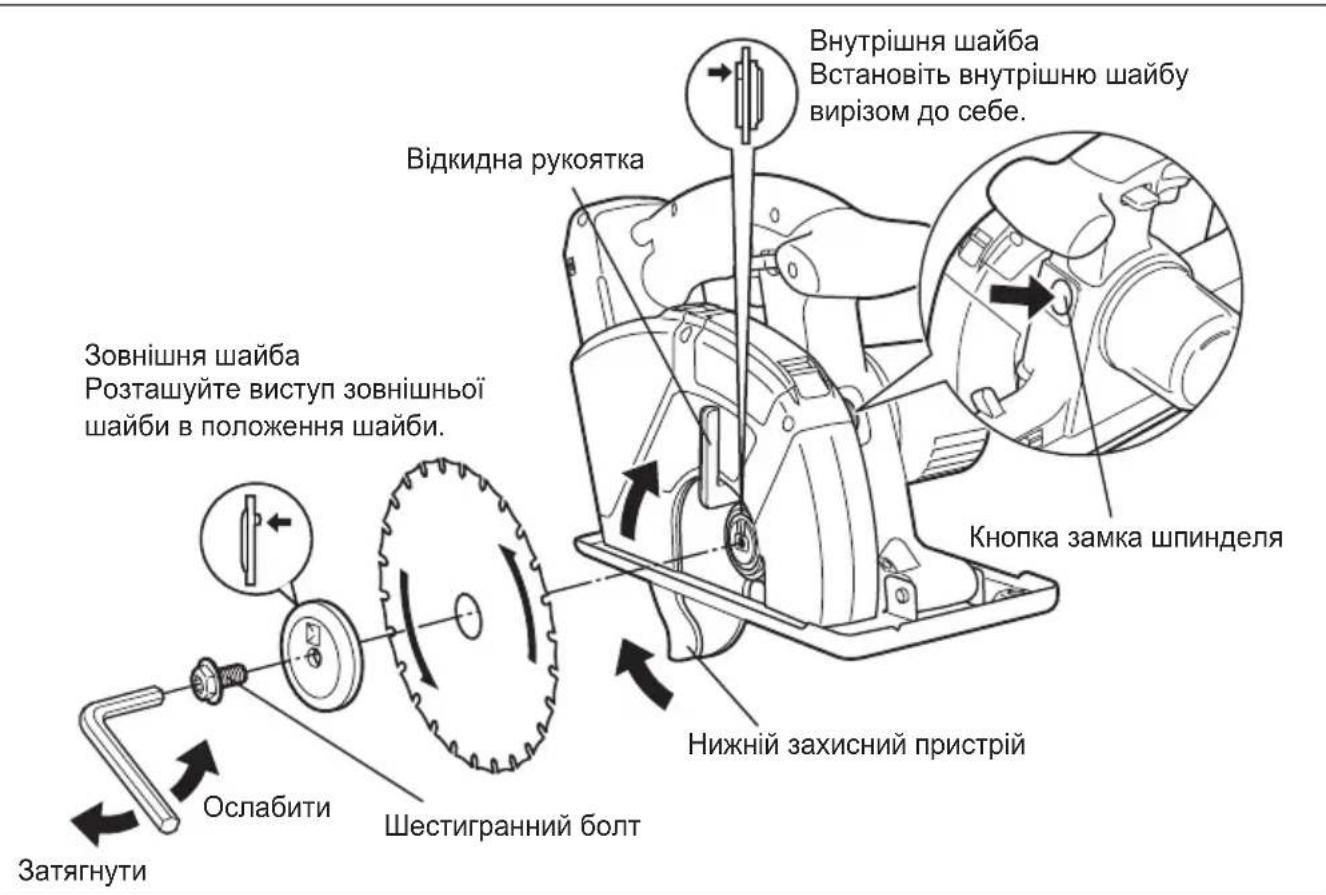
IITiHIOHH6aTapeHn 6JOK PIMITKA:
Bau 6aTapeHn 6Iok He c NobHicTo 3apJxHeHMn iD qac npu6aHH. He 3a6yDbTe 3apAHTn nepeD BnKOpNCTaHHM.
3apdHn npncptpi (EY0L80)
- BBimKHiTb 3apJHn npicTpI B wTeNceJbHy a po3ETky 3miHHoro cTpMy.
ПРИМITA:
PnPiKIOUeHHI WTeNcIbHOI BUNKIO D0 DKepeJa KINBIIeHn 3MIHNM CTpyMOM MOKyTb 3'YBNTuCA IcKn, aJe ue He CTBOpyIO npo6NeMy 3 TOUY 3OPY 6e3neKn.
- ⅢJIbHO BCTaBTe 6aTapeHn 6JOK B 3apAHN npucTpi.
1 3piBnIte MiTKu BnpiBHOBaHHa i po3M 6aTapeio y 3arNl6JIeHHi Ha 3apdHomy npucTpoi. 2 3cynbTe Ioro Bpeepy HnpanMky cTpiJKN.
3.ПдчacЗардкбуde ropiTNЯmnoчkaЗapдкп.пслязавршенизардкнabTOMaTHUcHcnpaIOE BHyTpIiHi eJIeKTPoHHn nepemKauch,3anobiraqunHaMiphi 3apdci.
3apka He noHcTbC, kUo 6aTapeHn 6Iok e HADTO rapaHm (HaPnKnaD, 6e3nocepEnhbo nicJyHKioHoBaHH npu BeNIkOMy HabaHTaxeHHi).
OpaHKeBa NaMNoUka peXmMy ouikyBaHHa 6ynde MrrTu, DOKN 6atape He oxonoHe.
B OCHOBHOMy IJIaPi3aHHIepeBHNH
POnToH0 PnJIN 3 TBepDocPnabHnMpiKyuMn
JIaactHAmn Dn piaHH ToHKoI DepeBHH
(doatkoBepnila)
- EY9PW13B
Дя pi3aHHToHkoI DepeBHH, KaO noTpipHa qnta pixyka Kpomka
PekomeHIOBaHa TOBUNHa MaTepiany - 10 12 MM
Hn HnoToHO nnn 3 TBepocnabHnMn pixyumn H nactnHaMn dpo pi3aHHn nnaCTmacn (doataKobeyornpnana)
- EY9PP13B
EY971045422 H2102 Printed in China
- DANGER
- WARNING
- HOW TO USE THIS MANUAL
- NOTE
- CAUTION
- ADDITIONAL SAFETY RULES
- SAFETY INSTRUCTIONS FOR ALL SAWS
- FURTHER SAFETY INSTRUCTIONS FOR ALL SAWS
- SAFETY INSTRUCTIONS FOR THIS SAW
- ASSEMBLY
- ATTACHING OR REMOVING BATTERY PACK
- OPERATION BEFORE USING THE TOOL
- INSTALLING BLADE
- FOLLOW THESE STEPS
- REMOVING BLADE
- USING THE TOOL
- ALIGNMENT WITH CUTTING LINE
- CUTTING DEPTH ADJUSTMENT
- RIP FENCE (EY3500B7727)
- COLLECTING DUST
- CONTROL PANEL
- LED LIGHT
- CAUTION: DO NOT STARE INTO BEAM
- OVERHEAT WARNING LAMP
- BATTERY LOW WARNING LAMP
- FOR PROPER USE (FURTHER DETAIL)
- CUTTING LARGE SHEETS
- CUTTING THIN OR CORRUGATED MATERIALS
- [BATTERY PACK]
- FOR APPROPRIATE USE OF BATTERY PACK
- LI-ION BATTERY PACK (EY9L40/ EY9L41)
- BATTERY PACK LIFE
- BATTERY RECYCLING
- ATTENTION
- [BATTERY CHARGER]
- CHARGING
- CAUTIONS FOR THE LI-ION BATTERY PACK
- COMMON CAUTIONS FOR THE LI-ION/NI-MH/NI-CD BATTERY PACK
- LI-ION BATTERY PACK
- BATTERY CHARGER (EY0L80)
- NI-MH/NI-CD BATTERY PACK
- LAMP INDICATIONS
- INFORMATION FOR USERS ON COLLECTION AND DISPOSAL OF OLD EQUIPMENT AND USED BATTERIES
- FOR BUSINESS USERS IN THE EUROPEAN UNION
- [INFORMATION ON DISPOSAL IN OTHER COUNTRIES OUTSIDE THE EUROPEAN UNION]
- NOTE FOR THE BATTERY SYMBOL (BOTTOM TWO SYMBOL EXAMPLES)
- MAINTENANCE
- CLEANING TOOL
- TRANSPARENT GUARD
- ACCESSORIES
- SPECIFICATIONS
- BATTERY PACK
- BATTERY CHARGER
- [LI-ION BATTERY PACK]
- ONLY FOR U.K
- VIII ELECTRICAL PLUG INFORMATION
- FOR YOUR SAFETY PLEASE READ THE FOLLOWING TEXT CAREFULLY
- IMPORTANT
- INTRODUCTION
- ADJUSTING THE CUTTING DEPTH
- DUST COLLECTION
- WORK LIGHT
- CAUTION: DO NOT LOOK INTO THE LIGHT BEAM
- [BATTERY PACKS]
- SERVICE LIFE OF THE BATTERY PACK
- BATTERY DISPOSAL
- [CHARGING DEVICE] CHARGING
- PRECAUTIONS FOR THE LITHIUM-ION BATTERY PACK
- PRECAUTIONS FOR THE LITHIUM-ION/NICKEL-METAL HYDRIDE/NICKEL-CADMIUM BATTERY PACK
- LITHIUM-ION BATTERY PACK NOTE
- CHARGING DEVICE (EY0L80)
- INDICATOR LIGHTS
- INFORMATION ON DISPOSAL FOR COUNTRIES NOT IN THE EUROPEAN UNION
- CLEANING THE TOOL
- FOLLOW THE INSTRUCTIONS
- TRANSPARENT PROTECTIVE GUARD
- TECHNICAL SPECIFICATIONS
- FUNCTION
- BEFORE USING THE INSTRUMENT
- SURFACE
- INSTALLING THE BELT
- PERFORM THE FOLLOWING STEPS
- HЯTTT NOJOTHA
- YBAGA
- BNKOHATE 3A3HAEHI HXKYE II
- ПРИMITKA
- IITIHIOHH6ATAPEHN 6JOK PIMITKA
- APDHN NPNCPTPI (EY0L80)
- ПРИМITA
Brand : PANASONIC
Model : EY4542
Category : Saw