BE0910 - Scale UFESA - Free user manual and instructions
Find the device manual for free BE0910 UFESA in PDF.



User questions about BE0910 UFESA
0 question about this device. Answer the ones you know or ask your own.
Ask a new question about this device
Download the instructions for your Scale in PDF format for free! Find your manual BE0910 - UFESA and take your electronic device back in hand. On this page are published all the documents necessary for the use of your device. BE0910 by UFESA.
USER MANUAL BE0910 UFESA
natural_image
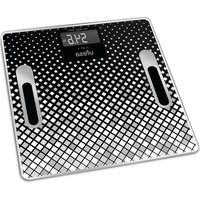
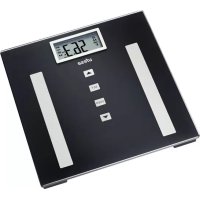
Black electronic device with four small buttons and a central display (no visible text or symbols)BE0910
INSTRUCCIONES DE USO
OPERATING INSTRUCTIONS
MODE D'EMPLOI
INSTRUÇÕES DE USO
GEBRAUCHSANLEITUNG
HASZNÁATI UTASÍT
text_image
Technical diagram showing labeled components of a device with numbered parts and two views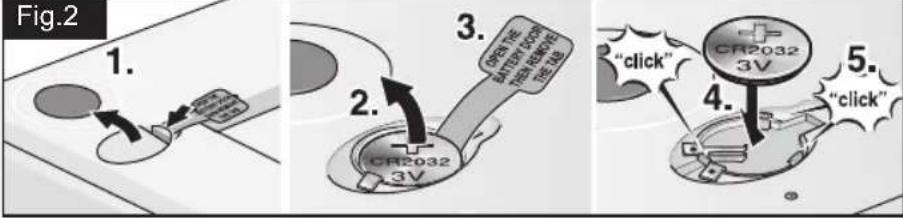
flowchart
graph TD
    A["1. Battery charging"] --> B["2. Battery charging with CR2032 3V"]
    B --> C["3. Open the battery charging then charging"]
    C --> D["4. CR2032 3V"]
    D --> E["5. Click"]
Fig.3
text_image
"kick"
text_image
0.0"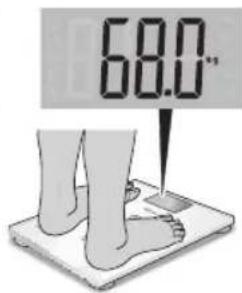
text_image
68.0"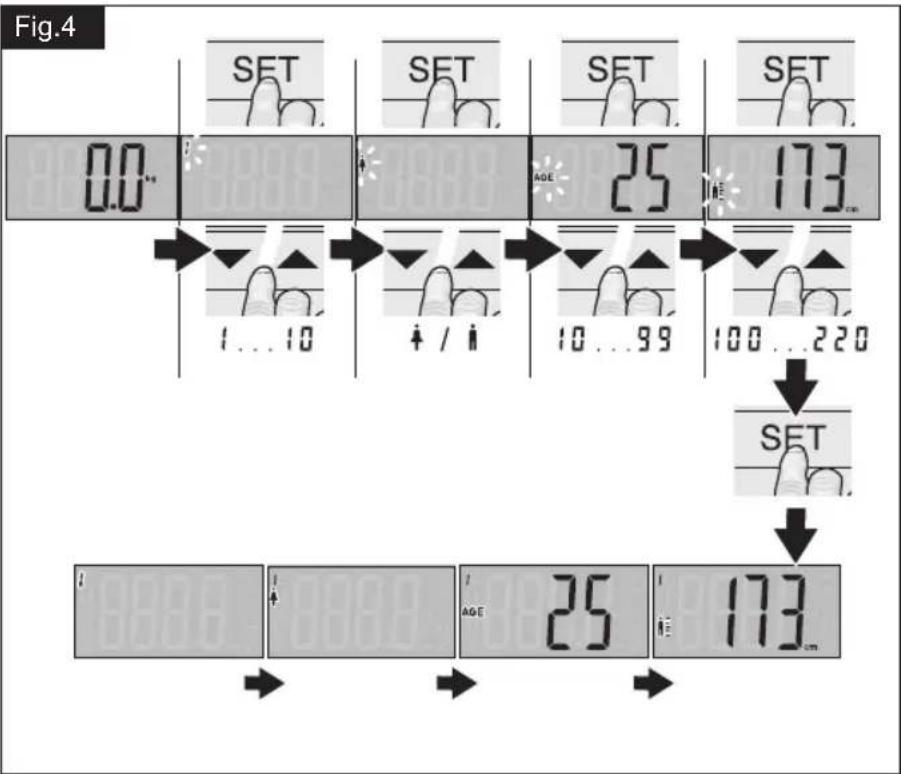
text_image
Fig.4 0.0" SET SET SET SET AGE 25 173 cm 1...10 +/+ 10...99 100...220 SET 25 173 cmFig.5
text_image
"kick" USER 1...10 25 173 cm 0.0° 60.5° 20.4° 15.2° 69.4° 36.8°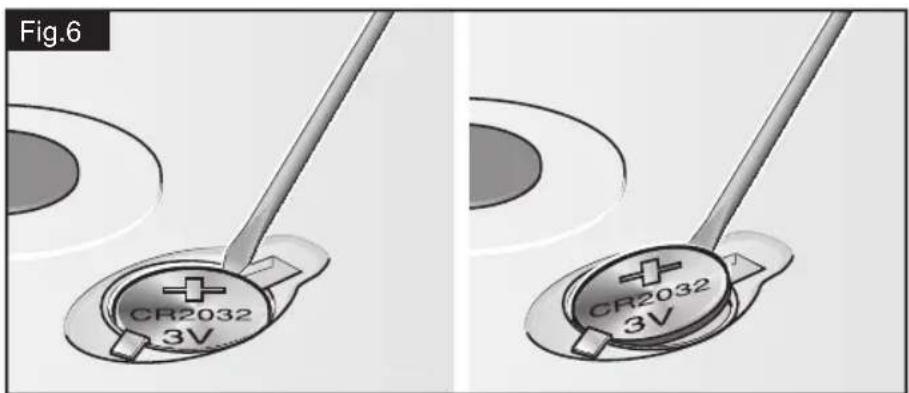
text_image
Fig.6 CR2032 3V CR2032 3VESPAÑOL
PARTES
Fig. 1
- Display
- Navigation buttons ▲ ▼
- USER button
- SET button
- Battery compartment
| Body height 100-220 | cm | |
| Weight kg/g (100 g graduation) | ||
| Age 10-99 years | ||
| Sex Male Female | ||
| Body Mass Index kg/m ^2 | ||
| Body Fat content as % (0.1% graduation) | ||
| Body Water content as % (0.1% graduation) | ||
| Muscle Mass as % (0.1% graduation) | ||
ADVICE AND INSTRUCTIONS FOR USE
- Please carefully read, follow and retain the operating instructions!
- This appliance is intended for domestic use only and not for industrial or medical applications.
- Pregnant women and persons with implanted medical devices such as pacemakers may use the weighing function only.
- To prevent danger, the appliance may be repaired by our customer service only.
- Place the scales on a flat, hard surface. Try not to place it on carpets or rugs, nor let it come into contact with walls or other objects.
- Clean the scales with a damp cloth. Do not let water or any other liquid get inside the appliance.
- To prevent slipping, do not get onto the scales with wet feet.
- Do not drop anything onto the scales.
- If you do not plan on using the scales for prolonged periods then remove the batteries.
- The scales are used to determine the weight of people.
- The measurements are only an indication of long-term changes. You are not replacing medical observation or consultant.
-
For more detailed information on the meaning of the body fat content, body water content as well as muscle mass and the values ideal for you, please consult with your GP.
-
To obtain comparable measurements, weigh yourself everyday at the same time and under the same conditions (recommended three hours after eating or sport).
- The measurement results are not reliable for children under 10 years of age.
- Important! Do not move the scales during or after calibration to ensure that the subsequent measurements are implemented exactly. If the scales are moved to a different location, repeat the process.
SWITCHING ON THE APPLIANCE
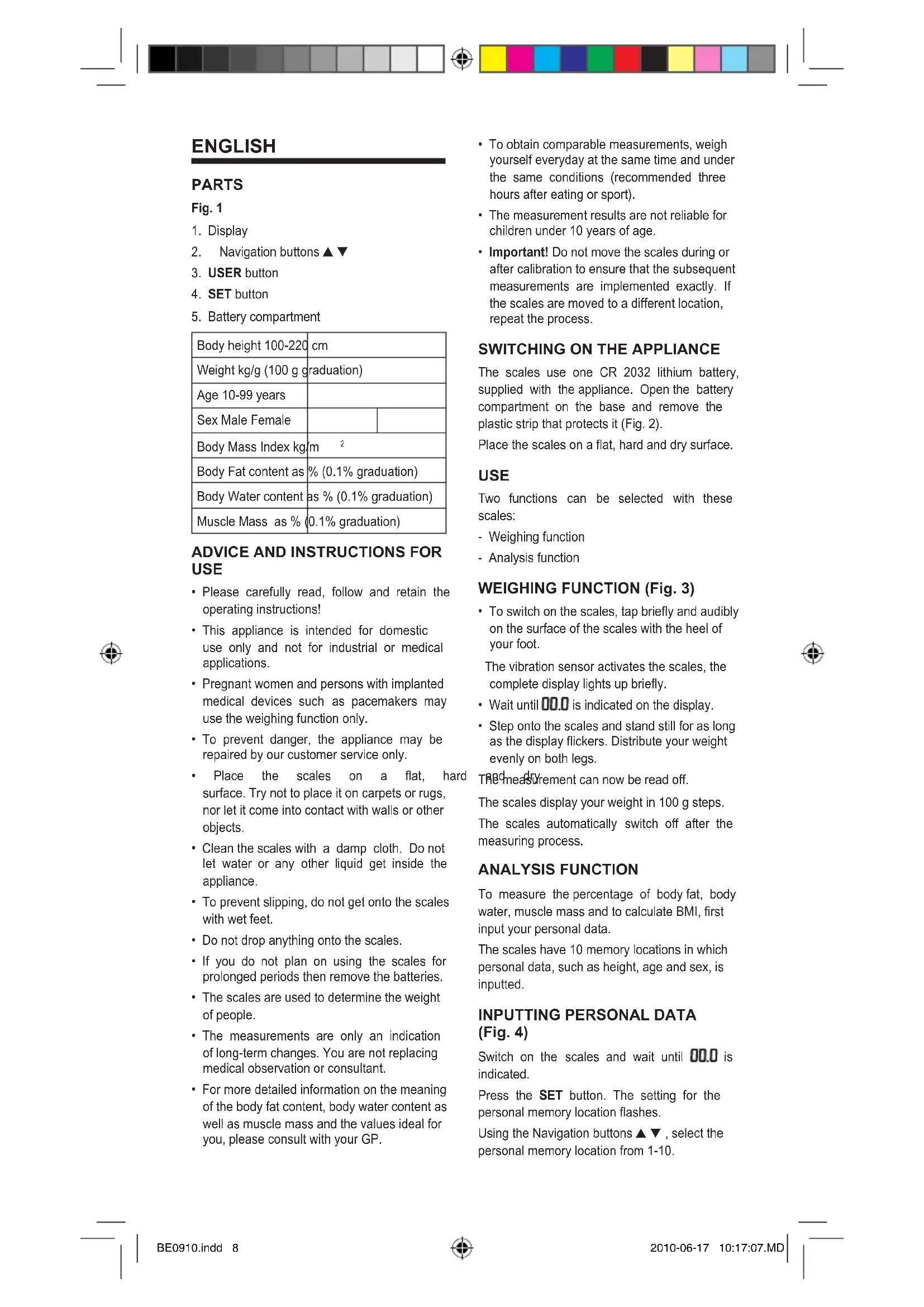
The scales use one CR 2032 lithium battery, supplied with the appliance. Open the battery compartment on the base and remove the plastic strip that protects it (Fig. 2).
Place the scales on a flat, hard and dry surface.
USE
Two functions can be selected with these scales:
- Weighing function
- Analysis function
WEIGHING FUNCTION (Fig. 3)
- To switch on the scales, tap briefly and audibly on the surface of the scales with the heel of your foot.
The vibration sensor activates the scales, the complete display lights up briefly.
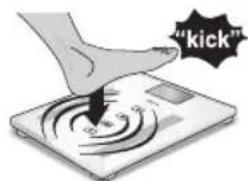
- Wait until 00.0 is indicated on the display.
- Step onto the scales and stand still for as long as the display flickers. Distribute your weight evenly on both legs.
The measurement can now be read off.
The scales display your weight in 100 g steps.
The scales automatically switch off after the measuring process.
ANALYSIS FUNCTION
To measure the percentage of body fat, body water, muscle mass and to calculate BMI, first input your personal data.
The scales have 10 memory locations in which personal data, such as height, age and sex, is inputted.
INPUTTING PERSONAL DATA (Fig. 4)
Switch on the scales and wait until 00.0 is indicated.
Press the SET button. The setting for the personal memory location flashes.
Using the Navigation buttons ▲▼, select the personal memory location from 1-10.


Confirm by pressing SET button.
The symbol for for flow flashes.
Using the Navigation buttons ▲▼, select your sex.
Confirm by pressing SET button.
The setting for input age flashes.
Using the Navigation buttons ▲▼, age.
Confirm by pressing SET button.
The setting for height input flashes.
Using the Navigation buttons ▲▼, height.
Confirm by pressing SET button.
Now all settings are displayed for approx. 2 seconds, OS indicated on the display. The scales automatically switch off after a couple of seconds.
NOTE: the Navigation buttons ▲▼
down for longer time, the numerical sequence is accelerated.
To assign other memory locations, repeat the Inputting personal data process.
NOTE: Memory locations which are already occupied can be reprogrammed at any time.
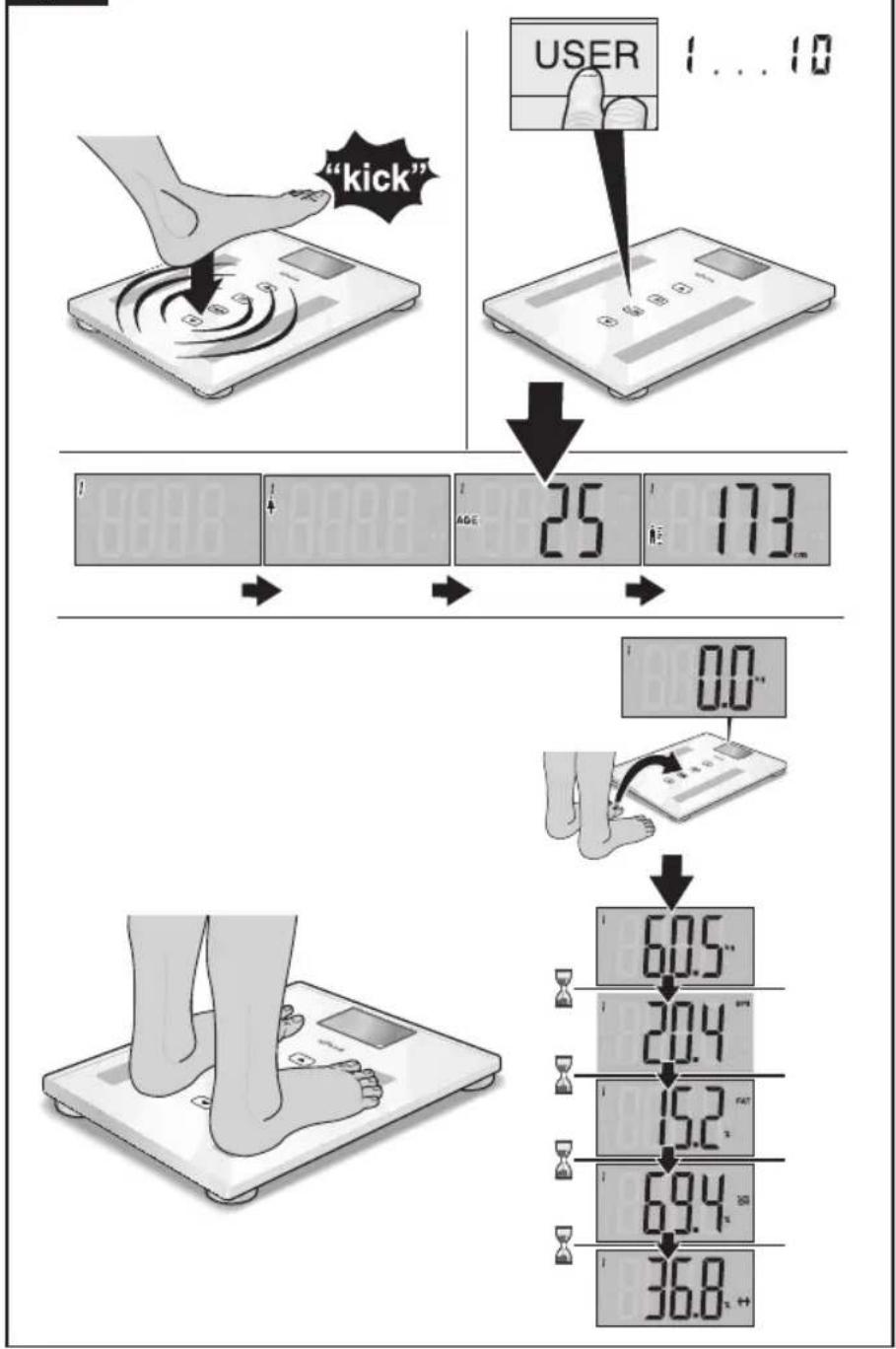
STARTING THE ANALYSIS (Fig. 5)
Measurement of weight as well as BMI, the percentage of body fat, body water and muscle mass.
Switch on the scales and wait until 00.0 is indicated.
Using the USER button, select the programmed personal memory location, e.g. 3. The input personal data is displayed for 2 seconds.
NOTE: the Navigation buttons ▲▼
down for longer time, the numerical sequence cannot be accelerated.
As soon as the scales display 086p on the scales and stand still for as long as the display flickers. Distribute your weight evenly on both legs.
NOTE: Stand on the scales with bare feet only.
NOTE: User number you selected appears always, when the analysis function is working.
The analysis function now requires a few seconds to perform the measurement and calculation.
Successive displays on display:
- Weight in kg
- The Body Mass Index BMI
- The body fat percentage FAT
- The body water percentage ≈
- The muscle mass ← as %
For approx. 3 seconds each.
These displays are automatically repeated 2 times in succession.
IMPORTANT: Stand with feet, calves and tights apart, otherwise the measurement will be incorrect.
set The scales automatically switch off a couple of seconds after the end of the measuring process.
WHAT DOES BMI MEAN?
set The Body Mass Index (BMI) is a measured value for evaluating the weight of a person.
The value can be used to determine whether the person is normal weight, overweight or underweight.
The Body Mass Index (BMI) is the quotient of your weight (kg) and the square of your height
are(m). The unit of the BMI is kg/m².
MEANING OF BMI (ACCORDING TO WHO)
| BMI Value | Meaning |
| under 19 | underweight |
| 19 to 25 | normal weight |
| 25 to 30 | overweight |
| 30 to 35 | obesity degree 1 |
| 35 to 40 | obesity degree 2 |
| over 40 | obesity degree 3 |
The Body Mass Index is a very approximate value only.
HOW DOES BODY FAT
are MEASUREMENT FUNCTION?
The Body fat is measured according to the BIA principle (bioelectrical impedance analysis). The appliance transmits a weak, harmless electrical signal through the body.
The resistance (impedance), i.e. the signal which the body resists, is measured.
The resistance is affected by the composition of the human body.
Muscles and organs contain water and are therefore good conductors. Fat resists the signal and is therefore a poor conductor.
The body fat percentage is calculated from this measured resistance taking into account the data (height, age, sex) which was input into the scales.
The body fat content varies greatly from person to person. Therefore, only approximate values are indicated in the following table.


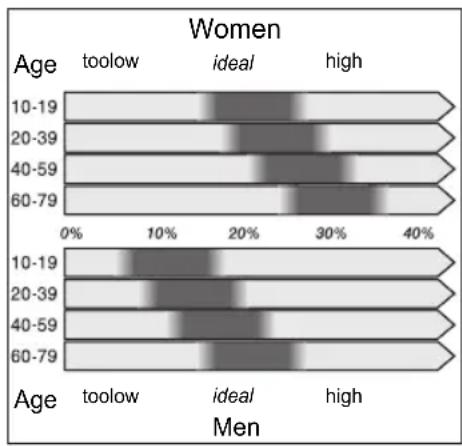
heatmap
Women | Age | toolow (%) | ideal (%) | high (%) | |---|---|---|---| | 10-19 | 25 | 30 | 20 | | 20-39 | 20 | 25 | 25 | | 40-59 | 25 | 30 | 20 | | 60-79 | 25 | 30 | 25 | | 10-19 | 30 | 35 | 20 | | 20-39 | 25 | 30 | 25 | | 40-59 | 25 | 30 | 25 | | 60-79 | 25 | 30 | 25 | Age: total population (Men) = total population (Women). The chart displays a horizontal bar format for each age group. Error bars are present in the top row.WATER MEASURED VALUES
The body fat and water measurements are influenced by the amount of water in the body.
The amount of water varies, e.g. according to the time of day, demands on the body, baths or showers, menstruation, eating and drinking. Even illnesses or medication may influence the result.
The following guide values, according to WHO, apply to persons who are normal weight:
- Women 50-55%
- Men 60-65%
WHAT IS MUSCLE MASS?
This function indicates the calculated mass of skeletal muscles (approximate value) in your body. A human being has over 600 muscles.
Muscles play an important role (movement, posture) and use energy. With increasing muscle mass (increase in activity and sport), more energy and calories are used and the body fat content is reduced.
Average skeletal muscle mass (International Commission on Radiological Protection, 1975):
- Women who weigh 58 kg: 30%
- Men who weigh 70 kg: 40%
CLEANING THE APPLIANCE
Never immerse the scales into water.
Do not use a steam cleaner.
Wipe the scales with a damp cloth, do not use scouring agents.
Clean the glass surface with a standard glass cleaner.
ERROR MESSAGES
- is indicated on the display:
- The calibration was defective.
-> Remove and re-insert the battery.
Then tap briefly and audibly on the surface of the scales with the heel of your foot.
- The weighing process was not conducted with the person standing still or for long enough.
-> You must stand still on the scales for at least five seconds.
- The weight to be weighed is too heavy (max. 180 kg).
- The contact between the soles of the feet and the measuring contacts is too low.
-> Place feet on the measuring contacts.
- Your feet have contacted with measuring contacts and metal frame around display.
-> Place feet only on the measuring contacts.
NOTE: Very dry skin and/or very hard skin may distort the result. The measurement results will be more accurate if the soles of the feet have good blood circulation or are damp. However, to avoid the risk of slipping, please ensure that the soles of the feet are not wet.
- The percentage of body fat is outside the range of 5-50%.
-> Repeat the measuring process.
- The percentage of body water content is outside the range of 43-75%.
-> Repeat the measuring process.
- The percentage of muscle mass is outside the range of 25-80%.
-> Repeat the measuring process.
- Lisdisplayed:
- The battery is discharged or too weak.
-> Change the battery. Then calibrate the scales, tap briefly and audibly surface of the scales with the heel of your foot.
Do not use rechargeable batteries.
Use the same type of batteries only.
CHANGING THE BATTERY
Whenever a battery needs changing, open the compartment and remove the dead battery by gently prizing it out as shown in (Fig. 6). Fit the new battery and press it down gently so that it locks into position. Make sure that the widest part is facing up, so that the « + » sign is visible.


on the

ADVICE ON DISPOSAL:

Our goods come in optimised packaging.
This basically consists in using noncontaminating materials which should be handed over to the local waste disposal service as secondary raw materials.

This product complies with EU Directive 2002/96/CE. The crossed wheelie bin symbol shown on the appliance indicates that when it
comes to dispose the product it must not be included in the household refuse. It must be taken to a special refuse collection point for electric and electronic appliances or returned to the distributor when purchasing a similar appliance. Under current refuse disposal regulations, users who fail to take discarded appliances to special refuse collection points may be penalised. Correct disposal of discarded appliances means that they can be recycled and processed ecologically, helping the environment and allowing materials used in the product to be reused. For more information on available waste disposal schemes contact your local refuse service or the shop where the product was purchased. Manufacturers and importers are responsible for ecological recycling, processing and disposal of products, whether directly or via a public system.
Your local town council can provide you with information about how to dispose of obsolete appliances.