ManualGo.com
PSS 3100 SE - Saw Mafell - Free user manual and instructions
Find the device manual for free PSS 3100 SE Mafell in PDF.



Frequently Asked Questions - PSS 3100 SE Mafell
Download the instructions for your Saw in PDF format for free! Find your manual PSS 3100 SE - Mafell and take your electronic device back in hand. On this page are published all the documents necessary for the use of your device. PSS 3100 SE by Mafell.
USER MANUAL PSS 3100 SE Mafell
Board sawing system Translation of the original operating instructions
5.12 Parallel cuts with special accessory crossfeed stop (2 pieces required) ........................ 31
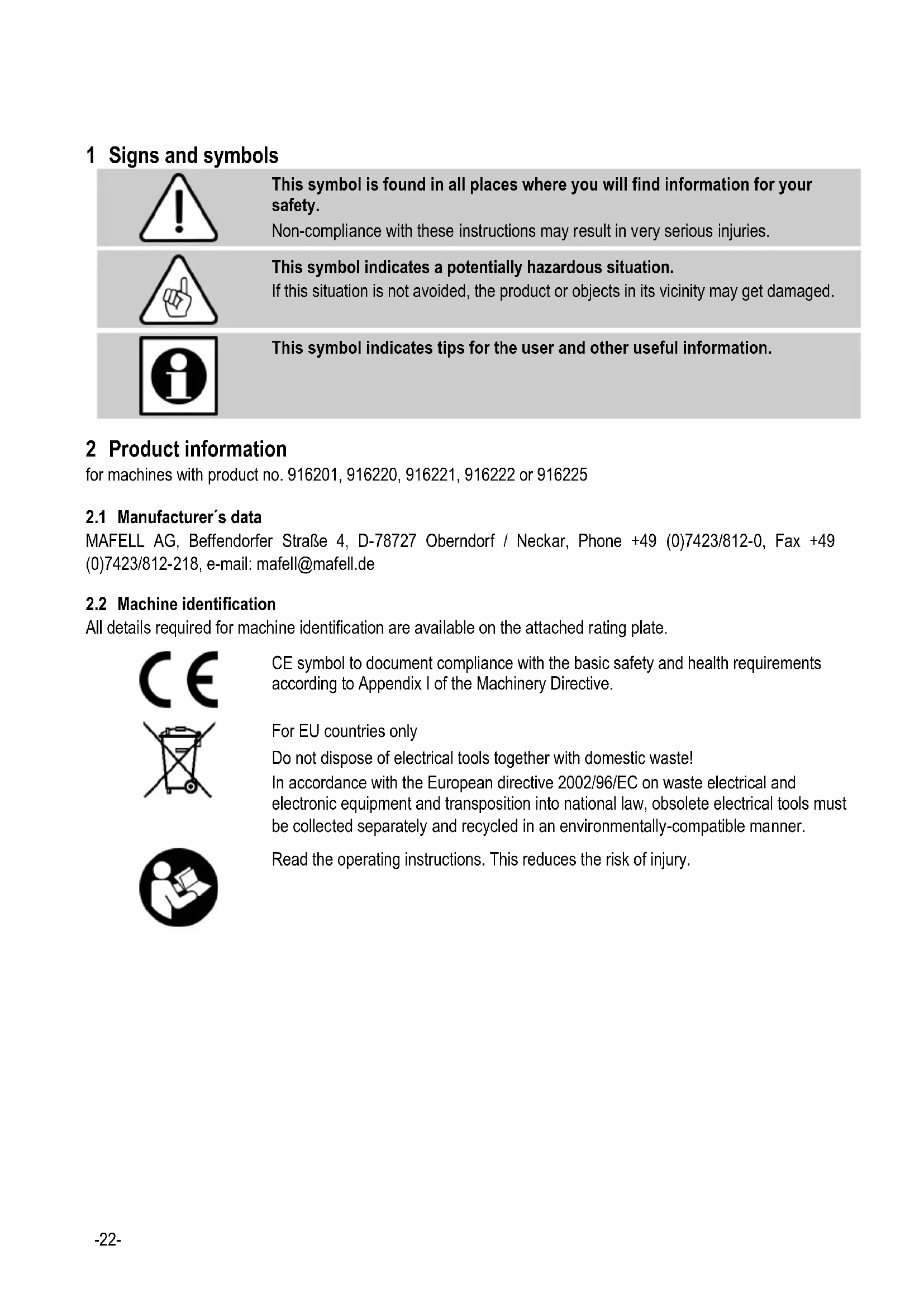
This symbol is found in all places where you will find information for your safety. Non-compliance with these instructions may result in very serious injuries.
This symbol indicates a potentially hazardous situation. If this situation is not avoided, the product or objects in its vicinity may get damaged.
This symbol indicates tips for the user and other useful information.
2 Product information for machines with product no. 916201, 916220, 916221, 916222 or 916225
All details required for machine identification are available on the attached rating plate.
CE symbol to document compliance with the basic safety and health requirements according to Appendix I of the Machinery Directive.
For EU countries only Do not dispose of electrical tools together with domestic waste! In accordance with the European directive 2002/96/EC on waste electrical and electronic equipment and transposition into national law, obsolete electrical tools must be collected separately and recycled in an environmentally-compatible manner.
Read the operating instructions. This reduces the risk of injury.-23-
50 Hz 50 Hz Input power continuous operation
Power consumption continuous operation
Saw blade cutting width 1.8 mm (5/64 in.) Saw blade mounting hole 20 mm Hose connector diameter
35 mm (1 3/8 in.) Cutting length without extension 1300 mm (51 in.) Cutting length with extension 3100 mm (122 in.) Bearing face with guide rail
14 kg (30.7 lbs) Weight of the extension 4.5 kg (9.9 lbs) Total weight without mains cable 18.3 kg (40.3 lbs)
The declared noise emission values have been measured in accordance with DIN EN 62841-1 and DIN EN 62841-2-5 and may be used for comparing the tool with another and also in a preliminary assessment of exposure.
Danger The noise emissions during actual use of the power tool can differ from the declared values depending on the ways in which the tool is used especially what kind of workpiece is processed. Always wear hearing protection, even when the power tool ist running idle in addition to the trigger time!-24-
2.4.1 Noise emission specifications
Noise emission values determined according to EN 62841-1 and EN 62841-2-5: Sound pressure level L
= 100 dB (A) Uncertainty K
= 4 dB (A) Sound power level
= 108 dB (A) Uncertainty K
= 4 dB (A) Saw blade: carbide-tipped circular saw blade Ø 160 mm (6 ¼ in.), 32 teeth Workpiece: uncoated chip board 16 mm (5/8 in.), length 1200 mm (47 in.), original width 700 mm (27 9/16 in.) and cutting of 40 mm (1 9/16 in.) wide strips Feed speed: 17 m/min (55.8 ft/min.) Working noise measurement: Cutting stroke + reverse motion of the saw unit with turned on saw blade drive Microphone position work station: 300 mm (11 3/16 in.) behind the machine's short side, at the centre of the machine, 1.5 m (59 in.) above the floor
Board sawing system PSS 3100 SE complete with: 1 guide rail extension 1 carbide-tipped circular saw blade Ø 160 mm (6 ¼ in.), 24 teeth 1 riving knife / splitter thickness 1.2 mm (3/64 in.) 1 bracket handle 1 service tool in retaining bracket on the motor casing 1 anti-friction agent 1 operating manual 1 folder “Safety Instructions”
Danger These devices are required for the machine's safe operation and may not be removed or rendered inoperative. Before operating the machine, check the safety devices for function and possible damage. Do not use the machine with missing or ineffective safety devices. The machine is equipped with the following safety devices: - Stationary guards around the saw blade. - Large bearing faces of the guide rails with slip guards. - Operation of infeed and saw blade drive from one operating point. - Index mechanisms without catch - Riving knife / splitter - Dust extractor - Limit switch - Rail end-25-
2.7 Use according to intended purpose
The MAFELL board sawing system PSS 3100 SE is exclusively intended for cutting the following materials: - Solid wood - Uncoated and coated chip boards, solid wood boards and multiplex boards - MDF-, HDF- and OSB boards - HP-laminate - Gypsum fibre boards - Cement-bonded boards - Fibre cement boards in conjunction with a diamond saw blade The maximum workpiece thickness may not exceed 45 mm. Use approved saw blades according to EN 847-
Any other use than described above is not permissible. The manufacturer cannot be held liable for any damage arising from such other use. So as to use the machine as intended, comply with the operating, maintenance and repair instructions specified by Mafell.
Danger Even if used in accordance with its intended purpose and despite conforming with the safety instructions, residual risks caused by the intended use that can lead to health consequences will always remain. - Touching the saw blade projecting below the guide rail in home position at the start of a cut. - Touching the part of the saw blade projecting below the workpiece during cutting and at the end of the cut if the slide bar is not correctly set for automatically lifting into rest position. - Tilting of the machine if the projecting guide rail is not sufficiently supported behind the workpiece to be cut. - Touching of turning parts from the side: saw blade body, clamping flange and flange screw. - Breakage of the saw blade and risk of the blade or pieces of the blade being hurled away. - Touching live parts with the housing open and the mains plug not removed. - Injuries caused by the sharp saw blade teeth while exchanging the saw blade. - Hearing impairment when working for long periods without ear protectors. - Emission of harmful wood dusts during longer operation without extraction. 3 Safety instructions Danger Always observe the following safety instructions and the safety regulations applicable in the respective country of use! Also read the safety instructions in the enclosed booklet "Safety instructions". General instructions: - Children and adolescents must not operate this machine. This rule does not apply to young persons receiving training and being supervised by an expert. - Never work without the protection devices prescribed for the respective operating sequence and do not make any changes to the machine that could impair safety. - When operating the machine outdoors, use of an earth-leakage circuit-breaker is recommended. - Damaged cables or plugs must be immediately replaced. Replacement may only be carried out by Mafell or an authorised MAFELL service workshop in order to avoid safety hazards. - Avoid sharp bends in the cable. Especially when transporting and storing the machine, do not wind the cable around the machine. Do not use: - Cracked and misshapen saw blades. - Saw blades made of high speed steel (HSS saw blades). - Blunt saw blades as they impose an excessive load on the motor. - Saw blades with a base body with a thickness greater than, or a cutting width (setting) less than, the thickness of the riving knife / splitter.-26- - Saw blades which are not suitable for the saw blade's idling speed. Instructions on the use of personal protective equipment - Always wear your personal protective equipment whenever you are working with the machine. Hearing protection, dust mask, protective goggles and protective gloves. Instructions on operation: - Make sure that no other persons are staying in the sawing area during machine operation. - Do not reach with your hands into the sawing area and do not touch the saw blade. With your other hand, support the supplementary handle or the motor casing. - Do not reach under the workpiece. - Adapt the cutting depth to the workpiece thickness. - Never support the workpiece in your hand or over your leg. Secure the workpiece against a sturdy support. - Only hold the device by its isolated handle surfaces when carrying out work during which the cutting tool could hit hidden power cables or its own connection cable. - Always use tools of the correct size and with matching mounting hole (e.g. star-shaped or round). - Never use damaged or incorrect saw blade washers or screws. - Hold the saw with both hands and bring your arms into a position where you are able to resist the backlash forces. Always keep to the side of the saw blade. Never bring the saw blade in line with your body. - If the saw blade gets jammed or sawing is interrupted for some other reason, release the on/off switch and keep the saw steady in the material, until the saw blade has come to a complete standstill. Never try to remove the saw from the workpiece or to pull it backwards while the saw blade is still moving or while a backlash could occur. - If you would like to restart a saw that is stuck in the workpiece, centre the saw blade in the saw slit and check whether the saw teeth are stuck in the workpiece. - Support large plates to reduce the risk of backlash caused by a jammed saw blade. - Do not use any blunt or damaged saw blades. - Before starting to saw, tighten the cutting depth and cutting angle adjustments. - Be especially careful when making a “plunge cut“ into a concealed area. - Use the saw blade matching the riving knife/splitter. - Adjust the riving knife/splitter as described in the operating instructions. - Always use the riving knife/splitter except for "plunge cuts". - For the riving knife/splitter to function, it has to be located in the saw slit. - Never operate the saw with bent riving knife/splitter. - Examine the workpiece for foreign objects. Never attempt to cut into nails or other metal objects. - Select the correct saw blade and feed speed on the basis of the diagram available on the operator panel and dependent on the material to be processed. - Set the slide bar to control interruption of the feed movement and automatic lifting of the saw unit into rest position correctly to the workpiece to be processed (workpiece length + 120 mm / 4 ¾ in.). - Never reach underneath the workpiece while cutting (risk of injury!). - Always lead the connecting cable away from the machine to the rear while sawing. - Do not switch off the machine by pulling the plug if the ON switch is depressed. - Only remove the system from the workpiece once the saw blade has come to a standstill and the saw unit has returned to its home position. - A diamond saw blade is necessary for cutting fibre cement board. Instructions on service and maintenance: - Regularly cleaning the machine, especially the adjusting devices and guides, constitutes an important safety factor. - Only original MAFELL spare parts and accessories may be used. Otherwise the manufacturer will not accept any warranty claims and cannot be held liable.-27- 4 Setting / Adjustment
4.1 Installation / Transport
The board sawing system PSS 3100 SE is delivered inside a transport carton. You should first of all examine the system for possible transport damages. Damage to the packing material may already be indicative of an improper transport. Immediately complain to your machine dealer about any transport damages identified. Check the following parts for a correct and tight seat: - Saw blade - Riving knife / splitter - Connection tube (saw guard)
4.2 Mains connection
Prior to commissioning make sure that the mains voltage complies with the operating voltage stated on the machine's rating plate. The board sawing system PSS 3100 SE is equipped with protective earthing according to Class I - EN 62841 and may therefore only be connected to socket outlets with protective earth conductor.
Connect the machine to a suitable external dust extractor during all work generating a considerable amount of dust. The air velocity must be at least 20 m/s (65.6 ft / sec.). The internal diameter of hose connector 1 (Fig. 1) is 35 mm (1 3/8 in.). Operation without extraction is basically not advisable. If no external dust extractor is available during use outdoors or in sufficiently ventilated rooms, you must remove the connection tube 10 (Fig. 4) between saw unit and chips guide duct to avoid clogging the chips guide duct. In Germany, certified dust extractors are required for the extraction of wood dusts. Air values that reliably fall below the air limit value of (2 mg/m³) can only be guaranteed if the board sawing system is connected to a certified dust extractor (e.g. industrial vacuum cleaner or combination device). This requires the following operating method: Execution of separating cuts on the pile of boards and in the process scoring the board underneath at least 1 mm. With this operating method, the system has received the FPH mark of conformity “Wood dust certified“.
4.4 Saw blade selection
Use a sharp tool to obtain a good cut quality and select a tool from the following list according to material and application: Cutting of solid wood: - TCT circular saw blade Ø 160 x 1.8 x 20 mm (6 1/4 x 5/64 in. x 20 mm), 16 teeth Cutting of solid wood boards, chip boards, cement-bonded chip boards, multiplex boards: - TCT circular saw blade Ø 160 x 1.8 x 20 mm (6 1/4 x 5/64 in. x 20 mm), 24 teeth Cutting of solid wood boards, chip boards, multiplex boards, HDF-, MDF- and OSB-boards, gypsum fibre boards: - TCT circular saw blade Ø 160 x 1.8 x 20 mm (6 1/4 x 5/64 in. x 20 mm), 32 teeth Cutting of chip boards, HDF-, MDF-, and OSB- boards, coated boards, OSB, HP-laminate: - TCT circular saw blade Ø 160 x 1.8 x 20 mm (6 1/4 x 5/64 in. x 20 mm), 56 teeth For fibre cement boards, the diamond saw blade - Ø 160 x 3.0 x 20 mm (6 ¼ x 1/8 in. x 20mm), 4 teeth is suitable These specifications can also be found on diagram 2 (Fig. 1) that is attached to the operator panel. From this diagram you can gather the matching feed speeds.-28-
Danger Pull the power plug during all service work.
Always wear your personal protective equipment whenever you are working with the machine.
- Using the Allen key 3 (brackets Fig. 2), unfasten the flange screw 5 (Fig. 3) counter clockwise; remove the screw as well as the front clamping flange 6.
- You can now remove the saw blade by lifting it to the front and pulling it away with a downward movement. Removing the saw blade is made easier if you tilt the system that far that the saw blade is automatically released from the rear flange collar.
- The clamping flanges must be free of adhering parts.
- Pay attention to the sense of rotation when inserting the saw blade.
- Afterwards, mount the clamping flange, attach the flange screw and tighten it by clockwise turning.
- In doing so, keep the locking bolt depressed.
2) with the machine running! The
machine may get damaged.
4.6 Riving knife/splitter
Danger Pull the power plug during all service work. The riving knife / splitter 8 (Fig. 3) prevents the saw blade from jamming during longitudinal cutting. The correct distance to the saw blade is shown in Fig. 5.
- Set the saw blade to the largest cutting depth (see Section 5.3).
- For adjustment, unfasten the two cylinder-head screws 9 (Fig. 4) with the Allen key supplied with the saw 3 (Fig. 2).
- Adjust the riving knife / splitter by shifting it in its longitudinal slit. Afterwards retighten the two cylinder-head screws. 5 Operation
Always wear your personal protective equipment whenever you are working with the machine.
5.1 Initial operation
Personnel entrusted to work with the machine must be made aware of the operating instructions, calling particular attention to the chapter "Safety instructions".
5.2 Switching on and off
Danger Pay attention that the saw blade moves freely and does not make contact with the workpiece. Lead the connecting cable and extraction hose away to the rear.
- Switching on: To turn on the saw blade drive, press the rocker switch 22 (Fig. 1) in direction and keep it depressed.
- Switching off: To switch off the saw blade drive, release the rocker switch 22. The infeed and the saw blade drive are immediately switched off. The saw blade will come to a standstill in less than 10 seconds.
Danger The saw blade immediately starts if the switch is pressed, shortly afterwards the infeed starts automatically.-29-
5.3 Cutting depth adjustment
The cutting depth is continuously variable between 0 and 45 mm (0 to 1 ¾ in.). Proceed as follows:
- Unfasten the wing screw 12 (Fig. 2).
- Set the cutting depth with the depth stop 13 according to the scale. The bevelled edge 14 of the gearbox case serves as indicator.
Always set the cutting depth approx. 2 to 5 mm (1/16 to 3/16 in.) larger than the material thickness to be cut.
5.4 Cutting length adjustment
You can set the cutting length up to 1300 mm (51 in.) with the normal guide rail. Once the guide rail extension has been installed, you can vary the cutting length continuously up to 3100 mm (122 in.). Set the cutting length as follows:
- Unfasten the knurling screw 15 (Fig. 6) at the stop slide 16.
- Set the stop slide 16 in the groove of the guide rail such that its position is approx. 120 mm (4 ¾ in.) longer than the desired cutting length.
- Retighten the wing screw 15.
Always use the stop slide and set it correctly. Otherwise the saw blade will not automatically return to rest position at the end of the cut. The saw blade is then not completely concealed!
5.5 Feed speed adjustment
You can set the feed speed continuously between 4 and 20 m/min (13.1 and 65.6 ft/min). You achieve a perfect cut edge if in addition to selecting a suitable saw blade you also adapt the feed speed to the material to be processed. Suitable combinations "Material – saw blade – feed speed" are contained in diagram 2 (Fig. 1). Set the desired feed speed at the rotary switch 17 that is arranged on the operator panel. If the rotary switch is turned counter clockwise against the limit stop, the infeed is switched off.
5.6 Control electronics
With the setting wheel 38 (Fig. 2) you can continuously adjust the saw speed between 2600 and 5200 rpm. Which speed has to be set for which material can be gathered from the chart.
To execute a longitudinal cut after tracing, proceed as follows:
- Place the machine with the saw unit in home position onto the horizontal workpiece that has been secured against shifting. The saw unit must at the same time be located in front of the front workpiece edge.
- Align the machine such that the right edge of the guide rail marks the desired cut.
- Set the cutting depth (see section 4.2).
- Set the cutting length (see section 4.3).
- Release the saw blade locking mechanism in rest position by pressing the plunge handle 20 (Abb. 6). Then press the saw unit into cutting position until it engages at the clamping lever 21.-30-
- Select the feed speed (see section 4.4) and switch on the saw drive (see section 4.5).
- Execute the saw cut by pressing the rocker switch 22 (Fig. 1) in direction until the saw unit drives up against stop slide 16 (Fig. 6) causing the saw blade to automatically return into rest position.
Please note that the infeed only runs as long as the rocker switch is pressed. When the rocker switch is released, the infeed and saw drive are immediately switched off. Move the saw unit into home position by pressing the rocker switch in direction . On reaching the rest position, the reverse motion is switched off automatically.
Danger Even in reverse motion, the saw blade may still be turning.
Only move the saw unit backwards if the saw blade is in rest position. Failure to do so may damage the cut edge on the workpiece! If you interrupt the infeed before reaching the stop slide, you have to bring the saw blade into rest position before its reverse motion by actuating the clamping lever 21 (Fig. 6).
With this system, you can safely execute plunge cuts. An otherwise existing hazard due to backlash does not exist with this machine using this operating sequence.
You do not need to remove the riving knife/splitter to execute a plunge cut. It is pushed back into the protective cover during the plunge cut. It will automatically return to its position behind the saw blade when the machine is moved forward. Execute plunge cuts as follows:
1. Move the saw unit by actuating the rocker switch
22 (Fig. 1) in direction until the front marking 23 (Fig. 6) agrees with the desired end of the plunge cut that has been marked on the workpiece.
Danger During the movement, the saw blade drive is also turned on.
Please note that the marking only agrees with the desired plunge point if the saw unit has been set to the deepest cutting depth.
- Adjust the stop slide 16 in the groove of the guide rail such that it is located 120 mm (4 ¾ in.) behind the marked end of the plunge cut.
- By actuating the feed switch, move the saw unit in direction until the rear marking 24 agrees with the desired start of the plunge cut that has been marked on the workpiece.
- Switch off the feed speed (see section 4.4) and switch on the saw drive with rocker switch 22 (Fig. 1) (see section 4.5).
- Release the saw blade's locking mechanism in rest position by pressing the plunge handle 20 and then press the saw unit into the cutting position until it engages.
- Execute the saw cut by pressing the rocker switch 22 in direction until the saw unit runs up against the stop slide 16 (Fig. 6) causing the saw blade to automatically return from cutting position into rest position. To do so, you have to switch the infeed back on again.
- Switch off the saw drive by releasing the rocker switch.
- Move the saw unit back into home position by pressing the rocker switch in direction
With the board sawing system, it is also possible to cut coated boards splinter-free with the integrated scoring equipment. Proceed as follows:
- Turn the scoring lever 25 (Fig. 7) in the direction specified on arrow symbol 26 (with that you offset the saw blade by approx. 0.15 mm (1/128 in.) into the position "scoring").
- Set the cutting depth to 2 mm (1/16 in.) (see
- Execute the scoring cut. Move the saw unit back into home position.
- Turn the scoring lever 25 back into basic position.
- Set the cutting depth according to the workpiece thickness (see section 4.2). Execute the separating cut.
5.10 Use of the guide rail extension
To execute longitudinal cuts with a length in excess of 1300 mm (51 in.) up to maximum 3100 mm (122 in.), the guide rail extension that is supplied as a standard is used.
Danger Please note that both when installing and dismantling the extension, the entire machine must be secured against tilting by means of sufficiently long supports! Carry out the installation as follows:
- Remove the hexagon head socket wrench 3 (Fig.
2) from its retaining bracket on the machine.
Then use it to adjust both clamping pieces 27 (Fig. 8) such that their opening is pointing in the direction of the guide rail end.
- Insert extension 28 with the two adaptors 29 into the grooves on the guide rail intended for that purpose up to the limit stop.
- Tighten the two clamping pieces 27 clockwise and return the hexagon head socket wrench 3 (Fig. 2) to its retaining bracket on the motor casing.
5.11 Cuts in excess of 3100 mm in length
If longitudinal cuts exceeding a length of 3100 mm (122 in.) are to be carried out, the machine offers the possibility to do so. Once the first part of the cut is completed, you can reinsert the machine at the end of the existing kerf. In this manner, you achieve an offset- free extension of the cut. To extend the cut proceed as follows:
- After completion of the first cut, press the refeeding stop 30 (Fig. 9) downwards. Insert the machine with the refeeding stop at the end of the kerf such that the saw unit too is still located above the kerf.
- Align the guide rail at the other end for a straight extension of the cut. The crossfeed stop system that is available as a special accessory is particularly suited in this regard.
- Execute the following cut.
Danger Switch off the saw blade drive before offsetting the machine for the next cut !
5.12 Parallel cuts with special accessory
crossfeed stop (2 pieces required) The crossfeed stop that is available as special accessory (cutting width stop) makes it possible to execute a cut that runs parallel to the left workpiece edge. You can also set the desired cutting width. The limit stop consists of two rails with limit stops, which can be adjusted between 250 mm (9 ¾ in.) and 1250 mm (49 in.). Use the limit stops as follows:
- Hook the two crossfeed stops 31 (Fig. 10) by swivelling in from the top into the groove available at the left edge of the guide rail.
- Adjust the desired cutting width by releasing the grip lever 32 and moving the sliding stop 33. The cutting width is shown at indicator 34. Afterwards reclamp the grip lever 32.
- Position the entire machine on the workpiece such that the two sliding stops rest against the left edge of the workpiece. Then execute the parallel cut as described in section 4.7.
To guarantee an accurate parallel cut, position the two crossfeed stops with a sufficient clearance, but best such that both can be set from the operator's location.-32- 6 Transport and storage
Always take off the extension for transport! The bracket handle 35 is intended for transports across longer distances (Fig. 11). For that purpose it must be set to the position on the guide rail that corresponds to the system's centre of gravity. Proceed as follows to carry out the setting: - Take off the extension if it has been installed. - Detach the two hexagon socket head cap screws 36 with the Allen key 3. - Move the bracket handle 35 in the guide rail groove until marking 37 is located in the centre of the bracket handle. - Retighten the hexagon socket head cap screws 36 and return the Allen key to its retaining bracket on the motor casing. - Once the bracket handle has been set like this, an ergonomically favourable transport of the machine as shown in Fig. 12 is possible.
For space-saving storage it is recommended to lean the board sawing system vertically against the wall with the saw unit in home position. The standing edge on the operator panel is equipped with an antislip coating.
Before this storage, always remove the extension, thus preventing the rails from bending. 7 Service and maintenance Clean the machine thoroughly if the machine is not used for a longer period of time. Spray blank metal parts with a rust-proofing agent.
Danger Pull the power plug during all service work. MAFELL machines are designed to be low in maintenance. The ball bearings used are greased for life. When the machine has been in operation for a longer period of time, we recommend to hand the machine in at an authorised MAFELL customer service shop for inspection. Only use our special grease, order No. 049040 (1 kg tin) for all greasing points.
The machine must be regularly cleaned of deposited dust (daily when processing gypsum fibre board). At the same time, joints and guide pieces in particular in the guide rail as well as the ventilation openings on the motor should be cleaned with a vacuum cleaner. Occasional spraying with machine oil maintains the ease of movement of joints and guide pieces. 8 Visual signal indication of operating condition The colour of the speed adjusting wheel indicates the machine’s operating state. As long as the machine is not overloaded in terms of output, the speed adjusting wheel permanently lights up green during operation. If the adjusting wheel permanently lights up red, there is a defect (see the Chapter Troubleshooting).-33- 9 Troubleshooting
Danger Determining the causes for existing defects and eliminating these always requires increased attention and caution. Pull the mains plug beforehand! Some of the most frequent defects and their causes are listed in the following chart. In case of other defects, please contact your dealer or the MAFELL customer service directly. Defect Cause Elimination Machine cannot be switched on and the speed adjusting wheel lights up red Overtemperature shutdown Allow the machine to cool down Overvoltage switch-off Have power supply checked by an electrician Undervoltage switch-off Machine cannot be switched on and the speed adjusting wheel does not light up No mains voltage Have power supply checked by an electrician Mains fuse defective Have fuse replaced by an electrician Machine cannot be switched on and the speed adjusting wheel lights up green Carbon brushes worn Take the machine to a MAFELL customer service shop Machine stops during cutting and the speed adjusting wheel lights up red Overload switch-off Reduce feed speed Overvoltage switch-off Have power supply checked by an electrician Undervoltage switch-off Machine stops during cutting and the speed adjusting wheel does not light up Mains failure Have mains-side pre-fuses checked by an electrician Feed drive cannot be switched on Saw unit has driven against limit switch at the stop slide or at the operator panel Initiate infeed counter movement Feed drive does not switch off if end position is approached Limit switch at stop slide or operator panel defective Take the machine to a MAFELL customer service shop Feed speed cannot be controlled Control (e.g. control dial) defective Take the machine to a MAFELL customer service shop Saw blade jams during saw unit advance Selected feed speed too high Reduce feed speed The saw blade used is unsuitable for the material or blunt Immediately stop the infeed and saw blade drive by releasing the switch. Remove the machine from the workpiece and replace the saw blade Tension in the workpiece Riving knife / splitter not available contrary to the regulations. Stop system as described above and by all means use riving knife / splitter-34- Defect Cause Elimination Burn marks on the cut surfaces The saw blade used is unsuitable for the task or blunt Replace saw blade Feed speed too low Increase feed speed Chip ejection blocked Wood is too damp Clean chip ejection Cutting without extraction Use external extraction, e.g. small dust collector External extraction too weak Use stronger external extraction Before turning on again, the extraction hose between chip outlet, saw unit and chip channel must be pulled off and cleaned
10 Optional accessories
Saw blade-TCT Ø 160 x 1.8 x 20 mm (6 1/4 x 5/64 in. x 20 mm), 32 teeth Order No. 092552 - Saw blade-TCT Ø 160 x 1.8 x 20 mm (6 1/4 x 5/64 in. x 20 mm), 48 teeth FZ/TR for sawing Trespa (laminated sheets) Order No. 092569
Saw blade-TCT Ø 160 x 1.8 x 20 mm (6 1/4 x 5/64 in. x 20 mm), 56 teeth Order No. 092553 - Saw blade-DIA Ø 160 x 3.0 x 20mm (6 1/4 x 1/8 in. x 20 mm), 4 teeth Order No. 092474 - Diamond saw blade kit (saw blade DIA and riving knife / splitter) Order No. 203640
= 100 dB (A) Negotovost K
= 108 dB (A) Negotovost K