ManualGo.com
 MS 5518 - Saw Mafell - Free user manual and instructions
Find the device manual for free MS 5518 Mafell in PDF.



Download the instructions for your Saw in PDF format for free! Find your manual MS 5518 - Mafell and take your electronic device back in hand. On this page are published all the documents necessary for the use of your device. MS 5518 by Mafell.
USER MANUAL MS 5518 Mafell
Portable circular saw Translation of the original operating instructions
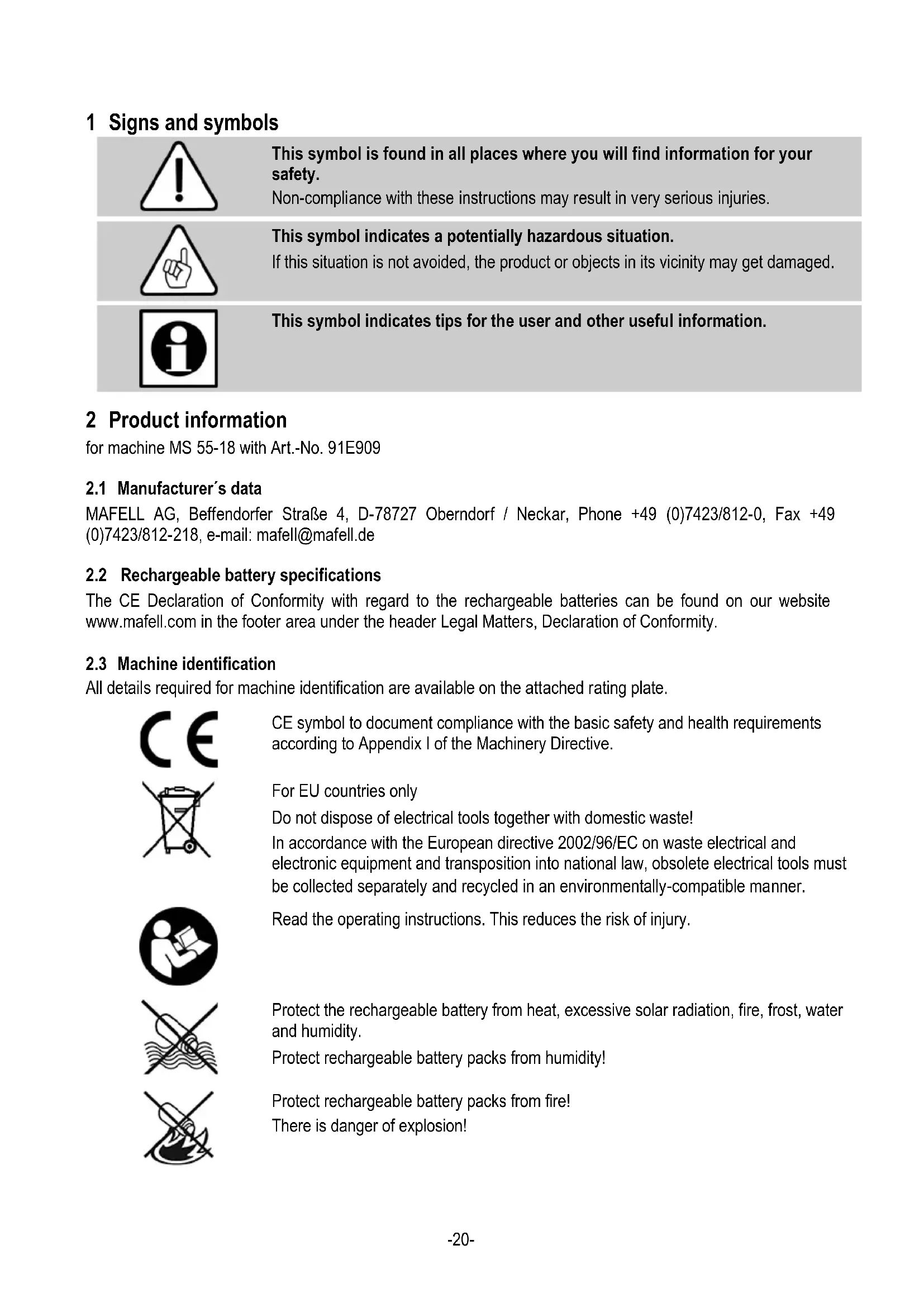
This symbol is found in all places where you will find information for your safety. Non-compliance with these instructions may result in very serious injuries.
This symbol indicates a potentially hazardous situation. If this situation is not avoided, the product or objects in its vicinity may get damaged.
This symbol indicates tips for the user and other useful information. 2 Product information for machine MS 55-18 with Art.-No. 91E909
2.2 Rechargeable battery specifications
The CE Declaration of Conformity with regard to the rechargeable batteries can be found on our website www.mafell.com in the footer area under the header Legal Matters, Declaration of Conformity.
2.3 Machine identification
All details required for machine identification are available on the attached rating plate.
CE symbol to document compliance with the basic safety and health requirements according to Appendix I of the Machinery Directive.
For EU countries only Do not dispose of electrical tools together with domestic waste! In accordance with the European directive 2002/96/EC on waste electrical and electronic equipment and transposition into national law, obsolete electrical tools must be collected separately and recycled in an environmentally-compatible manner.
Read the operating instructions. This reduces the risk of injury.
Protect the rechargeable battery from heat, excessive solar radiation, fire, frost, water and humidity. Protect rechargeable battery packs from humidity!
Protect rechargeable battery packs from fire! There is danger of explosion!-21-
Cordless Alliance System (=CAS) is a cross-manufacturer battery pack system. Further information is available at www.cordless-alliance-system.com
brushless Operating voltage
18 V DC Speed during idling
Saw blade mounting hole
20 mm (0.08 in.) Hose connector diameter 35 mm (0.08 in.) Weight with rechargeable battery
Dimensions (W x L x H)
The declared noise emission values have been measured in accordance with EN 62841-1 and EN 62841-2-5 and may be used for comparing the tool with another and also in a preliminary assessment of exposure.
Danger The noise emissions during actual use of the power tool can differ from the declared values depending on the ways in which the tool is used especially what kind of workpiece is processed. Always wear hearing protection, even when the power tool ist running idle in addition to the trigger time!
2.5.1 Noise emission specifications
Noise emission values determined according to EN 62841-1 and EN 62841-2-5: Sound pressure level L
= 93 dB (A) Uncertainty
= 3 dB (A) Sound power level L
= 101 dB (A) Uncertainty K
= 3 dB (A) The noise measurement was recorded using the saw blade included in the standard equipment.
2.5.2 Vibration specifications
The typical hand-arm vibration is less than 2.5 m/s
Portable circular saw MS 55-18 complete with: 1 carbide-tipped circular saw blade Ø 160 mm (6.30 in.), 32 teeth 1 riving knife / splitter (thickness 1.2 mm/3.32 in.)-22- 1 operating tool 1 operating manual 1 folder "Safety instructions"
Danger These devices are required for the machine's safe operation and may not be removed or rendered inoperative. Before operating the machine, check the safety devices for function and possible damage. Do not use the machine with missing or ineffective safety devices. The machine is equipped with the following safety devices: - Upper stationary saw guard - Lower retractable saw guard - Large base plate - Handles - Riving knife / splitter - Index mechanism and electrical brake - Hose connector
2.8 Use according to intended purpose
The portable circular saw is exclusively suitable for longitudinal and cross cutting of solid wood. Panel materials such as chip board, core board and medium density fibre board can also be processed. Only use the saw blades approved by Mafell in accordance with EN 847-1 in the specified ø-range Any other use than described above is not permissible. The manufacturer cannot be held liable for any damage arising from such other use. So as to use the machine as intended, comply with the operating, maintenance and repair instructions specified by Mafell. Only use saw blades with a speed marking that corresponds to or is higher than the speed specified on the power tool Only use original Mafell / CAS rechargeable batteries and accessories. Battery packs marked with CAS are 100% compatible with CAS devices (Cordless Alliance System).
Danger Even if used in accordance with its intended purpose and despite conforming with the safety instructions, residual risks caused by the intended use that can lead to health consequences will always remain. - Touching the saw blade in the vicinity of the starting aperture below the base plate. - Touching the part of the saw blade that protrudes below the workpiece when cutting. - Touching of turning parts from the side: saw blade, clamping flange and flange screw. - Machine backlash if the blade gets stuck in the workpiece. - Breakage of the saw blade and risk of the blade or pieces of the blade being hurled away. - Accidental activation if rechargeable battery is not unplugged. - Hearing can be impaired when working for long periods without ear protectors. - Emission of harmful wood dusts during longer operation without extraction. 3 Safety instructions Danger Always observe the following safety instructions and the safety regulations applicable in the respective country of use! Also read the safety instructions in the enclosed booklet "Safety instructions". General instructions: - Children and adolescents must not operate this machine. This rule does not apply to young persons-23- receiving training and being supervised by an expert. - Never work without the protection devices stipulated for the respective operating sequence and do not effect any modifications on the machine that could impair safety. - Examine the workpiece for foreign objects. Never attempt to cut into nails or other metal objects. - Protect the machine and the rechargeable batteries from humidity! - Do not throw the rechargeable batteries into a fire! - Do not use any defective or deformed rechargeable batteries! - Do not open the rechargeable batteries! - Do not touch the contacts of the rechargeable batteries and do not short-circuit them! - A slightly acidic, combustible liquid may leak from defective li-ion rechargeable batteries! If any battery liquid is leaking and comes in contact with the skin, immediately rinse with a copious amount of water. If any battery liquid gets into your eyes, rinse with clean water and immediately consult a doctor for medical treatment! - Remove the rechargeable batteries from the machine before carrying out any setting, retooling, maintenance or cleaning tasks. - Ensure that the machine is switched off when you push in the rechargeable battery. - Please remove the rechargeable battery from the machine if the machine is put down, transported or stored unattended. Do not use: - Cracked and misshapen saw blades. - Saw blades made of high speed steel (HSS saw blades). - Blunt saw blades as they impose an excessive load on the motor. - Saw blades with a base body with a thickness greater than, or a cutting width (setting) less than, the thickness of the riving knife / splitter. - Saw blades which are not suitable for the saw blade's idling speed. - Grinding discs Instructions on the use of personal protective equipment: - Always wear ear protectors during work. - Always where a dust mark during work. - Always wear protective goggles during work. Instructions on operation: Sawing method
Danger - Keep hands away from cutting area and the blade. Keep your second hand on auxiliary handle, or motor housing. If both hands are holding the saw, they cannot be cut by the blade. - Do not reach underneath the workpiece. The guard cannot protect you from the blade below the workpiece. - Adjust the cutting depth to the thickness of the workpiece. Less than a full tooth of the blade teeth should be visible below the workpiece. - Never hold the workpiece in your hands or across your leg while cutting. Secure the workpiece to a stable platform. It is important to support the work properly to minimise body exposure, blade binding, or loss of control. - Hold the power tool by insulated gripping surfaces, when performing an operation where the cutting tool may contact hidden wiring or its own cord. Contact with a "live" wire will also make exposed metal parts of the power tool "live" and could give the operator an electric shock. - When ripping, always use a rip fence or straight edge guide. This improves the accuracy of cut and reduces the chance of blade binding. - Always use blades with correct size and shape (diamond versus round) of arbour holes. Blades that do not match the mounting hardware of the saw will run off-centre, causing loss of control. - Never use damaged or incorrect blade washers or bolt. The blade washers and bolt were specially designed for your saw, for optimum performance and safety of operation.-24- Kickback causes and related warnings - kickback is a sudden reaction to a pinched, jammed or misaligned saw blade, causing anuncontrolled saw to lift up and out of the workpiece toward the operator; - When the blade is pinched or jammed tightly by the kerf closing down, the blade stalls and the motor reaction drives the unit rapidly back toward the operator; - if the blade becomes twisted or misaligned in the cut, the teeth at the back edge of the blade can dig into the top surface of the wood causing the blade to climb out of the kerf and jump back toward the operator. Kickback is the result of saw misuse and/or incorrect operating procedures or conditions and can be avoided by taking proper precautions as given below. - Maintain a firm grip with both hands on the saw and position your arms to resist kickback forces. Position your body to either side of the blade, but not in line with the blade. Kickback could cause the saw to jump backwards, but kickback forces can be controlled by the operator, if proper precautions are taken. - When blade is binding, or when interrupting a cut for any reason, release the trigger and hold the saw motionless in the material until the blade comes to a complete stop. Never attempt to remove the saw from the work or pull the saw backward while the blade is in motion or kickback may occur. Investigate and take corrective actions to eliminate the cause of blade binding. - When restarting a saw in the workpiece, centre the saw blade in the kerf so that the saw teeth are not engaged into the material. If a saw blade binds, it may walk up or kickback from the workpiece as the saw is restarted. - Support large panels to minimise the risk of blade pinching and kickback. Large panels tend to sag under their own weight. Supports must be placed under the panel on both sides, near the line of cut and near the edge of the panel. - Do not use dull or damaged blades. Unsharpened or improperly set blades produce narrow kerf causing excessive friction, blade binding and kickback. - Blade depth and bevel adjusting locking levers must be tight and secure before making the cut. If blade adjustment shifts while cutting, it may cause binding and kickback. - Use extra caution when sawing into existing walls or other blind areas. The protruding blade may cut objects that can cause kickback. Lower guard function - Check the lower guard for proper closing before each use. Do not operate the saw if the lower guard does not move freely and close instantly. Never clamp or tie the lower guard into the open position. If the saw is accidentally dropped, the lower guard may be bent. Raise the lower guard with the retracting handle and make sure it moves freely and does not touch the blade or any other part, in all angles and depths of cut. - Check the operation of the lower guard spring. If the guard and the spring are not operating properly, they must be serviced before use. Lower guard may operate sluggishly due to damaged parts, gummy deposits, or a build-up of debris. - The lower guard may be retracted manually only for special cuts such as "plunge cuts" and "compound cuts". Raise the lower guard by the retracting handle and as soon as the blade enters the material, the lower guard must be released. For all other sawing, the lower guard should operate automatically. - Always observe that the lower guard is covering the blade before placing the saw down on bench or floor. An unprotected, coasting blade will cause the saw to walk backwards, cutting whatever is in its path. Be aware of the time it takes for the blade to stop after switch is released. Riving knife function - Use the appropriate saw blade for the riving knife. For the riving knife to function, the body of the blade must be thinner than the riving knife and the cutting width of the blade must be wider than the thickness of the riving knife. - Adjust the riving knife as described in this instruction manual. Incorrect spacing, positioning and alignment can make the riving knife ineffective in preventing kickback.-25- - Always use the riving knife except when plunge cutting. The riving knife must be replaced after plunge cutting. The riving knife causes interference during plunge cutting and can create kickback. - For the riving knife to work, it must be engaged in the workpiece. The riving knife is ineffective in preventing kickback during short cuts. - Do not operate the saw if the riving knife is bent Even a light interference can slow the closing rate of a guard. Instructions on service and maintenance: - Regularly cleaning the machine, especially the adjusting devices and guides, constitutes an important safety factor. - Only original MAFELL spare parts and accessories may be used. Otherwise the manufacturer will not accept any warranty claims and cannot be held liable. 4 Setting / adjustment
4.1 Charging the rechargeable battery
Check whether the rated voltage of the rechargeable battery agrees with the information specified on the machine. Rechargeable battery and charger are matched to each other. Only use the MAFELL – APS 18 chargers for recharging. Before using a new machine, first of all charge the rechargeable battery. A description of how to start up and charge the APS 18 can be found in the appended instructions "APS 18 rechargeable power station". The rechargeable battery is equipped with a temperature monitoring system. This guarantees that the rechargeable battery is only charged in the temperature range between 0°C and 50°C. This achieves a long service life for the rechargeable battery. A considerably shortened operating time per charging procedure indicates that the rechargeable battery is spent and needs to be replaced.
Danger Explosion hazard Protect the rechargeable battery from heat, fire and moisture. Do not place the rechargeable battery onto heating appliances and do not expose the rechargeable battery to strong solar radiation for a longer period of time. Temperatures above 50°C are detrimental to the rechargeable battery. Allow a heated rechargeable battery to cool down before charging it. The optimum storage temperature ranges between 10°C and 30°C.
Do not open the rechargeable battery and protect it from impacts. Keep the rechargeable battery in a dry and frost-proof place.
Danger Cover the rechargeable battery's contacts if it is stored outside the charger. There is a fire and explosion hazard in case of a short circuit caused by metallic bridging.
Follow the instructions for the protection of the environment.
4.2 Fitting the rechargeable battery
Slide the charged rechargeable battery into the battery guide next to the handle until it perceptibly engages.
Before using the machine, convince yourself that the rechargeable battery is firmly seated in the machine.
4.3 Removing the rechargeable battery
Unlock the rechargeable battery by pressing the locking lever 21 (Fig. 1) and pull it out of the battery guide.
Do not use force to do so.
Danger Substances that are harmful to health must be taken up with an M- suction device.-26- Connect the machine to a suitable external dust extractor during all work generating a considerable amount of dust. The air velocity must be at least 20 m/s (65.6 ft / sec.). The inside diameter of hose connector 8 (Fig. 2) is 35 mm (1 3/8 in.).
4.5 Saw blade selection
Use a sharp tool to obtain a good cut quality and select a tool from the following list according to material and application: For cuts along and across the grain in soft and hard wood: - Circular saw blade carbide Ø 160 x 1.8 x 20 mm, 24 teeth - Circular saw blade carbide Ø 160 x 1.4 x 20 mm, 32 teeth For cuts especially along the grain in soft and hard wood: - Circular saw blade carbide Ø 160 x 1.8 x 20 mm, 16 teeth For cuts especially across the grain in soft and hard wood: - Circular saw blade carbide Ø 160 x 1.8 x 20 mm, 32 teeth
Danger Unplug the rechargeable battery for all service work.
- Press the push-button 2 (Fig. 1) and pull the locking lever 1 (Fig. 1) upwards. Now the saw shaft is locked in position and the shift lever locked.
- Using the Allen key included in the supply, release the flange screw 5 (Fig. 2) counter clockwise. Remove the screw and the front clamping flange 6 (Fig. 2).
- Now you can remove the saw blade after opening the retractable saw guard.
- The clamping flanges must be free of adhering parts.
- Pay attention to the sense of rotation when inserting the saw blade.
- Afterwards, mount the clamping flange, attach the flange screw and tighten it by clockwise turning.
4.7 Riving knife/splitter
Danger Unplug the rechargeable battery for all service work. The riving knife/splitter 7 (Fig. 2) prevents the saw blade from jamming during longitudinal cutting. The correct distance to the saw blade is shown in Fig. 4.
- To make an adjustment, unfasten the two cylinder- head screws 4 (Fig. 2) with the Allen key that has been enclosed in the supply.
- Adjust the riving knife/splitter by moving it in its longitudinal groove, and retighten the two cylinder- head screws afterwards. 5 Operation During operation and given corresponding conditions - in particular if the air is dry, or if materials such as coated board materials are used and there is no anti-static suction hose - electrostatic discharges via the operator can occur. The electronic system’s protective function is activated and the machine goes into a safe state. The machine switches off automatically.
5.1 Initial operation
Personnel entrusted to work with the machine must be made aware of the operating instructions, calling particular attention to the chapter "Safety instructions".
5.2 Switching on and off
- Switching on: Press the switch-on lock 9 (Fig. 1) forward to unlock it.Then actuate switch trigger 10 (Fig. 1) when the switch-on lock is pressed. As this is a switch without locking device, the machine will only run for as long as this switch trigger is pressed.-27- The built-in electronic system provides for jerk-free acceleration when the machine is switched on and under load readjusts the speed to the fixed setting. In addition, this electronic system adjusts the motor down in case of overload, i.e. the saw blade will stop. Switch the machine off then. Then switch the machine on again and continue sawing at a reduced feed speed. Warming of the machine leads to faster overload shutdown. WIth the setting wheel 11 (Fig. 2) you can adjust the saw speed between 2450 and 5450 rpm.
Material groups - PVC, Plexi, PA - Level: 1 - 6 - Hardwood, softwood, plywood - Level: 3 - 6 - Coated panel materials - Level: 4 - 6 - Fibre cement board - Level: 3 - 5
- Switching off: For switching off, release the switch trigger 10 (Fig. 1). The built-in automatic brake limits the saw blade slowing time to approx. 1 - 2 s. The switch-on lock automatically takes effect again and secures the portable circular saw against accidental switch-on.
5.3 Cutting depth adjustment
The cutting depth is continuously variable between 10 and 55 mm ( 3/8 to 2 3/16 in. ). Proceed as follows: - Release the clamping lever 3 (Fig. 2). The released clamping lever reveals a view of the depth scale through a recess in the stationary guard. You can read the set depth off the edge of the recess that is marked with an arrow.
- Set the cutting depth by means of a scissor-like movement between stationary guard and base plate.
- Retighten the clamping lever.
Always set the cutting depth approx. 2 to 5 mm (1/16 to 3/16 in.) larger than the material thickness to be cut.
5.4 Setting for bevel cuts
For bevel cuts, the saw unit can be set to any angle between 0 and 45°.
- Unfasten the wing screw 15 (Fig. 1).
- Adjust the angle according to the scale on the segment for tilting.
- Afterwards, tighten the wing screw 15.
5.5 Sawing according to tracings
The base plate has three tracing edges 12 (Fig. 2) for 0°, 30° and 45°. These tracing edges correspond to the saw blade's inside. For bevel cuts, the tracing can be viewed through the opening on the left-hand side of the upper saw guard.
- Hold the machine by its handles and place the front part of its base plate onto the workpiece.
- Switch on the portable circular saw (see chapter 5.2) and slide the machine evenly forward in the direction of the cut.
- When the cut is completed, switch off the saw by releasing the switch trigger 10 (Fig. 1). 6 Service and maintenance
Danger Unplug the rechargeable battery for all service work. MAFELL machines are designed to be low in maintenance. The ball bearings used are greased for life. When the machine has been in operation for a longer period of time, we recommend to hand the machine in at an-28- authorised MAFELL customer service shop for inspection. Only use our special grease, order No. 049040 (1 kg tin) for all greasing points.
Clean the machine thoroughly if the machine is not used for a longer period of time. Spray blank metal parts with a rust-proofing agent.
The included Li-ion rechargeable batteries are subject to the requirements of dangerous goods legislation. The rechargeable batteries can be transported by the user on the road without any further requirements. For the dispatch by third parties (e.g.: air transport or forwarding agent), special requirements for packaging and labelling must be observed. In this case, a dangerous goods expert must be consulted when preparing the package. Only dispatch rechargeable batteries if their housing is undamaged. Tape open contacts and pack the rechargeable battery so that it does not move in the packaging. Please also observe any further national regulations.
6.3 Disposal of rechargeable batteries/batteries
Electrical tools, rechargeable batteries, accessories and packaging should be recycled in an environmentally friendly manner. Do not dispose of electrical tools together with domestic waste! For EU countries only:
According to the European Directive 2002/96/EC, power tools that are no longer serviceable, and according to the European Directive 2006/66/EC, defective or used rechargeable batteries/batteries must be collected separately and recycled in an environmentally sound manner. Return unusable rechargeable batteries/batteries directly to: Germany Stiftung GRS Batterien Heidenkampsweg 44 20097 Hamburg Germany Rechargeable batteries/batteries:
Li-Ion: Please comply with the information in Section “Transport”, page 28. Subject to changes. 7 Troubleshooting
Danger Determining the causes for existing defects and eliminating these always requires increased attention and caution. Unplug the rechargeable battery beforehand! Some of the most frequent defects and their causes are listed in the following chart. In case of other defects, please contact your dealer or the MAFELL customer service directly. Defect Cause Elimination Machine cannot be switched on Discharge the rechargeable battery Charge the rechargeable battery Rechargeable battery not engaged in end position Allow rechargeable battery to engage completely-29- Defect Cause Elimination Rechargeable battery almost empty, an LED on the rechargeable battery is flashing. Electronic system protects the rechargeable battery from deep discharge. Press key 22 to check (Fig. 1 + 3). If only one LED is still glowing, recharge the rechargeable battery. Overload, machine switches off. A sustained load has overheated the machine or the rechargeable battery. A warning signal is sounded (beep tone). As long as the machine or the rechargeable battery have not cooled down, every further attempt to switch on the machine will result in another beep tone. Allow the machine and the rechargeable battery to cool down. The rechargeable battery can be cooled down much faster with a charger with air cooling. The machine can also be cooled down much faster by using a different rechargeable battery and idling the machine. The machine switches off at a sudden increase in load. The sudden increase in load also causes the current that is required for the machine to rise. A warning signal is sounded (beep tone). This rise in current, which occurs when there is a sudden blockage or backlash, is measured and then leads to the machine being switched off. Switch off the machine by releasing the switch trigger. Afterwards, you can switch the machine back on again and resume work as normal. Try to avoid further blockages. The machine switches off during operation. Electrostatic charge. The electronic system’s protective function is activated and the machine goes into a safe state. The machine switches off. Use an anti-static suction hose Saw blade jams as the machine is advanced Feed rate too fast Reduce feed speed Blunt saw blade Release the switch immediately. Remove the machine from the workpiece and replace the saw blade Tension in the workpiece Widen the kerf with a wedge Poor machine guidance Use parallel guide fence Uneven workpiece surface Straighten the surface Burn marks on the cut surfaces The saw blade used is unsuitable for the task or blunt Replace saw blade Chip ejection blocked Wood is too damp Use dry wood Clean chip ejection Extended cutting operation without extraction Connect machine to an external extraction, e.g. portable dust extractor-30- Defect Cause Elimination Sudden smoke emission from the motor casing Overload of the machine’s electronic system Interrupt the power supply by removing the battery pack. The smoke emission stops. Do not insert a rechargeable battery! Avoid inhaling the smoke! Saw blade stops - motor continues to turn Saw blade not correctly fastened Retighten saw blade Saw blade vibrates in the work piece Saw blade not correctly adjusted Retighten saw blade Work piece not fastened Fasten work piece with clamps Lower mobile protective cover does not close or closes only slowly Chips and pieces of wood in the bottom mobile protective cover Remove chips and pieces of wood
8 Optional accessories
Mushroom-shaped handle (can be mounted on front of base plate) Order No. 201451 - Saw blade - carbide Ø 160 x 1.8 x 20, 16 teeth (longitudinal cut) Order No. 092539 - Saw blade - carbide Ø 160 x 1.4 x 20, 32 teeth (longitudinal and cross cuts) Order No. 092610
Guide rail F 310, 3100 mm long Order No. 204383 - Angle fence F-WA Order No. 205357 - Accessories for guide rail:
Screw clamp F-SZ180MM (2 x) Order No. 207770
Connecting piece F-VS Order No. 204363
Rail bag 160 Order No. 204626
Rail bag kit F80/160 with angle fence consisting of: F80 + F160 + connecting piece + sliding bevel + 2 screw clamps + rail bag Order No. 204749 - Rail bag kit F160/160 consisting of: 2 x F160 + connecting piece + 2 screw clamps + rail bag Order No. 204805 - Rechargeable power station APS M Order No. 094492 - Rechargeable power station APS M GB Order No. 094493
Rechargeable battery PowerTank 18 M 99 LiHD Order No. 094503-31- - Rechargeable battery PowerTank 18 M 144 LiHD Order No. 094498
Power set 2: 2x 18 M 99 LiHD + APS M Order No. 209599
- Power set 3: 2x 18 M 144 LiHD + APS M+ Order No. 209598 - Aerofix suction-clamping-system F-AF 1 consisting of: Rail 1.3 m, adapter for top and bottom, flexible hose Order No. 204770 - Flexible hose FXS-L, length 3.2 m Order No. 205276
End caps packed F-EK Order No. 205400
= 93 dB (A) Negotovost K
= 101 dB (A) Negotovost