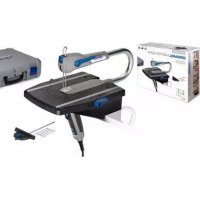
DSM2034 - Saw DREMEL - Free user manual and instructions
Find the device manual for free DSM2034 DREMEL in PDF.



| Brand | DREMEL |
| Model | DSM2034 |
| Type of product | Corded cut-off tool |
| Power supply | Mains 220-240 V ~50/60 Hz |
| Rated power | 710 W |
| No-load speed | 17,000 min⁻¹ |
| Max wheel diameter | 77 mm (type 1) |
| Wheel spindle | 11 mm |
| Max cutting depth | 21.5 mm |
| Power cord | Approx. 2 m (estimate) |
| Weight | Approx. 2.5 kg (estimate) |
| Main functions | Straight, flush, plunge, bevel, miter cuts (with accessories) |
| Sound pressure level | 96 dB(A) |
| Sound power level | 108 dB(A) |
| Vibration (hand-arm method) | 3.3 m/s² |
| Safety devices | Protective guard, paddle switch with lock-off, spindle lock |
| Dust extraction | Dust extraction port (optional adapter) |
| Maintenance and cleaning | Clean with compressed air, do not use harsh solvents |
| Spare parts and repairability | No user-serviceable parts, contact DREMEL service center |
| Warranty | Complying with applicable legal regulations |
| Compatible accessories (examples) | DSM500 wheels (wood), DSM510 (metal/plastic), DSM520 (masonry), DSM540 (hard materials), DSM600 (offset carbide), edge guide, miter guide |
Frequently Asked Questions - DSM2034 DREMEL
User questions about DSM2034 DREMEL
0 question about this device. Answer the ones you know or ask your own.
Ask a new question about this device
Download the instructions for your Saw in PDF format for free! Find your manual DSM2034 - DREMEL and take your electronic device back in hand. On this page are published all the documents necessary for the use of your device. DSM2034 by DREMEL.
USER MANUAL DSM2034 DREMEL
CE DECLARATION OF CONFORMITY We declare under our sole responsibility that this product is in conformity with the following standards or standardized documents: EN60745, EN55014, in accordance with the provisions of the directives 2006/95/EC, 2004/108/EC, 2006/42/EC.
NOISE/VIBRATION Measured in accordance with EN60745 the sound pressure level of this tool is 96 dB(A) and the sound power level 108 dB(A) (standard deviation: 3 dB), and the vibration 3.3m / s^2 (hand-arm method).
NOTE: The declared vibration total value has been measured in accordance with a standard test method and may be used for comparing one tool with another. It may also be used in a preliminary assessment of exposure.
WARNING The vibration emission during actual use of the power tool can differ from the declared total value depending on the ways in which you use the tool. Make an estimation of the exposure in the actual conditions of use and identify the safety measures for personal protection accordingly (taking account of all parts of the operating cycle such as the times when the tool is switched off and when it is running idle in addition to the trigger time).
Technical file at: SKIL Europe BV (PT-SEU/PJE), 4825 BD Breda, NL.
DE
EC/2006/42, EC/2004/108
EN60745 jy yj yj yj yj yj yj
(3 dB:Jyj) (Jyj) 108 dB(A) yj yj (Jyj) 96 dB(A)
()j 3.3 jinN
READ THESE INSTRUCTIONS

USE EYE PROTECTION

USE HEARING PROTECTION

DOUBLE INSULATION (NO EARTH WIRE REQUIRED)

DO NOT DISPOSE OF ELECTRIC TOOLS, ACCESSORIES AND PACKAGING TOGETHER WITH HOUSEHOLD WASTE MATERIAL
GENERAL POWER TOOL SAFETYWARNINGS

WARNING
READ ALL SAFETY WARNING
AND ALL INSTRUCTIONS. Failure
to follow the warnings and instructions may result in electric shock, fire and/or serious injury.
Save all warnings and instructions for future reference.
The term "power tool" in the warnings refers to your mains-operated (corded) power tool or battery-operated (cordless) power tool.
WORK AREA SAFETY
a. Keep work area clean and well lit. Cluttered and dark areas invite accidents.
b. Do not operate power tools in explosive atmospheres, such as in the presence of flammable liquids, gases or dust. Power tools create sparks which may ignite the dust or fumes.
c. Keep children and bystanders away while operating a power tool. Distractions can cause you to lose control.
ELECTRICAL SAFETY
a. Power tool plug must match the outlet. Never modify the plug in any way. Do not use any adapter plugs with earthed (grounded) power tools. Unmodified plugs and matching outlets will reduce risk of electric shock.
b. Avoid body contact with earthed or grounded surfaces such as pipes, radiators, ranges and refrigerators. There is an increased risk of electric shock if your body is earthed or grounded.
c. Do not expose power tools to rain or wet conditions. Water entering a power tool will increase the risk of electric shock.
d. Do not abuse the cord. Never use the cord for carrying,
pulling or unplugging the power tool. Keep cord away from heat, oil, sharp edges or moving parts. Damaged or entangled cords increase the risk of electric shock.
e. When operating a power tool outdoors, use an extension cord suitable for outdoor use. Use of a cord suitable for outdoor use reduces the risk of electric shock.
f. If operating a power tool in a damp location is unavoidable, use an earth leakage circuit breaker (ELCB) protected supply. Use of an earth leakage circuit breaker reduces the risk of electric shock.
PERSONAL SAFETY
a. Stay alert, watch what you are doing and use common sense when operating a power tool. Do not use a power tool while you are tired or under the influence of drugs, alcohol or medication. A moment of inattention while operating power tools may result in serious personal injury.
b. Use personal protective equipment. Always wear eye protection. Protective equipment such as dust mask, nonskid safety shoes, hard hat, or hearing protection used for appropriate conditions will reduce personal injuries.
c. Prevent unintentional starting. Ensure the switch is in the off-position before connecting to power source and/or battery pack, picking up or carrying the tool. Carrying power tools with your finger on the switch or energising power tools that have the switch on invites accidents.
d. Remove any adjusting key or wrench before turning the power tool on. A wrench or a key left attached to a rotating part of the power tool may result in personal injury.
e. Do not overreach. Keep proper footing and balance at all times. This enables better control of the power tool in unexpected situations.
f. Dress properly. Do not wear loose clothing or jewellery. Keep your hair, clothing and gloves away from moving parts. Loose clothes, jewellery or long hair can be caught in moving parts.
g. If devices are provided for the connection of dust extraction and collection facilities, ensure these are connected and properly used. Use of these devices can reduce dust related hazards.
POWER TOOL USE AND CARE
a. Do not force the power tool. Use the correct power tool for your application. The correct power tool will do the job better and safer at the rate for which it was designed.
b. Do not use the power tool if the switch does not turn it on and off. Any power tool that cannot be controlled with the switch is dangerous and must be repaired.
c. Disconnect the plug from the power source and/or the battery pack from the power tool before making any adjustments, changing accessories, or storing power tools. Such preventive safety measures reduce the risk of starting the power tool accidentally.
d. Store idle power tools out of the reach of children and do not allow persons unfamiliar with the power tool or these instructions to operate the power tool. Power tools are dangerous in the hands of untrained users.
e. Maintain power tools. Check for misalignment or binding
of moving parts, breakage of parts and any other condition that may affect the power tools operation. If damaged, have the power tool repaired before use. Many accidents are caused by poorly maintained power tools.
f. Keep cutting tools sharp and clean. Properly maintained cutting tools with sharp cutting edges are less likely to bind and are easier to control.
g. Use the power tool, accessories and tool bits etc., in accordance with these instructions, taking into account the working conditions and the work to be performed. Use of the power tool for operations different from those intended could result in a hazardous situation.
BATTERY TOOL USE AND CARE
a. Recharge only with the charger specified by the manufacturer. A charger that is suitable for one type of battery pack may create a risk of fire when used with another battery pack.
b. Use power tools only with specifically designated battery packs. Use of any other battery packs may create a risk of injury and fire.
c. When battery pack is not in use, keep it away from other metal objects like paper clips, coins, keys, nails, screws, or other small metal objects that can make a connection from one terminal to another. Shorting the battery terminals together may cause burns or a fire.
d. Under abusive conditions, liquid may be ejected from the battery; avoid contact. If contact accidentally occurs, flush with water. If liquid contacts eyes, additionally seek medical help. Liquid ejected from the battery may cause irritation or burns.
SERVICE
a. Have your power tool serviced by a qualified repair person using only identical replacement parts. This will ensure that the safety of the power tool is maintained.
MACHINE-SPECIFIC SAFETY WARNINGS
CUT-OFF MACHINE SAFETY WARNINGS
a. The guard provided with the tool must be securely attached to the power tool and positioned for maximum safety, so the least amount of wheel is exposed towards the operator. Position yourself and bystanders away from the plane of the rotating wheel. The guard helps to protect operator from broken wheel fragments and accidental contact with wheel.
b. Use only bonded reinforced or diamond cut-off wheels for your power tool. Just because an accessory can be attached to your power tool, it does not assure safe operation.
c. The rated speed of the accessory must be at least equal to the maximum speed marked on the power tool. Accessories running faster than their rated speed can break and fly apart.
d. Wheels must be used only for recommended applications. For example: do not grind with the side of cut-off wheel. Abrasive cut-off wheels are intended for peripheral grinding, side forces applied to these wheels may cause them to shatter.
e. Always use undamaged wheel flanges that are of correct diameter for your selected wheel. Proper wheel flanges support the wheel thus reducing the possibility of wheel breakage.
f. Do not use worn down reinforced wheels from larger power tools. Wheels intended for a larger power tool are not suitable for the higher speed of a smaller tool and may burst.
g. The outside diameter and the thickness of your accessory must be within the capacity rating of your power tool. Incorrectly sized accessories cannot be adequately guarded or controlled.
h. The arbour size of wheels and flanges must properly fit the spindle of the power tool. Wheels and flanges with arbour holes that do not match the mounting hardware of the power tool will run out of balance, vibrate excessively and may cause loss of control.
i. Do not use damaged wheels. Before each use, inspect the wheels for chips and cracks. If power tool or wheel is dropped, inspect for damage or install an undamaged wheel. After inspecting and installing the wheel, position yourself and bystanders away from the plane of the rotating wheel and run the power tool at maximum no load speed for one minute. Damaged wheels will normally break apart during this test time.
j. Wear personal protective equipment. Depending on application, use face shield, safety goggles or safety glasses. As appropriate, wear dust mask, hearing protectors, gloves and shop apron capable of stopping small abrasive or workpiece fragments. The eye protection must be capable of stopping flying debris generated by various operations. The dust mask or respirator must be capable of filtrating particles generated by your operation. Prolonged exposure to high intensity noise may cause hearing loss.
k. Keep bystanders a safe distance away from work area. Anyone entering the work area must wear personal protective equipment. Fragments of workpiece or of a broken wheel may fly away and cause injury beyond immediate area of operation.
1. Hold the power tool by insulated gripping surfaces only, when performing an operation where the cutting accessory may contact hidden wiring or its own cord. Cutting accessory contacting a "live" wire may make exposed metal parts of the power tool "live" and could give the operator an electric shock.
m. Position the cord clear of the spinning accessory. If you lose control, the cord may be cut or snagged and your hand or arm may be pulled into the spinning wheel.
n. Never lay the power tool down until the accessory has come to a complete stop. The spinning wheel may grab the surface and pull the power tool out of your control.
o. Do not run the power tool while carrying it at your side. Accidental contact with the spinning accessory could snag your clothing, pulling the accessory into your body.
p. Regularly clean the power tool's air vents. The motor's
fan will draw the dust inside the housing and excessive accumulation of powdered metal may cause electrical hazards.
q. Do not operate the power tool near flammable materials. Sparks could ignite these materials.
r. Do not use accessories that require liquid coolants. Using water or other liquid coolants may result in electrocution or shock.
SAFETY WARNINGS COMMON FOR GRINDING AND ABRASIVE CUTTING-OFF OPERATIONS
a. This power tool is intended to function as a grinder or a cut-off tool. Read all safety warnings, instructions, illustrations and specifications provided with this power tool. Failure to follow all instructions listed below may result in electric shock, fire and/or serious injury.
b. Operations such as sanding, wire brushing or polishing are not recommended to be performed with this power tool. Operations for which the power tool was not designed may create a hazard and cause personal injury.
c. Do not use accessories which are not specifically designed and recommended by the tool manufacturer. Just because the accessory can be attached to your power tool, it does not assure safe operation.
d. The rated speed of the accessory must be at least equal to the maximum speed marked on the power tool. Accessories running faster than their rated speed can break and fly apart.
e. The outside diameter and the thickness of your accessory must be within the capacity rating of your power tool. Incorrectly sized accessories cannot be adequately guarded or controlled.
f. The arbour size of wheels, flanges, backing pads or any other accessory must properly fit the spindle of the power tool. Accessories with arbour holes that do not match the mounting hardware of the power tool will run out of balance, vibrate excessively and may cause loss of control.
g. Do not use a damaged accessory. Before each use inspect the accessory such as abrasive wheels for chips and cracks, backing pad for cracks, tear or excess wear, wire brush for loose or cracked wires. If power tool or accessory is dropped, inspect for damage or install an undamaged accessory. After inspecting and installing an accessory, position yourself and bystanders away from the plane of the rotating accessory and run the power tool at maximum no-load speed for one minute. Damaged accessories will normally break apart during this test time.
h. Wear personal protective equipment. Depending on application, use face shield, safety goggles or safety glasses. As appropriate, wear dust mask, hearing protectors, gloves and workshop apron capable of stopping small abrasive or workpiece fragments. The eye protection must be capable of stopping flying debris generated by various operations. The dust mask or respirator must be capable of filtrating particles generated by your operation. Prolonged exposure to high intensity noise may cause hearing loss.
i. Keep bystanders a safe distance away from work area. Anyone entering the work area must wear personal
protective equipment. Fragments of workpiece or of a broken accessory may fly away and cause injury beyond immediate area of operation.
j. Hold the power tool by insulated gripping surfaces only, when performing an operation where the cutting accessory may contact hidden wiring or its own cord. Cutting accessory contacting a "live" wire may make exposed metal parts of the power tool "live" and could give the operator an electric shock.
k. Position the cord clear of the spinning accessory. If you lose control, the cord may be cut or snagged and your hand or arm may be pulled into the spinning accessory.
I. Never lay the power tool down until the accessory has come to a complete stop. The spinning accessory may grab the surface and pull the power tool out of your control.
m. Do not run the power tool while carrying it at your side. Accidental contact with the spinning accessory could snag your clothing, pulling the accessory into your body.
n. Regularly clean the power tool's air vents. The motor's fan will draw the dust inside the housing and excessive accumulation of powdered metal may cause electrical hazards.
o. Do not operate the power tool near flammable materials. Sparks could ignite these materials.
p. Do not use accessories that require liquid coolants. Using water or other liquid coolants may result in electrocution or shock.
KICKBACK AND RELATED WARNINGS
Kickback is a sudden reaction to a pinched or snagged rotating wheel, backing pad, brush or any other accessory. Pinching or snagging causes rapid stalling of the rotating accessory which in turn causes the uncontrolled power tool to be forced in the direction opposite of the accessory's rotation at the point of the binding.
For example, if an abrasive wheel is snagged or pinched by the workpiece, the edge of the wheel that is entering into the pinch point can dig into the surface of the material causing the wheel to climb out or kick out. The wheel may either jump toward or away from the operator, depending on direction of the wheel's movement at the point of pinching. Abrasive wheels may also break under these conditions.
Kickback is the result of power tool misuse and/or incorrect operating procedures or conditions and can be avoided by taking proper precautions as given below.
a. Maintain a firm grip on the power tool and position your body and arm to allow you to resist kickback forces. Always use auxiliary handle, if provided, for maximum control over kickback or torque reaction during start-up. The operator can control torque reactions or kickback forces, if proper precautions are taken.
b. Never place your hand near the rotating accessory. Accessory may kickback over your hand.
c. Do not position your body in the area where power tool will move if kickback occurs. Kickback will propel the tool in direction opposite to the wheel's movement at the point of snagging.
d. Use special care when working corners, sharp edges etc. Avoid bouncing and snagging the accessory. Corners,
sharp edges or bouncing have a tendency to snag the rotating accessory and cause loss of control or kickback.
e. Do not attach a saw chain woodcarving blade or toothed saw blade. Such blades create frequent kickback and loss of control.
SAFETY WARNINGS SPECIFIC FOR GRINDING AND ABRASIVE CUTTING-OFF OPERATIONS
a. Use only wheel types that are recommended for your power tool and the specific guard designed for the selected wheel. Wheels for which the power tool was not designed cannot be adequately guarded and are unsafe.
b. The guard must be securely attached to the power tool and positioned for maximum safety, so the least amount of wheel is exposed towards the operator. The guard helps to protect the operator from broken wheel fragments, accidental contact with wheel and sparks that could ignite clothing.
c. Wheels must be used only for recommended applications. For example: do not grind with the side of cut-off wheel. Abrasive cut-off wheels are intended for peripheral grinding, side forces applied to these wheels may cause them to shatter.
d. Always use undamaged wheel flanges that are of correct size and shape for your selected wheel. Proper wheel flanges support the wheel thus reducing the possibility of wheel breakage. Flanges for cut-off wheels may be different from grinding wheel flanges.
e. Do not use worn down wheels from larger power tools. Wheel intended for larger power tool is not suitable for the higher speed of a smaller tool and may burst.
ADDITIONAL SAFETY WARNINGS SPECIFIC FOR ABRASIVE CUTTING-OFF OPERATIONS
a. Do not "jam" the cut-off wheel or apply excessive pressure. Do not attempt to make an excessive depth of cut. Overstressing the wheel increases the loading and susceptibility to twisting or binding of the wheel in the cut and the possibility of kickback or wheel breakage.
b. Do not position your body in line with and behind the rotating wheel. When the wheel, at the point of operation, is moving away from your body, the possible kickback may propel the spinning wheel and the power tool directly at you.
c. When wheel is binding or when interrupting a cut for any reason, switch off the power tool and hold the power tool motionless until the wheel comes to a complete stop. Never attempt to remove the cut-off wheel from the cut while the wheel is in motion otherwise kickback may occur. Investigate and take corrective action to eliminate the cause of wheel binding.
d. Do not restart the cutting operation in the workpiece. Let the wheel reach full speed and carefully re-enter the cut. The wheel may bind, walk up or kickback if the power tool is restarted in the workpiece.
e. Support panels or any oversized workpiece to minimize the risk of wheel pinching and kickback. Large workpieces tend to sag under their own weight. Supports must be placed
under the workpiece near the line of cut and near the edge of the workpiece on both sides of the wheel.
f. Use extra caution when making a "pocket cut" into existing walls or other blind areas. The protruding wheel may cut gas or water pipes, electrical wiring or objects that can cause kickback.
ENVIRONMENT
DISPOSAL
The machine, accessories and packaging should be sorted for environmental-friendly recycling.
ONLY FOR EUROPEAN COUNTRIES

Do not dispose of power tools into household waste! According the European Guideline 2002/96/EC for Waste Electrical and Electronic Equipment and its implementation into national right, power tools that are no longer usable must be collected separately and disposed of in an environmentally correct manner.
SPECIFICATIONS
GENERAL SPECIFICATIONS
Dremel DSM20 cut-off tool
DSM20
Voltage Rating 220-240V~50/60Hz
Wattage rating 710 W
No Load Speed no 17000 min-1
Max abrasive wheel diameter 77 mm type 1
Wheel arbor 11 mm
Max cutting depth 21.5 mm
EXTENSION CORDS
Use completely unrolled and safe extension cords with a capacity of 5 Amps.
ASSEMBLY

WARNING
ALWAYS TURN OFF THE TOOL BEFORE CHANGING ACCESSORIES, CHANGING
COLLETS, OR SERVICING THE TOOL AND REMOVE BATTERY PACK.
GENERAL
This Dremel DSM20 tool is intended for straight cuts in wood, plastic, metal, drywall, fiberboard, and tile using the applicable accessories recommended by Dremel.
PICTURE 1
A. "Lock-on" button
B. Paddle switch with "lock-off" feature
C. Abrasive wheel
D. Line guide
E. Foot
F. Flush cut foot
G. Spindle lock
H. Ventilation openings
I. Cord
J. Depth adjustment lever
K. Dust port
L. Depth scale
INSTALLING AND REMOVING ACCESSORIES

WARNING
DISCONNECT THE PLUG FROM THE POWER SOURCE BEFORE MAKING ANY
ASSEMBLY, ADJUSTMENTS OR CHANGING ACCESSORIES. Such preventive safety measures reduce the risk of starting the tool accidentally.
Standard flat wheel assembly
- Turn LOCK BOLT with wrench provided clockwise and remove LOCK BOLT and OUTER WASHER. If the shaft moves while attempting to loosen the lock bolt press the spindle lock. PICTURE 2
- Slide wheel behind the guard face and mount it against the INNER WASHER on the shaft.
- Reinstall OUTER WASHER and tighten lock bolt finger tight.
- Press spindle lock to lock shaft and tighten LOCK BOLT counter-clockwise until tight with the wrench provided. NOTE: Be sure to read the instructions supplied with your Dremel accessory for further information on its use.
PICTURE 2
A. Standard flat wheel
B. Flush cutting wheel (optional)
C. Standard flat wheel
D. Deburring stone (optional)
E. Wrench
F. Lock bolt
G. Outer washer
H. Guard face
I. Inner washer
J. Spindle lock
PICTURE 3
A. Standard wheel
B. Guard face
Flush cutting wheel assembly
- Repeat step 1 of above.
- Place flush cutting wheel against the INNER WASHER on the spindle shaft. PICTURE 4
- Reinstall OUTER WASHER and tighten LOCK BOLT finger tight.
- Press spindle lock to lock shaft and tighten LOCK BOLT counter-clockwise until tight with the wrench provided.
PICTURE 4
A. Flush cutting wheel
Deburring stone assembly
- Repeat step 1 of above.
- Place flat wheel against the INNER WASHER on the spindle shaft. PICTURE 5
- Install DEBURRING STONE instead of outer washer and tighten finger tight.
- Press spindle lock to lock shaft and tighten DEBURRING STONE counter-clockwise until tight with the wrench provided.
PICTURE 5
A. Standard wheel flat
B. Deburring stone
DUST EXTRACTION
Your tool is equipped with a dust port for dust extraction. To use this feature, insert dust port adapter (optional accessory) into dust port, attach vacuum hose into the adapter, then connect the opposite end of the hose to a shop vacuum cleaner. PICTURE 6
PICTURE 6
A. Dust port
B. Dust port adapter (optional accessory)
C. Vacuum hose (not included)
USE
GETTING STARTED
Thank you for purchasing the Dremel DSM20. This tool was designed to tackle a wide variety of projects in and around the home. The Dremel DSM20 completes tasks quicker and more efficiently than a series of other tools that would be needed to complete a job or project. This tool is also compact, ergonomic, and cuts virtually all common materials.
After using your new Dremel DSM20 you'll find that it is the right size tool to get projects done at just a fraction of the size of a traditional circular saw. With a full line of accessories the tool cuts through virtually any common material in the home-wood, plastic, metal, drywall and tile. The tool also features two cutting wheel positions, one position using a standard flat wheel for all your typical straight cuts and a second position for making flush cuts along flooring or against a wall.
In addition to versatility, the Dremel DSM20 provides excellent line of sight for confident, precise cuts so you will get accurate cuts the first attempt and avoid wasting time or material.
Visit www.dremel.com to learn more about what you can do with your new Dremel tool.

WARNING
HOLD THE TOOL WITH BOTH HANDS WHILE STARTING THE TOOL, SINCE
TORQUE FROM THE MOTOR CAN CAUSE THE TOOL TO TWIST.
Start the tool before applying to work and let the tool come to full speed before contacting the workpiece. Lift the tool from the work before releasing the switch. DO NOT turn the switch "ON" and "OFF" while the tool is under load; this will greatly decrease the switch life.
Paddle switch with "Lock-OFF" feature
The Paddle switch enables the operator to control the switch functions of "LOCK-OFF", and "ON/OFF".
To unlock switch and turn tool "ON": Push "LOCK-OFF" switch release lever forward to unlock paddle switch, then squeeze paddle switch. PICTURE 7
To switch tool "OFF": Release pressure on paddle lever.
The switch is spring loaded and will return to "OFF" position automatically.
PICTURE 7
A. "Lock ON" button
B. "Lock OFF" switch release lever
C. Paddle switch
"LOCK-ON" button
The "LOCK-ON" feature, incorporated into the paddle switch, is a convenience for long operations.
To lock switch "ON": After paddle switch has been activated push "LOCK-ON" button at rear of tool completely in and release paddle switch. PICTURE 7
To switch tool "OFF": Squeeze and release paddle switch. In order to try to avoid recoil (a situation where the wheel wants to skip out of the material) it is recommended to make cuts in the same direction as the rotation of the wheel.

IT IS IMPORTANT TO READ AND
UNDERSTAND THE SECTION IN THIS
MANUAL CALLED "KICKBACK AND RELATED WARNINGS".
Depth adjustment
Disconnect plug from power source. Loosen the depth adjustment lever located on the right side of the tool. The foot is spring loaded and will lower automatically. PICTURE 8
Tighten lever counter clockwise at the depth setting desired.
Check desired depth.
PICTURE 8
A. Depth adjustment lever
B. Depth scale
Line guide
The cutting guide notch will give an approximate line of cut. Make sample cuts in scrap lumber to verify actual line of cut.
PICTURE 9
PICTURE 9
A. Line guide
General cut offs
Maintain a firm grip and operate the switch with a decisive action. Never force the tool. Use a light and continuous pressure PICTURE 10

WARNING
AFTER COMPLETING A CUT AND THE SWITCH HAS BEEN RELEASED, BE AWARE
OF THE NECESSARY TIME IT TAKES FOR THE WHEEL TO COME TO A COMPLETE STOP DURING COAST DOWN. DO NOT SET THE TOOL DOWN UNTIL THE ACCESSORY HAS COME TO A COMPLETE STOP.
- Make sure material being cut is secured in a vise or fixture before attempting to cut
- Keep your body positioned to either side of the wheel, but not in line with the wheel. It is important to support the tool properly and to position your body such as to minimize body exposure from possible wheel binding and recoil.
- Grip the tool firmly while cutting and always be ready and able to manage the cut.
- Avoid jamming, twisting or pinching the wheel with the workpiece of otherwise applying excessive side pressure to the wheel.
Cutting tile
Make sure material being cut is secured in a vise or fixture before attempting to cut.
Turn the tool on and wait for the wheel to reach full speed. For cuts that extend to the edge of a tile, cut all the way through edge(s) along your cut line.
Score the tile first along your cut line, making multiple passes to progressively cut through the tile.
This tool does not use wheels designed for face-grinding. If your cut requires a smooth, finished edge, use an appropriate tile finishing tool to refine the tile edge.
Plunge or interior cuts
The size and versatility of the Dremel DSM20 make it an excellent option for making plunge or interior cuts into a workpiece such as flooring, paneling, or siding.
- Mark the surface to be cut with the desired cut lines
- Loosen the Depth Adjustment Lever so that the spring loaded foot releases and goes to the zero depth setting. Leave the Depth Adjustment Lever loose during this cut.
- Rest the Foot of the tool on the workpieces and Align the tool's wheel with the cut line. PICTURE 11
- While holding the tool firmly, Press the Paddle Switch and allow the tool's wheel to come up to full speed.
- Slowly plunge/ lower the tool and wheel into the workpiece. PICTURE 12
- Guide the tool forward and complete the cut
- Release the Paddle Switch and allow the tool to come to a complete stop.
- Remove the tool from the workpiece.
- Repeat steps 3-8 as required to complete your cuts.
Flush cutting
First, consider the desired height of the flush cut. For flooring installation, add up the thickness of your flooring adhesive, the flooring itself, and any underlays or other material that will add to the thickness of the finished floor.
- Install the flush cutting wheel on the tool as described in "Flush Cutting Wheel Assembly".
- Adjust the depth of the wheel to the desired depth setting.
- Turn the tool on it's side so that the flush cut foot rests against the flooring.
- Firmly grip the tool. Turn tool on and allow it to come to full speed before entering workpiece.
- Complete your cut and remove the tool from the workpiece before turning the tool off. PICTURE 13
Cutting large sheets
Large sheets and long boards sag or bend, depending on support. If you attempt to cut without leveling and properly supporting the piece, the wheel will tend to bind, causing KICKBACK and extra load on the motor. PICTURE 14
Support the panel or board close to the cut, as shown in PICTURE 15. Be sure to set the depth of the cut so that you cut through the sheet or board only and not the table or work bench. The two-by-fours used to raise and support the work should be positioned so that the broadest sides support the work and rest on the table or bench. Do not support the work with the narrow sides as this is an unsteady arrangement. If the sheet or board to be cut is too large for a table or work bench, use the supporting two-by-fours on the floor and secure.
PICTURE 14
A. Wrong
PICTURE 15
A. Right
Straight edge guide
The straight edge guide (optional attachment) is used for cuts parallel to the edge of the work, and can be used from either side of the foot plate for cutting on the left or right side of the material. NOTE: When using the straight edge guide on the left side or right side of the tool, position guide as shown. PICTURE 16
Rip cuts
Rip cuts are easy to do with a straight edge guide. Straight edge guide is available as an accessory (optional attachment). To attach, insert straight edge guide, insert fence through slots in foot to desired width as shown and secure with the set screw. PICTURE 17
PICTURE 17
A. Desired width of cut
B. Straight
C. Set screw
Rip board guide
When rip cutting large sheets, the straight edge guide may not allow the desired width of cut. Clamp or nail a straight piece of 1" (25 mm) lumber to the sheet as a guide. PICTURE 18 Use the right side of the foot against the board guide.
PICTURE 18
A. Desired width of cut
B. Rip board guide
2^ × 4^ cutting guide
The Dremel DSM20 and the 2^ × 4^ Cutting Guide (Optional Attachment) can be used to quickly and accurately make cuts in 2^ × 4^ lumber. Since the depth of cut is less than the thickness of a 2^ × 4^ one cut on each side of the wood will be required to complete a cut through the work piece.
- Measure and mark the desired cut line on the piece of wood.
- Slide the 2^ × 4^ Cutting Guide over the wood in the designated location of the cut.
Note: When using the standard wheel measure a 1" offset to
properly align the guide to the offset indicator in the cutting guide.
While using the flush cut wheel, line the fence of the tool up with the cut line.
- Clamp the cutting guide to the work piece in the desired location to make the cut.
- Firmly hold the tool and use the edge of the guide as a fence and make the first cut. PICTURE 19
- Flip the work piece over while leaving the cutting guide clamped in place and make a second cut to complete the cut through the 2^ × 4^ .
Miter/trim cutting guide
The Dremel DSM20, Miter/Trim Cutting Guide (Optional Attachment) and Flush Cutting Wheel is a perfect combination to make miter, bevel, and straight cuts in baseboard, trim, and molding. Angle indicators also aid in making accurate cuts for other common angles like 15^ , 22.5^ or 30^ .
- Measure and mark the desired cut line on the piece of wood.
- Position the Miter/Trim Cutting Guide over the wood in the designated location of the cut.
- Clamp the cutting guide to the workpiece in the desired location to make the cut.
- Firmly hold the tool and make the cut.
Straight Cuts- use the outside edge of the cutting guide as the fence. PICTURE 20
45^ Miter Cuts- use the angled edge of the cutting guide as the fence. PICTURE 21
WARNING
ENSURE THE TOOL IS PROPERLY SEATED IN THE GUIDE BEFORE STARTING THE
TOOL AND USE CAUTION WHEN STOPPING THE TOOL WITHIN THE CUTTING RAIL TO ENSURE THAT THE CUTTING WHEEL DOES NOT COME INTO CONTACT WITH THE CUTTING GUIDE.
Miter Cuts (15^, 22.5^ or 30^) -Pivot the cutting guide at the designated corner to the desired angle using the angle indicator marking on the cutting guide, complete the cut using the outside edge of the cutting guide as the fence. PICTURE 20
45^ Bevel Cuts- While using the flush cutting wheel only, place the saw in the cutting rail to complete the cut. PICTURE 22
The guide positions the saw to make bevel cuts in workpieces up to 9/16" thick. To make a cut, first position the tool into the rail so the back of the tool's foot fits into the keying feature. Switch on the tool and proceed to make the cut. Stop the tool before removing from guide.
Determine if a Inside Left, Outside Left, Inside Right, or Outside Right cut is required and orient the workpiece. Positions A, B, C, or D. PICTURE 23
PICTURE 22 Accessory Chart, see Front Matter.
Addendum below:
| Accessory Application | |
| DSM500 | Abrasive cutting wheel with carbide grit which is intended to cut wood and other soft materials. |
| DSM510 | Reinforced Type 1 Abrasive cut-off wheel which is intended to cut a variety of materials such as metal and plastic. |
| DSM520 | Reinforced Type 1 Abrasive cut-off wheel which is intended to make sore cuts in masonry and stone. |
| DSM540 | Diamond abrasive wheel which is intended to make cuts in hard materials such as marble, concrete, brick, porcelain, and tile. |
| DSM600 | Offset abrasive cutting wheel with carbide grit which is intended to cut wood and other soft materials. |
MAINTENANCE
Preventive maintenance performed by unauthorized personnel may result in misplacing of internal wiring and components which could cause serious hazard. We recommend that all tool service be performed by a Dremel Service Facility. To avoid injury from unexpected starting or electrical shock, always remove plug from wall outlet before performing service or cleaning.
CLEANING

WARNING
TO AVOID ACCIDENTS, ALWAYS DISCONNECT THE TOOL AND/OR
CHARGER FROM THE POWER SUPPLY BEFORE CLEANING. The tool can be cleaned most effectively with compressed dry air. Always wear safety goggles when cleaning tools with compressed air.
Ventilation openings and switch levers must be kept clean and free of foreign matter. Do not attempt to clean the tool by inserting pointed objects through an opening.

WARNING
CERTAIN CLEANING AGENTS AND SOLVENTS DAMAGE PLASTIC PARTS.
Some of these are: gasoline, carbon tetrachloride, chlorinated cleaning solvents, ammonia and household detergents that contain ammonia.
SERVICE AND WARRANTY

WARNING
NO USER SERVICEABLE PARTS INSIDE. Preventive maintenance performed by
unauthorized personnel may result in incorrect connection of internal wiring and components which could cause serious hazard. We recommend that all tool service be performed by a Dremel Service Centre. SERVICEMEN: Disconnect the tool and/or charger from the power source before servicing.
This DREMEL product is guaranteed in accordance with statutory/
country-specific regulations; damage due to normal wear and tear, overload or improper handling are excluded from the warranty.
In case of a complaint, send the undismantled tool or charger and proof of purchase to your dealer.
CONTACT DREMEL
For more information on the Dremel product range, support and hotline, go to www.dremel.com.
Dremel Europe, P.O. Box 3267, 4800 DG Breda, The Netherlands
ÜBERSETZUNG DER
LESEN SIE DIESE ANWEISUNGEN

TRAGEN SIE AUGENSCHUTZ

TRAGEN SIE GEHÖRSCHUTZ

EST SUSCEPTIBLE DE LE FAIRE PIVOTER.
CORRECTEMENT PLACE DANS LE GUIDE
AVANT DE LE DEMARRER. ARRETEZ AVEC PRECAUTION L'OUTIL DANS LE RAIL DE DECOUPE AFIN QUE LA MEULE N'ENTRE PAS EN CONTACT AVEC LE GUIDE.
SOLO PER I PAESI EUROPEI

LEES ALLE VEILIGHEIDSWAARSCHUWINGEN EN ALLE
SIKKERHET I ARBEIDSOMRADET
YLEISET TEKNISET TIEDOT
Dremel DSM20 -katkaisutyokalu DSM20
Nimellisjannite 220-240 V~50/60 Hz
Ottoteho 710 W
LUGEGE NEED JUHISED LABI

KASUTAGE SILMAKAITSEID

KASUTAGE KUULMISKAITSEVAHENDEID

TOPELTISOLATSIOON (MAANDUSJUHET POLE VAJA)

ELEKTRITÖÖRISTADE, TARVIKUTE
JA PAKENDITE KÄITLEMINE KOOS
MAJAPIDAMISJAATMETEGA ON KEELATUD
ELEKTRILISE TÖÖRIISTA ÜLDISED OHUTUSHOIATUSED

AET
EVAATUST
LUGEGE TÄHELEPANELIKULT
LÄBI KÖIK OHUTUSJUHISED JA
LOIKESEADME OHUTUSJUHISED
UKSNES ELI LIJKMESRIIKIDELE

Maxloikamissugavus 21,5mm
PIKENDUSJUHE
g aalaae eae aee ae aee
a
g g clll 10000000000000000000000000000000
a jia gj/g 1
1
y
i 1
s/1
a
piall jjg jll g bag. djjgl k jk l bsj
15
aiee
g.
aas aai 1jg jie g
Jus Jus Jus Jus Jus Jus Jus Jus Jus
y 1
g j 1
a 1
y
A
aole jai caijai
aaii jao
Caiyue 0i 1

yall g

j11g

2^n + 1( a^n - b^n) = x^n + 1 - y^n + 1


auiy
1
E

y
a
y
ylll l (d) y
(D)
Joalabio
sblio/ .yol lglolg jaoiaiai
1
.3
J 1
Aii 1
y
sill 1
C. C
(2) 1 + 52 = 3
a 1
Jie jai jai (a) a 1
aill jbi jia iiall iiall
- iLjai j
yjia jbi liu .gai y
y j 1
i
aabg ybaal gabla aegy
y11 1211 11 11 11 11 11 11 11 11 11
1511 Jauu uuuu 2g. jbls uuuu uuuu
jieyduuilykai jaii gji ggi yg
yj. Asjaiall aljgl glalldal ggl jg j
yssll ssall jno ysslll lld
aaiiaaiiaaiiaaiiaaiiaaiiaaiiaaiiaaiiaaiiaaiiaaiiaaiiaaiiaaiiaaiiaaiiaaiiaaiiaaiiaaiiaaiiaaiiaaiiaaiiaaiiaaiiaaiiaaiiaaiiaaiiaaiiaaiiaaiiaaiiaaiiaaiiaaiiaaiiaaiiaaiiaaiiaaiiaaiiaaiiaaiiaaiiaaiiaaiiaaiiaai
Lg aalal lalal calege g ydljyclal
Jzlll 1s 1s 1s 1s 1s 1s 1s 1s 1s 1s 1s 1s 1s 1s 1s 1s 1s 1s 1s 1s 1s 1s 1s 1s 1s 1s 1s 1s 1s 1s 1s 1s 1s 1s
1 1
Culacgcll Cllalaaollaolai
a 10000000000000000000000000000000000000000000000000000000000000
i
1 1
C. 1,2,3
y 1
1ai,1bi,1c_i
y 15
.5
y 1
.
Jai Jai Jai Jai Jai Jai Jai Jai Jai Jai Jai
#
a 1
A
J 11111111111111111111111111111111
aaii
y y 1111111111111111
i 1
i j 1 i j j j j j j j j j j j j j j j j j j j j j j j j j j j j j j j j j j j j j j j j j j j j j j j j j j j j j j j j
aal alal alal alal alal alal alal alal
Jie 1eill jie 0jie jie jie jie jie jie Jai
a jai jil cia o 1
5 5
S OBC = S COD + S BOC - S BOC
J
S ACD = S COD + S BDO - S CDA
y 1
0 0
Sai jai jai ai 1
Jannnnn
aal aal aln 100000000000000000000000000
aellw jlae oai jse aai gjbjgc jolal
joll jll llaa aal 1
0g
aannnnnnae aennnnnnae
all
Jia jia jia jia jia jia jia jia jia jia jia jia jia jia jia jia jia jia jia jia jia jia jia jia jia jia jia jia jia jia jia jia jia jia jia jia jia jia jia jia
jai jai all oai piisw. jial jai will jie iia sl 1
s jy g jilall ia (a)jisi aia o1i) jiall iaia
g p jll jll jll jll jll jll jll jll jll
7.2.1.1.
ai a ai 分母最小值为 k .
(a)julil aololjulil jai jal
(zj)
1
#
Sd Dremel DSM20
a_b = 1
S ACD = S COD + S_ DCE
jia2011 2
a
a
(3) = 12
jáell jiāo
J
golgiolol
jL j pall jaiall jnnae jn aal
Jolalol jolaljol Jolalol
AaB aBaaBaaBaaBaaBaaBaaBaaBaaBaaBaaBaaBaaBaaBaaBaaBaaBaaBaaBaaBaaBaaBaaBaaBaaBaaBaaBaaBaaBaaBaaBaaBaaBaaBaaBaaBaaBaaBaaBaaBaaBaaBaaBaaBaaBaaBaaBaaBaaBaaBaaBaaa
A
aill aablll lssji
aellw jale alal g agall jll tia aad Jaa Jaa
2015 2015 2015 2015 2015 2015 2015 2015 2015 2015 2015 2015 2015 2015 2015 2015 2015 2015 2015 2015 2015
aiqai jgi jia jie biinbi jiall jlae oai ai jia
aLla aALLIe LcK syg yal g al alal ay
a122 122
Jaaa Jaaa aal aal aal aal aal
al alalal j 1
gacalw jaeolj ksc gai yjoc Jaaa
0e j 1o sli: abdo.2j gll bgl gla ool
Jusll Dremel 02jol
Jgolal Jgolgeall jyojo
yj
a aabaaal alal
(2) - y1y2 - y1 ≤ x1 - x_2
aaiiaaaai
()
1
Jall Jannn .
2
a
0
aaii aaii
29 = 3 :
yll bai jie y
x1 = 2,x2 = - 4,
alalal alal
a 1
- 5jmal jaiua ng lbaia binaial .la
a 1 a 1 1 1 1 1 1 1 1 1 1 1 1 1 1 1 1 1 1 1 1 1 1 1 1 1 1 1 1 1 1 1 1

Lalai
j jy 10000000000000000000000000000000000000000000000
a 1 j 1 1 1 1 1 1 1 1 1 1 1 1 1 1 1 1 1 1 1 1 1 1 1
alaiol
jolal jolal jolal jolal jolal jolal jolal jolal jolal jolal jolal jolal jolal jolal jolal jolal jolal jolal jolal jolal jolal jolal jolal jolal jolal jolal jolal jolal jolal jolal jolal jolal jolal jolal j
b
j jie 11111111111111111111111111111111111
aill aolll lte jw all qall Jai jai jai jai jai jai jai jai jai jai jai jai jai jai jai jai jai jai jai jai jai jai jai jai jai jai jai jai jai jai jai jai jai jai jai jai jai jai jai jai jai jai jai jai jai jai jai jai jai jai jai
aal alal
aee
a b c d e f g h i j k l m n o p q r s t
CILs 15.01.01 oio g bawil buaall ciaal plaii jay
jai jai aai ai aai ai jai jai ai gill abill adae
ablyll aJadl abll auiil (uill)
jilil jilil jilil jilil
Jd Dremel DSM20 1
A
ailll bllb gbs pwr aal lall hlll pia 1
e i 1i j 1000 1000 1000
1211 1111 1111 1111 1111 1111 1111
11 8 small abill bia
zaii jilb, jie jia jia jia jia jia jia jia jia jia jia
y .ai 1a
"Jellil" ciae yie g jai baii sll "jaiu" ciai Jee ai iai jaii liai g ie biai ai ayaii Cai jaii plai
V
..
"Jlll lll 1 1 1 1 1 1 1 1 1 1
V.
Jai Jia
"laal
C. = , =
"jiaai jiai"
aill jy jyj yjll q aal "jll jil" o jy
Alysb Jbiu ciJiae 1juaa
Jiaiial jaiil 1111111111111111111111111111111111
Ciaai jj jai jai jai jai jai jai jai jai jai jai jai jai jai jai jai jai jai jai jai jai jai jai jai jai jai jai jai jai jai jai jai jai jai jai jai jai jai jai jai jai jai jai jai jai jai jai jai jai jai jai jali jali jali jali jali jali jali jali jali
Vooaal
aiee
cuiiie 1
(olall j 1y jai all alal lai
1 1 1 1 1 1 1 1 1 1 1 1 1 1 1 1 1 1 1 1 1 1 1 1 1 1 1
#
"ddiiiaaii ci jiaiil
gaaal
g aagall gaaal baoe jie jy jai yai ball juaa n no jiall lalil 1jaii iiai iiai iiai
A
sli, yjlll lal g aclll w jae oai jie
A
- = ( x1,y1) , = ( x2,y2)
eball sbj
gall l 1
93jswall. jell holl Jn gill lalil hew
9 0
cbll sb sb
Cuaagxuaa 1gge
jai jali jali jali jali
aal) jall/lll gall Dremel DSM20 51
jlll glall clll alll aegall gell alg (y)
clus, gall, g ad jill g, uall y g pnnnll g y
Jg rai lglg qagac baae g y g 10
a aabaaal baaal baaa aaa aaa aaa aaa aaa aaa aaa aaa aaa aaa aaa aaa aaa aaa aaa aaa aaa aaa aaa aaa aaa aaa aaa aaa aaa aaa aaa aaa aaa aaa aaa aaa aaa aaa aaa aaa aaa aaa aaa aaa aaa aaa aaa aaa aaa aaa aaa aaa aaa aaa a aa aa aa aa aa aa aa aa aa aa aa aa aa aa aa aa aa aa aa aa aa aa aa aa aa aa aa aa aa aa aa aa aa aa aa aa aa aa aa aa aa aa aa aa aa aa aa aa aa aa aa aa aa aa aa aa aa aa aa aa aa aa aa aa aa aa aa aa aa aa aa aa aa aa aa aa aa aa aa aa aa aa aa aa aa aa aa aa aa aa aa aa aa aa aa aa aa aa ae
aai 1
i 1
yj yj yj yj yj yj yj yj yj yj yj yj yj yj yj yj yj yj yj yj yj yj yj yj yj yj yj yj yj yj yj yj yj yj yj yj yj yj yj yj yj yj yj yj yj yj yj yj yj yj

aill llll aliln aaln nlln
1 10) 111
111
111
111
111
111
111
111
rrrjss1.2"3"
1
"151 12014
y
a 111 111 111 111 111 111 111 111 111 111 111 111 111 111 111 1
a
1 1
10 8 g aagaa gao Lgabai yg bgy g j g g g g g g g g g g g g g g g g g g g g g g g g g g g g g g g g g g g g g g g g g g g g g g g g g g g g g g g
1 ≤ an + 1 < an
Lis
-
22 22
-
( x,y) = ( ab,52ab)
aannnnnne nnnnne
gall (y) 111 111 111 111 111 111 111 111 111 111 111 111 111 111 111 111 111 111 1
aaii 10
aaiial jaii aaiiaai 1y
aaii