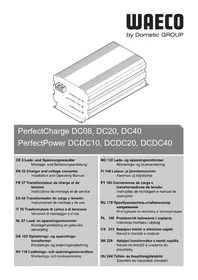
PerfectPower DCDC20 - Battery charger WAECO - Free user manual and instructions
Find the device manual for free PerfectPower DCDC20 WAECO in PDF.


| Product type | DC-DC voltage converter / Battery charger |
| Brand | Waeco |
| Model | PerfectPower DCDC20 |
| Reference | 9102500058 |
| Nominal input voltage | 12 V DC |
| Input voltage range | 8 V - 16 V DC |
| Output voltage | 27.6 V ± 0.1 V DC |
| Maximum output current | 20 A |
| Efficiency | Up to 87% |
| Operating ambient temperature | -20 °C to +50 °C |
| Dimensions (L x W x H) | 240 x 115 x 70 mm |
| Weight | 1.9 kg |
| Protection rating | IP20 (estimated) |
| Compatible battery type | Lead-acid batteries (12 V or 24 V depending on version) |
| Main functions | DC-DC voltage conversion, battery charging with IU characteristic, short-circuit and overload protection, galvanic isolation |
| Maintenance and cleaning | Clean with a damp cloth; do not immerse or use abrasive products |
| Safety | Polarity reversal protection (via fuse), automatic shutdown in case of overheating or overload, temperature-controlled fan |
| Spare parts and repairability | Repairs reserved for qualified personnel; fuse replaceable by manufacturer or after-sales service |
| General information | Designed for motorhomes, boats, commercial vehicles; horizontal or vertical wall mounting; minimum clearance of 5 cm around the device |
Frequently Asked Questions - PerfectPower DCDC20 WAECO
User questions about PerfectPower DCDC20 WAECO
0 question about this device. Answer the ones you know or ask your own.
Ask a new question about this device
Download the instructions for your Battery charger in PDF format for free! Find your manual PerfectPower DCDC20 - WAECO and take your electronic device back in hand. On this page are published all the documents necessary for the use of your device. PerfectPower DCDC20 by WAECO.
USER MANUAL PerfectPower DCDC20 WAECO
PerfectCharge DC08, DC20, DC40
PerfectPower DCDC10, DCDC20, DCDC40
EN 22 Charger and voltage converter
Installation and Operating Manual
Please read this instruction manual carefully before installation and first use, and store it in a safe place. If you pass on the product to another person, hand over this instruction manual along with it.
Contents
1 Explanation of symbols 23
2 General safety instructions 24
3 Scope of delivery 28
4 Proper use 28
5 Technical description 29
6 Mounting the converter 30
7 Connecting the converter. 31
8 Using the converter 33
9 Cleaning and caring for the converter 34
10 Guarantee 34
11 Disposal 34
12 Technical data 35
1 Explanation of symbols

DANGER!
Safety instruction: Failure to observe this instruction will cause fatal or serious injury.

WARNING!
Safety instruction: Failure to observe this instruction can cause fatal or serious injury.

CAUTION!
Safety instruction: Failure to observe this instruction can lead to injury.

NOTICE!
Failure to observe this instruction can cause material damage and impair the function of the product.

NOTE
Supplementary information for operating the product.
Action: This symbol indicates that action is required on your part. The required action is described step-by-step.
This symbol describes the result of an action.
Fig. 1 5, page 3: This refers to an element in an illustration. In this case, item 5 in figure 1 on page 3.
2 General safety instructions
The manufacturer accepts no liability for damage in the following cases:
- Damage to the product resulting from mechanical influences and excess voltage
- Alterations to the product without express permission from the manufacturer
- Use for purposes other than those described in the operating manual
Note the following basic safety information when using electrical devices to protect against:
Electric shock
- Fire hazards
Injury
2.1 General safety

DANGER!
- In the event of fire, use a fire extinguisher which is suitable for electrical devices.

WARNING!
- Only use the device as intended.
- Ensure that the red and black terminals never come into contact.
-
Disconnect the device from the mains:
-
Before cleaning and maintenance
- Before changing a fuse
If you disassemble the device:
- Detach all connections
-
Make sure that no voltage is present at any of the inputs and outputs
-
The device may not be used if the device itself or the connection cable are visibly damaged.
- If this power cable for this device is damaged, it must be replaced by the manufacturer, customer service or a similarly qualified person in order to prevent safety hazards.
-
This device may only be repaired by qualified personnel. Inadequate repairs may cause serious hazards.
-
People (including children) whose physical, sensory or mental capacities prevent them from using this device safely may not be allowed to operate it without the supervision of a responsible adult.
- Electrical devices are not toys. Always keep and use the appliance out of the reach of children.
Children must be supervised to ensure that they do not play with the device.

NOTICE!
- Before start-up, check that the voltage specification on the type plate is the same as that of the power supply.
- Ensure that other objects cannot cause a short circuit at the contacts of the device.
- Store the device in a dry and cool place.
2.2 Safety when installing the device

DANGER!
- Never mount the device anywhere where there is a risk of gas or dust explosion.

CAUTION!
- Ensure that the device is standing firmly. The device must be set up and fastened in such a way that it cannot tip over or fall down.

NOTICE!
- Do not expose the device to a heat source (such as direct sunlight or heating). Avoid additional heating of the device in this way.
- Set up the device in a dry location where it is protected against splashing water.
2.3 Safety when connecting the device electronically

DANGER! Danger of electrocution
- For installation on boats:
If electrical devices are incorrectly installed on boats, corrosion damage might occur. Have the device installed by a specialist (marine) electrician.
- If you are working on electrical systems, ensure that there is somebody close at hand who can help you in emergencies.

WARNING!
- Always use an adequate fuse in the positive line between the device and the battery.
- Make sure that the lead has a sufficient cross-section.
- Lay the cables so that they cannot be damaged by the doors or the bonnet.
Crushed cables can lead to serious injury.

CAUTION!
- Lay the cables so that they cannot be tripped over or damaged.

NOTICE!
- Use ductwork or cable ducts if it is necessary to lay cables through metal panels or other panels with sharp edges.
- Do not lay the 230V mains cable and the 12V DC cable in the same duct.
- Do not lay the cable so that it is loose or heavily kinked.
- Fasten the cables securely.
- Do not pull on the cables.
2.4 Operating the device safely

WARNING!
- Only use the device in closed, well-ventilated rooms.
- Do not operate the device in systems with lead acid batteries. These batteries give off explosive hydrogen gas that can be ignited by sparks on electrical connections.

CAUTION!
-
Do not operate the device
-
In salty, wet or damp environments
- In the vicinity of corrosive fumes
- In the vicinity of combustible materials
-
In areas where there is a danger of explosions.
-
Before starting the device, ensure that the power supply lines are dry.
- Always disconnect the power supply when working on the device.
- Please observe that parts of the device may still conduct voltage even if the fuse has blown.
- Do not disconnect any cables when the device is still in use.

NOTICE!
- Make sure the air inlets and outlets of the device are not covered.
- Ensure good ventilation.
2.5 Safety precautions when handling batteries

WARNING!
- Batteries contain aggressive and caustic acids. Avoid battery fluid coming into contact with your body. If your skin does come into contact with battery fluid, wash the part of your body in question thoroughly with water.
If you sustain any injuries from acids, contact a doctor immediately.

CAUTION!
- When working on the batteries, do not wear any metal objects such as watches or rings.
Lead acid batteries can cause short circuits which can cause serious injuries.
Danger of explosions!
Never attempt to charge a frozen or defective battery.
Place the battery in a frost-free area and wait until the battery has acclimatised to the ambient temperature. Then start the charging process.
- Wear goggles and protective clothing when you work on batteries. Do not touch your eyes when you are working on the battery.
- Do not smoke and ensure that no sparks can arise in the vicinity of the engine or battery.

NOTICE!
- Only use rechargeable batteries.
- Prevent any metal parts from falling on the battery. This can cause sparks or short-circuit the battery and other electrical parts.
- Make sure the polarity is correct when connecting the battery.
- Follow the instructions of the battery manufacturer and those of the manufacturer of the system or vehicle in which the battery is used.
- If you need to remove the battery, first disconnect the earth connection. Disconnect all connections and all consumers from the battery before removing it.
3 Scope of delivery
Quantity Description
1 Converter
1 Operating manual
4 Proper use
The transformers convert a 12V = = or 24V = = supply from a car or boat battery to a stable DC voltage:
- DC08 (item no. 9102500055), DC20 (item no. 9102500045), DC40 (item no. 9102500056): 12V = input voltage to 14.2V = output voltage (charge converter)
- DCDC10 (item no. 9102500057), DCDC20 (item no. 9102500058): 12V = input voltage to 27.6V = output voltage (voltage converter)
-
DCDC20 (item no. 9102500059), DCDC40 (item no. 9102500060): 24V = input voltage to 13.8V = output voltage (voltage converter)
-
DCDC10 (item no. 9102500061): 24V = input voltage to 27.6V = output voltage (voltage converter)
All the converters can also be used to charge lead batteries.

NOTICE!
Never use the device to charge other battery types (such as NiCd or NiMH).
The charge voltage has an IU charging characteristic with a charge voltage of 13.8V / 27.6V .
On charge converters, the output voltage is regulated to 14.2V . This means the battery is charged more quickly.

NOTICE!
Charge converter: Do not charge for longer than twelve hours.
5 Technical description
The light weight and compact construction allows the converters to be easily installed in mobile homes, commercial vehicles or motor and sailing vessels.
The transformers convert a 12V = = or 24V = = supply from a car or boat battery to a stable 12V = = or 24V = = voltage for connecting to equipment.
The isolation of the input and output voltages means the output voltage can be kept stable without interference from the input circuit.
Because the maximum output current is electronically regulated, the charge converters can be used to charge batteries to generate electricity in cars or on boats.
The devices are equipped with protection against shorting and overloading. If the protective function triggers, the device switches off and then switches on again when correctly connected or when the load has been adequately reduced.
5.1 Control elements
| No. in fig. 1, Explanation page 3 |
| 1 Output terminals |
| 2 “Power On” LED: There is voltage at the output terminals on the converter. The converter is ready for use. |
| 3 “Battery Low” LED: The input battery is no longer sufficiently charged. |
| 4 “Overload” LED: - If a consumer is connected: The converter is shorted or overloaded. - If connected as a charger: The converter is in the full current charging phase. |
| 5 Air outlet |
| 6 Main switch |
| 7 Red: Positive cable to input battery Black: Negative cable to input battery |
| 8 Connection for switching on with on-board voltage (e.g. ignition or external switch) |
6 Mounting the converter
6.1 Mounting instructions
If you wish to mount the converter in a fixed position, please observe the following mounting instructions:
- You can mount the device either horizontally or vertically.
- Do not mount the device
-In wet or damp environments
- In the vicinity of combustible materials
-In areas where there is a danger of explosions
-
The place of installation must be well-ventilated. A ventilation system must be present for installations in small, closed spaces. The minimum clearance around the device must be at least 5 cm (fig. 2, page 3).
-
The air intake on the underside or the air outlet on the back of the device must remain clear.
- For ambient temperatures higher than 40ircC (such as in engine or heating compartments, or direct sunlight), the heat from the device under load can lead to the automatic shut-down.
- The installation surface must be level and sufficiently sturdy.

NOTICE!
Before drilling any holes, ensure that no electrical cables or other parts of the vehicle can be damaged by drilling, sawing and filing.
6.2 Mounting the converter
Hold the converter against the installation location and mark the fastening points (fig. 3 A, page 3).
Fasten the converter using your chosen method (fig. 3 B, page 3).
7 Connecting the converter
7.1 Connecting the input battery

WARNING!
Do not reverse the polarity. Reverse polarity of the battery connections can cause injury and irreversably damage the device.

NOTICE!
Tighten the nuts or bolts to a torque of 12 - 13Nm . Loose connections may cause overheating.
Set the main switch (fig. 16, page 3) to "0".
Lay the positive cable (red) (fig. 17, page 3) from the converter to positive terminal of the battery and connect it.
Lay the negative cable (black) (fig. 17, page 3) from the converter to negative terminal of the battery and connect it.
7.2 Connecting the connection cable
You can switch on the device as follows:
Using the main switch on the device (fig. 1 6, page 3)
Using the ignition (fig. 5 A, page 4) Terminal 15: Connected positive terminal
Using an external switch (fig. 5 B, page 4)
Connecting the converter to be switched on via the main switch
Isolate the connecting line so no malfunction can occur.
Connecting the converter to be switched on via the ignition
Connect the connecting line to terminal 15 (connected positive terminal) (fig. 5 A, page 4).
Set the main switch (fig. 16, page 3) on the back of the converter to "0" permanently.
Connecting the converter to be switched on via an external switch
Connect the connecting line to an external switch (fig. 5 B, page 4).
Set the main switch (fig. 16, page 3) on the back of the converter to "0" permanently.
7.3 Connecting power consuming devices to the converter
Loosen the screw (fig. 4 2, page 4) from the positive terminal (red) (fig. 4 4, page 4).
Push the cable lug (fig. 4 3, page 4) of the positive cable of the power consuming device into the positive terminal (red) (fig. 4 4, page 4) and attach it using the screw (fig. 4 2, page 4) and the spring washer (fig. 4 1, page 4).
Connect the negative cable of the power consuming device in the same way to the negative terminal (black) (fig. 4, page 4).
8 Using the converter
You can switch on the device as follows, depending on the connection:
Using the main switch on the device (fig. 1 6, page 3)
Using the ignition (fig. 5 A, page 4) Terminal 15: Connected positive terminal
Using an external switch (fig. 5 B, page 4)
Switching on the converter
Set the main switch (fig. 1 6, page 3) on the back of the converter to "1" ...
... or start the ignition ...
... or push the external switch.
heckmark The LEDs (fig. 1 3 to 5, page 3) indicate the operating status:
LED Colour Explanation
Power On Green The device is switched on and there is voltage at the output terminals on the converter. The converter is ready for use.
Battery Low Yellow The input battery is no longer sufficiently charged.
Recharge the battery or use a charged battery.
Overload Red
If a consumer is connected:
The converter is shorted or overloaded.
Eliminate the short circuit or reduce the output load.
If connected as a charger:
The converter is in the full current charging phase.

NOTE
The internal fan is operated according to the temperature. It only runs when the temperature is too high. During this time the converter is switched off to prevent overheating.
Switching off the converter
Set the main switch (fig. 1 6, page 3) on the back of the converter to "0" ...
... or switch off the ignition ...
... or push the external switch.
9 Cleaning and caring for the converter

NOTICE! Danger of damaging the device!
Never clean the device under running water or in dish water.
Do not use abrasive cleaning agents or hard objects during cleaning as these can damage the device.
Occasionally clean the device with a damp cloth.
10 Guarantee
The statutory warranty period applies. If the product is defective, please contact the manufacturer's branch in your country (see the back of the instruction manual for the addresses) or your retailer.
For repair and guarantee processing, please include the following documents when you send in the device:
A copy of the receipt with purchasing date
A reason for the claim or description of the fault
11 Disposal
Place the packaging material in the appropriate recycling waste bins wherever possible.
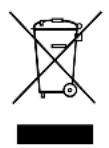
If you wish to finally dispose of the product, ask your local recycling centre or specialist dealer for details about how to do this in accordance with the applicable disposal regulations.
12 Technical data
| DCDC10 DCDC20 | ||
| Item no.: 9102500057 9102500058 | ||
| Transformation: 12 V → 24 V | ||
| Rated input voltage: 12 V== | ||
| Input voltage range: 8 V - 16 V | ||
| Output current: 10 A 20 A | ||
| Output voltage: 27.6 V ± 0.1 V | ||
| Efficiency up to: 87 % | ||
| Interference suppression: | 40 mA | |
| Ambient temperature for operation: | -20 °C to +50 °C | |
| Dimensions W x D x H: | 140 x 115 x 70 mm | 240 x 115 x 70 mm |
| Weight: | 1.0 kg | 1.9 kg |
| DCDC20 DCDC40 | ||
| Item no.: 9102500059 9102500060 | ||
| Transformation: 24 V → 12 V | ||
| Rated input voltage: 24 V== | ||
| Input voltage range: | 20 V - 32 V | |
| Output current: 20 A 40 A | ||
| Output voltage: 13.8 V ± 0.1 V | ||
| Efficiency up to: 87 % | ||
| Interference suppression: | 20 mA | |
| Ambient temperature for operation: | -20 °C to +50 °C | |
| Dimensions W x D x H: | 140 x 115 x 70 mm | 240 x 115 x 70 mm |
| Weight: | 1.0 kg | 1.9 kg |
| DC08 DC20 | DC40 | ||
| Item no.: 9102500055 910250004 | 5 9102500056 | ||
| Transformation: 12 V → 12 V | |||
| Rated input voltage: 12 V== | |||
| Input voltage range: 8 V - 16 V | |||
| Output current: 8 A 20 A 40 A | |||
| Output voltage: 14.2 V ± 0.1 V | |||
| Efficiency up to: 87 % | |||
| Interference suppression: 20 mA | |||
| Ambient temperature for operation: | -20 °C to +50 °C | ||
| Dimensions W x D x H: 100 x 115 | x 70 mm | 160 x 115 x 70 mm | 270 x 115 x 70 mm |
| Weight: | 0.75 kg | 1.2 kg | 2.1 kg |
| DCDC10 | |
| Item no.: | 9102500061 |
| Transformation: | 24 V → 24 V |
| Rated input voltage: | 24 V--- |
| Input voltage range: | 20 V – 32 V |
| Output current: | 10 A |
| Output voltage: | 27.6 V ± 0.1 V |
| Efficiency up to: | 87 % |
| Interference suppression: | 40 mA |
| Ambient temperature for operation: | -20 °C to +50 °C |
| Dimensions W x D x H: | 140 x 115 x 70 mm |
| Weight: | 1.0 kg |
Certification
e24
5 Description technique
6.2 MoHTax npeo6pa3OBaTeJIa
PnIIOXInTe npeo6pa3OBAteJb K Bbl6paHHOMy MeCTy N pa3MeTbTe TOKIN KpeJIeHnA (pnc. 3 A, cTp. 3).
3aKpeNITe npeo6pa3OBaTeIb Bbl6paHHbIM MeToIDOM KpeJIeHnA (pnc. 3B, cTp. 3).
PpncoeHHeHne ppeo6pa3OBaTeJn DnB KJIIOueHn BHeHnM BbIKIIOUaTeJeM
ПисоeДиHHTe COeДиHHTeJIbHbI npOBOD K BHeшHemy BblKlIOuHaTeJIIO (pnc. 5 B, cTp. 4).
YcTaHOBInTe rIaBHbI BblKIIuOaTeJIb (pnc. 1 6, cTp. 3), pacNoJoxeHHbI Ha 3aHHe CTOpOHe npeo6pa3ObaTeJIa, B noJoxeHne «0».
7.3 IopKJIoueHne nOtpe6nteJe K nppeo6pa3OBaTeJIHO
BbIBnHTnte BnHT (pnc. 4 2, ctp. 4) n3 noJoxnteIbHOrO 3aKIma (kpac- hIn) (pnc. 4 4, ctp. 4).
BCTaBbTe Ka6eHbI HaKoHeuHnK (pnc. 4 3, ctp. 4) noJoxHTeHbHO raKa6eIaOTpe6nteIa B noJoxHTeHbI 3axIM (kpacHbI) (pnc. 4 4, ctp. 4) n 3akpenTe erO BVHTOM (pnc. 4 2, ctp. 4) n npyXHHbIM KOJIb- zuom (pnc. 4 1, ctp. 4).
ПрсоeннiteОТпаTeьньКабьNotpe6ntЯ COOTBeTCTByI0- mO6pa3OM K OTPaTeBJHOMy 3axmMy (pehbl) (pnc.4 4, ctp.4).
...IJI INepeKJIIOUChTE BHeUHNI BbIKJIOUaTeJIb.
heckmark CBeToIIOIbI (pnc. 1 3-5, cTp. 3) yka3bBAIoT pa6Ooee coCTOJHHe:
BbIKJIouHe npeo6pa3OBaTeIa
YcTaHOBnTe rIaBHbI BbIKIOuAteJIb (pnc. 1 6, cTp. 3), paCNoIOXeHHbI Ha 3aHHe CTOpOHe npeo6pa3OBaTeJIa, B NOIOXeHne «0» ...
...NIN BBIKIIOUHTe 3aKnRaHne ...
...IJI INepeKJIIOUChTE BHeUHNI BBIKJIOUaTeJIb.
9 Yxod n ouncTka ppeo6pa3OBaTeJra

BHIMAHHE! Onacnocmb noepekdeHu npu6opa!
Kateropnueckn 3anpeaetcnyctntb npnbop noi ctpyeB OdbI INN B NocydomoeyHOn MaunHe.
He nCnoIb3yIte IJIa YnCTKn a6pa3nBHbIe YnCTaIe CpeIcTba IJIIOCTpbIe IpeDMeTbI, T. K. OHI MOrY T pINBeCTN K NOBpeXdEHNm npi6opa.
Dometic Australia Pty. Ltd.
1 John Duncan Court
Varsity Lakes QLD 4227
+61755076000
+61755076001
Mail: sales@dometic-waeco.com.au
AUSTRIA
Dometic Austria GmbH
Tsim Sha Tsui·Kowloon
Hong Kong
+852 24611386
+852 24665553
Mail: info@dometic-waeco.com.hk
HUNGARY
Domatic Plc. Sales Office
Kérékgyarto u.5.
H-1147 Budapest
+3614684400
+3614684401
Domatic Italy S.r.l.
Via Virgilio, 3
I-47100 Forli
+390543754901
+390543756631
Mail: info@dometic.it
NORWAY
Dometic Norway AS
Skolmar 24
N-3232 Sandefjord
+4733428450
+4733428459
Mail: firmpost@waeco.no
POLAND
Dometic Poland Sp. z o.o.
Ul. Puławska 435A
02-801 Warszawa
Poland
+48224143200
+48224143201
Mail: info@dometic.pl
RUSSIA
Domatic RUS LLC
Komsomolskaya square 6-1
107140 Moscow
Russia
+74957807939
+74959165653
Mail: info@dometic.ru
SLOVAKIA
Domatic Slovakia s.r.o.
Tehelna 8
SK-98601 Filakovo
+421474319107
+421474319166
Mail: info@dometic.sk
SPAIN
Dometic Spain S.L.
Avda. Sierra del Guadarrama, 16
E-28691 Villanueva de la Canada
Madrid
+34 902 111 042
+34900100245
Mail: info@dometic.es
SWEDEN
Dometic Scandinavia AB
Gustaf Melins gata 7
Dometic Switzerland AG
Riedackerstrasse 7a
CH-8153 Rümlang (Zürich)
+41448187171
+41448187191
Mail: info@dometic-waeco.ch
TAIWAN
WAECO Impex Ltd.
Taipei Office
2 FL-3 dot No. 56 Tunhua South Rd, Sec 2
Taipei 106, Taiwan
+886227014090
+886227060119
Mail: marketing@dometic-waeco.com.tw
UNITED KINGDOM
Domatic UK Ltd.
Dometic House · The Brewery
Blandford St. Mary
Dorset DT11 9LS
+448446260133
+448446260143
Mail: sales@dometic.co.uk
UNITED ARAB STATES
Dometic Middle East FZCO
P.O.Box 17860
S-D 6, Jebel Ali Freezone
Dubai, United Arab Emirates
+97148833858
+97148833868
Mail: info@dometic.ae
UNITED STATES OF AMERICA
Dometic Marine Division
2000 N. Andrews Ave. Extension
Pompano Beach, FL 33069 USA
+19549732477
+19549794414
Mail: marinesales@domesticusa.com
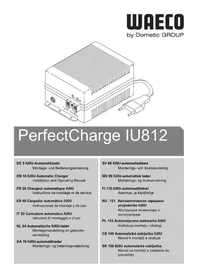
- PerfectCharge DC08, DC20, DC40
- PerfectPower DCDC10, DCDC20, DCDC40
- Contents
- Explanation of symbols
- DANGER!
- WARNING!
- CAUTION!
- NOTICE!
- NOTE
- General safety instructions
- General safety
- Safety when installing the device
- Safety when connecting the device electronically
- DANGER! Danger of electrocution
- Operating the device safely
- Safety precautions when handling batteries
- Scope of delivery
- Quantity Description
- Proper use
- Technical description
- Control elements
- Mounting the converter
- Mounting instructions
- Mounting the converter
- Connecting the converter
- Connecting the input battery
- Connecting the connection cable
- Connecting the converter to be switched on via the main switch
- Connecting the converter to be switched on via the ignition
- Connecting the converter to be switched on via an external switch
- Connecting power consuming devices to the converter
- Using the converter
- Switching on the converter
- LED Colour Explanation
- Switching off the converter
- Cleaning and caring for the converter
- NOTICE! Danger of damaging the device!
- Guarantee
- Disposal
- Technical data
- Certification
- Description technique
- MoHTax npeo6pa3OBaTeJIa
- PpncoeHHeHne ppeo6pa3OBaTeJn DnB KJIIOueHn BHeHnM BbIKIIOUaTeJeM
- IopKJIoueHne nOtpe6nteJe K nppeo6pa3OBaTeJIHO
- BbIKJIouHe npeo6pa3OBaTeIa
- Yxod n ouncTka ppeo6pa3OBaTeJra
- BHIMAHHE! Onacnocmb noepekdeHu npu6opa!
- Dometic Australia Pty. Ltd.
- AUSTRIA
- Dometic Austria GmbH
- HUNGARY
- Domatic Plc. Sales Office
- Domatic Italy S.r.l.
- NORWAY
- Dometic Norway AS
- POLAND
- Dometic Poland Sp. z o.o.
- RUSSIA
- Domatic RUS LLC
- SLOVAKIA
- Domatic Slovakia s.r.o.
- SPAIN
- Dometic Spain S.L.
- SWEDEN
- Dometic Scandinavia AB
- Dometic Switzerland AG
- TAIWAN
- WAECO Impex Ltd.
- UNITED KINGDOM
- Domatic UK Ltd.
- UNITED ARAB STATES
- Dometic Middle East FZCO
- UNITED STATES OF AMERICA
- Dometic Marine Division
Brand : WAECO
Model : PerfectPower DCDC20
Category : Battery charger