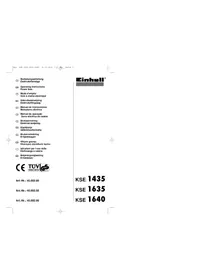
KSE 1640 - Electric saw EINHELL - Free user manual and instructions
Find the device manual for free KSE 1640 EINHELL in PDF.



| Product type | Electric chain saw |
| Brand | Einhell |
| Model | KSE 1640 |
| Nominal power | 1600 W |
| Maximum cutting length | 40 cm |
| Cutting speed at nominal speed | 22 m/s |
| Oil tank capacity | 85 ml |
| Weight without guide bar and chain | 3.6 kg |
| Chain brake time | 0.1 second |
| Guaranteed acoustic power level under load | 100 dB(A) |
| Acoustic pressure level under load | 94 dB(A) |
| Rear handle acceleration under load | 4.2 m/s² |
| Front handle acceleration under load | 3.3 m/s² |
| Safety class | II / double insulation |
| Chain brake | Yes, triggered by the front hand guard |
| Automatic chain lubrication | Yes, adjustable |
| Two-hand safety control | Yes |
| Chain guard included | Yes |
| Guide bar | Length 40 cm, pivotable |
| Power supply | 230 V / 50 Hz |
| Maintenance and cleaning | Clean the ventilation grilles, check lubrication, sharpen the chain regularly |
| Spare parts available | Guide bar ref. 45.003.31, chain ref. 45.003.11 |
| Warranty | 12 months |
Frequently Asked Questions - KSE 1640 EINHELL
User questions about KSE 1640 EINHELL
0 question about this device. Answer the ones you know or ask your own.
Ask a new question about this device
Download the instructions for your Electric saw in PDF format for free! Find your manual KSE 1640 - EINHELL and take your electronic device back in hand. On this page are published all the documents necessary for the use of your device. KSE 1640 by EINHELL.
USER MANUAL KSE 1640 EINHELL
Important information about these instructions
△A warning triangle marks all those instructions which are important for safety reasons. Always observe these as failure to do so could result in serious injury!
The illustrations referred to in the text are to be found inside the front cover. Keep these open while reading the instructions.
text_image
Technical diagram of a chain-linking device with numbered components and labeled parts2
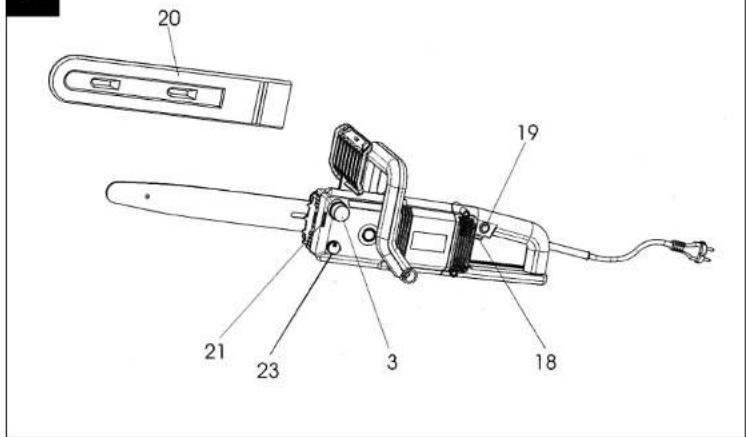
text_image
20 19 21 23 3 18natural_image
Technical illustration of a wooden rack and a chain saw (no text or symbols)natural_image
Diagram of a mechanical device with a tool and cylindrical components, no visible text or symbols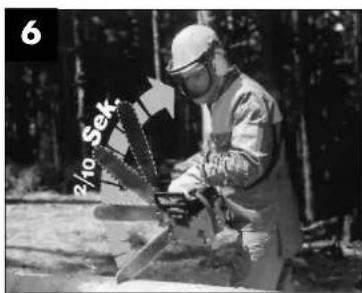
text_image
6 2% - 5%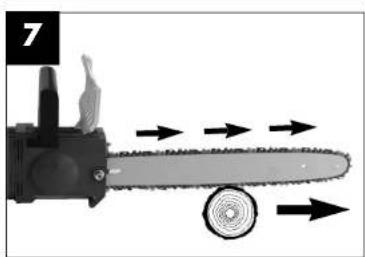
natural_image
Diagram of a chain saw cutting a wooden board with arrows indicating motion (no text or symbols)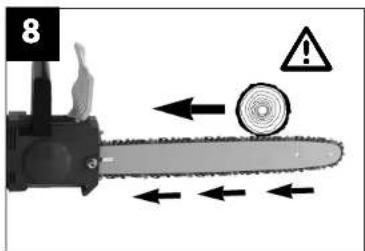
text_image
8 !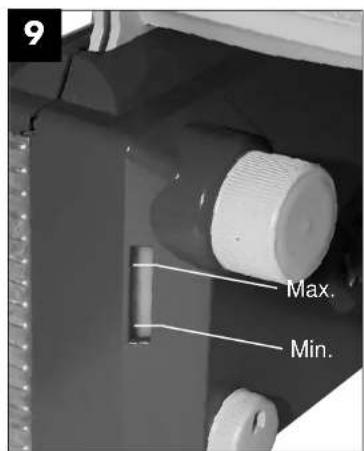
text_image
9 Max. Min.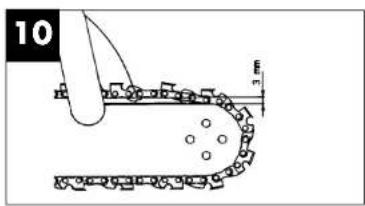
text_image
10 3 mm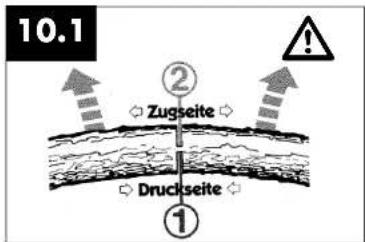
1 Front grip
2 Front finger guard
3 Oil tank cap
4 Oil outlet
5 Guide bolt
6 Chain tensioning screw
7 Saw chain
8 Chain bar
9 Sprocket nose
10 Rear grip
11 Rear finger guard
12 Chain wheel
13 Chain tensioning bolt
14 Chain tensioning borehole
15 Hood
16a Hexagonal screw
16b Lock washer
17 Claw stop
18 ON/OFF switch
19 Safety lock-off
20 Chain guard
21 Oil gauge
22 Two-handed safety switch
23 Oil regulating screw
2. Technical data
| Type KSE 1435 KSE 1635 KSE 1640 | |||
| Power rating: 1450 W 1600 W 1600 W | |||
| Cutting length, max. 35 cm 35 cm 40 cm | |||
| Cutting speed at rated rpm: 22 m/s 22 m/s 22 m/s | |||
| Oil tank capacity: 85 ml 85 ml 85 ml | |||
| Weight without sword + chain: | 3,6 kg | 3,6 kg | 3,6 kg |
| Chain brake: | 0,1 sec | 0,1 sec | 0,1 sec |
| Protection class: | II / ☐ | II / ☐ | II / ☐ |
| Guaranteed sound power level under load: | 100 dB(A) | 100 dB(A) | 100 dB(A) |
| Sound pressure level under load: | 94 dB(A) | 94 dB(A) | 94 dB(A) |
| Acceleration rear grip under load: | 4,2 m/s^2 | 4,4 m/s^2 | 4,4 m/s^2 |
| (calculated according to EN 50144) front grip under load: | 3,14 m/s^2 | 3,3 m/s^2 | 3,3 m/s^2 |
3. Explanation of the signs
flowchart
graph TD
    A["1 max. 350"] --> B["2"]
    C["1 a"] --> B
    D["1 b"] --> B
    E["max. 400"] --> F["3"]
    G["4"] --> H["4"]
    I["5"] --> J["5"]
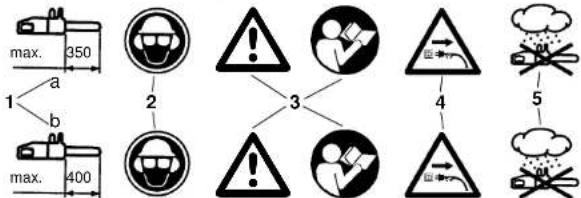
- Maximum cutting length: a.) max. 350mm with KSE 1435, KSE 1635 b.) max. 400mm with KSE 1640
- Wear protective headgear, goggles and ear muffs
- Caution! Read the operating instructions and follow the warnings and safety instructions
- If the cable is damaged, unplug the machine immediately!
- Protect from the damp
GB
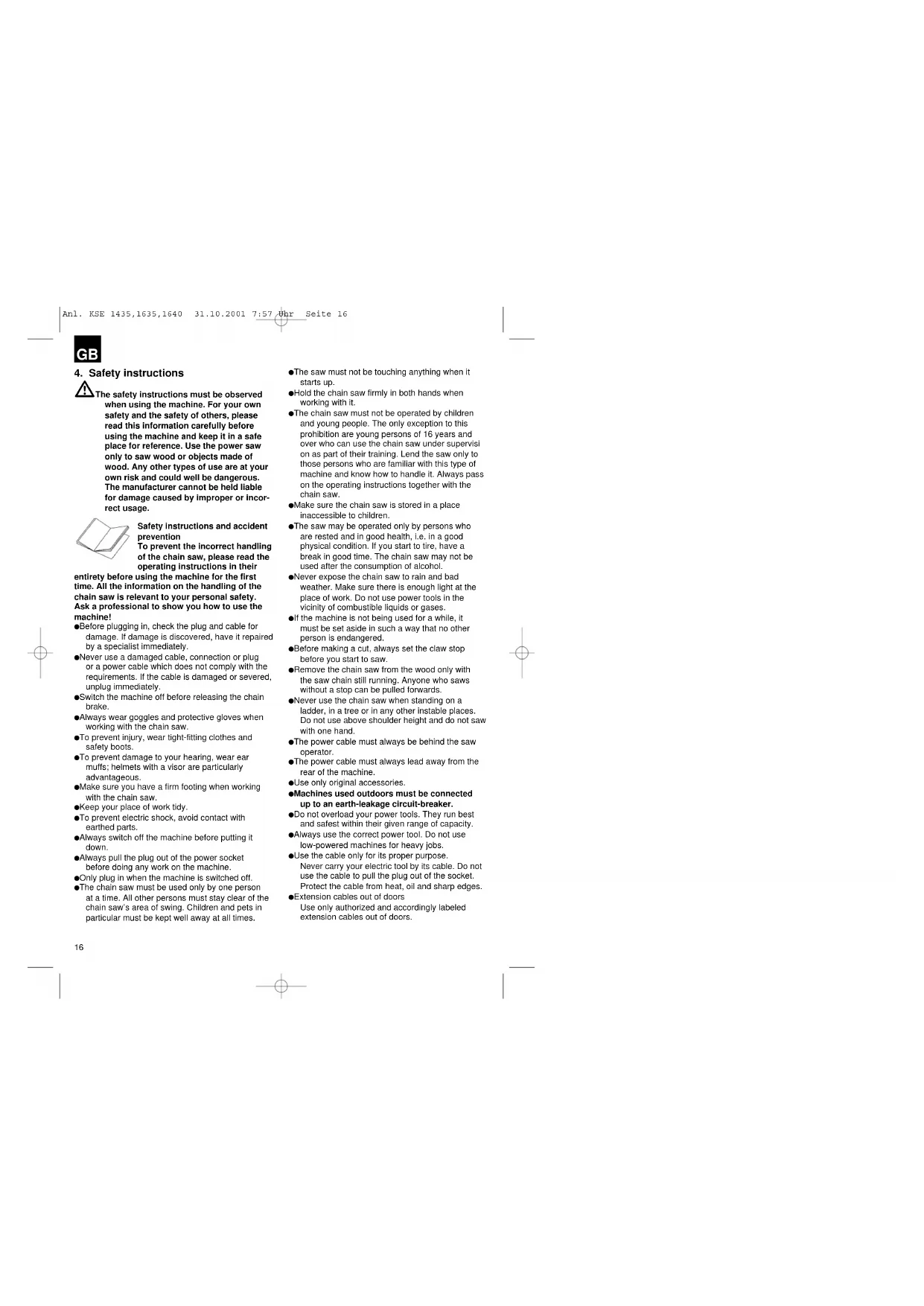
4. Safety instructions

The safety instructions must be observed when using the machine. For your own safety and the safety of others, please read this information carefully before using the machine and keep it in a safe place for reference. Use the power saw only to saw wood or objects made of wood. Any other types of use are at your own risk and could well be dangerous. The manufacturer cannot be held liable for damage caused by improper or incorrect usage.

Safety instructions and accident prevention To prevent the incorrect handling of the chain saw, please read the operating instructions in their
entirety before using the machine for the first time. All the information on the handling of the chain saw is relevant to your personal safety. Ask a professional to show you how to use the machine!
●Before plugging in, check the plug and cable for damage. If damage is discovered, have it repaired by a specialist immediately.
●Never use a damaged cable, connection or plug or a power cable which does not comply with the requirements. If the cable is damaged or severed, unplug immediately.
●Switch the machine off before releasing the chain brake.
●Always wear goggles and protective gloves when working with the chain saw.
●To prevent injury, wear tight-fitting clothes and safety boots.
●To prevent damage to your hearing, wear ear muffs; helmets with a visor are particularly advantageous.
●Make sure you have a firm footing when working with the chain saw.
- Keep your place of work tidy.
●To prevent electric shock, avoid contact with earthed parts.
●Always switch off the machine before putting it down.
●Always pull the plug out of the power socket before doing any work on the machine.
●Only plug in when the machine is switched off.
●The chain saw must be used only by one person at a time. All other persons must stay clear of the chain saw's area of swing. Children and pets in particular must be kept well away at all times.
●The saw must not be touching anything when it starts up.
●Hold the chain saw firmly in both hands when working with it.
●The chain saw must not be operated by children and young people. The only exception to this prohibition are young persons of 16 years and over who can use the chain saw under supervision as part of their training. Lend the saw only to those persons who are familiar with this type of machine and know how to handle it. Always pass on the operating instructions together with the chain saw.
●Make sure the chain saw is stored in a place inaccessible to children.
●The saw may be operated only by persons who are rested and in good health, i.e. in a good physical condition. If you start to tire, have a break in good time. The chain saw may not be used after the consumption of alcohol.
●Never expose the chain saw to rain and bad weather. Make sure there is enough light at the place of work. Do not use power tools in the vicinity of combustible liquids or gases.
- If the machine is not being used for a while, it must be set aside in such a way that no other person is endangered.
●Before making a cut, always set the claw stop before you start to saw.
- Remove the chain saw from the wood only with the saw chain still running. Anyone who saws without a stop can be pulled forwards.
●Never use the chain saw when standing on a ladder, in a tree or in any other instable places. Do not use above shoulder height and do not saw with one hand.
●The power cable must always be behind the saw operator.
●The power cable must always lead away from the rear of the machine.
●Use only original accessories.
●Machines used outdoors must be connected up to an earth-leakage circuit-breaker.
●Do not overload your power tools. They run best and safest within their given range of capacity.
●Always use the correct power tool. Do not use low-powered machines for heavy jobs.
- Use the cable only for its proper purpose.
Never carry your electric tool by its cable. Do not use the cable to pull the plug out of the socket.
Protect the cable from heat, oil and sharp edges.
- Extension cables out of doors
Use only authorized and accordingly labeled extension cables out of doors.
GB
- Use a strong support when sawing converted timber and thin branches (saw-horse, Fig. 4). Do not stack the timber and do not have it held by a second person or with your foot.
●Logs must be secured in position. - On sloping ground, always work facing upwards.
- When cross-cutting always set the claw stop against the timber you want to saw (see Fig. 4)
●Always set the claw stop before cross-cutting. Only then switch on the machine and start sawing into the wood. Pull the machine upwards at the rear and lead the direction with the front grip. Use the claw stop as a fulcrum. To reposition for further cutting, interrupt the sawing process and exert a slight pressure on the front grip. Pull the saw back a little, position the claw stop further down the cut and pull up the rear grip (see Fig. 5).
●Pull the saw out of the wood only when the saw chain is running. - If you carry out several cuts, switch off the chain saw in-between.
●Plunge cuts and horizontal cuts may only be carried out by professionals (high risk of kickback; see Fig. 6). - For horizontal cuts, position the saw at the smallest possible angle. This requires extreme caution, as the claw stop can not be applied in this case.
- If the chain gets stuck when sawing with the upper side it may be thrust towards the operator. For this reason you should saw wherever possible with the bottom side, as the power saw will then be thrust away from the body towards the wood (see Fig. 7 and 8).
●Pay extra attention when cutting splintered wood. Sawed off pieces of wood may be catapulted in any direction (risk of injury!).
●Do not use the chain saw to remove or sweep away small pieces of wood or similar objects - When lopping off branches, the chain saw should be supported wherever possible against the trunk. Do not cut with the tip of the chain bar (risk of kick-back; see Fig. 6).
- Leave branch lopping work to trained personnel! Risk of injury!
●Pay special attention to branches under tension. Do not cut through freely suspended branches from underneath.
●Never stand on the trunk when lopping off branches.
●The chain saw may not be used for forest work, i.e. for felling and lopping off branches in the forest. Because of the cable connection the saw operator does not have the necessary mobility and his safety is not guaranteed!
●Always stand to the side of the tree being felled.
- When the tree is being felled, wathc out for falling branches when stepping back.
●On slopes the saw operator should stand to the upper or left or right side the trunk or lying tree, never to the bottom side.
●Watch out for trunks rolling towards you. Kick-back!
●The power saw is likely to recoil if the tip of the chain bar (especially the top quarter) accidentally touches wood or any other solid objects. In this case the saw will move uncontrolled and will be hurled towards the operator at full power (risk of injury!).
In order to prevent kick-back, please follow these safety instructions:
●Never start cutting with the tip of the chain bar!
Always keep a close eye on the tip of the chain bar!
●Never cut with the tip of the chain bar! Be careful, when continuing cuts you are already working on!
●Always start cuts with the chain saw already running!
●Make sure that the saw chain is always properly sharpened.
●Never cut through more than one branch at a time! When lopping off branches, be careful not to touch any other branches.
- When cross-cutting, pay attention to trunks standing very close to each other. If possible use a saw-horse.
5. Transporting the chain saw
Before transporting the chain saw, always remove the plug from the power socket and slide the chain guard over the rail and chain. If several cuts are to be performed with the chain saw, the saw must be switched off between cuts.
6. Before starting up
The voltage and current supply must comply with the ratings on the type plate. Before commencing work, always check that the chain saw works properly and is safe to operate. Check also that the chain lubrication and the oil gauge are in good working order (see Fig. 9). When the oil level is approx. 5mm from the bottom mark (marked with ^n in the illustration), you must top up with oil. When the oil level is above this mark you can work without worry.
GB
Switch on the chain saw and hold it above light-coloured ground. Be careful not to allow the chain saw to touch the ground. For safety reasons it is best to keep a clearance of at least 20 cm. If you now see growing traces of oil, the chain lubrication system is working correctly. If there are no traces of oil at all, try cleaning the oil outlet (4), the upper chain tensioning borehole (14) and the oil duct, or contact your Customer Service. (Be sure to read the section „Filling in chain oil and chain lubrication" on this point). Check the chain tension and retention if necessary (see the section „Tensioning the saw chain" on this point). Make sure the chain brake is working properly (see also the section „Releasing the chain brake").
7. Assembling the chain bar and saw chain
The machine must be unplugged. Important: The front finger guard (2) must always be in the top (vertical) position.
The chain bar and saw chain are supplied separately. To assemble, first unscrew the nut and lock washer (16a and b) and remove the brake housing hood (15). The chain tensioning bolt (13) must be in the center of the guide (5). If necessary, tighten the chain tensioning bolt with the chain tensioning screw (6). To prevent injury on the sharp cutting edges, always wear gloves when assembling, tensioning and checking the chain. Before assembling the chain bar with the saw chain, check the cutting direction of the teeth! The running direction is marked with an arrow on the hood (15). To determine the direction of cut, it may be necessary to turn over the saw chain (7). Hold the chain bar (8) vertically with the tip pointing upwards and put on the saw chain (7), beginning at the tip of the bar. Then assemble the chain bar with the saw chain as follows: Place the chain bar with the saw chain on the guide bolt (5) and chain tensioning bolt (13). Place the saw chain round the chain wheel (12) and make sure it is correctly mounted (see No. 7 on the illustration). Place the hood (15) on top and tighten gently with the lock washer/hexagonal nut (16a + b). Now the saw chain has to be correctly tensioned:
8. Tensioning the saw chain
Always pull the plug out of the power socket before doing any work on the machine! Wear safety gloves!
Make sure the saw chain (7) is inside the guide groove of the chain bar (8)!
Using a Phillips screwdriver, turn the chain tensioning screw (6) clockwise until the saw chain is correctly tensioned. While the bolt (16a) is being tightened, the chain bar must then be pushed upwards. Check the chain tension again (see Fig. 10). Do not tension the chain too tightly. When cold, it should be possible to lift the chain in the middle of the chain bar approx. 5 mm. Tighten the bolt (16a) securely.
When warm, the saw chain will expand and slacken and there is a danger of it jumping off the rail altogether. Retension if necessary. If the saw chain is retensioned when hot, it must be loosened again when the sawing work has been completed. Otherwise, the contraction which takes place as the chain cools would result in excessively high tension. A new saw chain requires a running-in period of approx. 5 minutes. Chain lubrication is very important at this stage. After running in, check chain tension and retention if necessary.
9. Filling in chain oil
To prevent dirt getting inside the tank, clean the oil tank cap (3) before opening. Check the contents of the oil tank during sawing work by checking the oil gauge (21). Close the oil tank cap (3) tightly and wipe away any spills.
10. Chain lubrication
To prevent excessive wear, the saw chain and chain bar must be evenly lubricated during operation. Lubrication is automatic. Never work without chain lubrication. If the chain runs dry, the entire cutting apparatus will quickly become severely damaged. It is therefore important to check both chain lubrication and the oil gauge before every use (Fig. 9).
Never use the saw when the oil level is below the „Minimum* mark (Fig. 9).
●Minimum - When only approx. 5 mm of oil is visible at the lower rim of the oil gauge (21), you must top up with oil.
●Maximum - Top up with oil until the window is full.
11. Checking the automatic lubrication
Before commencing work, check the automatic chain lubrication and oil gauge. Switch on the chain saw and hold it above light-coloured ground. Be careful not to allow the chain saw to touch the ground. For safety reasons it is best to keep a clearance of at
least 20 cm. If you now see growing traces of oil, the chain lubrication system is working correctly. If there are no traces of oil at all, try cleaning the oil outlet (4), the upper chain tensioning borehole (14) and the oil duct, or contact your Customer Service.
Regulating the oil flow
Adjust the oil flow by turning the oil regulating screw (23). In the case of damp and soft wood the oil flow can be decreased (turn the oil regulating screw clockwise); in the case of dry, hard would more oil is required for lubrication (turn the oil regulating screw anti-clockwise)
12. Chain lubricants
The service life of saw chains and chain bars depends to a large extent on the quality of the lubricant used. Old oil must not be used! Use only environment-friendly chain lubricant. Store chain lubricant only in containers which comply with the regulations.
13. Chain bar
The chain bar (8) is subjected to especially severe wear and tear at the nose and on the bottom. To avoid one-sided wear and tear, turn the chain bar over (8) every time you sharpen the chain.
14. Chain wheel
The chain wheel (12) is subjected to especially high wear and tear. If you notice deep wear marks on the teeth, the chain wheel must be replaced. A worn chain wheel curtails the service life of the saw chain. Have the chain wheel replaced by a specialist dealer or your Customer Service.
15. Chain guard
The chain guard (20) must be clipped onto the chain and sword as soon as the sawing work has been completed and whenever the machine has to be transported.
16. Chain brake
In the event of kick-back, the chain brake will be actuated via the front finger guard (2). The front finger guard (2) is pushed forwards by the back of the hand and this causes the chain brake to stop the chain saw, or rather the motor, within 0.10 s.
17. Releasing the chain brake
To be able to use your chain saw again, you must release the saw chain again. First switch off the machine. Then push the front finger guard (2) back into the vertical position until it locks in place. The chain brake is now fully functional again.
18. Sharpening the saw chain
You can have your saw chain sharpened fast and correctly by specialist dealers, from whom you can also obtain chain sharpening equipment to enable you to sharpen the chain yourself. Please follow the corresponding operating instructions.
Take care of your tools. Keep your tools sharp and clean to enable you to work well and safely. Follow the maintenance regulations and the instructions for changing tools.
19. Starting up


Always wear safety goggles, ear muffs, protective gloves and heavy-duty work clothes! Use the saw only with approved extension cables with the prescribed Insulation and connections designed for outdoor use (approved rubber-sheather cables) which fit the machine plug. The chain saw is equipped with a two-handed safety switch. The machine works only when one hand holds the front grip (1) and the other hand actuates the switch on the rear grip (10).

If the chain saw does not run, the chain brake must be released at the front finger guard (2). Be sure to read the sections „Chain brake“ and „Releasing the chain brake“ on this point.
After switching on, the chain saw will run immediately at high speed.
To switch off: Release either the switch o the front grip (1) or the ON/OFF switch (18) on the rear grip. After working with the chain saw, you should always: Clean the saw chain and chain bar and replace the chain guard.
Never use the machine in the rain or in damp conditions.
If the extension cable is damaged, pull the plug out of the power socket immediately. Never work with a damaged cable.
Check the machine for damage. Before using your tool again, check the safety devices or any slightly damaged parts to ensure that they are in good working order. Make sure the moving parts are working correctly. All the parts must be correctly assembled and meet all the conditions required to ensure that the machine works correctly. Any damaged safety devices and parts must be properly repaired or replaced immediately by a Customer Service workshop or the company ISC-GmbH, unless there are instructions to the contrary in these operating instructions.
Notes on working practice
Kick-back

Fig. 6
you can avoid accidents by not sawing with the tip of the chain bar as this may cause the saw to rear up suddenly. Always use the complete safety equipment and clothes when working with the saw.
Kick-back is an upward and/or backward movement of the chain bar which can occur if the saw chain at the tip of the chain bar encounters an obstruction.
Make sure your workpiece is firmly secured. Use clamps to stop the workpiece slipping. This also makes it easier to operate the machine with both hands.
Kick-back causes the saw to behave uncontrollably and thus brings with it the risk of serious injury. Never saw with a slack or blunt chain. A poorly sharpened chain increases the risk of kick-back. Never saw above shoulder height.
20. Tips on chain saw use
Sawing up wood (See Fig. 4 and 5)
To saw up wood, please observe the safety regulations and proceed as follows: Make sure the wood to be sawed cannot slip. Clamp short pieces of wood in place before sawing. Saw only wood or wooden objects. When sawing, make sure that no stones or nails are touched as these could be thrown out and damage the saw chain. Avoid bringing the running saw into contact with wire fences or the ground. When lopping off branches, support the machine as far as possible and do not saw with the tip of the chain bar. Watch out for obstacles such as tree stumps, roots, ditches and hillocks as these could cause you to fall.
Remember:
The chain saw must be running before it comes into contact with the wood.
To switch on: Press the safety lock-off (19) and ON/OFF switch (18), as well as the switch on the front grip. Place the lowest claw (17) on the wood. Raise the chain saw by the rear grip (10) and saw into the wood. Move the chain saw back a little and place the claw (17) further down. Be careful when sawing splintered wood as pieces of wood may be ripped off.
To switch off: Release the ON/OFF switch (19) on the front grip.
Pull the plug out of the power socket.
Wood under tension

Fig. 10.1: Top side of trunk under
tension
Danger: Tree will rear up!
Fig. 10.2: Bottom side of trunk under
tension
Danger: Tree will move
downwards!
Fig. 10.3: Thick trunks and high tension
Danger: Tree will move sud
denly and with immense force!
Fig. 10.4: Both sides of trunk under
tension
Danger: Tree will move
sideways!
Felling trees
To fell trees, observe all the safety regulations and proceed as follows:
The chain saw may be used to fell only trees which are smaller in diameter than the length of the chain bar. Never try to extract a jammed saw with the motor still running. If the saw chain gets jammed, release it using a wooden wedge.

Remember:
Danger zone: Falling trees can bring down other trees with them. The danger zone is therefore twice the length of the tree being felled. (Fig. 11)
Felling trees is dangerous and requires practice. If you are a beginner or inexperienced, do not try to teach yourself but seek professional training. (Fig. 12)
Falling direction:
- First estimate the direction of fall, taking into account the centre of gravity of the crown and the wind direction. The chain saw must be running before it comes into contact with the wood. Switch on the chain saw. Saw an undercut in the tree in the direction of fall and then make a horizontal cut (back cut) on the side opposite to the undercut.
●Make the undercut: This will give the tree a direction and guidance.
- Check the direction of fall: If you have to correct the undercut, always recut over the entire width.
●Only now make the back cut, which must be higher than the sole of the undercut. Insert wedges in good time.
- Leave the bridge in place as it will function as a hinge. If you cut through the bridge, the tree will fall randomly.
●Fell the tree by driving a wedge into the back cut, not by sawing through it.
When the tree falls, step back and watch the crown. Wait for the crown to stop swinging. Do not continue working under branches which have got stuck.
Do not fell trees:
- if you can no longer distinguish details within the danger zone, e.g. owing to fog, rain, snow drifts or twilight,
- if the direction of fall cannot be reliably estimated owing to wind or gusts of wind. Felling work on sloping ground, black ice, frozen or dewy ground is safe only if you can get a firm foothold.
To switch off: Pull the plug out of the power socket.
To fell the tree, you must drive a wedge into the back cut. When retreating after making the back cut, watch out for falling branches.
Accessories:
Use only original spare parts:
Chain bar KSE 1435, KSE 1635 45.001.31
Chain bar KSE 1640 45.003.31
Saw chain KSE 1435, KSE 1635 45.001.11
Saw chain KSE 1640 45.003.11
Maintenance and cleaning
Always pull the plug out of the power socket before doing any work on the machine!
Keep the cooling vents on the motor housing clean and unobstructed at all times. Only the maintenance work described in these operating instructions may be carried out. Any other maintenance work must be carried out by our Customer Service. Do not modify the power saw in any way as this could jeopardize its safety. Should the machine fail despite our careful manufacturing and inspection procedures, have it repaired by an authorized Customer Service workshop. In the event of any inquiries and spare parts orders, always quote the type designation and the 9-digit order number.
Storage
Keep your chain saw in a safe place. The unused machine should be stored clean, on a flat surface and in a dry place which is inaccessible to children.
How to eliminate technical faults
Please read the safety information on page 16 and 17
| Fault Cause Remedy | ||
| Motor does not run No electricity Check socket, cable and plug. | ||
| Chain brake See section 16 and 17 „Chain brake“ and „Releasing the chain brake“. | ||
| Chain does not move Chain brake | Check the chain brake, release if necessary. | |
| Poor cutting performance Blunt chain Chain wrongly fitted Chain tension Sharpen the chain Check that the chain is fitted correctly Check the chain tension | ||
| Saw works only with difficulty Chain tension Check the chain tension Chain jumps off sword | ||
| Chain becomes hot Chain lubrication Check oil level | Chain chain lubrication | |
Never use tools with defective On/Off switches.
In the case of all other types of technical faults, please contact an authorized Customer Service workshop, our Central Service Department, or your local dealer.
(veja as figs. 4 e 5)
text_image
Exploded view diagram of a mechanical assembly with numbered parts for identificationThe guarantee period begins on the sales date and is valid for 1 year.
Responsibility is assumed for faulty construction or material or functional defects.
Any necessary replacement parts an necessary repair work are free of charge.
We do not assume responsibility for consequential damage.
Your customer service partner
© GARANTIE EINHELL
⑤ EINHELL GARANTIBEVIS
©EINHELL GARANTIBEVIS
32, Craven Court Winwick Quay
Warrington, Cheshire, WA2 8QU
⑤ Agence Bellut Prudent. Service Après-Vente
5, allée Joseph Cugnot, Z.I. du Phare
F-33700 Merignac
© Einhell Iberica SA
Rua da Aldeja
P-4405-017 Arcozelo Villa Nova de Gala
GR Antzoulatos E.E.
Paralia Patron-Panayitsa
GR-26517 Patras
① Einhell Italia s.r.l.
Via Marconi. 16
DK Danish Trading Co. Silkeborg ApS
⑤ Rodelundvej 11 - Rodelund
N DK-8653 Them
Technical changes subject to change