
HE 2000 - Heat gun METABO - Free user manual and instructions
Find the device manual for free HE 2000 METABO in PDF.



| Product type | Heat gun |
| Brand | Metabo |
| Model | HE 2000 |
| Power (230 V) | 2000 W |
| Power (120 V) | 1500 W |
| Air temperature - Level 1 | 50 °C |
| Air temperature - Level 2 | 50 - 600 °C |
| Air temperature - Level 3 | 50 - 600 °C |
| Air flow - Level 1 | 250 l/min |
| Air flow - Level 2 | 270 l/min |
| Air flow - Level 3 | 500 l/min |
| Temperature display | No display |
| Weight | 750 g |
| Sound pressure level | < 70 dB(A) |
| Vibrations | < 2.5 m/s² |
| Main functions | Paint stripping, drying, defrosting, heating plastics, soldering, hot melt bonding |
| Maintenance and cleaning | Clean the air filter with hot water and a brush, let it dry before reassembling |
| Safety | Do not look into the nozzle, do not point at flammable materials, use in a ventilated room, wear goggles and gloves, do not leave unattended |
| Spare parts and repairability | Use exclusively original Metabo accessories. Repairs must be carried out by a qualified electrician |
| General information | Stationary use possible thanks to non-slip support surfaces. Minimum distance of 4 cm from the workpiece. |
Frequently Asked Questions - HE 2000 METABO
User questions about HE 2000 METABO
0 question about this device. Answer the ones you know or ask your own.
Ask a new question about this device
Download the instructions for your Heat gun in PDF format for free! Find your manual HE 2000 - METABO and take your electronic device back in hand. On this page are published all the documents necessary for the use of your device. HE 2000 by METABO.
USER MANUAL HE 2000 METABO
Operating Instructions
Dear Customer,
Many thanks for the confidence you have shown in us with the purchase of your new Metabo power tool. Every Metabo power tool is carefully tested and is subjected to the strict quality controls of the Metabo Quality Assurance section. However, the service life of any power tool is to a great degree dependent on yourself as the user. Please take account of the information contained in these Operating Instructions and the accompanying documents. The more care you exercise in handling your Metabo power tool, the longer will be the reliable service it provides for you.
Contents
1 Declaration of Compliance
2 Proper Use
3 General Safety Rules
4 Special Safety Instructions
5 O v e r v i e w
6 Operation
7 Maintenance
8 Troubleshooting
9 Accessories
10 Repairs
11 Environmental Protection
12 Technical Specifications
1 Declaration of Compliance
On our own responsibility, we hereby declare that this product complies with the standards or standardsetting documents listed on page 2.
2 Proper Use
The hot-air blower is designed for the following uses:
stripping old paint
drying new coats of paint
thawing frozen water pipes
heating plastics prior to bending
brazing (e.g. copper pipes)
gluing and jointing with hot-melt-type adhesives, welding plastics.
This tool is not designed for use by persons (including children) with physical, sensory or mental disabilities, or with insufficient experience and/or knowledge, unless they are supervised by a person responsible for their safety, or have received instructions on how to use the tool by this person.
The operator bears sole responsibility for any damage caused by inappropriate use.
The generally recognised accident prevention
regulations and the accompanying safety instructions must be observed.
3 General Safety Rules

WARNING - Reading the operating instructions will reduce the risk of injury.

WARNING Read all safety warnings and instructions. Failure to follow all safety warn
ings and instructions may result in electric shock, fire and/or serious injury.
Keep all safety instructions and information for future reference.
Before using the power tool, carefully read through and familiarise yourself with all the enclosed safety information and the Operating Instructions. Keep all enclosed documentation for future reference, and pass on your power tool only together with this documentation.
4 Special Safety Instructions

Pay particular attention to the parts of the text marked with this symbol for your own safety and the protection of your power tool
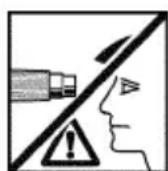
Never look into the blower nozzle.

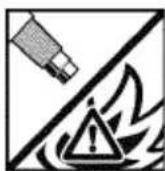
Do not aim the hot-air blower at easily flammable materials. Careless use of the hot-air blower may result in fire.
Never use the hot-air blower to dry hair.
Always wear safety goggles and protective gloves.
Exercise great care when using the hot-air blower in the vicinity of flammable materials or explosive gases.
Do not keep the hot-air blower trained on a single spot for more than a short period of time.
Be aware that heat can be transferred to flammable materials outside the operator's line of vision.
Use the hot-air blower in well-ventilated spaces only.
Do not inhale any vapours released during operation.
Do not leave the hot-air blower unattended when in use.
After use, place the hot-air blower on its bearing surfaces and allow to cool down before returning it to its storage location.
Warning: to prevent any risk of burns avoid touching the blower nozzle.
Children should be supervised to ensure that they do not play with the tool.
5 O v e r v i e w
Refer to illustrations on page 3.
1 (HE 2300 Control) LCD temperature display
2 Non-slip bearing surfaces on housing
3 Air filter
4 (HE 2000, HE 2300 Control) Switch (two-part)
Air temperature and air volume can be set independently of each other.
(H 1600)
Slide-switch for setting air temperature and air volume
6 Operation

Before initial use, check that the mains voltage and mains frequency stated on the rating plate match the figures for your own mains supply.

Avoid overheating:
- Do not work with the air filters obstructed. Clean the air filters in good time.
- Do not obstruct the blow-out pipe.
Maintain a minimum distance of 4cm to the workpiece and do not direct the air jet vertically onto the workpiece.
Stationary use
To use the hot-air blower in a stationary position, set it up on its non-slip bearing surfaces (2).
H 1600
Use the slide-switch (4) to switch the tool on and off and to select one of the three blower and temperature settings.
HE 2000, HE 2300 Control
Use the two-part switch (4) to set the temperature and air volume settings independently of each other.
Use the black slide-switch to switch the tool on and off and to select one of the three blower settings.
Use the red slide to continuously adjust the air temperature to any setting within its range.
The electronic system serves to monitor temperature and thus protects the heating coil.
HE 2300 Control
The pre-selected air temperature can be read in the LCD temperature display (1).
After the temperature has been pre-selected, the display shows the temperature of the emerging air after 3 seconds (displayed in 10^ increments).
Blower stage I:
The cold blower stage
- accelerates the cooling down of a previously warmed workpiece and
- accelerates the cooling down of the device itself after working.
Blower stage II:
The first warm blower stage (operating with a reduced fan speed) is used to carefully warm up a workpiece.
Heating the air causes it to expand, i.e. it increases in volume, thus increasing air throughput.
Blower stage III:
The second warm blower stage provides maximum air throughput.
7 Maintenance
Cleaning the air filter
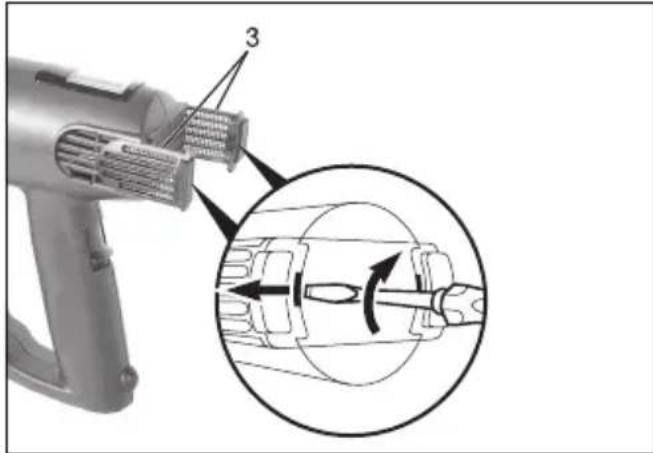
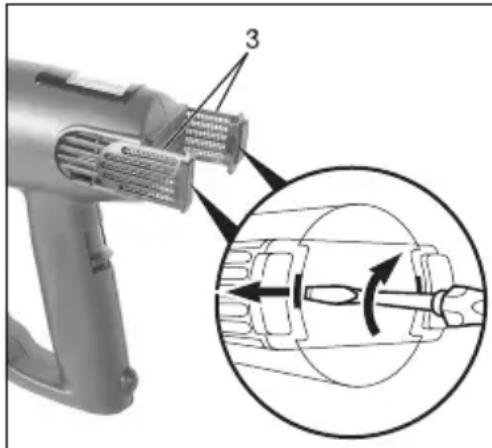
Disengage the air filter (3) with a flat-headed screwdriver and pull out of the tool. Use hot water and a brush to clean the filter. Allow to dry thoroughly and replace in the tool.
8 Troubleshooting
HE 2300 Control: Switching on procedures produce brief reductions in voltage. Unfavourable power conditions can be detrimental to other devices. Power impedances smaller than 0.4 ohm should not cause any malfunction.
9 Accessories
Use original Metabo accessories only.
Your Metabo dealer will supply you with any accessories you may require.
To assist in selecting the correct accessories, make sure that you take a note of the exact model of your tool for your dealer
See illustration on page 4 for available accessories.
A Wide-jet nozzle drying, stripping old paint
B Deflector nozzle stripping old paint from window frames
C Air-wrap nozzle heating plastic prior to bending, shrinking on shrink-fit plastic sleeves
D Slit nozzle overlap welding of PVC tarpaulins and sheeting
E Cutting nozzle making straight and curved cuts in rigid plastic foam (e.g. expanded polystyrene)
F Welding nozzle
G Reducing nozzle (HE 2000, HE 2300 Control only) for precision spot-heating (e.g. brazing and welding points)
H Butt-welding heater butt-welding plastic components The parts to be welded are pressed against the faces of the heater until the material reaches its melting point. They are then pulled off and pressed together.
I Shrink-fit plastic sleeves shrinking on cable ends, wiring harnesses, etc. by heating the sleeves with the air-wrap nozzle
J Plastic welding wire for welding jobs
K Paint-scaper kit
For complete range of accessories, see www.metabo.com or the main catalogue.
10 Repairs
Repairs to power tools must be carried out by a qualified electrician only.
Any Metabo power tools in need of repair can be sent to one of the addresses listed in the spare parts list.
Please send the tool for repair with a brief description of the fault identified.
11 Environmental Protection
Metabo packaging is 100% suitable for recycling.
Power tools and accessories at the end of their service life still contain large amounts of valuable raw materials and plastics which can likewise be fed back into a recycling process.
These Operating Instructions are printed on paper produced in a chlorine-free bleaching process.
Only for EU countries: Never dispose of power tools in your household waste! In accordance with European Guideline 2002/96/EC on used electronic and electric equipment and its implementation in national legal systems, used power tools must be collected separately and handed in for environmentally compatible recycling.
12 Technical Specifications
H 1600
Nominal power (230V) = 1600W
Nominal power (120V) = 1400W
Rated 120V AC 60c / s = 13 amps
Air temperature = Setting 1: 50 °C 120 °F
Setting 2: 350^ C
660°F
Setting 3: 550^
1000°F
Air volume = Setting 0: Off
Setting 1:250 l/min 8.8cfpm
Setting 2:350 l/min
12.4cfpm
Setting 3:500 l/min
17.7cfpm
Temperature display = -
Weight 0.70
Acoustic pressure level = < 70 dB (A)
Vibration = < 2.5m / s
HE 2000
Nominal power (230V) = 2000W
Nominal power (120V) = 1500W
Rated 120V AC 60c/s = 15 amps
Air temperature = Setting 1: 50^ C 120°F
Setting 2: 50 - 600^
120-1100°F
Setting 3: 50 - 600^
120-1100°F
Air volume = Setting 0: Off
Setting 1: 250 l/min
8.8cfpm
Setting 2: 270 l/min
9.5cfpm
Setting 3: 500 l/min
17.7cfpm
Temperature display = -
Weight = 0.75kg
Acoustic pressure level = < 70 dB (A)
Vibration = < 2.5m / s^2
HE 2300 Control
Nominal power (230V) = 2300W
Nominal power (120V) = 1500W
Rated 120V AC 60c/s = 15 amps
Air temperature = Setting 1: 50^
120°F
Setting 2: 50 - 650^
120-1200°F
Setting 3: 50 - 650^
120-1200°F
Air volume = Setting 0: Off
Setting 1: 250 l/min
8.8cfpm
Setting 2: 270 l/min
9.5cfpm
Setting 3: 500 l/min
17.7cfpm
Temperature display = LCD display
Weight = 0.75kg
Acoustic pressure level = < 70 dB (A)
Vibration = < 2.5m / s^2
We reserve the right to undertake modifications to reflect technical advances.
Measured values established according to EN 60745. The stated technical specifications are subject to tolerances (as specified in the respective current standards).
Mode d'emploi
Cher client,
La temperatura del aire y el caudal del aireSEOSEOSEOSEOSEOSEOSEOSEOSEOSEOSEOSEOSEOSEOSEOSEOSEOSEOSEOSEOSEOSEOSEOSEOSEOSEOSEOSEOSEOSEOSEOSEOSEOSEOSEOSEOSEOSEOSEOSEOSEOSEOSEOSEOSEOSEOSEOSEOSEOSEOSEOSEOSEOSEOSEOSEOSEOSEOSEOSEOSEOSEOSEOSEOSEOSEOSEOSEOSEOSEOSEOSEOSEOSEOSEOSEOSEOSEOSEOSEOSEOSEOSEOSEOSEOSEOSEOSEOSEOSEOSEOSEOSEOSEOSEOSEOSEOSEOSEOSEO SEOEO SEOEO SEOEO SEOEO SEOEO SEOEO SEOEO SEOEO SEOEO SEOEO SEOEO SEOEO SEOEO SEOEO SEOEO SEOEO SEOEO SEOEO SEOEO SEOEO SEOEO SEOEO SEOEO SEOEO SEOEO SEOEO SEOEO SEOEO SEOEO SEOEO SEOEO SEOEO SEOEO SEOEO SEOEO SEOEO SEOEO SEOEO SEOEO SEOEO SEOEO SEOEO SEOEO SEOEO SEOEO SEOEO SEOEO SEOEO SEOEO SEOEO SEOEQ
(H 1600)
I Kry m p s I a n g a r
He 3aIyIbIbAte B conNo!
He HanpaBnIe TexHueckn feh Ha IerKOBocPnAmEHaIOUneC MaTePnaIb!
HeHaIeXaUee o6paUeHne c TexHueckm fehOM MoXeT npVBecTN K NoXapy.
He nCnoJIb3yIe TeTexHnueckn fepH dJIa cyuKIN BOLOC!
BcerdaHaedeBaIte 3aunTHbIe OUYn pa6Oyne nepuATkn!
CobIoudaIte octopoXHOCTb npn 3KcNpyaTauIN TexHueCKoro fepHa B6n3n IerKOBocnlaMeHAOuNXc MaTePnaIOB nIN B3pbIOONaCHbIX ra3OB.
He HappaBnIe TexHnueckn QeH B TeueHne DInTeJbHoro BpeMeHn Ha OdHy ToKy!
TeNIO MOKeT DoIT NDo TROPUHX MaTePnaJIOB, HAXOJaXNXCR BHe 3OHbI BNIMOCTN.
3KcnpIyatpyuTeTexHnuecknФeHToJIbKO B XopoOo BEHTnIpyEmbIX NOMEueHnax!
He BdbiaaIte o6pa3yUoIuecnaPbI!
He octabJrTe TexHueckn 6e3 npncMOtpa, NOKa OH HAXOHTCB DeIcTBUN.
IIO OKOHuaHn IcNoJIb3ObaHn yCTaHOBnte TexHueckn cpeH Ha ONOpbl N daITe Emy OCTbITb, npexde Yem yopaTb ero Ha xpaHeHne!
Onachoctb oXora: He doTpaHnBaITeCb Do Harpetoro conla.
TeN DOJIxHbI HAXOINTbCnIO NOI NOCTORHHbIM Ha6JIODeHnEM, YTO6bl OHn He nCnONb3OBaNN np60p B KaueCTBe nrgyukn.
50630p
CM.C.3.
1 (HE 2300 Control) XX K uHdkaTOp TempePaTypbl
2 HeckoJIb3aIue onOpbl
3B03dyyHbIeΦnJIbTp
4 (HE 2000, HE 2300 Control)
ПepeключateNB (Двоин)
Тe mпература BO3dUxa N BO3dUwHbI NOTOK
perулруOTс He3aBnCmO dpyr O T dpyra.
(H 1600)
ПОЛЗУнКOBы ПepeключateNBдЯ
perулровки TempepaTpybl BO3dUxa N
BO3dUshOro NOTOKa
6 3Kcnpnyatazaia

Ipeed BBODOM B 3KcnplyaTaCNU npOBepbTe, COOTBETCTBYOT Jn HanpJxKeHne N YaCTOTA CETn, yKa3aHHbIe Ha 3aBODcKO T a6JIuYKe, napaMeTpam CETn 3JeKTPoNtAHn.

He donyckaTe neperpeBa: - He pa6otaTe c 3acopNBunmncB03dyuNbIMnФnlbTpamn.PerynapHo ouHuaTe BO3dyuHbIeФnlbTpbl. - He 6loKnpyte conno. BbIdepKbAaTe MInHMaJIbHoe pacCToHnE 4 cm OT o6pa6aTbIbAemOn DeTaN H He HanpaBnIte BO3dyuHbI NOTOK nepneHnIKyLnPHO NOBepxHOcTn.
CTaunohapbippekm
TcAIOHApHO NcNoB3OBAHn
TexHueCKOro cHa eRo CJeNyEt YcTaHbINBaTb
Ha HeCKoNb3rAne OnOpbl (2).
H 1600
C NOMOJIIO NOJ3YHKOBORO NpeKNIQUaTeJIa (4) Bbl MoXeTe BKJIQUaTb IN BBIKJIQUaTb INCTpyMeHT, a TaKxE Bbl6paTb Ondy n3 3 CTyPeHei pa60TbI n HarpeBa.
HE 2000, HE 2300 Control
C NOMOsbIO DBOHORO nepeKNIouaTeIa (4) MOXHO peRyJInpoBaTb TemNepaTpy BO3dyxa I BO3dyuHbI NOTOK He3aBnCmO dpyr OT dpyra.
C nOMOzIIO noJ3yHKOBOro nepeKlIOuataJIa YepHOrO zBETA BbIMoXeTe BKIOUaTb N BbIKIOUaTb IHCTpyMeHT, a TaKxE Bbl6paTb OdHy n3 3 CTyneHe pa0tbl.
C nomoubIIO noJ3yHKOBOro peryIaTopa KpacHoro CBeTa Bbl MoKeTe npOn3BOIDnB 6eCCTypeHcyupeRyIpOBky TeMnepaTypbI BO3dyxa.
3NeKtpoHbI 6Iok ClyXnT DnKoHTpOHa TempeaTpbl, a TaKxE DnA 3aunTbl HarpeBaTeBHOcnpaII.
HE 2300 Control
Ipn yctahOBKe TEMnepaTpyb IBO3dyxa C NOMOuBIO Kpachoro NOJ3yHKOBOro peryIaTopa MOxHO CHTaTb PpeBapntelbHO Bbl6paHHe 3NaueHne TEMnepaTpyb IBO3dyxa Ha XX INHdNKaTOpe TEMnpaTpyb (1).
Yepe3 3cekyndbI NocJIe yCTaHOBK TeMnepaTpybI INHdNKATOP CTAHet NOKa3bIBaTb TEMnpaTpy BbIXoJaIeO BO3dyxa. (OHa oTo6paXaetcA C OKpyrJHeHEm Do DeCrtKOB rpaDycob.)
Ctynehb pa60Tbl:
Pa60ta 6eHa 6e3 HArpeBa.ДЯ yckopeHoro oxnaXDeHnI npeBapntEnbHO HarpeToO obpa6aTbIbAemOn DeTaNN.ДЯ yckopeHoro
OxlaXdEHHNCHpymeHTa (NO OKOHuaHn pa60TbI).
CTyneh pa60tbl:
IepBaA CTyneHb pa60TbI peha (c yMeHbWeHHoYacTOToBpaUeHnA).Dna OCTOpOXHOrO HArpeBaHnO 6bpa6aTBiBaEm OTeaII. Ppi HArpeBe 6bem BO3dYa x yBeJIuNBAeTCa (O6bEMHOe pacuHpeHne), YTO npINBOJNT K yBeJIuHEnIO BO3dyuHOrO nOTOKa.
CTyneHb pa60Tbi III:
Btopa Ctyneh pa60bI pheHa. IINr CO3dHnMaKcMmaJIbHOBO3dyuHoro NtOKa.
7 TexHnueckoe obcIyJxNBAHne
OuNTKa BO3dUwHbIX qnIbTpOB
OTKpoTe BO3dUHbI ΦnJIbTp (3) C NOMOuBIO NNOCKO OTBePTKn U n3BNeKeNTe erO n3 INHCTpyMeHTa.
PpomOte ero TeIIOB BOIOH uTeKoN. XopoWeHbKO npocuWnte n yCTaHOBnTE B INHcTpymENT.
8 YcTpaHHeHne HEnCnPaBHOCTeI
BapnaHTbI npHnAdneKHOCTe IpeDcTaBJeHbI Ha pncyHKax Ha c. 4.
A LInpokoe npAMOTOHoe conIIO
Iyckn, ydaenHn CnoeB CTapO KpaKn
B CtpyHoe conJIO
IydaenHcTapoi Kpackn COKOHbIX paM
C PepekeKTopHoe conno
HarpeBa noJIIMephbx MaTePnaIOB nepeI o6pa6bOTko; Iy CHaTnY yCaOuHbIX oboJoueK
D LceneBoe conno
K KomnneKT ckpe6koB dny ydaeneHHa KpaKn
Полны accOPTUMENT ринадлжноcte CMOTPnTe Ha caTte www.metabo.com Иль В ГЛавHOM KaTaNore.
10 PeMoHT
KpeMOHTy 3JekTpOHcTpymeHa TOnyckaiOTcTolbko KBaHnΦnUpOBAHHbie cneuaJIncTbI-3JekTpKN!
IpyMeHTa npo3BOcTba Metabo OTnpabTe erno aDpecy n3 CNCKa 3anaChbix YAcTei.
K INHCTpymEnTy npINoXnTe KpaTKoe ONnCaHne yCTaHOBJIeHHO HENCnpaBHOCTN.
11 3aunTa OkpykaUoche Cpebl
YnakobKn 3denn Metabo noJHocTbno npiroDnbl npepeabOTkn BVtopuHoro nCNoIb3ObaHn.
OTcIyKINBWHne CBOI cPOK 3JIeKTPoHnHCTpyMeHTbI IN pINHaJdJIeXHOCTN CODEpXaT 6OJIbWoe KOJIuYeCTBO CEHHbIX CbIPbeBbIX I NOJIIMepHBIX MaTePnaNoB, KOTOpBIE TaKKe MOrY T 6blb HAnpaBHeHb HA NOBTOPhYIO nepepa60TKy.
HCTpykunnoNcNoJIb3ObaHnIO HaneYaTaHa Ha 6ymare,OTBeIeHHoB6e3 npImeHEnxlopa.

Tolbko Дяг CTpaH EC: He yTuJn3uPyuIte 3JIeKTPoPnp6OpbI N3JIeKTPoNHTpymEHTbl BMeCTe C 6bITOBbIM OTxOaMn! CorJIaCHO eBpOneiCKOn DInpeKtUBe 2002/96/EG o6
NcNoJIb3OBAHn CTapbIX 3NeKTpOpnp6OpOB n 3NeKTpOHOro 6ObpyDoBAHn I COOTBETCTBYIOUIM HaUNHOHaJIbHbIM HOPMaM 6bIBWne B yNOtpeBHeHn 3NeKTpOpnp6Opbl n 3NeKTpONHCTpyMeHTbI NOJnxat pa3JeBHOYTNIN3aCnC cJIbIoo IN NocIeDyUoSei EKOLOrueckn 6e30NaChOn nepepa6OTKn.
12 TexHnueckne xapaKTepeNCTnKn
H 1600
MoHOCTB=1600BT
TemnepaTypa
B03dyxa = CTyneHb 1: 50^
CTyneHb 2:350°C
CTyneHb 3:550°C
CKopoocTb = CTyneHb
BO3dyuHoro notoka CtyeHB 1:250 n/MnH
CTyneHb 2:350J/MnH
CTyPeneB3:500J/MnH
INdkaTOp
TemnepaTpybI
Macca 700
YpoBHeH 3ByKOBoro = <70 d5 (A) DaBnEHH
Bn6paun=<2,5M/c 2
HE 2000
MoHOCTB=2000BT
Temnepaotypa
B03dyxa = CTyneHb 1: 50 °C
CTyneHb 2:50-600°C
CTyneHb 3:50-600°C
CKopoocTb = CTyneHb
BO3dyuHoro nToKa cTynHeB 1:250n/MnH
CTyneHb 2:270J/MNH
CTyneHb3:500J/MnH
INdkaTOp
TemnepaTpybI
Macca 750
YpoBHe 3ByKOBoro = < 70 dE(A)
ДаВленья
Bn6paun=<2,5M/c 2
HE 2300 Control
MoUHOCTB=2300BT
TemnepaTypa
B03dyxa = cTynHeh 1: 50°C
CTyneHb 2:50-650°C
CTyneHb 3:50-650°C
CkopoocTb = CTyneHb
BO3dUshoro NtOKa CtyneHb 1:250J/MnH
CTyneHb 2:270J/MnH
CTyneHb3:500J/MnH
INHdkaTOp = KK INHdkaTOp TempepaTpybl
Macca 750
YpoBeHb 3ByKOBoro = <70 d5 (A)
DaBHeHnA
BuaHn=2,BlKJ. 2
OCTaBJIaEM 3a co6oI npaBO Ha TexHnueckne n3MeHeHH.
I3MepReMbIe 3HaueHnI NOJyHeHbB
COOTBETCTBmN CO CTaHapTOM EN 60745.
PnBbdeHhbleTexHueckneXapaKTepNcTKn COePKaT DonyCKN (BCOTBeTCTBmC COOTBeTCTBYUOM DeIcTBYUUM CTaHapTOM).
metabo
Metabowerke GmbH, 72622 Nürtingen, Germany
www.metabo.com


- Operating Instructions
- Contents
- Declaration of Compliance
- Proper Use
- General Safety Rules
- Special Safety Instructions
- O v e r v i e w
- Operation
- Stationary use
- H 1600
- HE 2000, HE 2300 Control
- HE 2300 Control
- Blower stage I:
- Blower stage II:
- Blower stage III:
- Maintenance
- Cleaning the air filter
- Troubleshooting
- Accessories
- Repairs
- Environmental Protection
- Technical Specifications
- HE 2000
- Mode d'emploi
- 50630p
- CM.C.3.
- 3Kcnpnyatazaia
- CTaunohapbippekm
- Ctynehb pa60Tbl:
- CTyneh pa60tbl:
- CTyneHb pa60Tbi III:
- TexHnueckoe obcIyJxNBAHne
- YcTpaHHeHne HEnCnPaBHOCTeI
- PeMoHT
- KpeMOHTy 3JekTpOHcTpymeHa TOnyckaiOTcTolbko KBaHnΦnUpOBAHHbie cneuaJIncTbI-3JekTpKN!
- 3aunTa OkpykaUoche Cpebl
- TexHnueckne xapaKTepeNCTnKn
- metabo
Brand : METABO
Model : HE 2000
Category : Heat gun