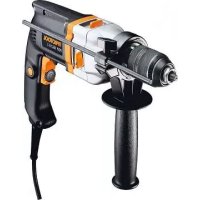
PDP 182 E1 - Drill Protool - Free user manual and instructions
Find the device manual for free PDP 182 E1 Protool in PDF.


| Product Type | Impact Drill |
| Brand | Protool |
| Model | PDP 182 E1 |
| Weight | 1.8 kg |
| Power Supply | 230-240 V ~ 50/60 Hz |
| Power Consumption | 650 W |
| No-load Speed (1st speed) | 0-1100 min⁻¹ |
| No-load Speed (2nd speed) | 0-3000 min⁻¹ |
| Impact Rate (1st speed) | 0-12600 min⁻¹ |
| Impact Rate (2nd speed) | 0-34600 min⁻¹ |
| Drilling Capacity (steel) | 13 mm |
| Drilling Capacity (wood) | 35 mm |
| Drilling Capacity (concrete) | 16 mm |
| Chuck Clamping Capacity | 1.5-13 mm |
| Chuck Thread | 1/2"-20 UNF |
| Protection Class | II (double insulation) |
| Main Functions | Simple drilling, impact drilling, screwdriving, threading |
| Settings | Electronic speed variator, pre-selection, 2 mechanical speeds, reversible rotation direction |
| Maintenance and Cleaning | Clean ventilation slots regularly; replace worn brushes; grease the motor unit every 200 hours |
| Safety | Wear hearing protection; use the additional handle; unplug before any intervention |
| Supplied Accessories | Additional handle, depth stop, chuck key, fork wrench, hex key, screwdriver bit |
Frequently Asked Questions - PDP 182 E1 Protool
User questions about PDP 182 E1 Protool
0 question about this device. Answer the ones you know or ask your own.
Ask a new question about this device
Download the instructions for your Drill in PDF format for free! Find your manual PDP 182 E1 - Protool and take your electronic device back in hand. On this page are published all the documents necessary for the use of your device. PDP 182 E1 by Protool.
USER MANUAL PDP 182 E1 Protool
Netzfrequency [Hz] 50/60
Mains frequency [Hz] 50/60
Nom. power requirement [W] 650
Rated rpm [min-1]
1st speed 0 ... 600
2nd speed 0 ... 1730
Rated rpm (no load) [min-1]
1st speed 0 ... 1100
2nd speed 0 ... 3000
Pulse frequency [min-1]
1st speed 0 ... 12600
2nd speed 0 ... 34600
Speed selection
Reverse rotation
Drill chuck capacity range 1.5 ... 13
Drill chuck thread 1 / 2^ - 20 UNF
Bit holder, hexagonal socket 1/4
Drill dia. [mm] steel 13
aluminium 16
wood 35
concrete 16
Clamping collar dia. [mm] 43
Weight [kg] 1,8
Protection class II/回
Operating controls
1 Key-type drill chuck
2 Spanner surface
3 Auxiliary handle collar
4 Drill/Percussion drill switch
5 Ventilation slots
6 Depth stop
7 Auxiliary handle
8 Gear selector switch
9 Rotational direction switch
0 Speed selector thumbwheel
1 ON/OFF switch
2 Lock-on button
3 Screwdriver attachment
4 Safety cover
5 Drill spindle
6 Chuck key
7 Open-ended spanner
8 Allen key
9 Keyless chuck
20 Securing screw
Not all of the accessories illustrated or described
are included as standard delivery.
Notes on Safety

This machine can only be operated safely when the operating instructions and the pamphlet containing the safety instructions have been completely read and
strictly adhered to.
For further notes on safety refer to enclosed Sheet.
Wear hearing protection, especially while drilling with impact. Without sufficient protective devices, the noise level can lead to hearing impairments.
Use the supplied auxiliary handle. Loss of control over the machine can lead to injuries.
Always inspect cable and plug before using machine. Only have damage repaired by a qualified professional.
Make sure machine is switched off before inserting plug in socket.
The machine must not be damp and must not be operated in a wet environment.
Caution with long hair. Do not wear loose-fitting clothing while working.
- Secure your workpiece with clamps.
Always direct power cable to rear away from the machine.
- When screwdriving, always operate in first gear and with low rpms.
Use caution when screwdriving long screws. Danger of injury due to slipping off.
Always ensure that you have a secure footing while working.
Watch out for the initial torque reaction of the drill, especially when drill bit is tight.
Before carrying out any work on the machine disconnect from power supply by removing plug from socket.
The chuck key should always be kept in the holder provided on the cable sleeve.
Intended Use
The machine is intended for impact drilling in brick, concrete and stone as well as for drilling in wood, metal, ceramics and plastics. Machines with electronic control and right/left rotation are also suitable for screwing and thread-cutting.
The user alone is responsible for any liabilities caused by usage other than intended.
Symbols used to mark instructions

This symbol is used to mark safety instructions that must be observed to prevent damage to persons.
Not to be included in municipal refuse.


Double insulation
Starting and Operation
Incorrect operation can lead to damage of the unit. Therefore always observe the following recommendations:
- Sharp drill bits optimize performance whilst minimizing wear on the machine.
- Do not place such loads on the machine that it ceases to turn.
- Change rotational direction only when the machine is not moving.
Check that the plug is the right type for the socket
Ensure that the voltage of the power supply matches the information on the type plate of the power tool. Tools with a rating of 230V can also be connected to a 220V/240V supply.
Auxiliary handle
The enclosed auxiliary handle (7) mounts on the collar (3). It should always be used to ensure operating safety. The drilling depth can be set with the depth stop (6).
Clamping a drill bit
Gear with chuck
Open drill chuck enough so the tool can be inserted. Insert the tool and tighten all 3 bores equally with the chuck key (16).
Quick Clamping Chuck
Open drill chuck enough so the tool can be inserted.
Turn the sleeve of the keyless drill chuck firmly by hand until a distinct ,click" is heard. The keyless drill chuck is thereby automatically locked.
The locking is released again when the sleeve is rotated in the opposite direction, in order to remove the tool.

Caution! The drill chuck may be very hot:
During longer working periods, in particular for impact drilling, the drill chuck can become very hot. In this case we recommend the use of protective gloves.
Switching on and off
Press the on/off switch (11) to switch on the machine. Release again to switch off.
Continuous use
Switching on: Press the ON/OFF button (11), hold and retain with the lock-on button (12).
Switching off: Press and release ON/OFF switch (11).
Speed Control
Lightly pressing the ON/OFF switch (11) results in a low rotational speed, allowing a controlled soft start.
Further pressure on the switch results in an increase in speed.
Electronic speed pre-selection
The required speed can be pre-selected with the speed selector thumbwheel (10) (also possible during operation).
The required speed depends on the material being machined and can be determined by trial.
When putting a high load on the machine, always set the speed selector thumbwheel (10) to the maximum speed.
After long periods at low operating speed, run the drill at high speed and without load for approx. 3 minutes, in order to cool the machine down.
Gear selection (Fig.)
Two speed ranges can be pre-selected with the gear selector switch (8):
Gear I: Lower speed range
Gear II: Higher speed range
The final speed can be electronically pre-selected within these speed ranges.
The gears can be switched when the machine is running down or at a standstill, however not under full load.
Changing rotational direction
Set the rotational direction switch (9) to the right (lefthand rotation) or to the left (right-hand rotation). Operation in left-hand rotational direction enables applications such as tapping or loosening bolts or nuts.
The rotational direction switch is locked when the ON/OFF switch (11) is activated. Change the rotational direction only when the machine is not running.
CAUTION! When using the left run it is especially important to firmly screw on the chuck.
Normal and percussion drilling
Selector switch (4) can be felt snapping into place, and can be actuated while the machine is operating.

Drilling
Push selector switch (4) to the left.
Percussion drilling
Push selector switch (4) to the right.
Tungsten carbide drill bits are required for drilling concrete, stone and masonry. The rotational direction switch (9) must be in the clockwise position.
Replacing the key-type drill chuck (Fig.)
The drill chuck is secured with the securing screw (20) against loosening from the drill spindle. Open the drill chuck fully and completely unscrew the securing screw (Caution: lefthand thread!).
Set an open-end spanner (size 17mm ) onto the spanner surface (2) of the drill spindle and hold tight. Insert the chuck key (16) into one of the three holes of the drill chuck. Use the chuck key as a lever to unscrew the drill chuck from the spindle, by rotating in counterclockwise direction against the open-end spanner. A snug drill chuck can be loosened by applying a light hammer blow onto the drill chuck key (16).
Replacing the keyless chuck (Fig.)
The drill chuck is secured with the securing screw (20) against loosening from the drill spindle. Open the drill chuck fully and completely unscrew the securing screw (Caution: lefthand thread!).
Clamp an Allen key (18) into the drill chuck. Set an openend spanner (size 17mm ) onto the spanner surface (2) of the drill spindle and hold tight. Loosen the drill chuck with a light blow on the Allen key.
Screw on the drill chuck in reverse order. Before tightening the securing screw (20) respectively, the quick clamping drill chuck must be tightened securely (tightening torque approx. 30Nm ).
Screwdriving (Fig.)
The drill spindle (15) is equipped with an internal hexagon for use with screwdriver bits (13). After removing the drill chuck, a screwdriver bit can be inserted directly into the internal hexagon of the drill spindle. Slide the safety cover (14) onto the spindle thread first, as it will retain the screwdriver bit.
Operational Tips
Sharpening drill bits
Only HSS drill bits in perfect condition (HSS = high speedsteel) should be used for drilling metal.
Bench Stands
For jobs requiring high precision, the use of a bench stand (accessories) is recommended.
Machine vice
Clamp work pieces tight for drilling, i.e., using the machine vice (see Accessories). This keeps the work piece from turning and thus prevents resulting accidents.
Drilling tiles
Set selector switch (4) to the drill symbol. Wait until the tile has been completely penetrated before switching over to the hammer symbol and continuing with percussion drilling.
Tapping
Clamp the tap drill carefully and very tight to prevent slipping.
Storage
The unit should be stored in a dry place where it is protective against freezing.
Environmental protection/disposal

Power tools, accessories and packaging should be sorted for environmental-friendly recycling.
Only for EU countries:
Do not dispose of power tools into household waste!
According to the European Directive 2002/96/EC on waste electrical and electronic equipment and its incorporation into national law, power tools that are no longer suitable for must be separately collected and sent for recovery in an environmental-friendly manner.
Maintenance
Periodically clean the ventilation slots (5) on the motor housing.
- When the carbon brushes are worn out, the machine switches itself off. The machine must then be sent to customer service for maintenance (see enclosed sheet).
Cable may only be replaced by a specialised electronics workshop qualified to perform such work.
After an operating period of approx. 200 hours, the following maintenance work must be performed:
- Renew the grease filling of the gearbox.

To verify that the double insulation is intact, the machine must be subjected to a safety test afterwards. Therefore, these maintenance tasks are to be performed only by a professional electro-workshop.
Service
See enclosed sheet.
Guarantee
Our equipment is under warranty for at least 12 months with regard to material or production faults in accordance with national legislation. In the EU countries, the warranty period for exclusively private use is 24 months (an invoice or delivery note is required as proof of purchase). Damage resulting from, in particular, normal wear and tear, overloading, improper handling, or caused by the user or other damage caused by not following the operating instructions, or any fault acknowledged at the time of purchase, is not covered by the warranty.
Complaints will only be acknowledged if the equipment has not been dismantled before being sent back to the suppliers or to an authorised PROTOOL customer support workshop. Store the operating instructions, safety notes, spare parts list and proof of purchase in a safe place. In addition, the manufacturer's current warranty conditions apply.
Note
We reserve the right to make changes to the technical data contained in this information as a result of ongoing research and development work.
Noise/vibration information
Measured values determined according to EN 50 144.
Typically the A-weighted noise levels of the product are: sound pressure level: 100 dB (A); sound power level: 113 dB (A). Wear ear protection!
The typical weighted acceleration is 3,5m / s^2
CE-Declaration of Conformity
We declare under our sole responsibility that this product is in conformity with the following standards or standardization documents: EN 55 014-1, EN 55 014-2, EN 61 000-3-2, EN 61 000-3-3, EN 60 745-1, EN 60 745-2-1 according to the provision of the regulations 89/336/EEC, 98/37/EC.
C∈05
f.f.d. Manfred Kirchner
Subject to change
Bruk kun helt skarpe HHS-bor (HHS = high speed) for metall.
Borestativ
For saerskilt naeyaktige arbeider anbefales det a brute et borestativ (se tilbehør).
Maskinskrustikke
1.stupen0...600
2.stupen0...1730