
CTB6250B - Refrigerator-freezer BEKO - Free user manual and instructions
Find the device manual for free CTB6250B BEKO in PDF.




| Product type | Extractor/filter hood |
| Brand | BEKO |
| Model | CTB6250B |
| Width | 598 mm |
| Depth | 175 mm |
| Height | 280 mm |
| Net weight | 7.6 kg |
| Gross weight | 8.5 kg |
| Color | Black |
| Power supply | 220-240 V, 50-60 Hz |
| Extraction power | 420 m³/h |
| Motor power | 140 W |
| Lighting | 2 bulbs of 28 W each |
| Number of speeds | 3 (minimum, average, maximum) |
| Control type | Mechanical push buttons (L, M, V) |
| Air outlet duct diameter | 120-150 mm |
| Anti-grease filters | Metallic, washable (dishwasher recommended) |
| Anti-odor filter (optional) | Activated carbon, non-washable, to be replaced every 3-4 months |
| Installation | Under wall cabinet, extraction or recirculation mode |
| Minimum distance from hob | 650 mm (unless otherwise stated) |
| Functions | Lighting, extraction, 3 speeds |
| Maintenance and cleaning | Clean anti-grease filters every 2 months; replace carbon filter every 3-4 months; clean outer surface with damp cloth and mild detergent |
| Safety | Do not flambé under the hood, do not leave open flames, disconnect before maintenance |
Frequently Asked Questions - CTB6250B BEKO
User questions about CTB6250B BEKO
0 question about this device. Answer the ones you know or ask your own.
Ask a new question about this device
Download the instructions for your Refrigerator-freezer in PDF format for free! Find your manual CTB6250B - BEKO and take your electronic device back in hand. On this page are published all the documents necessary for the use of your device. CTB6250B by BEKO.
USER MANUAL CTB6250B BEKO
CTB 6250 W
CTB 6250 B
CTB 6250 X
CTB 6250 XH
CTB 9250 X
CTB 9250 XH
EN
PT
RO
DE
DA
RU
FR
PL
SL
IT
LT
CS
ES
EL
SK
NL
BG
Please read this user manual first!
Dear Customer,
Thank you for preferring a Beko product. We hope that you get the best results from your product which has been manufactured with high quality and state-of-the-art technology. Therefore, please read this entire user manual and all other accompanying documents carefully before using the product and keep it as a reference for future use. If you handover the product to someone else, give the user manual as well. Follow all warnings and information in the user manual.
Remember that this user manual is also applicable for several other models. Differences between models will be identified in the manual.
Explanation of symbols
Throughout this user manual the following symbols are used:

Important information or useful hints about usage.

Warning for hazardous situations with regard to life and property.

Warning for electric shock.

Packaging materials of the product are manufactured from recyclable materials in accordance with our National Environment Regulations.
Do not dispose of the packaging materials together with the domestic or other wastes. Take them to the packaging material collection points designated by the local authorities.

This product was manufactured using the latest technology in environmentally friendly conditions.
| ENGLISH | 04-12 |
| DEUTSCH | 13-22 |
| FRANÇAIS | 23-32 |
| ITALIANO | 33-42 |
| ESPAÑOL | 43-52 |
| NEDERLANDS | 53-62 |
| PORTUGUÊS | 63-72 |
| DANSK | 73-82 |
| POLSKI | 83-92 |
| LIETUVIŲ K | 93-102 |
| ΕΛΛΗΝΙΚΑ | 103-115 |
| ΒЪЛГАРСКИ | 116-125 |
| ROMÂNĂ | 126-135 |
| PYССКИЙ | 136-147 |
| SLOVENŠČINA | 148-157 |
| ČESKY | 158-166 |
| SLOVENSKÝ | 167-176 |
01M-8842113200-4017-01
01M-8842103200-4017-01
01M-8844773200-4017-01
01M-8842043200-4017-01
01M-8844763200-4017-01
1
Important safety and environmental instructions

The Instructions for Use apply to several versions of this appliance. Accordingly, you may find descriptions of individual features that do not apply to your specific appliance.
1.1 Installation
- The manufacturer will not be held liable for any damages resulting from incorrect or improper installation.
- The minimum safety distance between the cooker top and the extractor hood is 650 mm (some models can be installed at a lower height, please refer to the paragraphs on working dimensions and installation).
- Check that the mains voltage corresponds to that indicated on the rating plate fixed to the inside of the hood.
- For Class I appliances, check that the domestic power supply guarantees adequate earthing.
- Connect the extractor to the exhaust flue through a pipe of minimum diameter 120 mm. The route of the flue must be as short as possible.
- Do not connect the extractor hood to exhaust ducts carrying combustion fumes (boilers, fireplaces, etc.).
- If the extractor is used in conjunction with non-electrical appliances (e.g. gas burning appliances), a sufficient degree of aeration must be guaranteed in the room in order to prevent the backflow of exhaust gas. The kitchen must have an opening communicating directly with the open air in order to guarantee the entry of clean air.
1.2 Use
The extractor hood has been designed exclusively for domestic use to eliminate kitchen smells.
- Never use the hood for purposes other than for which it has been designed.
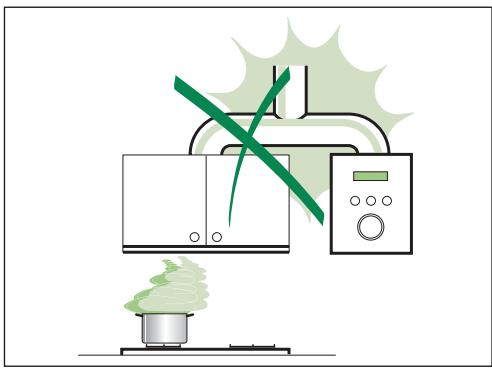
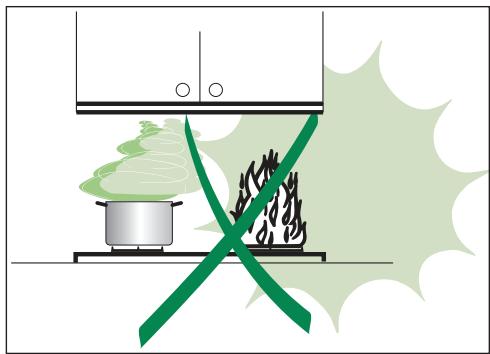
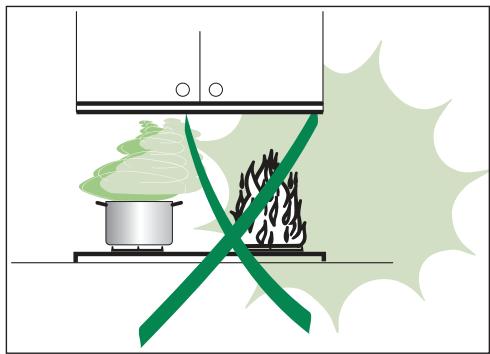
- Never leave high naked flames under the hood when it is in operation.
- Adjust the flame intensity to direct it onto the bottom of the pan only, making sure that it does not engulf the sides.
1
Important safety and environmental instructions
- Deep fat fryers must be continuously monitored during use; overheated oil can burst into flames.
- The hood should not be used by children or persons not instructed in its correct use.
1.3 Maintenance
- Switch off or unplug the appliance from the mains supply before carrying out any maintenance work.
- Clean and/or replace the filters after the specified time period (fire hazard).
- Clean the hood using a damp cloth and a neutral liquid detergent.
1
Important safety and environmental instructions
1.4 Compliance with the WEEE Directive and Disposing of the Waste Product:
This product complies with EU WEEE Directive (2012/19/EU). This product bears a classification symbol for waste electrical and electronic equipment (WEEE).

This product has been manufactured with high quality parts and materials which can be reused and are suitable for recycling. Do not dispose of the waste product with normal domestic and other wastes at the end of its service life. Take it to the collection center for the recycling of electrical and electronic equipment. Please consult your local authorities to learn about these collection centers.
Compliance with RoHS Directive
The product you have purchased complies with EU RoHS Directive (2011/65/EU). It does not contain harmful and prohibited materials specified in the Directive.
1.5 Package information

Packaging materials of the product are manufactured from recyclable materials in accordance with our National Environment Regulations. Do not dispose of the packaging materials together with the domestic or other wastes. Take them to the packaging material collection points designated by the local authorities.
2
Characteristics
2.1 Components
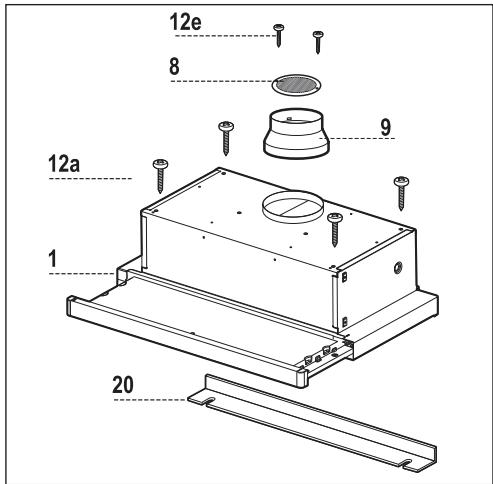
Ref. Q.ty Product Components
| 1 | 1 | Hood Body, complete with:Controls, Light, Blower, Filters |
| 8 | 1 | Directional Air Outlet grille |
| 9 | 1 | Reducer Flange ø 150-120 mm |
| 20 | 1 | Closing element |
Ref. Q.ty Installation Components
| 12a | 4 | Screws 4,2 x 44,4 |
| 12e | 2 | Screws 2,9 x 9,5 |
| Q.ty | Documentation | |
| 1 | Instruction Manual |
2.2 Dimensions
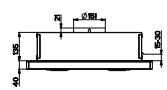
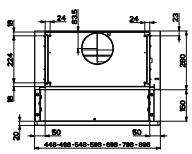
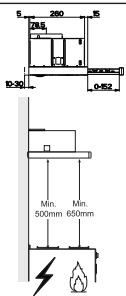
2.3 Technical Specifications
| CTB 6250 W | CTB 6250 B | CTB 6250 X/XH | CTB 9250 X/XH | |
| Width | 598 mm | 898 mm | ||
| Depth | 175 mm | |||
| Height | 280 mm | |||
| Supply voltage | 220 - 240 V, 50-60 Hz | |||
| Control | 3 positions | |||
| Suction power | 420 m3/h | |||
| Motor power | 140 W | |||
| Lamp power | 2X28 W | |||
| Air outlet pipe diameter | 120-150 mm | |||
| Net weight | 7,6 kg | 9,3 kg | ||
| Gross weight | 8,5 kg | 10,5 kg | ||
| Color | White | Black | Inox | Inox |
Markings on the product or the values stated in other documents supplied with the product are values obtained under laboratory conditions as per relevant standards. These values may vary according to the usage of the product and ambient conditions.
3
Installation
3.1 Drilling the Support Surface and Fitting the Hood
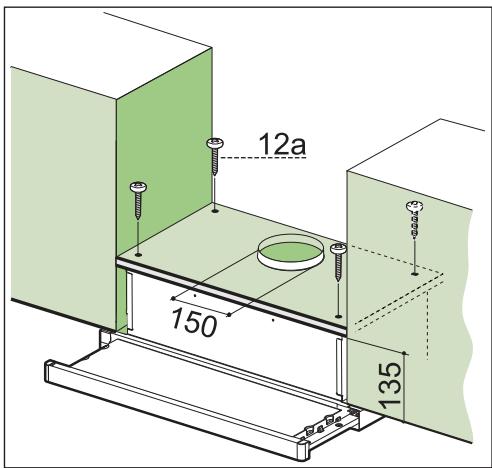
Screw Fitting
- The hood support surface must be 135 mm above the bottom surface of the wall units.
- Drill the support with a ø 4.5 mm drill bit, using the drilling template provided.
- Cut a hole ø 120-150 mm in size on the support surface, using the drilling template provided.
- Fix using the 4 screws 12a (4.2 x 44.4) provided.
Snap-On Fitting
- The hood can be installed either directly on the bottom surface of the wall units using snap-on side supports.
- Cut a fitted opening in the bottom surface of the wall unit, as shown.
- Insert the hood until the side supports snap into place.
Lock in position by tightening the screws Vf from underneath the hood.
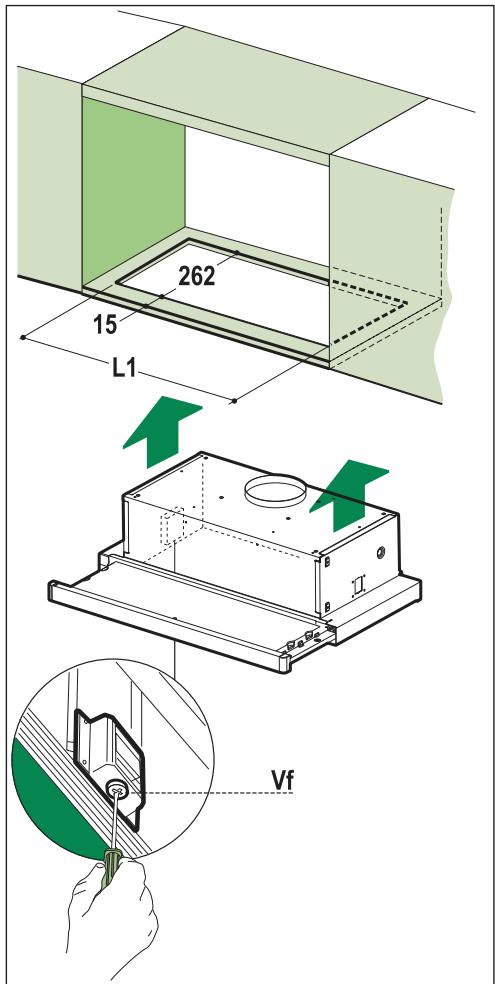
| Hood Type | CTB 6250 W/B/X | CTB 9250 X |
| L1 | 510 | 810 |
3
Installation
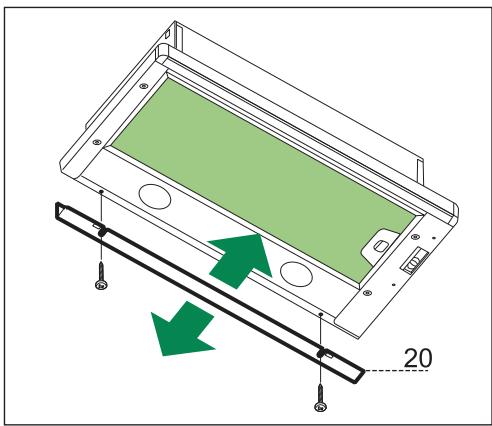
Closing Element
The space between the edge of the hood and the rear wall can be closed by applying the element 20 provided, using the screws supplied for this purpose.
3.2 Connection
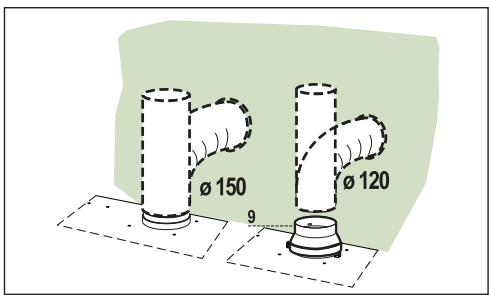
3.2.1 Ducted Version Air Exhaust System
When installing the ducted version, connect the hood to the chimney using either a flexible or rigid pipe Ø 150 or 120 mm, the choice of which is left to the installer.
- To install a Ø 120 mm air exhaust connection, insert the reducer flange 9 on the hood body outlet.
- Fix the pipe in position using sufficient pipe clamps (not supplied).
- Remove possible charcoal filters.
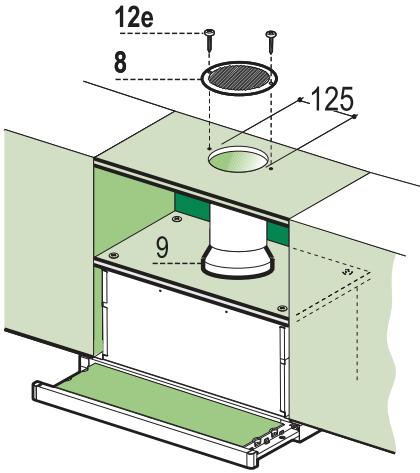
3.2.2 Recirculation Version Air Outlet
- Cut a hole of 125 mm diameter in any shelf that may be positioned over the hood.
- Insert the reducer flange 9 on the hood body outlet.
- Connect the flange to the outlet on the shelf over the hood by using a flexible or rigid pipe of 120 mm diameter.
- Fix the pipe in position using sufficient pipe clamps (not supplied).
- Fix the air outlet grid 8 on the recirculation air outlet by using the 2 screws 12e (2.9 x 9.5) provided.
- Ensure that the activated charcoal filters have been inserted.
3.2.3 Electrical Connection
- Connect the hood to the mains through a two-pole switch having a contact gap of at least 3 mm.
- When opening the sliding carriage for the first time after installing the hood, pull it out briskly until it clicks.
4 Use
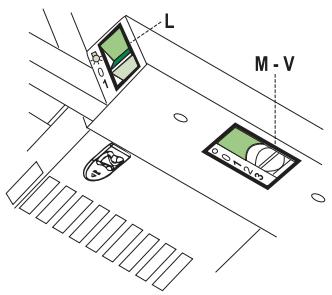
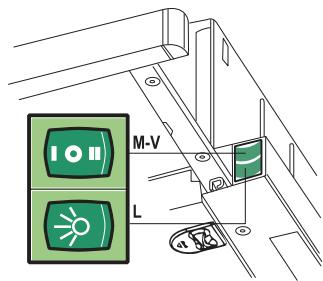
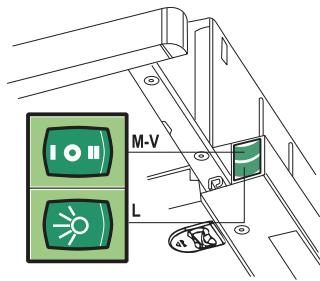
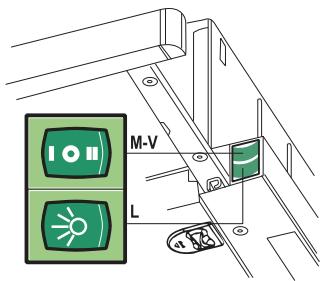
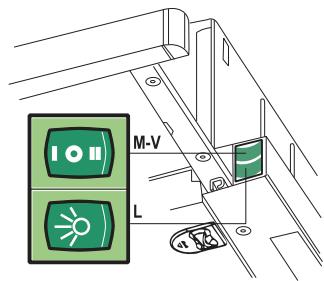
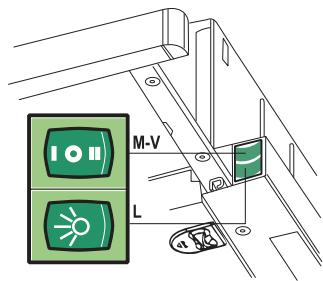
4.1 Control panel
| L | Light | Switches the lighting system on and off |
| M | Motor | Switches the extractor motor on and off |
| V | Speed | Sets the operating speed of the extractor:1. Low speed, used for a continuous and silent air change in the presence of light cooking vapour.2. Medium speed, suitable for most operating conditions given the optimum treated air flow/noise level ratio.3. Maximum speed, used for eliminating the highest cooking vapour emission, including long periods |
| L | Light | Switches the lighting system on and off |
| M | Motor | Switches the extractor motor on and off |
| V | Speed | Sets the operating speed of the extractor:1. Low speed, used for a continuous and silent air change in the presence of light cooking vapour.2. Medium speed, suitable for most operating conditions given the optimum treated air flow/noise level ratio. |
5
Maintenance
5.1 Grease Filters
5.1.1 Cleaning Metal Self-Supporting Grease Filters
- The filters must be cleaned every 2 months, or more frequently in case of particularly heavy use of the hood. Filters can be washed in a dishwasher.
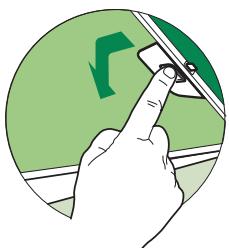
- Pull out the sliding suction panel.
- Remove the filters one by one, after having disconnected the relative fastening elements.
- Wash the filters, taking care not to bend them. Let them get dry before refitting them. (The colour of the filter surface may change throughout the time but this has no influence to the filter efficiency).
- When refitting the filters, make sure that the handle is visible on the outside.
- Close the sliding suction panel.
5.2 Charcoal filter (Recycling version)
5.2.1 Replacing Charcoal Filters

Warning: Turn the lights off and wait until the lamps cool down before you change the odour filter.
- These filters are not washable and cannot be regenerated, and must be replaced approximately every four months or more frequently by particularly heavy use.
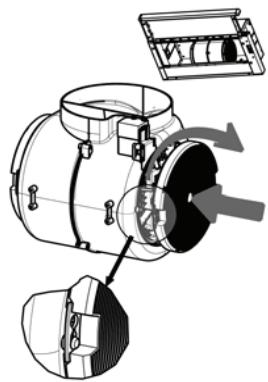
- Pull out the sliding suction panel.
- Remove the grease filters.
- Remove the saturated carbon filter by releasing the fixing hooks
- Fit the new filter by hooking it into its seating.
- Replace the grease filters.
- Close the sliding suction panel.
5.3 Lighting
5.3.1 Light Replacement
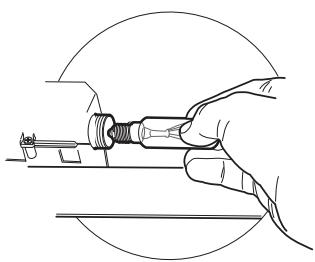
28W light
- Remove the metal grease filters.
- Unscrew the bulbs and replace them with new ones having the same characteristics.
- Replace the metal grease filters.
1
3.2.1 Connection in exhaust air version
5.3 Lighting
5.3.1 Replacing the lamps
28W lamps
1
3.2 Connections
3.2.1 Exhaust air version
5.2 Anti-odor filters (Recirculation version)
5.2.1 Replacement

5.3 Lighting
5.3.1 Replacing lamps 28W lamps
1
- The hood can be installed either directly on the bottom surface of the wall units using snap-on side supports.
- Cut a fitted opening in the bottom surface of the wall unit, as shown.
- Insert the hood until the side supports snap into place.
- Lock in position by tightening the screws Vf from underneath the hood.
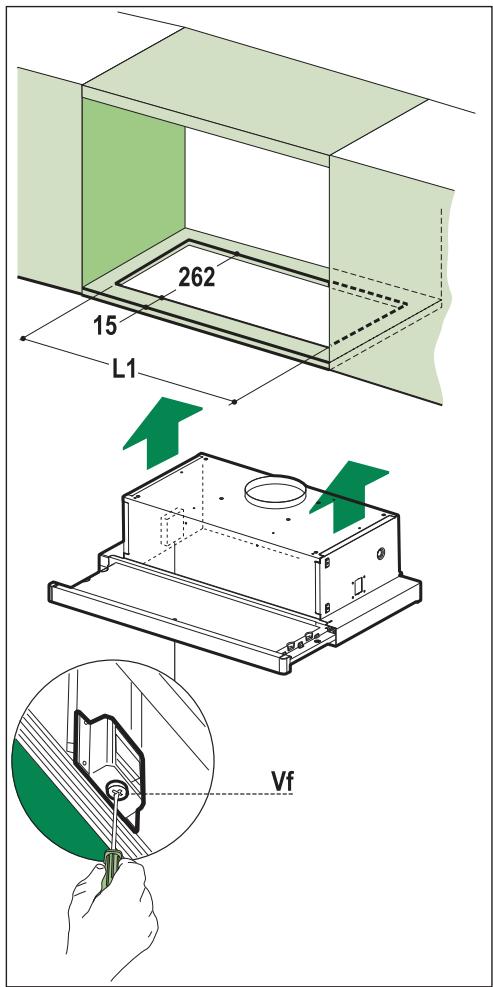
| Tipo Cappa | CTB 6250 W/B/X | CTB 9250 X |
| L1 | 510 | 810 |
Closing profile
3.2 Connections
4.1 Control panel
5.2 Anti-odor filters (Filtering version)
5.2.1 Replacement

5.3 Lighting
1.3 Maintenance
1
3.2 Connection
4.1 Control panel
5.3 Lighting
1
3.2 Connections
5.2 Odor filter (filter version)
5.2.1 Replacement

5.3 Lighting
1
3.2 Connections
4.1 Control panel
5.3 Lighting
1
3.2 Connections
5.2 Grease filter (Recirculation through filter)
5.2.1 Replacement

5.3 Lighting
1.3 Maintenance
1
3.2 Connection
5.3 Lighting
1
3.2 Connection
4.1 Control panel
5.2 Charcoal filter (disposable)
5.3 Lighting
1
3.2 Connection
4.1 Control panel
5 Maintenance
5.3 Lighting
1
3.2 Connection
5.3 Lighting
1.3 Maintenance
1
3.2 Connection
3.2.3 Electrical connection
5.3 Lighting
1
1
3.2 Connection
Before using the appliance, read the instructions for use!
Dear customers!
1.3 Maintenance
| Ref. | Količina | Deli izdelka |
| 1 | 1 | Hood Body, complete with: Controls, Light, Blower, Filters |
| 8 | 1 | Directional Air Outlet grille |
| 9 | 1 | Reducer Flange ø 150-120 mm |
| 20 | 1 | Closing element |
3.2 Connection
3.2.1 Hood with air exhaust
5.2 Charcoal filter (recycling option)
5 Maintenance
5.3 Lighting
5.3.1 Replacing the 28 W light
1.3 Maintenance
3.2 Connection
5.3 Lighting
1
3.2 Connection
4.1 Control panel
5.3 Lighting



- PLEASE READ THIS USER MANUAL FIRST
- EXPLANATION OF SYMBOLS
- IMPORTANT SAFETY AND ENVIRONMENTAL INSTRUCTIONS
- INSTALLATION
- USE
- MAINTENANCE
- COMPLIANCE WITH THE WEEE DIRECTIVE AND DISPOSING OF THE WASTE PRODUCT
- COMPLIANCE WITH ROHS DIRECTIVE
- PACKAGE INFORMATION
- CHARACTERISTICS
- COMPONENTS
- DIMENSIONS
- DRILLING THE SUPPORT SURFACE AND FITTING THE HOOD
- SCREW FITTING
- SNAP-ON FITTING
- CLOSING ELEMENT
- CONNECTION
- DUCTED VERSION AIR EXHAUST SYSTEM
- RECIRCULATION VERSION AIR OUTLET
- ELECTRICAL CONNECTION
- GREASE FILTERS
- CLEANING METAL SELF-SUPPORTING GREASE FILTERS
- CHARCOAL FILTER (RECYCLING VERSION)
- REPLACING CHARCOAL FILTERS
- LIGHTING
- LIGHT REPLACEMENT
- W LIGHT
- CONNECTION IN EXHAUST AIR VERSION
- REPLACING THE LAMPS
- W LAMPS
- CONNECTIONS
- EXHAUST AIR VERSION
- ANTI-ODOR FILTERS (RECIRCULATION VERSION)
- REPLACEMENT
- REPLACING LAMPS 28W LAMPS
- CLOSING PROFILE
- CONTROL PANEL
- ANTI-ODOR FILTERS (FILTERING VERSION)
- ODOR FILTER (FILTER VERSION)
- GREASE FILTER (RECIRCULATION THROUGH FILTER)
- CHARCOAL FILTER (DISPOSABLE)
- BEFORE USING THE APPLIANCE, READ THE INSTRUCTIONS FOR USE
- DEAR CUSTOMERS
- HOOD WITH AIR EXHAUST
- CHARCOAL FILTER (RECYCLING OPTION)
- REPLACING THE 28 W LIGHT
Brand : BEKO
Model : CTB6250B
Category : Refrigerator-freezer