
PWS20-230 - Angle grinder BOSCH - Free user manual and instructions
Find the device manual for free PWS20-230 BOSCH in PDF.
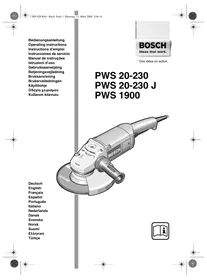

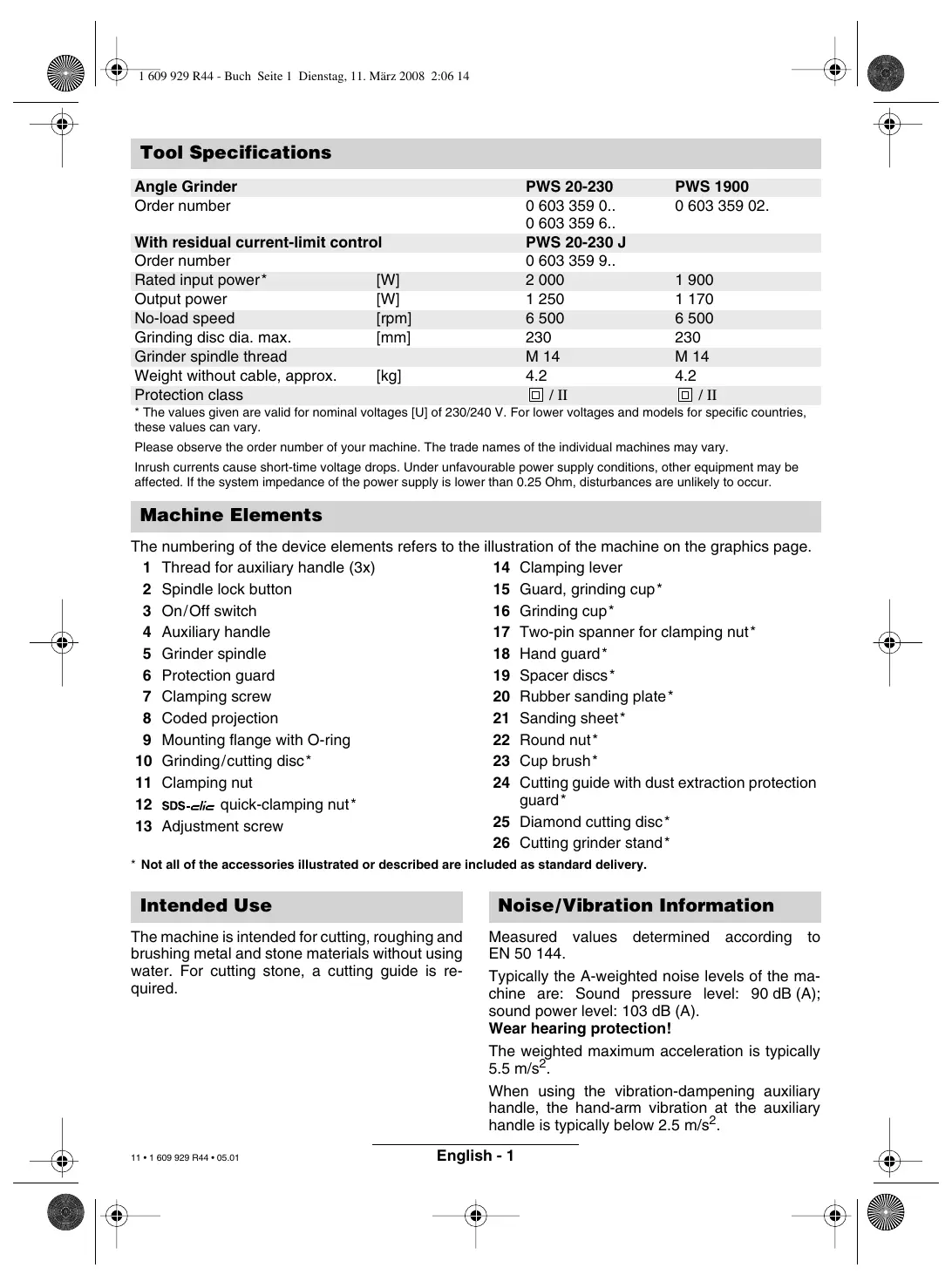


| Product type | Angle grinder |
| Brand | Bosch |
| Model | PWS20-230 |
| Rated power input | 2000 W |
| Output power | 1250 W |
| No-load speed | 6500 rpm |
| Max. wheel diameter | 230 mm |
| Spindle thread | M14 |
| Weight (without cable) | 4.2 kg |
| Protection class | II |
| Power supply | 230 V |
| Protective guard included | Yes, with clamping screw or quick-lock |
| Auxiliary handle | Yes, vibration-damping |
| Spindle lock | Yes, lock button |
| Switch | On/Off with lock-on possibility |
| Main functions | Cutting, grinding, brushing (metal and stone) |
| Recommended use | Dry cutting, dry sanding |
| Maintenance and cleaning | Regularly clean the cooling vents; dust inside if necessary |
| Safety | Wear safety glasses, hearing protection, gloves; use residual current device |
| Spare parts | Bosch original accessories available (guards, handles, grinding wheels, etc.) |
| Repairability | Bosch after-sales service; repair by authorized service centers |
| General information | Instructions available in several languages; manufacturing date not specified |
Frequently Asked Questions - PWS20-230 BOSCH
User questions about PWS20-230 BOSCH
0 question about this device. Answer the ones you know or ask your own.
Ask a new question about this device
Download the instructions for your Angle grinder in PDF format for free! Find your manual PWS20-230 - BOSCH and take your electronic device back in hand. On this page are published all the documents necessary for the use of your device. PWS20-230 by BOSCH.
USER MANUAL PWS20-230 BOSCH
Operating instructions
Senior Vice President
Engineering
Dr. Eckerhard Strötgen
Head of Product
Certification
- The values given are valid for nominal voltages [U] of 230/240 V. For lower voltages and models for specific countries, these values can vary. Please observe the order number of your machine. The trade names of the individual machines may vary.
Inrush currents cause short-time voltage drops. Under unfavourable power supply conditions, other equipment may be affected. If the system impedance of the power supply is lower than 0.25 Ohm, disturbances are unlikely to occur.
Machine Elements
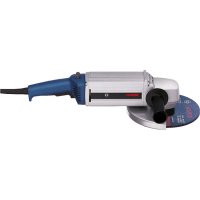
The numbering of the device elements refers to the illustration of the machine on the graphics page.
1 Thread for auxiliary handle (3x)
14 Clamping lever
2 Spindle lock button
15 Guard, grinding cup*
3 On/Off switch
16 Grinding cup*
4 Auxiliary handle
17 Two-pin spanner for clamping nut*
5 Grinder spindle
18 Hand guard*
6 Protection guard
19 Spacer discs*
7 Clamping screw
20 Rubber sanding plate*
8 Coded projection
21 Sanding sheet*
9 Mounting flange with O-ring
22 Round nut*
10 Grinding/cutting disc*
23 Cup brush*
11 Clamping nut
24 Cutting guide with dust extraction protection guard*
12 SDS-clip quick-clamping nut*
25 Diamond cutting disc*
13 Adjustment screw
26 Cutting grinder stand*
- Not all of the accessories illustrated or described are included as standard delivery.
Intended Use
The machine is intended for cutting, roughing and brushing metal and stone materials without using water. For cutting stone, a cutting guide is required.
Noise/Vibration Information
Measured values determined according to EN 50 144.
Typically the A-weighted noise levels of the machine are: Sound pressure level: 90 dB (A); sound power level: 103 dB (A).
Wear hearing protection!
The weighted maximum acceleration is typically 5.5m / s2
When using the vibration-dampening auxiliary handle, the hand-arm vibration at the auxiliary handle is typically below 2.5m / s2


For Your Safety

Working safely with this machine is possible only when the operating and safety information are read completely and the instructions contained therein are strictly followed. In addition, the
general safety notes in the enclosed booklet must be observed. Before using for the first time, ask for a practical demonstration.
Wear protective glasses and hearing protection. Wear additional protection equipment for your safety, such as protective gloves, sturdy shoes, hard hat and apron. The dust that is produced while working can be detrimental to health, inflammable or explosive. Suitable safety measures are required. Examples: Some dusts are regarded as carcinogenic. Use suitable dust/chip extraction and wear a dust respirator. Dust from light alloys can burn or explode. Always keep the workplace clean, as blends of materials are particularly dangerous. If the mains cable is damaged or cut through while working, do not touch the cable but immediately pull the mains plug. Never use the machine with a damaged cable. Connect machines that are used in the open via a residual current device (RCD) with an actuating current of 30 mA maximum. Do not operate the machine in rain or moisture. ■ When working with the machine, always hold it firmly with both hands and provide for a secure stance. - Secure the workpiece. A workpiece clamped with clamping devices or in a vice is held more secure than by hand. Always direct the cable to the rear away from the machine. Always switch the machine off and wait until it has come to a standstill before placing it down. For power outage or when the mains plug is pulled, unlock the On/Off switch immediately and turn it to the off position. This prevents uncontrolled restarting.
The machine must be used only for dry cutting/grinding. For all work with the machine, the auxiliary handle must be mounted. Hold the power tool only by the insulated gripping surfaces, when performing an operation where the cutting tool may run into hidden wiring or its own cord.
Contact with a "live" wire will make exposed metal parts of the tool "live" and shock the operator.
Use appropriate detectors to determine if utility lines are hidden in the work area or call the local utility company for assistance. Contact with electric lines can lead to fire and electric shock. Damaging a gas line can lead to explosion. Penetrating a water line causes property damage or may cause an electric shock. For work with grinding or cutting discs, the protection guard 6 must be mounted. For work with the rubber sanding plate 20 or with the cup brush 23/disc brush/flap disc, the hand guard 18 (accessory) is to be mounted. Use dust extraction when working with stone. The vacuum cleaner must be approved for masonry dust. When cutting stone, use the cutting guide. - Do not work with materials containing asbestos. Use only grinding tools with a permissible speed at least as high as the no-load speed of the machine. Check grinding tools before use. The grinding tool must be properly mounted and turn freely. Perform a test run for at least 30 seconds without load. Do not use damaged, out-of-round or vibrating grinding tools. - Protect the grinding tool from impact, shock and grease. Apply the machine to the workpiece only when switched on. - Keep hands away from rotating grinding tools. Pay attention to the direction of rotation. Always hold the machine so that sparks and grinding dust fly away from the body.

- When grinding metal, flying sparks are produced. Take care that no persons are endangered. Due to danger of fire, no combustible materials should be located in the vicinity (spark flight zone). ■ Be careful when cutting grooves, e.g. in structural walls: See Information on Structures.
- Blocking the cutting disc leads to jerking reaction forces on the machine. In this case switch off the machine immediately. Pay attention to the dimensions of the grinding disc. The mounting hole diameter must fit the mounting flange 9 without play. Do not use reducers or adapters.
- Never use cutting discs for rough grinding. Do not exert any lateral pressure on the cutting discs. Observe the manufacturer's instructions for mounting and using grinding tools. Caution! The grinding tool runs on after the machine is switched off. Do not clamp the machine in a vice. ■ Never allow children to use the machine. Bosch is only able to ensure perfect operation of the machine if the original accessories intended for it are used.
Information on Structures
Slots in structural walls are subject to the Standard DIN 1053, Part 1 or country-specific regulations.
These regulations are to be observed under all circumstances. Before beginning work, consult the responsible structural engineer, architects or the construction supervisor.

Mounting the Protective Devices
Before any work on the machine itself, pull the mains plug. For work with grinding or cutting discs, the protection guard 6 must be mounted.
Protection Guard with Locking Screw
The coded projection 8 on the protection guard 6 ensures that only a guard that fits the machine type can be mounted.
Loosen the clamping screw 7, if necessary.
Place the protection guard 6 with coded projection 8 into the coded groove on the spindle collar of the machine head and rotate to the required position (working position).
The closed side of the protection guard 6 must always point to the operator.
Tighten clamping screw 7.
Protection Guard with Quick Clamp
The protection guard is preadjusted to the diameter of the spindle collar. If required, the tightening tension of the clamping bracket can be changed by tightening or loosening the adjustment screw 13. Always ensure that the protection guard 6 is seated tightly on the spindle collar.
Open the clamping lever 14.
Place the protection guard 6 with coded projection 8 into the coded groove on the spindle collar of the machine head and rotate to the required position (working position).
To fasten the protection guard 6, close the clamping lever 14.
The closed side of the protection guard 6 must always point to the operator.
Auxiliary Handle
For all work with the machine, the auxiliary handle must be mounted.
Screw the auxiliary handle 4 into the head of the machine according to the working method.
Vibration-dampening Auxiliary Handle
VIBRATION CONTROL
The vibration-dampening auxiliary handle reduces vibrations, making operation more comfortable and secure.
Do not make any alterations to the auxiliary handle.
Do not continue to use an auxiliary handle if it is damaged.
Hand Guard
For work with the rubber sanding plate 20 or with the cup brush 23/disc brush/flap disc, the hand guard 18 (accessory) is to be mounted. The hand guard 18 is fastened with the auxiliary handle 4.

Mounting the Grinding Tools
Before any work on the machine itself, pull the mains plug.

Use only grinding tools with a permissible speed at least as high as the no-load speed of the machine.
Grinding and cutting discs become very hot while working; do not touch until they have cooled.
Clean the grinder spindle and all parts to be mounted. For clamping and loosening the grinding tools, lock the grinder spindle 5 with the spindle lock button 2.
Actuate the spindle lock button 2 only when the grinder spindle is at a standstill!
Grinding/Cutting Disc
Pay attention to the dimensions of the grinding disc. The mounting hole diameter must fit the mounting flange 9 without play. Do not use reducers or adapters.
When using a diamond cutting disc, take care that the direction-of-rotation arrow on the diamond cutting disc and the direction of rotation of the machine (direction-of-rotation arrow on the machine head) agree.
For mounting, see the illustration page.
Screw on the clamping nut 11 and tighten with the two-pin spanner (see Section "Quick Clamping Nut").
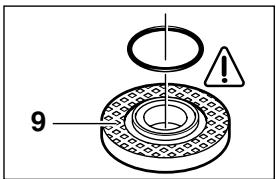
An O-ring (plastic part) is inserted in the mounting flange 9 around the spigot.
If the O-ring is missing or is damaged, it must in all cases be replaced (Order No. 1600 210 039) before the mounting flange 9 is mounted.

After mounting the grinding tool and before switching on, check that the grinding tool is correctly mounted and that it can turn freely.
Flap Disc
Depending on the application, remove the protection guard 6 and mount the hand guard 18. Place the special mounting flange 9 (accessory, Order No. 2605703028) and the flap disc on the grinder spindle 5. Screw on the clamping nut 11 and tighten with the two-pin spanner.
Rubber Sanding Plate 20
Depending on the application, remove the protection guard 6 and mount the hand guard 18.
Before mounting the rubber sanding pad 20, place the 2 spacers 19 onto the grinding spindle.
For mounting, see the illustration page.
Screw on the round nut 22 and tighten with the two-pin spanner.
Cup Brush 23/Disc Brush
Depending on the application, remove the protection guard 6 and mount the hand guard 18.
The grinding tool must be able to be screwed onto the grinding spindle 5 until it rests firmly against the grinder spindle flange at the end of the grinder spindle threads. Tighten with an open-end spanner.
Grinding Cup

When working with grinding cups, use the special guard 15.
The grinding cup 16 should always protrude from the guard 15 only as far as absolutely necessary for the work to be performed in each case.
Adjust the guard 15 to this distance.
For mounting, see the illustration page.
Screw on the clamping nut 11 and tighten with the fitting offset two-pin spanner 17.


Quick Clamping Nut SDS-c/ijc
Instead of the clamping nut 11, the quick-clamping nut 12 (accessory) can be used. Grinding tools can then be mounted without using tools.
The quick-clamping nut 12 may be used only for grinding and cutting discs.
Use only a flawless, undamaged quick-clamping nut 12.
When screwing on, take care that the side with printing does not point to the grinding disc. The arrow must point to the index mark 27.
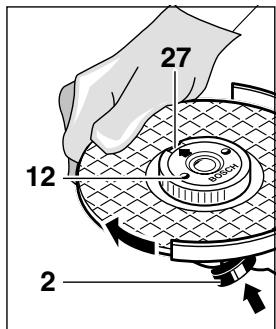
Lock the grinder spindle with the spindle lock button 2. Tighten the quick-clamping nut by forcefully turning the grinding disc in the clockwise direction.
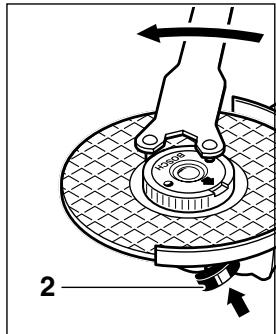
A properly tightened undamaged, quick-clamping nut can be loosened by hand turning the knurled ring in anticlockwise direction.
Never loosen a tight quick-clamping nut with pliers but use a two-pin spanner. Insert the two-pin spanner as shown in the illustration.
Approved Grinding Tools
All grinding tools mentioned in this operating manual instruction can be used.
The permissible speed [rpm] or the circumferential speed [m/s] of the grinding tools used must at least match the values given in the table.
Therefore, always observe the permissible rotational/circumferential speed on the label of the grinding tool.
| max. [mm] | [mm] d | [rpm] | [m/s] | ||
| D | b | ||||
| b D | 230 | 8 | 22.2 | 6 500 | 80 |
| D | 230 | - | - | 6 500 | 80 |
| b D | 100 | 30 | M 14 | 6 500 | 35 |
Starting Operation
Observe correct mains voltage: The voltage of the power source must agree with the voltage specified on the nameplate of the machine. Equipment marked with 230 V can also be connected to 220 V.
Switching On and Off
To start the machine, press the On/Off switch 3 forward and then down.
To lock-on, push the pressed On/Off switch 3 further forwards.
To switch off the machine, release the On/Off switch 3 or push and release it then.
Switch version without lock
(country-specific):
To start the machine, press the On/Off switch 3 forward and then down.
To switch off the machine, release the On/Off switch 3.


Test run!
Check the grinding tool before use. The grinding tool must be properly mounted and rotate freely. Perform a test run of at least 30 seconds without load. Do not use damaged, out-of-round or vibrating grinding tools.

Reduced Starting Current (PWS 20-230 J)
As a result of soft starting, a 13 A fuse is adequate.

A machine without reduced starting current requires higher fuse protection (use at least a 13 A time-delay fuse).
Operating Instructions
- Clamp the workpiece if it does not remain stationary due to its own weight.
- Do not strain the machine so heavily that it comes to a standstill. Grinding and cutting discs become very hot while working; do not touch until they have cooled.
Rough Grinding

The best roughing results are achieved when setting the machine at an angle of 30° to 40°. Move the machine back and forth with moderate pressure. In this manner, the workpiece will not become too hot, does not discolour and no grooves are formed.

Never use a cutting disc for roughing.
Flap Disc
With the flap disc (accessory), curved surfaces and profiles (contour sanding) can be worked.
Flap discs have a considerably higher service life than sanding sheets, lower noise level and lower sanding temperatures.
Cutting
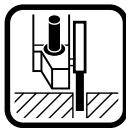
When cutting, do not press, jam or oscillate the machine. Work with moderate feed, adapted to the material being machined.
Do not reduce the speed of running down cutting discs by applying sideward pressure.
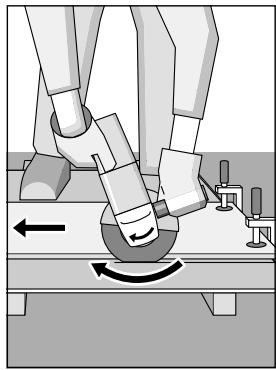
The direction in which the cutting is performed is important.
The machine must always work in an up-grinding motion. Therefore, never move the machine in the other direction! Otherwise, there is a risk of it being pushed uncontrollably out of the cut.
Grinder Stand
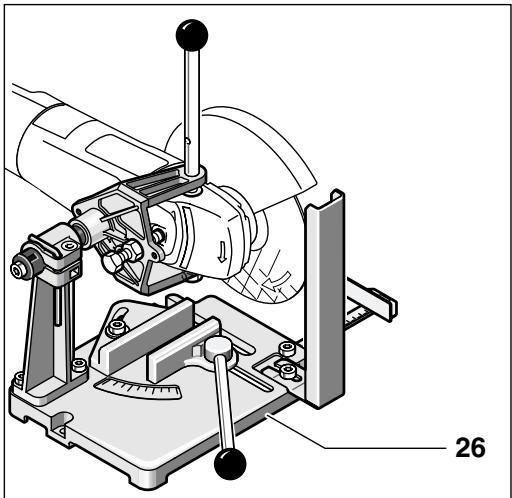
With the grinder stand 26 (accessory), workpieces can be cut at angles of 0 to 45 degrees at the same lengths.
The safety notes and operating instructions in the respective operating instructions manual of the angle grinder are to be strictly observed. Use only original Bosch grinder stands.


Cutting Stone
The machine must be used only for dry cutting/grinding.


It is best to use a diamond cutting disc. As a safety measure against jamming, use the cutting guide 24 with the special dust extraction protection guard.
Operate the machine with dust extraction only. In addition, wear a dust mask.
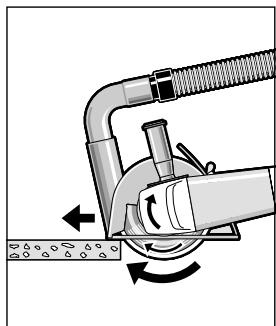
The vacuum cleaner must be approved for the extraction of masonry dust.
Bosch provides suitable vacuum cleaners.
Switch on the machine and place the front part of the cutting guide on the workpiece.
Slide the machine with moderate feed, adapted to the material to be worked (Figure).
For cutting especially hard material, e.g., concrete with high pebble content, the diamond cutting disc can overheat and become damaged as a result. This is clearly indicated by circular sparking, rotating with the diamond cutting disc.
In this case, interrupt the cutting process and allow the diamond cutting disc to cool by running freely at no-load speed for a short time.
Noticeable decreasing work progress and circular sparking are indications of a diamond cutting disc that has become dull. Briefly cutting into abrasive material (e.g., lime-sand brick) can sharpen the disc.
Rotating the Machine Head
Before any work on the machine itself, pull the mains plug.
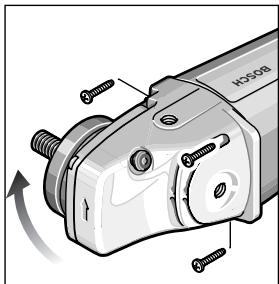
The machine head can be rotated with respect to the machine housing in 90° steps. In this manner, the On/Off switch can be brought to an advantageous handling position for special working situations, e.g., for cutting work
with the cutting guide 24/cutting grinder stand 26 (accessory) or for left-handed persons.
Unscrew completely the four screws.
Rotate the machine head carefully and without removing from the housing to the new position.
Screw in the screws again and tighten.
Maintenance and Cleaning
Before any work on the machine itself, pull the mains plug.
For safe and proper working, always keep the machine and the ventilation slots clean.
In extreme working conditions, conductive dust can accumulate in the interior of the machine when working with metal. The protective insulation of the machine can be degraded. The use of a stationary extraction system is recommended in such cases as well as frequently blowing out the ventilation slots and installing a residual current device (RCD).
If the machine should fail despite the care taken in manufacturing and testing procedures, repair should be carried out by an after-sales service centre for Bosch power tools.
In all correspondence and spare parts orders, please always include the 10-digit order number given on the nameplate of the machine.

WARNING! Important instructions for connecting a new 3-pin plug to the 2-wire cable.
The wires in the cable are coloured according to the following code:

Do not connect the blue or brown wire to the earth terminal of the plug.
Important: If for any reason the moulded plug is removed from the cable of this machine, it must be disposed of safely.
Environmental Protection

Recycle raw materials instead of disposing as waste.
The machine, accessories and packaging should be sorted for environmental-friendly recycling.
These instructions are printed on recycled paper manufactured without chlorine.
The plastic components are labelled for categorized recycling.
Service and Customer Assistance
Exploded views and information on spare parts can be found under: www.bosch-pt.com
Great Britain
Robert Bosch Ltd. (B.S.C.)
P.O. Box 98
Broadwater Park
North Orbital Road
Denham-Uxbridge
Middlesex UB9 5HJ
Service +44 (0) 18 95 / 83 87 82 Advice line +44 (0) 1895/838791 Fax. +44 (0) 18 95 / 83 87 89
Ireland
Beaver Distribution Ltd.
Greenhills Road
Tallaght-Dublin 24
Service +353 (0)1 / 414 9400
Fax. +353 (0)1 / 459 8030
Australia
Robert Bosch Australia Ltd.
RBAU/SPT2
1555 Centre Road
P.O. Box 66 Clayton
3168 Clayton/Victoria
+61 (0)1 / 800 804 777
Fax: +61 (0)1 / 800 819 520
www.bosch.com.au
E-Mail: CustomerSupportSPT@au.bosch.com
New Zealand
Robert Bosch Limited
14-16 Constellation Drive
Mairangi Bay
Auckland
New Zealand
C Declaration of Conformity
We declare under our sole responsibility that this product is in conformity with the following standards or standardization documents: EN 50 144 according to the provisions of the directives 89/336/EEC, 98/37/EC.
Dr. Egbert Schneider Dr. Eckerhard Strötgen
Senior Vice President Head of Product
Engineering Certification
Subject to change without notice

\section*{Technical specifications}
Robert Bosch France S.A.
After-sales service / Power tools
Senior Vice President
Engineering
Dr. Eckerhard Strötgen
Head of Product
Certification

- MACHINE ELEMENTS
- INTENDED USE
- NOISE/VIBRATION INFORMATION
- FOR YOUR SAFETY
- INFORMATION ON STRUCTURES
- MOUNTING THE PROTECTIVE DEVICES
- PROTECTION GUARD WITH LOCKING SCREW
- PROTECTION GUARD WITH QUICK CLAMP
- AUXILIARY HANDLE
- VIBRATION-DAMPENING AUXILIARY HANDLE
- VIBRATION CONTROL
- HAND GUARD
- MOUNTING THE GRINDING TOOLS
- GRINDING/CUTTING DISC
- FOR MOUNTING, SEE THE ILLUSTRATION PAGE
- FLAP DISC
- RUBBER SANDING PLATE
- CUP BRUSH 23/DISC BRUSH
- GRINDING CUP
- QUICK CLAMPING NUT SDS-C/IJC
- APPROVED GRINDING TOOLS
- STARTING OPERATION
- SWITCHING ON AND OFF
- SWITCH VERSION WITHOUT LOCK
- (COUNTRY-SPECIFIC)
- TEST RUN
- REDUCED STARTING CURRENT (PWS 20-230 J)
- OPERATING INSTRUCTIONS
- ROUGH GRINDING
- CUTTING
- GRINDER STAND
- CUTTING STONE
- ROTATING THE MACHINE HEAD
- MAINTENANCE AND CLEANING
- WARNING! IMPORTANT INSTRUCTIONS FOR CONNECTING A NEW 3-PIN PLUG TO THE 2-WIRE CABLE
- ENVIRONMENTAL PROTECTION
- RECYCLE RAW MATERIALS INSTEAD OF DISPOSING AS WASTE
- SERVICE AND CUSTOMER ASSISTANCE
- EXPLODED VIEWS AND INFORMATION ON SPARE PARTS CAN BE FOUND UNDER: WWW.BOSCH-PT.COM
- GREAT BRITAIN
- IRELAND
- AUSTRALIA
- NEW ZEALAND
- C DECLARATION OF CONFORMITY
Brand : BOSCH
Model : PWS20-230
Category : Angle grinder