
BM3990 - Kitchen appliance SEVERIN - Free user manual and instructions
Find the device manual for free BM3990 SEVERIN in PDF.


| Product type | Bread machine |
| Brand | SEVERIN |
| Model | BM3990 |
| Dimensions (W x D x H) | 420 mm x 280 mm x 305 mm |
| Weight | 5.7 kg |
| Power supply | 230 V ~ 50 Hz, 600 W |
| Maximum flour capacity | 550 g for a 900 g loaf |
| Number of programs | 12 automatic programs (Normal, White bread, Whole wheat, Biscuits, Cakes, Quick programs, Dough, Jam, Bake, etc.) |
| Delay timer | Up to 13 hours |
| Browning control | 3 levels (Light, Medium, Dark) for programs 1 to 7 |
| Keep warm function | Up to 60 minutes after baking |
| Pan material | Non-stick coating |
| Safety | Key lock during operation, automatic shutdown at program end, overheating protection |
| Included accessories | Measuring cup, measuring spoon, kneading hook removal tool |
| Cleaning | Pan and hook hand washable in warm soapy water; do not immerse appliance, do not wash in dishwasher |
| Repairability | Repairs exclusively by SEVERIN authorized service center |
| Warranty | 2 years against material and manufacturing defects |
| Intended use | Domestic, for preparing breads, doughs, jams and cakes |
Frequently Asked Questions - BM3990 SEVERIN
User questions about BM3990 SEVERIN
0 question about this device. Answer the ones you know or ask your own.
Ask a new question about this device
Download the instructions for your Kitchen appliance in PDF format for free! Find your manual BM3990 - SEVERIN and take your electronic device back in hand. On this page are published all the documents necessary for the use of your device. BM3990 by SEVERIN.
USER MANUAL BM3990 SEVERIN
Before using the appliance, please read the following instructions carefully and keep this manual for future reference. The appliance must only be used by persons familiar with these instructions.
IMPORTANT SAFETY INSTRUCTIONS
- In order to avoid hazards, repairs to this electrical appliance or its power cord must be carried out by our customer service. If repairs are needed, please send the appliance to our customer service department (see appendix).
- Before cleaning the appliance, ensure it is disconnected from the power supply and has cooled down completely.
- To avoid the risk of electric shock, do not clean the appliance with water and do not immerse it in water.
- Always clean the appliance after use. For detailed information, please refer to the section Cleaning and care.
- The appliance is not intended to be operated by means of an external timer or separate remote-control system
- Only recipes with a flour content of 200 - 550g should be used with this bread-maker. Use 112 teaspoons of yeast for wheat flour, and 2 teaspoons for rye flour.
Should the flour content fall short of this minimum, thorough kneading of the dough cannot be ensured. Excessive flour content may result in the dough rising over the edge of the baking-tin.
-
This appliance is intended for domestic or similar applications, such as
-
in shops, offices and other similar working environments,
- in agricultural working environments,
- by customers in hotels, motels etc. and similar establishments,
-
in bed-and breakfast type environments.
-
This appliance may be used by children (at least 8 years of age) and by persons with reduced physical, sensory or mental capabilities, or lacking experience and knowledge, provided they have been given supervision or instruction concerning the use of the appliance and fully understand all dangers and safety precautions involved.
Children must not be permitted to play with the appliance. - Children must not be permitted to carry out any cleaning or maintenance work on the appliance unless they are supervised and at least 8 years of age.
- The appliance and its power cord must be kept well away from children under 8 at all times.
- Caution: Keep any packaging materials well away from children - such materials are a potential source of danger, e.g. of suffocation.
The surface of the housing and the steam vents heat up during operation. Do not touch any hot parts of the unit. Be sure to use an oven-cloth or suitable gloves when removing the bread. Make sure to touch only the lid handle when opening the unit. -
The bread-maker should only be connected to an earthed socket installed in accordance with the regulations. Make sure that the supply voltage corresponds with the voltage marked on the rating label.
Always remove the plug from the wall socket after use, and also -
in case of any malfunction during use,
- when removing the baking-tin,
-
during cleaning of the appliance.
-
When removing the plug from the wall socket, never pull on the power cord; always grasp the plug itself. Do not let the power cord hang free; keep it well away from any hot parts of the appliance.
- Every time the appliance is used, the main body including the power cord as well as any attachment fitted should be checked thoroughly for any defects. Should the appliance, for instance, have been dropped onto a hard surface, or if excessive force has been used to pull the power cord, it must no longer be used: even invisible damage may have adverse effects on the operational safety of the appliance.
- Ensure a minimum distance of 5cm to walls or other objects. Do not position or operate the appliance close to or underneath any hanging objects such as curtains or other inflammable materials, and do not position any objects on top of the appliance while it is in use.
Always place the unit on a level, heat-resistant work surface. Do not allow the appliance or its power cord to touch hot surfaces or come into contact with any heat sources (e.g. oven-plates or open flames). - Do not operate the appliance unless the baking-tin with the ingredients has been placed inside the unit.
- Do not expose the appliance to rain or moisture and do not operate the appliance outdoors or on wet surfaces. Always ensure that it is well protected from water splashes.
- Caution: do not cover the bread with aluminium foil or similar items during the baking process; the resulting build-up of heat could seriously damage the unit.
- Do not use this appliance for any purpose other than the one described in this manual.
The use of any accessories other than those provided by the manufacturer may result in damage to the appliance; there is also a possibility of severe personal injury. - Do not touch any moving parts during operation. Do not put your fingers or hands inside the unit, unless it is disconnected from the mains supply and has cooled down completely.
Additional important instructions
Always use an oven-cloth or suitable gloves when touching the unit after use, or when handling freshly baked bread.
In case of a power failure of less than 5 minutes during operation, the baking process automatically continues at the point of interruption.
During the kneading process, water vapour may condense on the viewing window. However, this condensation will disappear
during the baking phase.
To ensure evenly baked bread, do not open the lid during the baking process.
After use, allow sufficient time for the bread-maker and the baking-tin to cool down before cleaning them thoroughly.
- The baking-tin and the kneading hook have a non-stick coating. In order to prevent damage, do not use any metallic, hard, sharp or pointed objects on the coating.
- Caution: Operating the bread-maker empty could result in damage to the unit by overheating of the empty baking-tin.
Caution
- In the event of any smoke coming from the baking compartment, be sure to keep the door firmly closed, but immediately remove the plug from the wall socket. Do not, under any circumstances, try to smother or extinguish smouldering dough with water. Dough may catch fire if it is allowed to rise over the edge of the baking-tin and touch the heating element. It is therefore important to follow the quantity limits given in the recipes.
Do not touch the steam vents at the rear of the lid, nor the viewing window in the lid: these parts heat up during operation.
YOUR BREAD-MAKER
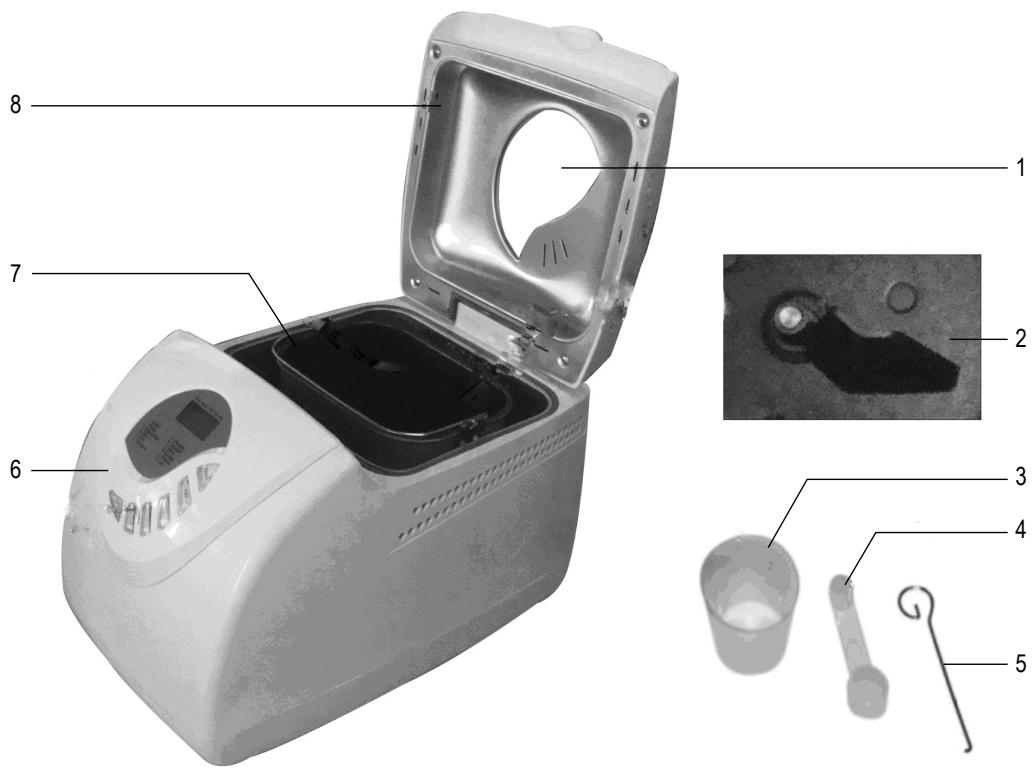
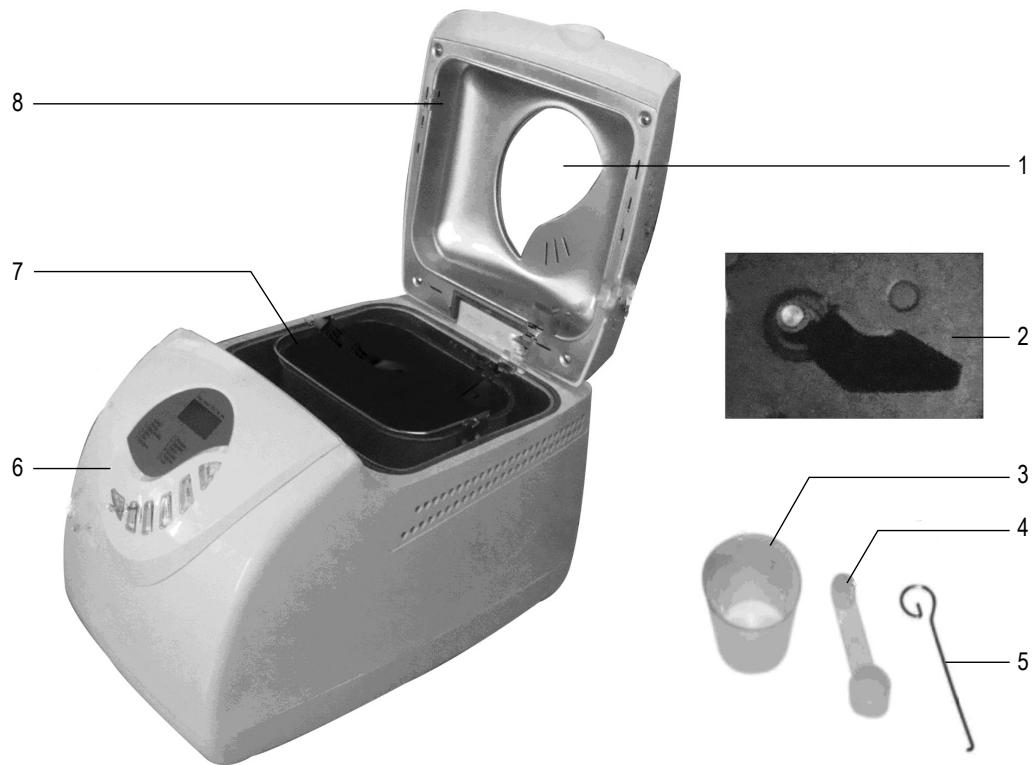
| 1. | Viewing window | 5. | Kneading hook extractor |
| 2. | Kneading hook | 6. | Control panel with display |
| 3. | Measuring cup | 7. | Bread baking-tin |
| 4. | Measuring spoon | 8. | Lid |
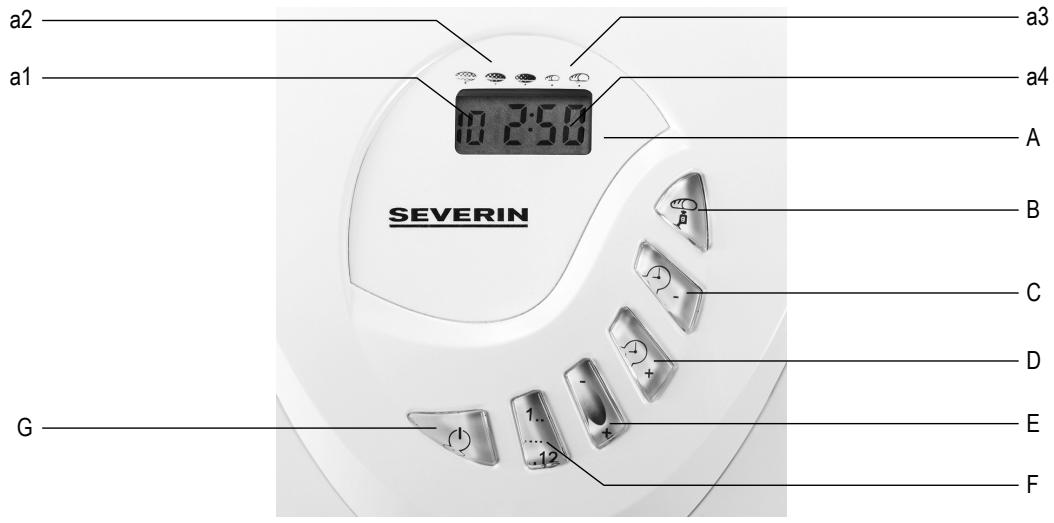
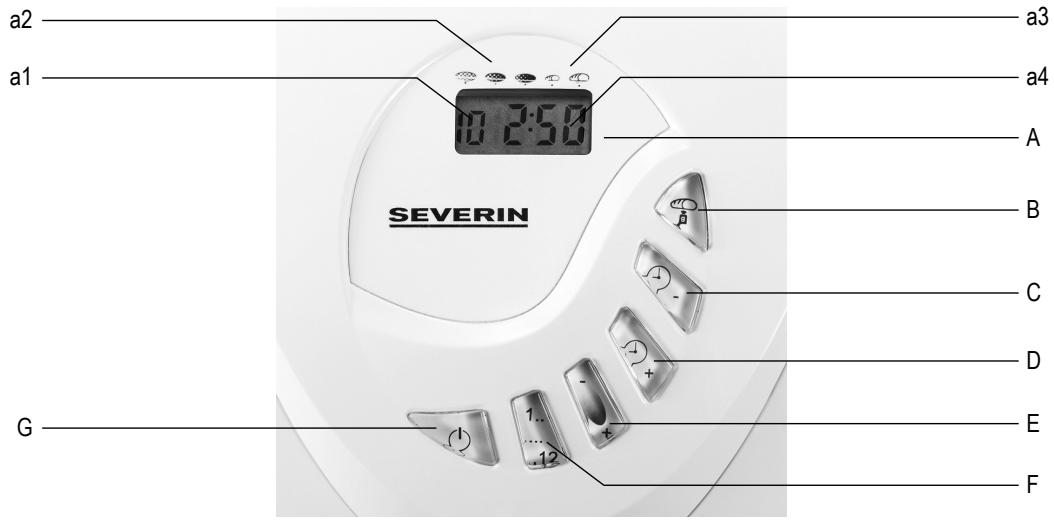
| A | Display | B | Bread weight |
| a1 | Display - programme | C | Timer - minus |
| a2 | Display - browning level | D | Timer - plus |
| a3 | Display - weight | E | Browning control |
| a4 | Display - running time | F | Programme 1............12 |
| G | Start / Stop |
CONTROL PANEL
A Display
The display shows the programme selected, level of browning, weight and remaining running time. An active programme is indicated by the continuously flashing colon in the time display.
B Loaf weight
Baking programmes 1, 2, 3, 5 and 11 allow for pre-selection of the loaf size. The selected weight is indicated in the form of an arrowhead symbol beneath the corresponding bread symbol on the display.
C/D Timer - minus 12 Timer - plus
Programmes 1, 2, 3, 4, 5, 8, 10, 11 and 12 may be started with a delayed timer setting, enabling the selected programme to finish up to 13:00 hours later.
Example:
You want to start the programme at 20:00, and you would like your bread to be finished at 7:30 the next morning. Accordingly, the total programme running time will be 11 hours and 30 minutes.
- Use the 1............12 button to select the desired programme.
- Press the appropriate timer button 12 or 14 until the display shows a total running time of 11:30.
- Add the ingredients following the instructions given in the section Operation. Avoid any contact between the yeast and fluids or salt.
- Do not use the timer function where a recipe requires the use of perishable ingredients such as eggs, fresh milk or fruit. The timer function is also unsuitable for recipes which require the addition of any ingredients (e.g. nuts, grains or dried fruits) during the kneading or rising phase.
E Browning
Baking programmes 1-7 allow for a pre-selection of the desired level of browning: three settings are available. The level of browning selected is indicated by an arrowhead in the upper part of the display.
LIGHT
MEDIUM
DARK

F Programme 1....12
Press the 1............12- button to select the desired programme.
The programme code appears in the display.
G Button
This button starts the selected programme.
A beep signal is heard, and the colon in the time display starts flashing.
To end the programme, keep the button pressed for 3 seconds. This is acknowledged by a beep signal.
Protection against wrong input:
Once a programme has been started, all other control buttons will remain blocked until the baking process has finished, or until the button has been pressed for a minimum of 3 seconds.
PROGRAMME FUNCTIONS
The menu allows for the selection of 12 different programmes:
1 = STANDARD
This programme is used most frequently and suitable for breads with a high content of wheat flour.
2 = WHITE BREAD/FRENCH BREAD
Suitable for typical light dough White bread/French bread.
3 = WHOLEMEAL
As opposed to the STANDARD setting, this programme has extended rising and baking phases, since the dough for bread with a high rye or wholemeal flour content tends to rise less strongly than dough containing wheat flour.
4 BISCUITS, PASTRY
Suitable for preparing biscuits, when using baking powder instead of yeast.
5 CAKES WITH YEAST
Because of its relatively high sugar content, sweet yeast dough tends to brown more quickly; in this programme, the baking phase is therefore shorter.
6 SHORT PROGRAMME, 700g
Suitable for recipes up to 700g; the loaves will also turn out smaller and firmer than usual.
7 = SHORT PROGRAMME, 1000g
Suitable for recipes up to 1000g; the loaves will also turn out smaller and firmer than usual.
8 = DOUGH
This programme does not include a baking phase. After the programme has finished, the dough (e.g. pizza dough) can be removed and then baked in a conventional oven.
9 = JAM, MARMALADE
Suitable for preparing jam, marmalade. During preparation, make sure the baking-tin is only two thirds full of all the ingredients (approx. 1000g), since the mixture may tend to foam up.
10 = NORMAL CAKES
Suitable for cakes where baking powder is used instead of yeast.
11 = SANDWICH
Suitable for baking sandwich bread. The bread has a light structure and a thin crust.
12 BAKING
Suitable for baking dough (e.g. dough previously kneaded using the DOUGH programme). In this way, the rising phase can be modified according to the type of dough before the BAKING programme is started.
Short Programme 700g and 1000g:
These programmes are suitable for baking bread in a shorter period of time. With a shortened rising phase, the loaves will turn out slightly smaller and firmer than usual. Please keep in mind that warm water must be used. Best results are generally achieved with a water temperature of around 48 - 50^ . We recommend using a suitable food thermometer. With the temperature too low, the bread may not rise sufficiently strongly; too high a temperature will cause the yeast contained in the dough to rise too early, again leading to an unsatisfactory baking result.
In the programmes STANDARD, WHITE BREAD, WHOLEMEAL, CAKES WITH YEAST, CAKE and SANDWICH, you may add such ingredients as wheat germ, sunflower seeds, herbs, caraway seeds, ground pepper, ground nuts, muesli, hominy grits, finely cut bacon cubes etc. according to taste.
An acoustic signal indicates when the most suitable time for adding these ingredients has been reached. The table below shows the most suitable times as *
| Programme | 1 Standard | 2 White bread/ French bread | 3 Wholemeal | 4 Biscuits, pastry | 5 Cakes with yeast | 6 Short, 750 g | 7 Short, 900g | 8 Dough (900g) | 10 Normal cakes | 11 Sandwich | |
| \(1^{st}\ Kneading phase\) | 9 min. | 16 min. | 9 min. | 7 min. | 10 min. | 12 min. | 8 min. | 20 min. | 10 min. | 15 min. | |
| 10 min. | 18 min. | 10 min. | |||||||||
| \(1^{st}\ Rising phase\) | 20 min. • | 40 min. • | 25 min. | 5 min. | 5 min. | - | - | - | 5 min. | 40 min. | |
| \(2^{nd}\ Kneading phase\) | 14 min. | 19 min. | 18 min. • | 8 min. | 20 min. • | - | - | - | 20 min. • | 5 min. • | |
| 15 min. | 22 min. | 20 min. • | |||||||||
| \(2^{nd}\ Rising phase\) | 20 min. | 20 min. | 20 min. | - | 20 min. | - | - | 20 min. | 29 min. | 24 min. | |
| Short stirring phase (Knock back) | 30 sec. | 30 sec. | 30 sec. | - | 30 sec. | - | - | 30 sec. | 30 sec. | 30 sec. | |
| \(3^{rd}\ Rising phase\) | 4 min. | 9 min. | 14 min. | - | 9 min. | - | - | 9 min. | 30 sec. | 30 sec. | |
| 30 sec. | 30 sec. | 30 sec. | 30 sec. | 30 sec. | |||||||
| Last rising phase | 45 min. | 50 Min. | 70 min. | - | 55 min. | 11 min. | 9 min. | 40 min. | 35 min. | 40 min. | |
| 50 min. | |||||||||||
| Baking | 60 min. | 65 min. | 55 min. | 80 min. | 50 min. | 35 min. | 40 min. | - | 70 min. | 50 min. | |
| 65 min. | 70 min. | 60 min. | 60 min. | 55 min. | |||||||
| Programme running time | 2:53 | 3:40 | 3.32 | 1:40 | 2:50 | 0:58 | 0:58 | 1:30 | 2:50 | 2:55 | |
| 3:00 | 3:50 | 3:40 | 2:55 | 3:00 | |||||||
| Acoustic signal during programme | x | x | x | - | x | - | - | - | x | x | |
| Menu 9 JAM, MARMALADE | Pre-heating 15 min. | Heating and kneading phase 45 min. | Standing phase 20 min. | Total 1:20 | |||||||
| Menu 12 BAKING | Baking 60 min. | Total 1:00 | |||||||||
Important information
- If you observe flour residue on the walls of the baking-tin, open the lid during the kneading phase, and use a rubber scraper to move the flour back into the dough so that it can be properly processed.
Close the lid afterwards. - When using yeast, the kneading hook may be removed after the final kneading phase.
USING THE BREAD-MAKER
Your new bread-maker allows you to:
- bake breads to various recipes, some of which can be found in the appendix to this manual. However, this bread-maker also allows you to use commercially available ready-to-bake mixtures with up to 500g of solid ingredients (for a loaf of up to 1000g).
- knead dough for bread rolls, pizza etc., and let the dough rise.
BEFORE FIRST USE
- Remove any exterior and interior packaging materials. All these materials are suitable for recycling.
- Remove the baking-tin by turning it anti-clockwise.
Before the bread-maker is used for the first time, it should be thoroughly cleaned, as described in the section Cleaning and Care. - Fit the kneading hook into its socket inside the baking-tin and fill the tin with around 125ml of water.
- Replace the baking-tin in the unit and turn it clockwise to lock it. Make sure that it locks firmly into place.
- Insert the plug into a suitable wall socket.
- Use the 1............12 button to select programme 12 (BAKING).
- Press the () -button and let the unit heat up for approximately 10 minutes with the lid open. This will remove the smell typically encountered when first activating the heating elements. Ensure sufficient ventilation.
- Afterwards, press and hold the () -button for approx. 3 seconds to switch the bread-maker off (this is confirmed by an acoustic signal); now remove the plug from the wall socket and allow the appliance to cool down.
- Clean the unit again as described in the section Cleaning and Care.
OPERATION
- Open the lid, turn the baking-tin anti-clockwise and remove it.
- Fit the kneading hook into its socket inside the baking-tin.
- For best results, always put liquids in first, followed by solid ingredients such as flour.
- Finally, add the yeast. Be sure to avoid any contact between the yeast and salt or liquids when using the timer.
- Replace the baking-tin in the unit and turn it clockwise to lock it. Make sure that it locks firmly into place. Before starting the programme, close the lid, insert the plug into a suitable wall socket and switch the appliance on.
- Use the 1............12 button to select the desired baking programme.
Each time the button is pressed, the display changes to the next programme in the sequence. - Select the desired level of browning . (Only for programmes 1-7)
- Select the weight 13 . (Only for programmes 1, 2, 3, 5 and 11)
- Press the (1) button to start the kneading and/or baking process. (If you wish to start the programme with a timer delay, the total running time desired can now be set, using the appropriate timer button or ① .)
- During the kneading or rising phase in programmes 1, 2, 3, 5, 10 and 11, an acoustic signal indicates that additional ingredients such as fruits and nuts can be added to the dough, after which do not open the lid, but wait until the programme has finished.
- If you need to interrupt the programme during operation, press the button for approx. 3 seconds. The key input is confirmed by an acoustic signal.
- Once the bread or dough is ready, a multiple acoustic signal is heard and the time display shows 0:00. Press the (1) button for at least 3 seconds and open the lid.
- Carefully remove the baking-tin using oven cloths. Do not place the hot baking-tin on any heat-sensitive surfaces.
- Remove the bread from the baking-tin. To loosen the bread, it may be lightly shaken. Should the kneading hook be stuck in the bread, it should be carefully removed using the extractor tool supplied. To allow the underside of the loaf to cool down as well, it should be placed on a suitable wire rack. Do not attempt to cut the bread until it has cooled down.
- If the bread-maker is not switched off immediately after the programme running time has elapsed, the bread will be kept warm automatically for a period of 60 minutes.
The unit will then switch off automatically.
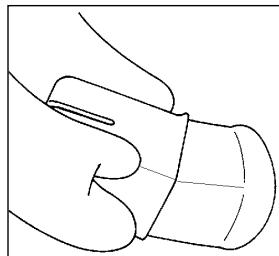
CLEANING AND CARE
- Caution: before cleaning the appliance, ensure that the plug has been removed from the wall socket, and that the appliance has cooled down. Never immerse the bread-maker in water.
- Turn the baking-tin anti-clockwise, lift it out and remove the kneading hook.
The baking-tin and the kneading hook may be cleaned using hot water and a mild detergent. Do not use any rough material for cleaning. If you are unable to separate the kneading hook from the baking tin using normal force, let it soak in lukewarm water for approximately 30 minutes. Do not use excessive force to remove the hook.
- To prevent damage to the drive-shaft seal, the baking-tin should not be left soaking for any extended period of time. Do not clean the baking-tin in a dish-washer.
- The inside of the lid may be cleaned with a slightly damp, soft cloth. The interior of the appliance must only be cleaned with a soft, dry cloth.
- Do not use cleaning agents specifically designed for ovens, and do not use any abrasives or harsh cleaning solutions, vinegar or bleaching agents for cleaning.
- Before storing the appliance, always ensure that it has cooled down and that it is completely dry.
TYPICAL PROBLEMS AND QUESTIONS
- The bread has a strong smell.
Check whether the correct amount of yeast was used. Too much yeast causes an unpleasant smell and makes the loaf rise too much. Always use fresh ingredients.
- The baked bread is wet and has a sticky surface.
Remove the bread from the appliance immediately after baking, and place it onto a wire rack, allowing it to cool down.
- Pressing the Start button fails to activate the selected programme.
Make sure that the unit is properly connected to the mains supply.
Should the appliance still be too hot after a previous work cycle, an automatic safety switch prevents the appliance from resuming operation. In that case, the LCD-display shows the letters H:HH, and a continuous acoustic signal is heard. Press the ① button for 3 seconds, and remove the baking-tin with the ingredients from the unit. Allow the bread-maker to cool down for about 20 minutes with the lid open before you attempt to start the programme again.
- After pressing the Start button, the message E:EE appears on the display.
This message indicates a temperature sensor malfunction. In such a case, the appliance must be checked by a qualified technician.
- The loaf has risen too high.
Reduce the amount of yeast, water or flour used.
- The loaf has not risen high enough.
Increase the amount of yeast, water or sweeteners. Ensure that the correct order is used when putting the ingredients into the baking-tin: first the liquid ingredients, followed by the solid ingredients, finally the yeast.
Note: bread made of rye or wholemeal flour tends to rise less strongly than bread made of wheat flour.
- After the baking phase has started, the dough collapses inwards.
The dough is too light. Slightly reduce the quantity of liquids or the amount of yeast, or use a programme with a shorter rising phase. You may also try increasing the amount of salt.
- The dough is too soft or too sticky.
The dough texture may become smoother if a spoonful of flour is added during kneading.
- The dough is very difficult to knead.
Add a spoonful of water during the kneading process.
RECIPES
White bread/French bread
Ingredients:
| Programme | 2 / White bread | ||
| Setting | |||
| water | 120 | 180 | ml |
| milk | 140 | 220 | ml |
| butter | 10 | 15 | g |
| salt | 1 1/2 | 2 | tsp. |
| sugar | 2 | 3 | tbs. |
| wheat flour, type 405 | 400 | 600 | g |
| dry yeast | 1 | 1 1/2 | tsp. |
| approx. yield | 650g | 1000g | |
Onion bread
Ingredients:
| Programme | 1 / Standard | ||
| Setting | |||
| water | 350 | 500 | ml |
| salt | 1 | 1 1/2 | tsp. |
| sugar | 1 | 1 | tsp. |
| wheat flour, type 1050 | 540 | 760 | g |
| fried onions | 75 | 100 | g |
| dry yeast | 1 1/2 | 2 | tsp. |
| approx. yield | 900g | 1300g | |
Raisin bread
Ingredients:
| Programme | 1 / Standard | ||
| Setting | |||
| water | 200 | 310 | ml |
| butter | 1 1/2 | 2 1/2 | tbs. |
| salt | 3/4 | 1 | tsp. |
| Honey | 2 | 3 | tbs. |
| wheat flour, type 405 | 420 | 650 | g |
| dry yeast | 1 1/2 | 2 | tsp. |
| raisins | 75 | 100 | g |
| approx. yield | 700g | 1100g | |
Wholemeal bread
Ingredients:
| Programme | 3 / Wholemeal bread | ||
| Setting | |||
| Water | 310 | 415 | ml |
| oil | 1 | 1 1/2 | tbs. |
| lemon juice | 1 | 1 1/2 | tbs. |
| rye wholemeal flour | 150 | 200 | g |
| wheat flour, type 1050 | 300 | 400 | g |
| sugar | 3 | 4 | tsp. |
| salt | 1 | 3 | tsp. |
| dry yeast | 2 | 3 | tsp. |
| oat meal | 4 | 6 | tsp. |
| approx. yield | 750 | 1000 | |
Wheat and rye bread
Ingredients:
| Programme | 1 / Basis | ||
| Setting | |||
| water | 220 | 350 | ml |
| natural plain yoghurt 3.5% fat content | 110 | 175 | ml |
| salt | 1 1/2 | 2 1/2 | tsp. |
| sugar | 1/4 | 3/4 | tsp. |
| wheat flour, type 550 | 230 | 350 | g |
| wheat flour, type 1150 | 230 | 350 | g |
| dry yeast | 1 1/4 | 2 | tsp. |
| approx. yield | 700g | 1150g | |
Pizza dough
Ingredients:
| Programme | 8 / Dough | ||
| Setting | |||
| water | 230 | ml | |
| olive oil | 3 | tbs. | |
| salt | 2 | tsp. | |
| sugar | 1 | tsp. | |
| wheat flour, type 550 | 400 | g | |
| dry yeast | 2 | tsp. | |
| approx. yield | 600g | ||
Tip:
Once the programme has finished, remove the dough from the baking-tin. Let the dough rise at room temperature for approximately 30 minutes.
Abbreviations:
tsp. = teaspoon (measuring spoon: 1 tsp.) = 5 ml
tbs. = tablespoon (measuring spoon: 1 tbs.) = 15 ml
g = gram
ml = millilitre
Commercially available ready-to-bake mixes
Various ready-to-bake mixes are to be found.
- Put up to 500g of the ready-to-bake mixture and the required amount of dry yeast into the baking-tin. Depending on the size of the mix, it may be that only half of the mix can be used at a time.
- Add the corresponding quantity of liquid.
Programme: STANDARD, WHITE BREAD or WHOLEMEAL, depending on the type of flour used.
Jam, marmalade
The basic recipe consists of finely cut or pureed fruit and gelatine sugar (e.g. '2:1'). Information about the correct proportions of fruit and gelatine sugar may be found on the sugar packaging.
- Wash the fruit and, if necessary, peel it.
- Weigh out about 900g of fruit, but always observe the overall quantity limits to prevent the mixture from foaming and spilling out. The fruit should be cut into small pieces (max. 1 cm) or pureed.
- Place the fruit and 500g gelatine sugar into the baking-tin. When making marmalade from berries, add 1 tbs. of lemon juice and blend in well.
- Start the JAM, MARMALADE programme.
- Carefully monitor the process. Use a rubber scraper to remove any sugar residue from the walls of the tin.
After the programme has finished, remove the plug from the wall socket, and carefully take out the baking-tin using an oven cloth.
Carefully transfer the jam or marmalade into prepared jars. Close the jars tightly afterwards, and allow them to cool down. - The baking-tin should be thoroughly rinsed immediately after use.
Additional recipe information
The bread-maker is designed to process recipes with a flour content of up to 550g. In order to prevent the dough rising over the edge of the baking-tin and to ensure that the dough is properly and thoroughly kneaded, do not exceed these limits.
All ingredients should be at normal room temperature.
Sugar assists the yeast as a rising agent, and tends to make the crust darker and thicker.
Salt gives a firmer texture to the dough and slows the rising process down.
When adding additional ingredients of a liquid nature to a recipe, make sure that the quantity of liquid given in the recipe is reduced accordingly. This applies, for instance, when eggs, fresh cheese or yoghurt are used.
The baking results depend on several factors such as air pressure, humidity, water hardness, room temperature or the temperature of the ingredients. If a recipe does not turn out to your taste right away, we recommend modifying the suggested recipes accordingly, as described in the section 'Typical problems'.
Special information for those with allergies
With this bread-maker you may also use flour mixtures specifically formulated for people allergic to grain. The loaves will turn out relatively firm even when higher quantities of yeast or baking powder are used.
However, in this case only the STANDARD programme should be used, choosing the darker browning setting. With this programme, the loaf turns out to have a stronger crust.
With gluten-free flour types, pre-programming is not recommended. Always start the programme immediately after the ingredients have been put in.
For gluten-free bread, commercially available ready-to-bake mixes are most suitable.
TECHNICAL SPECIFICATIONS
| Art.-Nr.: | BM 3990 |
| Operating voltage: | 230 V~, 50 Hz |
| Power consumption: | 600 W |
| Baking capacity: | max. 550g flour for a 900g loaf |
| Approximate dimensions: | 420 mm (L) x 280 mm (D) x 305 mm (H) |
| Weight: | 5.7 kg |
| Timer: | Pre-programmable up to 13 hours |
| Programme functions: | 12 |
| Accessories: | Measuring cup, measuring spoon, kneading hook extractor |
| This product complies with all binding CE labelling directives. | |

Disposal
Devices marked with this symbol must be disposed of separately from your household waste, as they contain valuable materials which can be recycled. Proper disposal protects the environment and human health. Your local authority or retailer can provide information on the matter.
GUARANTEE
This product is guaranteed against defects in materials and workmanship for a period of two years from the date of purchase. Under this guarantee the manufacturer undertakes to repair or replace any parts found to be defective, providing the product is returned to one of our authorised service centres. This guarantee is only valid if the appliance has been used in accordance with the instructions, and provided that it has not been modified, repaired or interfered with by any unauthorised person, or damaged through misuse.
This guarantee naturally does not cover wear and tear, nor breakables such as glass and ceramic items, bulbs etc. This guarantee does not affect your statutory rights, nor any legal rights you may have as a consumer under applicable national legislation governing the purchase of goods. If the product fails to operate and needs to be returned, pack it carefully, enclosing your name and address and the reason for return. If within the guarantee period, please also provide the guarantee card and proof of purchase.
Machine à pain
TABLE DES MATIÈRES
INTRODUCTION 25
CONSIGNES DE SECURITE IMPORTANTES 25
VOTRE MACHINE A PAIN 27
LE TABLEAU DE COMMANDE 28
LES PROGRAMMES 29
UTILISATION DE LA MACHINE A PAIN 31
AVANT LA PREMIÈRE MISE EN SERVICE 31
FONCTIONNEMENT 31
NETTOYAGE ET ENTRETIEN 32
PROBLEMES COURANTS ET QUESTIONS 32
RECETTES 33
FICHE TECHNIQUE 35
GARANTIE 35
INTRODUCTION
Chere cliente, Cher client,
VOTRE MACHINE A PAIN
5 = GATEAUX AVEC LEVURE
6 = PROGRAMME COURT, 700 g
7 = PROGRAMME COURT, 1000 g
10 = GATEAUX STANDARDS
Pain comple
Ingredients:
2 = WIT BROOD/FRANS BROOD
7 = KORT PROGRAMMA, 1000 g
TI = theelepel (maatlepel: 1 TI) = 5 ml
EI = eetlepel (maatlepel: 1 EI) = 15 ml
g = Gram
ml = Milliliter
6 PROGRAMMA BREV,700g.
7 = PROGRAMMA BREVE, 1000g.
6 = KORT PROGRAM, 700g
7 = KORT PROGRAM, 1000g
6 = KORT PROGRAM, 700 g
7 = KORT PROGRAM, 1000 g
Vitt brod/Baguette
Ingredienser:
Tsk = tesked (mattsked: 1 tsk) = 5 ml
Msk = matsked (mattsked: 1 msk) = 15 ml
g = gram
ml = milliliter
Fardiga brodmixprodukter
OHJELMOINTITOOMINNOT
10 = TAVALLISET KAKUT
6 PROGRAM KROTKI,700g
7 = PROGRAM KRÖTKI, 1000 g
IPIN ANO THN INPQTH XPHsH
ApaiaepoteKatheEgtwepikoai eouwepko uiko ouokueiaoc. Ola auta ta uikacivai kataaannla yia avakukawon.
- Iepiotpeyete n oporua ynojutao s apiotepoortpovia va va th byalte.
Piv xpiioiHOteTov apotapaaKuaaTHYia TTWt npa, 0aTe va tov kaopiaeTE kALa OTIWc TEPiypaFetai OTNV papyapo Evikos kaopiaoC kai PovtdA.
ToTnTeTne To zmuTnpa stny UTOdoxN tou moe aon fopma ynoiatoKai yeiote n opma e Tepitou 125ml vepo.
ToTOnoTeIneEaTnΦopma ynoiatoC Otn OuaKeun KAI TEPiOTpeYTE Tn 8eIoOtropa vla va aopaloei. BebaIWteTe oTI nΦopma ynoiatoC Exeia OxaAioe1 kala ot n Theon tns
Bálté to φiç tou ηεκτριού καλωδίου σε μia katαλληπ πίζα.
XpnoiotoinoTe to pIyKto 1.12vi va eTtaiEeTe to pIpya 12 (PHsIMO).
Piote To Iaiktopo (kai apnoote nouakeun vaoepuavthe iia 10 ppiou ae oavikto kattaki. Eoi, ta quyei n ouin Tou uvngho suvavntai otav evepyotioovtai ta eepuavtka stoiexia ia tpwn oppa. Povviote va utapx etrapkn6 Eaepioioc.
Katoiv, TIOTE TO TIAKTOPO 1YIA TEPIIOTU 3 DEUTEPOLETTA YIA VA ATVEVPEYOIOAETE TO VAPOTAPAOKEAOTA (ATO EITIEBAIWETAI ATO EVA NNTIKO OMA).Twpa BAYALETO NAKTPKO KAALWIO ATO TIV TTPICA KAI APNATE VA TAPELAeI apkTeos Xpovoc YA VA KPUOWEIN OUsKEUN.
Kaθapiote Ea vα ηοικευύ περηράφεται έπην παράγρασ Ενικός καθαρίαμός και φροντίδα.
AEIOTYPTIA
AvoiTe To kattaki KAI TEPIOIepeYte apioTEPOoTPOpa Tn oPpu ynoimuos Yia va tn yalAE.
ToTOnoBtIeTnToZuJuwTnpaOtnyUttOdoxHtoumuOppaYnsIpaToc.
Tia eIiota aOnTeAeOjata, TnVtva BaeTe PwTa Tu ypa uIkai kai t a OTEpea uIkai, otWcTo aLeuPI.
TéloC, TpOoθeTe Tn mayia. O'av xPnσIooTie To xPovobiaokotn, Povriote va mny epθεi Ε επaΦη n mayia με To aλat Kai ta Uypa uliká.
ToTtOeTnTe EaVn fOpma ynsiauatoC ot noukeun kai Tepioppeyte n dejioptopa via va aopalaei. Beauiweite ot n foipma npoiatoc exei aovapaioei kalataon then ts. PIV EKivnoeTE to TPoypaum, KAEIOTE TO KAATAKI, BAATE TO NkEKTPIKO Kaawioe ia katalnnn piciKa kai tote to diakottnn aeitoupyiacntv evpyn theo.
Xpnoiotoinote to nIrkpo 1.....12 ia va eIIeEte To npoypauma yoiipato Tn EiOuie.
KaTe φopα πou πiετe To Πλκτρo, Νθόνn αλλαει στο επόμενο πρόγραμια της ακολούθίας.
- Eπιλέξετο Τεπιθμητό Τεπιτέδο χρωματος (μόνο για τα προγάματa 1-7).
EπIλεξτο Φαρος (μόνο για τα προγάματa 1,2,3,5 και 11).
PiEOTo TnKTo 1yia va EkvHoeTe to Cmua n /kai to npio. (Av tioeite v EkvnoeTe to npoypaum a XpovokaouTepan, mtoeite va puOIO e Tupa to ovoLIO xpoV IOU EIOUeIe XpOIOIOWvTc to katALNO TnKtpo
XpoVoiakOToTn 中 H
Kata n diapkeia tou zmuuato s fouokwauo o ta npoypamata 1,2,3,5,10 ka1 11, eva nntiko anua uttoideikvuei ot mtopeite va poootheet e tttieov uik aotua kai kapubia otn zuun. Ows, eta n npoohkn uikuv, mnu avoiiete to kataki alna teripievee e osotou oolokanpwtei to npoypauma.
Av xpeiaotei va biakouet e TpOpyaumka tnt aeitoupyia, TiEOTe Tn A 3 TEPITou deutepoAETTA. H kataywpon tou TnKtpou EIIBaeauWevta ato eva nxtik o npua.
MolcTouwui n Cun eivai Etoia,thetaakoustei eva nntko anjka kai otny evdeicn xpvou aepavioatei n evd0 00.1eote to TAnktpo 1y ia Toulaxiotov 3 deutpoAETTTa kai avoite to kattaki.
Byalte TpoosekTlKtAnpOpa YnOaiatoc XpnaiiopoivTc Eva Navi yia to oPupvo. Mny tototheTnEeTn npOpa npoiatoc Ae Etniavieis Tou eivai EaiaoTheTc otN 0epuotna.
Byalte to wmu antn fopma ynsufaoc. Ia va dieukolvthe wote va byalete to wmu, kouvnte eAapra n npopma ynoiupac.Av o cmuonpaac meive iega oTo wmu, trpTei va to balyete pooeKTkA ME TOV Eaywyea TPOIAPexetai. ToTOnetne To wmu ie katalnn 0xapa ia va Kpuwoei kai To kauwepoc tou. Mny ETIIXEPHOETe v KoWETo wmu, av DcKpuwoei.
Av o aptopapaockeuaotc dev attevepyoiointhei aeouc moic tapeaei o xpovos eitoupyiaacou npoypauroc, to yuui diatnpoei autópute 6eoty ia 60 lettia.
Katoiv n ouakeun tha aenevepyoiothei autouata.
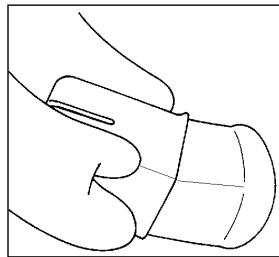
TENIKOZ KAθAPIZMOZ KAI ΦPONTIΔA
Ppoooyn: PIV Kαθaipεe Tn Oωkeu, φροντίσε Vα Φaλετε TO ηλεκτρικό Kαλωδio aTó TnV πρiça KαI VA ἐχει Kριωσει η σωkeu. Mn βυθίετe Tóte Tov aρτοπαρακεuaση Εε vερό.
- Pπeipotépyte tn φópu ψηομaiatoc apioptepooppa, σκκωte tn via va βyεi kai byalte to cμuwtnpa. Mtnopeite va kaθapiεetne tn φópu ψηoμaiatoc kai to cμuwtnpa ie ζεtó vεpó kai nTIO antoppauVTIO. ΓIA TOKαθapiou, mνxραιοτοieite ακλρá uλία. Σ επριΠωιn Που δεν μtnopeite va δiaxwpεeTe to cμuwtnpa aTó Φρópu ψηoμaiotac aακχvntac kavovikni πεια, apnoTE to va δiaTOniTe i e xλiapó vεpó yia 30 περιTou λεTTIa. Mν πiεζεTe uTPEβOλiKa to cμuwtnpa yia tv Tov bγλEte.
Ia va mI aapei n pfavtca tou agova kivnong, mnu apyve Tn fopma ynoiatoC o vepo yia eaylo xpvikó diatnma. Mny PLeve Tn fopma ynoiatoC e Pauvtipio Tiatuv.
MTopeite va kaOaipieTe to eotwepiok oepo aTo kAtaki e eva eaappa BpEyueo, paakotavi. Oa TpeTcIva KaatepizTe To eotepikocepo tsoukeuhs mvo e eva paakoc,oteyovpiavi.
ΓaTovKaθapiOμ, mynxnpoiotoiieTre pioovtaTou exou oxεδiaoTe γia KaθapiOμ oó pvw, δiaβpwtika n σkλnpá δiaμata KaθapiOμ n pioovTa Tou πeipéovv Eδi n λωpivn.
Piv ano m qualeqn ts oukeun, va qovtiie autn va exkpuwoe vteawc kai va eivat teleiwos oteyv.
ΣYNHOH ΠPOBAHMATA
- To ywpi exei evtovn puwoia.
EaVcT av exTe xpOoiOIOInoei Tn OoTn TIOOTn aayiac H yaln TIOOTn aayiac dnioupyei ia duapeotn ounkai to ψwip fouokwv i nlu. Na xpOoiOIOeIe naTv apeoka uikia.
IPABVJIA 6E3ONACHOCTN
- UTo6bI n36exaTb HeCuaB, peMOHT dAHHOrO 3NeKtpnpn60pa HIn shHpyPiTaHnAdoJKeH pOn3BOITbcra HaWe cny6oB cepBnCHOrO bcnynBaHn. Ecn Heo6xOIMpeMOHT, OTnpabTe, noXaIyNcTa, np6Op B haw OTdEeL cepBnCHOrO bcnynBaHn (CM. npiloxHe).
-
Ipeed Tem kak npicctynpitb K uicTe pni6opa, OTKJIIOHTe erO OT ceTn i daIte emy nolnoctbIO OCTblTb.
-Чтобы He Донуст b риcka элекгческого удара, He моite ппбори He поружайе erо в Вody.
Bcerda ouuau Te np6op nocne nCnoIb3OBaHn. UTo6bl noJyUHTb 6OJIe noIPO6HyU INΦopMaun IO OuncTke np6opa, obaTeCb, noKaIyIcTa, K pa3dEny «Obuui yxod u Yucmka».
-Даннbi npi6op He npeHa3HauehДЯ 3KcPnyatauC NcNoIb3OBAHHeM BHeUHero TaMepa IIN OTdJIbHOrO yCTpOJCTBa DnCTaHcNHOHOrO ynpabJeHn. -
Дя Вьпechк xлоба в 3Toи xлобечkedoЛжныИсpoЛьзOBaТСЯТЛьКо peцentы C coDEржанем мукп пrimерно 200-550 r. ИсpoЛьзУITE 1½ чayньх Ложкдрожкддя Белов муки 2 чayньх Ложкддя ржанов мук.
При соржану MYК MEньше 3TOО MINHIMyMa 6удET HeBO3MOxHO OБecneuTb TцаTeIbHbI 3aMec TeCTa.ИЗытOUHoe KOLINueCTBO MYK MoXe TpNBecTи K TOMY,чTO TeCTO HauHETпЕвалВаТбСУЧЕЗ край ФОмblДЯ ВыIneЧК.
-
3TOT npi6op npedHa3Hauen dIy IcnoJb3ObaHnB DOMaushnx INI NIO6hbx ycNoBnX, KaK, Hapnpimep:
-
B oΦιncαx ΜΙΝΑν Β ἀργιχκ KOMΜερχεκκην ΠΟΜΕύηνχ;
-BnpdnpnTnx,pacnoIOXKeHHbIX BceIbCKO MECTHOCTN; -
NOCTOJIbIaMn B OTeJIaX, MOTeJIaX I T.Д.ИВДPyrIx NIOJIo6hIbIX 3aBeIeHINIX;
-BROCTeBbIXDOMAXCIPpeIOCTaBJIeHMeHHOUJeraI3aBtpaka. -
3TOT npi6op MOKET nCIOJIb3OBAIbCS DeTbMn (He MJaIe 8-JeTHero BO3pAcTa) I JInuAMN C OrpaHnueHHbIMN cIN3UeCKIMN, CEHCOPHBIMN INIy UMCTBeHHbIMN CnOCo6HOCTaMn INJH He OblaAIOUzIMN DOCTaTOUHbIM ONbITOM N yMeHNEM TOJIbKO pRyUCOBIM, YTO OHN HAXODTcA IOI pINCMOTPOM INI NIOJUYINI INHCTpyKTax NO NIOJIb3OBAHNUO DaHHbIM PnIBOpOM, PONHOCTbIO OCO3HaOT BCE ONaCHOCTN, KOTOpBIE MOYr pRy TOM BO3HKnHyTB, INO3HaKOMJIeHbIC COOTBETCTBYUOUM INpABINlAmM TEXHKN Be3ONaCHOCTN.
-
He papeaute Teym irpaTb c np6opom.
-Детям можно разpeшать чістку и обслuyхиване ппбора только под ппсмOTpOMи ecnIM He Mehee 8.net.
Cneinte 3a tem, yto6bl detn Mnaadwe 8 let BCerda haxodmncb Ha doctatochom ydaJeHm ot npibopa n shhya nHTAHIA. -
PnpnpeHne. IepKHe ynaKObHbIe MaTePnAbI B HeIOCTyHOM dIa DeTe McTe, TAK KAK OHn PpeCTabJIOT ONaCHOCTb yduIbJ.
IobepxHocb kopnyca n OTBepCTna IyBaYnCka npa npa pa6oTe neKu CnIbHo HapReBaOTcH. He npKacaiTeck K rOpAHHm ChTAM np60pa. PpN 3BneEHn Xe6a o83aTeJIbHO NOnb3yIteCb KxOHNbIMn npXBAkAMn INn pyKaBuaMn. PpN OTKpbAHm Xe6oNeChn 6epTEcb Toblko 3a pyUky KpbIiKn.
BkIIOuayte np6bOp toIbKO b 3a3eMIIeHHy o03eTKy, yCTaHOBIIeHHy O COOTBETCTBm C DeIcTBYIOUIMM HOpMaMn. Y6eIITcB, UTO HApJxKeHHe B cTeN COOTBETCTByE T HApJxKeHnO, Yka3aHHomy Ha 3aBOIDCKo TaBJINKe.
Bcerda n3BnekaTe Bnky n3 po3eKn nocne nCnoNb3ObaHna np6opa, a taKke: -
npn IIO6bIX HenoJaKax BO BpeM IcNoIb3ObaHna,
-
nepei n3BneHHeM fOpMbI JIy BbIneKn,
-пегдчсков пибopa. -
PnI n3BJIeHmN BUNKn I3 CTENHO pO3eTKn HNKoRJa He TAnHe 3a 7Hyp PtTaNHa, 6epntc bToIbKO 3a BNkY. He DOnyckaTe npOBuCAHn YHpy nITAHn; DePKeTe erO Ha DoCTaTOHOM ydaJeHm OTHarpeBaUxxCs cacteI npi60pa.
IpeKd KaKdbM BkUOpEnHm 3NeKTPonpnp60a CneDyET yBeDnTcB AOTCYCTBm NOBpeXDeHm KAK Ha OCHOBm UcTPOJCTBE, BKNIOA H NHyP nITAHNA, TAK HA JIObOM DOnONHInTeBHOm, ECNI OHO YCTAHOBHe. EcNI BBy pOraHn PnIP6oHa TBepdyo NOBePxHOCTb IIN npINaraln Ype3MePHoe ycJIne IIN BByTINBaHnNl SHypa nITAHNA, 3OT Pn6oB He CneDyET BoJIbe NcIPOBtBAtb: DaKe HeNBUNMOE NOBpeXDeHme MOKeT OTPiuATeBHO cKa3aTbCnHa 3KcNpyataunOHn BeOtonachOCTn np60pa.
Ipi6opdoJIkeH haxoJtbcHa paacctOaHmHe MeHee 5 cm OT cTeH nIN dpYnx ppeMeTOB. He yctaHaBnBaIte np6op H He IcIOJIb3yIe erO OKoNo HacteHHbIX uKaΦOB nIN NO T HMI, INI NOD TAKMn PpeMeTaMn, KaK 3aHaBeCn n DpyTne JERKO BocPnAmehraUcHec MaTePnaJIb. HnEro He KlaDITe Ha Bepx np6opa.
Bcerda yctahabnabaIte npibop Ho pOBHyTo TennocToKyIO nobepxHocTb. Kopnyc npibopa u hyp nTaHna He doJnxbl coPnKacatbc C HapReBaOUnmncr PpeMTeAMN NIN C KaKMM-NIO BO NCTOHNKAMN TeIIa (TaKIMN, HApnPmep, KaK KOHΦOpKn KxohHO nnIIN OTKpbIeOE nnam).
He BkIouaIte np6op, noka He yctahOBITE B Hero fOpmy IJRA BByeueKINHrpeJeHTamN.
Cleinte 3a tem, yto6bI np6ob He nonan nOd doxdb u bepeHnte ero OT cbiopTHe nCnOJIb3yIe pnp6pHa oTKpItOM
Bo3dyxhe mIHa MOKpoi NOBepxHocTn. Bcerda npOBepaTe, TTo6bI OH 6blXopoIo 3auuien OTOnpaDAnHa Hrno BoJHbIX 6pb13r.
- PnpdpnpeXe HnakpbaiTe Xne6 aIOMHHeBcO foIbro nI npDymn IIOOBmnppeMetam BO Bpem npocceBaBbIeKn:BO3NkaOoee pni 30m NOBbIeHne TEmpeatpyb MoKeT cepbe3HO NOBpeINb npi6op.
- IcnoIb3yIte daHHbI npIbOpToIbKO dIraTex cIeNe, KOtOpIe yKa3aHbI B DaHHOM pyKOBoDCTBe.
IopJIb3yIteCbToJIbKO TeMn AkeccCyapAMn, KOtOpBle 6blNIOCTaBHeHb IpnO3BODInTeMe NpIb6oA. IVcNoJIb3OBaHme akceccyapOB DpyTnx PpOIN3BODInTeMe MoKET npINBeCTN K NOBpeJdeHIO pPb6oA INI dAKe K CepBe3HO TpaBME.
He npikacaiTecb K DvBxuymcmy TaCTM BO BpeMpa6oI np6opa. HnEero He DeJaTe BHyTpri np6opa, noka OH He 6ydet OTKIOUHEn OT cETN IIOJIHOCTbO He OXlaNTcra.
DOnoJIHnTeIbHbIe BaxHbIe yKa3aHn
Bcerda noIb3yIeTc kXoHHbIM npxBAtKAMn IIn pykABuCaAMn, KOrDa HxKHO npKOCHyTBcR K np6bpy nocne erO npMeHnrynn DoCTaB CBExeNCneHnhXne6.
- Pn npepebIe B Ipoaue 3neKtpo3Hepm MeHee He M Ha 5 MNHy T npOrpMa BblneKn ABToMaTneckn Bo306HOBJIaTeC TTO MeCTa, H KOTOPOM OHa 6blna npepBaHa.
BoBpemIpocecca3aMecaHacmTOPBOMOKHeMOyT KOHdEHCPOBaTcB OoHbIe npbl.Ondako BO BpemIpocecca BbIneyK3ta KOHdEHCauN Ncye3HT.
- Yto6bI xne6 nponekancra paBHomepHo, He oTKpbIbaiTe KpbIshKy Xne6oaneKn B npOcece BblneKn.
- Pocne IcnoIb3OBAHnna IpoOxKnTe, noka XnleBoneuKa nΦopMa dIra BblneKn IOnHOCTbO OCTbHyT, nocne Yero npicTyInTe Knx TtateNbo OuchTe.
ΦopMaДЯВынeukиN TeCTOMeCnIbHbI KpOvOK NOKpbITb aHTmPnIgRaphbIM NOKpbTtme. Yo6bI erO He NOBpeDnTB, He NOJIb3yIteCb MeTaNJIInueCKMIM, TBePbIMN, OCTpbIMN INI ONCTPOKOHeYhBM INpeMetaMn.
BbIMaHHe! BkIIOueHHe npCToXnE6OeKN MoKet npNBecTn K ee nobpeXdEHNO 3-3a nepeRpeBa npCTo FOpMbI dIy BblneuK.
MepbI npedoctoPOXHOCTN
B cnuyae noaBnneHn DbIMa n3 OTdeneHn dnn BblneKn npOBepbTe, YTO erO kpbIka pIoTHo 3akpIta, Ondako cpa3y JxE BblbTe BnIKy n3 po3eTKN. Hn npi KaNX o6ctOaTeBCTbXe NbIaTNeTcB NOracNTb TlneUooee Tecto BOIOJ. DbIM MoKet NOBtcbn I3-3a TORO, YTO nepeBaJIINBWeecea Cheep3 KpaIΦOpMbI Tecto NOnaHO Ha HapBeaTeBbHbIe 3IeMeHTbI. P03TOMy OChEB BaxHo co6IIOaTb IpedeIbHbIe KOINueCTBa, yka3aHNbIe B peuentax.
He npikacaiTebc K MetaJIInueckomy Kopnyc, K OTBepCTnM dIy BbIpycka npa Ha 3aHne CTeHKe npi6opa nIN K CMOTPOBOMO OKHy B KpbIiKe: npi pa6oTe npi6opa 3tn Yactn CInbHo HarpBaIOTc.
BAWA XJIEBOENEYKA
| 1. | Смоградове okно | 5. | Зкстрахтор{Tстомесильно Крочka} |
| 2. | Текомасьнький Крочok | 6. | Паень уралегия с диспeeм |
| 3. | Мерный-stakанчik | 7. | Форma对于我们白俄罗斯хлоба |
| 4. | Мерна пожka | 8. | Крышka |
5 = KEKCbI N3ДРОЖЕBOFO TECTA
V3-3a cpaBHTeHbO bICOKo CODepKAnHcaxapa CnAKnOe DpOxKeBOE TcTO NOpymHNBaETc6bICTpee; N03TOMy IPOCECC BIneYKN B3ToI pOrpamMe DnTcM MeHbSe BpeMeH, Yem B dpynx.
6 = KOPOTKAR IPOPAMMA, 700 r
PpimmehaetcI pyeentob do 700 r; npn 3om bxyahkn noyauotc mehboero pa3mepa n TBepke, yem npn o6bHOB BVineueke.
7 = KOPOTKAЯ ПОГРAMMA, 1000 r
PpimHeTcra drrpeuTeBTO 1000 r; npn 3tOM bxyaHKn nOlyaIOTc MehJSeero pa3Mepa n TbeKe, cHm npn ObHiOn BblneKe.
8 TECTO
B 3to nporpamme HeT ctaDnn BblneuKn. Iocne 3aBepweHn nporpaMMbI TcTo (HaNPIMep, TcTo dIa PIIuCbI) MOXHO BbyHyTB INcOnl30BaT bIra BblneuKN B O6bIHN dyXOBKe.
9 =ДЖЕМ, MAPMEJIАД
PpimHeTcA pI npIroTOBHeHn dKema n MapMeHa. PpI npIroTOBHeHn cIeNTe 3a TEM, YTObI foPMa I pI BbIeHKn 6bIa 3aONHeHa BCemn IHrpeHentamn (npImepHO 1000 r) ToIbKO h DaBe TpeTI, TaK KaK 3Ta CMEcMb Meet TeHdEHNIO K BCENHBaHIO.
10 = KEKCbI N3 ObIyHOrO TECTA
PnroHa nIy BIneK Kekcob, KOrDa BmecTo dpoXKe NcNoJb3yETcN ekapHbI NoPoWOk.
11 = C3HDbYBEbI
Пиговна дя Вьпechк CнDbчeberо xle6a.У 3тOrо xIe6а Лergka CTpykTypa n ToHka KopoUka.
12 = BblneYKA
PpimHeTcIy BbIneKuN3 TcTa (HAnpImep, N3 TcTa, pIroTOBHeHHOrO IIO pOporpaMMe TECTO). PpI 3OM, nepeI 3aIyckOM pIporpaMbI BbIeYKA CtaIINo IOJbEMA MOXHO N3MeHHTB COOTBETCTBnC TINOM INCNoJIb3yeMoTO TcTa.
Kopomka npoepamma 700 e u 1000e:
3Tn nporpammbI nCNOJIb3yOTc IaI BbIeueKIN XIE6a 3a 6oJee KOpOTKoe BpeM. PIn nCNOJIb3OBAHmN CTaIIN COKpaUeHHORo NOBema Tecta 6ByaHKn NOnuYATcR HeCKOIbKO MeHbIMM N OoEe TBepblIM, Yem ObUHIO. ImeTe B BVdy, cTO dIra 3TOrO DOJHKA nCNOJIb3OBAITcR Tennna BOda. IyUhne peZyIbTaIb ObIyHO DocTnAOTcP rPi nCNOJIb3OBAHmN BOIc b TEmNEpatypoN nopAka 48-50°C. Mbl peKoMeHdYeM nCNOJIb3OBACTe CneuaJIbHb NIIeSeBOr TepMometp. PnI cnIKOM Hn3Ko TEmNepatype NOBem Tecta MoKet OKa3aTcR HeOcTAToOHbIM; Ondako CNlUKOM BbICOKA TEmNEpatya Bb1OBet CNIJKOM paHHN NOBem DpOxKej, CODEPKaUXcR B Tecte, TO ONaTb K eJePNBeED K HEyDObNETBOPNTENbOMy KaueCTBy BIneKcN.
- PnBbINHHeHn npOaPamM O5bIyHbI, B5JIbI XJIeB, XJIeB I3 LJIbHOH MyK, KEKCbI IN 3 DPOXOXEBOrTO TECTA, KEKCbI IN3 O5bIyHNO TECTA u C3HNBUNYEBbI Bbl MoKeTe DoabTb, B 3aBcNMOCTn OT BaWero BKyCa, TaKne INHpeJeHt bK kApOdBiIIN PNeHmUc, CeMaHa NODCOnHeuHnKa, TpaBbI, CeMaHa TMnHa, 3emJHOH nepeU, 3emJHOH oePxN, MocIn, Kykpy3Hy0 Kpyu MeJkoR OomOna, Hape3aNHy0 Ky6nKAMn BeTHHy n T. d.
- Пдача 3ыковоро сгнана означаet, чун hacTyПио само пoxOДяшь Врм дя do6abIeHЯ 3tIx nHrpeIeHToB.В npИБЕДEHNo HnIXe TabJInce само пoxOДяшь Врм рoka3aho CmBOLOM'.
2/F., Block A, Dong He Industrial Building
Yue He Street, Sha Shen Road, Sha Tou Jiao
Shenzhen
Tel.: +86 755 25551458 or 25550852
Fax: +86 755 25357468 or 25357498
eMail: sales@severinchina.com
Web: http://www.severinchina.com
Czech Republic
BVZ Commerce s.r.o.
Parkerova c.p. 618
CZ 25067 Klecany
Tel.: +420 233 55 94 74
Fax:+420233559474
Danmark
F&H of Scandinavia A/S
Gl. Skivevej 70
DK-8800 Viborg
Tel.: +45 8928 1300
Fax: +45 8928 1301
F-67210 OBERNAI CEDEX
Tel.: +33 3 88 47 62 08
Fax:+33388476209
eMail: severin.france@severin.fr
Web: http://www.severin.fr
Greece
BERSON
C. Sarafidis Bros. S.A.
Agamemnonos 47
176 75 Kallithea, Athens
Tel.: 0030-210 9478700
Philippines Business Center
Service Post of Thermi
570 01 Thessaloniki, Greece
Tel.:0030-2310954020
Hong Kong
Pacific Coffee Company
7/F Hollywood Centre, 233 Hollywood Road,
Sheung Wan, Hong Kong
Tel.: +852 2805 1627
Fax: +852 2850 4015
eMail: espresso@pacificcoffee.com
India
Zansaar
1210, 2nd Floor
Fawar Manor, 100ft Road
Indiranaqai, Bangalore 560 038
Tel.: +91 80 49170000
eMail: customersupport@zansaar.com
Web: http://www.zansaar.com
Iran
IRAN-SEVERIN KISH CO. LTD.
No.668,7th.Floor
Bahar Tower
Ave. South Bahar
TEHRAN - IRAN
Tel.: 009821-77616767
Fax:009821-77616534
Info@iranseverin.com
www.iranseverin.com
Iraq
AI JOUD Home Appliances Manufacturing Co. Ltd
PIC: Eng. Ahmad Al-Sharabi
Al Joud Building Karadat Kharej
Baghdad - Iraq
Tel.: +964 782 270 2727
+9647700035533
+9647712317850
Ireland
Bluestone Sales & Distribution Ltd
26 Oaktree Business Park
Trim Co Meath Ireland
Tel.: +353 46 94 83100
Fax: +353 46 94 83663
Web: www.bluestone.ie
Italia
via Dino Col 52r-54r-56r
I-16149 Genova
Green Number: 800224155
Tel.:010/6451102-010418609
Fax: 010/6425009
e-mail: videoelettronica@panet.it
Jordan
J.L.C.
P.O.Box 910330
Mecca Street, Jaber Complex Building No. 193
Amman 11191 Jordan
Tel: +962 6593 9365
Korea
Jung Shin Electronics co., Ltd.
501, Megaventuretower 77-9
Moonrae-Dong 3ga, Yongdeungpo-Gu
Seoul, Korea
Tel: +82-22-637 3245~7
Fax: +82-22-637 3244
Service Hotline: 080-001-0190
Kuwait
Mohammed Abdulrahman Al Bahar
Al Bahar Building P.O.Box 148
Safat 13002 Kuwait
Tel: +965 4810855
Latvia
SERVO Ltd.
Mr. Janis Pivovarenoks
Tel: +371 7279892
Lebanon
Khoury Home
7th Floor, Cité Dora 3 Building, Dora
P.O.Box 70611
Antelias, Lebanon
Tel: +961 1 244200
Fax:+9661253535
eMail: info@khouryhome.com
Internet: www.khouryhome.com
Luxembourg
Ser-Tec
RueduChateau d'Eau
3364 Leudelange
Tel.: +352 37 94 94 402
Fax: +352 37 94 94 400
Macedonia
Agrotehna
St.Prvomajska bb
1000-Skopje
MACEDONIA
e-mail: servis@aqrotehna.com.mk
Tel: +389 2 / 24 45 009 or -019
Fax:+38922463270
Magyarorszag
TFK Elektronik Kft.
Gyar u.2
H-2040 Budaörs
Tel.: (+36) 23444266
Fax: (+36) 23444267
GHALA 112, P.O. Box 996
Muscat Sultanate of Oman
Tel.: +968 24593025
Fax.: +968 24593490
Philippines
COLOMBO MERCHANT PHILIPPINES, INC.
Mezzanine 1, South Center Tower
2206 Venture Street, Madrigal Business Park
Alabang, Muntinlupa City
Tel.: 8093441
eMail: severinconsumercare@colombophils.com.ph
Polska
SERV- SERWIS SP. Z 0.0.
UL.WSCHODNIA4
46-070 CHMIELOWICE K/OPOLA
Tel: +48 77 453 86 42
Fax:+48774538642
Serbia and Montenegro
tel: +381-21-524-638
tel: +381-21-553-594
fax: +381-21-522-096
Singapore
Beste (S) Pte. Ltd.
Tagore Building
6 Tagore Drive, #03-04
Singapore 787623
Tel.: +65 6455 0005
Fax:+6564554010
eMail: info@beste.com.sg
Slovenia
SEVTIS d.o.o.
Smartinska 130
1000 Ljubljana
Tel: 00386 1542 1927
Fax:0038615421926
Slowak Republic
PREMT.S.R.O.
Skladova 1
917 01 Tmava
Tel: +421 33 55 45 007
Fax:+421335545007
eMail:premt@premt.sk
South Africa
AL.CD.Ashley (Pty) Ltd
ABSA on Grove
Grove Avenue
Claremont, Cape Town 7708
Tel.: +27 21 674 0294
Fax:+27 216740295
eMail:greg@alcdashley.co.za
Web: www.alcdashley.co.za
Svenska
Rakspecialisten HS
Mollevangsgatan 34
214 20 Malmö
Tel.: +46 40 12 07 70
Fax:+46406110335
eMail: info@rakspecialisten.se
Switzerland
Joud Industries Domestic Appliances Co.
P.O.Box 199 or 219
Motorway entrance
Lattakia-Syria
Tel.: +963 41 416 590
+96341416591
Fax:+96341444622
Thailand
Verasu Ltd. part.
83/7 Wireless Rd., Lumpini,
Patumwan, Bangkok 10330
Tel.: +662 254 81 008
eMail: askverasu@verasu.com
United Arab Emirates
Juma al Majid Est
P.O.Box 156
Dubai U.A.E.
Tel.: 04 266 5210
Fax:042623431
eMail: shahid-saleem@al-majid.com
Web: www.al-majid.com
United Kingdom
Homespares Centres Limited
Firwood Industrial Estate
Thicketford Road
Bolton, BL2 3TR
Tel.: +44 1204 558160
Fax:+441204558161
eMail: office@hscl.info
Web: www.hsc1.info
Vietnam
Brand Partner
W.22, D. Binh Thanh
180/38 Nquyen Huu Canh Street
Ho Chi Minh City. Vietnam
Tel.: +84 862 899 648
Fax:+84862899649
eMail: info@brandpartner.vn
Stand: 08.2014