
TORONTO 400 BT - Car radio BLAUPUNKT - Free user manual and instructions
Find the device manual for free TORONTO 400 BT BLAUPUNKT in PDF.
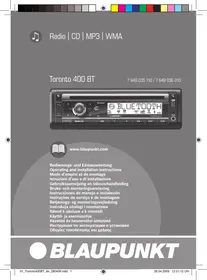



| Brand | BLAUPUNKT |
| Model | TORONTO 400 BT |
| Product type | Car radio |
| Power supply | 10.5 - 14.4 V (max. current 10 A) |
| Standby consumption | < 3.5 mA |
| Sinusoidal output power | 4 x 26 W (14.4 V, 4 Ω) |
| Maximum power | 4 x 50 W |
| FM wavebands | 87.5 - 108 MHz (Europe/Thailand), 87.7 - 107.9 MHz (USA/South America) |
| AM wavebands | 531 - 1602 kHz (MW); 153 - 279 kHz (LW, Europe) |
| FM bandwidth | 30 - 15,000 Hz |
| CD bandwidth | 20 - 20,000 Hz |
| Supported formats | Audio CD, CD-R/RW, MP3, WMA, USB files (FAT32) |
| Bluetooth | Hands-free kit and audio streaming (short range, up to 5 paired devices) |
| Connectors | CD slot, front USB, front AUX-IN jack, rear AUX input, 4-channel preamp outputs (2 V) |
| Front panel | Detachable, with control buttons and backlit display |
| Radio functions | RDS, PTY, Travelstore, storage of 5 stations per level (FM1, FM2, FMT, AM, AMT) |
| Sound settings | Bass, treble, balance, fader, X-Bass, 3-band equalizer, presets Pop/Rock/Classic |
| Display | Backlit display with color adjustment (4096 colors) and day/night brightness |
| Dimensions | 1-DIN standard (182 x 53 x 160 mm, estimated) |
| Weight | Approx. 0.5 kg (estimated) |
| Safety instructions | Class 1 laser, do not open, moderate volume for road safety |
| Maintenance and cleaning | Clean with a dry or slightly damp cloth; alcohol for front panel contacts |
| Included accessories | Manual, front panel case, mounting frame, small hardware, removal tools, USB cable |
| Warranty | Manufacturer's warranty in the European Union; contact Blaupunkt for support |
Frequently Asked Questions - TORONTO 400 BT BLAUPUNKT
User questions about TORONTO 400 BT BLAUPUNKT
0 question about this device. Answer the ones you know or ask your own.
Ask a new question about this device
Download the instructions for your Car radio in PDF format for free! Find your manual TORONTO 400 BT - BLAUPUNKT and take your electronic device back in hand. On this page are published all the documents necessary for the use of your device. TORONTO 400 BT by BLAUPUNKT.
USER MANUAL TORONTO 400 BT BLAUPUNKT
AM (MW): 531 - 1602 kHz
LW (Europe only): 153 - 279 kHz
USA wavebands:
FM (VHF): 87.7 - 107.9 MHz
AM (MW): 530 - 1710 kHz
AM (MW): 530 - 1710 kHz
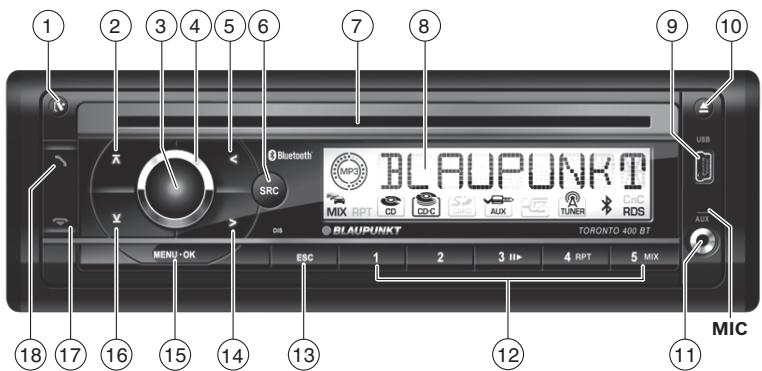
1 button: Unlock the detachable control panel. ② A button: In the menu: Call up menu item. Radio mode: Select memory bank. MP3/WMA/C'n'C/CD changer mode: Change to next folder / CD. On/Off button: Short press: Switch on car sound system. In operation: Mute car sound system (Mute). Long press: Switch off car sound system. (4) Volume control. 5 <button: In the menu: Change settings. Radio mode: Adjust the stations. Other operating modes: Track selection. ⑥ SRC button: Selecting an audio source. CD tray. ⑧ Display. USB port. 10 button (Eject): Eject a CD. (1) Front AUX-IN socket. 12 Keys 1-5.
DIS/ESC button: In the menu: Exit menu. In operation: Switch display. 14> button: In the menu: Change settings. Radio mode: Adjust the stations. Other operating modes: Track selection. 15 MENU-OK button: Short press: Call up menu, confirm settings. Long press: Start scan function. 16 v button: In the menu: Call up menu item. Radio mode: Select memory bank. MP3/WMA/C'n'C/CD changer mode: Change to previous folder / CD. 17 button: Ending/rejecting a phone call. 18 button: Answering a call, speed dial.
Safety notes. 29
Symbols used 29. Road safety 29. General safety notes 29. Declaration of conformity 29.
Cleaning notes. 30
Disposal notes. 30
Scope of delivery. 30
Optional equipment (not part of the scope of delivery) 30
Placing the device in operation 31
Attaching/detaching the control panel.....31 Setting the tuner region. 31 Switching on/off 31 Volume 32 Switching demo mode on/off 32 Displaying version numbers 32
Traffic information. 32
Radio mode 33
RDS 33 Changing to radio mode 33 Selecting the memory bank 33 Tuning into a station. 33 Storing stations/Calling stored stations.....34 Scanning stations. 34 Storing stations automatically (Travelstore) ...34 PTY. 34 Configuring the display. 35
CD/MP3/WMA/C'n'C/CD changer mode.....35
Basic information 35 Changing to CD/MP3/WMA/C'n'C/ CD changer mode. 36 Inserting a CD. 37 Ejecting a CD 37 Connecting/removing a USB data carrier ...37 Selecting tracks 37 Select a folder/CD (only in MP3/WMA/ C'n'C or CD changer mode) 37 Fast searching. 38 Interrupting playback 38 Playlist mode (only in MP3/WMA mode) .....38 Scanning all tracks. 38
Playing tracks in random order 38 Repeatedly playing individual tracks, CDs or directories 39 Configuring the display. 39
Bluetooth 39
Bluetooth® menu. 40 Registering and connecting a device.....40 Telephone functions 41 Bluetooth® streaming mode 42 Additional functions in the Bluetooth® menu. 43
External audio sources. 44
Front AUX-IN socket. 44 Rear AUX input. 44
Sound settings 45
Calling and exiting the audio menu 45 Performing settings in the audio menu.....45 Calling and exiting the enhanced audio menu. 46 Performing settings in the enhanced audio menu 46
User settings 47
Calling and exiting the user menu. 47 Performing settings in the user menu 47
Factory settings. 50
Useful information. 51
Warranty. 51 Service 51
Technical data 51
Installation instructions 381
Safety notes
The car sound system was manufactured according to the state of the art and established safety guidelines. Even so, dangers may occur if you do not observe the safety notes in these instructions.
These instructions contain important information to easily and safely install and operate the car sound system.
- Read these instructions carefully and completely before using the car sound system.
- Keep the instructions at a location so that they are always accessible to all users.
- Always pass on the car sound system to third parties together with these instructions.
In addition, observe the instructions of the devices used in conjunction with this car sound system.
Symbols used
These instructions employ the following symbols:

DANGER!
Warns about injuries

CAUTION!
Warns about damaging the CD drive

The CE mark confirms the compliance with EU directives.
Identifies a sequencing step
- Identifies a listing
Road safety
Observe the following notes about road safety:
- Use your device in such a way that you can always safely control your vehicle. In case of doubt, stop at a suitable location and operate your device while the vehicle is standing.
- Remove or attach the control panel only while the vehicle is standing.
- Always listen at a moderate volume to protect your hearing and to be able to hear acoustic warning signals (e.g. police sirens). During mute phases (e.g. when changing the audio source), changing the volume is not audible. Do not increase the volume during this mute phase.
General safety notes
Observe the following notes to protect yourself against injuries:
- Do not modify or open the device. The device contains a Class 1 laser that can cause injuries to your eyes.
- Do not increase the volume during mute phases, e.g., when changing the audio source. Changing the volume is not audible during a mute phase.
Use as directed
This car sound system is intended for installation and operation in a vehicle with 12V vehicle system voltage and must be installed in a DIN slot. Observe the performance limits in the technical data. Repairs and installation, if necessary, should be performed by a specialist.
Installation instructions
You may only install the car sound system yourself if you are experienced in installing car sound systems and are very familiar with the electrical system of the vehicle. For this purpose, observe the installation instructions at the end of these instructions.
Declaration of conformity
The Blaupunkt GmbH declares that the car sound system Toronto 400 BT complies with the basic requirements and the other relevant regulations of the directive 1999/5/EG.
Cleaning notes
Solvents, cleaning and scouring agents as well as dashboard spray and plastics care product may contain ingredients that will damage the surface of the car sound system.
- Use only a dry or slightly moistened cloth for cleaning the car sound system.
- If necessary, clean the contacts of the control panel regularly using a soft cloth moistened with cleaning alcohol.
Disposal notes

Do not dispose of your old unit in the household trash!
Use the return and collection systems available to dispose of the old device.
Scope of delivery
The scope of delivery includes:
1 Car sound system, 1 Operating/installation instructions, 1 Case for the control panel, 1 Support frame, 1 Set of small parts, 2 Disassembly tools, 1 USB connecting cable
Note:
We recommend the use of original Blaupunkt accessories (www.blaupunkt.com).
Optional equipment (not part of the scope of delivery)
Contact your Blaupunkt specialised dealer or visit us on the Internet under www.blaupunkt.com for information about optional equipment, such as:
- The steering wheel or handheld remote control from Blaupunkt for safe and convenient operation of the basic functions (switching on/off not possible with the remote control)
- The C'n'C-ready interfaces from Blaupunkt (C'n'C = Command and Control) for connecting additional data carriers and devices (e.g. via the iPod®/USB interface)
- Blaupunkt CD changer
- Blaupunkt or Velocity amplifier
Placing the device in operation
Attaching/detaching the control panel
The car sound system is equipped with a detachable control panel (release panel) to protect your equipment against theft. In the delivery state, the control panel is in the supplied case. To start operating the radio after installation, you must first attach the control panel (see the section "Attaching the control panel" in this chapter).
Always take the control panel with you when leaving the vehicle. The car sound system is worthless to a thief without this control panel.
Caution
Damage to the control panel
Never drop the control panel.
Transport the control panel so that it is protected against impacts and the contacts cannot become dirty.
Do not expose the control panel to direct sunlight or another heat source.
Avoid direct skin contact with the control panel's electrical contacts.
Attaching the control panel
Push the control panel into the bracket at the right edge of the device. Push the control panel carefully into the left bracket until it clicks into place.
Removing the control panel
Press the button 1 to unlock the control panel.
The left side of the control panel detaches from the device and is secured by a latch against falling out.
Grasp the control panel at the left side and pull it beyond the resistance of the latch and straight out of the bracket.
Note:
The car sound system automatically switches off as soon as the control panel is removed.
Setting the tuner region
This car sound system is designed for operation in different regions with different frequency ranges and station technologies. It is factory set to the tuner region "EUROPE". Other available tuner regions include "USA", "THAI" (Thailand) and "S AMERICA" (South America). If you operate the car sound system outside of Europe, you may first have to set a suitable tuner region:
Switch off the car sound system if it is not already turned off. Press and hold the buttons MENU·OK 15 and 4 12 at the same time and press the On/Off button 3.
The car sound system switches on. The currently set tuner region appears on the display.
Press the button V (16) / A (2) repeatedly until the desired tuning region is displayed. Press the MENU·OK button 15.
Switching on/off
Switching on/off with the On/Off button
For switch-on, press the On/Off button ③. The car sound system switches on. To switch off the device, press and hold down the On/Off button 3 for longer than 2 seconds.
The car sound system switches off.
Note:
If you switch on the car sound system while the vehicle ignition is switched off, it automatically switches off after 1 hour to preserve the vehicle battery.
Switching on/off via vehicle ignition
The car sound system will switch off/on simultaneously with the ignition if the device is correctly connected to the vehicle's ignition as shown in the installation instructions and you did not switch the device off by pressing the On/Off button ③.
Volume
Adjusting the volume
You can adjust the volume in steps from 0 (off) to 50 (maximum).
Turn the volume control 4 to change the volume.
Note:
If a telephone or navigation system is connected with the car sound system as described in the installation instructions, the car sound system is muted in case of a telephone call or navigation announcement so that you can hear the playback of the telephone or navigation system undisturbed. While it is muted, the display shows "TELEPHONE".
Muting the car sound system (Mute)
You can quickly reduce the volume to a preset level.
Briefly press the On/Off button ③ to mute the car sound system or to reactivate the previous volume.
While it is switched low, the display shows "MUTE".
To adjust the mute volume, please read the section "Performing settings in the user menu", "Mute LVL" menu item in the chapter "User settings".
Switching demo mode on/off
The demo mode shows the functions of the car sound system as scrolling text on the display. You can turn the demo mode on or off:
Switch off the car sound system if it is not already turned off. Press and hold the buttons MENU-OK 15 and 2 12 at the same time and press the On/ Off button 3.
The car sound system switches on. The display briefly shows "DEMO MODE" if you switched on the demo mode. By pressing any button, the demo mode is interrupted and you can operate the device.
Displaying version numbers
You can display the version numbers of the different device components.
Switch off the car sound system if it is not already turned off. Press and hold the buttons MENU-OK 15 and 1 12 at the same time and press the On/ Off button 3.
The car sound system switches on. The display shows the version number of the first component. The first character identifies the component: P = CPU, E = EPROM, A = Accordo, B = Bluetooth®.
Press the button < 5 / > to display the version number of the other components. Press the MENU-OK button 15 to return to the previously played audio source.
Traffic information
In the tuner region "EUROPE", an FM station can identify traffic reports by means of an RDS signal. If the priority for traffic announcements is switched on, a traffic announcement is automatically switched through, even if the car sound system is currently not in radio mode or if a station of the wavebands MW or LW is set.
If priority is switched on, the display shows the traffic jam symbol (一). "TRAFFIC" is displayed during a switched-through traffic announcement.
To switch the priority on and off, please read the section "Performing settings in the user menu", "TRAF" menu item in the chapter "User settings".
Notes:
- The volume is increased for the duration of the switched-through traffic announcement. You can adjust the minimum volume for traffic announcements (see the ch. "User settings", section "Performing settings in the user menu", "TA VOLUME" menu item).
To cancel a switched-through traffic announcement, press the DIS/ESC button 13.
Radio mode
RDS
Many FM stations broadcast an RDS (Radio Data System) signal in addition to their programme in the tuner region "EUROPE" that allows the following additional functions:
- The station name is shown on the display.
- The car sound system recognises traffic announcements and news broadcasts and can automatically switch them through in any operating mode (e.g. in CD mode).
- Alternate frequency: If RDS is activated, the car sound system automatically selects the best receivable frequency for the station that is currently set. Regional (REG): At certain times, some radio stations divide their programme into regional programmes providing different content. If the REG function is activated, the car sound system changes only to those alternate frequencies on which the same regional programme is being broadcast.
To switch the RDS or REG function on or off, please read the section "Performing settings in the user menu" in the chapter "User settings" (menu items "RDS", "REG").
Changing to radio mode
Press the SRC button 6 repeatedly until "TUNER" is displayed:
The current memory bank appears once as scrolling text on the display.
Selecting the memory bank
The following memory banks are available in the different tuner regions:
| Region | Memory banks |
| EUROPE | FM1, FM2, FMT, MW, LW |
| USA | FM1, FM2, FMT, AM, AMT |
| THAI | FM1, FM2, FMT, AM |
| SAMERICA | FM1, FM2, FMT, AM, AMT |
Press the button V (16) / A (2) repeatedly until the desired memory bank is displayed.
Note:
Up to 5 stations can be stored in each memory bank.
Tuning into a station
There are various ways of tuning into a station:
Tuning into stations manually
Briefly press the button < 5 / > 14 once or several times to change the frequency in increments, or long to quickly change the frequency.
Notes:
- For the tuner region "EUROPE": In the FM waveband, the next station of the broadcasting network is automatically tuned into if the RDS function is switched on.
- For the tuner regions "EUROPE", "USA" and "SAMERICA": In the FM waveband, the currently selected programme type is displayed and can be changed if the PTY function is activated (see the chapter "PTY").
Starting station seek tuning
Press the button < 5 / > 14 for approx. 2 seconds to start station seek tuning.
The radio tunes into the next receivable station.
Notes:
- For the tuner region "EUROPE": In the FM waveband, only traffic information stations are tuned into if the priority for traffic information (一) is switched on.
- For the tuner regions "EUROPE", "USA" and "S AMERICA": In the FM waveband, the next station with the currently selected programme type is tuned into if the PTY function is activated (see the chapter "PTY").
- The sensitivity of seek tuning can be adjusted (see the chapter "User settings", section "Performing settings in the user menu", menu item "SENS").
Storing stations/Calling stored stations
Select the desired memory bank. If necessary, set the desired station. Press the station button 1-5 (12) for approx. 2 seconds to store the current station under the button.
-or-
Briefly press the station button 1-5 to call up the stored station.
Scanning stations
The scan function is used to scan every receivable station of the current waveband.
Press the MENU-OK button 15 for approx. 2 seconds to start the scan, or long to continue playing the currently set station.
During the scan, the display alternately shows "SCAN" and the current frequency, as well as the memory bank or station name.
Note:
For radio mode, you can adjust the scan time for each station (see the chapter "User settings", section "Performing settings in the user menu", "SCAN TIME" menu item).
Storing stations automatically (Travelstore)
With Travelstore, you can automatically search for and store the 5 FM stations offering the strongest reception in the region in one memory bank. Any previously stored stations in this memory bank are deleted in the process.
In the tuner regions "EUROPE" and "THAI", you can store 5 FM stations in the FMT memory bank with Travelstore. In the tuner regions "USA" and "S AMERICA", you can also store 5 AM stations in the AMT memory bank.
- Select a memory bank of the desired waveband, e.g. FM1 or AM. Press the button \(\underline{\mathbf{V}} 16 / \mathbf{A}2\) for approximately 2 seconds.
The tuner starts the automatic station seek tuning; the display shows "FM TSTORE" or "AM TSTORE". After the storing is completed, the radio plays the station at memory location 1 of the FMT or AMT level.
Note:
For the tuner region "EUROPE": If the priority for traffic information is switched on (1), only traffic information stations are stored.
PTY
In the tuner regions "EUROPE", "USA" and "S AMERICA", an FM station can transmit its current programme type, e.g. CULTURE, POP, JAZZ, ROCK, SPORT or SCIENCE. Hence, the PTY function allows a targeted search for broadcasts of a certain programme type, e.g. for rock or sports broadcasts. Note that PTY is not supported by all stations.
Note:
To use the PTY function, you must activate it separately in the menu (see the chapter "User settings", section "Performing settings in the user menu", "PTY" menu item).
Selecting a programme type
Note:
In the tuner region "EUROPE", you can adjust the language in which the programme types are displayed (see the chapter "User settings", section "Performing settings in the user menu", "PTYLANG" menu item).
Briefly press the button <5> / >14.
The currently selected programme type is briefly displayed, and you can select a different programme type.
If necessary, press the button <5> / >14 repeatedly until the desired programme type is selected.
Searching for stations
Press the button <5> / >14 for approx. 2 seconds.
As soon as the seek tuning starts, the display briefly shows "SEARCH". Afterwards, the current programme type is displayed.
As soon as a station is found, "PTY FOUND" is briefly shown. As long as the programme type of the adjusted station corresponds to the currently selected programme type, the display alternately shows the programme type and the station name or frequency.
Notes:
- If no station with the selected programme type is found, "NO PTY" is briefly displayed and a beep sounds. The radio will then retune to the station that it played last.
- If the tuned radio station or another station on the broadcasting network broadcasts your selected programme type at a later point in time, the car sound system will automatically switch from the currently tuned station or from the current audio source (e.g. CD) to the station whose programme type matches the one you selected. Note that this function is not supported by all stations.
Configuring the display
Press the DIS/ESC button 13 to change between these two displays:
| Display | Meaning |
| ABCDEF or FM1 102.90 | Station name or memory bank/frequency |
| FM1 11:32 | Memory bank/time |
CD/MP3/WMA/C'n'C/ CD changer mode
Basic information
CD/MP3/WMA mode
This car sound system can be used to play audio CDs (CDDA) and CD-R/RWs with audio, MP3 or WMA files as well as MP3 or WMA files on USB data carriers.

Risk of severe damage to the CD drive!
Noncircular contoured CDs (shape CDs) and CDs with a diameter of 8 cm (mini CDs) must not be used.
We accept no responsibility for any damage to the CD drive that may occur as a result of the use of unsuitable CDs.
Notes:
- To ensure proper functioning, use only CDs with the Compact-Disc logo.
- Blaupunkt cannot guarantee the flawless function of copy-protected CDs and all CD blanks and USB data carriers available on the market.
Note the following information when preparing an MP3/WMA data carrier:
- Naming of tracks and directories:
Max. 16 characters (CD) or 24 characters (USB) incl. the file extension ".mp3" or ".wma" (if more characters are used, the number of tracks and folders that are recognisable by the car sound system is reduced) - No umlauts or special characters
- CD formats: Audio CD (CDDA), CD-R/RW, 0:12 cm
- CD data formats: ISO 9669 Level 1 and 2, Joliet
- CD burn speed: Max. 16x (recommended)
- USB format/file system: Mass storage device/FAT32
- File extension of audio files:
- .MP3 for MP3 files WMA for WMA files
- WMA files only without Digital Rights Management (DRM) and created with Windows Media Player version 8 or later
- MP3 ID3 tags: Version 1 and 2
- Bitrate for creating audio files:
- MP3: 32 to 320 kbps WMA: 32 to 192 kbps
- Up to 20,000 entries can be administered depending on the file structure on the USB medium.
C'n'C mode
The C'n'C interface from Blaupunkt (C'n'C = Command and Control) allows an even more convenient control of devices and data carriers that are connected to the car sound system via a C'n'C-ready Blaupunkt interface.
Before connecting a C'n'C-ready Blaupunkt interface, check the mode of the rear AUX input. For
further details, please read the section "Rear AUX input" in the chapter "External audio sources".
CD changer mode
You can connect the following CD changers to the car sound system:
- Blaupunkt CDC A03
- Blaupunkt CDC A08
- Blaupunkt IDC A09
Information on handling CDs, inserting CDs and operating the CD changer can be found in the operating instructions supplied with your CD changer.
Before connecting a CD changer, check the mode of the rear AUX input. For further details, please read the section "Rear AUX input" in the chapter "External audio sources".
Changing to CD/MP3/WMA/C'n'C/CD changer mode
Press the SRC button 6 repeatedly until the desired audio source is displayed:
- "CD": Inserted CD.
- "MP3": Inserted CD that has already been recognised as MP3 CD.
- "USB": Connected USB data carrier. Name of the device connected via C'n'C.
- "CDC / AUX": Connected CD changer (if no other external audio source is connected).
Notes:
- The respective audio source can be selected only if a corresponding CD is inserted or a corresponding device (e.g. a USB data carrier or CD changer) is connected.
- If the car sound system first has to read the data of a connected device or data carrier before the playback, the display shows "READING". For large data volumes, this may take up to 1 minute. If the device or data carrier is defective or the transferred data cannot be played back, a corresponding message appears on the display (e.g. "ERROR" or "USB ERROR").
- If the connected CD changer first acquires the inserted CDs (e.g. after an interruption of the power supply or a change of the magazine), "MAG SCAN" is displayed. If the CD changer does not contain any CDs or magazine, "NO DISC" is displayed.
Inserting a CD
Note:
You must not hinder or assist the drive as it automatically draws in the CD.
Insert the CD with its printed side up into the CD tray ⑦ until you feel a slight resistance.
The CD is automatically pulled in and its data are checked (the display shows "READING" during this time). Afterwards, the playback starts in CD or MP3 mode. If a CD is inserted, the display shows the CD symbol.
Note:
If the inserted CD cannot be played back, "CD ERROR" is briefly displayed and the CD is automatically ejected after approx. 2 seconds.
Ejecting a CD
Notes:
- If a CD is ejected and not removed, the drive will automatically draw it back in again after approx. 10 seconds.
- You can also eject CDs while the car sound system is switched off or whilst another audio source is activated.
Press the button to eject an inserted CD.
Connecting/removing a USB data carrier
To be able to connect a USB data carrier, the supplied USB cable must be connected to the car sound system (see Installation Instructions).
- Switch of the car sound system so that the data carrier will be correctly registered and unregistered. Connect the USB data carrier to the USB cable or pull it off.
If a USB data carrier is connected, the display shows the USB symbol. If the USB data carrier is initially selected as audio source after connecting it or after switching on the car sound system, the data are read in first (the display shows "READING" during this time).
Notes:
- If the connected USB data carrier cannot be seen, "USB ERROR" is briefly displayed.
- The time required for reading in the data depends on the design and size of the USB data carrier.
Selecting tracks
Briefly press the button < 5> / > 14 to change to the previous/next track.
Note:
If the current track plays longer than 3 seconds, pressing < 5 once restarts the track.
Select a folder/CD (only in MP3/WMA/C'n'C or CD changer mode)
Press the button √16 / √2 to change to the previous/next folder or CD.
Note:
This also allows you to change between playlists of a device connected via C'n'C.
Fast searching
Press and hold down the button < 5 / >14 until the desired position has been reached.
Interrupting playback
Press the button 3 to interrupt the playback ("PAUSE") or to continue.
[ Playlist mode (only in MP3/WMA mode) ]
The car sound system can play playlists that were created with an MP3 manager, such as WinAmp or Microsoft Media Player. The playlists must be stored in the root folder of the CD or USB data carrier. The following playlist formats can be recognised: M3U, PLS.
Selecting tracks in Playlist mode
Press the 2 button (12) for approx. 2 seconds to change to the Playlist mode:
"LIST MODE" briefly appears on the display. The first track of the first playlist is played.
Note:
If the data carrier does not contain any playlists, "NO LIST" is briefly displayed.
Briefly press the button < 5 / > to change to the previous/next track of the current playlist. Press the button [16] / [2] to change to the previous/next playlist.
The display briefly shows the name of the selected playlist, and the first track of the playlist is being played.
Exiting the Playlist mode
Press the 2 button (1) for approx. 2 seconds:
"LIST OFF" briefly appears on the display. The current track continues playing.
Scanning all tracks
The scan function scans all available tracks.
Press the MENU-OK button 15 for approx. 2 seconds to start the scan, or long to continue playing the currently scanned track.
During the scan, the display alternately displays "SCAN" and the current track number or file name.
Notes:
- In the CD changer mode, the scan time per track is approximately 10 seconds. For all other operating modes, you can adjust the scan time for each track (see the chapter "User settings", section "Performing settings in the user menu", "SCAN TIME" menu item).
- In the Playlist mode (MP3 mode), only the tracks of the current playlist are scanned.
Playing tracks in random order
Press the 5 MIX button to change between the playback modes:
| Opera- tion | Display | Meaning |
| CD | MIX ALL | Mixing tracks |
| MP3/WMA/C'n'C' | MIX DIR2 | Mixing tracks of the current folder |
| MIX ALL2 | Mixing tracks of the data carrier | |
| CDC | MIX CD | Mixing tracks of the current CD |
| MIX ALL | Mixing tracks of all CDs | |
| Gen. | MIX OFF | Regular playback |
1 In C'n'C mode, additional playback modes may be available depending on the connected device 2 Not in MP3 Playlist mode
If the MIX function is active, the MIX symbol appears on the display.
Repeatedly playing individual tracks, CDs or directories
Press the 4 RPT button to change between the playback modes:
| Opera- tion | Display | Meaning |
| CD | RPT TRACK | Repeating tracks |
| MP3/WMA/C'n'C'1 | RPT TRACK | Repeating tracks |
| RPT DIR2 | Repeating folders | |
| CDC | RPT TRACK | Repeating tracks |
| RPT DISC | Repeating a CD | |
| Gen. | RPT OFF | Regular playback |
1 In C'n'C mode, additional playback modes may be available depending on the connected device 2 Not in MP3 Playlist mode
If the RPT function is active, the RPT symbol appears on the display.
Configuring the display
Press the DIS/ESC button 13 once or several times to change between these displays:
| Opera- tion | Display | Meaning |
| CD | T 01 02:15 | Track number and playing time |
| T 01 18:33 | Track number and time | |
| MP3/WMA/C'n'C | 01 ABC | File name |
| ABCDEF | Artist¹ | |
| ABCDEF | Album name¹ | |
| PLAY 02:15 | Playing time | |
| CLK 18:33 | Time | |
| CDC | T 01 02:15 | Track number and playing time |
| T 01 18:33 | Track number and time | |
| CD 02T 03 | CD number and track number |
1 Artist and album name must be stored as ID3 tag and are displayed only for approximately 10 seconds and perhaps as scrolling text; otherwise, the file name is displayed.
Note
You can switch the display of CD text of an audio CD on and off (see the chapter "User settings", section "Performing settings in the user menu", "CD TEXT" menu item). If CD text is switched on, the corresponding CD text is displayed once as scrolling text at the start of a track.
Bluetooth®
You can connect the car sound system via Bluetooth® with other Bluetooth®-ready devices, such as cell phones or MP3 players. This allows you to use the car sound system with its integrated microphone as a hands-free system for connected cell phones and control the audio output of other Bluetooth® devices and play them back via the loudspeakers of the car sound system (Bluetooth® streaming).
Bluetooth® technology is a wireless connection of short range. For this reason, Bluetooth® devices must be located near the car sound system (in the vehicle) to establish and maintain a connection.
To establish a Bluetooth connection, you must first register the car sound system and the Bluetooth device. When you register the devices, a Bluetooth connection is subsequently established automatically. This connection remains in effect as long as the Bluetooth device is within range. If the connection is interrupted, e.g. because you moved the cell phone outside the range, the connection is automatically re-established as soon as you are back within range.
You can connect only one cell phone and streaming device with the car sound system at a time. If you connect a new device with the car sound system, the connection to a currently connected device may automatically be interrupted. However, the car sound system leaves up to 5 different Bluetooth® devices registered, and you can quickly and easily connect any of these devices
with the car sound system again. If you register a sixth one, the Bluetooth® device registered first is unregistered.
Bluetooth® menu
In the Bluetooth® menu, you find all the functions for registering, connecting and managing Bluetooth® devices.
Calling the Bluetooth® menu
Press the MENU-OK button 15. Press the v button 16 to select the "BLUE-TOOTH" menu item. Press the > button 14 to open the Bluetooth® menu. Press the button V16 / A2 repeatedly until the desired menu item is selected.
Notes:
- The Bluetooth® menu is automatically exited approx. 30 seconds after the last button activation and you are returned to the display of the current audio source.
- If a Bluetooth® process is running (e.g. re-establishing the connection to the last connected device), the functions of the Bluetooth® menu are blocked. If you attempt to open the Bluetooth® menu during this time, "LINK BUSY" appears on the display. To return to the current audio source, press the DIS/ESC button 13. To cancel the Bluetooth® process and open the Bluetooth® menu, press the + button 17.
Exiting the Bluetooth® menu
Briefly press the DIS/ESC button 13 to exit the Bluetooth® menu.
Registering and connecting a device
Registering and connecting a cell phone
In the Bluetooth® menu, select the "PAIR" menu item. Press the > button 14 to open the submenu.
The "PHONE" menu item is selected.
Press the > button ⑭ to register a cell phone.
The display shows "PAIRING" and the Bluetooth® symbol is flashing. The car sound system can now be recognised by a Bluetooth® cell phone for approx. 2 minutes and connected.
Search the car sound system from your cell phone (Bluetooth® name: "TORONTO 400 BT").
As soon as the car sound system is found by the cell phone and should be connected, "ENTER PIN" appears on the display and the PIN "1234".
Establish the connection from your cell phone. Enter the PIN displayed by the car sound system.
The display may show "PAIRED", followed by "CONNECTED", as soon as the car sound system and the cell phone are registered and connected.
Note:
If no connection can be established, "CON FAIL" (connection failed) is briefly displayed.
Registering and connecting a Bluetooth® streaming device
In the Bluetooth® menu, select the "PAIR" menu item. Press the > button ⑭ to open the submenu.
The "PHONE" menu item is selected.
Press the button to select the "STREAMING" menu item. Press the → button 14 to register a streaming device.
The display shows the currently stored PIN (default "1234"). If required, enter the PIN of the streaming device:
Press the button V^(16) / A^(2) repeatedly until the desired number appears at the respective current location. Press the button < 5 / > 14 to change between the 4 locations of the PIN. Press the MENU-OK button (15) to confirm the PIN entered.
Note:
Not all streaming devices require the entry of a PIN on the car sound system. For some streaming devices, you have to enter the PIN of the car sound system instead. For those devices, you can simply confirm the current PIN of the car sound system by pressing the MENU-OK button (15) and then enter it on the streaming device.
The display shows "PAIRING" and the Bluetooth® symbol is flashing. The car sound system can now be recognised by the streaming device for approx. 2 minutes and connected.
Search the car sound system from your streaming device (Bluetooth® name: "TORONTO 400 BT") and establish the connection. Enter the PIN of the car sound system, if necessary.
The display may show "PAIRED", followed by "CONNECTED", as soon as the car sound system and the streaming device are registered and connected.
Note:
If no connection can be established, "CON FAIL" (connection failed) is briefly displayed.
Telephone functions
Answering/rejecting an incoming phone call
With an incoming call, the display alternately shows "INCOMING" and the number of the caller. The current audio source is muted and a ring tone is played via the loudspeakers of the car sound system.
Note:
If the number of the caller is not being transmitted, the display shows "PRIVATE NUMBER" instead of the number. If the number of the caller is stored together with a name, the name of the entry and the number are displayed (see the ch. "Storing a phone number").
Press the button 18 to answer the call. "CALL" and the duration of the ongoing call are displayed. Press the + button to reject the call or to end the current call. The display shows "CALL END".
Making a call
In the Bluetooth® menu, select the "DIAL NEW" menu item. Press the button 14.
You can now enter a phone number with up to 20 digits:
Press the button 16 / 2 repeatedly until the desired number appears at the respective current location. Press the button 5 / 14 to change between the locations of the number. Press the button to call the number entered.
"OUTGOING" and the dialed number are alternately shown on the display.
Note:
If the dialed number is stored together with a name, the name of the entry and the number are displayed (see the ch. "Storing a phone number").
As soon as your calling party answers the call, the display alternately shows "CALL" and the time of the current phone call.
Storing phone numbers
In the Bluetooth® menu, select the "DIAL NEW" menu item. Press the button 14.
You can now enter a phone number with up to 20 digits:
Press the button 16 / 2 repeatedly until the desired number appears at the respective current location. Press the button 5 / 14 to change between the locations of the number. Press the desired memory button 1-5 12 for approx. 2 seconds to store only the number. - or - Press the MENU-OK button (15) to enter a name for the entry.
You can now enter a name with up to 9 characters:
Press the button 16 / 2 repeatedly until the desired character appears at the respective current location. Press the button 5 / 14 to change between the locations of the name. Press the desired memory button 1-5 (12) for approx. 2 seconds to store the number and name.
Note:
A number previously stored on the memory button is replaced.
Speed dial
With speed dial, you can call the number dialed last or a stored number (see ch. "Storing a phone numbers").
Press the button 18.
The display shows the number dialed last.
Note:
If no cell phone is currently connected, the Bluetooth® menu is opened. The "PAIR" menu item is selected.
If necessary, press a memory button 1-5 (12) to call the number stored. Press the button to call the number. "OUTGOING" and the dialed number are alternately shown on the display.
Bluetooth® streaming mode
Starting the Bluetooth® streaming mode
Press the SRC button repeatedly until "BT STREAM" appears on the display.
The playback starts.
Notes:
- The Bluetooth® streaming mode can be selected only if a suitable streaming device is connected.
- If the connection to the streaming device is lost during playback, the display briefly shows "CON LOST" (connection lost) and the car sound system changes to the previous audio source.
Selecting tracks
Briefly press the button < 5 / > to change to the previous/next track.
Additional functions in the Bluetooth® menu
Changing the Bluetooth® PIN
The factory-set Bluetooth® PIN of the car sound system is "1234"; e.g. it must be entered on the cell phone when registering a cell phone. This PIN can be changed.
In the Bluetooth® menu, select the "PIN EDIT" menu item. Press the >button 14 to open the submenu. Press the button 16 / A2 repeatedly until the desired number appears at the respective current location. Press the button < 5 / > to change between the 4 locations of the PIN. Press the MENU-OK button 15.
Managing registered devices
In the Bluetooth® menu, you can manage the registered Bluetooth® devices (cell phones and streaming devices such as MP3 player).
The registered devices are displayed in the device lists for cell phones ("PHN LIST") and streaming devices ("STR LIST"). You can do the following:
- Connecting the connection to the currently connected Bluetooth® device
- Establishing a connection to one of the registered Bluetooth® devices
- Unregistering a Bluetooth® device In the Bluetooth® menu, select the menu item "PHN LIST" or "STR LIST". Press the >button 14 to open the submenu.
The first device on the list is displayed.
Note:
If no device is registered, "EMPTY" is briefly displayed.
If necessary, press the button repeatedly until the desired device is displayed.
You have the following options:
Press button 18 to connect the displayed device.
The display shows "CONNECTING". As soon as the device is connected, "CONNECTED" is briefly displayed and you are returned to the Bluetooth® menu. If the device is already connected, "CON EXIST" (connection exists) is briefly displayed and you are returned to the list of registered cell phones or streaming devices.
Press button 17 to disconnect the connection to the displayed device.
The display briefly shows "DISCONNTD" and you are returned to the Bluetooth® menu. If the device was not connected, "NO CONNECT" (no connection) is briefly displayed and you are returned to the list of registered cell phones or streaming devices.
Press and hold button 17 for approx. 2 seconds to unregister the displayed device.
The display briefly shows "DELETED" and you are returned to the Bluetooth® menu.
Unregistering all registered devices
In the Bluetooth® menu, select the "DELETE ALL" menu item. Press button 14 to unregister all registered devices.
The display shows "CONFIRM".
Press button 14 again.
The display briefly shows "DELETED".
External audio sources
Front AUX-IN socket

Danger! Increased risk of injury from connector.
In case of an accident, the protruding connector in the front AUX-IN socket may cause injuries. The use of straight plugs or adapters leads to an increased risk of injury.
For this reason, we recommend using angled jack plugs, e.g. the Blaupunkt accessories cable (7 607 001 535).
As soon as an external audio source, such as a portable CD/MiniDisc or MP3 player is connected to the Front-AUX-IN socket, it can be selected with the SRC button ⑥. "FRONT AUX" then appears on the display.
Rear AUX input
Different external audio sources can be connected to the car sound system via the rear AUX input (Rear-AUX-IN):
- C'n'C-ready devices from the Blaupunkt accessories programme (e.g. a C'n'C-ready Bluetooth®/USB or iPod®/USB interface; C'n'C = Command and Control).
- CD changer
- Other external audio sources, such as portable CD players, MiniDisc players, MP3 players or a non-C'n'C-capable Blaupunkt interface.
Note:
An adapter cable is needed to connect an external audio source via the rear AUX input. You can obtain this cable (Blaupunkt no.: 7607897093) from your Blaupunkt dealer.
Before you connect a certain device, first check the mode of the rear AUX input and, if necessary, change the setting (see ch. "User settings", section "Performing settings in the user menu",
"CDC" menu item). Ensure that you change the setting only as long as no device is connected to the rear AUX input. If necessary, remove connected devices first while the car sound system is switched off.
Starting C'n'C mode
Press the SRC button ⑥ repeatedly until the name of the device connected via C'n'C appears on the display.
The playback starts.
Notes:
- The C'n'C mode can be selected only if a suitable device is connected via a C'n'C-ready interface. To operate the radio in C'n'C mode, please read the chapter "CD/MP3/WMA/C'n'C/CD changer mode".
- When using suitable adapter cables, you can connect up to 3 C'n'C-ready Blaupunkt interfaces to the car sound system. For the car sound system to distinguish the different interfaces, you can assign an individual device number to every interface (see ch. "User settings", section "Performing settings in the user menu", "C'N'C" menu item).
Starting AUX mode
Press the SRC button ⑥ repeatedly until "CDC/AUX" appears on the display.
The playback starts.
Note:
You can enter a separate name for the rear AUX input that is shown on the display in AUX mode if you selected the connected audio source (see ch. "User settings", section "Performing settings in the user menu", "AUX EDIT" menu item).
Sound settings
The following sound settings can be changed in the Audio menu:
- Adjusting bass and treble
- Setting the left/right volume distribution (Balance) or front/rear (Fader)
- Setting the boost of bass at low volume (X-Bass).
In the Enhanced Audio menu, you can also perform the following settings:
- Setting the 3-band equalizer:
- Setting the middle level
- Selecting bass, middle and treble
- Adjusting quality factor for bass and middle
Performing advanced X-Bass settings (level and frequency) - Selecting equalizer presettings
Note:
The settings for bass, middle and treble are each stored for the current audio source.
Calling and exiting the audio menu
- Briefly press the MENU·OK button (15) to open the User menu. Press the button V (16) / A (2) repeatedly until the "AUDIO" menu item is selected. Press the > button 14 to open the audio menu. Press the button V (16) / A (2) repeatedly until the desired menu item is selected. Perform the setting (see the next section).
- Briefly press the MENU-OK button (15) to select a different menu item.
-or-
- Briefly press the DIS/ESC button 13 to exit the menu.
Note:
The menu is automatically exited approximately 15 seconds after the last button activation, and you are returned to the display of the current audio source.
Performing settings in the audio menu
BASS
Bass level. Settings: -7 to +7.
Press the > button 14 to open the submenu. Press the button V 16 / A2 to perform the setting.
TREBLE
Treble. Settings: -7 to +7.
Press the > button 14 to open the submenu. Press the button V 16 / A2 to perform the setting.
BALANCE
Left/right volume distribution. Settings: L9 (left) to R9 (right).
Press the > button 14 to open the submenu. Press the button V 16 / A2 to perform the setting.
FADER
Front/rear volume distribution. Settings: R9 (rear) to F9 (front).
Press the > button 14 to open the submenu. Press the button V 16 / A2 to perform the setting.
X-BASS
Increase of bass at low volume. Settings: 0 (off) to 3 (highest increase). Press the > button ⑭ to open the submenu.
Press the button ▼ 16 / ▲ 2 to perform the setting.
Calling and exiting the enhanced audio menu
In the audio menu, select the "ENHANCED" menu item. Press the > button ⑭ to open the ENHANCED menu. Press the button ▼ 16 / ▲ 2 repeatedly until the desired menu item is selected. Perform the setting (see the next section). - Briefly press the MENU-OK button (15) to select a different menu item.
-or-
- Briefly press the DIS/ESC button (13) to exit the menu.
Performing settings in the enhanced audio menu
E-BASS
Adjusting bass frequency and quality factor. Settings:
- Bass frequency: 60/80/100/200 Hz Quality factor: 1.0/1.25/1.5/2.0
Press the → button 14 to open the E-BASS submenu. Press the button ▼ 16 / ▲ 2 to change between the submenus "FREQ" (frequency) and "QFAC" (quality factor). Press the button < 5 / > to change between the available settings of the submenu.
E-TREBLE
Setting the treble frequency. Settings: 10/12.5/15/17.5 kHz. Press the → button 14 to open the E-TREBLE submenu.
Press the button < 5 / > to change between the available settings of the submenu.
E-MIDDLE
Setting the middle level, frequency, and quality factor. Settings:
- Middle level: -7 to +7
- Centre frequency: 0.5/1.0/1.5/2.5 kHz Quality factor: 0.5/0.75/1.0/1.25
Press the → button to open the E-MIDDLE submenu. Press the button √16 / √2 to change between the submenus "GAIN" (level), "FREQ" (frequency), and QFAC (quality factor). Press the button < 5 / >14 to change between the available settings of the submenu.
E-XBASS
Setting the X-bass level and frequency. Settings:
X-bass level: 0 (off) to 3 X-bass frequency: 30/60/100 Hz
Press the → button 14 to open the E-XBASS submenu. Press the button ▼ 16 / ▲ 2 to change between the submenus "GAIN" (level) and "FREQ" (frequency). Press the button < 5 / > to change between the available settings of the submenu.
PRESETS
Selecting equalizer presettings. Settings: POP, ROCK, CLASSIC, P-EQ OFF (no presetting).
Press the → button 14 to open the PRESETS submenu. Press the button ▼ 16 / ▲ 2 to change between the settings.
User settings
Calling and exiting the user menu
- Briefly press the MENU·OK button (15) to open the menu. Press the button ▼ (16) / ▲ (2) repeatedly until the desired menu item is selected. Perform the setting (see the next section).
- Briefly press the MENU-OK button (15) to select a different menu item.
-or-
- Briefly press the DIS/ESC button (13) to exit the menu.
Note:
The menu is automatically exited approx. 15 seconds after the last button activation and you are returned to the display of the current audio source.
Performing settings in the user menu
CDC
Setting the rear AUX input mode Settings: ON (to connect a CD changer or another external audio source), OFF (to connect a C'n'C-ready Blaupunkt interface).
Press the > button (14) to open the submenu. Press the > button (14) to change between the settings. - Briefly press the MENU-OK button (15) to confirm the selected setting.
The car sound system automatically switches off and on again with the selected setting.
CN
Assigning an individual device number to connected C'n'C-ready interfaces (C'n'C = Command and Control). Length: 4 digits, characters: 0-9, A-F (hexadecimal).
Press the > button (14) to open the submenu. Press the V (16) / A (2) button to select the interface ("DEV 1-3"). Press the > button (14) to change the device number. Press the < (5) / > (14) button to change between the positions.
The character at the selected position flashes if selected.
Press the V (16) / A (2) button to select a character at the selected location. - Briefly press the MENU-OK button (15) to confirm the device number entered.
CDTEXT
Switching the display of CD text on or off. Settings: ON, OFF.
Press the > button ⑭ to open the submenu. Press the ▷ button 14 to change between the settings. - Briefly press the MENU-OK button (15) to confirm the selected setting.
TA VOLUME
(only for tuner region "EUROPE")
Setting the minimum volume for traffic announcements. Settings: 1 - 50.
Press the > button ⑭ to open the submenu. Press the button ▼ 16 / ▲ 2 or turn the volume control ④ to perform the setting.
SENS
Only possible in radio mode: Setting the sensitivity of station seek tuning. Settings: LO1 (lowest) - HI6 (highest).
Press the > button ⑭ to open the submenu. Press the button ▼ 16 / ▲ 2 to perform the setting.
SCAN TIME
Setting the scan time in 5-second increments. Settings: 5 - 30.
Press the > button ⑭ to open the submenu. Press the button ▼ 16 / ▲ 2 to perform the setting.
CLOCK SET
Setting the time.
Press the > button ⑭ to open the submenu. Press the < or > button to switch between minutes and hours.
The minute or hour display flashes if it is selected.
Press the < or > button to adjust the minutes or hours. Briefly press the MENU·OK button (15) to confirm the time entered.
Note:
In 12-hour mode (12H MODE), an "A" is displayed after the time for the time before noon or a "P" for the time after noon.
12H/24H MODE
Selecting the 12 or 24-hour time. Settings: 12H, 24H.
Press the > button ⑭ to open the submenu. Press the > button ⑭ to change between the settings.
CLOCK
Switching the display of time on or off with radio and vehicle ignition switched off. Settings: ON, OFF.
Press the > button ⑭ to open the submenu. Press the > button ⑭ to change between the settings.
- Briefly press the MENU·OK button (15) to confirm the selected setting.
BEEP
Switching the confirmation beep on or off. Settings: ON, OFF.
Press the > button ⑭ to open the submenu. Press the > button ⑭ to change between the settings. Briefly press the MENU·OK button (15) to confirm the selected setting.
MUTE LVL
Setting the volume for low volume. Settings: 0 - 50.
Press the > button ⑭ to open the submenu. Press the button V 16 / or turn the volume control to perform the setting.
ON VOLUME
Setting the power-on volume. Settings: 0 - 50 or LAST VOL (volume set last before switching off the car sound system). With the "LAST VOL" setting, the power-on volume is limited to max. 25.
Press the > button 14 to select the setting "LAST VOL".
-or-
Press the < button 5 to set the power-on volume between 0 and 50. Press the button V 16 / A 2 or turn the volume control 4 to perform the setting.
REG
(only for tuner region "EUROPE")
Only possible in FM radio mode: Switching REG function on or off. Settings: ON, OFF.
Press the > button 14 to open the submenu. Press the > button 14 to change between the settings.
PTYLANG
(only for tuner region "EUROPE")
Only possible in FM radio mode: Selecting the language for the display of programme types. Settings: ENGLISH, FRANCAIS, DEUTSCH.
Press the > button 14 to open the submenu. Press the button √16 / √2 to change between the settings.
PTY
(only for tuner regions "EUROPE", "USA", "S AMERICA")
Only possible in FM radio mode: Switching PTY function on or off. Settings: ON, OFF.
Press the > button ⑭ to open the submenu. Press the ▷ button 14 to change between the settings.
DISP COL
Mixing the colour for the display illumination from the basic colours Red, Green and Blue (RGB). Settings: For R, G and B each 0 to 16.
Press the button 14 to select the "256 COL" menu (setting R and G, B remains unchanged). Press the > button 14 to open the submenu. Press the button < 5 / > to change between the colours.
The value of the selected colour flashes.
Press the button √16 / √2 to adjust the value of the selected colour. - Briefly press the MENU-OK button ⑤ to confirm the selected setting.
SCAN
Switching the constant colour change of the display illumination on or off. Settings: ON, OFF. Press the > button 14 to open the submenu.
Press the ▷ button 14 to change between the settings. - Briefly press the MENU-OK button (15) to confirm the selected setting.
If the constant colour change is switched on, the colour of the display illumination changes constantly across the colour spectrum.
COL SCAN
Selecting the colour of the display illumination during a colour seek.
Press the > button ⑭ to start the colour seek. The display alternately shows "SCANNING" and "OK (MENU)" and the colour of the display illumination changes constantly. Briefly press the MENU-OK button 15 to select the currently set colour.
DIM DAY/DIM NIGHT
Setting the display brightness for the day (DIM DAY) or the night (DIM NIGHT). Settings: 1-16.
Press the > button ⑭ to open the submenu. Press the button V 16 / A 2 to perform the setting.
If your car sound system is installed as described in the installation instructions and your vehicle features the corresponding connection, the display brightness for day and night is switched by switching the vehicle lighting on or off.
AUX EDIT
Entering names for the rear AUX input in AUX mode. Length: 9 digits; characters: A-Z, 0-9.
Press the > button 14 to open the submenu. Press the button < 5 / > to change between the positions.
The character at the selected position flashes if selected.
Press the button V 16 / A 2 to select a character at the selected location. - Briefly press the MENU-OK button (15) to confirm the name entered.
TRAF (only for tuner region "EUROPE")
Only possible in FM radio mode: Switching priority for traffic announcements on or off. Settings: ON, OFF.
Press the > button 14 to open the submenu. Press the > button 14 to change between the settings.
RDS (only for tuner region "EUROPE")
Only possible in FM radio mode: Switching RDS function on or off. Settings: ON, OFF.
Press the > button 14 to open the submenu. Press the ▷ button 14 to change between the settings.
Factory settings
Factory settings in the user menu:
| ON VOLUME | LAST VOL |
| MUTE LVL | 0 |
| SENS | HI6 |
| SCAN TIME | 10 |
| CLOCK | OFF |
| BEEP | ON |
| DIM DAY | 15 |
| DIM NIGHT | 12 |
| CDTEXT | OFF |
| 12H/24H MODE | 24H |
| CLOCKSET | 00:00 |
| TA VOL | 20 |
| RDS* | ON |
| REG* | ON |
| TRAF* | OFF |
- Only in tuner region "EUROPE"
You can restore the original factory settings of the car sound system:
- Briefly press the MENU·OK button ⑤ to open the menu. Press the button ▼ 16 / ▲ 2 repeatedly until the "NORMSET" menu item is selected. Press and hold down the MENU·OK button 15 for longer than 4 seconds.
"NORM ON" briefly appears on the display. The car sound system automatically switches off and on again with the factory settings.
Note:
If you press the MENU·OK button 15 for less than 4 seconds, "NORM OFF" appears on the display and the current settings are retained.
Useful information
Warranty
We provide a manufacturer's warranty for products bought within the European Union. For devices purchased outside the European Union, the warranty terms issued by our respective responsible domestic agency are valid.
The warranty terms can be called up under www.blaupunkt.com or requested directly from:
Blaupunkt GmbH
Hotline
Robert-Bosch-Str. 200
D-31139 Hildesheim
Service
In some countries, Blaupunkt offers a repair and pick-up service.
Information about the availability of this service in your country can be found at www.blaupunkt.com.
If you want to take advantage of this service, you may request a pick-up service for your car sound system via the Internet.
Technical data
Voltage supply
Operating voltage: 10.5 - 14.4 V
Current consumption
In operation: 10 A
10 sec. after switch-off: < 3.5 mA
Amplifier
Output power: 4 × 26 watts sine at
14.4V at 4 ohms.
4 x 50 watts max.
power
Tuner
Wavebands in Europe/Thailand:
FM: 87.5 - 108 MHz
AM (MW): 531 - 1,602 kHz
LW (Europe only): 153 - 279 kHz
Wavebands in the US:
FM: 87.7-107.9 MHz
AM (MW): 530 - 1,710 kHz
Wavebands in South America:
FM: 87.5-107.9 MHz
AM (MW): 530 - 1,710 kHz
FM frequency response:
30-15,000 Hz
CD
Frequency response:
20-20,000 Hz
Pre-amp out
4 channels: 2 V
Input sensitivity
Rear-AUX-IN: 1.2 V / 10 kΩ
Front-AUX-IN: 500 mV / 6 kΩ
Tel/Navi input: 10 V / 1 kΩ
Dimensions and weight
WxHxD (mm): 182x53x155
Weight: approx. 1.30 kg
Subject to changes
Mode Bluetooth® Streaming. 68
Reading starts.
Note:
Reading starts.
Note:
Reading starts.
Note:
Rear-AUX-IN: 1.2V/10kΩ
Front-AUX-IN: 500mV / 6kΩ
Tel/navi input: 10V / 1kΩ
Dimensions and weight
WxHxD (mm): 182×53×155
Weight: approx. 1.30 kg
AM (MW): 531 - 1602 kHz
OL (LW) (Europe only): 153 - 279 kHz
USA wave range:
FM: 87.7-107.9 MHz
AM (MW): 530 - 1710 kHz
AM (MW): 530 - 1710 kHz
Rear-AUX-IN: 1.2 V / 10 kΩ
Front-AUX-IN: 500 mV / 6 kΩ
Tel/Nav input: 10 V / 1 kΩ
Dimensions and weight
WxHxD (mm): 182 x 53 x 155
Weight approx. 1.30 kg
AM (MW): 531 - 1602 kHz
LW (Europe only): 153 - 279 kHz
USA frequency ranges:
FM: 87.7-107.9 MHz
AM (MW): 530 - 1710 kHz
AM (MW): 530 - 1710 kHz
FM frequency range:
30-15000 Hz
CD
Frequency range:
20-20000 Hz
Pre-amp out
Four channels: 2 V
Input sensitivity
Rear AUX IN: 1.2 V / 10 kΩ
Front AUX IN: 500 mV / 6 kΩ
Tel/Navi input: 10 V / 1 kΩ
Store in stationer 134
Save station / recall a saved station. 135
Present stations 135
Save stations automatically (Travelstore) 135
PTY. 135
Display options. 136
Set tuner region
RDS (only for tuner region "EUROPE")
Only possible in FM radio mode: activate or deactivate the RDS function. Settings: ON, OFF.
Technical data
MP3/WMA/C'n'C/multi-CD player mode:
Tune in stations 183
Remove the front panel
| Região | Níveis de memória |
| EUROPE | FM1, FM2, FMT, MW, LW |
| USA | FM1, FM2, FMT, AM, AMT |
| THAI | FM1, FM2, FMT, AM |
| S AMERICA | FM1, FM2, FMT, AM, AMT |
Tune in stations
AM (MW): 531 - 1602 kHz
LW (Europe only): 153 - 279 kHz
Bands in the USA:
FM: 87.7-107.9 MHz
AM (MW): 530 - 1710 kHz
South America bands:
FM: 87.5-107.9 MHz
AM (MW): 530 - 1710 kHz
I drift: Shift visiting
14-key
Menu: Edit settings
Radio mode: Set station
Other modes: Title selection
(15) MENU-OK key
Short press: Open menu, confirm settings
Long press: Start scanning function
16 V key
In menu: Select menu item
Radio mode: Select memory level
Mp3-/WMA-/C'n'C-/CD-changer mode: Switch
Ignition on/off. 206
Volume 207
Activating/deactivating demo mode...207
Save station/retrieve saved station 209
Scan stations 209
Automatic station storage (Travelstore) 209
PTY. 209
Set station manually
Save station/retrieve saved station
AUX input on the back
| Strefa | Pozimiy zapisu |
| EUROPE | FM1, FM2, FMT, MW, LW |
| USA | FM1, FM2, FMT, AM, AMT |
| THAI | FM1, FM2, FMT, AM |
| SAMERICA | FM1, FM2, FMT, AM, AMT |
Long wave (LW), (only in Europe):
153-279kHz
AM (MW): 531 - 1602 kHz
LW (Europe): 153 - 279 kHz
Frequency ranges USA:
FM: 87.7 - 107.9 MHz
AM (MW): 530 - 1710 kHz
AM (MW): 530 - 1710 kHz
FM frequency response:
30-15000 Hz
CD
Frequency response:
20-20000 Hz
Pre-amp Out
4 channels: 2V
Input sensitivity
Rear-AUX-IN: 1.2V/10kΩ
Front-AUX-IN: 500 mV / 6 kΩ
Power input: 10V / 1kΩ
Dimensions and weight
LxWxH (mm): 182 x 53 x 155
Weight: approx. 1.30 kg
AM (MW): 531 - 1602 kHz
LW (Europe only): 153 - 279 kHz
Frequency ranges, USA:
FM (UKW): 87.7 - 107.9 MHz
AM (MW): 530 - 1710 kHz
Frequency ranges, South America:
FM (UKW): 87.5 - 107.9 MHz
AM (MW): 530 - 1710 kHz
Device switching on. 330
Network/installation settings ...330
Tuner region setting. 330
Switching on/off 330
Volume 331
Switching on/off demonstration mode....331
Display channel numbers 331
Additional information 331
Modes332
RDS 332
Switching to standby mode 332
Selecting a station band 332
Radio settings.. 332
Memorizing stations/recalling memorized stations. 333
Scanning stations with preview. 333
Setting the clock (Travelstore) .........333
PTY. 333
Display settings 334
MP3/WMA/C'C/CD player mode ...334
Basic information 334
Previous/next MP3/WMA/C'C/CD player. 335
Inserting a CD 336
Ejecting a CD 336
Connecting/removing USB data storage 336
Selecting a track 336
Selecting a track/CD (only for MP3/WMA/C'C or CD player modes) .337
Fast search. 337
Stopping playback 337
Disc mode (only in MP3/WMA playback mode) 337
Scanning all tracks with preview. 337
Table of contents 338
Performing settings via the Audio menu.....345
Calling up and exiting the extended Audio menu 345
Performing settings in the extended Audio menu... 345
User settings 346
Calling up and exiting the user menu....346
Performing settings in the user menu. 346
Factory settings 350
Useful information. 351
Service. 351
Technical specifications. 351
Installation instructions 381
Safety instructions
The automatic machine has been manufactured in accordance with the current state of science and technology and the recognized rules of technical safety. Nevertheless, failure to observe the instructions given in this manual may result in hazards.
This manual contains important information for simple and reliable installation and control of the automatic machine.
- PLEASE READ THIS INSTRUCTION MANUAL CAREFULLY BEFORE USING THE AUTOMATIC TRANSMISSION. KEEP THE INSTRUCTION MANUAL SO THAT IT IS AVAILABLE TO ALL USERS AT ALL TIMES. PASS ON THE AUTOMATIC TRANSMISSION TO OTHER USERS ONLY TOGETHER WITH THIS INSTRUCTION MANUAL.
IN ADDITION, OBSERVE THE INSTRUCTIONS ON THE DEVICES THAT YOU USE TOGETHER WITH THIS AUTOMATIC TRANSMISSION.
SYMBOLS USED
The following symbols are used in this instruction manual:

DANGER!
Warning about risk of injury

CAUTION!
Warning about damage to the CD drive

The CE marking confirms compliance with EU directives.
Indicates an operation to control
- Indicates a requirement
Road safety
Observe the following safety instructions for operation:
Use the device in such a way that you can always safely control your vehicle. If in doubt, stop at a suitable place and use the device only when the vehicle is stationary. - Remove or install the control panel only when the vehicle is stationary. Always set the volume to a moderate level so that you can hear warning sounds (e.g., sirens) and protect your hearing. In case of sudden loudness (e.g., when changing the audio source), adjust the volume gradually. Do not increase the volume during a temporary volume reduction.
General safety instructions
Follow the instructions to protect the most vulnerable road users:
- Do not open or modify the device! The device contains a Class 1 laser that can damage your eyes.
- Do not increase the volume level during audio playback, for example, when changing the audio source. Changing the volume when the sound is off is not audible.
Intended Use
This car radio is intended for installation and operation in vehicles with a 12 V on-board electrical system. Observe the power ratings indicated in the technical specifications. Repairs, if necessary, and installation must be carried out by a specialist.
Installation Instructions
You may install the car radio yourself only if you have experience installing car radios and are familiar with vehicle electrical systems. Follow the installation instructions in these instructions.
Declaration of Conformity
Hereby, "Blaupunkt GmbH" declares that the car radio "Toronto 400 BT" complies with the essential requirements and other relevant provisions of Directive 1999/5/EG.
Cleaning Instructions
Solvents and cleaning agents, as well as aerosols for caring for plastic parts, may contain substances that can damage the surface of the car radio.
- To clean the car radio, use only a dry or slightly damp cloth.
- If necessary, clean the contacts of the control panel with a cloth moistened with alcohol for cleaning contacts.
Disposal Instructions

Do not dispose of your old device in household waste!
Always follow the existing systems for the return and collection of used equipment.
Scope of delivery
The scope of delivery includes:
1 car radio 1 operating/installation instructions 1 remote control 1 mounting frame 1 set of small parts 2 tools for disassembly 1 USB connection instructions
Note:
We recommend using original accessories from "Blaupunkt" (www.blaupunkt.com).
Optional accessories (not included in the scope of delivery)
Get information about optional accessories from your Blaupunkt dealer or on the Internet at www.blaupunkt.com, for example:
Remote control for the Blaupunkt remote control for safe and comfortable control of the main functions (switching on/off via the remote control is not possible) Compatible C&C interfaces from "Blaupunkt" (C&C = Command and Control) for connecting optional data carriers and devices (e.g., via iPod/USB interface) - CD changer "Blaupunkt" - Amplifier Blaupunkt or Velocity
Switching on the device
Removing/installing the control panel
To protect against theft, the car radio is equipped with a removable control panel (Release Panel). The control panel is supplied with a case. To be able to switch on the car radio after installation, you must first install the control panel (see section "Installing the control panel" in the chapter).
When leaving the car, always take the control panel with you. Without this panel, the car radio is of no value to thieves.
Caution
Damage to the control panel
The handle is adjustable for height.
The control lever can be moved so that it is protected from impacts and accidental contact.
The control lever must not be subjected to the action of direct sunlight or other heat sources.
Avoid direct contact of the operator's hands with the control lever.
Installing the control lever
Insert the control lever into the bracket from the right side of the device. Carefully insert the control lever into the bracket until it locks.
Removing the control lever
Press the button ① to unlock the control lever.
The two-sided control lever is held in place by a clip that protects it from falling out.
Take the control lever by the left side and pull it straight out, overcoming the resistance of the clip, from the bracket.
Note:
The automatic machine automatically turns off as soon as the control lever is released.
Setting the tone region
This automatic machine is designed for operation in different regions with different mains frequencies and technical requirements. At the factory, the tone region "EUROPE" (Europe) is set. In addition, there are also tone regions "USA" (USA), "THAI" (Thailand) and "S AMERICA" (South America). If you use your automatic machine outside Europe, you need to set the appropriate tone region:
First, turn off the automatic machine. Press and hold simultaneously the buttons MENU-OK 15 and 12. Press the button...
The automatic shutdown is set to the desired timer period.
Press button 16/ A2 until the desired timer period is displayed. Press the MENU-OK button 15.
Switching on/off
Switching on/off the keypad/display
To switch on, press the ON/OFF button.
It switches on automatically.
To switch off, press and hold the ON/OFF button (approx. 2 seconds).
It switches off automatically.
Note:
If you switch on the automatic function with the ignition off, it will automatically switch off after 1 hour to save the car battery.
Switching off/on the car ignition
If the automatic function is connected to the car ignition as described in the installation instructions and the keypad/display has not been switched off
③, it will switch on and off simultaneously with the ignition.
Volume
Volume adjustment
The volume can be adjusted in the range from 0 (minimum) to 50 (maximum).
Turn the volume control 4 to change the volume level.
Attention: Follow the instructions.
If the telephone or navigation system is connected to the car radio as described in the installation instructions, then during a telephone call or communication with the navigation system, the radio sound is automatically muted so that you can listen without interference to the sound of the telephone call or navigation system. The display shows "TELEPHONE" while the sound is muted.
Automatic sound muting (Mute)
You can temporarily reduce the volume of the set value.
Briefly press the On/Off button ③ to mute the radio sound or return to the previous volume level.
While the sound is muted, the display shows "MUTE".
To set the volume level for muting or the sound, see the chapter "User Settings", section "Performing Settings in the User Menu", menu item "MUTE LVL".
Switching the demonstration mode on/off
The demonstration mode shows you the functions of the car radio in the form of a running line on the display. You can switch the demonstration mode on or off:
First switch off the radio. Press and hold the MENU-OK button 15 and 2 12 simultaneously, then press the On/Off button 3.
The radio switches on. If the demonstration mode is activated, "DEMO MODE" is briefly displayed on the display. Pressing any button cancels the demonstration mode, and you can use the device normally.
Display software version
You can enable the display of the version numbers of the various components of the device.
If necessary, turn off the automatic tuner. Press and hold the MENU-OK button simultaneously for 1 second, then press the Bk/BykA 3 button.
The automatic tuner turns on. The display shows the version of the first component. The first symbol indicates the component: P = processor, E = EPROM (software), A = Accord, B = Bluetooth®.
Press button <5/>14 to display the version of other components. Press the MENU-OK button ⑤ to return to the previously played audio source.
Traffic information
In the "EUROPE" region, FM radio stations can use the RDS signal to broadcast traffic information. If the traffic information priority is enabled, the device automatically switches to the traffic information broadcast, even if the automatic tuner is not in radio mode or is tuned to a station in the FM, MW, or LW bands.
When the traffic information priority is enabled, the "traffic" symbol () is displayed on the screen. During a priority traffic information broadcast, "TRAFFIC" is displayed on the screen.
To enable or disable this mode, refer to the "User settings" section, "Performing settings in the user menu", menu item "TRAF".
Note:
During a traffic information broadcast, the volume level is adjusted. You can set a minimum volume for traffic information (see "User settings" section, "Performing settings in the user menu", menu item "TA VOLUME"). - To interrupt the traffic information broadcast, press the DIS/ESC button 13.
Mode
RDS
In the "EUROPE" region, many FM stations transmit, in addition to the radio program, an RDS signal (Radio Data System) that provides the following additional functions:
- The station name is displayed on the display.
- The automatic tuner recognizes traffic announcements and news, and can automatically switch to the corresponding mode (e.g., in CD playback mode). Alternative frequency: If the RDS system is enabled, the automatic tuner automatically tunes to the frequency with the best reception of the station.
- Regional (REG): Some stations at certain times of day divide their broadcast into regional programs with different content. When the REG function is enabled, the automatic tuner tunes only to those alternative frequencies on which the same regional program is broadcast.
Turning the RDS and REG functions on/off. See the "User Settings" section, "Performing Settings in the User Menu" (menu items "RDS", "REG").
Switching the radio on/off
Press the SRC button ⑥ until "TUNER" appears.
The tuner is turned on and the last received station is displayed as a frequency.
Selecting the station memory bank
In different reception situations, the following station memory banks are available:
| Рergион | Банки памяты Stанци |
| EUROPE | FM1, FM2, FMT, CB, DB |
| USA | FM1, FM2, FMT, AM, AMT |
| THAI | FM1, FM2, FMT, AM |
| S AMERICA | FM1, FM2, FMT, AM, AMT |
Press button 16/ A2 until the desired station memory bank is displayed.
Note:
In each memory bank you can store up to 05 stations.
Press button <5/>14 briefly one or more times to make a fine adjustment to the frequency, or press and hold to change the frequency quickly.
Note:
- For the tuner region "EUROPE": In the FM band, when the RDS function is enabled, the next receivable radio station is tuned automatically. For the tuner regions "EUROPE", "USA" and "S AMERICA": In the FM band, when the PTY function is enabled, the currently selected program type may be displayed and changed (see the "PTY" section).
Storing radio stations
Press and hold the number key for about 2 seconds to store the current radio station.
The system is tuned to the received station.
Note:
- For the "EUROPE" tuner: In the FM waveband, only those radio stations that transmit traffic information are tuned in. - For the "EUROPE", "USA" and "S AMERICA" tuners: In the FM waveband, when the PTY function is enabled, the tuner scans for radio stations with the currently selected program type (see the "PTY" chapter). The scan sensitivity can be adjusted (see the "User settings" chapter, section "Performing settings in user mode", menu item "SENS").
Storing stations / Recalling stored stations
Select the desired station using the tuning buttons. Press and hold the station button 1-5 (11) for about 2 seconds to store the current station under that button.
-
Press the station button 1-5 (11) briefly to recall the stored station.
Press the <5/ >14 button briefly. The currently selected program type is displayed briefly, and you can select another program type. Press the <5/>14 button as needed until the desired program type is selected.
Station search
Press the <5/>14 button and hold it for about 2 seconds.
As soon as the search starts, the display briefly shows "SEARCH". Then the current program type is displayed.
As soon as a station is found, "PTY FOUND" is displayed briefly. As long as the program type of the tuned station matches the currently selected program type, the program type and the station name or frequency are displayed alternately.
Note:
If the receiver does not find a station matching the selected program type,
the display briefly shows "NO PTY" and a beep is heard. In this case, the receiver returns to the station that was tuned in before.
If the tuned station or another station begins to broadcast a program of the selected type later, the receiver automatically switches from the current station and audio source (e.g., CD) to the station whose program type matches the selected one. Note that not all stations support this function.
Press the DIS/ESC button 13 several times to switch between these displays:
It is not allowed to insert or eject a CD disc automatically.
Insert the CD disc with the label side up into the CD disc slot 7 until you feel resistance.
The CD disc is automatically pulled in and a check of your data is performed (during this time the display shows "READING"). Then playback starts in CD mode. When a CD disc is loaded, the CD symbol is shown on the display.
Press the <5> button 14 briefly to select the previous/next track.
Note:
If the current track is played for more than 3 seconds, pressing <5> once starts the track from the beginning.
Selecting a folder/CD disc (only for MP3/WMA/CD-TEXT or CD changer)
Press the button 16 (A2) to switch to the previous/next folder or the previous/next CD disc.
Note:
You can also use this method to switch between playlists of a device connected via CD changer.
Fast search
Press and hold the <5> button until the desired position is reached.
Playback stop
Press the MODE button briefly to pause playback, then press it again to resume.
Playlist mode (only in MP3/WMA playback mode)
The car audio system can play playlists that were created in MP3 file managers, such as WinAmp or Microsoft Media Player. Playlists must be saved in the root directory of the CD disc or USB drive. The following playlist formats are supported: M3U, PLS.
Selecting a playlist
Press and hold button 2 for about 2 seconds to enter playlist mode.
The display briefly shows "LIST MODE". Playback of the first track of the first playlist begins.
Note: Follow.
If there are no playlists on the storage device, "NO LIST" is briefly displayed.
Briefly press button <5>/14 to select the previous/next track of the current playlist. Press button V 16/7A2 to switch to the previous/next playlist. The name of the selected playlist is briefly displayed, and the first tracks of the playlist are played.
Exiting playlist mode
Press and hold button 2 for about 2 seconds. The display briefly shows "LIST OFF". Playback of the current track continues.
Scanning all tracks with preview
The scan function allows you to preview the beginning segments of all tracks on the disc.
Press and hold the MENU-OK button 15 for about 2 seconds to start scanning with preview, or briefly press it to continue playback of the current track being previewed.
During scanning with preview, the display alternately shows "SCAN" and the number or name of the current track.
Timing:
In CD player mode, the pre-listening time for each track is about 10 seconds. For all other modes, the pre-listening time can be set in the settings (see chapter "User Settings", section "Performing Settings in the User Menu", menu item "SCAN TIME"). In MP3 mode, pre-listening of tracks is only possible from the current MP3 disc.
Playing tracks in random order
Press button 5 MIX to switch between playback modes:
Exiting the Bluetooth menu
To exit the Bluetooth menu, briefly press the DIS/ESC button 13.
Pairing and connecting the device
Pairing and connecting a mobile phone
Select the "PAIR" menu item in the Bluetooth® menu. Press button 14 to open the submenu.
The "PHONE" menu item is selected.
Press button 14 to establish pairing with the mobile phone.
The display shows "PAIRING" and the Bluetooth® symbol. The car radio can now be detected and connected to a Bluetooth®-supported mobile phone within about 2 minutes.
Perform a search on your mobile phone for the car radio (e.g., "TORONTO 400 BT").
As soon as the mobile phone has found the car radio, you will be prompted to enter the PIN. The display shows "ENTER PIN" and the PIN "1234".
Establish the connection with your mobile phone. Enter the PIN displayed on the car radio.
As soon as the car radio is paired and connected to the mobile phone, the display will show "PAIRED" and then "CONNECTED".
Note:
If the connection cannot be established, "CON FAIL" (connection failed) is briefly displayed.
Pairing and connecting the streaming audio device via Bluetooth
Select the "PAIR" menu item in the Bluetooth® menu. Press button 14 to open the submenu.
The "PHONE" menu item is selected.
Press button 16 to select the "STREAMING" menu item. Press button 14 to set up pairing with the streaming audio device.
The display shows the current PIN code (standard "1234"). If necessary, enter the PIN code of the streaming audio device.
Press button 16/14 until the desired digit appears at the current position. Press button 5/14 to move between the digits of the PIN code. Press the MENU-OK button 15 to confirm the entered PIN code.
Note:
Not all streaming audio devices require entering their own PIN code in the car radio. On some streaming audio devices, you need to enter the car radio's PIN code instead. On such devices, you can confirm the current PIN code of the car radio by simply pressing the MENU-OK button (15), and then enter it on the streaming audio device.
The display shows "PAIRING" and the Bluetooth® symbol flashes. The car radio can now be detected and connected to the streaming audio device within approx. 2 minutes.
Perform a search for the car radio on your streaming audio device (e.g., "TORONTO 400 BT") and establish the connection. Enter the PIN code of the car radio if necessary.
As soon as the car radio is paired and connected to the streaming audio device, the display will show "PAIRED" and then "CONNECTED".
Note:
If the connection cannot be established, "CON FAIL" (connection failed) is briefly displayed.
Phone functions
Answering/ending a call
When a call comes in, "INCOMING" and the caller's number are briefly displayed. The sound of the current audio source is
muted, and the call is output through the car's speakers.
Note: Observe.
If the caller's number is not transmitted, "PRIVATE NUMBER" is displayed instead of the number. If the caller's number is stored in the phone book, the stored name is displayed (see "Storing a phone number").
Press button 18 to answer the call.
"CALL" and the current call duration are displayed on the display.
Press button ⑦ to reject the call or end the current phone call.
"CALLEND" is displayed on the display.
Making a call
Select the "DIAL NEW" menu item in the Bluetooth® menu. Press button > 14.
You can now enter the phone number with up to 20 digits:
Press button 16/T ② until the desired digit appears at the current position. Press button <5/>14 to move between the digits of the number. Press button 18 to call the entered number.
It will alternately display "OUTGOING" and the dialed number.
Note:
If the dialed number is saved together with a name, the name of the entry will be displayed (see chapter "Saving a Phone Number").
As soon as you have established the call, the display will alternately show
"CALL" and the current call duration.
Saving a Phone Number
Select the menu item "DIAL NEW" in the Bluetooth® menu. Press the key 14.
Now you can enter a phone number up to 20 digits:
Press the key 16/7 ② until the desired digit appears at the current position. Press the key <5/>14 to move between the digits of the number. Press and hold the desired key for approx. 2 seconds (keys 1-5 12) to save the number.
-AN
Press the MENU key ⑤ to enter the name for the entry.
Now you can enter a name up to 9 characters:
Press the key 16/7 ② until the desired character appears at the current position. Press the key <5/>14 to move between the characters of the name. Press and hold the desired key for approx. 2 seconds (keys 1-5 12) to save the number and name.
Note:
A previously saved number under this key will be replaced.
Quick dial
With the quick dial function, you can call the last dialed number or a saved number (see "Saving a phone number").
Press key 18.
The last dialed number is displayed on the screen.
Note:
If there are no connected mobile phones at the moment, the Bluetooth® menu opens. Select "PAIR" if needed.
If necessary, press the memory key 1-5⑫ to call a saved number. Press key 18 to call that number.
The screen alternately displays "OUTGOING" and the dialed number.
Streaming audio mode via Bluetooth®
Streaming audio playback via Bluetooth
Press the SRC key ⑥ until "BT STREAM" appears on the screen.
Playback starts.
Note:
Streaming audio playback via Bluetooth is only available if the connected device supports streaming audio. If the connection to the streaming audio device is lost during playback, "CON LOST" (connection lost) is briefly displayed, and the device automatically switches back to the previous audio source.
Track selection
Briefly press button <5> to select the previous/next track.
Additional functions in the Bluetooth® menu
The display shows the first device from the list.
Note:
If there are no paired devices, "EMPTY" (empty list) is briefly displayed.
Press button 16/ A as needed until the desired device is displayed.
The following options are available:
Press button 18 to connect the displayed device.
The display shows "CONNECTING" (connecting). As soon as the device is
connected, "CONNECTED" (connected) is briefly displayed and you return to the Bluetooth® menu. If the device is already connected, "CON EXIST" (connection exists) is briefly displayed and you return to the list of paired mobile phones/audio devices.
Press button 17 to disconnect the displayed device.
The display briefly shows "DISCONNTD" (disconnected) and you return to the Bluetooth menu. If the device was not connected, "NO CONCT" (no connection) is briefly displayed and you return to the list of paired mobile phones/audio devices.
Press and hold button 17 for 2 seconds to delete the pairing with the displayed device.
The display briefly shows "DELETED" (deleted) and you return to the Bluetooth® menu.
Deleting the pairing with all paired devices
Select the "DELETE ALL" menu item in the Bluetooth® menu.
Press button ≥14 to delete all pairings with all paired devices.
The display shows "CONFIRM" (confirm).
Press button ⑭ once more.
The display briefly shows "DELETED" (pairing deleted).
External audio sources
AUX-IN jack on the front side

Danger! Risk of injury from the jack plug.
A protruding jack plug in the AUX-IN jack on the front panel can cause injury. Use of angled plugs or adapters may increase the risk of injury.
Therefore, we recommend using angled contact plugs, for example, the cable from Blaupunkt accessories (7 607 001 535).
As soon as an external audio source, for example, a portable CD/MiniDisc player, is connected to the AUX-IN jack on the front side, it can be selected with the SRC button ⑥. The display shows "FRONT AUX".
Press the SRC button ⑥ until the name of the device connected via the CDC interface appears on the display.
Playback starts.
Notes:
The CDC mode can only be selected if a corresponding device is connected to the CDC-compatible interface. - Please read the description of the CDC mode in the section "CD/MP3/WMA/CDC/Changer mode". - When using the appropriate cable adapter, you can connect up to 3 CDC-compatible Blaupunkt interfaces to the car radio. In order for the car radio to distinguish between the different interfaces, you can assign each interface its own device name (see section "User settings", subsection "Executing the device menu", menu item "CDC").
Press the SRC button ⑥; the current source will not switch to "CDC/AUX".
Playback starts.
Note:
You can assign a custom name to the AUX input, which will be displayed in AUX mode when an audio source is connected (see the "User Settings" section, "Performing Settings in the User Menu", menu item "AUX EDIT").
Sound Settings
In the "Audio" menu, you can adjust the following sound settings:
- Adjusting the level of low and high frequencies; adjusting the sound distribution left/right (balance) and front/rear (fader).
- Boosting low frequencies at low volume levels (X-Bass).
In addition, in the extended "Audio" menu, you can perform the following settings:
Adjusting the 3-band equalizer:
Adjust the level of mid frequencies. - Select the frequency of low, mid, and high frequencies. - Adjust the Q factor for low and mid frequencies.
Perform extended X-Bass adjustment (level and frequency); select an equalizer preset.
Note:
The settings for low, mid, and high frequencies are stored separately for the current audio source.
Press the MENU-OK button 15 briefly to open the user menu.
Press the MENU-OK button 15 briefly to open the user menu. Press button 16/② until the "AUDIO" menu item is selected. Press button ≥14 to open the Audio menu. Press button 16/② until the desired menu item is selected.
Perform the setting (see next section). Press the MENU-OK button 15 briefly to select another menu item.
Press the DIS/ESC button briefly
to exit the menu.
Note:
Exiting the menu occurs automatically. After 15 seconds after the last touch on the keypad, you will return to the current audio source.
Performing settings in the audio menu
BASS
Low frequency level. Settings: from -7 to +7.
Press button ≥14 to open the submenu. Press button 16/② to perform the setting.
TREBLE
High frequency level. Settings: from -7 to +7.
Press button ≥14 to open the submenu. Press button 16/② to perform the setting.
BALANCE
Balance of loudness left/right. Settings: L9 (left) to R9 (right).
Press button >14 to open the submenu. Press button 16/TA2 to adjust.
FADER
Distribution of loudness rear/front. Settings: R9 (rear) to F9 (front). Press button >14 to open the submenu.
Press button 16/AT② to adjust.
X-BASS
Boost of low frequencies at low volume level. Settings: 0 (off) to 3 (maximum boost).
Press button >14 to open the submenu. Press button 16/ A 2 to adjust.
Exit from the extended Audio menu
Select the "ENHANCED" menu item in the Audio menu. Press button >14 to open the "ENHANCED" menu. Press button 16/T ② until the desired menu item is selected. Perform the adjustment (see next section). Press the MENU·OK button 15 briefly to select another menu item. - Or press the DIS/ESC button 13 briefly to exit the menu.
Performing adjustments in the extended Audio menu
E-BASS
Adjustment of low frequency and damping factor. Settings:
- Low frequency: 60/80/100/200 Damping factor: 1.0/1.25/1.5/2.0
Press button >14 to open the E-BASS submenu. Press button 16/72 to switch between the "FREQ" (frequency) and QFAC (quality factor) submenus.
Press button <5/>14 to navigate between the available settings in the submenu.
E-TREBLE
High frequency adjustment. Settings: 10/12.5/15/17.5 kHz.
Press button >14 to open the E-TREBLE submenu. Press button <5/>14 to navigate between the available settings in the submenu.
E-MIDDLE
Adjustment of mid frequencies level and quality factor. Settings:
- Mid frequencies level: from -7 to +7. Mid frequencies: 0.5/1.0/1.5/2.5 kHz. Quality factor: 0.5/0.75/1.0/1.25
Press button >14 to open the E-MIDDLE submenu. Press button 16/72 to switch between the "GAIN" (level), "FREQ" (frequency) and QFAC (quality factor) submenus. Press button <5/>14 to navigate between the available settings in the submenu.
E-XBASS
Adjustment of X-Bass level. Settings:
- X-Bass level: 0 (off) to 3
- X-Bass frequency: 30/60/100 Hz
Press button >14 to open the E-XBASS submenu. Press button 16/ A ② to switch between the "GAIN" (level) and "FREQ" (frequency) submenus. Press button <5/>14 to navigate between the available settings in the submenu.
PRESETS
Selecting the equalizer preset. Settings: POP, ROCK, CLASSIC, P-EQ OFF (no preset).
Press button 14 to open the preset menu. Press button 16/2 to cycle through the presets.
User settings
Calling up and exiting the user menu
Briefly press the MENU·OK button 15 to open the menu. Press button 16/ A ② until the desired menu item is selected. Perform the setting (see the corresponding section). Briefly press the MENU·OK button 15 to select another menu item. Or briefly press the DIS/ESC button 13 to exit the menu.
Note:
Exiting the menu occurs automatically after 15 seconds after the last key press, and you will return to the current audio source.
Performing settings in the user menu
CDC
Setting the AUX input mode on the rear side. Settings: ON (for connecting a CD changer or another external audio source), OFF (for connecting a CDC-compatible Blaupunkt interface).
Press button 14 to open the submenu.
Press button 14 to cycle through the settings. Briefly press the MENU·OK button 15 to confirm the selected setting.
The automatic switch-off is automatically switched on again with the selected setting.
CN
Assigning the connected CDC-compatible interface or an external device (CDC = Command and Control). Range: 4 digits, digits: 0-9, A-F (hexadecimal).
Press button >14 to open the submenu. Press button 16/ A2 to select the interval ("DEV 1 - 3"). Press button >14 to change the device number. Press button <5/>14 to switch between digits.
The symbol of the selected digit flashes if it is selected.
Press button 16/ A2 to select the digit in the selected digit position. Press button MENU-OK 15 briefly to confirm the entered device numbers.
CD TEXT
Enable/disable CD text display setting: ON (on), OFF (off).
Press button >14 to open the submenu. Press button >14 to switch between settings. Press button MENU-OK 15 briefly to confirm the selected setting.
TA VOLUME
(Only for the "EUROPE" region)
Setting for the minimum volume level for traffic information. Settings: 1-50.
Press button >14 to open the submenu. Press button 16/ A2 or rotate the volume control 4 to adjust the setting.
SENS
Possible only in FM radio mode: setting the sensitivity of the station search. Settings: LO1 (minimum) - HI6 (maximum).
Press button >14 to open the submenu. Press button 16/ A2 to adjust the setting.
SCAN TIME
Setting the duration of the pre-listening pause in scanning. Settings: 5-30.
Press button >14 to open the submenu. Press button 16/A2 to confirm the setting.
CLOCK SET
Clock setting.
Press button >14 to open the submenu. Press button < 5 > / > 14 to switch between hours and minutes. The indicator for minutes or hours flashes. Press button 16/A2 to set the minutes or hours. Press the MENU-OK button 15 briefly to confirm the entered time.
Notes:
In 12-hour format (12H MODE), the time indicator shows "A" for before noon or "P" for after noon.
12H/24H MODE
Select the hour mode 12H or 24H. Settings: 12H, 24H.
Press button >14 to open the submenu. Press button ≥ 14 to switch between settings.
CLOCK
Enable/disable the time display when the ignition is off and the engine is off. Settings: ON (on), OFF (off).
Press button >14 to open the submenu. Press button ≥ 14 to switch between settings. Press the MENU-OK button (15) briefly to confirm the selected setting.
BEEP
Enable/disable the confirmation beep. Settings: ON (on), OFF (off).
Press button >14 to open the submenu. Press button >14 to switch between settings. Press the MENU-OK button 15 briefly to confirm the selected setting.
MUTE LVL
Setting the volume level of the mute. Settings: 0-50. Press button >14 to open the submenu.
Press button 16 or rotate the volume control to adjust.
ON VOLUME
Setting the volume of the mute. Settings: 0-50 or LAST VOL (the last volume level set before the device was turned off). When setting "LAST VOL", the volume of the mute is limited to max. 25.
Press button ≥14 to select the "LAST VOL" setting. Or press button <5 to set the volume of the mute within the range from 0 to 50. Press button 16 or rotate the volume control to adjust.
REG
(Only for the "EUROPE" region)
Possible only in FM radio mode: enable or disable the REG function. Settings: ON (enable), OFF (disable).
Press button >14 to open the submenu. Press button >14 to switch between settings.
PTYLANG
Input sensitivity
Rear-AUX-IN input sensitivity: 1.2V/10kΩ
AUX-IN input sensitivity: 500mV/6kΩ
Telephone/Hands-free input: 10V/1kΩ
Weight
Dimensions (W × H × D): 182 × 53 × 155
Weight: approx. 1.30 kg
Audio MP3/WMA/CD changer:
Playable media: CD
(17) Play
Terminal/connector
(18) Remote control
Audio output, video output
General safety instructions 357
Symbols 357
General safety 357
General safety instructions 357
Safety instructions for installation 357
General cleaning instructions 358
Ynoeicvi aTn anokoib. 358
IIeipexojevo oukeuaoiac 358
Eioka aEeouaDP (6ev auineplaamabovotai otn ouakeuaoia) 358
Evcpyonoin. 359
TOnoTeTnO/aqaipeo npoooync. 359
Epyoataaekcpuioaeic. 378
XpoueC pnoopopiec 379
Eyyunon 379
Service 379
XpnoouoovuaeTnpoobaypapec
This radio has been designed to operate with a 12 V DC power supply and must be installed in a DIN slot. The power limits are given in the technical specifications. During installation and connection, the installation must be done by a specialist.
Installation instructions
Install the radio only if you have experience with the installation of car radios and are familiar with the electrical system of the vehicle. Follow these installation instructions at the end of these instructions.
Declaration of conformity
With this, Blaupunkt GmbH declares that the car radio Toronto 400 BT complies with the essential requirements and other relevant provisions of Directive 1999/5/EC.
It can be used to cover the radio, or it can be used to divide the surface of the radio.
Use a soft, dry cloth for cleaning the radio. If necessary, dampen the cloth slightly with a mild alcohol solution.
Switching on/off with the ON/OFF button
To switch on, press the ON/OFF button ③.
The radio switches on.
To switch off, press and hold the ON/OFF button ③ for more than 2 seconds.
The radio switches off.
Note:
If the radio is switched on via the machine switch, it switches off automatically after a certain time to protect the battery of the device.
Switching on/off via the machine switch
If the radio is connected to the machine switch of the device, as shown in the instructions
for installation, and has not been switched off with the ON/OFF button ③, it will be switched on and off with the machine switch.
Wall mounting
Wall mounting
The volume can be set from 0 (minimum) to 50 (maximum).
Press the volume button for 4 seconds to adjust the volume.
Note:
If the car radio is connected to the car's telephone or a navigation system, as described in the installation instructions, during a telephone call or a navigation announcement, the car radio is muted so that you can hear the call or announcement without interference. During the call, the indication "TELEPHONE" appears on the screen.
Car radio mute
You can quickly mute the volume for a call that you have set.
Press the ON/OFF button ③ briefly to mute the car radio or to restore the previous volume setting.
During mute, "MUTE" appears on the screen.
The volume setting for a call can be read in the chapter "Settings" in the section "Call settings", under the menu item "MUTE LVL".
Activate/deactivate demonstration mode
The demonstration mode shows you the functions of the radio as moving text on the screen. You can activate and deactivate the demonstration mode:
To deactivate, first turn on the car radio. Press and hold the MENU-OK buttons 15 and 2 12 simultaneously, then press the ON/OFF button ③.
The radio is activated. The text "DEMO MODE" appears briefly on the screen if you have activated the demonstration mode. Pressing any button interrupts the demonstration mode and you must use the device.
Display of version numbers
You can display the version numbers of the different software components of the device.
The radio is activated when needed in the car. Press and hold the MENU-OK button 15 and button 12 simultaneously, then press the ON/OFF button 3.
The radio is activated. The display shows the software version number. The first character indicates the software: P = Processor, E = EPROM, A = Accordo, B = Bluetooth®.
Press button < 5 > / > 14 to view the version numbers of the other software components. Press the MENU-OK button 15 to return to the last menu item.
CD/MP3/WMA operation
With this car radio you can play audio CDs (CDDA) and CD-R/RW with MP3 or WMA files, as well as MP3 or WMA files stored on a USB device.

Danger of accidents due to the CD guide!
It is not permitted to use CDs that are not round (Shape-CD) and CDs with a diameter of 8 cm (Mini-CD).
AUX-IN connection possible

Danger! High risk of injury from the strap.
AM (MW): 531 - 1602 kHz
LW (Europe only): 153 - 279 kHz
Frequency ranges H7A:
FM: 87.7 - 107.9 MHz
AM (MW): 530 - 1710 kHz
Frequency ranges North America:
FM: 87.5-107.9 MHz
AM (MW): 530 - 1710 kHz
FM sensitivity:
30-15000 Hz
CD
CD sensitivity:
20-20000 Hz
Pre-amp OUT
4 channels: 2 V
Input sensitivity
Rear AUX-IN: 1.2V/10kΩ
Front AUX-IN: 500 mV / 6 kΩ
Input impedance: 10V/1kΩ
Dimensions and weight
W x H x D (mm): 182 x 53 x 155
Weight: approx. 1.30 kg
Installation and connection without prior notice
GB - Installation instructions

Safety instructions
When carrying out installation work and connections please observe the following instructions:
- Do not connect the vehicle's plug connectors to the radio!
- Disconnect the negative terminal of the battery! When doing so, please observe the vehicle manufacturer's safety instructions. Make sure you do not damage vehicle components when drilling any holes.
- The cross sections of the positive and negative cables must not be less than 1.5 mm².
You can obtain the adapter cable required for your vehicle type from any BLAUPUNKT dealer.
- Depending on the model, your vehicle may differ from the description provided here. We accept no responsibility for any damages due to incorrect installation or connection or for any consequential damages.
If the information provided here is not suitable for your specific installation requirements, please contact your Blaupunkt dealer, your vehicle manufacturer or our telephone hotline.
When installing an amplifier or changer, you must first connect the device earth connections before connecting the plugs for the line-in or line-out jacks.
Earth connection of external devices may not be connected to earth of car sound system (housing).
Supplied Mounting Hardware
Installation and connection
3. Antenna connection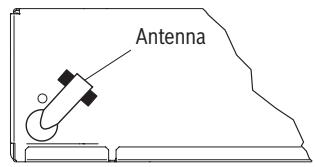
4.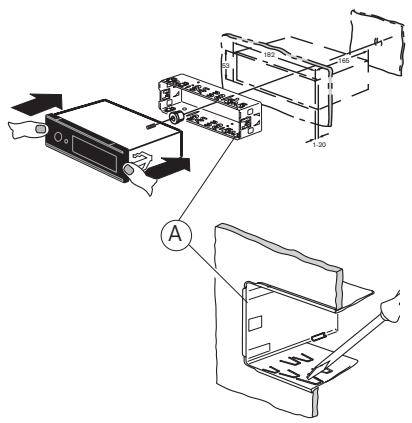
- Removal
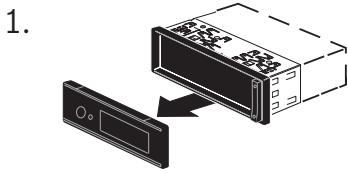
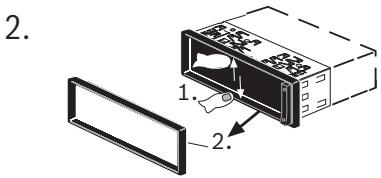
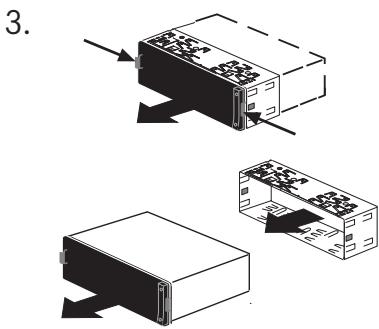
6.
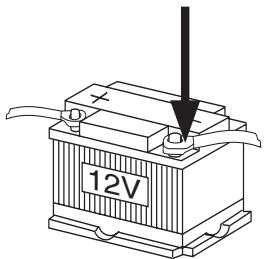
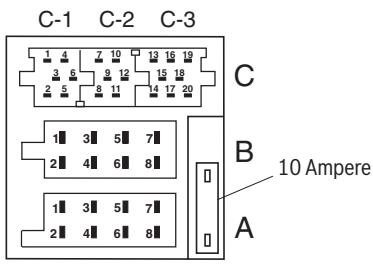
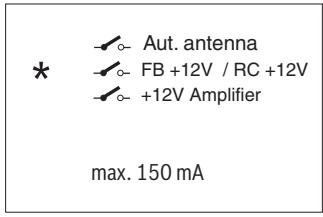
| A | B | ||
| 1 | NC | 1 | Speaker out RR+ |
| 2 | Radio Mute | 2 | Speaker out RR- |
| 3 | NC | 3 | Speaker out RF+ |
| 4 | Permanent +12V | 4 | Speaker out RF- |
| 5 | Aut. antenna* | 5 | Speaker out LF+ |
| 6 | Illumination | 6 | Speaker out LF- |
| 7 | KI.15/Ignition | 7 | Speaker out LR+ |
| 8 | Masse/GND | 8 | Speaker out LR- |
| C1 | C2 | C3 | |||
| 1 | Line Out LR | 7 | NC | 13 | CDC-Data In |
| 2 | Line Out RR | 8 | NC | 14 | CDC-Data Out |
| 3 | Line Out / Ground | 9 | Radio Mute | 15 | Permanent +12V |
| 4 | Line Out LF | 10 | SW Supply - RC +12V* | 16 | SW Supply +12V* |
| 5 | Line Out RF | 11 | Remote Control | 17 | Bus - Masse/GND |
| 6 | SW Supply +12V Amp. * | 12 | RC - GND | 18 | CDC/AUX1 Audio IN-GND |
| 19 | CDC/AUX1 Audio IN-L | ||||
| 20 | CDC/AUX1 Audio IN-R | ||||
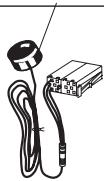
CD-Changer / AUX IN
Preamp-Out cable
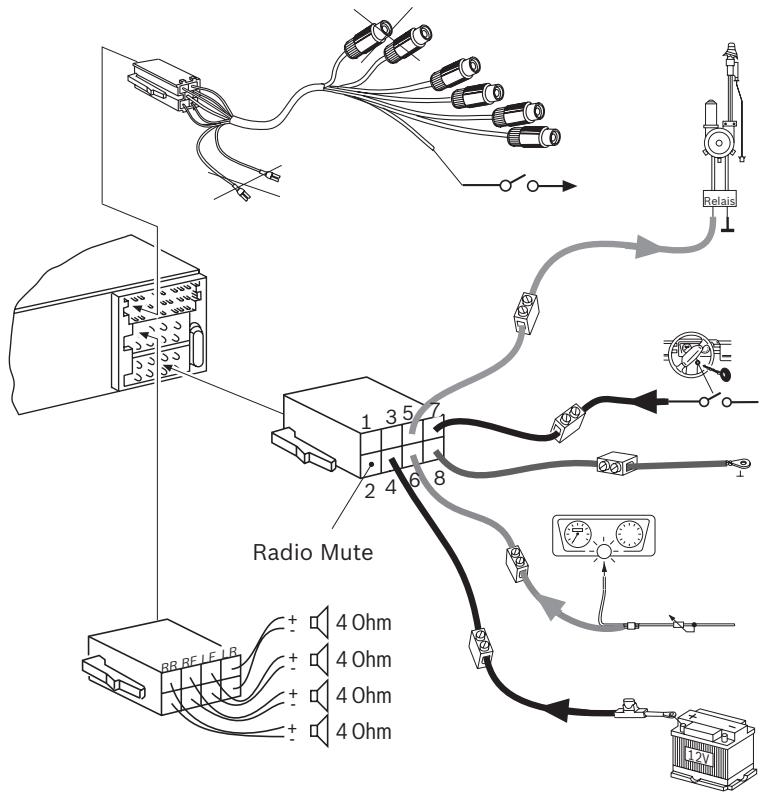
Subject to changes!
Subject to changes!
Subject to changes!
Subject to changes!
© 2008 All rights reserved by Blaupunkt. This material may be reproduced, copied or distributed for personal use only.
This product is protected by certain intellectual property rights of Microsoft. Use or distribution of such technology outside of this product is prohibited without a license from Microsoft.
| Country: | Phone: | Fax: | WWW: | |
| Germany | (D) | 0180-5000225 | 05121-49 4002 | http://www.blaupunkt.com |
| Austria | (A) | 01-610 39 0 | 01-610 39 391 | |
| Denmark | (DK) | 44-898 360 | 44-898 644 | |
| Finland | (FIN) | 09-435 991 | 09-435 99236 | |
| Great Britain | (GB) | 01-89583 8880 | 01-89583 8394 | |
| Greece | (GR) | 210 94 27 337 | 210 94 12 711 | |
| Ireland | (ILR) | 01-46 66 700 | 01-46 66 706 | |
| Italy | (I) | 02-369 62331 | 02-369 62464 | |
| Luxembourg | (L) | 40 4078 | 40 2085 | |
| Norway | (N) | +47 64 87 89 60 | +47 64 87 89 02 | |
| Portugal | (P) | 2185 00144 | 2185 00165 | |
| Spain | (E) | 902 52 77 70 | 91 410 4078 | |
| Sweden | (S) | 08-7501850 | 08-7501810 | |
| Switzerland | (CH) | 01-8471644 | 01-8471650 | |
| Czech. Rep. | (CZ) | 02-6130 0446 | 02-6130 0514 | |
| Hungary | (H) | 76 889 704 | - | |
| Poland | (PL) | 0800-118922 | 022-8771260 | |
| Turkey | (TR) | 0212-335 07 23 | 0212-346 00 40 | |
| USA | (USA) | 800-950-2528 | 708-6817188 | |
| Brasil (Mercosur) | (BR) | 0800 7045446 | +55-19 3745 2773 | |
| Malaysia (Asia Pacific) | (MAL) | +604-6382 474 | +604-6413 640 | |
Passport
Name:
Type: 7649...
Serial no.: BP


BLAUPUNKT


- SAFETY NOTES
- CLEANING NOTES
- DISPOSAL NOTES
- SCOPE OF DELIVERY
- PLACING THE DEVICE IN OPERATION
- TRAFFIC INFORMATION
- RADIO MODE
- CD/MP3/WMA/C'N'C/CD CHANGER MODE
- BLUETOOTH
- EXTERNAL AUDIO SOURCES
- SOUND SETTINGS
- USER SETTINGS
- FACTORY SETTINGS
- USEFUL INFORMATION
- TECHNICAL DATA
- INSTALLATION INSTRUCTIONS
- SYMBOLS USED
- DANGER
- CAUTION
- ROAD SAFETY
- GENERAL SAFETY NOTES
- USE AS DIRECTED
- DECLARATION OF CONFORMITY
- NOTE
- OPTIONAL EQUIPMENT (NOT PART OF THE SCOPE OF DELIVERY)
- ATTACHING/DETACHING THE CONTROL PANEL
- DAMAGE TO THE CONTROL PANEL
- ATTACHING THE CONTROL PANEL
- REMOVING THE CONTROL PANEL
- SETTING THE TUNER REGION
- SWITCHING ON/OFF
- SWITCHING ON/OFF WITH THE ON/OFF BUTTON
- SWITCHING ON/OFF VIA VEHICLE IGNITION
- VOLUME
- ADJUSTING THE VOLUME
- MUTING THE CAR SOUND SYSTEM (MUTE)
- SWITCHING DEMO MODE ON/OFF
- DISPLAYING VERSION NUMBERS
- NOTES
- RDS
- CHANGING TO RADIO MODE
- SELECTING THE MEMORY BANK
- TUNING INTO A STATION
- TUNING INTO STATIONS MANUALLY
- STARTING STATION SEEK TUNING
- STORING STATIONS/CALLING STORED STATIONS
- SCANNING STATIONS
- STORING STATIONS AUTOMATICALLY (TRAVELSTORE)
- PTY
- SELECTING A PROGRAMME TYPE
- SEARCHING FOR STATIONS
- CONFIGURING THE DISPLAY
- CD/MP3/WMA/C'N'C/ CD CHANGER MODE
- BASIC INFORMATION
- CD/MP3/WMA MODE
- RISK OF SEVERE DAMAGE TO THE CD DRIVE
- C'N'C MODE
- CD CHANGER MODE
- CHANGING TO CD/MP3/WMA/C'N'C/CD CHANGER MODE
- INSERTING A CD
- EJECTING A CD
- CONNECTING/REMOVING A USB DATA CARRIER
- SELECTING TRACKS
- SELECT A FOLDER/CD (ONLY IN MP3/WMA/C'N'C OR CD CHANGER MODE)
- FAST SEARCHING
- INTERRUPTING PLAYBACK
- [ PLAYLIST MODE (ONLY IN MP3/WMA MODE) ]
- SELECTING TRACKS IN PLAYLIST MODE
- EXITING THE PLAYLIST MODE
- SCANNING ALL TRACKS
- PLAYING TRACKS IN RANDOM ORDER
- REPEATEDLY PLAYING INDIVIDUAL TRACKS, CDS OR DIRECTORIES
- BLUETOOTH®
- BLUETOOTH® MENU
- CALLING THE BLUETOOTH® MENU
- EXITING THE BLUETOOTH® MENU
- REGISTERING AND CONNECTING A DEVICE
- REGISTERING AND CONNECTING A CELL PHONE
- REGISTERING AND CONNECTING A BLUETOOTH® STREAMING DEVICE
- TELEPHONE FUNCTIONS
- ANSWERING/REJECTING AN INCOMING PHONE CALL
- MAKING A CALL
- STORING PHONE NUMBERS
- SPEED DIAL
- BLUETOOTH® STREAMING MODE
- STARTING THE BLUETOOTH® STREAMING MODE
- ADDITIONAL FUNCTIONS IN THE BLUETOOTH® MENU
- CHANGING THE BLUETOOTH® PIN
- MANAGING REGISTERED DEVICES
- UNREGISTERING ALL REGISTERED DEVICES
- FRONT AUX-IN SOCKET
- DANGER! INCREASED RISK OF INJURY FROM CONNECTOR
- REAR AUX INPUT
- STARTING C'N'C MODE
- STARTING AUX MODE
- CALLING AND EXITING THE AUDIO MENU
- PERFORMING SETTINGS IN THE AUDIO MENU
- BASS
- TREBLE
- BALANCE
- FADER
- X-BASS
- CALLING AND EXITING THE ENHANCED AUDIO MENU
- PERFORMING SETTINGS IN THE ENHANCED AUDIO MENU
- E-BASS
- E-TREBLE
- E-MIDDLE
- E-XBASS
- PRESETS
- CALLING AND EXITING THE USER MENU
- PERFORMING SETTINGS IN THE USER MENU
- CDC
- CN
- CDTEXT
- TA VOLUME
- (ONLY FOR TUNER REGION "EUROPE")
- SENS
- SCAN TIME
- CLOCK SET
- H/24H MODE
- CLOCK
- BEEP
- MUTE LVL
- ON VOLUME
- REG
- PTYLANG
- (ONLY FOR TUNER REGIONS "EUROPE", "USA", "S AMERICA")
- DISP COL
- SCAN
- COL SCAN
- DIM DAY/DIM NIGHT
- AUX EDIT
- TRAF (ONLY FOR TUNER REGION "EUROPE")
- RDS (ONLY FOR TUNER REGION "EUROPE")
- WARRANTY
- SERVICE
- VOLTAGE SUPPLY
- CURRENT CONSUMPTION
- AMPLIFIER
- TUNER
- CD
- PRE-AMP OUT
- INPUT SENSITIVITY
- DIMENSIONS AND WEIGHT
- SET TUNER REGION
- REMOVE THE FRONT PANEL
- TUNE IN STATIONS
- SET STATION MANUALLY
- SAVE STATION/RETRIEVE SAVED STATION
- AUX INPUT ON THE BACK
- FREQUENCY RANGES USA
- DEVICE SWITCHING ON
- ADDITIONAL INFORMATION
- MODES
- MP3/WMA/C'C/CD PLAYER MODE
- TECHNICAL SPECIFICATIONS
- SAFETY INSTRUCTIONS
- GENERAL SAFETY INSTRUCTIONS
- INTENDED USE
- CLEANING INSTRUCTIONS
- DISPOSAL INSTRUCTIONS
- OPTIONAL ACCESSORIES (NOT INCLUDED IN THE SCOPE OF DELIVERY)
- SWITCHING ON THE DEVICE
- REMOVING/INSTALLING THE CONTROL PANEL
- INSTALLING THE CONTROL LEVER
- REMOVING THE CONTROL LEVER
- SETTING THE TONE REGION
- SWITCHING ON/OFF THE KEYPAD/DISPLAY
- SWITCHING OFF/ON THE CAR IGNITION
- VOLUME ADJUSTMENT
- ATTENTION: FOLLOW THE INSTRUCTIONS
- AUTOMATIC SOUND MUTING (MUTE)
- SWITCHING THE DEMONSTRATION MODE ON/OFF
- DISPLAY SOFTWARE VERSION
- MODE
- SWITCHING THE RADIO ON/OFF
- SELECTING THE STATION MEMORY BANK
- STORING RADIO STATIONS
- STORING STATIONS / RECALLING STORED STATIONS
- STATION SEARCH
- SELECTING A FOLDER/CD DISC (ONLY FOR MP3/WMA/CD-TEXT OR CD CHANGER)
- FAST SEARCH
- PLAYBACK STOP
- PLAYLIST MODE (ONLY IN MP3/WMA PLAYBACK MODE)
- SELECTING A PLAYLIST
- NOTE: FOLLOW
- EXITING PLAYLIST MODE
- SCANNING ALL TRACKS WITH PREVIEW
- TIMING
- EXITING THE BLUETOOTH MENU
- PAIRING AND CONNECTING THE DEVICE
- PAIRING AND CONNECTING A MOBILE PHONE
- PAIRING AND CONNECTING THE STREAMING AUDIO DEVICE VIA BLUETOOTH
- PHONE FUNCTIONS
- ANSWERING/ENDING A CALL
- NOTE: OBSERVE
- SAVING A PHONE NUMBER
- QUICK DIAL
- STREAMING AUDIO MODE VIA BLUETOOTH®
- STREAMING AUDIO PLAYBACK VIA BLUETOOTH
- TRACK SELECTION
- DELETING THE PAIRING WITH ALL PAIRED DEVICES
- AUX-IN JACK ON THE FRONT SIDE
- DANGER! RISK OF INJURY FROM THE JACK PLUG
- PRESS THE MENU-OK BUTTON 15 BRIEFLY TO OPEN THE USER MENU
- EXIT FROM THE EXTENDED AUDIO MENU
- PERFORMING ADJUSTMENTS IN THE EXTENDED AUDIO MENU
- CALLING UP AND EXITING THE USER MENU
- CD TEXT
- (ONLY FOR THE "EUROPE" REGION)
- WEIGHT
- GENERAL CLEANING INSTRUCTIONS
- YNOEICVI ATN ANOKOIB
- IIEIPEXOJEVO OUKEUAOIAC
- EVCPYONOIN
- EPYOATAAEKCPUIOAEIC
- XPOUEC PNOOPOPIEC
- XPNOOUOOVUAETNPOOBAYPAPEC
- SWITCHING ON/OFF VIA THE MACHINE SWITCH
- WALL MOUNTING
- CAR RADIO MUTE
- ACTIVATE/DEACTIVATE DEMONSTRATION MODE
- DISPLAY OF VERSION NUMBERS
- CD/MP3/WMA OPERATION
- DANGER OF ACCIDENTS DUE TO THE CD GUIDE
- AUX-IN CONNECTION POSSIBLE
- DANGER! HIGH RISK OF INJURY FROM THE STRAP
- GB - INSTALLATION INSTRUCTIONS
- DO NOT CONNECT THE VEHICLE'S PLUG CONNECTORS TO THE RADIO
- PREAMP-OUT CABLE
- PASSPORT
- BLAUPUNKT
Brand : BLAUPUNKT
Model : TORONTO 400 BT
Category : Car radio