67121 - Vacuum Cleaner Lund - Free user manual and instructions
Find the device manual for free 67121 Lund in PDF.


| Product Type | Bagless Cyclonic Vacuum Cleaner |
| Brand | Lund |
| Model | 67121 |
| Usage | Household only, for hard floors and carpets |
| Battery Type | Built-in Li-ion, 22.2 V DC, 2 Ah |
| Rated Voltage | 22.2 V DC |
| Rated Power | 200 W |
| Turbo Brush Power | 15 W |
| Weight | 3.2 kg |
| Electrical Protection Class (Appliance) | III |
| Electrical Protection Class (Charger) | II |
| Charger Input Voltage | 100-240 V~, 50/60 Hz |
| Charger Output Voltage | 27 V DC, 500 mA |
| Charge Indicator | LED Ring (flashes during charging, stays on when complete) |
| Power Settings | 2 suction levels |
| Filters | External metal mesh filter and internal HEPA filter (washable) |
| Included Accessories | Aluminum tube, turbo brush, turbo brush for carpets, crevice tool, 2-in-1 bristle flat brush, mop with water tank, flexible hose, wall mount hook |
| Maintenance | Clean tank and filters with a damp cloth; filters can be rinsed with warm water and dried completely (24 h) |
| Safety | Do not use without filter, do not vacuum liquids, hot ashes, or sharp objects |
| Storage | Use the wall mount hook to attach the vacuum to a wall |
Frequently Asked Questions - 67121 Lund
User questions about 67121 Lund
0 question about this device. Answer the ones you know or ask your own.
Ask a new question about this device
Download the instructions for your Vacuum Cleaner in PDF format for free! Find your manual 67121 - Lund and take your electronic device back in hand. On this page are published all the documents necessary for the use of your device. 67121 by Lund.
USER MANUAL 67121 Lund
natural_image
Black vacuum cleaner with extended handle and adjustable arm (no text or symbols visible)CE
natural_image
Exploded view of a vacuum cleaner assembly with numbered parts (no text or symbols on the diagram itself)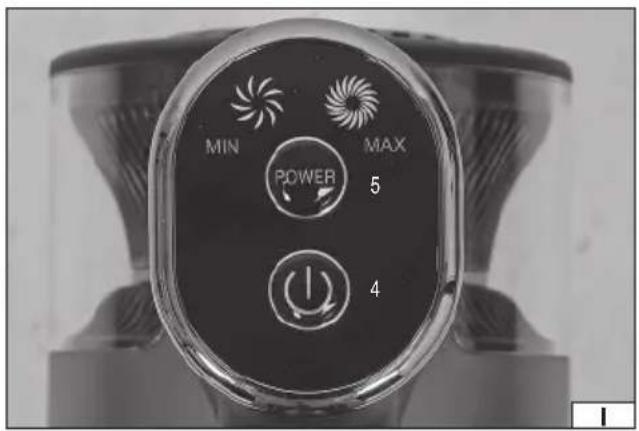
natural_image
Close-up of hands holding a vacuum cleaner with a mesh handle, showing internal airflow patterns (no text or symbols visible)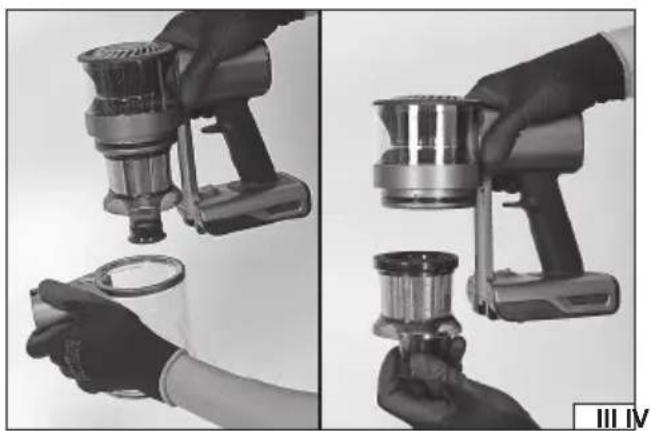
natural_image
Two-panel black-and-white photo showing hands operating a cleaning brush and a small container, no text or symbols visible.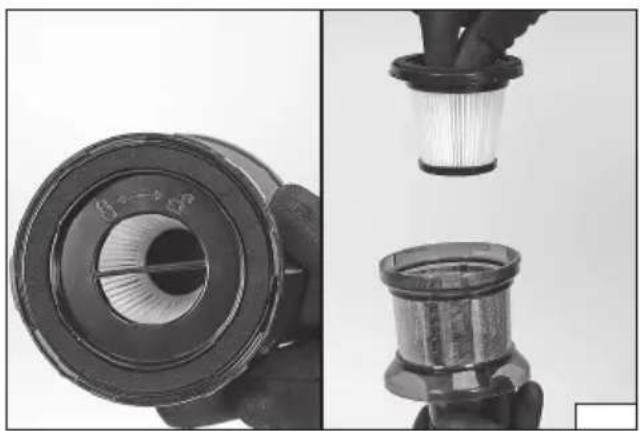
natural_image
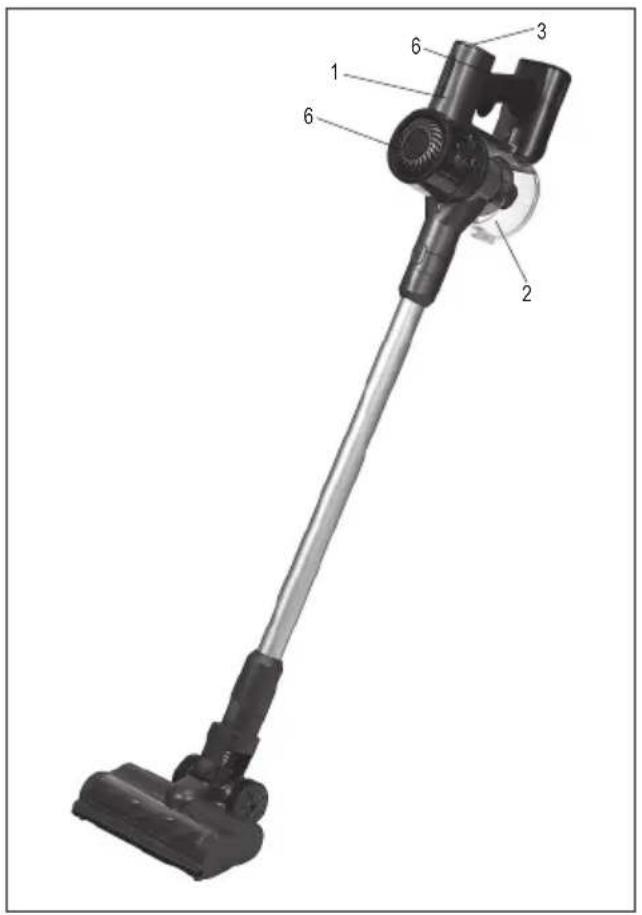
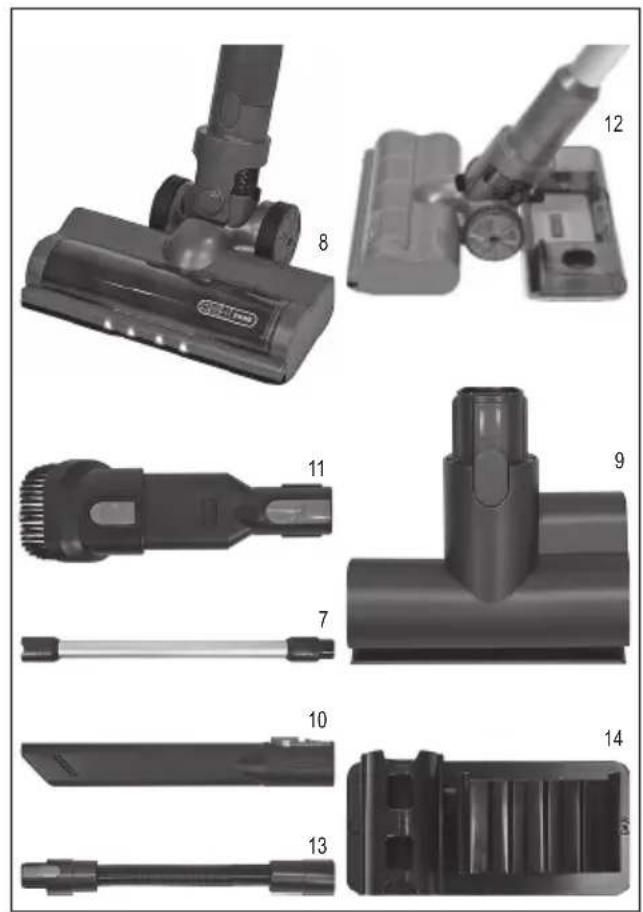
Close-up of mechanical components including a cylindrical component and a flanged housing, with no visible text or symbols.- vacuum cleaner
- dust container
- control panel
- power switch
- suction power adjustment
- battery charge indicator
- aluminium pipe
- turbo brush
- carpet turbo brush
- crevice nozzle
- 2 in 1 fl at bristle brush
- mop with water tank
- elastic hose
- wall bracket
DE
Read the operating instruction
This symbol indicates that waste electrical and electronic equipment (including batteries and storage cells) cannot be disposed of with other types of waste. Waste equipment should be collected and handed over separately to a collection point for recycling and recovery, in order to reduce the amount of waste and the use of natural resources. Uncontrolled release of hazardous components contained in electrical and electronic equipment may pose a risk to human health and have adverse effects for the environment. The household plays an important role in contributing to reuse and recovery, including recycling of waste equipment. For more information about the appropriate recycling methods, contact your local authority or retailer.
APPLIANCE CHARACTERISTICS
The cyclone vacuum cleaner is used to clean hard floors and carpets with an air stream. The vacuum cleaner does not require dust bags. The air stream is set in a swirling motion inside the vacuum cleaner's container, which allows to separate the sucked in impurities. The product is designed for domestic use only and may not be used in commercial applications. The correct, reliable, and safe operation of the appliance depends on its proper use, so:
Reading and keeping the entire manual before the first use of the appliance.
The supplier shall not be held liable for any damage resulting from failure to observe the safety regulations and recommendations specified in this manual.
ACCESSORIES
The vacuum cleaner is supplied with additional accessories in the form of a pipe and brushes for various purposes.
SAFETY INSTRUCTIONS
CAUTION! Read all of the following instructions. Failure to do so may result in electric shock, fire, or personal injury.
FOLLOW THE INSTRUCTIONS BELOW
Do not use the product in an explosive environment containing flammable liquids, gases, or vapours. Do not place the appliance near any heat or fire sources. Connect the appliance only to the power network with the voltage and frequency indicated on the nameplate of the appliance. The plug of the power cord must match the power socket. Do not modify the plug. Do not use any power adapters to adapt the plug to the socket. An unmodified plug, which matches the socket, reduces the risk of an electric shock. After each application, unplug the power cord from the power socket. Avoid direct contact with grounded surfaces such as piping, radiators and refrigerators. Grounding of the body increases the risk of an electric shock. The appliance is intended for indoor use only. Do not expose the appliance to any precipitation or moisture. If water and moisture enters the appliance, the risk of an electric shock is significantly increased. Do not immerse the product in water or any other liquid. Do not obstruct the ventilation openings and make sure they are clear. Obstructed and/or clogged ventilation openings may cause the appliance to overheat. This can lead to damage to the appliance or cause fire or electric shock. Do not overload the power cord. Do not use the power cord to carry, connect, or disconnect the plug from the power socket. Avoid any contact between the power cord and heat sources, oil, sharp edges, and moving parts. Damage to the power cord increases the risk of an electric shock. If the power cord is damaged (e.g. it is cut, its insulation is melted), immediately unplug it from the wall socket, and return it to an authorised service facility. It is not allowed to use the product with a damaged power cord. It is not allowed to have the power cord repaired. It must be changed for a new one at an authorized service centre. When using extension cords, use extension cords with power parameters such as those shown on the appliance's nameplate. The cross-section of the extension wires shall not be less than the cross-section of the wires of the power cord of the appliance. This should be checked on the insulation of the power cord and the extension cord, or contact the manufacturer of the appliance and/or the extension cord. If you notice any damage to any part of the appliance, you must discontinue using it. In this case, the appliance must be taken to an
EN
authorised service centre or replaced by yourself, if this is permitted by the user's manual. Turn off the appliance and unplug the power cord from the wall socket before you start any work on replacing, cleaning, or adjusting. Switch off the appliance before replacing the accessories and unplug the power cord from the socket. This appliance may be used by children of at least 8 years of age and by persons with reduced physical, mental abilities and persons with no experience or knowledge of the appliance, if supervised or instructed on its safe use so that the risks associated with it were understandable. Children should not play with the appliance. Children should not be allowed to clean or maintain the product without supervision. The appliance is intended for home use only. Do not use the vacuum cleaner on people and animals, do not put the inlet of the suction nozzles near eyes and ears. Do not pass through the power cord with the vacuum cleaner, do not stand on the power cord. This can damage the cable and cause electrical shock. Check the condition of the vacuum cleaner filters before each use. It is forbidden to use the vacuum cleaner without filters or with damaged filters. Before each use, check the passability of the hose, pipes and suction nozzles. If a decrease in suction power or increased noise is noticed during operation, the passability of the above mentioned elements and the level of filling of the dust container must be checked. Do not vacuum cigarette butts, matches, hot ashes. Avoid pulling in sharp objects such as needles, nails, pins or staples. Do not vacuum water or other liquids. Do not vacuum wet waste. Do not vacuum fine dust, e.g. flour, gypsum, printer toner, etc. Do not use the vacuum cleaner for cleaning industrial waste, e.g. sawdust, debris, metal filings, etc. The vacuum cleaner must not be used in a dust extraction system where the dust is generated during operation of other tools, e.g. grinding, cutting, polishing, etc. When vacuuming, static charges may occur on the appliance. This is normal, especially when cleaning in low humidity conditions. In order to minimise this phenomenon, it is necessary to periodically touch the grounded, metal objects around the house, e.g. radiators, with the pipe and to increase the humidity in the room to be cleaned.
OPERATING THE APPLIANCE
CAUTION! Turn off the appliance and unplug the power cord from the socket during accessory assembly and disassembly activities.
Appliance assembly and disassembly
Take the vacuum cleaner, the dust container, and accessories out of the packaging and remove all packaging components.
Assemble the dust container.
Before first use, make sure that the container has all components and is correctly assembled.
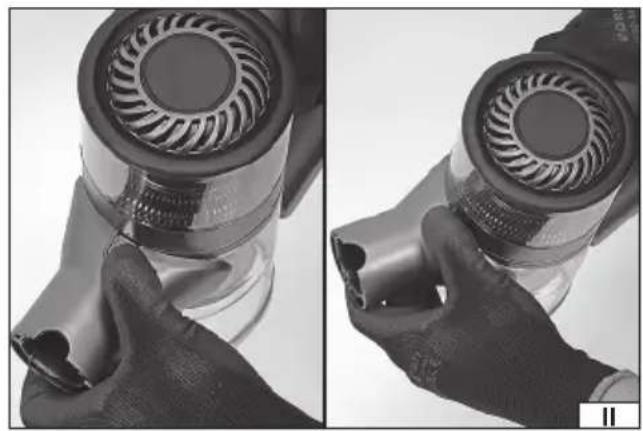
If the container is mounted on a vacuum cleaner, it must be removed. Press the lock lever with your finger and then remove the container (II) from the vacuum cleaner (III).
Pull and remove the filter assembly (III). The filter assembly consists of an external metal mesh filter and an internal HEPA filter.
The internal filter can be removed by turning it in the direction indicated by the arrow pointing at the open padlock symbol, and then sliding out (IV).
Check the condition of each filter and the condition of the gasket in the paper filter base to ensure that no components are damaged. The container has a snap-on lid on the front. Make sure it is closed. The lid is opened by pulling back the latch (V).
Attach the container with the closed lid and the installed filters to the vacuum cleaner. The container and the internal filter have special grooves near their edge in which the tabs of the assembly point must be inserted. Correctly installed, these two elements adhere with edges along the entire circumference to their assembly points.
A correctly installed container cannot be removed otherwise than by pressing the latch and rotating the container.
Assembly of accessories
Insert the selected accessory (VI) into the opening in the vacuum cleaner housing. The properly installed accessory is secured
EN
with a latch. The accessory can be removed by pressing and holding the latch (VII).
If an aluminium pipe has been used at the other end, the brush can be mounted in the same manner as described above.
Intended use of the accessories
Aluminium pipe – a fixed-length pipe which allows to extend the length of the vacuum cleaner, making it possible to clean larger areas comfortably. The pipe is also used to power the turbo brush.
Turbo brush – universal brush for cleaning all types of hard floors. With the additional rotating brush it is possible to effectively clean hair and fur.
Carpet turbo brush – a special brush designed for cleaning carpets, carpet flooring, wall-hanging rugs and other soft surfaces.
Crevice nozzle – allows for cleaning narrow crevices and places inaccessible for larger brushes.
2 in 1 flat bristle brush – a universal brush of a smaller size than turbo brushes which allows to clean in places with limited access.
Mop with a water container – allows to wet-clean hard surfaces. The mop only connects to the turbo brush and there is no other way to use the mop.
Flexible hose – allows easier manoeuvring with a brush connected to it. The hose does not power the turbo brush.
Wall bracket – allows to attach the vacuum cleaner and some accessories to the wall (IX), organising storage and facilitating access to the vacuum cleaner.
Charging the battery
The vacuum cleaner has a built-in battery which cannot be removed from the vacuum cleaner. Charging is possible after connecting the charger plug to the vacuum cleaner socket (VIII). Then, the charger needs to be connected to the mains outlet.
During charging, the LED ring on top of the vacuum cleaner housing will pulsate. The end of charging is indicated by the ring glowing continuously.
The vacuum cleaner should be under supervision throughout the charging process. Immediately after charging is complete, disconnect the charger from the mains and the vacuum cleaner from the charger.
WARNING! Leaving the vacuum cleaner with a fully charged battery connected to the charger will lead to irreparable damage to the battery and may cause fire or electric shock.
WARNING! It is forbidden to use a different charger for charging than the one supplied with the vacuum cleaner.
It is not possible to use a vacuum cleaner for cleaning while charging the battery.
Safety instructions for battery charging
Caution! Before starting charging, make sure that the charger body, cord and plug are not cracked or damaged. It is forbidden to use a defective or damaged charger! Use only the supplied accessory charger to charge the batteries. Use of another charger may result in fire or damage to the appliance. The battery should only be charged in a closed, dry room, protected against unauthorised access, especially by children. Do not use the charger without the constant supervision of an adult! If you need to leave the room where the vacuum cleaner is being charged, disconnect the charger from the mains by removing the charger plug from the socket. If smoke, suspicious odours, etc. are escaping from the charger, remove the charger plug from the mains socket immediately! The product is supplied with an uncharged battery and should therefore be charged according to the procedure described in the manual before use. Li-ion (lithium-ion) batteries do not have the so-called "memory effect", which allows them to be recharged at any time. However, it is recommended to discharge the battery during normal operation and then charge it to full capacity. If, due to the nature of work, it is not possible to use the battery in such a manner every time, it should be done at least every several work cycles. Never discharge the batteries by closing the battery contacts, as this will cause irreparable damage! Also, do not check the battery charge status by closing the contacts and checking sparking.
Battery storage
If possible, it is recommended to disconnect the battery from the product for storage. Proper storage conditions will help to extend the life of the battery. The battery can withstand approximately 500 charge-discharge cycles. Store the battery at a temperature ranging from 0^ C to 30^ C at the relative air humidity of 50%. Charge the battery to approx. 70% of its total capacity to store it for a longer period of time. In case of prolonged storage, the battery should be periodically charged once a year. Do not over-discharge the battery as this will shorten its life and may cause irreparable damage. During storage, the battery will gradually discharge due to leakage. The self-discharge process depends on the storage temperature – the higher the temperature, the faster the discharge process. If the batteries are stored incorrectly, the electrolyte may leak. In case of leakage, secure the leak with a neutralising agent. In the case of electrolyte contact with eyes, rinse eyes thoroughly with water, and immediately seek medical attention. It is not allowed to use the appliance with a damaged battery. If the battery is completely worn, return it to a specialist waste disposal centre.
Transport of batteries
Lithium-ion batteries are treated as hazardous materials, according to legal regulations. The user of the appliance can transport the product with the battery and the batteries themselves by land. In that case, no additional conditions have to be met. If you entrust transport to third parties (e.g. a courier company), follow the regulations regarding the transport of hazardous goods.
Before shipping, please contact a properly qualified person. It is not allowed to transport damaged batteries. During transport, the
EN
disassembled batteries should be removed from the product, the exposed contacts should be secured, e.g. sealed with insulation tape. Protect the batteries in the packaging in such a way that they do not move inside the packaging during transport. National regulations for the transport of hazardous materials must also be observed.
Using the appliance
After installing the dust container and the selected accessories, make sure that the battery has been correctly installed in the vacuum cleaner. Press the power switch. The vacuum cleaner will begin operation. The button marked "POWER" adjusts the suction. Two suction settings are available.
The charge indicator will illuminate and its segments will go out as the battery power runs out. The higher the suction power, the faster the battery will be depleted.
When using the mop, open the filler by turning the cap in the direction indicated by the arrow marked with the open padlock symbol, fill the tank with clean water and close the filler cap. Only when filled can the mop be connected to the turbo brush. Do not fill the tank with a liquid other than clean, cold water. Do not fill the tank connected to the turbo brush. If water is spilled when filling the mop, dry it thoroughly before attaching the mop to the brush.
Control the amount of dust in the container during operation. The container has an indicator of the maximum level of impurities marked "Max". Place the container vertically with the lid downwards and check the amount of impurities. Empty the container, if necessary.
MAINTENANCE AND STORAGE
CAUTION! Never immerse the vacuum cleaner in water or other liquids. Doing so may result in electric shock.
After cleaning, turn off the vacuum cleaner with the switch, disconnect the power cord plug from the socket, disconnect the accessories, and proceed with maintenance.
Disconnect the dust container from the vacuum cleaner. Open the lower cover of the container and discharge the waste collected in the container. Open the top lid, remove both filters. Clean the container with a damp, soft cloth, then dry with a dry cloth or allow to dry.
Warning! It is forbidden to use the vacuum cleaner with a wet or damp filter. This can result in electrocution.
The filters can be rinsed under running, lukewarm water. Next dry with a dry cloth and allow to dry completely. Wait at least 24 hours after placing the filter in a well-ventilated place at room temperature.
Do not wash filters in mechanical dishwashers and do not dry them with a stream of hot air. This can cause deformation of the materials used for the construction of the filters. Avoid exposing the filters to direct sunlight.
No other part of the vacuum cleaner must be exposed to water. Replace the filter with a new one in case of excessive contamination.
Clean the remaining parts of the vacuum cleaner with a cloth slightly soaked in water, then dry or allow to dry.
To clean the turbo brush shaft, disconnect the brush from the pipe or the vacuum cleaner, then remove the brush clamp and take out the shaft (X), clean it and reinstall it in the brush in the order reverse to that of disassembly.
TECHNICAL PARAMETERS
| Parameter Unit Value | ||
| Catalogue No. 67121 | ||
| Rated voltage [VDC] 22.2 | ||
| Rated power [W] 200 | ||
| Brush rated power | [W] | 15 |
| IEC protection class III | ||
| Weight [kg] 3.2 | ||
| Battery | ||
| - type Li-ion | ||
| - capacity [Ah] | 2 | |
| - rated voltage | [VDC] 22.2 | |
| Charger | ||
| - rated supply voltage | [V~] | 100 - 240 |
| - rated frequency | [Hz] | 50/60 |
| - rated input current | [A] | |
| - rated output voltage | [VDC] | 27 |
| - rated output current | [mA] | 500 |
| - electrical protection class | II |
GERÄTEBESCHREIBUNG
Transport van accu's
- DE
- APPLIANCE CHARACTERISTICS
- ACCESSORIES
- SAFETY INSTRUCTIONS
- FOLLOW THE INSTRUCTIONS BELOW
- EN
- OPERATING THE APPLIANCE
- Appliance assembly and disassembly
- Assembly of accessories
- Intended use of the accessories
- Charging the battery
- Safety instructions for battery charging
- Battery storage
- Transport of batteries
- Using the appliance
- MAINTENANCE AND STORAGE
- GERÄTEBESCHREIBUNG
- Transport van accu's
Brand : Lund
Model : 67121
Category : Vacuum Cleaner