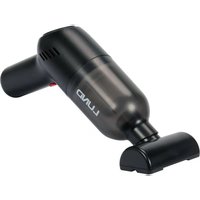
82955 - Vacuum Cleaner Lund - Free user manual and instructions
Find the device manual for free 82955 Lund in PDF.


| Brand | Lund |
| Model | 82955 |
| Product type | Cordless vacuum cleaner for car and small spaces |
| Rated voltage | 5 VDC (charge input) |
| Rated power | 60 W |
| Maximum charging current | 1 A |
| Weight | 0.7 kg |
| Battery type | Lithium-ion (Li-ion) |
| Battery capacity | 2.0 Ah |
| Rated battery voltage | 7.4 VDC |
| Dust tank capacity | Approximately 0.5 L (estimate) |
| Approximate runtime | Approximately 15 minutes (normal use) |
| Included accessories | Wide nozzle, crevice nozzle, brush |
| Filter type | Replaceable air filter |
| Filter maintenance | Dry cleaning (compressed air ≤0.3 MPa) or warm water |
| Filter replaceability | Yes, user-replaceable filter |
| Charger | USB charger (not included), recommended AC adapter |
| Charge indication | Red LED (charging), green LED (charging complete) |
| Maximum waste temperature | 40 °C |
| Usage | Indoor only, for dry materials |
| Safety instructions | Do not vacuum liquids, hot ashes, glowing objects; disconnect before maintenance |
| Disposal | Do not dispose with household waste; recycle according to WEEE regulations |
Frequently Asked Questions - 82955 Lund
User questions about 82955 Lund
0 question about this device. Answer the ones you know or ask your own.
Ask a new question about this device
Download the instructions for your Vacuum Cleaner in PDF format for free! Find your manual 82955 - Lund and take your electronic device back in hand. On this page are published all the documents necessary for the use of your device. 82955 by Lund.
USER MANUAL 82955 Lund
natural_image
Black LUND-branded medical device with three blades and a central propeller (no visible text or symbols)INSTRUKCJA ORYGINALNA
PL EN DE RU UA LT LV CZ SK HU RO ES FR IT NL GR

natural_image
Close-up of a white cylindrical device with three vertical slots, possibly a button or knob (no visible text or symbols)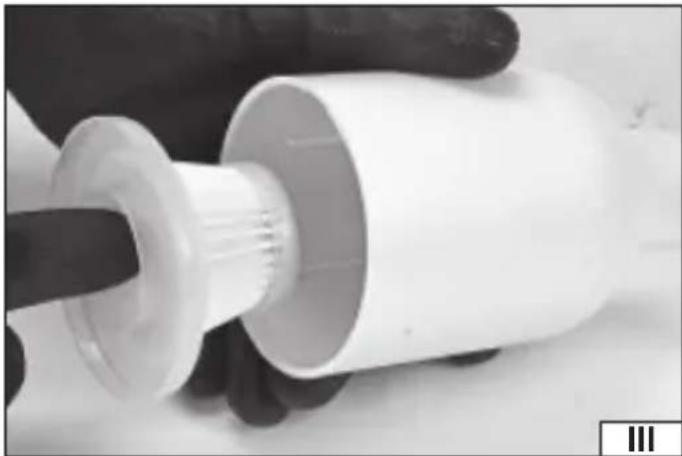
natural_image
Close-up of a hand holding a white cylindrical object with a side tab, no visible text or symbols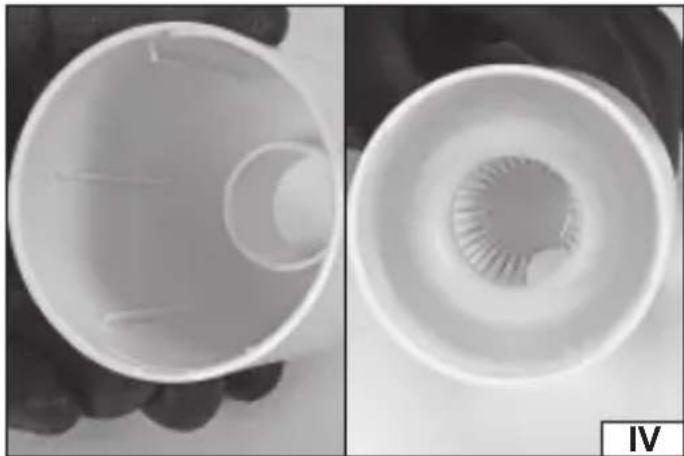
natural_image
Two views of a white plastic cup: top view shows interior and side, bottom view shows internal structure (no text or symbols)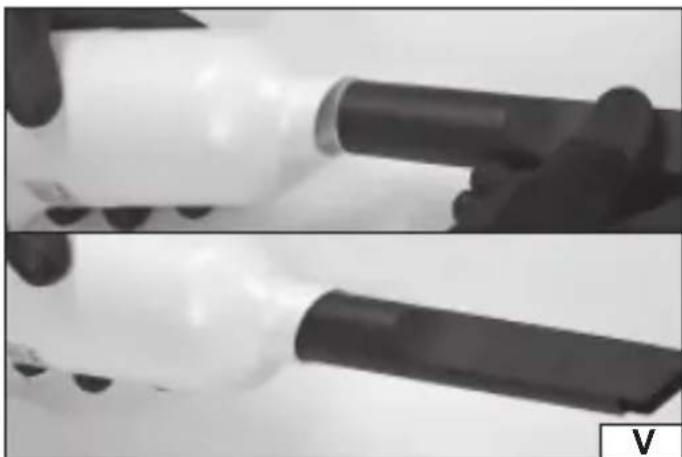
natural_image
Two black-and-white photos showing a cylindrical object being processed, with no visible text or symbols.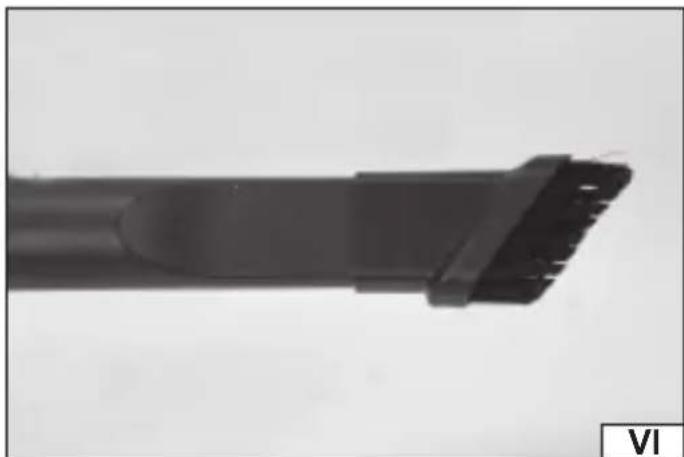
natural_image
Close-up of a black mechanical component with a flanged end and a small protrusion, labeled 'VI' in the corner (no other text or symbols visible)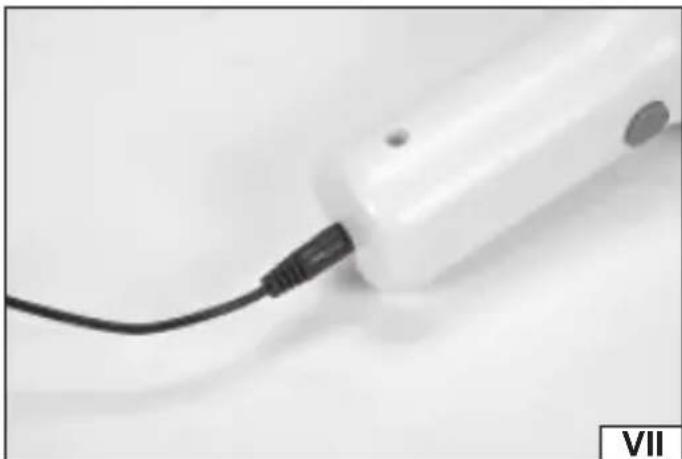
natural_image
Close-up of a white electric shaver with black cable, no visible text or symbols
Read the operating instruction
This symbol indicates that waste electrical and electronic equipment (including batteries and storage cells) cannot be disposed of with other types of waste. Waste equipment should be collected and handed over separately to a collection point for recycling and recovery, in order to reduce the amount of waste and the use of natural resources. Uncontrolled release of hazardous components contained in electrical and electronic equipment may pose a risk to human health and have adverse effects for the environment. The household plays an important role in contributing to reuse and recovery, including recycling of waste equipment. For more information about the appropriate recycling methods, contact your local authority or retailer.
WYPOSAŻENIE PRODUKTU
The vacuum cleaner allows you to clean the interior of cars, caravans, boats and other small surface interiors. The vacuum cleaner is equipped with a replaceable air filter. The product is designed for domestic use only and may not be used in commercial applications. The correct, reliable and safe operation of the appliance depends on its proper use therefore:
Read and keep the entire Manual before the first use of the tool.
The tool supplier shall not be liable for any damage resulting from failure to comply the safety instructions and recommendations specified in this manual.
ACCESSORIES
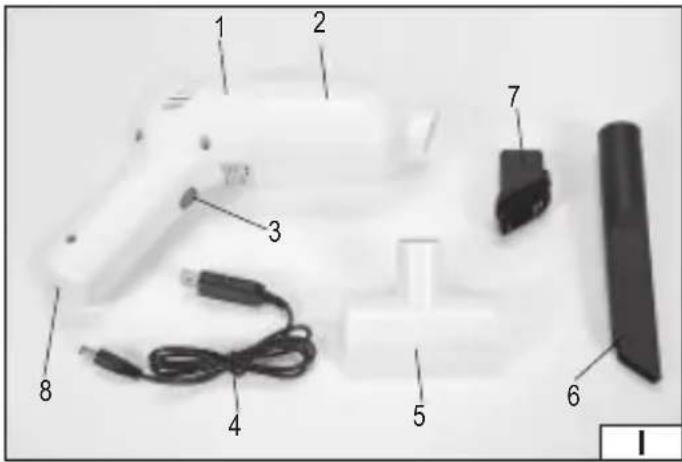
The product is supplied complete and does not require assembly. The vacuum cleaner is delivered with nozzles.
TECHNICAL DATA
| Parameter Unit Value | ||
| Catalogue No. 82955 | ||
| Rated voltage [V DC] 5 | ||
| Rated power [W] 60 | ||
| Maximum charging current [A] 1 | ||
| Weight [kg] 0.7 | ||
| Battery | ||
| - type | Li-ion | |
| - capacity | [Ah] | 2.0 |
| - rated voltage | [V DC] | 7.4 |
SAFETY INSTRUCTIONS
CAUTION! Read all of the following instructions. Failure to do so may result in electric shock, fire, or personal injury.
FOLLOW THE INSTRUCTIONS BELOW
Do not use the product in an explosive environment containing flammable liquids, gases, or vapours. Do not place the appliance near any heat or fire sources.
Connect the appliance only to the power network with the voltage and frequency indicated on the nameplate of the appliance.
The plug of the power cord must match the power socket. Do not modify the plug. Do not use any adapters to fit the plug to the socket. If unmodified, the plug matches the socket thus reducing the risk of an electric shock.
After each application, unplug the power cord plug from the socket.
EN
The appliance is intended for indoor use only. Do not expose the appliance to any precipitation or moisture. If water and moisture enters the appliance, the risk of an electric shock is significantly increased. Do not immerse the product in water or any other liquid.
Do not obstruct the ventilation openings and make sure they are clear. Obstructed and/or clogged ventilation openings may cause the appliance to overheat. This can lead to damage to the appliance or cause fire or electric shock.
Do not overload the power cord. Do not use the power cord to carry, connect, or disconnect the plug from the power socket. Avoid any contact between the power cord and heat sources, oil, sharp edges, and moving parts. Damage to the power cord increases the risk of an electric shock. If the power cord is damaged (e.g. it is cut or its insulation is melted), immediately unplug it from the wall socket and return it to an authorised service facility. It is not allowed to use the product with a damaged power cord. It is not allowed to have the power cord repaired. It must be changed for a new one at an authorized service centre. When using extension cords, use extension cords with power parameters such as those shown on the appliance's nameplate.
If you notice any damage to any part of the appliance, you must discontinue using it. In this case, the appliance must be taken to an authorised service centre or replaced by yourself, if this is permitted by the user's manual.
Turn off the appliance and unplug the power cord from the wall socket before you start any work on replacing, cleaning, or adjusting.
Switch off the appliance before replacing the accessories and unplug the power cord from the socket. This appliance may be used by children of at least 8 years of age and by persons with reduced physical, mental abilities and persons with no experience or knowledge of the appliance, if supervised or instructed on its safe use so that the risks associated with it were understandable. Children should not play with the appliance. Unattended children should not be allowed to perform the cleaning and maintenance of the device.
The vacuum cleaner is designed for dry running. It is forbidden to draw in water, wet ash or other wet waste. This may result in electric shock, which may endanger the health and life of the user and others.
Never draw in hot, glowing or burning objects. This can lead to fire or explosion and expose the user to serious injury or death. The maximum temperature of suctioned waste must not exceed 40^ C.
The device is intended for use in closed rooms and should not be exposed to water, including precipitation.
Make sure that the mains power parameters comply with the ones shown on the appliance's name-plate before connecting the power cord plug to the unit.
Before each use, check the condition of the appliance, including the power cord and plug. If any faults are noticed, do not use the device. Damaged cables and wires must be replaced with new ones in a specialist workshop.
Make sure that the power cord plug has been disconnected from the mains socket before carrying out maintenance on the unit.
Keep the device out of reach of unauthorized persons, especially children. Make sure that the device is out of the reach of unauthorized persons, especially children also during operation.
Move the device using the handle, do not move the device by pulling the power cord.
APPLIANCE OPERATION
CAUTION! Turn off the appliance and disconnect the charging cable during all equipment assembly and disassembly activities.
EN
Appliance assembly and disassembly
Take the vacuum cleaner, the dust container, and accessories out of the packaging and remove all packaging components. Assemble the dust container.
Before first use, make sure that the container has all components and is correctly assembled.
If the container is mounted on a vacuum cleaner, it must be removed. Hold the vacuum cleaner with one hand and grab the dust container with the other and turn it clockwise. Then remove the dust container from the vacuum cleaner (II).
Inside the dust container, there is a filter that protects the vacuum cleaner from dirt from the dust container getting into the vacuum cleaner. Inside the filter, there is a holder that allows for easy sliding out of the filter from inside the container (III). After emptying the container and cleaning the filter, slide it into the container so that its flange rests on the guides inside the container. The filter flange should adhere to the wall of the container along its entire circumference and be parallel to the container edge (IV). Otherwise, proper isolation of the vacuum cleaner from the dust container will not be ensured and the filter will not function properly.
Assemble the dust container on the vacuum cleaner. When assembling, make sure that the projecting elements at the edge of the vacuum cleaner are inserted into the recesses at the dust container edge (II). After both edges are adjacent to each other along their entire circumference, hold the vacuum cleaner and turn the dust container counter-clockwise as far as it will go.
The correctly assembled container adheres with the entire edge to the vacuum cleaner. The correctly assembled container cannot be removed otherwise than by rotating it in relation to the vacuum cleaner.
Assembly of accessories
Slide one of the attachments into the opening on the front of the dust container (V). You can assemble an additional brush on the crevice attachment (VI).
Disassemble the accessories by sliding them out from the dust container inlet opening.
Charging the battery
Plug the charger cable plug into the charging socket (VII) and then plug the charger into the USB socket of e.g. a computer or charger equipped with such a socket.
The charging process is indicated by the illumination of the red status light.
The end of charging is indicated by the illumination of the green status light.
The vacuum cleaner should be under supervision throughout the charging process. Immediately after charging is complete, disconnect the charger from the mains and the vacuum cleaner from the charger.
WARNING! Leaving the vacuum cleaner with a fully charged battery connected to the charger will lead to irreparable damage to the battery and may cause fire or electric shock.
It is not possible to use a vacuum cleaner for cleaning while charging the battery.
Safety instructions for battery charging
Caution! Before starting charging, make sure that the charger body, cord and plug are not cracked or damaged. It is forbidden to use a defective or damaged charger! Use only the supplied accessory charger to charge the batteries. Use of another charger may result in fire or damage to the device. The battery should only be charged in a closed, dry room, protected against unauthorised access, especially by children. Do not use the charger without the constant supervision of an adult! If you need to leave the room where the vacuum cleaner is being charged, disconnect the charger from the mains
EN
by removing the charger plug from the socket. If smoke, odours, etc. are escaping from the charger, remove the charger plug from the socket immediately! The product is supplied with an uncharged battery and should therefore be charged according to the procedure described in the manual before use. Li-ion (lithium-ion) batteries do not have the so-called “memory effect”, which allows them to be recharged at any time. However, it is recommended to discharge the battery during normal operation and then charge it to full capacity. If, due to the nature of work, it is not possible to use the battery in such a manner every time, it should be done at least every several work cycles. Never discharge the batteries by closing the battery contacts, as this will cause irreparable damage! Also, do not check the battery charge status by closing the contacts and checking sparking.
Battery storage
If possible, it is recommended to disconnect the battery from the product for storage. Proper storage conditions will help to extend the life of the battery. The battery lasts for about 500 charge-discharge cycles. Store the battery in a temperature range from 0 to 30 degrees Celsius at a relative humidity of 50%. To store the battery for a longer period of time, it should be charged to approx. 70% of its capacity. In case of prolonged storage, the battery should be periodically charged once a year. Do not over-discharge the battery as this will shorten its life and may cause irreparable damage. During storage, the battery will gradually discharge due to leakage. The self-discharge process depends on the storage temperature, the higher the temperature, the faster the discharge process. If the batteries are stored incorrectly, the electrolyte may leak. In case of leakage, secure the leak with a neutralising agent, in case of electrolyte contact with eyes, rinse eyes thoroughly with water, and seek medical attention immediately. It is forbidden to use the device with a damaged battery. If the battery is completely used, return it to a specialist waste disposal centre.
Transport of batteries
Lithium-ion batteries are treated as hazardous materials according to legal regulations. The user of the device can transport the product with the battery and the batteries themselves by land. Additional conditions do not have to be met. If you entrust transport to third parties (e.g. courier service), follow the regulations for the transport of hazardous goods. Before shipping, please contact a qualified person. It is forbidden to transport damaged batteries. During transport, the disassembled batteries should be removed from the product, the exposed contacts should be secured, e.g. sealed with insulation tape. Protect the batteries in the packaging in such a way that they do not move inside the packaging during transport. National regulations for the transport of hazardous materials must also be observed.
Preparing for operation
Check the vacuum cleaner container, empty it of waste, if necessary.
Check the filter condition. If the filter is dirty, dry clean it with a compressed air stream with a pressure of no more than 0.3 MPa, or wet clean it under the stream of lukewarm running water. If dirt cannot be removed from the filter, replace it with a new one. Check the condition of the filter seals, replace the fi Iter with a new one if they show damage.
CAUTION! It is forbidden to work with a vacuum cleaner without a properly installed air filter. This can cause damage to the vacuum cleaner as well as electric shock.
EN
Working with the vacuum cleaner
CAUTION! It is forbidden to use a vacuum cleaner to vacuum hot ashes. The temperature of waste suctioned by the vacuum cleaner must not exceed 40^ C.
Make sure that all preparatory activities have been carried out correctly.
Press the power switch. The vacuum cleaner will begin operation.
After finishing work, turn off the vacuum cleaner using the power switch, and then proceed with the maintenance of the vacuum cleaner.
Caution! If suspicious vibrations, a drop in thrust force or noisier motor operation are observed during operation, this may mean that the container is full or that the hose or suction attachment is clogged. In this case, turn off the vacuum cleaner with the power switch immediately. Then empty the container and check the permeability of the hose and attachment. Unclog if necessary. If it is not possible to unclog the hose or the suction attachment, replace them with new ones before continuing work.
Maintenance of the vacuum cleaner
Caution! Before carrying out any maintenance work, make sure that the power cord plug has been disconnected from the mains socket of the power system.
After each use of the vacuum cleaner, check the tank, lid seal and air filter as described in the section: "Preparing for operation".
Clean the vacuum cleaner from the outside and the filter with a stream of compressed air of not more than 0,3 MPa. Special attention should be paid to the permeability of ventilation openings, both inlet and outlet openings. Clean them with a stream of compressed air of not more than 0,3 MPa, if needed. Do not use sharp, metal objects for cleaning the ventilation openings. Do not immerse the vacuum cleaner in water to clean it. Check the vacuum cleaner hose for damage after and before each use. It is forbidden to use a damaged hose.
Remove larger dirt from the housing with a soft cloth.
Maintenance of the vacuum cleaner
Caution! Before carrying out any maintenance work, make sure that the power cord plug has been disconnected from the mains socket of the power system.
After each use of the vacuum cleaner, check the tank, lid seal and air filter as described in the section: "Preparing for operation".
Clean the vacuum cleaner from the outside and the filter with a stream of compressed air of not more than 0,3 MPa. Special attention should be paid to the permeability of ventilation openings, both inlet and outlet openings. Clean them with a stream of compressed air of not more than 0,3 MPa, if needed. Do not use sharp, metal objects for cleaning the ventilation openings. Do not immerse the vacuum cleaner in water to clean it. Check the vacuum cleaner hose for damage after and before each use. It is forbidden to use a damaged hose.
Remove larger dirt from the housing with a soft cloth.
GERÄTEBESCHREIBUNG
CARACTÉRISTIQUES DU PRODUIT
- WYPOSAŻENIE PRODUKTU
- Read and keep the entire Manual before the first use of the tool.
- ACCESSORIES
- SAFETY INSTRUCTIONS
- FOLLOW THE INSTRUCTIONS BELOW
- EN
- APPLIANCE OPERATION
- Assembly of accessories
- Charging the battery
- Safety instructions for battery charging
- Battery storage
- Transport of batteries
- Preparing for operation
- Maintenance of the vacuum cleaner
- GERÄTEBESCHREIBUNG
- CARACTÉRISTIQUES DU PRODUIT
Brand : Lund
Model : 82955
Category : Vacuum Cleaner