USSW 300 C3 - Voltage converter ULTIMATE SPEED - Free user manual and instructions
Find the device manual for free USSW 300 C3 ULTIMATE SPEED in PDF.


User questions about USSW 300 C3 ULTIMATE SPEED
0 question about this device. Answer the ones you know or ask your own.
Ask a new question about this device
Download the instructions for your Voltage converter in PDF format for free! Find your manual USSW 300 C3 - ULTIMATE SPEED and take your electronic device back in hand. On this page are published all the documents necessary for the use of your device. USSW 300 C3 by ULTIMATE SPEED.
USER MANUAL USSW 300 C3 ULTIMATE SPEED
POWER INVERTER 300W USSW 300 C3 SPANNUNGSWANDLER 300W USSW 300 C3 VERTISSEUR DE TENSION 300W USSW 300 C3
GB IEN CYMT
POWER INVERTER
Operation and Safety Notes Translation of the original instructions
FRBE CH
CONVERTISSEUR DE TENSION
Before reading, unfold the page containing the illustrations and familiarise yourself with all functions of the device.
DE AT CH
GB/IE/NI/CY/MT Operation and Safety Notes Page 5
Intended use Page 7
Scope of delivery.. 8
Parts description Page 8
Technical Specifications.. 9
Safety instructions 11
Specific safety instructions Page 15
Using the device. 16
Instructions for operation.. 16
Installing and securing.. 17
Operation in a vehicle 17
Connecting to a voltage supply 17
Connecting to a 12 V motor vehicle cigarette lighter socket....... Page 18
Connecting to a car battery 19
Connecting and operating a load/device.. 19
Instructions for operating devices.. 20
Signal if the battery voltage is low.. 20
Charging a USB device.. 21
Replacing the fuse . 21
Troubleshooting 22
Cleaning and maintenance 23
Information about recycling and disposal.. 24
Original EC Declaration of Conformity 25
Warranty and service information.. 26
Warranty conditions.. 26
Warranty period and statutory claims for defects.. 26
Extent of warranty.. 27
Processing of warranty claims 27
Service.. 28
| ● Table of pictograms used | |||
| Read the operating instructions! | Please note | ||
| The power inverter is only suitable for indoor operation. | Warning: Risk of electric shock! Danger to life! | ||
| Observe warnings and safety instructions! | 50 Hz | Frequency of 50 Hertz | |
| Direct current | Don't throw away – recycle! | ||
| Made from recycled material | Dispose of the device and packaging in an environmentally friendly manner! | ||
| Attention! Hot surface! | V~ | Alternating voltage in volt | |
| 20PAP | Packaging material – corrugated paper | You are legally obliged to place devices marked as such in a collection which is separate from unsorted municipal waste. Disposal through household waste is prohibited. | |
| Notebook | |||
| 8 | Mini stereo system | ||
| Camera Heater | |||
| Appliance class II Shaver | |||
| USB charger Cool box | |||
POWER INVERTER 300W USSW 300 C3
z Introduction
Congratulations! You have purchased one of our high-quality products. Please familiarise yourself with the product before using it for the first time. To do this, please read through the following operating and safety instructions carefully.
KEEP OUT OF THE REACH OF CHILDREN!
z Intendeduse
This power inverter is designed to operate 230V devices with maximum 300 W power draw or USB devices with maximum 1A current draw in the car with a 12V connection. The power inverter can either be connected to the cigarette lighter of the vehicle using the cigarette lighter adapter cable delivered with the device or connected directly to the battery using the adapter cable with clamps delivered with the device. If the power inverter is connected directly to the battery using the adapter cable with clamps, then the power inverter can only be used with a stationary vehicle. The manufacturer is not liable for any injury or damage resulting from improper use or incorrect operation. This power inverter is not suitable for commercial use. Commercial use will void the warranty. The device has been developed for consumer use and is not suitable for use in a commercial or industrial environment. The product must only be started up initially by people who have been trained to do so. Keep these instructions in a safe place. Ensure you hand over all documentation when passing the product on to anyone else.

PLEASE NOTE! The output power depends on the temperature and voltage. Output voltage varies depending on the load and input voltage.

ATTENTION! Devices with sensitive electronics should not be operated the power inverter, as the output voltage may not be sufficiently constant for devices. These devices could be damaged. If you have any doubts, please act the manufacturer of the connected device.
- Scope of delivery
Pleases Note! After unpacking the product, please check that all of the package contents are present and that the power inverter is in perfect condition. Do not use the device if it is defective.
1 power inverter
2 cable with connecting clamp (1x red 40 cm, 1x black 40 cm)
1 cable with 12 V motor vehicle cigarette lighter plug (1.94 m)
1 set of operating instructions
2 replacement 20 A flat motor vehicle fuses
1 tongs for flat motor vehicle fuse
- Parts description
Pleases NOTE! After unpacking the product, please check that all of the package contents are present and that the device is in perfect condition. Do not use the device if it is defective.
To do this see Fig. A-D:
| 1 | Power inverter |
| 2 | USB C connector 1 A |
| 3a | Overload display (red) |
| 3b | Operating LED (green) |
| 4 | USB A connector 1 A |
| 5 | On/Off switch: “0” means “OFF”; “1” means “ON” |
| 6 | 230Vsocket |
| 7 | 12 V screw connector, red + |
| 8 | 12 V screw connector, black - |
| 9 | 2 x fuse holders |
| 10 | Cable with red connecting clamp |
| 11 | Cable with black connecting clamp |
| 12 | Cable with 12 V motor vehicle cigarette lighter plug |
| 13 | 2 x 20 A flat motor vehicle fuses |
| 14 | Fan |
| 15 | Mounting holes for fixed installation |
| 16 | Red nut |
| 17 | Black nut |
| 18 | Cigarette lighter plug |
| 19 | 10 A glass fuse |
| 20 | Contact pin |
| 21 | Fuse screw plug |
| 22 | Replacement 20 A flat motor vehicle fuses |
| 23 | Tongs for flat motor vehicle fuse |
Pleases NOTE! The use of the term 'product' or device' in the following text refers to the power inverter described in these operating instructions.
- Technical Specifications
Input:
| Voltage: 12 V | --- |
| Max. voltage: 14.8 V | --- |
| Nominal input current: 30 A | |
| Undervoltage switch-off: at 10.5 V ± 0.3 V | |
| Overvoltage switch-off: at 14.8 V ± 0.3 V |
Output:
| Voltage: 230 V~ / 50 Hz | |
| Output current: max. 1.30 A | |
| Continuous output: max. 300 W | |
| Efficiency (η): >75% | |
| Output wave form: modified sine wave | |
| Overload protection: >= 315 W | |
| Temperature switch-off at 65 °C ± 5 °C | |
| Peak output: max. 315 W / 0.1s |
and USB connectors:
| Voltage: 5 V | --- |
| Output current: max. 1 A |
Fuse:
| Flat fuse in the power inverter: 2 x 20 A flat motor vehicle fuse |
| Glass fuse in the 12 V motor vehicle cigarette lighter plug: 10 A glass fuse |
General data:
| Operating temperature: 5 °C – 40 °C | |
| Operating humidity (relative air humidity – no condensation): | 0–80% |

PLEASE NOTE! Changes to technical and visual aspects of the product may
be made as part of future developments without notice. Accordingly, no warranty is offered for the physical dimensions, information and specifications in these operating instructions. The operating instructions cannot therefore be used as the basis for asserting a legal claim.
- Safety instructions

PLEASE READ THROUGH THE OPERATING INSTRUCTIONS CAREFULLY BEFORE USE.
THESE FORM PART OF THE PRODUCT AND MUST BE AVAILABLE AT ALL TIMES!
This section covers the basic safety instructions applicable when working with the device.
Personal safety!
This device may be used by children aged 16 years and older, and by persons with reduced physical, sensory or mental capacities, or a lack of experience and knowledge, if they are supervised or have been instructed in how to use the device safely and understand the dangers that may arise when using it. Do not allow children to play with the device.
- Cleaning and day-to-day maintenance must not be performed by children without supervision.
Children must be supervised to ensure that they do not play with the device.
- Keep the device away from people - especially children - and household pets.
Within the working area, the user is responsible for any damage or injury to third parties that was caused by the use of the device.
During operation, never point the device at yourself or other individuals, and keep the device well way from your ears and eyes. There is a risk of injury!
- Do not leave the device running unattended.
- Keep the device in a dry location and out of the reach of children.
In order to avoid dangers, before using or cleaning the power inverter each time, unplug it from the car's electrical system or remove the connecting clamps from the car battery.
- Only connect the power inverter to the car battery when the engine is switched off! There is a risk of injury through moving parts!
The power inverter must always be accessible so that the device can be quickly disconnected from the battery in case of emergency.
This helps prevent device damage and possible personal injuries that could result from it:
Risk of electric shock!
-
Only connect the power inverter to a 12V car battery/electrical system. Connecting to a 24V voltage can damage the device.
-
When connecting the power inverter using the 12 V motor vehicle cigarette lighter plug make sure that the polarity of the motor vehicle cigarette lighter plug matches the polarity of the socket for the car's electrical system. The socket of the electrical system must have internal positive polarity, i.e. the positive terminal of a vehicle battery must not be connected to the chassis of the vehicle.
Before connecting the inverter, check that the socket for the electrical system is sufficiently fused. This fuse protection must not be bypassed or altered, under any circumstances.
- Only use the connection cable delivered with the product.
- You must not open or repair the housing of the device. If you do, then the safety of the device is no longer assured and the guarantee will be null and void.
The device is only suitable for use indoors.
Fire hazard!
-
Do not use the device near hot surfaces.
-
Do not position the device in places which are exposed to direct sunlight. Otherwise it could overheat and be damaged beyond repair. Do not use the device in a vehicle which is parked in the sun.
-
Never leave the device unattended when it is being used.
-
Do not cover the ventilation slots of the fan when the device is switched on.
-
Do not place any open ignition sources such as, for example, candles on the device.
-
Both connection cables can get warm under high loading.
Due to the high transfer resistances, using the cable with 12 V motor vehicle cigarette lighter plug can lead to the plug connection heating up. Therefore when working with high loads, always use the connection cable with the connecting clamps.
Notes on disconnecting from the power supply!
The On/Off switch of this device does not completely disconnect the device from the electrical system or battery. When the motor vehicle cigarette lighter
plug is connected, the device takes power. In order to disconnect the device completely from the car's electrical system, the 12 V motor vehicle cigarette lighter plug must be unplugged from the socket of the electrical system/the connecting clamps must be removed from the car battery.
Working with the device
Before setup or first use, check the device for any damage and do not use unless in perfect working order.
- Do not expose the device to rain or wet weather.
- Do not let the device come into contact with water.
-
Do not immerse the device in water. There is a risk of electric shock!
-
Keep all openings of the device free during operation. Do not block the openings with your hands or fingers, and do not cover the device. There is a risk of overheating!
In hot weather, do not leave the device in a car. This could permanently damage the device.
The device will become warm during use. There is a risk of burn injuries from touching the hot surfaces.
Take care to ensure that sand, dust and other small foreign objects cannot enter the air inlet or air outlet openings.
-
Do not operate the device near to flammable liquids or gases. Do not use the device to draw in hot fumes. Failure to comply risks causing a fire or explosion!
-
Switch the device off and disconnect the device from the voltage supply:
-
if you are not using the device;
-
if you are leaving the device unsupervised;
- if you are doing cleaning work;
- if the connection cable is damaged;
- if foreign objects have got into the device or you notice unusual noises.
Only use the accessories supplied and recommended by the manufacturer.
- Do not disassemble or modify the device.
This device must only be repaired by a maintenance technician.
- Do not store in places where the temperature can exceed 65^ C .
Only use in an ambient temperature between 5^ and 40^ . - Only use the adapter cable as supplied with the device.
CAUTION! How to avoid accidents and injuries from electric shock:
Electrical safety:
- Do not use the device if the switch cannot be switched on and off. Arrange for damaged switches to be replaced.
- Do not carry the device by the cable. Do not unplug the plug from the socket by pulling on the cable. Protect the cable from heat, oil and sharp edges.
If the cable of the device is damaged, disconnect it from the voltage supply immediately.
- Specific safety instructions
A slightly higher operating temperature is absolutely normal and not a malfunction.
- Protect the device from moisture and high temperatures, including fires.
Store the device in a dry place and protect the it from moisture and corrosion. - Do not drop the device.
Using the device
Take all parts from the packaging and check whether the power inverter or parts show any damage. If this is the case, do not use the power inverter. Contact the manufacturer via the indicated service address. Remove all protective films and other transport packaging. Check that the delivery is complete.

ATTENTION! Do not allow small children to play with the packaging film.
There is a risk of suffocation!
- Instructions for operation
For continuous operation of devices using the power inverter 1 the socket for the electrical system must have a voltage between 10.5 V and 14.8 V. Before connecting the power inverter 1 , check whether the voltage supply provides sufficient power for operation. The power required for operation can be calculated as follows:
~draw~(A) = & (~output~of~the~load~(W)Efficiency~(n))Input~voltag e~(V)
Example:
$$ \begin{array}{r l} & (\frac {3 0 0 \mathrm {W}}{0 . 7 5}) \ & \frac {\mathrm {1 2 V}}{1 2 \mathrm {V}} = 3 3. 3 \mathrm {A} \end{array} $$
The voltage supply should provide at least 33.3 A for a continuous load of 300 W.

PLEASE NOTE!
12 V sockets for the electrical system provide max. 10 A, therefore in this example, the power inverter 1 must be connected directly to the car battery using the connecting clamps. This is the only way to ensure continuous output of 300 W.

ATTENTION! Never connect the power inverter to a 24 V electrical
system. Otherwise the device will be damaged. The device must only be connected to a voltage supply with a nominal voltage of 12V .
- Installing and securing
The power inverter should be positioned on a flat, even surface.
Make sure that there is at least 1cm free space around the power inverter for air circulation.
A gap of 50~cm must be maintained behind the ventilation slots of the
There are holes in the plastic base of the power inverter 1 so that it can mounted securely in a vehicle. Using suitable screws, the power inverter 1 can be securely mounted. When doing this make sure you maintain the space for air circulation as stated above.
Due to vehicle-specific factors, it is not possible to include fittings which fit all situations.
If you are unsure, contact your motor vehicle garage.
Operation in a vehicle
If you are operating the power inverter in a vehicle, make sure that the installation does not impair your driving. You should therefore always lay the cable so that it does not touch any moving parts inside the vehicle and does not obstruct your vision.

PLEASE NOTE! The power inverter 1 can also be operated with the
engine switched off. But please note that the power inverter 1 may possibly not work when you are starting up the engine.
- Connecting to a voltage supply

ATTENTION!
Before connecting the power inverter 1 to a voltage supply, make sure that the On/Off switch 5 of the device is in the "0" (OFF) position. You can connect the
power inverter using the 12 V vehicle cigarette lighter plug to the socket for the 12 V car's electrical system or clamp the cables with the and connecting clamps directly to the car battery.
- Connecting to a 12 V motor vehicle cigarette lighter socket
Undo the red 16ton the power inverter 1. Guide the red fork eyelet of the cable with 12V motor vehicle cigarette lighter plug 12 with the opening over the screw connector 7 (see Fig. 1). Make sure that the washer is positioned between the fork eyelet and the nut 16.
Tighten the red hatsuch that the fork eyelet is held in place.
Undo the black on the power inverter. Guide the black fork eyelet of the cable with 12 V motor vehicle cigarette lighter plug with the opening over the 12 V screw connector (see Fig. 1). Make sure that the washer is positioned between the fork eyelet and the nut.
Tighten the black 17t such that the fork eyelet is held in place.
Plug the cable with 12 V motor vehicle cigarette lighter into a motor vehicle cigarette lighter socket.
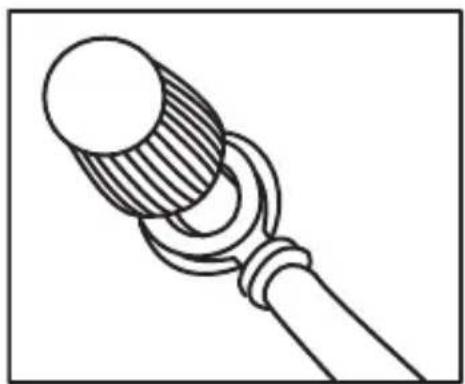
Fig. 1
Pleases Note! Due to the high transfer resistances, using the cable with 12 V motor vehicle cigarette lighter plug can lead to the plug connection heating up. Therefore when working with high loads, use the connection cable with the and connecting clamps.
- Connecting to a car battery
Undo the red 16 ton the power inverter 1. Guide the red fork eyelet of the cable with the red connecting clamp 10 over the 12V screw connector (see Fig. 1). Make sure that the washer is positioned between the fork eyelet and the nut 16.
Tighten the red 36t such that the fork eyelet is held in place.
Undo the black on the power inverter. Guide the black fork eyelet of the cable with the black connecting clamp over the screw connector (see Fig. 1). Make sure that the washer is positioned between the fork eyelet and the nut.
Tighten the black bus such that the fork eyelet is held in place.
- First connect the red clamp to the positive terminal of the car battery and then connect the black clamp to the negative terminal of the car battery.
- Connecting and operating a load/device
ATTENTION! Before connecting a load/device to the power inverter, make sure that the On/Off switch of the device is in the "0" (OFF) position. Make sure that the output of the connected load/connected device does not exceed the maximum continuous output of the power inverter.
ATTENTION! Do not switch on the load/device to be operated yet!.
Connect the plug of the load to be connected/device to be operated to the 230 V socket 6 of the power inverter 1 .
- Switch the power inverter, by moving the On/Off switch 5 to the "1" (ON) position. You will hear a short beep and the overload display 3a (red) lights up briefly. After that the operating LED 3b (green) lights up, if the power inverter 1 is properly connected to a charged battery.
Now switch on the load/device to be operated.
Pleases NOTE! If you hear a beep and the overload display 3 lights up red, the input voltage is too low, or output of the load/device connected to the power inverter 1 is too high.
- Instructions for operating devices
General notes:
Information about the power consumption in Ampere (A) or the power draw in Watt (W) is usually shown on the rating plate of devices. Before using the device, please make sure that the maximum current draw is not higher than 1.30A and the maximum continuous output is not more than 300 W.
- Loads with a high internal resistance can be operated very effectively using the power inverter 1 , whereas loads with a low internal resistance, such as, for example, heating and cooking devices, generally have a power draw in Watt which is too high.
Inductive loads such as, for example, televisions or stereo devices (devices with a coil or a transformer) often require a start-up current which is many times higher than resistive loads with the same given power draw in Watt. When switching on, televisions require a power draw which is many times higher than the value given on the rating plate. Because of this you may need to switch the power inverter 1 on and off several times, in order to be able to switch a television on.
If you have any doubts, please contact the manufacturer of the connected device.
Televisions:
The power inverter 1 is screened and outputs a modified sine wave. However if reception from television channels is extremely weak, this can lead to interference or picture distortion. In this case, position the power inverter 1 as far from the television, aerial cable and aerial as possible. Align the power inverter 1 , television, aerial cable and aerial to one another, until the reception improves. If possible, use a high-quality, screened aerial cable.
Audio systems:
Some audio/video systems emit a humming noise through the speaker when they are operated using the power inverter 1. This is due to the fact that these devices cannot filter the modified sine wave of the power inverter 1 and is not a defect of the power inverter 1.
- Signal if the battery voltage is low
If the battery voltage sinks below 10.5V , the power inverter switches off and the overload display lights up red. A warning beep sounds.
- Charging a USB device
ATTENTION! Before connection, make sure that the current draw of the USB device is not higher than 1 A. For more detailed information, please refer to the operating instructions for your USB device.
Plug the USB plug of the USB device to the USB A connector or the USB C connector 2 of the power inverter 1.
If necessary, switch the USB device on.
Pleases NOTE! The 230 V socket and the USB connection 2 / 4 can be used at the same time.
- Replacing the fuse
DANGER TO LIFE THROUGH ELECTRIC SHOCK! Before replacing the fuse, disconnect the power inverter 1 from the power supply. Also remove any device connected to the power inverter 1. Replace the fuse with one of equal value with the same cut-off characteristics (20 A), as given in the technical specifications or with one of the enclosed flat motor vehicle fuses 22.
ATTENTION! You must not use a fuse with a different value! Before switching the power inverter 1 back on, ascertain why the fuse tripped.
In order to replace the 20 A flat motor vehicle fuse [13], proceed as follows:
Pull the flat motor vehicle fuse out of the fuse holder. You can pull the fuse out easily by using the enclosed tongs for the flat motor vehicle fuse.
Insert a new fuse of equal value.
In order to replace the 10 A glass fuse in the cigarette lighter plug, proceed as follows:
Unscrew the fuse screw plug. The fuse is located below this plug.
When doing this, make sure you do not lose the loosely inserted contact
Remove the defective 10 A glass f
Insert a new 10 A glass fuse of equal value
Insert the contact into the fuse screw plug and screw the fuse screw plug back onto the 12 V cigarette lighter plug.
- Troubleshooting
| Problem Possible cause Solution: | ||
| No output voltage | The power inverter 1 is overloaded. | Reduce the load until it no longer exceeds the maximum load given in the technical specifications. |
| The input voltage is below 10.5 V. | Keep the input voltage of the power inverter over 10.5 V, in order to maintain an output voltage. | |
| Low output voltage The | input voltage is below 12 V. | Keep the input voltage of the power inverter over 12 V, in order to maintain a constant output voltage. |
| The signal for low battery voltage sounds repeatedly. | The battery is defective. Replace the battery. | |
| Insufficient voltage supply or power supply. | Check the condition of the socket of the car's electrical system and the 12 V vehicle cigarette lighter plug 12 and clean these if required. | |
| No output power | The power inverter 1 is not completely warmed up due to low environmental temperatures (e.g. at temperatures below 10 °C in the winter). | Switch the power inverter 1 on and back off, until the device connected to the power inverter 1 is supplied with power. Repeat this procedure in order to be able to switch the device on. |
| Problem Possible cause Solution: | |
| No output power The ignition must be switched on in order for the socket for the car's electrical system to have power. | Switch the motor vehicle ignition on or move to the "1" (ON) position. |
| The power inverter 1 is overloaded. | Reduce the load until it no longer exceeds the maximum load given in the technical specifications. |
| The power inverter 1 has overheated. | Wait until the device has cooled off. Make sure that there is sufficient ventilation clearance. Make sure that the connected load does not continuously exceed the maximum loading, in order to avoid the device overheating again. |
| The fuse in the device has blown. | Replace the fuse, as described in the "Replacing the fuses" chapter. Make sure that the power inverter 1 is connected to the power supply using the right polarity. |
- Cleaning and maintenance
ATTENTION!
The device must not come into contact with water or be placed in water. There is a risk of injury due to electric shock if moisture enters the device.
Before cleaning, always disconnect the power inverter from the motor vehicle cigarette lighter socket/remove the connecting clamps from the car battery. Also remove any device connected to the power inverter 1.
Clean the surface of the housing and accessories with a slightly damp cloth. Never use petrol, solvents or cleaners as these can corrode the surface of the device! If the ventilation slots are dusty, clean them with a soft brush.
Information about recycling and disposal
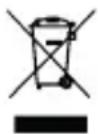


DO NOT DISPOSE OF ELECTRICAL TOOLS IN HOUSEHOLD WASTE! DON'T THROW AWAY - RECYCLE!
According to European Directive 2012/19/EU, used electrical devices must be collected separately for environmentally compatible recycling or recovery. The symbol of the crossed out dustbin means that this device must not be disposed of in household waste at the end of its service life. The device must be handed in at established collection points, recycling centres or waste management depots. The disposal of defective devices which you have sent in will be carried out free of charge. In addition, distributors of electrical and electronic equipment as well as food distributors are obliged to accept returned waste. LIDL provides you with return options directly in its branches and shops. Return and disposal is free of charge for you. When buying a new device you have the right to return an equivalent old device at no charge. In addition you have the option, regardless of whether you are buying a new device, to hand in (up to three) old devices at no charge, as long as the device is no larger than 25cm in any dimension.
Before returning the device please delete all personal information. Before returning, please remove batteries or rechargeable battery packs which are not enclosed by the old device, as well as bulbs, which can be removed without destroying the product and take these to a separate collection point.
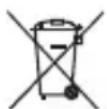
Batteries containing harmful substances are labelled with the adjacent symbol, which indicates the prohibition on disposal in household waste. The abbreviations for the relevant heavy metals are: Cd = cadmium, Hg = mercury, Pb = lead.
Take used batteries to a waste management company in your city or community or return them to your dealer. This satisfies your legal obligations while also making an important contribution to protecting the environment.
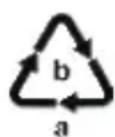
Please note the marking on the different packaging materials and separate them as necessary. The packaging materials are marked with abbreviations (a) and digits (b) with the following definitions: 1-7: Plastics, 20-22: Paper and cardboard, 80-98: Composite materials.

- Original EC Declaration of Conformity
We,
C. M. C. GmbH Holding
Responsible for documentation:
Dr. Christian Weyler
Katharina-Loth-Str. 15
66386 St. Ingbert
GERMANY
hereby take sole responsibility for declaring that the product
Power inverter
IAN: 444935_2307
Art.no.: 2661
Year of manufacture: 2024/11
Model: USSW 300 C3
meets the basic safety requirements as specified in the European Directives
Electromagnetic Compatibility:
(2014/30/EU)
Low Voltage Directive:
(2014/35/EU)
RoHS Directive:
(2011/65/EU+2015/863/EU)
and the amendments to these Directives.
The object of the declaration described above meets the requirements of Directive 2011/65/EU of the European Parliament and of the Council of 8 June 2011 on the restriction of the use of certain hazardous substances in electrical and electronic equipment.
This conformity assessment is based on the following harmonised standards:
EN 62368-1:2014/A11:2017
EN 50498:2011
St. Ingbert, 01 September 2023
C.M.C.GmbH Holding Katharina-Loth-StraBe 15 69386 St. Ingbert Tel. +49 6894 99897-50 Fax +49 6894 99897-29
Dr. Christian Weyler
- Quality Assurance -
Warranty and service information
Warranty from C. M. C. GmbH Holding
Dear Customer,
The warranty for this equipment is 3 years from the date of purchase. In the event of product defects, you have legal rights against the retailer of this product. Your statutory rights are not affected in any way by our warranty conditions, which are described below.
Warranty conditions
The warranty period begins on the date of purchase. Please retain the original sales receipt. This document is required as your proof of purchase.
Should this product show any defect in materials or manufacture within 3 years from the date of purchase, we will repair or replace it - at our discretion - free of charge. This warranty service requires that you retain proof of purchase (sales receipt) for the defective device for the three year period and that you briefly explain in writing what the fault entails and when it occurred.
If the defect is covered by our warranty, we will repair and return your product or send you a replacement. The original warranty period is not extended when a device is repair or replaced.
Warranty period and statutory claims for defects
The warranty period is not extended by the guarantee. This also applies to replaced and repaired parts. Any damages or defects detected at the time of purchase must be reported immediately after unpacking. Any incidental repairs after the warranty period are subject to a fee.
- Extent of warranty
This device has been manufactured according to strict quality guidelines and carefully inspected before delivery.
The warranty applies to material and manufacturing defects only. This warranty does not extend to product parts, which are subject to normal wear and tear and can thus be regarded as consumable parts, or for damages to fragile parts, e.g. switches, rechargeable batteries or parts made from glass.
This warranty is voided if the product becomes damaged or is improperly used or maintained. For proper use of the product, all of the instructions given in the operating instructions must be followed precisely. If the operating instructions advise you or warn you against certain uses or actions, these must be avoided in all circumstances.
The product is for consumer use only and is not intended for commercial or trade use. The warranty becomes void in the event of misuse and improper use, use of force, and any work on the device that has not been carried out by our authorised service branch.
- Processing of warranty claims
To ensure prompt processing of your claim, please follow the instructions given below.
Please retain proof of purchase and the article number (e.g. IAN) for all inquiries. The product number can be found on the type plate, an engraving, the cover page of your instructions (bottom left), or the sticker on the back or underside of the device.
In the event of malfunctions or other defects, please first contact our service department below by phone or email. If your product is found to be defective, you can then send your product with proof of purchase (till receipt) and a statement describing what the fault involves and when it occurred free of charge to the service address given.
Please Note: You can download this handbook and many more, as well as product videos and software at www.lidl-service.com.

With this QR code you can gain immediate access to the Lidl Service page (www.lidl-service.com) and you can open your operating instructions by entering the article number (IAN) 444935.
Service
How to contact us:
GB, IE, NI, CY, MT
Website: www.cmc-creative.de
E-mail: service.gb@cmc-creative.de
Phone: 0-808-189-0652
Registered office: Germany
IAN 444935_2307
Please note that the following address is not a service address. Please first contact the service point given above.
Address:
C. M. C. GmbH Holding
Katharina-Loth-Str. 15
66386 St. Ingbert
GERMANY
Ordering spare parts:
Dr. Christian Weyler
Katharina-Loth-Str. 15
DE-66386 St. Ingbert
DEUTSCHLAND
service.at@cmc-creative.de
service.ch@cmc-creative.de
Telefon: +49 (0) 6894/ 9989750
Dr. Christian Weyler
Katharina-Loth-Str. 15
DE-66386 St. Ingbert
ALLEMAGNE
Dr. Christian Weyler - Assurance qualite -
Dr. Christian Weyler
Katharina-Loth-Str. 15
D-66386 St. Ingbert
DUITSLAND
Dr. Christian Weyler
Dr. Christian Weyler
Katharina-Loth-Str. 15
DE-66386 St. Ingbert
NIEMCY
Dr. Christian Weyler
-Zapewnieniejakosci
Dr. Christian Weyler
Katharina-Loth-Str. 15
66386 St. Ingbert
NEMECKO
Dr. Christian Weyler
Katharinga-Loth-Str., 15
66386 St. Ingbert
ALEMANIA
Dr. Christian Weyler
Katharina-Loth-Str. 15
66386 St. Ingbert
TYSKLAND
Dr. Christian Weyler
Katharina-Loth-Str. 15
66386 St. Ingbert
GERMANIA
Dr. Christian Weyler
Katharina-Loth-Str. 15
66386 St. Ingbert
NEMETORSZAG
Dr. Christian Weyler
- Minõsegbiztositas -
Last Information Update