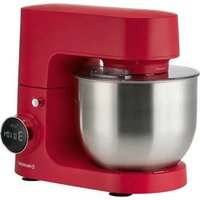
SKM 600 F1 - Food Processor SILVERCREST - Free user manual and instructions
Find the device manual for free SKM 600 F1 SILVERCREST in PDF.


| Product type | Food processor |
| Brand | SilverCrest |
| Model | SKM 600 F1 |
| Power | 600 W |
| Supply voltage | 220-240 V ~ 50-60 Hz |
| Bowl capacity (total) | 5000 ml |
| Max fill level (MAX mark) | 3700 ml |
| Included accessories | Dough hook, whisk, flat beater, splash guard |
| Number of speeds | 8 levels + Turbo function (speed 8) |
| Display | Touch screen: speed and time (00:01 to 09:59) |
| Max continuous operation time | 10 minutes |
| Safety protection | Overheat protection, drive arm lock |
| Cleaning of accessories | Dishwasher safe (bowl, hook, whisk, flat beater, splash guard) |
| Cleaning the base unit | Wipe with a damp cloth, do not immerse in water |
| Functions | Whisk, beat, stir, knead, mix |
| Usage | Household use only, indoors |
| Warranty | 3 years |
| Non-slip | Plastic suction feet |
| Cable winder | Integrated under the base unit |
Frequently Asked Questions - SKM 600 F1 SILVERCREST
User questions about SKM 600 F1 SILVERCREST
0 question about this device. Answer the ones you know or ask your own.
Ask a new question about this device
Download the instructions for your Food Processor in PDF format for free! Find your manual SKM 600 F1 - SILVERCREST and take your electronic device back in hand. On this page are published all the documents necessary for the use of your device. SKM 600 F1 by SILVERCREST.
USER MANUAL SKM 600 F1 SILVERCREST
natural_image
Exterior view of a modern kitchen mixer with a black control panel and metallic bowl (no visible text or symbols)KÜCHENMASCHINE SKM 600 F1 STAND MIXER SKM 600 F1 ROBOT MULTIFONCTION SKM 600 F1
For EU market: Imported for GB market by: HOYER Handel GmbH Lidl Great Britain Ltd Kühnehöfe 12 Lidl House - 14 Kingston Road 22761 Hamburg Surbiton - KT5 9NU GERMANY
Stand der Informationen - Status af information - Version des informations Stand van de informatie - Stan informacji - Stav informaci Stav informaci: Estado de las informaciones - Informationernes stand Versione delle informazioni - Az informació kelle 09/2025 ID: SKM 600 F1_25_V1.1
IAN
485014 2501 485015 2501
8

IAN
485014 2501 485015 2501
Deutsch...... 2
English.... 24
Français 46
Nederlands.... 72
Polski 94
Česky 116
Slovenčina 138
Español.... 160
Dansk 184
Italiano 204
Magyar.... 228
Übersicht / Overview / Aperçu de l'appareil / Overzicht / Przegląd / Přehled / Prehlad / Vista general / Oversigt / Panoramica / Áttekintés

Inhalt
natural_image
Line drawing of a kitchen mixer with control panel and base (no text or symbols)natural_image
Diagram of a mechanical component with a circular component and directional arrow, no text or symbols presentnatural_image
Diagram showing a device with a connector inserted into a circular earpiece, connected to a separate mechanical component (no text or symbols present)1 Päckchen Backpulver
1 Prise Salz
- Overview 25
- Intended purpose 26
- Safety information 27
- Items supplied 30
- Unpacking and setting up 30
- Overview of functions ...... 31
- Using the mixing tools 32
- Basic operation 33
8.1 Power supply.... 33
8.2 Safety functions 33
8.3 Switching the device on/off and selecting speed 34
8.4 Turbo function 34
-
Dismantling the device 34
-
Cleaning and servicing the device 35
10.1 Cleaning the base unit.... 35
10.2 Cleaning in the dishwasher 35
10.3 Cleaning the accessories 35
10.4 Storage 35
- Recipes 36
11.1 Mascarpone cream 36
11.2 Pear tarte tatin.... 36
11.3 Pizza dough.... 37
11.4 Basic batter recipe 37
11.5 Basic yeast dough recipe 38
11.6 Basic waffle recipe.... 38
11.7 Basic cocoa sponge recipe 39
11.8 Crumb cake with sour cherries.... 39
11.9 Basic shortcrust pastry recipe.... 40
11.10Baby carrot cupcakes with orange frosting.... 40
- Trouble-shooting 41
- Disposal 42
- Technical specifications 42
- Warranty of the HOYER Handel GmbH 43
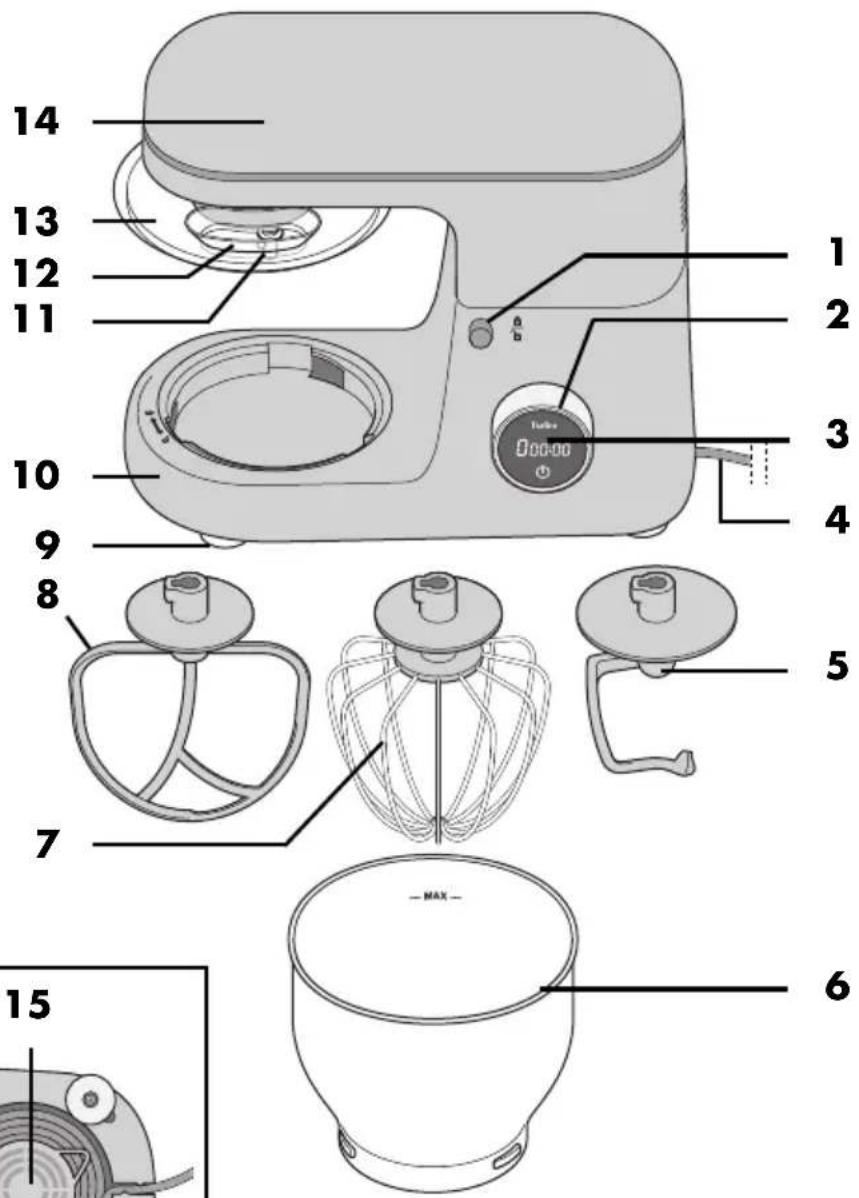
1. Overview
1 Unlock button (for the drive arm)
2 Speed control 0 - 8
3 Touch display:
Display: speed and time (minutes and
seconds from 00:01 to 09:59)
Button ⏻ switch device on and off
Button Turbo: switches immediately to the highest setting (8)
when pressed.
4 Power cable with mains plug
5 Dough hook
6 Mixing bowl
7 Whisk
8 Beater
9 Suction foot
10 Base unit
11 Axle for holding mixing tools
12 Filling opening
13 Splash guard
14 Drive arm
15 Cable spool
Thank you for your trust!
Congratulations on the purchase of your new food processor.
For safe handling of the product and in order to get to know the entire range of features:
- Read these user instructions thoroughly prior to initial use.
- Above all, observe the safety information!
- The device should only be used as described in this copy of the user instructions.
- Keep this copy of the user instructions for reference.
- If you pass the device on to someone else, please include this copy of the user instructions. The user instructions are a part of the product.
We wish you a lot of joy with your new food processor!
Symbols on the device

The food-safe material of devices with this symbol will not change the taste or smell of food.

This symbol warns of possible hand injuries.
NOTE: the device is supplied in different colours. The operation is identical for all colour variants.
2. Intended purpose
The food processor is used to whisk, beat, stir, knead, and mix food.
The device is designed for private, domestic use. The device must only be used indoors.
This device must not be used for commercial purposes.
Foreseeable misuse
WARNING! Risk of material damage!
- The food processor should not be used continuously for longer than 10 minutes.
After this, the device must remain switched off until it has cooled down to room temperature.
3. Safety information
Warnings
If necessary, the following warnings are used in this copy of the user instructions:

DANGER! High risk: failure to observe this warning may result in injury to life and limb.
WARNING! Moderate risk: failure to observe this warning may result in injury or serious material damage.
CAUTION: low risk: failure to observe this warning may result in minor injury or material damage.
NOTE: circumstances and specifics that must be observed when handling the device.
Instructions for safe operation
- This device must not be used by children.
- Children must not play with the device.
- The device and the power cable must be kept away from children.
- This device can be used by people with restricted physical, sensory or intellectual abilities or people without adequate experience and/or understanding if they are supervised or instructed on how to use this device safely and if they are aware of the resulting hazards.
- If the mains power cable of this device should become damaged, it must be replaced by the manufacturer, the manufacturer's customer service department or a similarly qualified specialist, in order to avoid any hazards.
- The device must not be immersed in water.
- Disconnect the mains plug from the wall socket ...
... when it is not supervised, ... before you assemble or disassemble the device, ... before changing accessories or attachments, and ... before cleaning.
- This device is not intended to be operated using an external timer or a separate remote control system.
- Depending on type of use, the device is intended for the following maximum operating times without interruption:
- max. 10 minutes mixing/kneading with the mixing tools.
After this, the device must remain switched off until it has cooled down to room temperature.
- Prior to the replacement of accessories or attachments which move when in operation, the device must be switched off and disconnected from the mains power supply.
- Please take note of the chapter on cleaning (see "Cleaning and servicing the device" on page 35).
- Misuse of the device may result in injury.
- This device is equally intended for use in the home and in applications similar to the home, such as for example...
... in kitchens for staff in shops, offices and other commercial settings;
... on agricultural properties;
... by customers in hotels, motels and other residential facilities;
... in bed-and-breakfast establishments.

DANGER for children!
- Packing materials are not children's toys. Children should not be allowed to play with the plastic bags: there is a risk of suffocation.

DANGER to and from pets and livestock!
Electrical devices can represent a danger to pets and livestock. In addition, animals can also cause damage to the device. For this reason you should keep animals away from electrical devices at all times.

DANGER! Risk of electric shock due to moisture!
- The device must never be operated in the vicinity of a bathtub, a shower, a filled washbasin or similar items.
- The base unit, the power cable and the mains plug must not be immersed in water or other liquids.
- Protect the base unit against moisture, water drips and splashes.
- If liquid should enter the base unit, pull out the mains plug immediately. Have the device checked before reusing.
- Never touch the device with wet hands.
- If the device falls into water, disconnect the mains plug immediately. Only then is it safe to remove the device.

DANGER! Risk of electric shock!
- Only plug the mains plug into the wall socket after the device has been completely assembled.
- Only connect the mains plug to a properly installed and easily accessible wall socket whose voltage corresponds to the specifications on the rating plate. The wall socket must still be easily accessible after the device is plugged in.
- Ensure that the power cable cannot be damaged by sharp edges or hot spots. Do not wrap the power cable around the device.
- Even after it has been switched off, the device is not completely disconnected from the mains power supply. In order to fully disconnect it, pull out the mains plug.
- Keep the power cable away from hot surfaces (e.g. hot plates).
- When using the device, ensure that the power cable cannot be trapped or crushed.
- When removing the mains plug from the wall socket, always pull on the plug and never the cable.
- Disconnect the mains plug from the wall socket ...
... if there is a fault,
... when you are not using the food processor,
... prior to assembling or disassembling the food processor,
... prior to cleaning the food processor and
... during thunderstorms.
- Do not use the device if there is visible damage to the device, accessories or power cable.
- To avoid any risk, do not make modifications to the product.

DANGER of hand injuries by crushing!
- Never put your hands between the drive arm and the housing. There is a risk of injury from crushing when folding down.

DANGER from rotating parts!
- Do not touch rotating parts with spoons or similar utensils. Keep long hair and loose clothing away from the rotating parts.
- Always ensure that the speed control is set to 0 before you plug the mains plug into the wall socket.
- Switch the device off and pull out the mains plug from the wall socket before you exchange auxiliary equipment or accessories that move while in operation.
WARNING! Risk of material damage!
- Place the device exclusively on a level, dry, non-slip and waterproof surface, so that it can neither fall nor slip off.
- The mixing mechanism must not be operated continuously for longer than
10 minutes at a time. You must then allow the device to cool down to room temperature.
- The device must never be operated without the container.
- Never place the device on a hot surface, e.g. a hot plate.
- Do not change the position of the device, as long as there is still food or dough in the device.
- Never overfill the mixing bowl, since otherwise the contents could be ejected. Overflowing liquid would flow onto the surface. You should therefore place the device on a waterproof surface.
- Do not operate the device when it is empty, as this causes the motor to overheat and may result in it becoming damaged.
- Only use the original accessories.
- Do not use any astringent or abrasive cleaning agents.
- The beater and dough hook have a non-stick coating. Do not damage them with sharp, pointed or scratching objects (e.g. knife, scourer).
The device is equipped with non-slip plastic suction feet. As furniture is coated with a wide array of varnishes and plastics and is also treated with different care products, it cannot be fully ruled out that some of these materials contain components that could attack and soften the non-slip plastic suction feet. If necessary, place a non-slip mat under the device.
4. Items supplied
1 food processor, base unit 10
1 splash guard 13
1 mixing bowl 6
1 dough hook 5
1 whisk 7
1 beater 8
1 complete copy of the user instructions (on the Internet)
1 copy of the short manual (enclosed with the device)
5. Unpacking and setting up
- Remove all packing material.
- Check to ensure that all parts are present and undamaged.
- Disassemble the device (see "Dismantling the device" on page 34).
- Clean the device prior to first use! (see "Cleaning and servicing the device" on page 35).
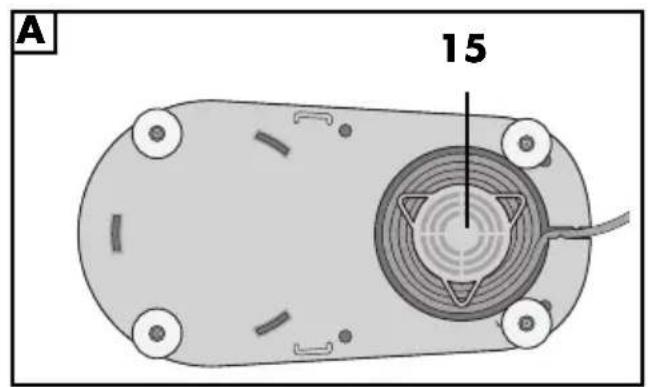
- Figure A: wind the excess power cable 4 around the cable spool 15 on the underside of the base unit 10.
- Place the base unit 10 on a level, dry and waterproof surface, so that the device can neither fall nor slip off. Select a smooth, clean surface, so that the suction feet 9 can stick firmly in place and ensure a secure grip.
CAUTION:
- Overflowing liquid would flow onto the surface. You should therefore place the device on a waterproof surface.
6. Overview of functions
| Working tool Speed | Function Notes | ||
| Dough hook 5 | 1 - 2 | - Kneading and mixing solid dough or relatively solid ingredients | min. quantity:The working tool should be immersed at least 1 cm deep in the material to be mixed.max. quantity yeast dough:1657 gProcessing time pastry dough*:approx. 3 minutesmax. operating time:10 minutes |
| 2 - 3 | - Kneading yeast dough- Kneading thick batter | ||
| Beater 8 | 2 - 3 | - Mixing thick batter- Mixing butter and flour- Mixing yeast dough | min. quantity:The working tool should be immersed at least 1 cm deep in the material to be mixed.max. quantity batter:1216 gProcessing time batter*:approx. 5 minutesmax. operating time:10 minutes |
| 4 - 6 | - Cake m i- Beating together butter and sugar- Cookie | ||
| 6 | - Dough with dried fruit | max. total weight:950 gFold in sensitive fruit at speed 1 - 2.max. operating time:10 minutes | |
| Whisk 7 7 - 8 | - Whipped cream- Egg white- Mayonnaise- Whipping butter to a froth | min. quantity:The working tool should be immersed at least 1 cm deep in the material to be mixed.max. quantity cream:1000 mlmax. operating time:10 minutes | |
*NOTE: the processing time varies depending on the quantity and properties of the ingredients.
7. Using the mixing tools
Lifting up the drive arm
- Press the unlock button 1 and fold up the drive arm 14 until it engages and the unlock button 1 pops out again.
Inserting the mixing bowl
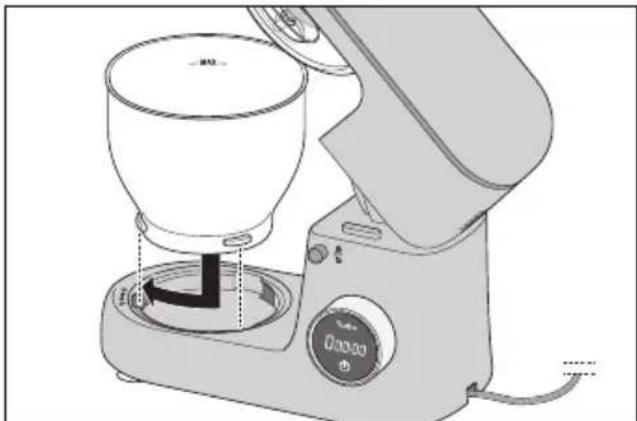
- Place the mixing bowl 6 into the base unit 10 in such a way that the metal pins on the lower edge fit into the recesses in the base unit.
natural_image
Line drawing of a kitchen mixer with control panel and baseplate (no text or symbols)- Lock the mixing bowl 6 by turning it towards the closed lock symbol until it is firmly seated.
Mounting the splash guard
CAUTION:
- Never use the mixing bowl 6 without the splash guard 13 attached. The material you are mixing could otherwise be ejected.
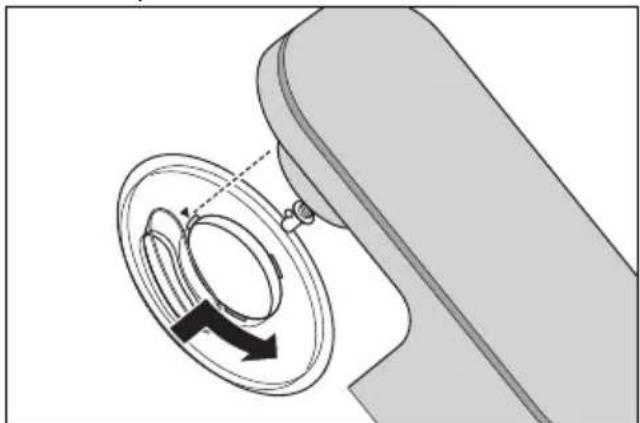
- Place the splash guard 13 onto the drive arm 14 from below. The arrow (▲) on the splash guard 13 points to the open lock symbol on the drive arm 14.
natural_image
Diagram of a mechanical component with a circular component and directional arrow, no text or symbols present- Rotate the splash guard 13 in the direction of the closed lock symbol until it clicks into place.
Inserting the mixing tool
-
Select the appropriate mixing tool:
-
Dough hook 5: for heavy doughs, e.g. bread dough
- Whisk 7: for whipping cream, egg white etc.
- Beater 8: for medium to light dough or batter, e.g. cake mix or pancake batter.
For further information: see "Overview of functions" on page 31.
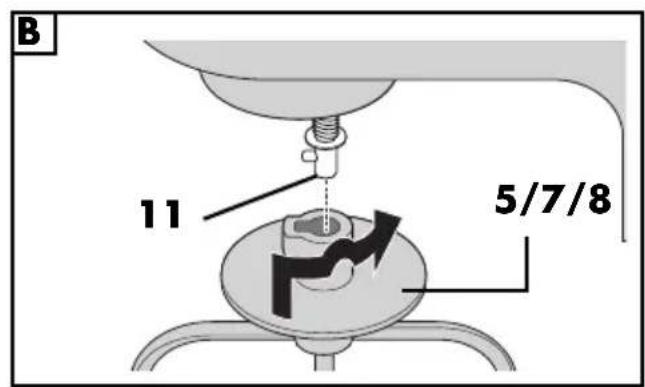
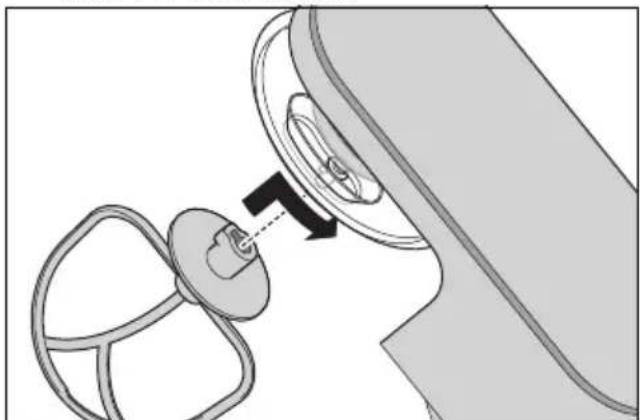
- Place the mixing tool 5/7/8 onto the axle 11 from below.
natural_image
Diagram showing a mechanical component with a dashed arrow indicating assembly or motion (no text or symbols present)Ensure that the metal pin on the axle 11 slots into the recess in the mixing tool.
- Figure B: press the mixing tool 5/7/8 upwards slightly and rotate it in the direction of the arrow until it stops.
Adding ingredients
- You can add ingredients into the mixing bowl 6 while the drive arm 14 is lifted up.
- During mixing, you can add ingredients through the filling opening 12 in the splash guard 13:
- Reduce the speed to 1 - 2.
- Add the ingredients.
Lowering the drive arm

DANGER of hand injuries by crushing!
- Never put your hand between the drive arm 14 and the housing. There is a risk of injury from crushing when folding down.
- Press the unlock button 1 and move the drive arm 14 all the way down. The unlock button 1 pops out again.
The device is now fully assembled. On working with the device: see "Basic operation" on page 33.
8. Basic operation
8.1 Power supply

DANGER! Risk of electric shock!
- Only connect the mains plug 4 to a properly installed and easily accessible wall socket whose voltage corresponds to the specifications on the rating plate. The wall socket must still be easily accessible after the device is plugged in.
NOTE: when the device is used the first few times, some odour may be generated by the device due to the heating of the motor. This is harmless. Please ensure adequate ventilation.
- Assemble the device for the desired function.
- Plug the mains plug 4 into a suitable wall socket. The wall socket must still be easily accessible after connection. The button appears on the touch display 3.
- Pull out the mains plug 4 before cleaning the device.
8.2 Safety functions
The device has several safety functions, which are described below.
Functions only when the drive arm is lowered
The device will only work if the drive arm 14 is correctly engaged in the lower position and the unlock button 1 has fully popped out.
Overheating protection
The device has an overheating protection system. If the motor becomes too hot, the device automatically switches itself off:
- Switch off the device.
- Pull out the mains plug 4.
- Allow the device to cool down to room temperature.
When the device has cooled down sufficiently, it can be switched on again.
8.3 Switching the device on/off and selecting speed
WARNING! Risk of material damage!
- The mixing mechanism must not be operated continuously for longer than 10 minutes at a time. You must then allow the device to cool down to room temperature.
NOTE: the device may move slightly while you are processing large quantities of dough.
- Turn on the device by pressing the symbol ☑ on the touch display. The display shows:
- Speed : 0
- Minutes and seconds: 0000
- To start, turn the speed control 2 slightly clockwise. The display shows 1.
- To increase the speed: turn the speed control 2 slightly clockwise for each level.
- To reduce the speed: turn the speed control 2 slightly anticlockwise for each level.
-
Reduce the speed to speed 1 - 2 when you are adding ingredients during operation through the filling opening 12.
-
Turn the speed control 2 anticlockwise in increments until O appears on the touch display.
-
Turn off the device by pressing the symbol ☐ on the touch display.
NOTE: above all, the ideal speed depends on the consistency of the material being blended. The more liquid the contents, the faster you can blend them.
8.4 Turbo function
- By pressing Turbo, you can temporarily increase the speed to the highest setting (8). The turbo function ends when released.
9. Dismantling the device

DANGER from rotating parts!
- Turn off the device and unplug the mains plug 4 from the wall socket before disassembling the device.
Lifting up the drive arm
- Press the unlock button 1 and fold up the drive arm 14 until it engages and the unlock button 1 pops out again.
Removing the mixing tool
- Figure C: Push the mixing tool 5/7/8 slightly upwards and turn it anticlockwise until it can be pulled off the axle 11.
Removing the splash guard
- Turn the splash guard 13 towards the open lock symbol until it can be removed.
Removing the mixing bowl
- Turn the mixing bowl 6 towards the open lock symbol until it can be removed.
Lowering the drive arm
- Press the unlock button 1 and move the drive arm 14 all the way down. The unlock button 1 pops out again.
10. Cleaning and servicing the device

DANGER! Risk of electric shock!
- Disconnect the mains plug 4 from the wall socket before each cleaning.
- Never immerse the base unit 10 in water.
WARNING! Risk of material damage!
- Never use any abrasive, corrosive or scouring cleaning agents. These might damage the device.
NOTES:
- Certain foods or spices (e.g. curry, carrots) can discolour the plastic parts (e.g. the splash guard 13). This is not a device error and is harmless to health.
- Please note that water drops may still be present on the accessories after drying. Allow all parts to air dry completely.
10.1 Cleaning the base unit
- Clean the base unit 10 with a damp cloth. You can also use a little detergent.
- Wipe with a clean cloth with clear water.
- Do not use the base unit 10 until it has completely dried.
10.2 Cleaning in the dish-washer
The following parts are dishwasher-safe:
- Mixing bowl 6
- Dough hook 5
- W h i s k 7
- Beater 8
- Splash guard 13
The following parts must never be cleaned in a dishwasher:
- Base unit 10
10.3 Cleaning the accessories
- Clean all accessories by hand in a sink with dishwater or in the dishwasher.
- When cleaning by hand, rinse all parts with clean water.
- Allow all parts to dry completely before reassembling, putting them away or reusing them.
10.4 Storage
- Allow all parts to dry completely before placing them in storage.
- Store the device so that it is protected against dust and dirt and out of the reach of children.
• Figure A: you can wind up the power cable 4 in the cable spool 15 on the underside of the base unit 10.
11. Recipes
11.1 Mascarpone cream
Ingredients:
2 eggs
2 tablespoons fine sugar
1 tablespoon sweet wine (e.g. Madeira)
250 g mascarpone
12 untreated orange (juice and some grated orange peel)
Preparation
- Separate the eggs.
- Add the egg whites to a fat-free mixing bowl and whip them with the whisk until stiff. Increase the speed to speed 8.
- Add the whipped egg whites to another bowl and store it in a cool place.
- In the mixing bowl, whip the egg yolks with sugar and sweet wine with the whisk at speed 6 until foamy.
- Reduce the speed to speed 3 and alternately add spoonfuls of mascarpone and orange juice.
- Fold in the grated orange peel and the whipped egg whites by hand.
- For decoration, sprinkle a few thin strips of orange peel onto the finished cream.
- Place the cream in the refrigerator until you are ready to enjoy it. Consume the mascarpone cream within 24 hours.
Tip: layer the mascarpone cream with fresh seasonal fruit or compote in dessert glasses.
11.2 Pear tarte tatin
Ingredients for the dough:
200 g wheat flour
1 pinch salt
100 g cold butter (in flakes)
3 teaspoons fine sugar
4 tablespoons cold water
For blind baking:
dried peas or rice
Ingredients for the almond paste:
100 g soft butter
100 g sugar
2 eggs (room temperature)
100 g crushed almonds
For garnish:
approx. 3 ripe pears
Preparation
- Place all the ingredients for the batter in the mixing bowl and mix with the beater on speed 3 until large lumps have formed. (If necessary, stop the machine in between and push the ingredients down from the edge with a spatula.)
- Quickly knead the dough by hand into a ball and roll it out with a little flour between two sheets of baking paper.
- Line a greased tart mould with the dough, cut off the protruding edge and place in the refrigerator for at least 30 minutes.
- Prick the base of the dough several times with a fork. Place a piece of baking paper on the dough and fill the mould with dried peas or rice to weigh down the dough.
-
Bake the dough at 180 °C (convection oven) for 15 minutes, then remove baking paper and peas/rice and bake again for another 10 to 15 minutes.
-
For the almond paste, whip butter, sugar and eggs with a whisk. Increase the speed to speed 8.
- Afterwards, remove the whisk and insert the beater. Briefly stir in the almonds using speed 4.
- Pour the almond mixture onto the cooled tart base.
- Peel the pears, remove the core and cut them into slices.
- Top the almond paste with the pear slices.
- Bake the tarte for approx. 35 minutes at 170^ C (convection oven).
11.3 Pizza dough
Ingredients:
250 g wheat flour
^3/_4 teaspoon salt
21 g fresh yeast
120 ml lukewarm water
12 teaspoon brown sugar
some flour for kneading and rolling
Preparation
- Mix flour and salt in the mixing bowl and make a depression in the middle.
- Mash and mix the yeast and sugar in the water with a fork and stir until everything is dissolved. Pour this mixture into the depression.
- Work the mixture with the dough hook at speed 2 until large lumps of dough have formed.
- Continue kneading by hand until the dough becomes smooth.
- Form a ball of dough and leave to rise under a cover in a warm place until it has doubled in size.
- Knead the dough once more, roll it out and top as desired.
11.4 Basic batter recipe
Ingredients for 1 loaf tin (approx. 30 cm):
300 g soft butter
300 g sugar
5 large eggs
300 g plain flour (type 405)
1 teaspoon baking powder
Additionally soft butter for the tin
Preparation
- Preheat the oven to 175^ C (top/bottom heat).
- Grease the loaf tin or line it with baking paper.
- To make the batter, cut the butter into small pieces and place in the mixing bowl with the sugar.
- Insert the beater and splash guard and mix the ingredients for approx. 30 seconds on speed 4.
- Then mix the mixture on speed 6 for approx. 5 minutes to form a soft mass.
- Stir in the eggs one at a time on speed 2 for approx. 30 seconds.
- Then continue to stir on speed 6 for approx. 40 seconds.
- Mix the flour with the baking powder and sieve it over the mass.
- Mix all the ingredients on speed 3 for approx. 40 seconds to form a smooth batter.
- Pour the batter into the tin and smooth it out with a spatula.
- Bake the cake for approx. 65 minutes.
- Test to see if it is done about 10 minutes before the end of the baking time. To do this, prick the centre of the cake with a wooden skewer. The cake is done when no more batter sticks to the skewer.
- Before removing the cake from the tin, leave it to cool in the tin for approx. 10 minutes.
11.5 Basic yeast dough recipe
Ingredients:
500 g wheat flour (type 550)
42 g fresh yeast
60 g butter
1 pinch salt
1 teaspoon sugar
200 - 250 ml lukewarm milk
2 eggs
Preparation
-
Mix flour and salt in the mixing bowl and make a depression in the middle.
-
Mash and mix the yeast and sugar in the lukewarm milk with a fork and stir until everything is dissolved. Pour this mixture into the depression.
-
Add the remaining ingredients to the mixing bowl.
-
Knead the dough with the dough hook for 1 minute on speed 2 and then for 5 minutes on speed 3.
-
Form the dough into a ball and let it rest for 40 minutes in a mixing bowl.
-
Preheat the oven to 200 °C (top/bottom heat).
-
Roll the dough out on a baking tray and top it to taste.
-
Bake the dough at 200 °C for 25 - 30 minutes in the preheated oven.
11.6 Basic waffle recipe
Ingredients for 4 portions:
125 g room temperature butter
75 g sugar
1 packet vanilla sugar
2 large eggs
250 g wheat flour
12 teaspoon baking powder
180 ml buttermilk
2 tablespoons liquid honey
Preparation
-
Place the butter, sugar and vanilla sugar in the mixing bowl.
-
Insert the beater and splash guard and mix the ingredients for approx. 30 seconds on speed 4 until smooth.
-
Add eggs, flour and baking powder and mix the mixture for approx. 30 seconds on speed 2.
-
Then stir for 2 minutes on speed 6.
-
Gradually work the buttermilk into the batter on speed 2.
-
Add the honey and continue to mix for approx. 1 minute on speed 5.
-
Pour the batter in portions into a hot, greased waffle iron and spread.
-
Bake the waffles until golden brown.
11.7 Basic cocoa sponge recipe
Ingredients:
4 large eggs
1 pinch salt
150 g icing sugar
25 g cocoa powder
50 g flour
75 g cornflour
1 teaspoon baking powder
Baking paper for the tray
Preparation
-
Preheat the oven to 225 °C (top/bottom heat).
-
Separate the eggs.
-
Add the egg whites to a fat-free mixing bowl and whip them with the whisk until stiff. Increase the speed to speed 8.
-
Add the whipped egg whites to another bowl and store it in a cool place.
-
Add the egg yolks with the icing sugar to a mixing bowl and whip it with the whisk on speed 6 until creamy.
-
Mix cocoa powder, flour, cornflour and baking powder and sieve the mixture over the egg yolk crème.
-
Add 1/3 of the whipped egg whites and mix with a beater until smooth.
-
Fold in the remaining whipped egg whites with a wooden spoon until all ingredients are combined.
-
Line a baking tray with baking paper and spread the batter on it.
-
Bake the dough at 225 °C for 12 minutes in the preheated oven.
-
Turn the sponge out onto a tea towel.
-
Brush the baking paper with a little cold water and carefully peel it off.
11.8 Crumb cake with sour cherries
Ingredients for 26 cm spring-form cake tin:
250 g flour
12 teaspoon baking powder
1 egg yolk
150 g sugar
150 g butter
2 packets vanilla sugar
approx. 700 g sour cherries, stoned
Preparation
-
Preheat the oven to 200 °C (top/bottom heat).
-
Please the sour cherries into a sieve and drain them.
-
Add the butter with the remaining ingredients into the mixing bowl and mix the ingredients with the beater on speed 4 until the ingredients have been mixed well and small crumbs form.
-
Line the springform cake tin with baking paper and grease the sides.
-
Add half of the crumbs to the form and lightly press everything together to form a soft base.
-
Add the drained sour cherries to the base and crumble the rest of the dough on top.
-
Bake the cake at 200 °C for 30 minutes in the preheated oven.
11.9 Basic shortcrust pastry recipe
Ingredients:
250 g flour
125 g cold butter
1 pinch salt
1 egg
150 g sugar
Preparation
- Add all ingredients into the mixing bowl and knead with the beater on speed 3 for approx. 3 - 4 minutes to form a short pastry dough.
- Place the dough in the refrigerator for 30 minutes.
- Preheat the oven to 200 °C (top/bottom heat).
- Grease the springform cake tin and sprinkle lightly with flour.
- Roll out the dough between two plastic wraps (to a diameter of approx. 30 cm) and place it into the springform cake tin.
- Bake the dough at 200 °C for 15 minutes in the preheated oven.
11.10 Baby carrot cupcakes with orange frosting
Ingredients for the cupcakes (24 portions):
130 g walnuts
375 g flour
1 packet baking powder
1 pinch salt
450 g carrots, peeled
3 organic eggs
80 g natural yoghurt
1 teaspoon vanilla sugar
300 g sugar
335 ml vegetable oil
1 teaspoon cinnamon
Peel of an untreated orange some nutmeg, freshly grated
Ingredients for the frosting:
85 g room temperature butter
300 g cream cheese
220 g icing sugar
Peel of an untreated orange
Preparation
- Preheat the oven to 180 °C (convection oven) and line the muffin baking tray with muffin liners.
- Finely grate the carrots and add them to the mixing bowl.
- Add eggs, yoghurt, vegetable oil, vanilla sugar, sugar, cinnamon, nutmeg and orange peel to the carrots.
- Insert the beater and splash guard and mix the ingredients on speed 4.
- Mix flour, baking powder and salt and add these to the carrot mix. Stir on speed 3 until a thick batter forms.
- Coarsely chop the walnuts and fold them into the batter.
- Evenly add the batter to 24 muffin liners (each liner should be filled about 2/3).
- Bake the batter in the oven for approx. 20 - 25 minutes.
- Take the muffins out of the muffin baking tray and let them cool completely.
- For the frosting, add the butter with half of the sugar into a mixing bowl. Insert the beater and splash guard and whip everything on speed 6 until frothy.
- Add cream cheese, the remaining sugar and orange peel and whip everything again until all ingredients have been mixed well.
- Fill the frosting into a piping bag and decorate the cupcakes.
12. Trouble-shooting
If your device fails to function as required, please try this checklist first. Perhaps there is only a minor problem, and you can solve it yourself.

DANGER! Risk of electric shock!
- Do not attempt to repair the device yourself under any circumstances.
| Fault | Possible causes / Action |
| Display E2 | • The device cannot start because the drive arm 14 is not locked in the lower position. |
| Fault | Possible causes / Action |
| No function | Has the device been connected to the power supply?Check the connection.Has the overheating protection switched off the device (see "Overheating protection" on page 34)?Is the drive arm 14 not completely folded down? |
| Whisk 7, beat-er 8 or dough hook 5 will not turn or do so only with great diffi-culty. | Switch off immediately, remove the mains plug 4 and check the following:- Block a g container?- Food too tough or too hard?- Device not assembled correctly? |
| Display E1 | There is a defect that must be repaired by a qualified technician. |
e i n t h e
13. Disposal
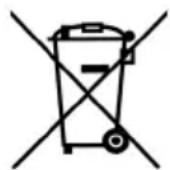
This product is subject to the provisions of European Directive 2012/19/EC. The symbol showing a wheelie bin crossed through indicates that the product requires separate refuse collection in the European Union. This applies to the product and all accessories marked with this symbol. Products identified with this symbol may not be discarded with normal household waste, but must be taken to a collection point for recycling electric and electronic appliances.
This recycling symbol marks e.g. an object or parts of the material as valuable for recycling. Recycling helps to reduce the consumption of raw materials and protect the envi

Packaging
When disposing of the packaging, make sure you comply with the environmental regulations applicable in your country.
14. Technical specifications
| Model: SKM 600 F1 | |
| Mains voltage: 220 - 240 V ~50 - 60 Hz | |
| Power consumptionwhen switched off: | ≤ 0,5 W |
| Protection class: II | ☐ |
| Power rating: 600 watt | |
| Mixing bowlVolume:Max. filling volume(MAX marking): | 5000 ml3700 ml |
| Maximum load for beater 8 and dough hook 5: | Batter:max. 1216 gYeast dough:max. 1657 g |
| Max. continuous operation (KB): | (indicates how long the device is permitted to run continuously)10 minutes |
| Speed (measured on the tool): | 40 - 220 rotations/minute |
Symbols used
 | Double insulation |
 | Geprüfte Sicherheit (certified safety): devices must comply with the generally acknowledged rules of technology and the German Product Safety Act (Produkt-sicherheitsgesetz - ProdSG). (Not for UK) |
 | With the CE marking, HOYER Handel GmbH declares the conformity with EU guidelines. |
 | This symbol reminds you to dispose of the packaging in an environmentally friendly manner. |
 | Recyclable materials are marked with the recycling symbol (3 arrows). The material can be specified by the recycling number in the centre (here: 21) and/or an abbreviation (here: PAP). |
| ~ | AC voltage |
 | The symbol identifies parts that can be cleaned in the dishwasher. |
 | It is a recyclable product which is subject to an extended producer responsibility and for which the rules of waste separation apply. |
 | With the UKCA marking, HOYER Handel GmbH declares that the product is in conformity with the UKCA requirements. |
 | The symbol identifies the product manufacturer. |
Subject to technical modifications.
15. Warranty of the HOYER Handel GmbH
Dear Customer,
your device is provided with a 3 year warranty starting with the purchase date. In the event of product defects, you are entitled to statutory rights against the vendor. These statutory rights are not restricted by our warranty presented in the following.
Warranty conditions
The warranty period starts with the purchase date. Please keep the original purchase receipt in a safe place. This document is required to verify the purchase.
If within three years from the purchase date of this product a material or factory defect occurs, the product will be repaired or replaced by us – at our discretion – free of charge to you, or the purchase price will be refunded. This warranty implies that within the period of three years the defective device and the purchase receipt are presented, including a brief written description of the defect and the time it occurred.
If the defect is covered by our warranty, the repaired or a new product will be returned to you. No new warranty period starts with a repair or replacement of the product.
Warranty period and statutory claims for defects
The warranty period is not extended when the warranty has been claimed. This also applies to replaced and repaired parts. Any damages and defects already existing at the time of purchase must be reported immediately upon unpacking. Repairs arising after the expiration of the warranty period are subject to a charge.
Warranty coverage
The device was produced carefully according to strict quality guidelines and tested diligently prior to delivery.
The warranty applies to material or factory defects.
Excluded from the warranty are wear parts subject to normal wear and damages to fragile parts, e.g. switches, lamps or other parts manufactured from glass.
This warranty expires if the product is damaged, not used as intended or not serviced. For the proper operation of the product, all instructions listed in the operating instructions must be observed carefully. Any form of use and handling that is advised against in the operating instructions or warned against must always be avoided.
The product is only intended for private and not for commercial use. In the case of incorrect and improper treatment, use of force and interventions not performed by our authorised Service Centre, the warranty shall cease.
Handling in case of a warranty claim
In order to ensure prompt processing of your matter, please observe the following notes:
- Please keep the article number
IAN: 485014_2501 /
485015_2501 and the purchase receipt as a purchase verification for all inquiries.
- The article number can be found on the rating plate, an engraving, the title page of your instructions (in the bottom left), or as a label on the rear or underside of the device.
- If faulty operation or other defects occur, first contact the Service Centre listed in the following by telephone or email.
- Then, you are able to send a product reported as defective free of charge to the service address specified to you, including the purchase receipt and the information on the defect and when it occurred.
At www.lidl-service.com you can download this and many other manuals, product videos and installation software.
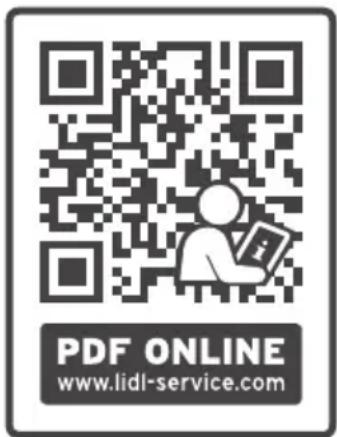
This QR code takes you directly to the Lidl Service website (www.lidl-service.com), where you can enter the article number (IAN)
485014_2501 / 485015_2501 to open your user instructions.

Service Centre
GB Service Great Britain
Tel.: 0800 404 7657
E-Mail: hoyer@lidl.co.uk
IE Service Ireland
Tel.: 1800 101010
E-Mail: hoyer@lidl.ie
MT Service Malta
Tel.: 80062230
E-Mail: hoyer@lidl.com.mt
CY Service Cyprus
Tel.: 8009 4241
E-Mail: hoyer@lidl.com.cy
IAN: 485014_2501 / 485015_2501
Supplier
Please note that the following address is no
service address. First contact the aforementioned Service Centre.
HOYER Handel GmbH
Kühnehöfe 12
22761 Hamburg
GERMANY
Sommaire
natural_image
Line drawing of a kitchen mixer with control panel and baseplate (no text or symbols)Monter la protection anti-projections
ATTENTION :
natural_image
Diagram of a mechanical component with a circular component and directional arrow, no text or symbols presentnatural_image
Diagram showing a device with a connector and a magnified view of its internal structure (no text or symbols)Retirer la protection anti-projections
... in ontbijtpensions.

natural_image
Line drawing of a kitchen mixer with control panel and baseplate (no text or symbols)natural_image
Diagram of a mechanical device with a circular component and directional arrows indicating motion (no text or symbols)natural_image
Diagram showing a mechanical component with a dashed arrow indicating assembly or connection (no text or symbols present)natural_image
Line drawing of a kitchen mixer with control panel and base (no text or symbols)natural_image
Diagram of a mechanical component with a circular component and directional arrow, no text or symbols presentnatural_image
Diagram showing a mechanical component with a dashed arrow indicating assembly or connection (no text or symbols present)natural_image
Line drawing of a kitchen mixer with control panel and base (no text or symbols)natural_image
Diagram of a mechanical component with a circular component and directional arrow, no text or symbols presentnatural_image
Diagram showing a device with a connector inserted into a housing, connected to a separate panel (no text or symbols present)natural_image
Line drawing of a kitchen mixer with control panel and base (no text or symbols)natural_image
Diagram of a mechanical device with a rotating ring and adjustment knob (no text or symbols)natural_image
Diagram showing a device with a connector and internal components, no text or symbols presentnatural_image
Line drawing of a coffee maker with a cup and stand, no text or symbols presentnatural_image
Diagram showing a mechanical component with a circular component and directional arrows, no text or symbols present.natural_image
Diagram showing a device with a connector and a magnified view of its internal structure (no text or symbols)natural_image
Line drawing of a coffee maker with a digital display and control panel (no text or symbols)natural_image
Diagram of a mechanical device with a circular component and directional arrow, no text or symbols presentnatural_image
Diagram showing a device with a connector inserted into a circular housing, connected to a separate curved component (no text or symbols present)natural_image
Line drawing of a coffee maker with a side panel and stand mixer (no text or symbols)natural_image
Diagram of a sewing machine with a circular component and directional arrow indicating rotation (no text or symbols)natural_image
Diagram showing a mechanical component being inserted into a motor, with no visible text or symbols.natural_image
Line drawing of a kitchen mixer with a glass bowl and control panel (no text or symbols)natural_image
Diagram of a mechanical device with a circular component and directional arrow (no text or symbols)natural_image
Diagram showing a mechanical component with a directional arrow pointing to a circular feature (no text or symbols present)- KÜCHENMASCHINE SKM 600 F1 STAND MIXER SKM 600 F1 ROBOT MULTIFONCTION SKM 600 F1
- Übersicht / Overview / Aperçu de l'appareil / Overzicht / Przegląd / Přehled / Prehlad / Vista general / Oversigt / Panoramica / Áttekintés
- Inhalt
- Overview
- Thank you for your trust!
- Symbols on the device
- Intended purpose
- Foreseeable misuse
- WARNING! Risk of material damage!
- Safety information
- Warnings
- Instructions for safe operation
- DANGER for children!
- DANGER to and from pets and livestock!
- DANGER! Risk of electric shock due to moisture!
- DANGER! Risk of electric shock!
- DANGER of hand injuries by crushing!
- DANGER from rotating parts!
- Items supplied
- Unpacking and setting up
- CAUTION:
- Overview of functions
- Using the mixing tools
- Lifting up the drive arm
- Inserting the mixing bowl
- Mounting the splash guard
- Inserting the mixing tool
- Adding ingredients
- Lowering the drive arm
- Basic operation
- Power supply
- Safety functions
- Functions only when the drive arm is lowered
- Overheating protection
- Switching the device on/off and selecting speed
- Turbo function
- Dismantling the device
- Removing the mixing tool
- Removing the splash guard
- Removing the mixing bowl
- Cleaning and servicing the device
- NOTES:
- Cleaning the base unit
- Cleaning in the dish-washer
- Cleaning the accessories
- Storage
- Recipes
- Mascarpone cream
- Ingredients:
- Preparation
- Pear tarte tatin
- Ingredients for the dough:
- Ingredients for the almond paste:
- For garnish:
- Pizza dough
- Basic batter recipe
- Ingredients for 1 loaf tin (approx. 30 cm):
- Basic yeast dough recipe
- Basic waffle recipe
- Ingredients for 4 portions:
- Basic cocoa sponge recipe
- Crumb cake with sour cherries
- Ingredients for 26 cm spring-form cake tin:
- Basic shortcrust pastry recipe
- Baby carrot cupcakes with orange frosting
- Ingredients for the cupcakes (24 portions):
- Ingredients for the frosting:
- Trouble-shooting
- Disposal
- Packaging
- Technical specifications
- Symbols used
- Warranty of the HOYER Handel GmbH
- Warranty conditions
- Warranty period and statutory claims for defects
- Warranty coverage
- Excluded from the warranty are wear parts subject to normal wear and damages to fragile parts, e.g. switches, lamps or other parts manufactured from glass.
- Handling in case of a warranty claim
- Service Centre
- Supplier
- Sommaire
- Monter la protection anti-projections
- ATTENTION :
- Retirer la protection anti-projections
Brand : SILVERCREST
Model : SKM 600 F1
Category : Food Processor