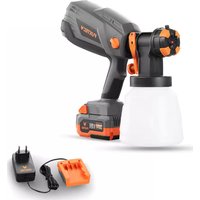
FX-E1CSP20 - Paint gun Fuxtec - Free user manual and instructions
Find the device manual for free FX-E1CSP20 Fuxtec in PDF.



| Product type | Cordless paint sprayer (HVLP) |
| Brand | Fuxtec |
| Model | FX-E1CSP20 |
| Rated voltage | 20 V |
| Paint container capacity | 1000 ml |
| Max. liquid flow rate | 600 ml/min |
| Max. viscosity | 85-100 DIN-s |
| Diameter of supplied nozzles | 1.5 mm / 1.8 mm / 2.2 mm |
| Net weight | 1.1 kg |
| Power supply | 20 V Li-ion battery (not included) |
| Charger type | Manufacturer recommended charger (not included) |
| Intended use | Spraying of paints, varnishes, glazes, etc. (flash point ≥ 21°C) |
| Spray modes | Vertical flat spray, horizontal flat spray, circular spray |
| Flow adjustment | Adjustment knob (increase by turning clockwise) |
| Spray width adjustment | Adjustment lever |
| Maintenance | Clean after each use with solvent or water, do not immerse |
| Safety | Safety goggles, respirator mask, gloves recommended |
| Important safety instructions | Do not use flammable liquids, keep out of reach of children, remove battery before cleaning |
| Included accessories | 3 nozzles (1.5/1.8/2.2 mm), viscosity measuring cup, cleaning needle |
| Warranty | Conforms to CE directive |
Frequently Asked Questions - FX-E1CSP20 Fuxtec
User questions about FX-E1CSP20 Fuxtec
0 question about this device. Answer the ones you know or ask your own.
Ask a new question about this device
Download the instructions for your Paint gun in PDF format for free! Find your manual FX-E1CSP20 - Fuxtec and take your electronic device back in hand. On this page are published all the documents necessary for the use of your device. FX-E1CSP20 by Fuxtec.
USER MANUAL FX-E1CSP20 Fuxtec
- Introduction and security 20
- Safety instructions for cordless handheld sprayer 22
- Safety instructions for the charger 24
- Safety instructions for Li-ion batteries 24
- Safety instructions for working with the cordless hand-held sprayer 25
- Product 26
- Assembly 27
20.Use 28 - Maintenance 33
- Disposal 34
- Specifications 34
- Konformitätserklung / Declaration of Conformity 35
VERSION FRANCAISE 36
POLSKAWERSJAJEZYKOWA 20
Akku Handspruhgerat / E1 20V Cordless Painted Sprayer
Typ / model FX-E1CSP20
EG-Richtlinie / EC directive
2014/30/EU
Angewandte Normen / applicable standards
EN 55014-1:2017
EN 61000-3-2:2014
EN 61000-3-3:2013
EN 55014-2:2015
Hereby we declare that the above mentioned machine meet the essential safety and health requirements of the above stated EC directives. Any manipulation or change of the machine not being explicitly authorized by us in advance renders this document null and void.
13. Introduction and security
Never allow children or anyone unfamiliar with these instructions to use the tool. Children should be supervised to ensure that they do not play with the device.
Intended use
This device is intended for private use only and is designed for spraying liquids. Use is only permitted with suitable accessories and for approved liquids.
The appliance is designed in accordance with the instructions set out in this user manual, given descriptions and safety instructions. Any other use is not in accordance with its intended purpose. Incorrect use will void the warranty and disclaim any responsibility on the part of the manufacturer. The user is liable for any damage to third parties and their property. Only operate the device in the technical condition prescribed and delivered by the manufacturer. Unauthorized modifications to the device exclude liability of the manufacturer for resulting damage.
General safety instructions for power tools
WARNING!
Read all safety instructions and instructions. Failure to comply with the safety instructions and instructions may result in electric shock, fire and/or serious injury.
Keep all safety instructions and instructions for the future.
The term power tool used in the safety instructions refers to mains-powered power tools (with a power cord) and battery-powered power tools (without a power cord).
Job security
- Keep your workspace clean and well-lit. Clutter or unlit work areas can lead to accidents.
- Do not use the power tool in an explosive environment where flammable liquids, gases or dusts are present. Power tools produce sparks that can ignite the dust or fumes.
- Keep children and other people away while using the power tool. If you are distracted, you may lose control of the device.
Electrical safety
- The connection plug of the power tool must fit into the socket. The plug must not be changed in any way. Do not use adapter plugs with grounded power tools. Unchanged plugs and matching sockets reduce the risk of electric shock.
- Avoid physical contact with grounded surfaces such as pipes, heaters, stoves and refrigerators. There is an increased risk of electric shock if your body is grounded.
- Keep power tools away from rain or moisture. Water ingress into a power tool increases
the risk of electric shock.
-
Do not misuse the cable to carry the power tool, hang it up or to pull the plug out of the socket. Keep the cord away from heat, oil, sharp edges, or moving device parts. Damaged or tangled cables increase the risk of electric shock.
-
If you're working outdoors with a power tool, only use extension cords that are also suitable for outdoor use. Applying an extension cord suitable for outdoor use reduces the risk of electric shock.
-
If you're working outdoors with a power tool, only use extension cords that are also suitable for outdoor use. Applying an extension cord suitable for outdoor use reduces the risk of electric shock.
Safety of people
-
Be attentive, pay attention to what you are doing, and approach working with a power tool with reason. Do not use a power tool if you are tired or under the influence of drugs, alcohol or medication. A moment of carelessness when using the power tool can lead to serious injuries.
-
Wear personal protective equipment and goggles at all times. Wearing personal protective equipment, such as dust masks, non-slip safety shoes, safety helmet or hearing protection, depending on the type and use of the power tool, reduces the risk of injury.
-
Avoid unintentional commissioning. Make sure the power tool is turned off before plugging it into the power supply and/or battery, picking it up, or carrying it. If you have your finger on the switch while carrying the power tool or connect the device to the power supply when switched on, this can lead to accidents.
-
Remove any adjustment tools or wrenches before turning on the power tool. A tool or wrench that is in a rotating part of the device can cause injury.
-
Avoid abnormal posture. Ensure a safe
Stand up and keep your balance at all times. This allows you to better control the power tool in unexpected situations.
- Wear appropriate clothing. Do not wear loose clothing or jewelry. Keep hair, clothing, and gloves away from moving parts. Loose clothing, jewellery or long hair can be caught by moving parts.
Use and treatment of the power tool
-
Do not overload the device. Use the dedicated power tool for your work. With the right power tool, you will work better and safer in the specified power range.
-
Do not use a power tool whose switch is defective. A power tool that can no longer be switched on or off is dangerous and needs to be repaired.
- Unplug it from the power outlet and/or remove the battery before making device adjustments, changing accessories, or putting the device away. This precaution prevents the power tool from starting unintentionally.
- Keep unused power tools out of the reach of children. Do not allow people to use the device who are not familiar with it or follow these instructions.
have not read. Power tools are dangerous when used by inexperienced people.
- Maintain power tools with care. Check that moving parts are working properly and are not jammed, that parts are broken or damaged in such a way that the function of the power tool is impaired. Have damaged parts repaired before using the device. Many accidents are caused by poorly maintained power tools.
-
Keep cutting tools sharp and clean. Carefully maintained cutting tools with sharp cutting edges are less likely to jam and are lighter
-
Use power tools, accessories, insert tools, etc. according to these instructions. Consider the working conditions and the job to be performed. The use of power tools for applications other than those intended can lead to dangerous situations.
Use and treatment of the cordless tool
- Only charge the batteries with chargers recommended by the manufacturer. A charger that is suitable for a certain type of battery poses a risk of fire when used with other batteries.
- Only use the batteries provided for this purpose in the power tools. The use of other batteries can lead to injury and fire hazard.
- Keep the unused battery away from paper clips, coins, keys, nails, screws, or other small metal objects that could cause contacts to be bypassed. A short circuit between the battery contacts can result in burns or fire.
- If used incorrectly, liquid can leak out of the battery. Avoid contact with them. In case of accidental contact, rinse with water. If the fluid gets into the eyes, seek additional medical help. Leaking battery fluid can cause skin irritation or burns.
14. Safety instructions for cordless handheld sprayer
General safety instructions
-
For your safety and the safety of others, read this instruction manual and its safety instructions before using the device. Please keep the instruction manual and its safety instructions safe for later use and keep them safe for later use.
every insert at hand. -
Pass on the operating instructions in the event of a change of ownership with the device.
- Persons operating the device must not be under the influence of intoxicants (e.g. alcohol, drugs or medication).
- Only operate the device in the technical condition prescribed and delivered by the manufacturer. Unauthorized changes to the device exclude liability of the manufacturer for resulting damage.
- Use the device only in daylight or under good artificial lighting.
- Use the device only in dry weather conditions. Keep it away from rain or wet. Water ingress into the device increases the risk of electric shock.
-
Turn off the device and remove the battery if you have the following conditions:
-
if the device is left unattended;
before checking, cleaning or other work on the device;
if the device starts to vibrate excessively.
Before use
- Before starting work, familiarize yourself with the device and its functions as well as its controls.
- Check the device for signs of wear or damage before use and after an impact.
- Do not use a device whose switch is defective and can no longer be switched on or off.
- Check that all nuts, bolts, and screws are tight to ensure that the device is operating safely.
- Never use a device with damaged or missing parts. Have them repaired or, if necessary, replaced by a qualified specialist or specialist workshop.
- When working with or on the device, always wear appropriate personal protective equipment (safety goggles, ear protection, non-slip work gloves, etc.). Wearing personal protective equipment reduces the risk of injury.
During use
Do not turn on the device if people (especially children) or animals are in close proximity. Make sure that children do not play with the device.
Make sure you have a firm footing and work calmly and prudently. When using the device, wear respiratory protection and, if necessary, noise protection. Exposure to noise can lead to hearing loss, and paint fumes can lead to lung damage. Hold the power tool by the insulated grip surfaces.
After the assignment
Turn off the device and remove the battery from the sprayer. Then place the unit in a safe place.
Keep the device out of reach of children. Make sure the vents in the unit are clean.
Please do not clean soiling with water. Damage to the electrical device may occur.
15. Safety instructions for the charger
- Keep the charger away from rain or moisture. Water ingress into a charger increases the risk of electric shock.
- Keep the charger clean. Contamination poses a risk of electric shock.
- Check the charger, cable and plug before each use. Do not use the charger if you notice damage.
Do not open the charger yourself and only have it repaired by qualified professionals and only with original spare parts.
Damaged chargers, cables, and plugs increase the risk of electric shock.
- Do not place objects on the charger or place it on soft surfaces. There is a risk of fire.
- Always check that the mains voltage corresponds to the voltage indicated on the charger's nameplate.
- Never use the charger if the cable, plug or the device itself is damaged by external influences.
Take the charger to the nearest specialist workshop.
- Do not open the charger under any circumstances. In the event of a malfunction, take it to a specialist workshop.
16. Safety instructions for Li-ion batteries
- Do not open the battery. There is a risk of a short circuit.
- Protect the battery from heat, including continuous sunlight, fire, water and moisture. There is a risk of explosion.
- If the battery is damaged and used improperly, fumes may escape. Take in fresh air and consult a doctor if you have any symptoms. The fumes can irritate the respiratory tract.
- If used incorrectly, liquid can leak out of the battery. Avoid contact with them. In case of accidental contact, rinse with water. If the fluid gets into the eyes, seek additional medical help. Leaking battery fluid can cause skin irritation or burns.
- Only use original batteries with the voltage indicated on the nameplate of your power tool. When using other batteries, e.g. imitations, refurbished batteries or third-party makes, there is a risk of injury and property damage due to exploding batteries.
-
The battery voltage must match the battery charging voltage of the charger. Otherwise, there is a risk of fire and explosion.
-
Only charge the batteries with chargers recommended by the manufacturer. A charger that is suitable for a certain type of battery poses a risk of fire when used with other batteries.
-
The battery can be damaged by sharp objects such as nails or screwdrivers or by external force. An internal short circuit may occur and the battery may burn, smoke, explode or overheat.
17. Safety instructions for working with the cordless hand-held sprayer
- Only coating materials such as paints, varnishes, glazes, etc. with a flash point of at least 21^ may be sprayed without additional heating.
- The device must not be used in workplaces that fall under the explosion protection regulations.
- When spraying, make sure that there are no ignition sources, such as open flames, cigarettes, cigars and pipes, sparks, glowing wires, etc., nearby.
- Wear respiratory protection when spraying.
- Do not spray on the device.
- The device is only splash-proof if the air hose is properly connected.
- Do not let children play with the device. Keep out of reach of children.
- Do not use spray guns to spray flammable liquids.
- Do not clean spray guns with flammable solvents.
- Take precautions against possible hazards from spray liquid and follow all instructions that are affixed to the containers or specified by the manufacturer of the liquid.
- Do not spray liquids with unknown hazard potential.
18. Product
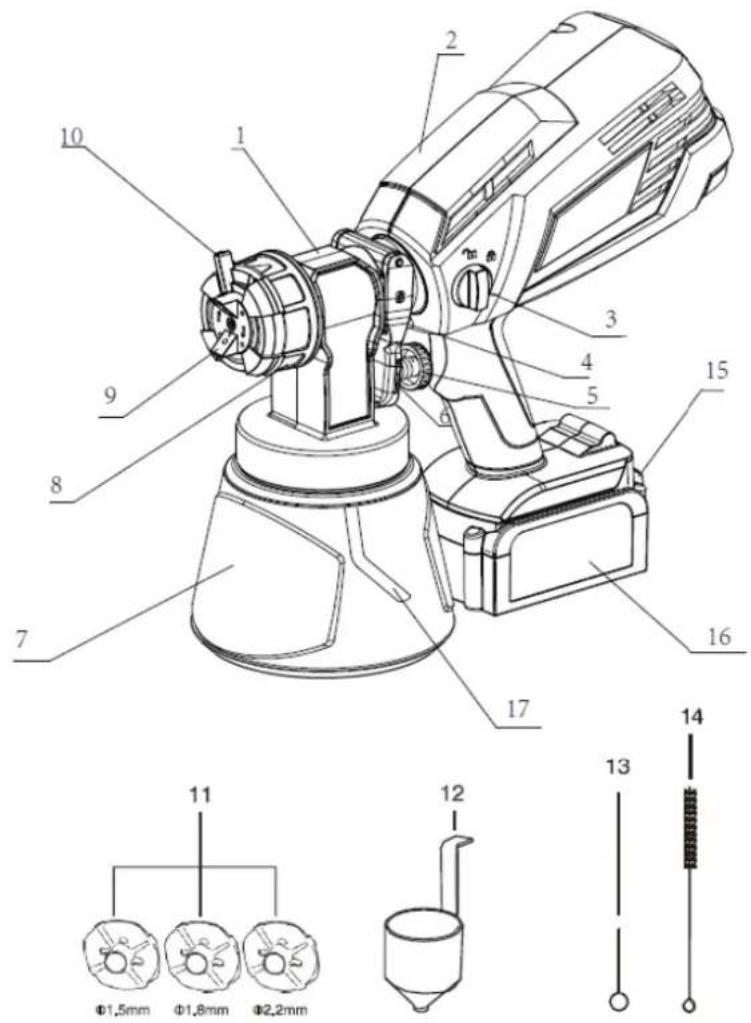
Illustration:
1) Body Hand Sprayer 10) Lever for spray width
2) Engine housing 11) Nozzle (Diameter: 1.5 / 1.8 / 2.2mm )
3) Rotary knob quick release 12) Liquid container
4) Toggle lever 13) Cleaning needle
5) Flow control knob 14) Cleaning brush
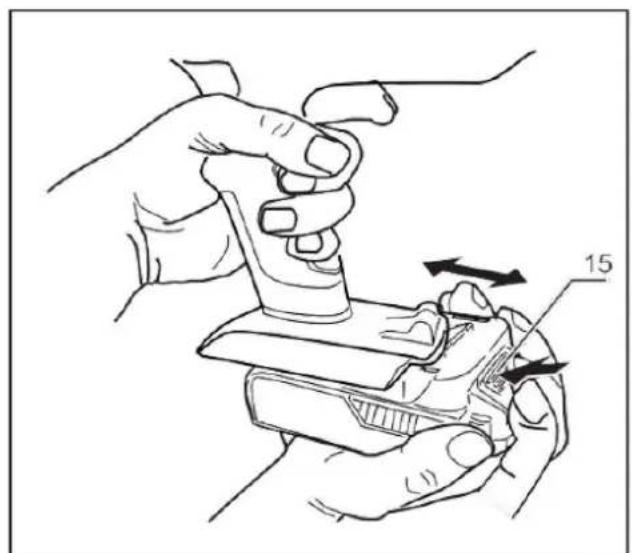
6) On/off switch (page 31) 15) Battery Clip
7) Paint Tank 16) Battery (optional)
8) Nozzle holder 17) Pipeline9) Air cap
19. Assembly
NOTE: This product needs to be partially assembled.
- Carefully remove the product and all accessories from the box. Inspect the product carefully to ensure that no breakage or damage has occurred during transport. Do not throw away the packaging material until you have fully inspected and operated the product satisfactorily.
IMPORTANT: To prevent accidental starting, always remove the battery from the device when assembling parts.
- Remove the battery.
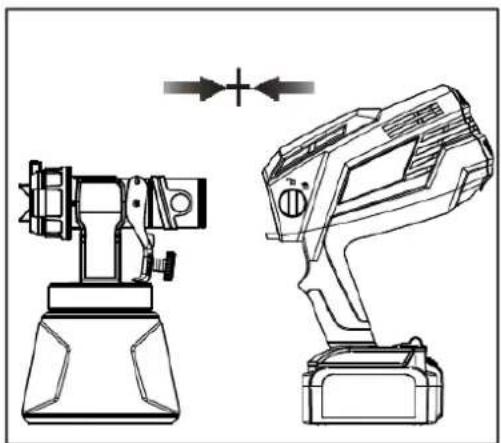
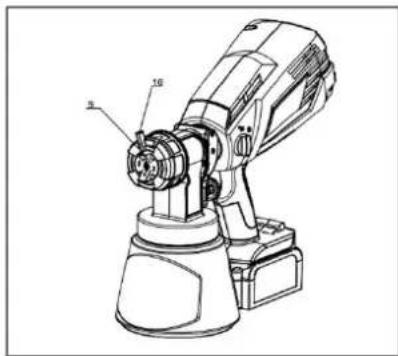
- Insert the spray gun unit into the engine housing (Figure 1).
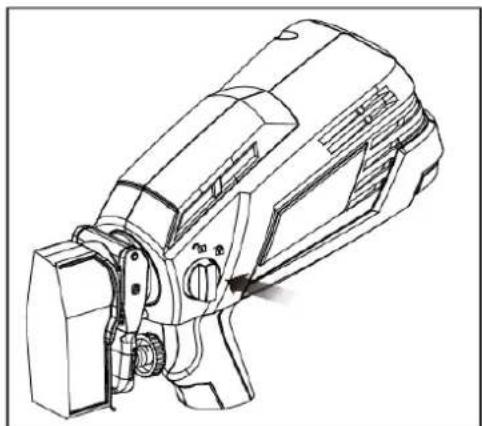
- Secure the unit by locking it using the quick-release button (Figure 2).
1
2
- If the device is used horizontally or low, turn the pipe forward (Fig. 3)
- For overhead work, turn the piping backwards (Fig. 4)
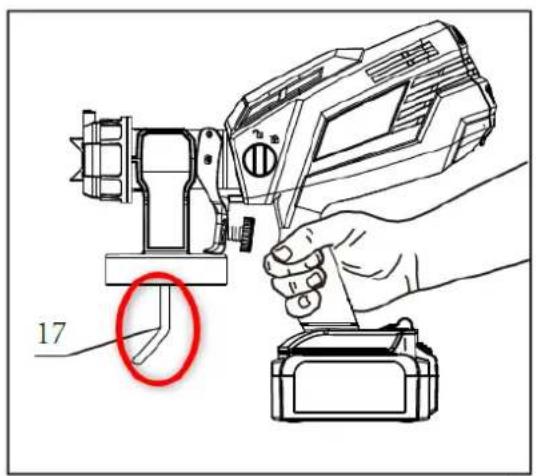
3
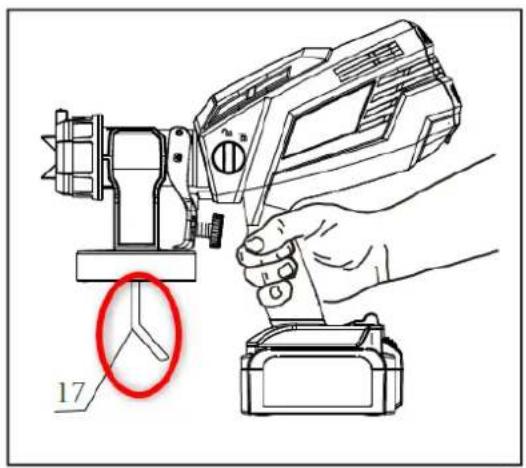
4
20.Use
Preparation
Viscosity measurement:
Make sure that the material you use can be cleaned with either alcohol or paint thinner (for oil paints) or with a warm water and soap solution (for water-soluble paints such as latex). When pouring, mixing, and testing the viscosity of the materials to be sprayed, use drapes to protect your feet and anything in the spray area that you don't want to touch. The liquid to be sprayed may need to be diluted before starting. When diluting, use the dilution recommended by the material manufacturer on the container.
To determine the viscosity of the material used, a viscosity measuring cup is included.
Before measuring the viscosity present, stir the material thoroughly.
- Dip the viscosity cup into the material to be sprayed and fill the cup completely.
Hold the cup over the material container and stop the time it takes for the outflowing material to "drip" or stop being a constant stream from the bottom of the cup (70 seconds or less). The measured time is the so-called "run-out time".
See the dilution table for information about the dilution required for different materials.
It is possible to spray latex paint with this device, however, the required dilution may exceed the material manufacturer's recommendation.
- Dilute latex paint so that it runs through the viscosity cup within 70 seconds.
The operator should consider the type of application and the final location of the project when spraying a material that takes more than 70 seconds to pass through the viscosity cup
Tips for preparation:
Always stir and strain the material thoroughly before use.
For all spraying work, you should always make sure that you prepare the surface properly to achieve an optimal result. This means that all surfaces are free of dust, dirt, rust and grease. Wash decks or outdoor surfaces with light pressure, making sure they are dry before spraying.
Although HVLP sprayers produce very little spray, it is recommended that you tape all edges and other areas and use drapes to protect your floors and anything that is in the spraying area and should remain untouched.
The skin that forms on the surface of the paint can clog the sprayer. Remove skin before mixing.
Strain with a funnel with the filter attached or through a hose to remove contaminants.
that could clog the system
Before starting work, keep gloves, paper towels, rags, etc. ready for unexpected spills.
Filling the paint container:
Make sure the canister is fully screwed onto the sprayer.
Unscrew the quick refill lid.
Place the sprayer firmly on a smooth and horizontal surface.
Fill the properly diluted and sieved spray material into the canister (Fig. 6).
Clean the thread and sides of the canister and sprayer of any liquid residue.
Screw the lid completely onto the upper filling container by screwing in the threads evenly. Check that the lid is properly and fully screwed on before picking up the handheld sprayer.
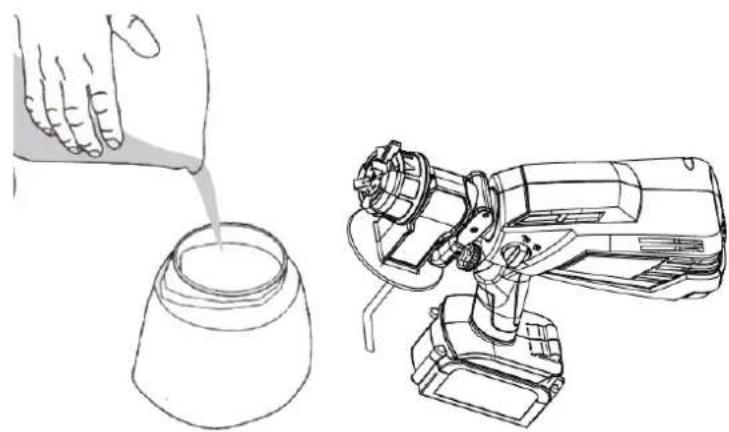
On/off switch
Press the trigger (6), the trigger activates the switch inside the tool through the switch release lever (4) to turn the tool on. Release the trigger to turn off the machine.
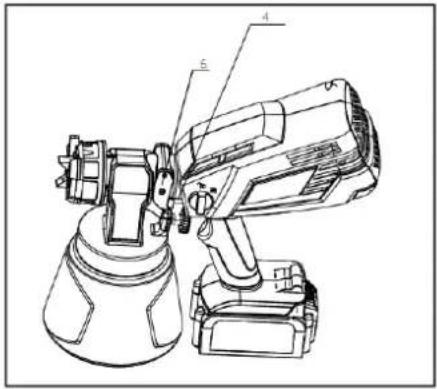
Spray pattern setting
You can choose between three spray patterns:
Vertical flat jet
Horizontal flat jet
Circular beam
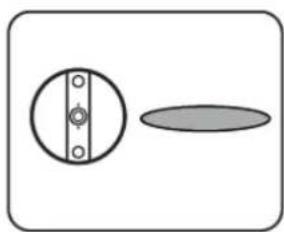
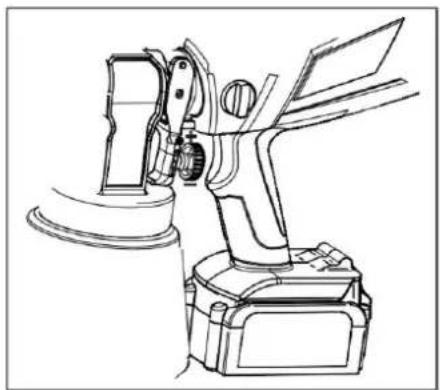
Always test the spray pattern first for cardboard residues or similar material. First, set the flow regulator to the highest setting. If you want a lower flow, turn the flow regulator counterclockwise to reduce the fluid flow. Heavier, thicker materials should be sprayed with the flow regulator at the highest setting. Thinner materials should be sprayed with the flow regulator on the low setting.
Adjustment of the material flow rate
The flow regulator (5) regulates the amount of liquid that can be sprayed. Turning the flow regulator clockwise increases the fluid flow. Turning the knob counterclockwise reduces the flow of liquid.
Spray technology
Practice spraying on a piece of waste material, such as cardboard, to check your spray pattern and familiarize yourself with how the sprayer works.
Make sure that the surface to be sprayed is free of dust, dirt and grease.
Make sure the environment is free of dust, otherwise it could be blown onto the freshly sprayed surfaces.
Cover any areas that you don't want to be sprayed.
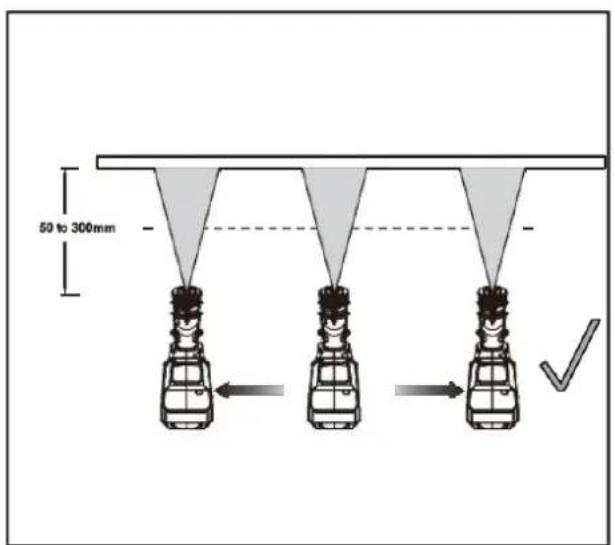
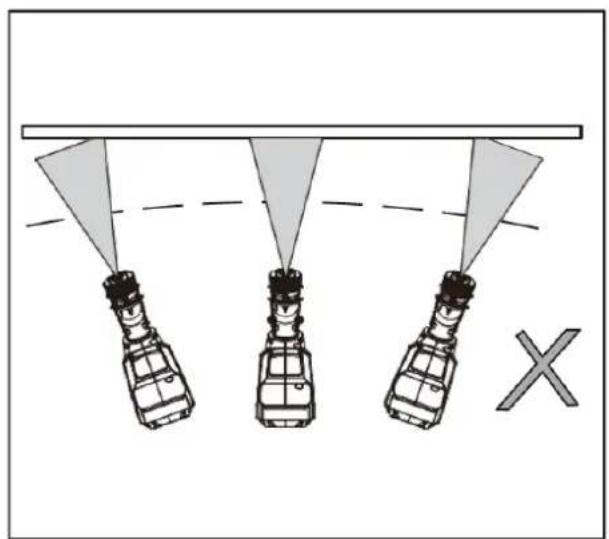
Always spray from a minimum distance of 50~mm and a maximum distance of 300~mm (Fig. 10).
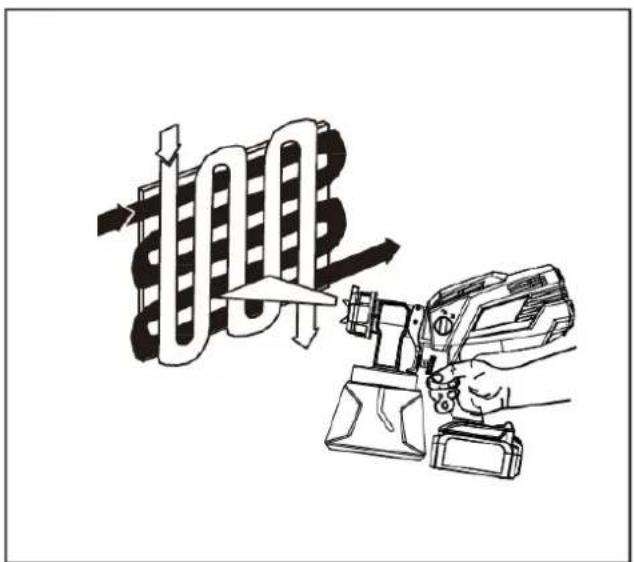
A commonly used method for spraying a large area is the "cross pattern".
This is done by spraying in horizontal strips and then crossing over these strips with vertical strips (Fig. 12).
To ensure an even distribution of the spray jet, always keep your arm at the same distance (Fig. 10) from the area to be sprayed and avoid moving your wrist (Fig. 11).
- Maintain a steady and constant speed to avoid inaccuracies. Start spraying when the run has begun and release the trigger before stopping the run.
Avoid overspraying in a specific area. Several light coats are better than one thick layer, which can cause bleeding and dripping.
Remember that the flow regulator regulates the amount of liquid that can be sprayed. Turning the flow regulator clockwise increases the amount of liquid. Turning the knob counterclockwise reduces hydration. If it does run or drizzle, have a dry brush ready to touch up the affected area.
10
11
12
13
21. Maintenance
The handheld sprayer can only work satisfactorily if it is cleaned and maintained after each use.
Attention!
Never immerse the spray gun in liquid when cleaning.
- Unscrew the paint container and empty any unused paint or stain into the original container.
Note: Do not return diluted paint to its original container. Dispase of them properly or store them in an extra container for further use.
Fill the paint container with solvent or water.
Note: Only use solvents with a melting point above 21^
Clean the paint container and the suction tube with a brush and then screw the paint container back into the gun. Note: Make sure the gasket and suction pipe are in place before screwing the paint reservoir back onto the spray gun.
Insert the gun unit back into the gun body and spray the solvent onto a piece of cardboard or other waste material. Repeat the process until the clear solvent comes out.
Remove the paint container and empty the remaining solvent.
Note: Always keep the seal of the container free of coating material and check for damage.
Clean the outside of the spray gun and paint container with a soft cloth.
1 Unscrew the air cap nut to remove the air cap.
- Turn the quick-release knob to remove the gun unit.
Remove and disassemble the suction tube by turning it clockwise.
- Dip a cloth in solvent or water and clean the air cap, nozzle, gun housing, back of gun unit, and suction tube.
Note: Never clean the nozzle or air holes of the spray gun with molded metal objects, as this may cause damage.
Pay attention to the two holes on the suction pipe, which can be cleaned by the included cleaning needle in the event of a blockage
Make sure the spray gun is completely dry before storing.
NOTE: Keep the spray gun vents clean at all times. Prevent If possible, prevent foreign objects from getting into the ventilation openings. If the housing of the spray gun needs to be cleaned, do not use solvents, but only a damp, soft cloth. Never allow liquid to enter the inside of the pistol housing; do not immerse any part of the gun in a liquid.
Make disused power tools unusable before disposal:
- mains-powered power tools by removing the connection plug,
- battery-powered power tools by removing the battery.

Only for EU countries
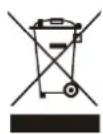
Do not throw power tools in the household waste! According to the European Directive 2012/19/EC on waste electrical and electronic equipment and its transposition into national law, used electrical and electronic equipment must be collected separately and recycled in an environmentally sound manner. Raw material recovery instead of waste disposal. Device, accessories and packaging should be environmentally friendly recycling. Plastic parts are marked for single-origin recycling.


WARNING!
Do not throw rechargeable batteries/batteries in household waste, fire or water. Do not open used batteries. Rechargeable batteries should be collected, recycled or disposed of in an environmentally friendly way.
For EU countries only: According to Directive 2006/66/EC, defective or used rechargeable batteries must be recycled.

HINT
Please find out about disposal options from your municipality/city,
23. Specifications
Cordless tool
Nominal voltage 20V
Max. Volumen des Farbbechers 1000ml
Max. flow of liquid 600ml/min
Max. Viscosity 85-100DIN-sDiameter of nozzles
1.5mm/1.8mm/2.2mm
Net Weight 1.1kg
Name / name Accumulator Hand-held sprayer / E1 20V Cordless Painted Sprayer
Type / Model FX E1CSP20
EG-Richtlinie / EC directive 2014/30/EU
Angewandte Normen / applicable standards
EN 55014-1:2017
EN 61000-3-2:2014
EN 61000-3-3:2013
EN 55014-2:2015
We hereby declare that the above-mentioned machine complies with the essential safety and health requirements of the listed EC Directive due to its design in the version we have placed on the market.
Hereby we declare that the above mentioned machine meet the essential safety and health requirements of the above stated EC directives. Any manipulation or change of the machine not being explicitly authorized by us in advance renders this document null and void.
Storage of technical documents: FUXTEC GmbH · Kappstraße 69 · 71083
Herrenberg · Germany, T. Gumprecht, Managing Director
la tazza completeness.
3) Snabbkoppling for vridknapp
12) Vatskebehallare
4) Omkopplingsspak
13) Rengöringsnal
5)Vredforflodeskontroll
14) Rengöringsborste
6) På/av-omkopplare (sidan 14)
15) Batteriklamma
E-post: info@fuxtec.de
Webb: www.fuxtec.de
Bezeichnung / namn