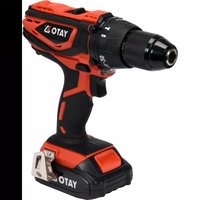
YT-82786 - Drill Yato - Free user manual and instructions
Find the device manual for free YT-82786 Yato in PDF.



| Product type | Cordless drill/driver |
| Brand | Yato |
| Model | YT-82786 |
| Rated voltage | 18 V DC |
| No-load speed (1st gear) | 0 - 440 min⁻¹ |
| No-load speed (2nd gear) | 0 - 1650 min⁻¹ |
| Impact frequency | 0 - 7920 / 0 - 29700 min⁻¹ |
| Max torque | 40 Nm |
| Chuck diameter | 1.5 - 13 mm |
| Max drilling in wood | 25 mm |
| Max drilling in concrete | 13 mm |
| Max drilling in steel | 10 mm |
| Weight | 1.3 kg |
| Battery type | Lithium-ion (Li-Ion) |
| Battery capacity | 2 Ah |
| Charger: input voltage | 220 - 240 V~, 50/60 Hz |
| Charger: output voltage | 21 V DC |
| Charger: output current | 2.4 A |
| Charging time | 1 h |
| Sound pressure level (LpA) | 82.0 dB(A) ± 3.0 |
| Sound power level (LwA) | 93.0 dB(A) ± 3.0 |
| Vibration (drilling without impact) | 3.0 m/s² ± 1.5 |
| Vibration (drilling with impact) | 9.89 m/s² ± 1.5 |
| Protection degree | IP20 |
| Insulation class | III |
Frequently Asked Questions - YT-82786 Yato
User questions about YT-82786 Yato
0 question about this device. Answer the ones you know or ask your own.
Ask a new question about this device
Download the instructions for your Drill in PDF format for free! Find your manual YT-82786 - Yato and take your electronic device back in hand. On this page are published all the documents necessary for the use of your device. YT-82786 by Yato.
USER MANUAL YT-82786 Yato
Nominals griezes atrums
Jmenovite otáčky
Menovite otacky
Nevleges fordulatszam
Maximum drilling diameter
MaKc. DnAmet CpBepHeHH
MaKc. diametp cBepnyBaHn
Maks. grezimo diamestras
Maksimals urbanas diameters
Max.prumer vtani
Max. priemer vrtania
Max furatatmero
Electronic adjustment of the rotation
Read the operating instruction
Wear protective goggles
Schutzbrille tragen
Pb30BaTbC8auntHbIMOnOyKaM
KopnCTyIyTeCb 3axiCNHIMN OKyIpypAMN
Vartok apsauginius akinius
Jalieto drośibas brilles
Pouzivej ochranné bryle
Pouzivaj ochranné okuliare
Wear hearing protectors
Gehorschutz tragen
Tb30BaTcBcpeCTBaMn 3aunTb cnyxa
KopncTyIeTcB 3acobamn 3axncTy cnyx
Vartoti ausines klausai apsaugoti
Jalieto dzirdes drośibas fidzekluk
This symbol indicates that waste electrical and electronic equipment (including batteries and storage cells) cannot be disposed of with other types of waste. Waste equipment should be collected and handed over separately to a collection point for recycling and recovery, in order to reduce the amount of waste and the use of natural resources. Uncontrolled release of hazardous components contained in electrical and electronic equipment may pose a risk to human health and have adverse effects for the environment. The household plays an important role in contributing to reuse and recovery, including recycling of waste equipment. For more information about the appropriate recycling methods, contact your local authority or retailer.
CHARAKTERYSTYKA WYROBU
The drill and screwer is a universal portable tool which does not require external power supply for do-it-yourself enthusiasts designed to drill holes in distinct materials (e.g. wood and wood-derived materials, metals) and to screw and unscrew bolts. Its special advantages will be appreciated by DIY enthusiasts realising assembly and finishing jobs. The tool has been designed solely for domestic work and must not be used professionally, i.e. in workshops and for remunerable jobs. A correct, reliable and safe functioning of the electric tool depends on its proper use, so:
Before you proceed to operate the device, read the manual thoroughly and keep it.
The supplier will not be held responsible for any damage resulting from the safety regulations and the recommendations indicated hereby not being observed.
EQUIPMENT
The product is supplied in a complete state and requires no assembly. Together with the product there are provided: the rechargeable battery and charging station (charger).
Attention! Products with catalog numbers: YT-82787, YT-82789 have not been equipped with a rechargeable battery and charging station.
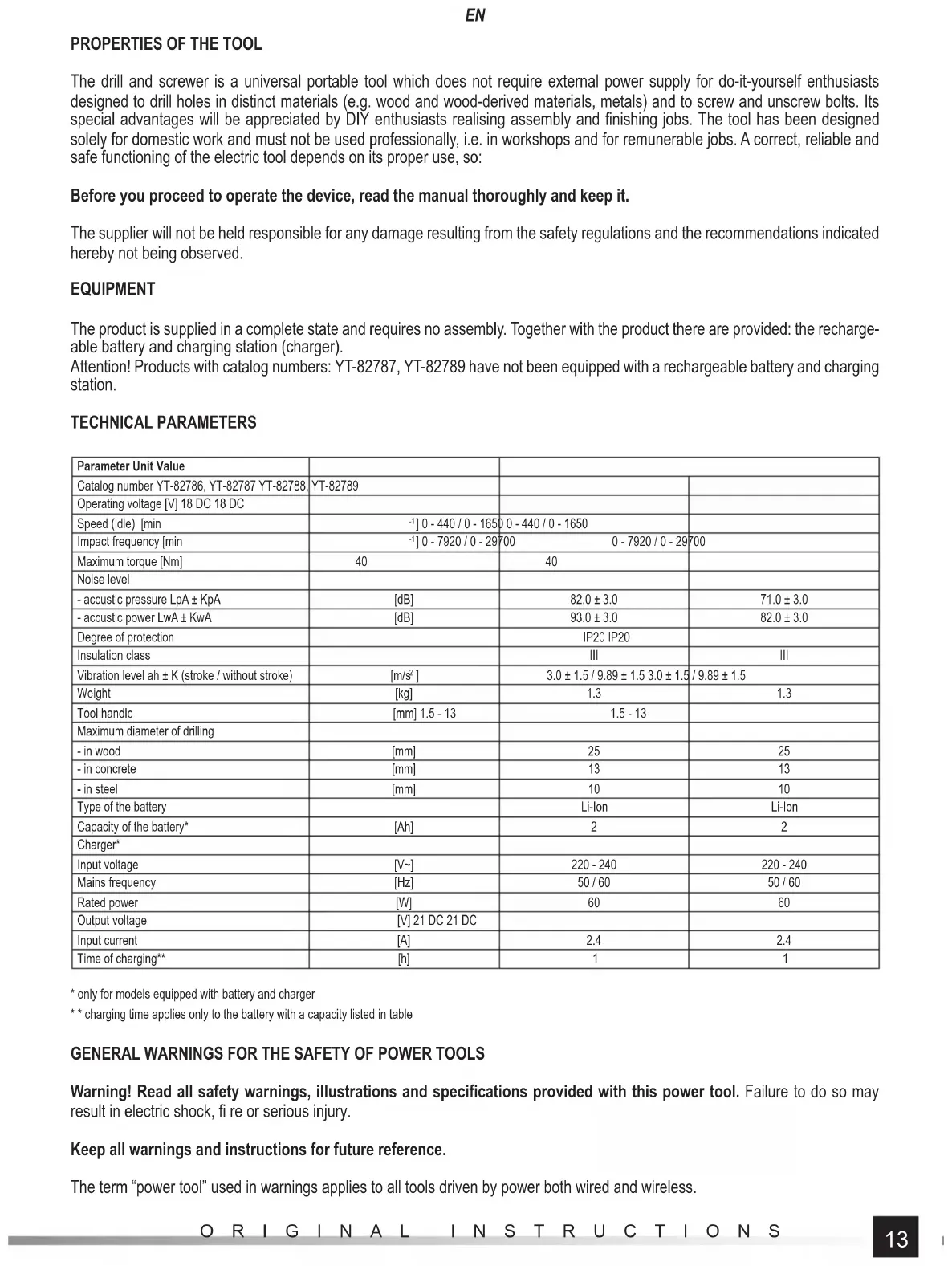
TECHNICAL PARAMETERS
| Parameter Unit Value | |||
| Catalog number YT-82786, YT-82787 YT-82788, | YT-82789 | ||
| Operating voltage [V] 18 DC 18 DC | |||
| Speed (idle) [min] | \( ^{-1} \)0 - 440 / 0 - 165 | 0 - 440 / 0 - 1650 | |
| Impact frequency [min] | \( ^{-1} \)0 - 7920 / 0 - 29 | 0 - 7920 / 0 - 29700 | |
| Maximum torque [Nm] | 40 | 40 | |
| Noise level | |||
| - acoustic pressure LpA ± KpA | [dB] | 82.0 ± 3.0 | 71.0 ± 3.0 |
| - acoustic power LwA ± KwA | [dB] | 93.0 ± 3.0 | 82.0 ± 3.0 |
| Degree of protection | IP20 IP20 | ||
| Insulation class | III | III | |
| Vibration level ah ± K (stroke / without stroke) | [m/s2] | 3.0 ± 1.5 / 9.89 ± 1.5 3.0 ± 1.5 | / 9.89 ± 1.5 |
| Weight | [kg] | 1.3 | 1.3 |
| Tool handle | [mm] 1.5 - 13 | 1.5 - 13 | |
| Maximum diameter of drilling | |||
| - in wood | [mm] | 25 | 25 |
| - in concrete | [mm] | 13 | 13 |
| - in steel | [mm] | 10 | 10 |
| Type of the battery | Li-Ion | Li-Ion | |
| Capacity of the battery* | [Ah] | 2 | 2 |
| Charger* | |||
| Input voltage | [V-] | 220 - 240 | 220 - 240 |
| Mains frequency | [Hz] | 50 / 60 | 50 / 60 |
| Rated power | [W] | 60 | 60 |
| Output voltage | [V] 21 DC 21 DC | ||
| Input current | [A] | 2.4 | 2.4 |
| Time of charging** | [h] | 1 | 1 |
- only for models equipped with battery and charger
-
- charging time applies only to the battery with a capacity listed in table
GENERAL WARNINGS FOR THE SAFETY OF POWER TOOLS
Warning! Read all safety warnings, illustrations and specifications provided with this power tool. Failure to do so may result in electric shock, fire or serious injury.
Keep all warnings and instructions for future reference.
The term "power tool" used in warnings applies to all tools driven by power both wired and wireless.
EN
Workplace safety
Keep the workplace well-lit and clean. Disorder and poor lighting can be causes of accidents.
Do not work with power tools in an environment with an increased risk of explosion, containing flammable liquids, gases or vapors. Power tools generate sparks that can ignite dust or fumes.
Children and third persons should not be allowed to enter the workplace. Loss of concentration can result in loss of control.
Electrical safety
The plug of the electric cable must match the power socket. You must not modify the plug in any way. Do not use any plug adapters with earthed power tools. An unmodified plug that fits the outlet reduces the risk of electric shock.
Avoid contact with earthed surfaces such as pipes, radiators and coolers. Grounding the body increases the risk of electric shock. Do not expose power tools to contact with atmospheric precipitation or moisture. Water and moisture that gets inside the power tool increases the risk of electric shock.
Do not overload the power cable. Do not use the power cord to carry, pull or unplug the power plug from the power outlet. Avoid contact of the power cable with heat, oils, sharp edges and moving parts. Damage or entanglement of the power cord increases the risk of electric shock.
In the case of working outside closed rooms, use extension cords intended for work outside closed rooms. The use of an extension cord adapted for outdoor use reduces the risk of electric shock.
When using a power tool in a humid environment is unavoidable as a protection against supply voltage use a residual current device (RCD). The use of RCD reduces the risk of electric shock.
Personal safety
Stay alert, pay attention to what you do and keep common sense while working with the power tool. Do not use a power tool when you are tired or under the influence of alcohol or medication. Even a moment of inattention while working can lead to serious personal injury.
Use personal protective equipment. Always wear eye protection. The use of personal protective equipment such as dust masks, anti-slip safety shoes, helmets and hearing protection reduce the risk of serious personal injury.
Prevent accidental operation. Make sure that the electric switch is in the "off" position before connecting to the power supply and / or battery, lifting or moving the power tool. Moving the power tool with the finger on the switch or powering the power tool, when the switch is in the "on" position can lead to serious injuries.
Before turning on the power tool remove any keys and other tools that were used to adjust it. The key left on the rotating parts of the power tool can lead to serious injuries.
Do not reach and do not lean too far. Keep the right attitude and balance all the time. This will allow easier control over the power tool in case of unexpected work situations.
Dress accordingly. Do not wear loose clothing or jewelry. Keep your hair and clothing away from moving parts of the power tool. Loose clothing, jewelry or long hair can be caught by moving parts.
If the devices are fitted for the connection of dust extraction or dust collection, make sure that they are connected and used properly. The use of dust extraction reduces the risk of dust hazards.
Do not let the experience acquired from frequent use of the tool resulted in carelessness and ignoring safety rules.
Carefree action can cause serious injuries in a fraction of a second.
Use and care of the power tool
Do not overload the power tool. Use the power tool appropriate for the selected application. The right power tool will provide a better and safer job if used according to the designed load.
Do not use the power tool, if the electric switch does not allow switching on and off. Power tool, which cannot be controlled by means of a power switch is dangerous and must be returned for repair.
Disconnect the plug from the power socket and / or remove the battery if it is detachable from the power tool before adjusting, changing accessories or storing the tool. Such preventive measures will allow you to avoid accidentally turning on the power tool.
Keep the tool out of the reach of children, do not let people who do not know how to operate the power tool or these instructions use a power tool. Power tools are dangerous in the hands of untrained users.
Maintain power tools and accessories. Check the tool for mismatches or jams of moving parts, damage to parts and any other conditions that may affect the operation of the power tool. Damage must be repaired before using the power tool.
Many accidents are caused by incorrectly maintained tools.
Keep cutting tools sharp and clean. Properly maintained cutting tools with sharp edges are less prone to jamming and are easier to control when working.
Use power tools, accessories and inserted tools etc. in accordance with these instructions, taking into account the type and conditions of work. The use of tools for work other than designed is likely to result in a dangerous situation.
Handles and grping surfaces must be dry, clean and free from oil and grease. Slippery handles and gripping surfaces do not allow for safe operation and control of the tool in dangerous situations.
Repairs
Repair the power tool only in authorized facilities using only original spare parts. This ensures proper operation safety of the power tool.
DRILL SAFETY WARNINGS
Safety instructions for all operations
Wear ear protectors when impact drilling. Exposure to noise can cause hearing loss.
Use the auxiliary handle(s). Loss of control can cause personal injury.
Brace the tool properly before use. This tool produces a high output torque and without properly bracing the tool during operation, loss of control may occur resulting in personal injury.
Hold the power tool by insulated gripping surfaces, when performing an operation where the cutting accessory may contact hidden wiring or its own cord. Cutting accessory contacting a "live" wire may make exposed metal parts of the power tool "live" and could give the operator an electric shock.
Safety instructions when using long drill bits
Never operate at higher speed than the maximum speed rating of the drill bit. At higher speeds, the bit is likely to bend if allowed to rotate freely without contacting the workpiece, resulting in personal injury.
Always start drilling at low speed and with the bit tip in contact with the workpiece. At higher speeds, the bit is likely to bend if allowed to rotate freely without contacting the workpiece, resulting in personal injury.
Apply pressure only in direct line with the bit and do not apply excessive pressure. Bits can bend causing breakage or loss of control, resulting in personal injury.
PREPARATION FOR WORK
ATTENTION! All the operations mentioned in this point must be realised with the power supply off.
- the battery must be disconnected from the tool!
Safety recommendations for battery loading
Attention! Before loading may start make sure the body of the charger, the cable and the plug are not broken or damaged. It is prohibited to use a damaged loading dock and charger! For the purpose of loading batteries only the charging dock and the charger provided may be used. Using another charger may be a cause of fire or damage the tool. Batteries may be charged only in a dry room, protected from unauthorised persons, particularly children. Do not use the charging dock and the charger without permanent supervision of an adult! If it is necessary to leave the room where loading is taking place, it is required to disconnect the charger from the mains, removing the charger from the mains socket. In case when smoke comes out of the charger, or a strange smell is emitted, etc., it is required to immediately remove the plug of the charger from the mains socket!
The drill and automatic return screwdriver is provided with an unloaded battery, so before work may commence, it is required to charge it following the procedure below, using the charger and charging dock provided. Li-ION batteries do not show the so called "memory effect", so it is allowed to charge them at any moment. However, it is recommended to discharge them during normal work, and then load them to their full capacity. If due to the nature of the task it is not possible to do so each time, then it is required to do it at least from time to time. Under no circumstances is it allowed to discharge the batteries short-circuiting the electrodes, since this would cause irreversible damage! It is also prohibited to check the load of the batteries, short-circuiting the electrodes for sparking.
Storage of the battery
In order to prolong the life of the battery, it is required to provide adequate storage conditions. The batteries can go through approximately 500 "loading - discharging" cycles. The battery must be stored between 0 and 30^ , at the relative humidity of 50% . In order to store the battery for a prolonged period, it is required to charge it to approximately 70% of its capacity. In case of prolonged storage, it is required to recharge the battery once a year. Do not permit excessive discharging of the battery, since this would reduce its life and may cause irreversible damage.
During storage, the battery will be gradually unloading due to leakage conductance. The process of automatic unloading depends on the temperature of storage, since the higher the temperature, the fastest the process. In case of incorrect storage of batteries, there is a danger of electrolyte leakage. In case of leakage, it is required to protect the leakage with neutralizing agent. In case of contact of electrolyte with the eyes, it is required to rinse the eyes abundantly, and then immediately seek medical assistance. It is prohibited to use a tool with a damaged battery.
In case the battery is completely worn out, it is required to deposit it at a special point dedicated to disposal of such waste.
Transport of the batteries
Lithium-ion batteries are in accordance with legal regulations treated as dangerous waste. The user of the tool may transport the tool with the battery or only batteries by land. Then no additional conditions must be complied with. In transport is realised by third parties (for example dispatch through courier service), then it is required to proceed in accordance with regulations for transport of dangerous materials. Before shipment, contact an authorised person.
It is prohibited to transport damaged batteries. During transport the battery must be removed from the tool, and the exposed contacts protected, e.g. with insulating tape. Protect the batteries so that they do not move inside the package during transport. It is also required comply with the national regulations for transport of dangerous materials.
EN
Charging the battery
Attention! Before charging you should disconnect the charger from the mains by unplugging the power supply plug from the mains. In addition, you should clean the battery and its terminals of dirt and dust with a soft, dry cloth.
The battery has a built-in charge indicator. When you press the button, LEDs will light up (II), the more LEDs will light up, the more fully the battery pack is charged. If the button is pressed and the LEDs are off it means that the battery is discharged.
Disconnect the battery from the tool.
Push the battery in the charger socket (II).
Plug the charger into a mains socket.
When the red LED lights up, it means the loading process.
When charging is complete, the red LED goes off, and green LED lights up, indicating a full charge of the battery.
Unplug the charger from the mains outlet.
Remove the battery from the charging station, by pressing the battery latch button.
Attention! If, when the charger is connected to the power supply, the green LED is on, this indicates a fully charged battery. In this case, the charger does not start charging.
Setting the rotational speed and selection of torque
Screwdriver has two mechanically switched gears (III). Depending on the maximum rotational speed you should choose one of them. The gear which is characterized by a lower rotational speed is recommended for tightening and loosening screws, while running the gear with a higher speed is recommended for drilling.
The torque is set with the ring located behind the chuck (IV). The higher the setting number the higher is torque offered by the screwdriver. Do not set a higher torque than it is necessary in order to work properly. Otherwise, this may lead to the destruction of threads. In the case of screwing the screws directly into the material, you should experimentally choose the correct torque, by carrying out a test on waste material. If you do not know which the maximum torque is safe for a given connection, you should set the smallest value and then increase it, until you achieve a suitable value for your work. If the screwdriver reaches the maximum set torque, the overload clutch will start its operation, then you should stop tightening.
If the product has been equipped with a drilling function with stroke, has the hammer symbol is visible on the setting ring. If you adjust the ring on hammer symbol this will start the hammer mechanism. Drilling with stroke should be used for drilling in concrete, and it should not be used for drilling in wood or plastic.
In the case when you use of the tool for drilling holes, you should adjust the ring to the symbol of a drill or a hammer. This will disconnect the overload clutch, and the maximum torque will be transferred to the drill bit.
Attention! You should not use the settings which are marked with numbers for drilling. Operation of the overload clutch during drilling may cause the destruction of material or damage the drill bit, this would also increase the risk of injury.
Mounting the drill bits in the self-locking chuck
You should select the drill which is appropriate for your work with roll drill bit chuck.
Insert the drill bit to the chuck. Hand tighten the chuck, till the drill bit will be firm fixed (V).
Set the maximum torque. The torque knob you should set to the symbol of a drill or hammer.
Adjustment of the direction of rotation
Place the selector of rotation to R - right rotation or L - left rotation (VI).
Attention! The direction of rotation may be changed only if the power supply is off! It is prohibited to change the direction of rotation during operation of the drill and screwer!
Installation of screwdriver bits in the drill chuck
Place a bit holder in the drill chuck and install an adequate bit. (VII)
Preparation for work
Before work:
Secure the material to be processed in an anvil or using woodwork clamps.
Use tools which are adequate for the job to be done. Make sure they are sharp and in good conditions.
Wear protective clothes as well as eye and hearing protectors.
Hold the tool with both hands (VIII).
Adopt a stable and secure position.
Turn the tool on pressing the switch with a finger.
Attention! In case suspicious noise, cracks and smell are detected during operation, the tool must be immediately turned off and the battery removed.
USING OF THE TOOL
Attention! Use hearing protection while using the tool!
Using right or left rotation
The right rotation should be used while drilling with common dextrorotatory drill bits.
The left rotation should be used if the dextrorotatory drill bit is seized in the material and to remove bolts. In case of removing bolts, use the lowest rotation.
Drilling in wood
Before making a hole it is recommended to secure the material with clamps or in an anvil, and then to mark the point to be drilled with a centre punch or a nail. Secure an adequate drill bit in the drill chuck, adjust the torque, connect the tool to the battery and start drilling.
In case of making holes through the material, it is recommended to place a wooden pad under the material, so as to avoid fraying of the edge of the hole.
In case of making holes of large diameters it is recommended to drill first a smaller guiding hole.
Drilling in metals
Always secure the material to be processed. In case of thin sheet it is recommended to place it on a wooden pad so as to avoid undesired bends, etc. Then mark the points to be drilled with a centre punch and start drilling.
Use drill bits for steel. In case drilling is done in white cast iron, it is recommended to use sintered carbide drill bits.
In case of making holes of large diameters it is recommended to drill first a smaller guiding hole.
In case of drilling in steel, cool the drill bit with machine oil.
In case of drilling in aluminium, cool the drill bit with turpentine or paraffin.
In case of drilling in brass, copper or cast iron, do not use cooling agents. In order to cool the drill bit, it should be often removed from the material.
Drilling in ceramic materials
Drilling in hard, compact materials (concrete, hard bricks, stone, marble, etc.)
Applies only to hammer tools.
Before the desired hole is made, drill a smaller hole with the hammer function off. Drill the proper hole with the hammer function on. Use hammer sintered carbide drill bits in good conditions.
Drilling in glaze, soft bricks, plaster, etc.
Use hammer drill bits. Do not turn the hammer function on (if applicable). During drilling press the tool hard with constant force.
Remove the drill bit from the hole being drilled from time to time, in order to remove dust and waste.
Using the tool to screw bolts in and out
It is recommended to use the lowest rotation and adequate bits.
Bits may be installed directly in the drill chuck or with a special magnetic holder.
In order to unscrew a bolt select the left rotation (L).
Using attachments
The tool must not be used to power working attachments.
Additional information
During work do not exert excessive pressure on the processed material and do not make violent moves, so as to avoid any damage to the working tool and the drill.
Make regular breaks during work.
Do not overstress the tool. The temperature of the external surfaces must not exceed 60^ .
Once the work has been concluded, turn the drill off, remove the battery and carry out maintenance tasks and inspection.
The declared total value of vibrations was measured with a standard method and may be used to compare different tools.
The declared total value of vibrations may be used at the preliminary evaluation of exposition.
Attention! Emission of vibrations during work with the tool may differ from the declared value, depending on how the tool is used.
Attention! It is required to determine the safety measures to protect the operator, which are based upon evaluation of exposition under real conditions of operation (including all the stages of the working cycle, e.g. when the tool is off or idling, as well as when the tool is on).
MAINTENANCE AND OVERHAUL
ATTENTION! Before any adjustment, technical service or maintenance operations unplug the tool. Once the operations have been finished, the technical conditions of the tool must be assessed by means of external evaluation and inspection of the following
EN
elements: body and handle, conductor with a plug and deflection, functioning of the electric switch, patency of ventilation slots, sparking of brushes, noise level of functioning of bearings and gears, start-up and smoothness of operation. During the guarantee period, the user cannot dismantle the electric tools or change any sub-assemblies or elements, since it will cancel any guarantee rights. All irregularities detected at overhaul or during functioning of the tools are a signal to have the tool repaired at a service shop. Once the functioning has been concluded, the casing, ventilation slots, switches, additional handle and protections must be cleansed with a stream of air (at a pressure not exceeding 0.3MPa ), with a brush or a cloth without any chemical substances or cleaning liquids. Tools and handles must be cleansed with a clean cloth.
CHARACTERISTIK DES ERZEUGNISSES
Bohren in Keramikmaterial
3neKtpnuecka6e3oNaCHOCTb
WTeNCeB npoBoda DOJxHeN NOxDOniB K cTeBoH po3eTke. He NoIaraeTc MoDnΦnCnPoBaTb WTeNCeH KaKIM-JIN60 HbIM CnOco6om. He NoIaraeTc pIIMeHrTB HkAknx aadTepOB WTeNCeH C 3a3EmJeHHbIM NJEKTponHCTpyMeHTamn / MaunHAM.He MoDnΦnCnPoBaHHbIM WTeNCeB, NOxOJaH K po3eTke, yMeHbShaet PnCK nopaxHeH 3NEKTpueckm TOKOM.
Cneyet n36eratb KOHTaTc 3a3emHbIMn TaKMM NOBepxHOCTMn, KaK Tpy6bl, O6orpeBaTeN IN XOIOJNBHNK. 3a3emHe TeNa yBeHHuBaET pCK NopaxeHn 3JeKTPnueckm TOKOM.
He cIeNyET noDBepraTb 3JIeKTPoHnCtpyMeHTbl / Maunn Ha KOHTaKT C aTMoccepehBIMN OcaKaMn NIN BnaXHoCTbIO. Boda n BlaXHoCTb, KOTopaa npoHnKHeT BHyTp b 3JIeKTPoHnCtpyMeHTa / Maunnbl, yBeJInuBaet pck nopaxKeHH 3JIeKTPnuCeCKm TOKOM.
He npotraBabntaoun Ka6enb. He npimeHbT ntaoUero Ka6e, yTo6bHocHTb, TaHyTB nn OTCoeHNrTa bTeCNcBbOT cTeBOu po3eTKN. N36eratb KOHTAKTA ntaoUero Ka6eC TENLOM, MacJamn, OCTpbIMKpOMkAMN INODBHXHBIMu Yactm. NobpeXdHne Hnn CnyTbIBaHne ntaoUero Ka6eYBEJIINHBAET pCK NOPaxEHn 3JKeKTPnuCeKM TOKOM.
B cnyuae pa60tbI BHE 3akpb1bIX NOMeueHn, cneJeT npmehrTy ydHHTeHn, npedHa3NaeeHHbI dna pa60tbI BHe 3akpb1bIX NOMeueHn. Ncnoh3oBaHne ydHHTeJI, npncnoc6JenHoro dna pa60tbI HApjxN nomueHn, yMehbwaet pck nopaxhen 3neKtpnueckIM TOKOM.
B cnyuae, kornda npimehene 3neKtpoHcTpymeHa / mAsn BO BnaJHO cpea RbnaTc Hn36exHbIM, TOrda Ka K3aunTy ot Hanpajekn nIiTaHn CNeDyET npimeharyb yCToPcTBO dOΦpepeHuaHbHO TOKa (YIT) [ahn. residual current device, RCD]. Pnpimehene YdT yMehbaeT pCK nopaxhen 3neKtpnueckm TOKOM.
PepcoHaJIbHaJa 6e3OnaNacHocTb
6ydb 6dnteJIeH, 6paauB HnMaHHe Ha To, yTO deNaeBb, IN xpaHn 3dpabBbI paccyDOK BO BpEma pa60tbl c 3NeKtpOnHCTpyMeHTOM / MaunHO. He npimeHn 3NEKTPoHNHCTpyMeHTa / MaunHbI, 6dyuN nepeyTOMneHHbIM NIN NOB 03DenCTBnEM HAPKOTIKOB anKORONAn nn NekapCTB. Daxke MNHyTa HeBHnMaHn BO BpEma pa60tbl MOxET npNBecTN K cepBe3HBIM nepcoHaJIbHbIM TpaBMam.
PpmeHcpeCTBa nepcoHaBHO 3aunTbI. Bcerda haknaDbBn 3aunTy 3peHH. PpmeHHe cpeCTB nepcoHaBHO 3aunTbI, TAKNX KAK NJIe3aunTHbI peCnnpaTop, npOTNBCKONb3raa 3aunTHa o6yBB, KACKN 3aunTHNK cnYxa, yMeHbwaIOT pNCK cepbe3HbIX nepcoHaBbIX TpaBM.
IpeodotbpaaclyauhB BOD B DeiCTBne. Y6eHcB, TTO 3nEKTpueckn BKIOUaTeNb nepeoNcoeHNHeHem K NHTAHIO /nnn akKymlyTopy, NOHeceHnEM nn NepeHOCKO 3nEKTPOHCTPymeHTa /MaunHbI, HxOOnTCB N03uNN «BbIKNoHEn». IpehoNcKa 3nEKTponHCTpyMeHTa / MaunHbI C NaJIbCem Ha BKIOUaTeJe nn NtAHHe 3nEKTPOHCTpyMeHTa / MaunHbI, KOJa BKNIOUaTeNb HaxOHTCBA No3uNN «BkIOUeH», MOKeT npNBecTN K cepBe3HBIM TpaBMam.
Ipeed BkHoueHem3neKtpOnHcTpymEHTa /MaunHbCHMN BCE KIOUHNpyHe HNCTpymEHTbI, KOtOpBie 6blIN NC- NOB3OBAHbI dner eroperynnpOBKn. KnOu, octaBnEHbI Ha BpaataeNbHbIX 3NeMeHTax HNCTpymEHTa /MaunHbI, MOKeT BECTN K cepbe3HbIM TpaBMAM.
He npotraBai pyky Hne BbICOBbIaCra OueH daJeKO. UdepXnBaI COOTBeTCTByOooe NOIOKeHne, a TAKKe paBHOBeCne Ha npotraKeHHN BCero BPemEH. 3TO N03BOJNT IerYe OBlaTeB 3JIeKTPoHCTpyMeHTOM / MaUHOB B Cnyae HenpeiBnDEHHbIX CNTyaCuN BO BpeMa pa60tbl.
CootBcTBeHNO OeBaic. He HaneBaB 6oJee Cbo6OHyO odExyI INN 6nKyTePIO. YdePKNB BONOCbI OeKdy B OTdAneHHN OT NOBHXHbIX YactEn 3NeKTPouHcTpyMeHTa / MaunHBi. Cbo6OHaN AOEkd, 6nKyTePn IIN dINHHbIe BOLOcbl MOrY T 6bITb CXBaueHbI NOBHXHbIMu YacTAMN.
Ecnn yctpoctBa npncnoc6nHeBnI nI npncoeHHeHn BbITaKn| nbIn nHn HakonneHn nbIn, y6eNcB, TTO OHn 6bln noCoedHHeBn I nCnoJIb3ObaHbI npabInbHo. PnpMeHHe N BbITaKn nbIn yMeHbwaet pck yrpo3, CBraHHbx CblJAMN.
He no3B0JIb, yTO6bl ONbI, npNo6peTeHHbI qAc7bIM nCIOJIb3OBAHmE mHCTpyMeHTa / MaunHbI, NOBJIeKnI 6e33a6oTHocTb IHRopnpOBaHne npabIN 6e3OnachOcTN. 6e33a60THoe DeIcTBnE MOKeT pNBeCTn DO cEpbe3bIX TpaBM B ONDy DOJIIO CEkyHbI.
3Kcnnyataaunn 3a60TnNBOCTb 06 3NeKtpOnHCTpyMeHT / MaUNHe
He neperpykain 3neKtpoHnCtpymeHT / MaunHy. PnpmeHry 3neKtpoHnCtpymeHT / MaunHy, COOTBeTCTByuIy IJIy Bbl
RU
6paHoro npimHeHHa. COOBETCTBMyuI 3JIeKTPoHcTpyMeHT / MaunHa o6ecneuHT lyuSyu I 6OJee 6e3Onachypo 8070, ecn Byet nCNOb3OBAH dIy cnpoeKTHPOBAHHO Harpy3Kn.
He npimehny 3neKtpOnHcTpymeHT / MaunHy, ecn 3neKtpnueckn BKIOuateNb He deNaet BO3MOXhbIM BKNIOUeHne| N BbIKIOUeHne. HcTpymeHT / MaunHa, KOtOpBn HE daETc KONTPOINPOBaT npn NOMOu n CeTeBO r BOIKIOUaTeTn ABJr-ETcR ONachbIM I ero CneDyET CdaTb B peMOHT.
OTcoeHN Htencelb OT nHTaUoee po3ETKn H/nn DeMOHTpyk AkkyMnyTOp, ecJyABnEeTcO kNIOAeMbIM OT 3NeKTPOnHCTpymEnTa / MaunHbI nepepepynpOBKo, 3ameHO npHaJeXHocTe Nn XpaHeHem IHCTpyMeNTa / MaunHbI. TaKe npEOxpanHeJIbHbI MeopnpTnNo3BOJrNt N36ExKaTb CnyaHOrO BkIOUeHn 3NEKTPOnHCTpyMeNTa / MaunHbI.
XpaHn HNCTpyMeHT B HeIOCTyINOM dIeTe MeCTe, He No3BOJb JINzAM, He3HAOUM 06cIyKINBaHNr 3NeKTPoINHCTpyMeHTa / MaunHbI NNI 3TNx INHCTpyKuIN, NOJIb3OBaTbcr 3NeKTPoINHCTpyMeHTom / MaunHOH. 3NeKTPoINHCTpyMeHTbl / MaunHbI ONACHbI B pykax NOnb3OBaTeJe, He IPOWEdIX KypCBI NODROTOBKN.
IpoBOn TeXHueckn yxOd 3a 3neKtpoHnCtpymeHTAmu / MaunHaMn, a TaKke 3a npHnAdnEKnocTbU. IpoBepR nHCTpyMeHT / MaunHy NOd yrIOM HeCOOTBeTCTBn rnn Haceyek NODBnKhbix qacteN, NobpeJdeHn YacTeN, a TAKKE KaKnx-160 dpyrnx ycIOBn, KOtOpBle MOrY TNOBnAIB Ha DeINCTBne 3neKtpoHnCtpymeHTa / MaunHbI. NobpeKDeHn CJeDyET NoOHHTb nepeD NcNoB3oBaHNem 3neKtpoHnCtpymeHTa / MaunHbI. MHorO cnyaEB Bbl3BaHbI HeCOOTBeTCTBeHHbIM TexHueckm yxOdom 3a INCtpyMeHTAmu / MaunHaMn.
Pexyue HnctpymeHbI cJeMye yepxBaT b uCTote N B 3aoctpenHom coctoHN. Pexyue HnctpyMeHbI cOctpbl MN KpOMKaMn C COOTBeTcTBeHHN IPOBeEHbIM TexHueCKM yXoDM ABJrOTc MHeee CKNoHHbIMK 3aUemneHIO/ 3aKJIuHbAHNO MoKHO Jere KOHTpOJIuPoBaT b Xx BO BpeMa pa60tbl.
PpmeHn 3neKtponHCTpyMeHTbl / MaunHbI, npHaadNexHOCTn INHCTpyMeHTbl, KOtOpBIE BCTaBnHOCTc n T.D. cOrnaCHO c daHHbIMn IHCTpyKUmaMn, npHmra BO BHMaHHe Bn N yCNoBn pa60TbI. PnpMeHeHne IHCTpyMeHToB dnyrpo pa60TbI, Yem dnn KOTopoO 6bIIN CNpOeKtnpoBaHbI, MoKet pNBecTn DO Bo3HNKHOBeHn ONaCHOn CNTyaun.
PykoTn I NOBepxHOCTN DnI XBAkTN COxpaHn cyXIMN, YNCTbIMN, a TAKKe CBO6OdbHMn OT MaCnA nMa3n. CkONb3Kne pykoTn I NOBepxHOCTN DnI XBaTKn He No3BOJIOHT Ha 6e3oNaCHOe OBCnyKINBaHne, a TAKKe KOHTpOIpOBaHne INHCTpyMeNTa / MaunHBn B ONaChbIX CNTyauqnx.
PeMoHTbl
Pemontpyu 3eKtpounHctpyment / MaunHy ToIbKO B yupexdneHnx, HmeIoUx Ha 3TO cnyke6hble npaBa, KOtOpbe npmHeHOT TOIbKO opunHaBhbIe 3anactn. ObecneYb 3Ty COoTBetCTbyIOUyO 6e3OnacHOctb pa60Tb 3JKeTPOUNHcTpymentTa.
IIOIROBKA K PABOTE
BHIMAHHE! Bce pa60bI, onncanHbIe B 3tOM pa3dene, cneJeT npoOuNTb, OTKJIIOUH yCTpoiCTBO OT nCTOCHNka nITaHn -obraTeNbHO OTKJIOUHTb AKkyMylrTop ot yCTpoiCTBa!
Hcmpkyu no 6e0nacno 3apdke akymyimopa
BnHmAHne! Ipei Hauanom 3apRikn Heo6xOIMo y6eIITbc, YTO KOpNc 6noka nTahnna, UHyp N WTeNCbHa BnKa He IMeKOT TpeuH INI NOBpeKDeHIn. 3aIpeuaTcra NCIOJIb3OBaTb HEINCPaBHyIO IN6O NOBpeKDeHHyO 3apRdHyIO CTAnCIO INI 6nOK nTahnra! DnA 3apRikn AKKymIaTOPa MoXHO INCNOJIb3OBaTb TObKO 3apRdHyIO CTAnCIO IN 6nOK nTahnra IN3 KOMPNeKtA AKKymIaTOPa. INcONb3OBaHne IIOBOrO dpyrTO 6noka nTahnra MOKeT PnBecTN K Bo3ropaHIO INI NOBpeKDeHHIO IHCTpyMeHTa.
3apkka akkymaTopa moKet ocuuectbTaCToIbKO B 3akpbTOM, cyXOM NOMEeHIN, 3aunneHHOM OT DocTypa NoCTOpOHnXnIu, ocObeHNO detei. 3anpeuaetcN cnoB3oBaTb 3apdhyIO ctaHUN I bok nitaHn6bOK nitaHn6e3 noCTOHHOR npncmOTpa B3pocblx! Ecn im Tpe6yETc BbInu n3 NOMEeHIN, B KOTOPOM 3apjXaeTc AKKYMaTAP, Heo6xoIMo OKJIouHTb 3apJHOe yCTpoiCTBO OT CEtN, BbHyB BNky 6noka nItAHnI IN3 po3ETKn. B cnUyae nOraBHeHnB 3apJHOM ycTPOICTBe Dbima, NOO3pTeBHOro 3aNaXaI T.I., Heo6xOIMo HemeDIIeHNO BbHyTB BNky 3apJHOrO yCTPOICTBa IN3 po3ETkn!
DpeIb- WpyyOBepT NOCTABJRETC C He 3apjKeHHbIM AKKymJrTOPOM, N03TOMY Ipeep Haayanom 3KcNlyataun Eero HEO6xOIMo 3apJNTB COOTBETCTBn C pOueDpyoN, ONcaHNO Hmke, C NOMOzbu npnilraembx 6JIOKA nITaHnI 3apJHO CTAHUN. AKKymJrTOpbl Li-Ion (JIITNI-HOHHe) He NODBeRKeHb T. H. "300fektV PAMrT, YTO IO3BOJReT IO3apjXaTb Mx B JIO6OE BDEM.
Ondako, peKomeHdyetc noHocbIpa3pKaTb aKKymyIaTOB npocece HopMaIbHO 3KcNpyaTuIN, a 3aTeM 3apKAtb ero do MaKcImaJIbHO emKocTN. Ecn xapaKtep pa60t He no3BOJAE peAIN3OBaTB daHHbI anrOpNTM, TOrda HeobXODIMo 3To deNaTb, no KpaHne Mepe, KaXdbie 10-20 uKnIOB. Kateropnueckn 3anpeuacTc pa3pKaTa b aKKymyIaTOp, KopOTKO 3aMbIkaerero 3NeKTPOdbI, noCKoJIbky 3TO Bbl3BaET HeobpatmMbIe NobpeJdeHn! TaXke 3anpeuaetc npOBepaTb coCTOHNHe 3apJa aKKymyIaTOPa nyTEM 3ambIKAHn 3JeKTPOOB Dn I pOBepkn NCKpeHn.
XpaHeHue aKkyMylmopa
Длп подени Срoka 3ксплуатуги Akkyмлготopa He6хою МОобсчNTь Ндlexkaше условихраанен. Akkyмлгтор Bыдерхивaelokono500цИКЛOB"Заряда-разяда". Akkyмлгтор сд endet xpaHITb npT Tempepatype ot 0do 30 rpaDycob no LcENbCSIOIOTHOBnBnAaxHocTN Bo3duxa 50%.ДлЯхання AkkymлгтopaВ TeueHne DOJrTOBpemeH,ero He6xOIMO 3apdntbnpimephnoHa70% emKoCTN.BovBpeMДПNTeHBOxPAnEHnHNe6xOIMOpepnoDnueckn(OINHpa3Bto)3apRkTaB Akkymлгтор. He cledyET donyckatb Upe3MePHOrO p3prda AkkymLryTopa, nockolby 3TO Chnkaet cpoK erO 3KcIIpyatauun MoKeT Bbl3BaT He6bpaTImbIe NOBpeXdEHH.
RU
Bo Bpem xpaehn akkymyIaTOp 6ydt nocTeenHno pa3pKaTcBn-3a yTeKn. IpoceC camonpon3BOhON pa3pAkn 3aBNCIT OT temnepatpybXpaHEH: cem Bblwe TemnepaTpya, tem 6bictpee npocxOHT pa3pAka. HnpabunbHOe XpaHeHne akkymyIaTOpOB MOKe TnpBeCTN K yTeK e3NeKTPoNTa. B cnYae yTeKn 3NeKTPoNTa, MeTo yTeKn Tpe6yETc8 o6pa0TaB HeiTpAn3UoUM areHtOM, a npn nonadAHn 3NeKTPoNTa B rla3a, Heo6xoMnTOaTeNBHO pombyt b 60nbWM KOINCeTBOM BObl N HEmdEHHo 6bpaTbC K BpaCy. 3anpeaaetc McNoB3OBAbH INHCTpyMeHt C nobpeXdeHHbIM aKKymyIaTOpOM. B cnYae noHoro n3Hoca aKKymyIaTOpA, ero Heo6xoMn CdaT B CnEuaJIINPObAHBBI NyHK TynlI3auIN OTxOIOB.
TpaHcnpmupoeka akkymyarnopoe
IINHIOHHbIE AKKMyJITOpblcorglachO3AKOHDAteJIbCTByRBnIOTcOnaCHbIMMaTePNAJAMn. NOb3OBATEbNHCPTyMeNTa MoKetepeB03ntb HCTpyMeHT cAkkymJITOpOM n camn AKKMyJITOpbl Ha3eMHbIM TpaHcNtOpTOM.B 3OMCnyae He Tpe6yeTcB BbINOHNb KaKne-1n6o DOnONHtEJIbHbIE ycNoBn. B Cnyae npuyehn TpaHCnptpOBKn AKKMyJITopOB TpeTBm IInaM (HaNP., DoCTABKa KypBepcko Cnyk6o), Heo6xOIMO co6IHOdTa NOLOKeHNO TpaHCnptpOBKe ONaChbIX MaTePNAOB. Ipeed OTnpabKO cnDeyET o6patNTbcra No OToMY Bonpocy K Ntu, BnaJeIoUeMy COOTBeCTByIOue KBAINΦkaUeN.
3aIpeaaetc TpaHcnopTnpoBaT nobpeXeHHbte aKkyMnyTopbl. Ha Bpem TpaHCnOpTnpOBKn cbEmhble aKkyMnyTopbl HeobxOIMo CHrB C HnCTpyMeHTA, OTKpbITbE KOHTaKTb OBMOtaTb, Hanp., 130neHToB. B ynaKOBKe aKkyMnyTopbl Tpebyetc pa3MeCTNTb TaKIM o6pa3OM, YTObI OH He nepeMeuaNcB bHyTpN yNaKOBKn BO Bpem TpaHCnOpTnpOBKn. TaKke HeobxOIMo co7IODaTb HaCuHOHaNbHbIe NOIOKeHn O TpaHCnOpTnpOBKe ONaChbIX MaTePnaIOB.
3apdaakkymymnpoa
BhimaHne! Ipeep3apqkno Heo6xOIMMO OTcoeHNHTb 3apraHoe yCTpoCTBO OT 3JIeKTPocETN, BByHB BVNIky 6Ioka nITAHn H3 po3eTK. Kpome TOrO, Tpe6yETc8 OUHCTNTb KNeMMbl aKKMyJrTOpa N Cam aKKMyJrTOp OT rpr3N IN bJIIN C NOMUZbIO MRAKO, cyX0rTKaHN.
AkkymyIaTOp NmEeBCTpoehHbI HnIkaTOp 3apra. Ipn Haxatn Ha KHOkY 3aropaoTc HndKATOpHbIe CBeToIOoDbI (II). KoIInueCTBO 3aropeBwixxCBAETODIOOB COOTBETCTByET yPOBn AKKymyIaTOp. Ecn np Haxatnn KHOKN CBTeOIOIOHe 3aTropoc - 3TO O3HaaeT, YTO AKKymyIaTOp pa3pJKeH.
OTcoeHnHTb aKKMyJrTOp OT INHCTpyMeHtA.
BCTaBt bAkkymyIaTOp B rHe3do 3apdHoro yctpoiCTBa (II).
IopKJIIOHHTb 3apAHOe yCTpoiCTBO K po3eTke.
3aropntcKpachnHnDnkaTOp,coPBOXdaUoI npOeCC 3apAKn.
Iocne 3aBepseHn 3apAkn KpaChb NHNkATOp noraCHe, n 3arOpntc 3eJeHb, yKa3bBaIOuN Ha IOnHyO 3apAky aKKyMnyTopa.
Heo6xOIMBOBHybBnky3apdHoro yctpoicTBa n3 3neKtpueecko po3eTK.
BbHyt bakymyIop n3 3apdHOrO yctpoCTBa, haxmam Ha 3aueKy akkyMnyIopTa.
BhmuHne! Ecn nocne noKnHcHn 3apnHO yCtpoNCTBa K cTeN 3aROpNTc 3eHeh b HnDnKaTOp - 3TO O3Haayet, YTO aKkyMnTOp 3apxKeH NoHnOCTbIO. B 3OM cnUyae, 3apnHOye yCtpoNCTBO He NaHET pOceCC 3apnIKn.
Ycmaohokka ckopocmu epaueu u noobop kpymeo MOMehma
UpynoBepT mMeET DBe MexaHmueckn nepeKlOuaembIX nepedaun (III). B 3abncmoCTn OT bIbpaHNO MAkcmalbHO CKOpocTN BpaueHn Heo6XoDmO Bbl6paTb OndHy n3 Hx. PepedaC Hn3weckopocTbB BpaueHn peKOMeHdyetc dIy 3aTmBaHnOTBnHvBaHn BOITOB, B TO BpemKa KepedaC BblcWeckopocTb peKOMeHdyetc dIy CbepeHn.
KpyraH MOMENT yCTaHbINBaTcC nMOUbKObua, HaxOJaIeROc3 a NaIPOHOM (IV). BoJIbWee YnCSIO COOTBeCTBye 60JIbEemy KpyraHcMMy MOMHTy. He cneJyET yCTaHbINBaTb KpyraUIM MOMENT 60JIbWe, Yem 3TO Heo6XoIMo dIg HopMaJIbHO pa6Otbl. B npotNBOM cnYae - MOxHO NOBpeDITb pe3b6y. IINr 3aBnHnBaHnN WypynOB HeoCpeDCTBeHNBO MaTePnA1 Tpe6yeTcR 3KcNEpIMENTaJIbHO nOIO6paTB COOTBeCTByOUsNI KpyraUIM MOMENT, BblONHnB NCbTIaHnHa OTxOaX MaTePnA1. Ecn IN3BeCTeH MaKcImaJIbHbIK pyraUIM MOMENT, 63ONaChbI dIIN daHNO CoeINHeHn, Heo6XoIMo yCTaHOBNTMnHMaJIbHOe 3NaueHne, a 3ATEM yBeJIuNBAtB eO IO COOTBeCTByOJeO dIIN DaHNO pa6Obl 3NaueHn. Ecn WypynOBepT DOCTIrHET MaKcImaJIbHO rOCTaHOBLeHHOR 3NaueHn KpyraUeO MOMHTa, Cpa6OtaE t PpeOxpanTeNbHn MyfTa, IN B 3TOM cnYae Heo6XoIMo pKePaTtB 3aBnHnBaHnE.
EcH yctpoiCTBO OchaueHO fHKue CbepHeNc yapom, Ha KOnbue HAcTPOeK MmEeTCaMBOJ MoNTKa. Pn yctaHOBKe KOJIbaHa cIMBOJe MOIOTKa BKnIOuAeTcYdApHbI MExAHN3M. CbepHeNeC yApOM CneDyET NcNOJIb3ObaTb Dnra CbepeHnroOTBepCTnB 6eTOHe, ODAHko, OHO HENpIMeHMo dRy BblONHeHr OTBepCTnB DepeBE ININ PnactKe.
PnncnoB3OBAHINHCTpyMeHTaIgCBepHeHrO TBepCtnKoNbIO Heo6xOIMO yCTaHOBTb Ha CMBON CBepNa IINMOJOTKa, 3TO OTKNHOUT npedeoxpahnteHyIO MyO Ty, H a CBepNo Byet nepeDaBaTcMaKcMmaNbHbIKpyTAAUM MOMENT.
BHHMaHHe! He yctaHaBnBaTb npCsbpeHmKoIbCuB B noIOxKeHmC uOcPam. CpaBaTaBaHne ppeOxAHTeHbHO Mytbo Bo Bpem CbePeHm MOKET npVBecTu K nobpeXdeHm MaTePnAa IIN CBePna, a TAKke NOBbIaAeT PNC NOLyueHm TpaMbbl.
YcmaHObKa cBepn e nampone
Heo6xOIMBOBpaTb COOTBcTByIOoee daHHO pa6ote CbePIO cUINHdpueckm XBOCTOBKOM.
BCTaBtB CBePn B NaTPOH DpeN. 3aTMyTb NaTPOH BpyHyIO, HAdExHO 3aKpeINB CBePNO (V).
RU
YcTaHOBnTB MaKcMaJIbHbI KpyTaeuN MOMeHT. Puyk y HactpoKn KpyTaeero MOMeHTa YcTaHOBnTB Ha CmBOJ CBepna NIM MOJOTka.
Bb6op npaebx u neebix oboptomoe
PnBecTnepeBepcnBHyI nepeKniUcATEb B noJIOXKeHHe R (npabIe) nnL (JeBbIe oboopoTbI) (VI).
BhImaHne! HanpaBHeHne BpaueHn moXHO MeHrToTbKO C OTKIOUeHHoCetbIO NITaHn! 3anpeuaetc DaNaTb 3TO BO Bpem paobToI dpen!
Kpenenue hacadok dny uypynoepa 8 cpeunbHom nampone
B OTBepCTHe B CBePnHbHom NaTPOHE BCTaBtB NaTPOH IIN HacaIOK, a NOTOM OTBeHaUOy U daHOMy BnD y pa6OtI HacaIky. (VII)
Iodzomovka K paobome
Ipeed nauanom pa6oTbI:
3aKpeNTb 6pbabTaBbAembMaTePnAn B TnCKax C NOMOsbIO CTOnpHbIX 3aKIMOB.
PpMHeTb paOue HnCTpyMeHtbl, OTBeaIOUe BnDy daHHo PaobToB. I03a60NTbcra O TOM, YTObI OH N 6blN OTTOeHHbIMN IN BXopoWeM COCToHnn.
B3aTb yCTpoNCTBO DByMa pyKaMn (VIII)
PpHbTyBpeHHyIO n CTaMbHyIO nO3y.
BkJIOHTb yCTpOINCTBO, Haxab naJIbIeM Ha 3JIeKTOBbIKHIOATeINb.
BHMHHe! Ecn BO BpempaObToIobHApyKe HIOOp3PnteHbHbI Wym, Tpeck, 3aax n.T.D., TO CneDyET HemeJeHHO BbIKIOUHTb yCTPOINCTBO N BbHyTb N3 HERO aKKMyJITop.
CeepeHue numku, Mekoo Kupnuu, u.m.
Heo6xOIMO noIb3OBaTbc yIapNbIMn CBePamM, Ho He BKIOUaTb yIap (ecn IpeNb OCHAeHa COOTBETCTBEHHOH FyHKuie).
Bo Bpem CBepeHn HnBHO n paBHomepo HaxmTa h yctpoCTBO. IepnoDnueckn BbIHMaTb cBepNo n3 OTBepCTnC ueh ydaJIeHn nbIIN oTOxOIOB.
RU
Ppumehue ycmpoecma npu 8uHuaau u 8ieunuaa u wypnoe
C 3TOI LJIbIO peKOMeHdyeTcI pIMMeHeHne BO3MOXHO HN3KHX O6OpOTOB I COOTBETCTBeHHbIX HAcADOK.
Hacadkn MoXHO 3aKpeNtB HenocpeDCTBeHHO B CBepNlBHom nATPOHe Nn C NOMoUsbCneuaJbHoro MaHTHOrO nATPOHa.
TTo6bBvBHTnTbUpyn, cneDyET peBepCBNbIM nepeKIOHateMe NbbpaT JEBble o6oPoTb (L).
Tolb30aHue npucmaekamu
3anpeaaetcnoB30BaTbCyaTpoNCTBOM KaueCTBe npBODa pa6oHx npnCTaBOK.
Птумейаня
Bo Bpemra pa6oTb He HaxmMatb CnIshKom CnIbHO Ha 6pa6aTbBaembl MaTePnaI n He DeNaTpe3Knx DnIXeHn, YTO6bI He nobpeDnncra pa6OuHn INCTpyMeHT n dpenb.
HeoXoDIMO deNaTb perynapHbIe nepepbBbI b paOte.
3anpeaetcnaperpy3ka yctpoctBa.TemnepaTypa BHeunx nobepxhoTeH MeKet npebbtaTb 60^
Iocne 3aBepseHnpa6oTbblBkHIOHTbdpenb, BbHyTbakkyMylarTop n npOBecTN OCMOTp KOHCepBaLIO.
3aBnEoe nonHoe 3HaHeHne KonebHn, nMepraocb c NOMOsbIO cTaNapTHo MeToDa NCCNeIOBaHn mMOKET npIMeHrTBcIy IcpaBHeHn icTpymeHTOB dpYr C dpyrom. 3aBnEoe, nHOe 3HaueHne KonebHn MOKet yNtpe6nTbcR BO BXoHoi OeHKe 3KcNo3uHn.
PpmeHHe! 3Mnccn Kone6aHn BO BpeMa paObToB C IHCTpyMeHOM MOKeT OTJNUATbcr O T3aBnREMO 3HaueHn, B 3aBNCIMoCTn OT cNoCOba yNtpeBneHn IHCTpyMeHTa.
PpmeHHe! Hao onpeenntb cpeCTBa 6eONaCHocTn, KOtOpBie dONKbI 3aunuATb OepaTopa, KOtOpBie oOcHOBaHHbIe Ha ouEKe NOBepraHn ONaCHOCTN B DeINCTBNTeNBHX yCIOBnX yNOptpeHnry (yUHTbBa BCE aactn pa6oeryo uKna, KaHapmep Bpemr KOrda INHCTpyMeHT BbIKNoueH nIN pa6oTaET Ha XOJOCToM XOdy, TaKke Bpemr AKTNBaun).
KOHCEPBALINOCMOTPbI
BHIMAHHE! NpeH naHOM hAcTPOKn, TexHueCKoro 6cnykunBaHnI IIN KOHcePbaUN CneDeyET BbHyTB WTeNCenb yCTpoCTBa n3 rHe3a 3NeKTPOCeTN. Pocne 3abepuHnra paOToBc cneDyET npOBepNTb texHueCKoe coCToHne 3NeKTPOcyCTPOCTBA nyTEM BHeSHero OCmToPA u OeHKn: KopNyca n pyKoTKn, 3NeKTponpOBOda co wTeCenEM n OTNkoN, paOToBt 3NeKTpuEckoro BKIOUaTeJn, npoxODIMOCrBEHTNJLIOHOHbIX UeJIeN, NCKpeHnIeTOK, yPOBnIyMa npaBoTe NOdUnHnKOB n PepeDaH, 3anycka n paBHomePHOCTn paOToBt. B TeueHne rapaHTnHORo nepNoDA NOTpeBntEn He MOKeT npOBoNTb DOOnHNTeBHOro MOHTaxa 3NeKTPOyCTPOCTB n PBOOHTb 3AmEHy JIObix ChTeN COCTABHbIX, NCKOJIbky 3TO BbI3bIAeT NotepHQ rapaHTnHBIX npab. Bce nepeBOn, oBapUxHe BO BPEM OCMOtpA IIN paOToBt, RBNIOCTCR CNHANOM dIpynpoBeHnpeMoHTa B cepBnCHom nyHKeT. Pocne 3abepuHnra paOToBc KOpNc, BEHTNJLIOHHbIE UeJIeN, NepeKIOUaTeN, DOONHITeNBHyO pyKoTky IN UTKn CInDeyET OHCTNTB, HApR., CTpyE Bo3dyxa (dABJeHne He 60nee 0,3 MPa), KcTbU IO II cyXO TprNOyKo63 npimHeHHN XMHueCKNX CpeCTB n MOIOUX XIKKOCTeY. YCTPOCTBO n 3aXMMbl OOHCTNT cyXO YICTOT TpRikKO.
XAPAKTEPNUKBA BINO6Y
AkymyIaTOpHa dprn3 wypynOBepTom - ce yHIBePCaBHN npCTpi, kN He Bmara 30BHIhBo OJKepeNa JINBneHH, npn3NaueHn IpnBteBcBkoKopncTyBaHH nD qac CbePnyBaHH p3HomaiTHnx MaTePiAB (Hanp., DepeBnHa ta noxidiMaTePiAn, Metan), a TAKoK nD qac BkpyuBaHH Ta BnKpyuBaHH WypyniTa 6oTrib. DaHn npctpi cTae y npiroDi ocoBnBO KOpNCyBaayam, 03aMiaObC MoTaxHmTa onopdKvBaHmPo6oTaMn. PpaBnHa, 6e3BIMOBHa Ta 6e3NeHa npaqrnpCTpo 3aJIeXHTB BiD NOr npaBnBHO EKnIpyataui, TOMy:
Ipeep noaatkom po60tn 3 npctpoem cnid deTaIbHO O3HaonMTncra 3 iHctpykuieo Ta 36epertn ii.
IocTaybHnK He BiINOBiJaE 3a 36ntKN, HaeceHi BHaCNIIDOK NopyuWeHHN IpaBnN TexHikN Be3neKn Ta peKomeHdaui 3 daHOIHCTpykui.
OCHACTKA
Pnncpii nocabTbcy y KOMnneKti I He Bmarae MOHTaxy. Pnucptpi KOMnneKtycBc: akyMnyTopHO 6aataeeio 3apdHIM npntpoem (aanTepom).
Ybara! Pnpctpoi 3 aptnkynamn (kaTanoXHmH HomepaM): YT-82787, YT-82789 He KOMnIeKtTyOToBcAkyMylrTopHOIO 6bTaapeCIO i 3apndHm npntpOeM.
Odhytnpooboun OndraTa3acobn 3axncTy 3opyi cnyxy.
B3aTn npncptpi DbOMa pykamn (VIII)
PnHnTn cTa6iBHy Ta NaiHy no3y.
YbIMKHyTN npncTpiH,HaTnCKaHOn naJIbceM Ha eNEkTPOBIMnKaU.
Ybara! Raio n iac po6oTn yTu nio3pinn ranac, tpick, 3anax i.T.D., To Heo6xioHO HeraiHO BmKHyTu npucpi Ta BnHrTa 3 HbOro akymyIaTOp.
KOPNUCTYBAHNAI PNUCTPOEM
Ybara!Пд уасКориСТУВАннЯ писстpoЕ М HeO6xIDNo KOPИСТУВАпсязAzOБами 3axnCtу cnyx!
Ppasi ma nisi obepmu
IpaBIObePbNtBnKOpncTObYbTOcBnIiucCBepDnYBaHnCBePdIaMnPiPaBOrOxOy3aRaJIbHOBOBKnITKy.
Jibi o6epTu BnKOpNCTOBcY BnnaIky, KOJI CBePINO npaBoro XOy 3acTpHRe y MaTepiJI, a TAKoX NiD qac BnKpyUbaHHu wypynib. Y BnnaIky BnKpyUbaHHa Wypynib cIiD yBIMKnHyTmMImalbHI o6epTu.
CeepeyaeanhepeeenuH
IpeepcBepnyBaHHM OTbpy peKomeHdyTbc 3akpiinTu MaTepian o6po6ky y neaatax a6o 3a donomoroTO cToJIrpHnx 3aTHKIB, a notim KepHepom abo C8yXOM 3aHaHTN TOky CBepnyBaHH. Y cbepnyBaHn NAtPOH BCTaBHTN BiIOBIDHe CBepDNo, B6paTN OeptN, nideHaTn Pnctpii do akymyTATopa Ta Noatu CBepnyBaHH.
Y Bnnpky CBeepnyBaHnHa HACKpi3Hnx OTBopippeKomeHdyEeTbcra niKnaCTn niD MaTePiaJ DepeBraHm 6pycok, 3aBdAnuOmy KpaI OTBOpy He 6yDyTB po36pn3KaHmM.
Y BnnaKy CBepnnyBaHH OTBOPIB BENIKORO Diamepy peKomeHcyTbcra paHIwe npocBepnnyBaTN MeHsN OTBip 3 MToIO HaBeHnn.
CeepeyaeHHmemaie
O6OB3KOBO HaDiHNO 3aΦikCyBaTH MATEPIAN 06p06KN. Y BnuaKny TOHKoI 6Jnx peKOMeHyEYbCra NkNactn NiI HeI DepeBHN 6pycOK, Uo6 yHnKHTn He6axKaHx 3aRnHIB i.T.D. Notim KepHePOM 3a3HaHTN TOUky MaBsyTbOro OTBOPy Ta po3NoaTN CBepdIyBaHH.
CniD KopnCTyBaTnCA BepnAmN DnA Metany. Y BnAnady CbePnyBaHHa 6iNo rAByHy peKOMeHdyTeBc KOpNCTyBaTnca CBepnAmN 3 HakoHeuHnKaMn 3 TBepnx CnnaBIB. Y BnAnady CbePnyBaHHa OTbOpB iBenKOro diametpy peKOMeHdyTeBc paHilpe npocBepnYBaTn MeHnn OTBip 3 MToIO HaBeHeHHa.
Y Bnnpky CBepeIyBaHHCTani 3 MeTOO OXONODKeHH CnID KOPCTyBaTHCMAHINHHIM MacTIOM.
Y Bnauky aIOMHHO OXJIOxByaTn CBepdno TepneHTnHOM a6o npapafihom.
Y BnnaKy CBePnyBaHnHaIaTyHi, MiDi a6o YabyHy He cNdi 3actOCOByBaTH OXONIOKByBaJIbHI 3acO6N. 3 MeTOO OxONIOJKeHHaCTO BnIMaTI N CBePINO 3 MaTePIaIy, UoB BOHO BnCTNIIO.
CeepeybaHn KepamHuX Mamepianie
Ceepeyeanmepdux,MOHonimhux Mamepiiane (6emoh, mepda ueana, kamiHB, Mapmyp i.m.d.)
CTocyeTbcra Nnue npncTroo 3 cyNciio ydapy.
Ipeed BnKoHaHnM nOtpi6HOrO OTBpy npocBepdnyBaTu 6e3 ydpay MeuHm OTBip. Ntpi6Hm OTBip cpeDnyBaTu 3 yBIMKHyToIO fynKc1eU ydpay.KopncTyBaTuCRAydpHnMn CbePnAmn 3 TBePnx CnJaB, y do6pomy CTahi.
CeepeyaeHHnmuKu, MaKoIeenu, uymyamypku i.m.d
CniD KopnctyBaTncs ydapHmN CBepnAm, ane He BMkATu ydp (AaIO npncptiO cHaueHn BiIOBIDHO 0yHKciEIO).Pi dac CbePnYBaHHc NbHO Ta pIBHomipHO HATnCKaTN Ha dpNIIO. IepioNuHO BnMaTn CBepnO 3 OTbOPy, uO6 ycHyTu 3 HbOro nI Ta BiXODI.
3a6b0pOHeTbcK KopnCTyBaTnc npntpoem JnpNBOOM pobOuH npNCtABOK.
Iodamkoei 8ka3ieku
Iiudacpo6oTHeHaTnckaTn3aHAdToCnJIbHOHaMaTePiaNobp6KnTaHepoBnPi3KnxpyxIB,OoHEBnKnKaTuNoKoJKeHNpo6oTOIHCTpyMeHTaDpNI.
CπiDpo6nTnperynpiHnepeBnPiicpobotn.
3abopohetbcpebahtaxybatn npctpi, temepatypa noro 30Bhiunix nobepxhocte He moke nepebnuybatn 60^
Iicn3aBpeHHe npoBTo BmKHyTdpnIO,BnHrTa akymyJrTO Ta npOBecrOrJi KOhcepBaJIO.
IobHe 3aueHHKoHuaHH, 30 3aBnBcBcBmipBoaoc 3a DOnOMoroO cTahdPHTHO MeToy DoCNIpKeHH I Hm MoxHa KopNCTyBaTnCnDn npOBHHn ODHOro IHCTpyMeHTy 3 dpyHM. NobHm 3HaueHHM KOINxAh, 30 3aBnBcTBcMoXHa KopNCTyBaTnCn Dn BCTynHO oiiHK n EKCNOuII.
Ybara! Emicia konixanhipucpobotn 3 IHctpymeHOM MOKe BiDpi3HrTnc B iD 3aBHeHO 3HaueHH, 3aIexHo BiD cnocoby KopncTyBaHHI HcTpymeHOM.
Ybara! CnD Bn3NaHTn 3acobn 6e3neKn, 0o 6ydytb 3axuatau onepaTopa, kI OCHOBaHI Ha oUHJI HapaxHeHHB DInCHNX yMOBX KOpNCtYBaHHN (BpaxOByIOHy ue yci uactHN pOboOHO rKJny, RANPNIKAAD YAC KOJI INCTpyMeHT BmKHyTNI ABO npauoc HA HepoBooyOMxOJI, TAKOX YAc AKTINBaUI).
KOHCEPBALIJA TA OJIY
YBAI! Npeed noatkom perynboHHa, texHCHoro ocbnyrobyaHH a6o KOHcpeBaui c1d BnHHTn 7tencenb npnady 3 rhi3da enektpomejki. Picna 3abepeHHa pobOTn c1d nepeBipuTH nTexHCHN CTAN eKTPponpnuJady wJnxom 3OBHIhBOrO orJy Ta ouiHK: Kopnyca ta pykoTKn, eKTPponpoBODa 3 wTeNCem E BiDHNKO, pObotn eKTPPOHoro BmNKaay, npoxidocti BeHTNIaunix uINH, icKeHHa uitok, pIBNa upi npoBoi niuunHkib Ta nepeaH, zanycka Ta pIBHomipHocTi poBOTn. Ipotrom rapaHTIHORo nepiody kopncTyBauch He MOke npoBODTu DOaTKOB MONTAK eKTPponpnuAIB abo 3amiHy bdy-RAx ENeMeHTIB Ta qactNH, OcklbKn ce BKNKNAe BTPaTy rapaTihn npab. BciNki nepeBoi, BnKPTi niq cac ORJy abo pObotn, cCNRanOM do npObeEHPAPEMOHTy CepBICHOMy NYKTi. Picna 3abepeHHa pobOTn KOPnyc, BeHTNJIuHni UINH, nepeMKAAY, dOdATKOBy pkoRTky ta uNTKn c1d npouHCTnH, HAp., cTpyMeHem NobITpr (TCK He 6Inbwe 0,3 MPa), nen3lem abo cyxoIO umATKOIO be3 3actOCOBAHHH XIMUHN peOBHH TA MNOHX pIDIN. PpNJAD T aTtNCK nPOnHCTTN cyxoU HCTO IO SMATOIO.
IRANKIO CHARACTERISTIKA
CHARACTERISTIQUES DU PRODUIT
Transport van accu's
MANUTENÇAO E INSPEÇÖES
ul.Soltsyowsicka 13-15
51-168 Wroclaw
tel.: 071 32 46 200
fax: 071 32 46 373
e-mail: biuro@yato.pl
ODDZIAI WARSZAWSKI
Teren ProLogis Park Nadarzyn
al. Kasztanova 160
05-831 Mlochow k. Nadarzyna
tel.: 022 73 82 800
fax:0227382828
TOYA ROMANIA SA
Soseaua Odai 109-123
Sector 1, Bucaresti
www.yato.ro
office@yato.ro
tel: 031 710 8692
fax 0317104008
DEKLARACJA ZGODNOSCI
1025/YT-82786/EC/2025
DECLARATION OF CONFORMITY
1025/YT-82786/EC/2025
We declare and guarantee with full responsibility that the following products:
Cordless drill / driver 18 V d.c., 010 mm, 0 - 440 / 0-1650 min ^-1 ; item no. YT-82786,YT-82787
Cordless drill / driver 18 V d.c., 010 mm, 0 - 440 / 0-1650 min ^-1 ; item no. YT-82788, YT-82789
meet requirements of the following European Standards / Technical Specifications:
EN 62841-1:2015 + A11:2022
EN 62841-2-1:2018 + A11:2019 + A1:2022 + A12:2022
EN IEC 55014-1:2021
EN IEC 55014-2:2021
and fulfill requirements of the following European Directives:
2006/42/EC Machinery and safety elements
2014/30/EU Electromagnetic compatibility (EMC) Directive
2011/65/EU Restriction of the Use of Certain Hazardous Substances
Serial number: concern all serials numbers of item(s) mentioned in this declaration
The person authorized to compile the technical file:
Agnieszka Redziak
(Place and date of issue)
V-CE_PREZES ZARZADU
JAN SZMIIDI
(Name and signature of authorized person)
TOYA S.A.