
YT-2376 - Drill Yato - Free user manual and instructions
Find the device manual for free YT-2376 Yato in PDF.


| Product Type | Electric Drill |
| Brand | Yato |
| Model | YT-2376 |
| Power Supply | Corded electric (mains) |
| Rated Power | 600–800 W |
| Voltage | 230 V (EU) / 120 V (US) |
| Chuck Type | Keyless, 13 mm (1/2 inch) |
| Max Drilling Capacity (Steel) | 13 mm |
| Max Drilling Capacity (Wood) | 40 mm |
| No-Load Speed | 0–2800 RPM (variable) |
| Speed Control | Variable speed trigger |
| Forward/Reverse | Yes |
| Weight | 1.8–2.2 kg |
| Dimensions (L x W x H) | Approx. 280 x 65 x 200 mm |
| Key Features | Ergonomic handle, integrated LED light, belt clip |
| Safety Features | Double insulation, lock-on button, safety switch |
| Maintenance | Keep vents clean, lubricate chuck occasionally |
| Spare Parts Availability | Carbon brushes, chuck, switch assembly |
| Included Accessories | Drill bit set (5 pcs), auxiliary handle, depth gauge |
Frequently Asked Questions - YT-2376 Yato
User questions about YT-2376 Yato
0 question about this device. Answer the ones you know or ask your own.
Ask a new question about this device
Download the instructions for your Drill in PDF format for free! Find your manual YT-2376 - Yato and take your electronic device back in hand. On this page are published all the documents necessary for the use of your device. YT-2376 by Yato.
USER MANUAL YT-2376 Yato
natural_image
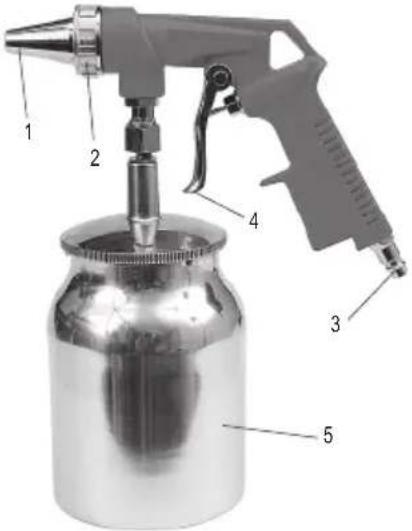
Exterior view of a gray spray gun with metal handle and nozzle (no text or symbols visible)CE
PL EN DE RU UA LT LV CZ SK HU RO ES
PL EN DE
Before operation of the device may commence, please read the whole manual and keep it.
PURPOSE
The purpose of the sand blast gun is to remove old lacquer coatings, rust and other dirt from surfaces, as well as to shape surfaces. Cleaning is realised by means of a compressed air jet and an abrasive material.
TECHNICAL DATA
| Catalogue number | Tank capacity | Operating pressure | Maximum air pressure | Maximum air consumption | Noise level L_pA / L_wA (EN 14462) | Vibrations Weight |
| [I] [MPa] | [MPa] [l/min.] [dB(A)] [m/s] | ^2 [kg] | ||||
| YT-2376 1,0 0,2 | -0,5 0,8 160 | 91 / 102 ≤ 2,03 0,73 |
SAFETY RECOMMENDATIONS
Do not ever direct the outlet of the tool towards people – the coating materials or compressed air may cause injuries. Injection of the lubricant may cause necrosis or even lead to amputation of a limb. In case of injection of a lubricant, consult a doctor immediately.
Before you proceed to installation, operation, repairs, maintenance actions or replacement of accessories, as well as in case of work in the vicinity of a pneumatic tool, it is required to get acquainted with the operating manual, due to numerous hazards involved. Otherwise there is a risk of serious injuries. Installation, adjustments and assembly of pneumatic tools may be carried out exclusively by qualified and trained personnel. Do not modify the pneumatic tool. Modifications may impair the efficiency and compromise the safety level, as well as increase the possible risks to the operator of the tool. Do not dispose of the operating manual, but hand it to the operator of the tool. Do not use the pneumatic tool, if it is damaged.
Operators and service personnel must be given proper training regarding operation and maintenance of the device.
It is prohibited to apply any other gas than compressed air.
Using other gases may be a cause of serious injuries, fires or explosions.
While connecting the tool to a compressed air system, it is required to consider the space which is required for the hose, in order to avoid damage to the hose or to the connectors.
The working area must be equipped with an efficient ventilation system. Absence of efficient ventilation system may imply a risk to health or cause fi res or explosions.
The tool has not been designed to be operated in explosive atmospheres.
The tool must be operated far from sources of heat and fire, since these might damage the device or reduce its efficiency.
Observe general safety regulations during work with sprayed materials, and wear appropriate individual protection means, such as goggles, masks and gloves.
During work and maintenance tasks there is a risk of ingestion of particles of sprayed materials or substances used for maintenance due to the following causes:
- insufficient natural or forced ventilation,
- incorrect atomizing pressure,
- insufficient optimisation of parameters of atomization in order to reduce contamination,
- incorrect distance between the nozzle of the tool and the area of application of the sprayed material; the distance must be adequately adjusted in accordance with the kind of sprayed substance,
- ingestion of solvent vapours or other harmful substances
- incorrect application, for example use of incorrect sprayed substances.
Do not ever leave an assembled pneumatic system unattended by a person authorised to operate it. Do not allow children near an assembled pneumatic system.
Compressed air under high pressure may cause the tool to recoil in an opposite direction to the direction of ejection of the sprayed material. Take special precautions, since the recoil may – under certain circumstances – cause multiple injuries.
It is recommended to test the tool, before proceeding to operate it. It is recommended to properly train persons meant to operate the tool. This will signifi cantly improve the level of safety.
Observe recommendations specified by the manufacturer of the sprayed materials and use them in accordance with the specified personal protection, fire protection and environmental protection regulations. In case the recommendations of the manufacturer of the sprayed materials are not observed, there is a risk of serious injuries.
In order to ascertain the compatibility with the applied sprayed materials, a list of materials applied in the design of the tool shall be available, if requested.
During work with compressed air energy accumulates in the whole system. Be careful during work and breaks, so as to avoid dangers caused by the energy accumulated from compressed air.
Since there is a possibility of accumulation of electrostatic charges, it is necessary to realise measurements in order to determine whether it is required to ground the tool or to use surfaces and / or compressed air systems dissipating electric charges. Measurements and assembly of such systems must be carried out by properly qualified personnel.
EN
Do not ever direct a stream of lubricant towards a source of heat or fire, since this might lead to a fire.
OPERATION
Commencement of work
Make sure the sand blast gun outlet nozzle securing nut has been properly tightened.
If the sand blast gun is equipped with an abrasive material tank, fill the tank with abrasive material. Close the tank cover and attach the tank to the sand blast tank. The tank securing nut must be tightened with a spanner.
If the sand blast gun is equipped with a suction nozzle hose, the hose must be connected to the sand blast gun, and the suction nozzle must be installed at the other end of the hose. It is recommended to use band clips in order to ensure correct and secure installation of the hose on the sand blast gun and nozzle connections.
Immerse the suction nozzle in the abrasive material tank so that the deaeration pipe tip protrude above the surface of the abrasive material.
Check the connections of the compressed air system for tightness.
Blow the air supply hose before it is connected to the installation.
Before the sand blast gun is operated, make sure it has been cleaned and maintained properly.
Filling the dispenser with abrasive
Attention! It is prohibited to use other substances than loose abrasives. The recommended diameter of the abrasive grains should be within the range between 0.2 and 0.4 mm. It is prohibited to use materials whose grains have a diameter exceeding 0.8 mm.
Disconnect the dispenser from the gun, fill lit with an abrasive material, and then connect it to the gun again. Do not fill the dispenser up to the edge, but leave approximately 1 cm of free space from the upper edge of the dispenser.
Replacement of the outlet nozzle
Disconnect the sand blast gun from the compressed air supply. Disconnect the tank or the hose from the sand blast gun.
Remove the outlet nozzle securing nut. Clean the thread of the sand blast gun and the securing nut.
Install a new outlet nozzle and tighten properly the securing nut.
Work with the sand blast gun
Adjust the pressure in the pneumatic system not exceeding the maximum operating pressure for the sand blast gun so as not to damage the surface to be cleaned.
Direct the nozzle mouth towards the surface to be cleaned and press the trigger.
During work with the sand blast gun large quantities of dust may be generated, so it is necessary to use personal protection means, such as helmets with air supply, hearing protection and appropriate protective clothing.
CLEANING AND MAINTENANCE
The coating material outlet is blocked
In case the sprayed substance stops coming out of the gun outlet, the nozzle may be blocked. Empty the coating material dispenser. Then remove the ring fixing the nozzle to the gun, find the blocked area and clean it not using sharp metal tools which might damage the nozzle, the gun or other elements.
Spare parts
In order to obtain information regarding spare parts for pneumatic tools, contact the manufacturer or its agent.
After work clean the casing, ventilation slots, switches, handles and guards must be cleaned, e.g. with air stream (whose pressure must not exceed 0.3 MPa), brush or a dry cloth, without using chemicals and cleaning agents. The tool and its handles must be cleaned with a clean dry cloth.
Used tools are recyclable – do not dispose of them along with domestic trash, since they contain substances which are harmful for people and dangerous for the environment! We ask you active assistance in efficient management of natural resources and protection of the environment, by sending old devices to a special collection point. In order to limit the amount of waste, it is necessary to reuse or recycle it, or recover it in another manner.
PL
DEKLARACJA ZGODNOŚCI DECLARATION OF CONFORMITY DECLARATIE DE CONFORMITATE
0123/YT-2376/EC/2023
We declare and guarantee with full responsibility that the following products:
meet requirements of the following European Standards / Technical Specifications:
and fulfill requirements of the following European Directives:
2006/42/EC Machinery and safety elements
Serial number: concern all serials numbers of item(s) mentioned in this declaration
The person authorized to compile the technical file:


- PL EN DE RU UA LT LV CZ SK HU RO ES
- PL EN DE
- PURPOSE
- TECHNICAL DATA
- SAFETY RECOMMENDATIONS
- It is prohibited to apply any other gas than compressed air.
- EN
- OPERATION
- Commencement of work
- Filling the dispenser with abrasive
- Replacement of the outlet nozzle
- Work with the sand blast gun
- CLEANING AND MAINTENANCE
- The coating material outlet is blocked
- Spare parts
- PL
- DEKLARACJA ZGODNOŚCI DECLARATION OF CONFORMITY DECLARATIE DE CONFORMITATE
Brand : Yato
Model : YT-2376
Category : Drill