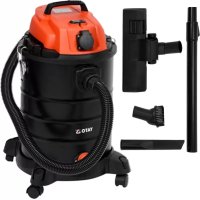
YT85700 - Vacuum Cleaner Yato - Free user manual and instructions
Find the device manual for free YT85700 Yato in PDF.



| Product Type | Industrial wet/dry vacuum cleaner |
| Brand | Yato |
| Model | YT85700 |
| Rated Power | 1400 W |
| Rated Voltage | 220-240 V~ |
| Frequency | 50/60 Hz |
| Working Vacuum | 18 kPa |
| Tank Capacity | 20 L |
| Insulation Class | II |
| Protection Rating | IPX4 |
| Weight | 4,2 kg |
| Filtration Types | Dry filter (paper) and wet filter (sponge), dust bag |
| Included Accessories | Filter, hose, extension tube, wide brush, narrow nozzle |
| Built-in Power Outlet | Yes, max. 2000 W, with automatic mode |
| Float System | Air cut-off in case of overflow |
| Wheels | 4 swivel wheels for transport |
| Usage | Dry and wet cleaning, tool dust extraction |
| Maintenance | Removable filters, wash with water for wet filter, compressed air for dry filter |
| Max. Waste Temperature | 40 °C |
| Safety | IPX4 splash protection, automatic shut-off in case of overflow |
| Repairability | Spare parts available (filters, hose, bags, etc.) |
Frequently Asked Questions - YT85700 Yato
User questions about YT85700 Yato
0 question about this device. Answer the ones you know or ask your own.
Ask a new question about this device
Download the instructions for your Vacuum Cleaner in PDF format for free! Find your manual YT85700 - Yato and take your electronic device back in hand. On this page are published all the documents necessary for the use of your device. YT85700 by Yato.
USER MANUAL YT85700 Yato
natural_image
Black YATO vacuum cleaner with attached hose and control panel (no visible text or symbols on device body)YT-85701YT-8570
PL EN DE RU UA LT LV CZ SK HU RO ES FR IT NL GR


natural_image
Close-up of a mechanical component with internal structure and mounting bracket (no visible text or symbols)
natural_image
Close-up of a hand adjusting a black plastic mechanical component, showing part assembly and mounting detail (no text or symbols visible)
natural_image
Close-up of two mechanical components with internal grid structure, no visible text or symbols
natural_image
Close-up of two mechanical components with ribbed surfaces, one showing internal structure and the other showing a thick black component (no text or symbols visible)
natural_image
Close-up of a mechanical component with paper covering, showing internal structure and part (no text or symbols)
natural_image
Close-up of hands operating a mechanical clamp or bracket device (no visible text or symbols)natural_image
Close-up of a hand holding a threaded mechanical component, showing structural details (no text or symbols visible)
natural_image
Close-up of a hand holding a black cylindrical object, possibly a tool or pipe (no text or symbols visible)
natural_image
Close-up of a black curved pipe or duct with segmented sections, no visible text or symbols
natural_image
Close-up of a black vacuum cleaner with a handle and clip, labeled 'XI' in the corner (no other text or symbols)
natural_image
Close-up of a mechanical component with two views (top and side), no visible text or symbols
natural_image
Close-up of a mechanical component with a black handle and circular button, no visible text or symbols
natural_image
Close-up of a hand holding a mechanical component, showing a close-up view of a connector with a white plastic plug (no text or symbols visible)PL
- vacuum cleaner cover
- container
- caster
- caster's base
- inlet orifi ce
- outlet orifi ce
- switch
- fi Iter for dry vacuum cleaning
- fi lter for wet vacuum cleaning
- bag
- pipe
- elastic hose
- brush
- narrow sucker
- electric socket
DE
Mains voltage and frequency
Read the operating instruction
Wear protective goggles
Schutzbrille tragen
This symbol indicates that waste electrical and electronic equipment (including batteries and storage cells) cannot be disposed of with other types of waste. Waste equipment should be collected and handed over separately to a collection point for recycling and recovery, in order to reduce the amount of waste and the use of natural resources. Uncontrolled release of hazardous components contained in electrical and electronic equipment may pose a risk to human health and have adverse effects for the environment. The household plays an important role in contributing to reuse and recovery, including recycling of waste equipment. For more information about the appropriate recycling methods, contact your local authority or retailer.
WYPOSAŻENIE PRODUKTU
PRODUCT CHARACTERISTICS
The industrial vacuum cleaner is used for cleaning workplaces from dry and wet impurities, which would not be handled by a household vacuum cleaner. It can also be used for extracting the dust generated when working with other power tools. Thanks to the capacious container, flexible hose, it is possible to reach hardly reachable places and clean them thoroughly. The base fitted with casters enables easy transport of the vacuum cleaner. The vacuum cleaner has been fitted with replaceable air filters. Correct, reliable and safe operation of the product depends on proper operation, therefore:
Before starting the work with this tool, please read this manual and keep it properly.
The supplier does not assume any liability for damages resulting from failure to follow safety regulations and recommendations specified in this manual.
PRODUCT ACCESSORIES
The product is delivered complete and does not require assembly. The product has been delivered with: filters, the flexible hose, extension pipes and two suction nozzles: wide and narrow.
TECHNICAL DETAILS
| Parameter Measuring unit Value Value | |||
| Catalogue number YT-85700 YT-85701 | |||
| Mains voltage [V~] 220 -240 220 -240 | |||
| Mains frequency [Hz] 50/60 50/60 | |||
| Rated power | [W] | 1400 | 1400 |
| Maximum socket load | [W] | 2000 | 2000 |
| Operating vacuum | [kPa] | 18 | 18 |
| Container capacity | [I] | 20 | 30 |
| Insulation class | II | ||
| Protection class | IPX4 IPX4 | ||
| Weight | [kg] | 4.2 | 4.0 |
GENERAL SAFETY CONDITIONS
The device can be used by children aged 8 and older and people with reduced physical, sensory or mental ability, also by people lacking experience and knowledge, if they are supervised and received instructions how to use it safely, and understand the hazards. Supervise children so that they do not play with the device. Cleaning and maintenance should not be performed by children unattended. The vacuum cleaner is designed for dry and wet cleaning. Before the start of work involving the sucking of water or wet impurities, please follow recommendations included in this user instruction. Failure to comply with them may result in electric shock, which in turn may pose a threat to health and life of the user and third parties. Suction of other wet impurities than water is forbidden. Suction of paints, oils, solvents, gasoline and other flammable substances can lead to irreversible damage to the vacuum cleaner or its components, and may also pose a threat of electric shock, fire or explosion. Before changing the type of work, always empty, clean and dry the vacuum cleaner container. Impurities remaining in container after the previous work may disturb the operation in case of changing its nature. Never suck in hot, glowing or burning objects. This can lead to fire or explosion and expose the user to serious injury or death. The maximum temperature of impurities sucked in cannot exceed 40 degrees centigrade. The device is intended for work in confined spaces and should not be exposed to water, including atmospheric precipitation. Prior to connecting the power cord plug to the vacuum cleaner, make
EN
sure that mains parameters correspond with parameters indicated on vacuum cleaner's data plate. Prior each use, please check the condition of the device, including power cord and plug. If any faults are found, do not use the device. Damaged cables and cords must be replaced with new ones in a specialist workshop. The degree of protection given in the table with technical data is ensured if the device will be connected to a socket with at least the same degree of protection. Prior to maintenance of the device please make sure, that the power cord plug was disconnected from the mains socket. The device should be stored in a place inaccessible for third parties, children in particular. Also during the work please note, that the device is out of reach of unauthorised persons, children in particular. Carry the device using the handle, do not move the device by pulling the power cord. In case the vacuum cleaner is used as a blower, it is forbidden to direct the hose outlet towards people and animals. Check the condition of connector on a regular basis. It is forbidden to use the vacuum cleaner with the hose damaged.
DEVICE OPERATION
Preparation to work
Check the vacuum cleaner container, empty it from waste if necessary.
Check the condition of filters. If the filters intended for dry cleaning (paper) and a nonwoven filter are dirty, they should be cleaned only with a stream of compressed air of a pressure not higher than 0.3 MPa. If impurities cannot be removed from filters, they must be replaced with new ones. Filters designed for wet cleaning (sponge) can be cleaned by immersing them in lukewarm water with addition of soap. After cleaning, rinse them in clean water and squeeze out the excess of water. Do not twist. Allow them to dry before use.
Check the condition of gaskets, if any damage is found, gaskets should be replaced with new ones.
NOTE! It is forbidden to work with a vacuum cleaner without properly installed air filter. This may lead to damaging the vacuum cleaner and also cause an electric shock.
The base of vacuum cleaner features possibility of mounting the casters. In the first place, fix the caster holders in the base and fasten them using screws (II). Then press down the caster plugs into the caster holders (III).
A metal chain was attached to the bottom side of the container. Make sure that it will be in contact with the ground during the work, this will allow discharging electrostatic charges that accumulate during operation.
The vacuum cleaner has been fitted with a float (IV), which cuts off the supply of air every time the tank overflows. Before the start of work, make sure that the float and guides in which it is moving have not been damaged, are clean and ensure free float movement. Each float activation is signalled by louder motor operation and a drop in suction power.
Note! It is forbidden to use a vacuum cleaner without a properly functioning float.
The vacuum cleaner has been fitted with two types of filters designed for various types of work.
A filter made of sponge is designed for wet cleaning. Paper filter is designed for dry cleaning.
Regardless of the type, the filter should be slid over the float guides to cover them along the entire length [V].
Make sure that the filter will not slide off the float guide spontaneously.
Do not use the wrong type of filter. Using a filter designed for dry cleaning for filtering during wet cleaning will lead to damaging the filter, which may lead to damaging the vacuum cleaner. Using a filter designed for wet cleaning for filtering during dry cleaning will not provide the correct level of filtering, which may lead to damaging the vacuum cleaner.
In case of dry vacuum cleaning, a bag should be attached inside the container. The bag's inlet should be slid over the inner part of hose fastening (VI) so that the gasket around the bag's orifice is fully attached to the hose fastening. Inner part of hose attachment has been fitted with a flange used for holding down the bag attached.
Note! Do not attach the bag in case of wet vacuum cleaning.
Attach the cover onto the upper edge of vacuum cleaner container so that it adheres with its entire circumference. Using latches, hold the cover tight against tank. Please note that there are two marked points on the cover that allow obtaining proper tightness of fastening (VII).
Connect the flexible hose to the inlet orifice. Hose connection should be slid into the orifice so that the cuts on it hit the protrusions of the inlet orifice and then turn in direction pointed by arrow marked "CLOSE" (VIII). Make sure the hose would not slip off during operation.
EN
Connect the two parts of pipe together by inserting the narrower end of pipe into the wider one (IX). Then connect the pipe to free end of the elastic hose, also inserting the narrower end of hose into the wider end of pipe (X). In the same way, attach the accessory in form of a brush or a narrow sucker (XI) to free end of the pipe.
Select proper accessory for the selected type of work. The brush is intended for cleaning large and flat surfaces, and a narrow sucker for places that cannot be reached using a wide nozzle.
In order to dismantle the hose, turn its connector in direction pointed by arrow marked "OPEN", and then slide off the connection of inlet orifice. Dismantling of extension pipes and nozzles should be carried out the other way round than assembly.
The vacuum cleaner allows connecting the hose also to the outlet orifice, so it can used as a blower. The hose is connected in a similar way to the inlet orifice: slide it in and turn to block.
Caster holders and the cover of vacuum cleaner are fitted with handles allowing temporary fixing of accessories for the time of work or storage of the vacuum cleaner. It is possible to attach extension pipes and suction nozzle in base brackets (XII).
Working with vacuum cleaner
NOTE! It is forbidden to work with a vacuum cleaner dealing with hot ashes. The temperature of trash sucked by vacuum cleaner cannot exceed 40 degrees centigrade.
Make sure that all preparatory operations have been carried out in a correct way.
Make sure that the vacuum cleaner switch remains in the off position - "O".
Plug the power cord into the mains socket, and then turn the switch to the on position - "I" (XIII).
The brush is fitted with a lever that slides off the bristles. The bristles should be slid off when cleaning smooth, hard surfaces. It is recommended to clean carpet floorings and carpets with hidden bristles.
After the work is finished, switch off the vacuum cleaner with a switch, and then disconnect the power plug from the mains socket.
Proceed to operations that preserve the vacuum cleaner.
Emptying the container of vacuum cleaner (XIV)
After the dry vacuum cleaning is finished, dismantle the cover and check the bag's filling level. If the bag is full, it should be removed and replaced with a new one.
After the wet vacuum cleaning is finished, dismantle the cover of vacuum cleaner. The container has been fitted with a cover placed near its base. Opening the cover will cause the emptying of the container.
Impurities remaining in container can be removed by tilting the container. After having it emptied, clean the container with a water jet. Close the cover and then dry thoroughly.
Built-in electrical socket
The vacuum cleaner features a built-in electrical socket, which is used to supply the power tools belonging to I and II class of electrical insulation.
This allows for easier use of the vacuum cleaner in the form of system of extraction of dust generated during the work. Voltage appears in the socket when the plug of power cord supplying the vacuum cleaner is connected to the mains socket. Therefore, before connecting the vacuum cleaner to power supply and the power tool to the vacuum cleaner socket, make sure that switches of both devices remain in the off position.
After connecting the vacuum cleaner to the outlet of power tool's dust extraction (a suitable adapter may be needed for this, that is not delivered with the vacuum cleaner) and the power tool plug to the vacuum cleaner socket, the vacuum cleaner may be started by turning the switch to the "I" position, the vacuum cleaner will start working regardless of the operation of power tool and it will continue to work until the switch is turned to the "O" position.
An automatic mode is the recommended operating mode. To this end, after connecting the vacuum cleaner to the outlet of power tool's dust extraction, and the power tool plug to the vacuum cleaner socket, turn the switch to the "II" position. The vacuum cleaner will switch on automatically after a short time from the start-up of power tool and will also switch off automatically after a short time from switching off the power tool.
Regardless of the selected mode of operation, after the work is finished, switch off the vacuum cleaner by turning the switch to the "O" position, and then disconnect the vacuum cleaner plug from the mains socket, unplug the power tool from the vacuum cleaner socket and proceed with maintenance operations.
Note! If during operation suspicious vibrations, drop in suction force or louder operation of the engine are observed, this may indicate that the container is full or the hose, extension tubes or suction nozzle are clogged. In this case, immediately switch off the vacuum cleaner with the switch and unplug the power cord from the mains socket. Then empty the container and check patency of hose and endings. If necessary, unclog it. If it is not possible to unclog the hose, extension pipes or suction nozzle replace them with new ones before continuation of work.
Note! When using the vacuum cleaner as a blower, make sure that the container has been emptied of all waste, the bag has been
EN
removed and the filter cleaned or replaced with a new one. There is a risk of impurities collected in the container or in the bag being sucked in through the outlet orifice.
Vacuum cleaner maintenance
Note! Before proceeding with any maintenance operations, make sure that the power cord plug has been disconnected from the mains socket.
Each time, when using the vacuum cleaner, please check the container, cover gasket and air filters as described in point: "Preparation to work".
Clean the vacuum cleaner from the outside using a jet of compressed air at a pressure not more than 0.3 MPa. In particular, pay attention to patency of vents, both inlet and outlet. If it is necessary, clean it using a jet of compressed air at a pressure not more than 0.3 MPa. Do not use sharp, metal objects to clean the vents. Do not immerse the vacuum cleaner in water to clean it. Check the vacuum cleaner hose before and after each use for damages. It is forbidden to use damaged hose. In case of sucking in water or wet impurities, clean the inside of vacuum cleaner, the flexible hose, extension pipes and the endings immediately after the work is finished. Dried impurities can lead to irreversible damage to the vacuum cleaner or its components.
The inside of the hose and extension pipes should be cleaned with a stream of water, after disconnecting from the vacuum cleaner, and then allow them to dry before next use. Remove larger soiling from the cover with a soft cloth.
GERÄTEBESCHREIBUNG
CARACTERISTIQUES DU PRODUIT

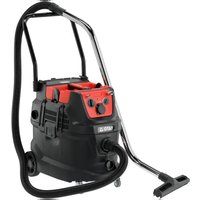
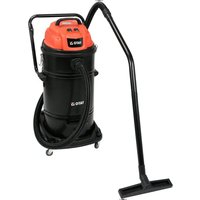
Brand : Yato
Model : YT85700
Category : Vacuum Cleaner