YT-85717 - Vacuum Cleaner Yato - Free user manual and instructions
Find the device manual for free YT-85717 Yato in PDF.


| Product type | Versatile industrial wet/dry vacuum cleaner |
| Brand | Yato |
| Model | YT-85717 |
| Mains voltage | 220–240 V ~ |
| Frequency | 50 / 60 Hz |
| Rated power | 1600 W (suction) / 3600 W (total with tool socket) |
| Maximum load of integrated socket | 2000 W |
| Depression (functional vacuum) | 22 kPa |
| Maximum air flow | 40 L/s |
| Tank capacity | 40 L |
| Filtration class | M |
| Insulation class | I |
| Protection rating | IPX4 |
| Weight | 12.9 kg |
| Sound level | 79 dB(A) |
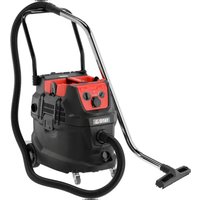
| Included accessories | HEPA filter, bag, flexible hose, extension tubes, large brush, narrow nozzle, round brush |
| Main functions | Wet/dry vacuum, blower, power tool connection with automatic stop, automatic or timed filter shaker |
| Safety system | Water level sensor with automatic stop, IPX4 protection, safety stop for vacuum without filter |
| Maintenance | Water-washable filter, washable tank, washable hose and tubes, drying required |
| Repairability | Replaceable filters and bags, standard hose and accessories, specialized workshop for electrical repairs |
Frequently Asked Questions - YT-85717 Yato
User questions about YT-85717 Yato
0 question about this device. Answer the ones you know or ask your own.
Ask a new question about this device
Download the instructions for your Vacuum Cleaner in PDF format for free! Find your manual YT-85717 - Yato and take your electronic device back in hand. On this page are published all the documents necessary for the use of your device. YT-85717 by Yato.
USER MANUAL YT-85717 Yato
- vacuum cleaner cover
- tank
- inlet hole
- control panel
- suction power adjustment knob
- operating mode selector knob
- pneumatic system connections
- air fi lter
- bag
- pipe
- fl exible hose
- wide brush
- narrow nozzle
- round brush
- power outlet
- transport handle
- blower socket
DE
Read the operating instruction
Wear protective goggles
This symbol indicates that waste electrical and electronic equipment (including batteries and storage cells) cannot be disposed of with other types of waste. Waste equipment should be collected and handed over separately to a collection point for recycling and recovery, in order to reduce the amount of waste and the use of natural resources. Uncontrolled release of hazardous components contained in electrical and electronic equipment may pose a risk to human health and have adverse effects for the environment. The household plays an important role in contributing to reuse and recovery, including recycling of waste equipment. For more information about the appropriate recycling methods, contact your local authority or retailer.
PRODUCT CHARACTERISTICS
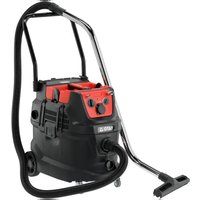
An industrial vacuum cleaner is used to clean workplaces from dry and wet dirt that a household vacuum cleaner would not be able to handle. It can also be used to extract dust generated during work with other power tools. Thanks to the capacious tank and flexible hose, it is possible to reach hard-to-reach places and clean them thoroughly. The base equipped with wheels allows easy transport of the vacuum cleaner. The vacuum cleaner is equipped with replaceable air filters. Correct, reliable and safe operation of the device depends on proper use, therefore:
NOTE! Before using the tool, read the entire manual and keep it.
The supplier is not liable for any damage resulting from failure to comply with the safety regulations and recommendations of this manual.
EQUIPMENT
The product is delivered complete and does not require assembly. The product comes with: a filter, a bag, a flexible hose, extension tubes and three suction tips: wide, narrow, round.
TECHNICAL DATA
| Parameter Unit of measurement Value | ||
| Catalogue number YT-85717, YT-85718 | ||
| Mains voltage [V~] 220 - 240 | ||
| Network frequency [Hz] 50 / 60 | ||
| Rated power [W] 1600 / 3600 | ||
| Maximum socket load [W] 2000 | ||
| Working vacuum [kPa] 22 | ||
| Maximum air flow | [l/s] | 40 |
| Tank capacity [l] | 40 | |
| Filtration class | M | |
| Insulation class | I | |
| Degree of protection | IPX4 | |
| Mass | [kg] | 12,9 |
| Noise level - sound pressure LpA | [dB(A)] | 79 |
GENERAL SAFETY CONDITIONS
The device must not be used by persons (including children) with limited physical, sensory or mental abilities or by persons lacking the appropriate experience or knowledge. The vacuum cleaner is designed for dry and wet work. Before starting work involving the suction of water or wet dirt, follow the recommendations contained in this manual. Failure to follow them may result in electric shock, which may consequently pose a threat to the health and life of the user and bystanders. It is forbidden to suck in liquids other than water. Sucking in paints, oils, solvents, petrol and other flammable substances may lead to irreversible damage to the vacuum cleaner or its components, and may also pose a risk of electric shock, fire or explosion. Before changing the type of work, always empty, then clean and dry the vacuum cleaner tank. Dirt remaining in the tank from the previous work may disrupt work if its nature changes. Never suck in hot, glowing or burning objects. This may lead to fire or explosion and expose the user to serious injury or death. The maximum temperature of the dirt being sucked in may not exceed 40 °C. The device is designed for use in closed rooms and should not be exposed to water, including precipitation. Before connecting the power cable plug, make sure that the parameters of the mains supply correspond to the parameters shown on the device's rating
EN
plate. Before each use, check the condition of the device, including the condition of the power cable and plug. If you notice any defects, do not use the device. Damaged cables and wires must be replaced by new ones at a specialist workshop. The degree of protection given in the technical data table will be ensured if the device is connected to a socket with at least the same degree of protection. Before starting to maintain the device, make sure that the power cable plug has been disconnected from the mains socket. The device should be stored in a place inaccessible to unauthorized persons, especially children. Also, during operation, make sure that the device is in a place inaccessible to unauthorized persons, especially children. Carry the device using the handle, do not move the device by pulling on the power cable. When using the vacuum cleaner as a blower, it is forbidden to point the hose outlet at people or animals. The condition of the hose should be checked regularly. It is forbidden to use the vacuum cleaner with a damaged hose.
Check the vacuum cleaner tank and, if necessary, empty it of dirt.
Check the condition of the HEPA filter, which is located under the tank cover (V). If dirty, remove the filter from the vacuum cleaner cover as described later in the manual and clean it with water. Do not use detergents for cleaning. The filter must be completely dry before reinstallation. If the filter contamination cannot be removed or a decrease in operating efficiency is observed, the filter should be replaced with a new one.
WARNING! It is forbidden to work with a vacuum cleaner without a properly installed air filter. This can damage the vacuum cleaner and cause electric shock.
The base of the vacuum cleaner is equipped with wheels. Depending on the model, it may be necessary to mount the wheels. To do this, the rear wheel axle should be pressed into the catches in the base of the housing, and the rear wheels should be mounted on the axle. Attach the front swivel wheels by inserting the wheel pins into the holes in the base of the tank.
In case of dry work, a bag (III) must be attached inside the tank. It is forbidden to use a bag during wet work. Slide the bag inlet opening onto the inner part of the hose attachment so that the seal around the bag opening is completely adjacent to the hose attachment. The inner part of the hose attachment is equipped with a flange, which is used to hold the attached bag. In some models, the bag may be equipped with a clip, which makes it easier to empty it. The clip should be pushed onto the lower edge of the bag so as to connect both edges of the material from which the bag was made.
When working wet, first remove the vacuum cleaner bag, which could be damaged by contact with water.
Attach the cover to the upper edge of the vacuum cleaner tank so that it adheres along its entire circumference. Using the latches, press the cover onto the tank. Make sure that there are marked places on the cover that allow for the correct tightness of the connection to the tank.
Connect the flexible hose to the inlet opening. The hose connector should be inserted into the opening so that the notches on it fit into the protrusions of the inlet opening, and then turned clockwise. Make sure that the hose does not slip out of the opening during operation.
Install the vacuum cleaner tube, insert one end of the tube into the end of the hose and insert the other end into the brush or nozzle connection (II).
You should choose the right accessory for the type of work you are doing. The wide brush is designed for cleaning large and flat surfaces, the narrow nozzle for places that are not accessible with the wide tip, and the round brush for fabrics and upholstered furniture.
Working with a vacuum cleaner
NOTE! It is forbidden to work with hot ash with a vacuum cleaner. The temperature of the dirt sucked in by the vacuum cleaner must not exceed 40 °C.
The vacuum cleaner can work independently as a regular vacuum cleaner or as a dust extractor for dust generated when working with a power tool.
When operating as a regular vacuum cleaner, make sure that all preparatory steps have been carried out correctly.
Make sure the vacuum cleaner mode selector knob is in the "OFF" position.
Insert the power cable plug into the wall outlet and then turn the operating mode selector knob to the desired position, as described in the "Control panel" section.
EN
After finishing work, turn off the vacuum cleaner by turning the mode selector knob to the "OFF" position, and then disconnect the power cable plug from the mains socket. Proceed with maintenance.
Control panel (IV)
The vacuum cleaner control panel has 2 knobs: suction power adjustment and operating mode selection. The suction power adjustment knob allows you to select the appropriate operating power for the vacuuming conditions, turning the knob towards the MIN symbol reduces the power, towards the MAX symbol increases the power. The operating mode selection knob allows you to select the desired way of using the device:
- filter shaker symbol and AUTO - turns on the vacuum cleaner; the filter is automatically shaken of dirt when the suction power is weak;
- filter shaker symbol and TIMED - vacuum cleaner on; the filter is shaken of dirt every 20 seconds;
- filter shaker, power tool and AUTO symbol - the vacuum cleaner turns on automatically after switching on the power tool connected to the built-in electrical socket; after switching off the power tool, the vacuum cleaner will turn off after approximately 8 seconds; the filter is automatically shaken of dirt when the suction power is weak;
- filter shaker, power tool and TIMED symbol - the vacuum cleaner switches on automatically after switching on the power tool connected to the built-in electrical socket; after switching off the power tool, the vacuum cleaner will switch off after approximately 8 seconds; the filter is shaken of dirt every 20 seconds.
Built-in power socket (IV)
The vacuum cleaner has a built-in electrical socket, which is used to power power tools belonging to the I and II electrical insulation class. This allows for easier use of the vacuum cleaner as an installation extracting dust generated during work. Voltage in the socket appears when the plug of the vacuum cleaner's power cable is connected to the electrical socket. Therefore, before connecting the vacuum cleaner to the power supply network and the power tool to the vacuum cleaner socket, make sure that the switches of both devices are in the off position.
After connecting the vacuum cleaner to the dust extraction outlet of the power tool (for this purpose you may need an appropriate adapter which is not included with the vacuum cleaner) and the plug of the power tool to the vacuum cleaner socket, you can start the vacuum cleaner in the desired operating mode.
Regardless of the selected operating mode, after finishing work, turn off the vacuum cleaner by switching the operating mode selector knob to the "OFF" position, then disconnect the vacuum cleaner plug from the electrical outlet, disconnect the power tool plug from the vacuum cleaner socket and proceed to maintenance.
Pneumatic connections (only for model YT-85718)
The device is equipped with pneumatic connections (IV). The connection on the left side of the control panel is used to connect the pneumatic tool, the connection on the right side is used to connect the compressed air supply.
Blower function
To activate the blower function, insert the hose into the blower socket and secure it by turning the hose connection clockwise. Then select the desired operating mode and start the device.
Emptying the vacuum cleaner tank
After finishing dry work, remove the vacuum cleaner cover and check the tank filling level. Due to the tank capacity, it is recommended to empty it after each use. This will be easier than emptying a full tank.
After finishing wet work, the vacuum cleaner cover should be removed. The dirt remaining in the tank can be removed by tilting the tanks. After emptying, clean the tank with a water jet and then dry thoroughly.
The vacuum cleaner is equipped with a water level sensor in the tank. If the permissible water level is exceeded, the vacuum cleaner will turn off. In this case, you should switch the operating mode selector knob to the "OFF" position, disconnect the vacuum cleaner cable from the power supply, and then empty the tank of water and dirt. After cleaning and drying the tank, you can start the vacuum cleaner again.
Vacuum cleaner maintenance
Note! Before starting any maintenance, make sure that the power cord plug has been disconnected from the wall outlet.
After each use of the vacuum cleaner, check the tank, cover seal and air filters as described in the section: "Preparing for work". Clean the outside of the vacuum cleaner using a jet of compressed air with a pressure of no more than 0.3 MPa. Pay special attention to the patency of the ventilation holes, both inlet and outlet. If necessary, clean using a jet of compressed air with a pressure of no more than 0.3 MPa. Do not use sharp, metal objects to clean the ventilation holes. Do not immerse the vacuum cleaner in water to clean it. The vacuum cleaner hose should be checked for damage before and after each use. It is forbidden to use a damaged hose. In the event of sucking water or wet dirt, clean the inside of the vacuum cleaner, the hose, extension tubes and tips immediately after finishing work. Dried dirt can lead to irreversible damage to the vacuum cleaner or its components.
The inside of the hose and extension tubes should be cleaned with a water jet, after disconnecting them from the vacuum cleaner, and then left to dry completely. Remove larger dirt from the housing with a soft cloth.
PRODUKTMERKMALE
PRODUKTA RAKSTUROJUMS
CARACTÉRISTIQUES DU PRODUIT
WERKING VAN HET APPARAAT
DEKLARACJA ZGODNOŚCI DECLARATION OF CONFORMITY DECLARATIE DE CONFORMITATE
0925/YT-85717/EC/2025
We declare and guarantee with full responsibility that the following products:
meet requirements of the following European Standards / Technical Specifications:
and fulfill requirements of the following European Directives:
2006/42/WE Machinery and safety elements
2014/30/UE Electromagnetic compatibility (EMC) Directive
Directiva privind compatibilitatea electromagnetică (EMC) (H.G. nr. 487/2016)
2011/65/UE Restriction of the Use of Certain Hazardous Substances
Serial number: concern all serials numbers of item(s) mentioned in this declaration
The person authorized to compile the technical file: