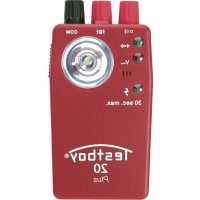
20 Plus - Multimeter Testboy - Free user manual and instructions
Find the device manual for free 20 Plus Testboy in PDF.



| Product Type | Multimeter |
| Brand | Testboy |
| Model | 20 Plus |
| Power Supply | 3 x 1.5 V type AA (LR6) batteries |
| Main Functions | Visual (LED) and audible (buzzer) continuity test, non-contact continuity test, single-pole phase detection, LED flashlight |
| Visual Control Range | 0 ~ 20 Ω |
| Audible Control Range | 0 ~ 250 Ω |
| External Voltage Protection | up to 300 V ~ (30 s max.) |
| Overvoltage Category | CAT II 300 V |
| Protection Rating | IP20 |
| Standard | IEC/EN 61010-1 (DIN VDE 0411) |
| Flashlight | High-performance LED, battery life up to 80 h, lifespan > 100,000 h |
| Included Accessories | 2 test leads |
| Cleaning | Damp cloth with mild cleaner |
| Safety | Do not modify the device, observe the five safety rules, do not point the laser at eyes |
| Intended Use | Only for the applications described in the manual |
| Disposal | Electronic device and batteries separately according to the WEEE directive |
Frequently Asked Questions - 20 Plus Testboy
User questions about 20 Plus Testboy
0 question about this device. Answer the ones you know or ask your own.
Ask a new question about this device
Download the instructions for your Multimeter in PDF format for free! Find your manual 20 Plus - Testboy and take your electronic device back in hand. On this page are published all the documents necessary for the use of your device. 20 Plus by Testboy.
USER MANUAL 20 Plus Testboy
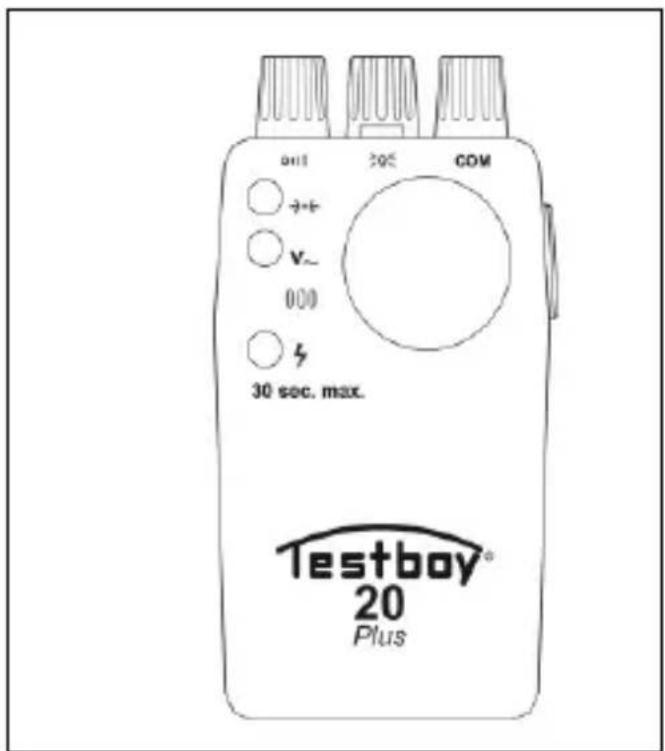
Testboy® 20 Plus
Version 1.6
de Testboy® 20 Plus Bedienungsanleitung 3
en Testboy® 20 Plus 19
Operating instructions
fr Testboy® 20 Plus Mode d'emploi 34
it Testboy® 20 Plus 49
Istruzioni per l'uso
es Testboy® 20 Plus 65
Instrucciones de empleo
pt Testboy® 20 Plus 81
Instruções de serviço
Testboy® 20 Plus
Gebruiksaanwijzing
97
Testboy® 20 Plus 113
Instrukcja obsługi
Testboy® 20 Plus
Инструкция по эксплуатации
129
CS Testboy® 20 Plus 145
Návod k obsluze
Hinweise
Sicherheitshinweise

WARNUNG
natural_image
Line drawing of a handheld electronic device with ports and a cable (no text or symbols)Bild 3
An additional source of danger is posed my mechanical parts which can cause severe personal injury.
Objects can also be damaged (e.g., the instrument itself can be damaged).
WARNING
An electric shock can result in death or severe injury. It can also lead to property damage and damage to this instrument.
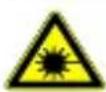
WARNING
Never point the laser beam directly or indirectly (on reflective surfaces) towards the eyes. Laser radiation can cause irreparable damage to the eyes. You must first deactivate the laser beam when measuring close to people.
General safety notes

WARNING
Unauthorized changes or modifications of the instrument are forbidden – such changes put the approval (CE) and safety of the instrument at risk. In order to operate the instrument safely, you must always observe the safety instructions, warnings and the information in the "Proper and Intended Use" chapter.

WARNING
Please observe the following information before using the instrument:
Do not operate the instrument in the proximity of electrical welders, induction heaters and other electromagnetic fields.
After an abrupt temperature fluctuation, the instrument should be allowed to adjust to the new temperature for about 30 minutes before using it. This helps to stabilize the IR sensor.
Do not expose the instrument to high temperatures for a long period of time.
Avoid dusty and humid surroundings.
Measurement instruments and their accessories are not toys. Children should never be allowed access to them!
In industrial institutions, you must follow the accident prevention regulations for electrical facilities and equipment, as established by your employer's liability insurance organization.
Each time before use, inspect the instrument to ensure that it is working faultlessly (for example, on known source of voltage, known resistor, etc.).

Please observe the following five safety rules:
1 Disconnect.
2 Ensure that the instrument cannot be turned back on again.
3 Ensure isolation from the main supply voltage (check that there is no voltage on both poles).
4 Earth and short-circuit.
5 Cover neighbouring parts that are under live electrical load.
Proper and intended use
This instrument is intended for use in applications described in the operation manual only. Any other usage is considered improper and non-approved us-age and can result in accidents or the destruction of the instrument. Any misuse will result in the expiry of all guarantee and warranty claims on the part of the operator against the manufacturer.

Remove the batteries during longer periods of inactivity in order to avoid damaging the instrument.

We assume no liability for damages to property or personal injury caused by improper handling or failure to observe safety instructions. Any warranty claim expires in such cases. An exclamation mark in a triangle indicates safety notices in the operating instructions. Read the instructions completely before beginning the initial commissioning. This instrument is CE approved and thus fulfils the required guidelines.
FOR USE BY COMPETENT PERSONS
Anyone using this instrument should be knowledgeable and trained about the risks involved with measuring voltage, especially in an industrial setting, and the importance of taking safety precautions and of testing the instrument before and after using it to ensure that it is in good working condition.
Cleaning
Use a damp cloth and mild household cleaning agent to clean the instrument should it become soiled through daily use. Never use aggressive cleaning agents or solvents to clean the instrument.
All rights reserved to alter specifications without prior notice © Testboy GmbH, Germany.
Disclaimer and exclusion of liability

The warranty claim expires in cases of damages caused by failure to observe the instruction! We assume no liability for any resulting damage!
Testboy is not responsible for damage resulting from:
failure to observe the instructions,
changes in the product that have not been approved by Testboy,
the use of replacement parts that have not been approved or manufactured by Testboy,
the use of alcohol, drugs or medication.
Correctness of the operating instructions
These operating instructions have been created with due care and attention. No claim is made nor guarantee given that the data, illustrations and drawings are complete or correct.
All rights are reserved in regards to changes, print failures and errors.
Disposal
For Testboy customers: Purchasing our product gives you the opportunity to return the instrument to collection points for waste electrical equipment at the end of its lifespan.
The WEEE directive regulates the return and recycling of electrical appliances. Manufacturers of electrical appliances are obliged to take back and recycle all electrical appliances free of charge. Electrical devices may then no longer be disposed of through conventional waste disposal channels. Electrical appliances must be recycled and disposed of separately. All equipment subject to this directive is marked with this logo.
Disposing of used batteries
As an end user, you are legally obliged (by the relevant laws concerning battery disposal) to return all used batteries. Disposal with normal household waste is prohibited!
Contaminant-laden batteries are labelled with the adjacent symbol which indicates the prohibition of disposal with normal household waste.
The abbreviations used for heavy metals are:
Cd = Cadmium, Hg = mercury, Pb = lead.
You can return your used batteries for no charge to collection points in your community or everywhere where batteries are sold!
Certificate of quality
All aspects of the activities carried out by Testboy GmbH relating to quality during the manufacturing process are monitored permanently within the framework of a Quality Management System. Furthermore, Testboy GmbH confirms that the testing equipment and instruments used during the calibration process are subject to a permanent inspection process.
Declaration of Conformity
The product conforms to the present directives. For more detailed information, go to www.testboy.de
Operation
Thank you for choosing the Testboy ® 20 Plus. The Testboy ® 20 Plus represents the latest advancement in the popular Testboy ® 2 series. It features six professional functions for working with electrical cables and wires:
Low-ohm, optical continuity testing
High-ohm, acoustic continuity testing
High-power LED flashlight
Cable break detection
Single-pole phase searching
Protection from external voltages of up to 300 V
Optical continuity testing
Insert the test leads (as shown in Figure 1a).
The large LED display will illuminate between 0 to 20 Ω. The intensity of the light decreases proportionally after 10 Ω.
If an unexpected voltage is applied to the object being measured, the light will illuminate.
If a phase is active on one of the wires being tested, the red V\~ LED will illuminate!
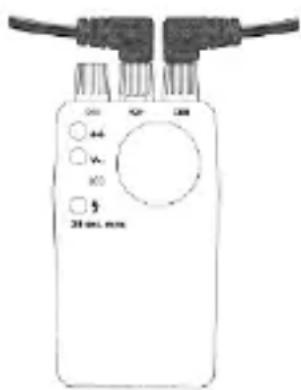
Figure 1a
Acoustic continuity testing
Insert the test leads (as shown in Figure 1b).
An acoustic signal can be heard between 0 – 250 Ω. The green LED illuminates at the same time.
If an unexpected voltage is applied to the object being measured, the light will illuminate and the buzzer will issue a warning tone!
If a phase is active on one of the wires being tested, the red V\~ LED will illuminate!
The Testboy® 20 Plus is protected against external voltages of up to 300 V\~ (for max. 30 seconds)!
You can carry out a continuity test while the flashlight is on!
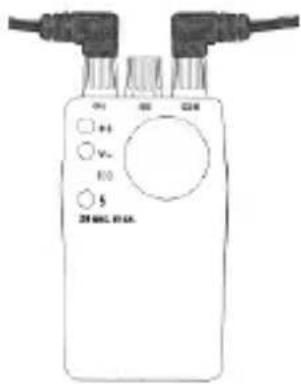
Figure 1b
Cable break detection
The cable break detection is intended for non-contact localization of cable breaks on non-exposed live lines.
When the metal clip located in the back of the Testboy ® 20 Plus is held over a live cable (>110 V AC) starting from the feeding point, the V\~LED will illuminate before breaking point.
No test leads need to be attached (as show in Figure 2)!
A flowing current is not required! The metal clip acts here as an extended sensor.
Do not apply the metal clip on uninsulated hazardous live conductors, which may render electric shock, electric burn, or arc flash.
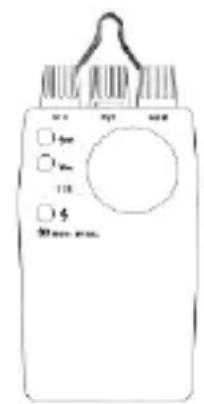
Figure 2
When carrying out the cable break detection, if the V\~ LED does not illuminate, a dangerous high voltage (> 33 V AC or 70 V DC) may nevertheless be present. The non-contact sensor can only detect voltage generated by sufficiently strong electric fields from power sources (grids, > 110 V AC). If the field strength is low, the instrument may not detect applied voltage and thus cannot locate the cable break correctly. If the instrument does not detect any existing voltage, this can be due to the following factors, amongst other things:
- Shielded wires/cables
- Thickness and type of insulation
- Distance from the voltage source
- Condition of the Tester and Batteries

WARNING
Exercise caution at voltages above 30 V, as there is a risk of electric shock.

WARNING
The non-contact cable break detection function is not suitable for the detection of hazardous line voltage.

CAUTION
Before touching conductive parts the absence of hazardous voltage must be checked with the two-pole direct contact measurement of other equipment.
Single-pole phase searching
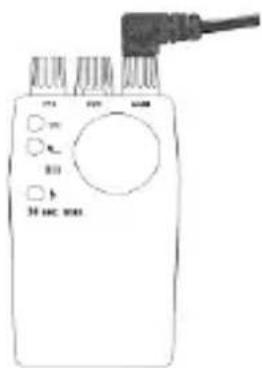
Plug a test lead in the COM port (as shown in Figure 3).
Before the test, make absolutely sure to disconnect all other test leads. Then touch the probe tip to the wire. Be sure not to touch the clip attached to the back side (move to up position). If a phase is active, the V\~ LED will illuminate!
The sensitivity of the electronics increases if the metal clip is touched during the measurement. This means that AC voltage fields can be detected even at distances of several millimetres!
natural_image
Line drawing of a handheld electronic device with ports and a cable (no text or symbols)Figure 3
This test is not suitable for determining the presence of hazardous line voltage. During the test, even if V\~ LED does not illuminate, a dangerous high voltage (> 33 V AC or 70 V DC) may nevertheless be present.
The tester can only detect voltage generated by sufficiently strong electric fields from power sources (grids, >110 V AC). If the field strength is low, the tester may not provide indication of live voltages. Lack of an indication occurs if the tester is unable to sense the presence of voltage which may be influenced by several factors including, but not limited to:
- Shielded wire/cables
- Thickness and type of insulation
- Distance from the voltage source
- Receptacles in recessed sockets/ differences in socket design
- Condition of the Tester and Batteries

WARNING
Exercise caution at voltages above 30 V, as there is a risk of electric shock.

WARNING
The phase searching function is not suitable for the detection of hazardous line voltage.

CAUTION
Before touching conductive parts the absence of hazardous voltage must be checked with the two-pole direct contact measurement of other equipment.
Changing the batteries
Use a screwdriver to leverage the upper housing section upwards and towards the front, between the protruding knobs and the middle socket (refer to Figure 4). To remove the lid, un-hook downwards. Make sure you insert the new batteries with the polarity properly aligned!

Do not dispose of batteries in normal household rubbish! Use an authorised local collection point!
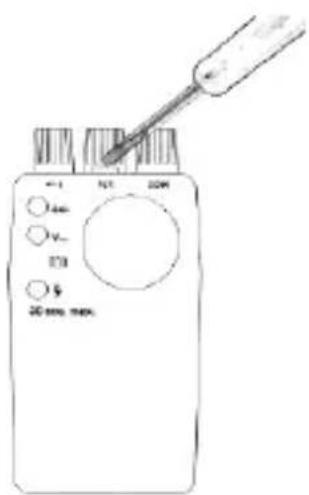
Figure 4
All test leads should be removed before opening up the continuity tester!
Definition of measurement categories
Measurement category II: Measurements on circuits directly connected to low voltage networks electrically via plug. Typical short-circuit current < 10 kA.
Measurement category III: Measurements within the building installation (stationary consumer devices with non-plug-in connection, distributor connection, permanently installed equipment in the distributor). Typical short-circuit current < 50 kA.
Measurement category IV: Measurements at the source of the low voltage installation (meters, mains connection, primary overcurrent protection). Typical short-circuit current >> 50 kA.

To establish the measurement category in a combination of test lead and measuring instrument, the lowest category, either of the test lead or the measuring instrument, always applies.
Flashlight
Slide the switch on the side of the tester downwards. The high-performance LED can illuminate for up to 80 hours! The lifespan of the LED is over 100,000 hours.
Technical Specifications
| Continuity testing optical acoustic | 0 – 20 Ohm0 – 250 Ohm |
| Protection against external voltage | 300 V ~ |
| Power supply | Three 1.5 V size AA batteries |
| Degree of protection | IP 20 |
| Overvoltage category | CAT II 300 V |
| Testing standard | IEC/EN 61010-1(DIN VDE 0411) |
Remarques
Cd = cadmium, Hg = mercure, Pb = plomb.
Figure 3
Fig. 1b
Ilustración 4
natural_image
Line drawing of a handheld electronic device with ports and a cable (no text or symbols)Figura 3
Cd = cadmium, Hg = kwik, Pb = lood.
Afbeelding 3
WAARSCHUWING! LEVENSGEVAAR!
Rysunek 2
natural_image
Line drawing of a handheld electronic device with ports and a cable (no text or symbols)Rysunek 3
Рисунок 1а
Рисунок 16
Obrázek 3
Obrázek 4
VÝSTRAHA OHROŽENÍ ŽIVOTA!
Testboy GmbH Tel: 0049 (0)4441 / 89112-10
Germany info@testboy.de


- Testboy® 20 Plus
- Hinweise
- Sicherheitshinweise
- WARNUNG
- WARNING
- General safety notes
- Proper and intended use
- FOR USE BY COMPETENT PERSONS
- Cleaning
- Disclaimer and exclusion of liability
- Correctness of the operating instructions
- Disposal
- Disposing of used batteries
- Certificate of quality
- Declaration of Conformity
- Operation
- Optical continuity testing
- Acoustic continuity testing
- Cable break detection
- CAUTION
- Single-pole phase searching
- Changing the batteries
- Definition of measurement categories
- Flashlight
- Remarques
- WAARSCHUWING! LEVENSGEVAAR!
- VÝSTRAHA OHROŽENÍ ŽIVOTA!
Brand : Testboy
Model : 20 Plus
Category : Multimeter