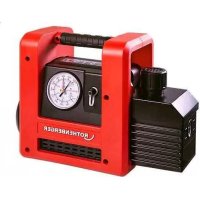
Roairvac R32 6.0 - Vacuum packaging machines ROTHENBERGER - Free user manual and instructions
Find the device manual for free Roairvac R32 6.0 ROTHENBERGER in PDF.



| Product type | Two-stage vacuum pump for HVAC&R systems |
| Brand | ROTHENBERGER |
| Model | Roairvac R32 6.0 |
| Intended use | Evacuation of air from air conditioning and refrigeration systems |
| Oil capacity | 580 ml |
| Dimensions (L x W x H) | 395 x 170 x 270 mm |
| Weight | 17.3 kg |
| Protection class | I |
| Protection index | IP 44 |
| Sound pressure level | ≤ 68 dB(A) |
| Sound power level | ≤ 79 dB(A) |
| Pump type | Two-stage with integrated non-return solenoid valve |
| Gas ballast valve | Yes |
| Vacuum gauge | Integrated |
| Provided suction connections | 1/4" SAE female, 5/16" SAE male, 3/8" SAE male |
| Recommended oil | ROTHENBERGER lubricating oil (mineral or synthetic) |
| Motor thermal protection | Yes, with automatic reset |
| Cooling | Forced ventilation |
| Included accessories | Power cable, oil can, connectors, manual |
| Routine maintenance | Periodic oil check and change |
Frequently Asked Questions - Roairvac R32 6.0 ROTHENBERGER
User questions about Roairvac R32 6.0 ROTHENBERGER
0 question about this device. Answer the ones you know or ask your own.
Ask a new question about this device
Download the instructions for your Vacuum packaging machines in PDF format for free! Find your manual Roairvac R32 6.0 - ROTHENBERGER and take your electronic device back in hand. On this page are published all the documents necessary for the use of your device. Roairvac R32 6.0 by ROTHENBERGER.
USER MANUAL Roairvac R32 6.0 ROTHENBERGER
natural_image
Red Rothenberger R32 air purifier device with control panel and ventilation slots (no visible text or symbols on main body)Bedienungsanleitung
Instructions for use
text_image
Warning symbol and icon: triangular warning sign with exclamation mark next to person reading a book1000001231

A Overview
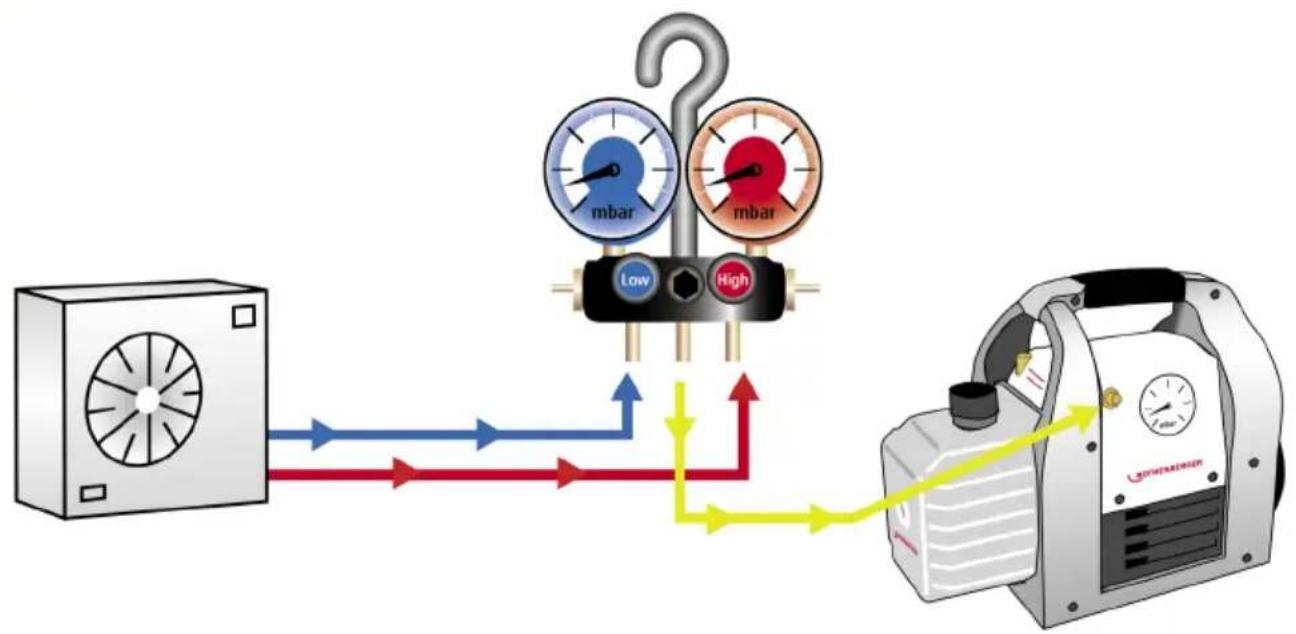
flowchart
graph LR
    A["Fan with Air Fan"] --> B["Pressure Gauge with mbar"]
    B --> C["Control Unit with High Pressure Gauge"]
    C --> D["Air Purifier with Control Valve"]
    style A fill:#f9f,stroke:#333
    style D fill:#bbf,stroke:#333
B Overview
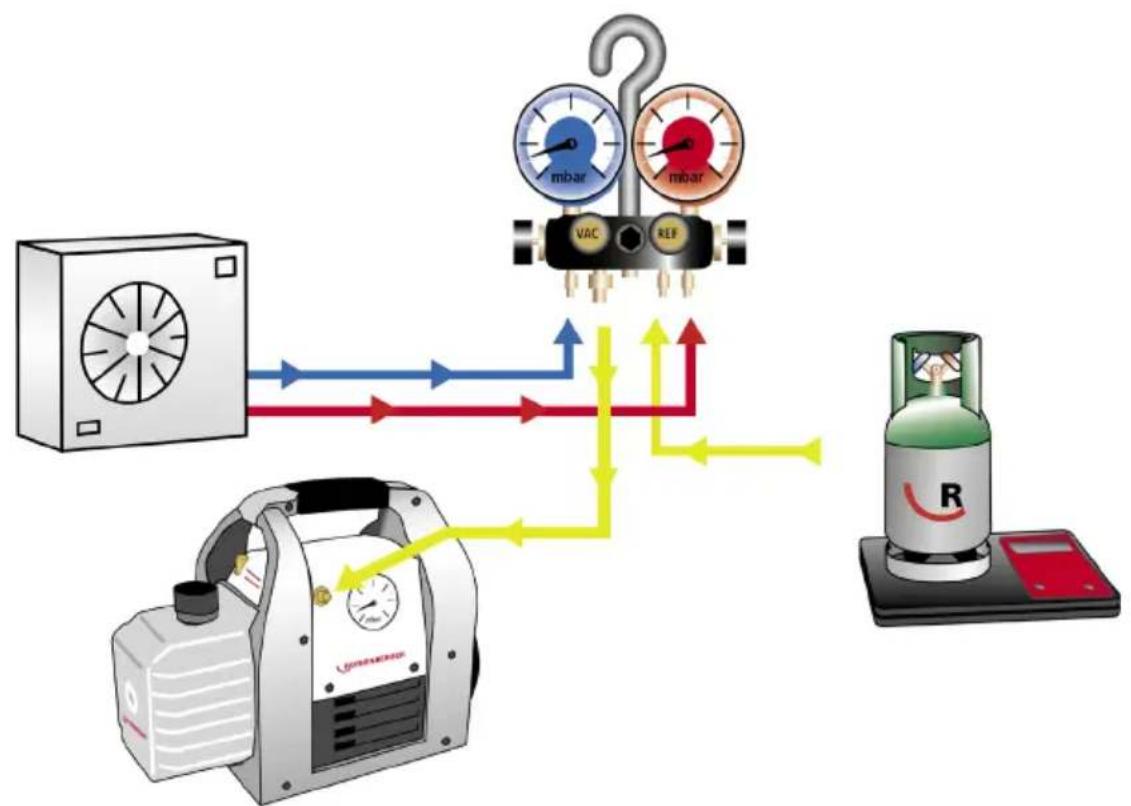
flowchart
graph TD
    A["Air Generator"] --> B["VAC"]
    B --> C["REF Valve"]
    C --> D["Gas Cylinder"]
    style A fill:#f9f,stroke:#333
    style B fill:#ccf,stroke:#333
    style C fill:#cfc,stroke:#333
    style D fill:#fcc,stroke:#333
C ROAIRVAC R32 6.0
text_image
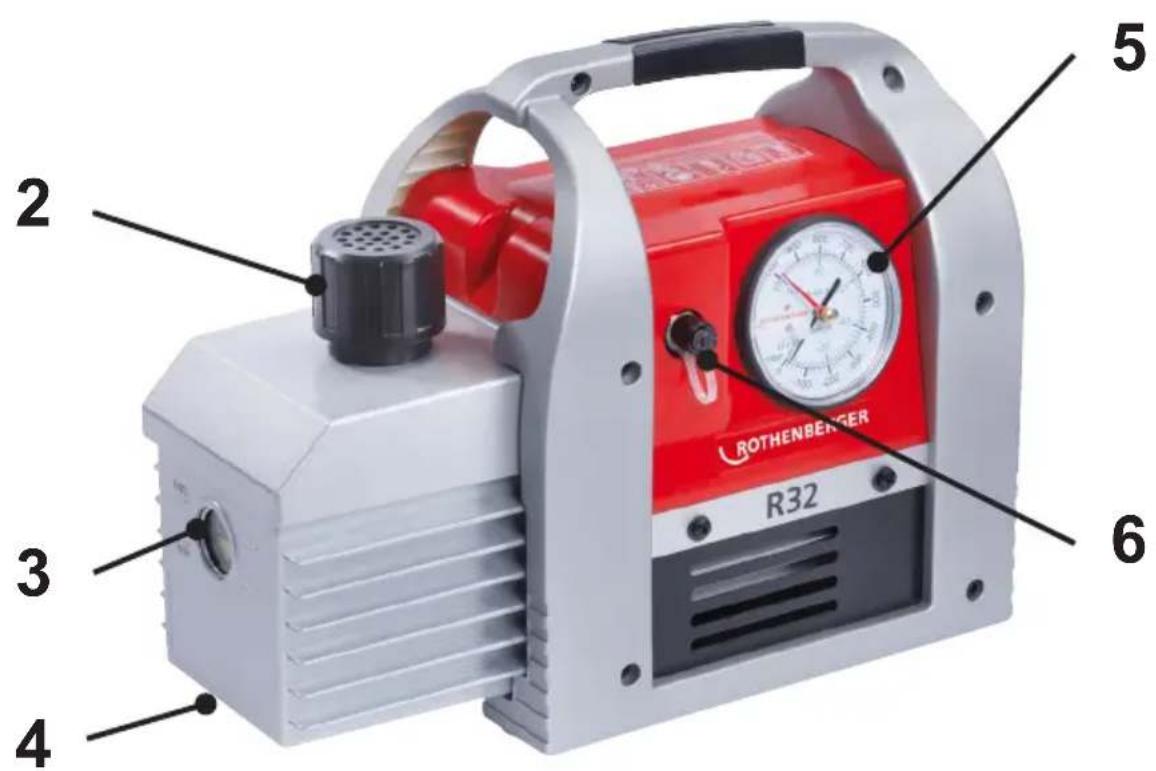
ROTHENBERGER R32 2 3 4 5 6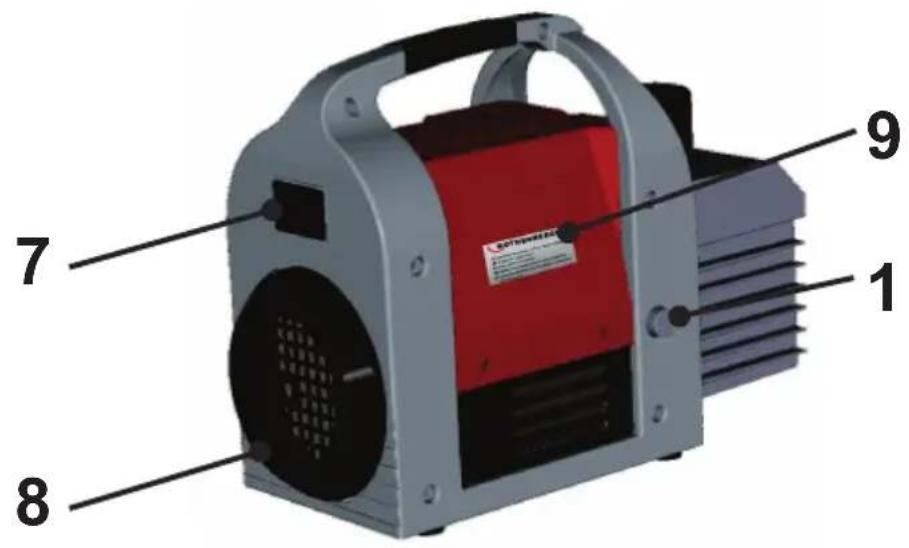
text_image
7 8 1 9Intro
EC-DECLARATION OF CONFORMITY
We declare on our sole accountability that this product conforms to the standards and guidelines stated.
DECLARATION CE DE CONFORMITÉ
Manufacturer / authorized representative signature
César Sainz de Diego Abadiano, 24.04.2015
60 Hz......6,0 cfm / 170 l/min
Endvakuum 15 micron
Email: service@rothenberger.com
www.rothenberger.com
11 Entsorgung
1.1 General safety instructions .... 11
1.2 Special safety instructions .... 12
2 Material included....12
3 Description (A - B - C)....12
4 Technical Data ....13
5 Set-up of pump before first operation....13
6 Operation....14
7 Routine maintenance....14
8 Extraordinary maintenance / repair 15
9 Troubleshooting....15
10 Customer service....16
11 Disposal....16
Markings in this document:

Danger!
This sign warns against the danger of personal injuries.

Caution!
This sign warns against the danger of property damage and damage to the environment.

Call for action
1.1 General safety instructions

ATTENTION! When using electric tools, the following fundamental safety measures must be taken to prevent electric shock, injury or fire.
Read all of these instructions before you use the electric tool, and store the safety instructions properly.
Service and maintenance:
1 Regular cleaning, maintenance and lubrication. Always pull the electrical plug before any adjustment, maintenance or repair.
2 Have your device repaired only by qualified experts and only with original replacement parts. This ensures the continued safety of the device.
Working safely:
1 Keep your work area orderly. A messy work area can cause accidents.
2 Consider environmental influences. Do not expose electric tools to rain. Do not use electric tools in damp or wet environments. Keep the work area well lit. Do not use electric tools where there is a risk of fire or explosion.
3 Protect yourself from electric shock. Avoid physical contact with earthed parts (such as pipes, radiators, electric stoves or cooling devices).
4 Keep other people away. Do not let other people — especially children — touch the electric tool or its cable. Keep them away from the work area.
5 Store electric tools safely when they are not in use. Unused electric tools should be kept in a dry, high or closed area, out of reach of children.
6 Do not overload your electric tool. Work is better and safer within the performance range indicated.
7 Use the right electric tool. Don't use low-performance machines for heavy-duty jobs. Do not use the electric tool for purposes for which it was not intended. For example, do not use a portable circular saw for cutting tree branches or logs.
8 Wear proper clothing. Do not wear loose clothing or jewellery, as they can get caught in moving parts. When working outdoors, wear slip-resistant shoes. Wear a hairnet over long hair.
9 Use protective gear. Wear safety glasses. Wear a breathing mask during work that creates dust.
10 Connect the dust extraction equipment. If there are connections to dust extraction and collection equipment, make sure that they are connected and properly used.
11 Do not use the cable for purposes for which it was not intended. Never use the cable to pull the plug from the socket. Protect the cable from heat, oil and sharp edges.
12 Secure the work piece. Use clamps or a vice to hold the work piece firmly. They will hold it more securely than your hand can.
13 Avoid abnormal postures. Make sure to stand securely and always keep your balance.
14 Maintain your tools with care. For better and safer work, keep cutting tools sharp and clean. Follow the instructions for lubrication and changing tools. Regularly inspect the electric tool's connection cable, and if it is damaged, have it replaced by an authorized expert. Regularly check extension cords and replace them if they are damaged. Keep the handles dry, clean and free of oil and grease.
15 Pull the plug from the socket. When not using the electric tool, before maintenance or when changing tools, such as saw blades, drills and cutting bits.
16 Do not leave any tool keys inserted. Before switching on, check to see that keys and adjustment tools have been removed.
17 Avoid unintentional activation. When plugging the tool in, make sure that the switch is turned off.
18 Use outdoor extension cords. When outdoors, use only extension cords that are approved and appropriately marked.
19 Be alert. Pay attention to what you do. Approach your work sensibly. Do not use the electric tool when you are distracted.
20 Check the electric tool for damage. Before using the electric tool, you must inspect safety equipment or slightly damaged parts carefully to ensure that they work properly and as intended. Check to see that the moving parts operate freely and don't stick, and to make sure no parts are damaged. All parts must be mounted properly and meet all the conditions for ensuring trouble-free operation of the electric tool.
Damaged safety equipment and parts must be properly repaired or replaced by a professional facility, unless otherwise indicated in the user manual. Damaged switches must be replaced by a customer service facility.
Never use an electric tool whose switch cannot be turned on and off.
21 Caution. Using other insertion tools and accessories may cause injury.
22 Have your tool repaired by an electrical expert. This electric tool meets applicable safety requirements. Repairs must be made only by an electrical expert using original replacement parts. Otherwise accidents many occur.
1.2 Special safety instructions
Unit is intended for operator professionally well trained, he must know refrigeration fundamentals, cooling systems, refrigerants and possible damages that equipments under pressure could cause.
Read carefully instructions in the literature, strict observance of procedures is main condition for operator safety, constant declared performances and unit undamaging.
Wear safety glasses and gloves when handling refrigerant; avoid contact with refrigerant, blindness and injuries may result to operator.
Keep away from flames and hot surfaces; high temperature decomposes refrigerant releasing toxic contaminants very dangerous for environment and operator.
Avoid skin contact; refrigerant has a very low boiling temperature (approx. -18^ / -3^ ) and freezing may occurs.
Avoid inhaling vaporized refrigerant gas; it has a narcotic effect.
Vacuum pump must always be suitably earthed.
Even if the pump temperature is not expected to rise a high level during use, it is advisable to locate the unit so that users cannot make contact with the casing, as burns may result.
Vacuum pump is air cooled with integral fan; use only where air can freely circulate.
During operations, do not vent refrigerant in environment.
2 Material included
1 x Vacuum pump
1 x Cable
1 x Mineral oil bottle
1 x Connector 1/4" SAE - F - 5/16" SAE - M
1 x Connector 1/4" SAE - F - 3/8" SAE - M
1 x Instructions for use
3 Description
(A - B - C)
Vacuum pump for air evacuation of closed systems (air conditioners, tanks, etc). This equipment is specially designed for HVAC&R systems.
The two Stages of these pumps make it feasible to achieve the final vacuum level requested for these type of systems. Besides, the solenoid non-return valve avoids any oil mixture due to the backflow after a power interruption or any other process interruption.
Overview:
1 Gas ballast valve 6 1/4"SAE connection
2 Charging plug with filter 7 ON/OFF
3 Oil level sight glass 8 Cooling fan
4 Oil drainage plug 9 Characteristics label
5 Vacuum gauge and solenoid valve integrated
4 Technical Data
Voltage 230 V, 50/60 Hz
Flow rate....50 Hz....5,0 cfm / 142 l/min
60 Hz ......6,0 cfm / 170 l/min
Final vacuum....15 micron
Power.... ^3/4 HP / 0,55 kW
Refrigerant classes....A1, A2
Inlet 14 " SAE
Oil capacity....580 ml
Dimensions (L x W x H) 395 x 170 x 270 mm
Weight......ca. 17,3 kg
Protection class ....I
Protection type....IP 44
Typical A-rated sound level:
Noise pressure level (LpA) ≤ 68 dB (A) | KpA 3 dB (A)
Noise pressure level (LWA) ....≤ 79 dB (A) | KWA 3 dB (A)
The noise level during operation can exceed 85 dB (A). Wear ear protection!
Measured values determined in accordance with EN 61029-1:2010.
5 Set-up of pump before first operation
Pump is supplied without oil charge; before initial operation, it is mandatory to fill the pump with the recommended oil charge.
Filling of oil
Pump must be turned off for filling the oil and level control.
Pump is supplied with a mineral oil bottle but without oil charge inside the vacuum pump; before initial operation, it is mandatory to fill the pump with the oil up to the indicated oil level in the oil level sight glass. Only use ROTHENBERGER oil; different lubricants reduce performance and may cause irreversible damage to the pump. Warranty is void if other oil has been used.
For fill-up proceed as follows:
→ Unscrew charging plug (placed on upper part of pump)
→ Slowly add the oil until middle of sight glass has been reached (indicated by MAX MIN line)
→ Screw-on the plug again
To avoid excessive filling, it is suggested to only add the oil with a graduated recipient; in that way it is easy to check the added volume. In case of excessive filling, it is necessary to completely empty the pump and repeat the oil filling procedure.

WARNING: Do not pollute the environment by spilling oil; the lubricant oil is a special waste and must be disposed of according to relevant local law / guidelines in force.
Connection for evacuation
Shorter hose length or wider ID, as well as straight path, reduce the evacuation time as the pump will reach the desired vacuum more quickly. To prevent backflow of lubricant from the pump into the evacuated system in case of unexpected power failure, a solenoid non-return valve is provided at the suction connection.
Power Supply
Always check the power supply; it has to comply with the data on the rating label on the pump. The pumps' motor is equipped with a thermal overload protection with automatic reset and cuts off power supply at +130°C / +266°F.
General precautions
The pumps' motor must always be suitably grounded. The pump temperature is not expected to rise to a very high level during operation; however it is advisable to locate the unit in such a way that no contact can be made, as it may cause burns. When using the pump with other equipment, it must be ensured that the pump is fixed properly and safe to use for the operator. The vacuum pump is air cooled by a built-in fan; only use it where the air can freely circulate and keep it away from walls or obstacles no less than 2" (5 cm). Do not cover the pump during operation.
6 Operation
To guarantee reliability and high level of quality, each pump is subjected to a rigorous testing and suitable preliminary running in before it leaves the factory. Constant performance and long operating life are assured by strictly observing the following procedures:
Pump start
Before the first initial run, it is mandatory to:
→ Fill the pump with the provided oil (see section "filling of oil").
→ Before subsequent start-ups, always check the oil level before starting the pump. If necessary, top-up or replace the oil.
Before connecting the pump to the system to be evacuated, check that there is no pressure inside. In case of connecting the pump with a pressurized system, the vacuum gauge may break. The vacuum gauge measures negatives pressures and get collapsed with positive pressures. Warranty is void if the pump is connected to a positive pressure.
→ Connect the pump to the system to be evacuated by the necessary equipment (quality hoses, quality manifolds, etc). The evacuation quality will be directly related to the way of connection and to the equipment quality.
In case of malfunctioning, stop the pump and call the Service- After-Sales.
Pump stop
As the mixture of incompatible lubricants (pump oil and compressor oil) can lead to pump failure, installing a non-return solenoid valve at the suction connection is required (provided). In case of frequent on-off cycling, do not stop the pump but shut-off at the charging hose or manifold instead.
7 Routine maintenance
Periodic and correct maintenance of the vacuum pump will ensure a long operation life and constant performance.
Lubrication
The oil provided with the pump has been specially formulated & manufactured to lubricate vacuum pumps; it is special as it features minimum viscosity fluctuation when in use under a wide temperature range. The type of lubricant supplied with the pump allows the evacuation of systems operating refrigerants. Working with ROTHENBERGER POE synthetic oil is also feasible. Both ROTHENBERGER oil types available after order.
Volumes to be filled into the pumps are specified in section 1.1. Replace the oil charge no later than 20 hours of operation.
Oil could be polluted by other oil, humidity, refrigerants, etc. It is mandatory to use oil in perfect conditions to assure a perfect performance of the pump.
Oil-change
Over-used lubrication oil damages the pumps' mechanism; make sure to replace oil as soon as it starts to turn cloudy. For conducting the oil-change, the pump must be switched off. For changing the oil proceed as follows:
→ Unscrew the oil drainage plug located on the lower part of the pump
→ Check that oil comes out completely from the pump
→ Tightly screw the oil drainage plug back on
→ Re-fill the pump with oil (see "Filling of oil")

WARNING: Do not pollute the environment by spilling oil; the lubricant oil is a special waste and must be disposed of according to relevant local law / guidelines in force.
8 Extraordinary maintenance / repair
Conduct extraordinary maintenance or repair whenever serious faults occur such as overheating, poor ultimate vacuum, persistent loudness / noise, blocked pump or any other irregular functioning.
In that case, the pump needs to be disassembled, parts need to be cleaned, repaired or replaced. Only qualified service staff shall carry out such maintenance or repair work; otherwise the warranty will be void.
For any information please contact our Service-After-Sales.
9 Troubleshooting
| Problem | Solution |
| The pump doesn't work | Check that the pump is connected to the power supply.Check that the plug and cable are not damaged.Check that the power supply is suitable for the pump requirements (see the label of the pump).Check that the pump is filled up with oil (see section 2.1).Contact our Service-After-Sales. |
| Overheating | Check that the pump is filled up with oil (see section 2.1).Check that the pump is not covered and that air could flow easily.Check that the power supply is suitable for the pump requirements (see the label of the pump).Contact our Service-After-Sales. |
| Poor ultimate vacuum | Check that the pump has been working for the enough time. The final vacuum level is directly related with the time of performance. The time must be according to the volume to be evacuated.Check that there is no leak in the connection or in the system to be evacuated. Switch off the pump and check that the vacuum level remains.Check that all the connections and the equipment used are the appropriate ones.Contact our Service-After-Sales. |
| Persistent loudness / noise | Check that there are no damages on the fan cover. Any impact on this area could affect the fan movement.Check that the pump is perfectly screwed.Contact our Service-After-Sales. |
| Blocked pump | Contact our Service-After-Sales. |
| Oil overconsumption | Check that the oil is ROTHENBERGER oil.Check that the drainage plug is perfectly closed and that there is no oil spill.Check that there is no leak in the connection or in the system to be evacuated. Open systems increase the oil consumption.Contact our Service-After-Sales. |
| The vacuum gauge doesn’t move but the engine is running. | Check that the pump sucks in air. If the pump sucks in air, it is possible that the vacuum gauge is damaged. If the pump does not suck in air, it is possible that the non-return solenoid valve is blocked.Contact our Service-After-Sales. |
10 Customer service
The ROTHENBERGER service locations are available to help you (see listing in catalog or online) and replacement parts and service are also available through these same service locations.
Order your accessories and spare parts from your specialist retailer or using our service-after-sales hotline:
Phone: +49 (0) 61 95 / 800 - 8200
Fax: +49 (0) 61 95 / 800 - 7491
Email: service@rothenberger.com
www.rothenberger.com
11 Disposal
Components of the unit are recyclable material and should be put to recycling. For this purpose registered and certified recycling companies are available. For an environmental friendly disposal of the non-recyclable parts (e.g. electronic waste) please contact your local waste disposal authority.
For EU countries only:
Do not dispose electric tools with domestic waste. In accordance with the European Directive 2012/19/EC the disposal of electrical and electronic equipment and its implementation as national law, electric tools that are no longer serviceable must be collected separately and utilised for environmentally compatible recycling.
Table des matières
Tension....230 V, 50/60 Hz
Flux de vitesse....50 Hz....5,0 cfm / 142 l/min
60 Hz......6,0 cfm / 170 l/min
Vide Final 15 micron
Alimentation.... ^3/4 PS / 0,55 kW
Classes de fluides frigorigènes ......A1, A2
Connexion .... ^1/4 " SAE
Email: service@rothenberger.com
www.rothenberger.com
Email: service@rothenberger.com
www.rothenberger.com
11 Eliminación
60 Hz......6,0 cfm / 170 l/min
Vuoto Finale 15 micron
Potenza nominale assorbita.... ^3/4 PS / 0,55 kW
Classi refrigeranti.....A1, A2
Email: service@rothenberger.com
www.rothenberger.com
11 Smaltimento
60 Hz......6,0 cfm / 170 l/min
Vácuo Final....15 micron
Email: service@rothenberger.com
www.rothenberger.com
11 Eliminação
60 Hz......6,0 cfm / 170 l/min
Slutvakuum....15 micron
Nominal optagen effekt.... ^3/4 PS / 0,55 kW
Kølemiddel klasser ......A1, A2
Email: service@rothenberger.com
www.rothenberger.com
11 Affaldsbehandling
60 Hz ......6,0 cfm / 170 l/min
Slutvakuum.... 15 micron
Nominell ineffekt .... ^3/4 PS / 0,55 kW
Refrigerant klasser....A1, A2
Inloppskanal .... ^1/4 " SAE
Oljevolym....580 ml
Mått (Ixbxh)....395 x 170 x 270 mm
Vikt ca. 17,3 kg
Skyddsklass....I
Skyddstyp....IP 44
Email: service@rothenberger.com
www.rothenberger.com
11 Avfallshantering
Flow fart....50 Hz....5,0 cfm / 142 l/min
60 Hz......6,0 cfm / 170 l/min
Sluttvakuum.... 15 micron
Nominell opptakkseffekt.... ^3/4 PS / 0,55 kW
Email: service@rothenberger.com
www.rothenberger.com
11 Avfallsdumping
60 Hz......6,0 cfm / 170 l/min
Lopullinen alipaine....15 micron
Ottoteho.... ^3/4 PS / 0,55 kW
Email: service@rothenberger.com
www.rothenberger.com
11 Kierrätys
60 Hz......6,0 cfm / 170 l/min
Email: service@rothenberger.com
www.rothenberger.com
11 Utylizacja
ROTHENBERGER Worldwide
| Australia | ROTHENBERGER Australia Pty. Ltd.Unit 6 · 13 Hoyle Avenue · Castle Hill · NLS.W. 2154Tel + 61 2 / 98 99 75 77 · Fax + 61 2 / 98 99 76 77rothenberger@rothenberger.com.auwww.rothenberger.com.au | Italy | ROTHENBERGER Italiana s.r.l.Via G. Reiss Romoli 17-19 · I-20019 Settimo MilaneseTel + 39 02 / 38 50 601 · Fax + 39 02 / 38 50 0151Info@rothenberger.it · www.rothenberger.pl |
| Austria | ROTHENBERGER Werkzeuge- und Maschinen Handelsgesellschaft m.b.H.Gewerbeparkstraße 9 · A-5081 AntfTel + 43 62 46 / 7 20 91-45 · Fax + 43 62 46 / 7 20 91-15office@rothenberger.at · www.rothenberger.at | Netherlands | ROTHENBERGER Nederland by Postbus 45 · NL-5120 AA RijenTel + 31 1 61 / 29 35 79 · Fax + 31 1 61 / 29 39 08Info@rothenberger.nl · www.rothenberger.nl |
| Belgium | ROTHENBERGER Benelux bybaAntwerpsesteenweg 59 · B-2630 AartselaarTel + 32 3 / 8 77 22 77 · Fax + 32 3 / 8 77 03 94Info@rothenberger.be · www.rothenberger.be | Poland | ROTHENBERGER Polska Sp.z.o.o.Ul. Annopol 4A · Budynek C · FL-08-236 WarszawaTel + 48 22 / 2 13 59 00 · Fax + 48 22 / 2 13 59 01bluro@rothenberger.pl · www.rothenberger.pl |
| Brazil | ROTHENBERGER do Brasil LTDAAv. Fagundes de Oliveira, 526 · Galpão A409950-300 · Diadema / SP · BrazilTel + 55 111/40 44-4748 · Fax + 55 111/40 44-5051spacente@rothenberger.com.br · www.rothenberger.com.br | Russia | ROTHENBERGER RussiaAvtosavodskaya str. 25115280 Moscow, RussiaTel + 7 485 / 792 59 44 · Fax + 7 485 / 792 59 46Info@rothenberger.rz · www.rothenberger.ru |
| Bulgaria | ROTHENBERGER Bulgaria GmbHBoul. Sltnjakovo 79 · BG-11111 SofiaTel + 35 9 / 2 9 46 14 59 · Fax + 35 9 / 2 9 46 12 05Info@rothenberger.bg · www.rothenberger.bg | South Africa | ROTHENBERGER-TOOLS SA (PTY) Ltd.P.O. Box 4360 · Edenvale 1610165 Vanderbilt Street, Meadowdale GemristonGauteng (Johannesburg), South AfricaTel + 27 111 / 3 72 96 31 · Fax + 27 11 / 3 72 96 32Info@rothenberger.co.za · www.rothenberger.co.za |
| China | ROTHENBERGER Pipe Tool (Shanghai) Co., Ltd.D-4, No.195 Qianpu Road.East New Area of SongjiangIndustrial Zone, Shanghai 201611, ChinaTel + 86 21 / 67 60 20 61 · + 86 21 / 67 60 20 67Fax + 86 21 / 67 60 20 63 · office@rothenberger.cn | Spain | ROTHENBERGER S.A.Ctra. Durango-Borlo, Km 2 · E-48220 Abadiano (Vizcaya)(P.O. Box) 1117 · E-48200 Durango (Vizcaya)Tel + 34 94 / 6 21 01 00 · Fax + 34 94 / 6 21 01 31export@rothenberger.es · www.rothenberger.es |
| Czech Republic | ROTHENBERGER CZPrumyslova 13087 · 102 00 Praha 10Tel +420 271 730 183 · Fax +420 267 310 187prodej@rothenberger.cz · www.rothenberger.cz | Sweden | ROTHENBERGER Sweden ABHemvämsgatan 22 · S- 171 54 Solna, SverigeTel + 46 8 / 54 60 28 00 · Fax + 46 8 / 54 60 23 01roswe@rothenberger.se · www.rothenberger.se |
| Denmark | ROTHENBERGER Scandinavia A/SSmedevænget 8 · DK-9560 HadsundTel + 45 98 / 15 75 66 · Fax + 45 98 / 15 66 23roscan@rothenberger.dk | Switzerland | ROTHENBERGER (Schwetz) AGHerostr. 9 · CH-8046 ZürichTel + 41 (0)44 435 30 30 · Fax + 41 (0)44 401 06 08Info@rothenberger-werkzeuge.ch |
| France | ROTHENBERGER France S.A.24, rue des Draplers, BP 45033 · F-57071 Metz Cedex 3Tel + 33 3 / 87 74 92 92 · Fax + 33 3 / 87 74 94 03Info-fr@rothenberger.com · www.rothenberger.fr | Turkey | ROTHENBERGER Tes. Aktiwe Mok. San Tlic Ltd. 38lPoyraz Sok. No: 203 - Delay Is MerkeziTR-34722 Kadkoy-IstanbulTel + 90 / 216 449 24 85 · Fax + 90 / 216 449 24 87rothenberger@rothenberger.com.trwww.rothenberger.tr |
| Germany | ROTHENBERGER Deutschland GmbHIndustriestraße 7 · D-65779 Kelkheim/GermanyTel + 49 61 95 / 800 81 00 · Fax + 49 61 95 / 800 37 36verkauf-deutschland@rothenberger.comwww.rothenberger.com | UAE | ROTHENBERGER Middle East FZCOPo Box 261190 · Jebel Ali Free ZoneDubai, United Arab EmiratesTel + 971 / 48 83 97 77 · Fax + 971 / 48 83 97 57office@rothenberger.se |
| Greece | ROTHENBERGER Werkzeuge Produktion GmbHLilenthalstraße 71 · 87 · D-37235 Hesselsch-LichtenauTel + 49 56 02 / 93 94-0 · Fax + 49 56 02 / 93 94 36 | UK | ROTHENBERGER EQUIPMENT TRADING & SERVICES LLCPo Box 91208 · Mussafah Industrial AreaAbu Dhabi, United Arab EmiratesTel + 971 / 25 50 01 54 · + 971 / 25 50 01 53uaesales@rothenberger.se |
| Hungary | ROTHENBERGER Hellas S.A.Agias Kyrals 45 · 17564 Paleo Faliro · GreeceTel + 30 210 94 02 049 · +30 210 94 07 302 / 3Fax + 30 210 / 94 07 322ro-he@otenet.gr · www.rothenberger.com | USA | ROTHENBERGER USA LLC7130 Clinton Road · Loves Park, IL 611111.USATel +1 / 60 05 45 76 98 · Fax + 1 / 61 56 33 08 79pipetools@rothenberger-usa.comwww.rothenberger-usa.com |
| India | ROTHENBERGER Hungary KitGubacsl 01 26 · H-1097 BudapestTel + 36 1 / 3 47- 50 40 · Fax + 36 1 / 3 47- 50 59Info@rothenberger.hu · www.rothenberger.hu | ||
| ROTHENBERGER Werkzeuge GmbHIndustriestraße 7D- 65779 Kelkheim / GermanyTelefon + 49 (0) 61 95 / 800 - 0Fax + 49 (0) 6195 / 800 - 3500info@rothenberger.com |
