
HTM82 D4 - Speaker BOWERS & WILKINS - Free user manual and instructions
Find the device manual for free HTM82 D4 BOWERS & WILKINS in PDF.

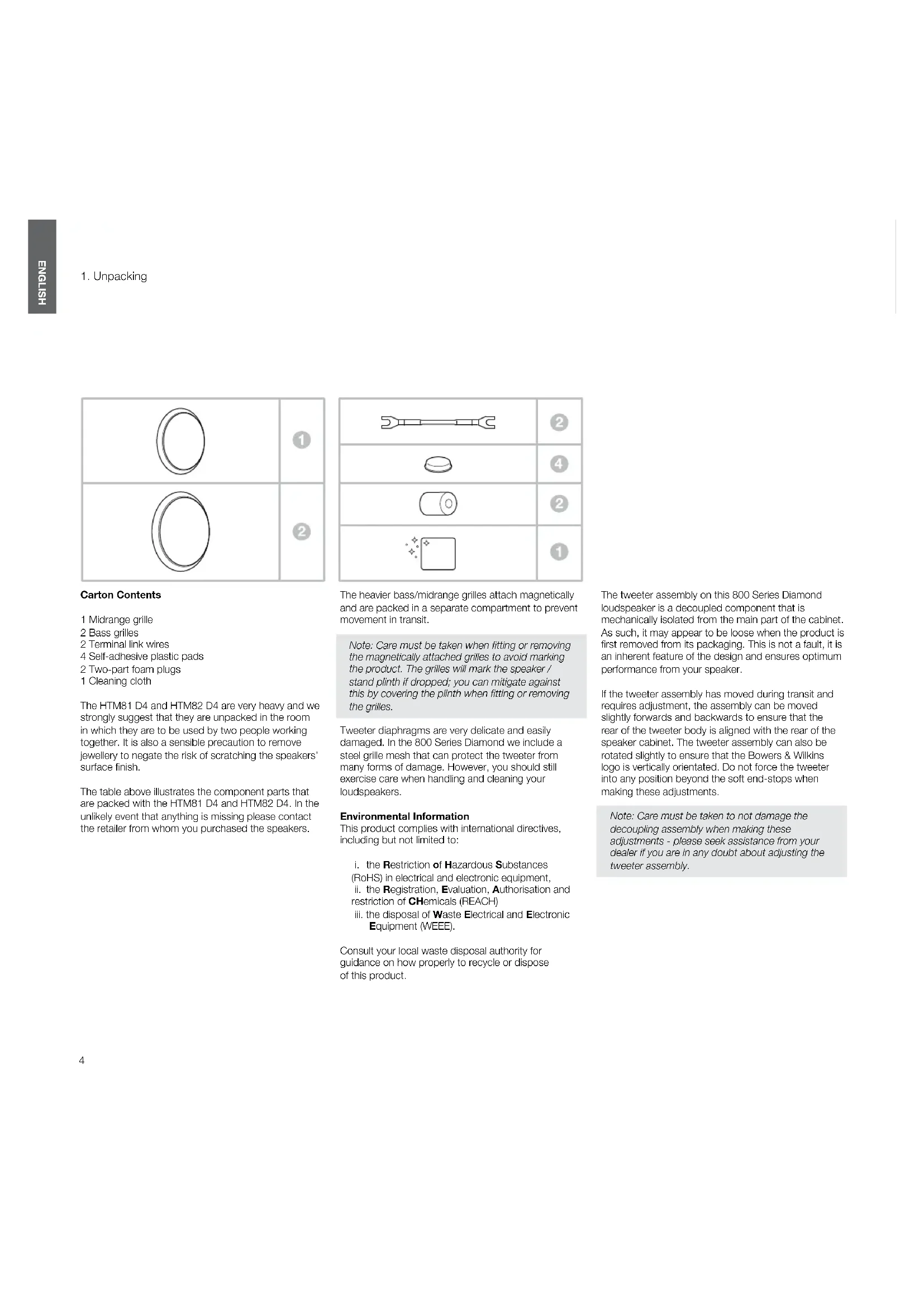


| Product Type | Center channel speaker |
| Brand | Bowers & Wilkins |
| Model | HTM82 D4 |
| Series | 800 Series Diamond |
| Speaker Type | 2-way: midrange/bass and diamond tweeter |
| Tweeter | Mechanically decoupled diamond |
| Grilles | Magnetic and removable |
| Included Accessories | Grilles (midrange and bass), link cables, adhesive feet, foam bungs, cleaning cloth |
| Link Cables | 2 cables supplied (for bi-wiring or standard connection) |
| Feet | 4 self-adhesive plastic feet supplied |
| Foam Bungs | 2 two-part bungs for bass adjustment |
| Cleaning | Use the supplied cloth; avoid abrasive, acidic, ammonia or antibacterial products |
| Wood Care | UV varnish; avoid heat sources; sun exposure to even out the shade |
| Safety | Banana plugs regulated in Europe (plastic bungs); make connections with power off |
| Installation | Unpacking by two people recommended; remove jewelry to avoid scratches |
| Positioning | Dedicated FS-HTM D4 stand recommended; tilt adjustable to 4° or 8° |
| Bi-wiring | Possible thanks to two pairs of terminals at the rear |
| Break-in | About 15 hours of normal use for mechanical stabilization |
| Tweeter Decoupling | Tweeter body mechanically isolated; can be slightly adjusted if moved |
| Power | Passive (requires external amplifier) |
Frequently Asked Questions - HTM82 D4 BOWERS & WILKINS
User questions about HTM82 D4 BOWERS & WILKINS
0 question about this device. Answer the ones you know or ask your own.
Ask a new question about this device
Download the instructions for your Speaker in PDF format for free! Find your manual HTM82 D4 - BOWERS & WILKINS and take your electronic device back in hand. On this page are published all the documents necessary for the use of your device. HTM82 D4 by BOWERS & WILKINS.
USER MANUAL HTM82 D4 BOWERS & WILKINS
Welcome and thank you for choosing
Bowers & Wilkins. Our founder, John Bowers, believed that imaginative design, innovative engineering and advanced technology were keys that could unlock the enjoyment of audio in the home. His belief is one that we continue to share and inspires every product we design.
The 800 Series Diamond is the world's most advanced range of loudspeakers. Each model benefits from thoughtful installation, so we would suggest that you take some time to read this manual before you begin the installation process. Continue to page 4 →
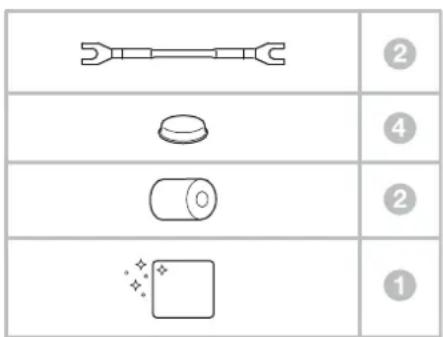
1 Midrange grille
2 Bass grilles
2 Terminal link wires
4 Self-adhesive plastic pads
2 Two-part foam plugs
1 Cleaning cloth
The HTM81 D4 and HTM82 D4 are very heavy and we strongly suggest that they are unpacked in the room in which they are to be used by two people working together. It is also a sensible precaution to remove jewellery to negate the risk of scratching the speakers' surface finish.
The table above illustrates the component parts that are packed with the HTM81 D4 and HTM82 D4. In the unlikely event that anything is missing please contact the retailer from whom you purchased the speakers.
The heavier bass/midrange grilles attach magnetically and are packed in a separate compartment to prevent movement in transit.
Note: Care must be taken when fitting or removing the magnetically attached grilles to avoid marking the product. The grilles will mark the speaker / stand plinth if dropped; you can mitigate against this by covering the plinth when fitting or removing the grilles.
Tweeter diaphragms are very delicate and easily damaged. In the 800 Series Diamond we include a steel grille mesh that can protect the tweeter from many forms of damage. However, you should still exercise care when handling and cleaning your loudspeakers.
Environmental Information
This product complies with international directives, including but not limited to:
i. the Restriction of Hazardous Substances (RoHS) in electrical and electronic equipment,
ii. the Registration, Evaluation, Authorisation and restriction of CHemicals (REACH)
iii. the disposal of Waste Electrical and Electronic Equipment (WEEE).
Consult your local waste disposal authority for guidance on how properly to recycle or dispose of this product.
The tweeter assembly on this 800 Series Diamond loudspeaker is a decoupled component that is mechanically isolated from the main part of the cabinet. As such, it may appear to be loose when the product is first removed from its packaging. This is not a fault, it is an inherent feature of the design and ensures optimum performance from your speaker.
If the tweeter assembly has moved during transit and requires adjustment, the assembly can be moved slightly forwards and backwards to ensure that the rear of the tweeter body is aligned with the rear of the speaker cabinet. The tweeter assembly can also be rotated slightly to ensure that the Bowers & Wilkins logo is vertically orientated. Do not force the tweeter into any position beyond the soft end-stops when making these adjustments.
Note: Care must be taken to not damage the decoupling assembly when making these adjustments - please seek assistance from your dealer if you are in any doubt about adjusting the tweeter assembly.
- Positioning 3. Connecting
Speaker Installation
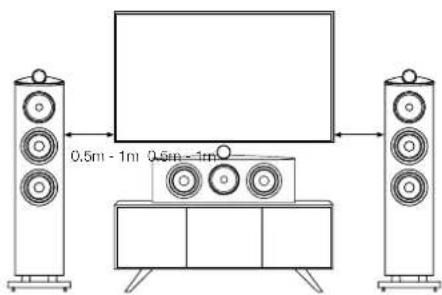
If using a projection television with an acoustically transparent screen, position your HTM81 D4 or HTM82 D4 speaker behind the centre of the screen. Otherwise, position it either directly below or above the screen using either a floor-stand, furniture unit or wall shelf ensuring the speaker is as close to ear height as possible.
If a floor-stand is to be used, we recommend the FS-HTM D4. FS-HTM D4 is an adjustable centre speaker stand that allows either HTM81 D4 or HTM82 D4 to be tilted by either 4° or 8°. This range of adjustment makes it easier for you to 'aim' the speaker at your ear level when you are seated. It is important for both safety and performance that the floor-stand assembly instructions are followed.
If a wall-shelf or furniture unit is used, we recommend using the foam bung inserts (supplied) to optimise port performance (see Section 4: Fine Tuning and Running In).
Note: If using a shelf, ensure that it is strong enough to properly support the weight and fit the 4 self-adhesive plastic feet to the underside of the speaker.
Important Safety Notice
All connections should be made with the audio equipment switched off. When using audio equipment in normal operation, touching uninsulated speaker terminals or wiring may result in an unpleasant sensation.
The HTM81 D4 and HTM82 D4 speaker terminals accept a variety of cable terminations: 4mm banana plugs, 6mm and 8mm (1/4 in and 5/16 in) spades, or bare wires up to 4mm (5/32 in) diameter.
Important Safety Notice In certain countries, notably those in Europe, the use of 4mm banana plugs is considered a potential safety hazard, because they may be inserted into the holes of unshuttered mains supply sockets. In order to comply with European CENELEC safety regulations, the 4mm holes in the ends of the terminals are blocked by plastic pins. If you are using the products in any country where these conditions apply, you should ensure that any banana plugs cannot be used in an unsafe manner by children or other uninformed persons. The plastic pins can be removed if you wish to use banana plugs.
Ask your dealer for advice when selecting speaker cable. Keep its total impedance below the maximum recommended in the speaker specification and use a low inductance cable to avoid attenuation of high frequencies.
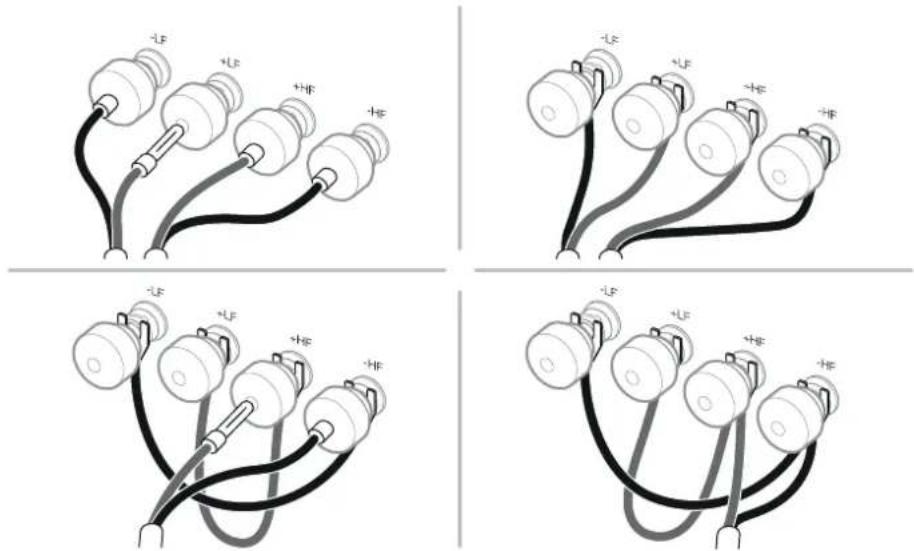
There are two pairs of terminals at the back of each speaker that enable bi-wiring (top). For conventional, single wire connection, fit the supplied link wires to join the like polarity terminals together.
Ensure that the positive terminals on the speaker (with red ring) are connected to the positive output terminal on the amplifier and the negative terminals on the speaker (with black ring) are always connected to the negative output terminal on the amplifier. Incorrect connection will not result in damage but will cause poor audio imaging and loss of bass. Always screw the terminal caps down fully to prevent rattles.
-
Fine Tuning and Running In
-
Aftercare
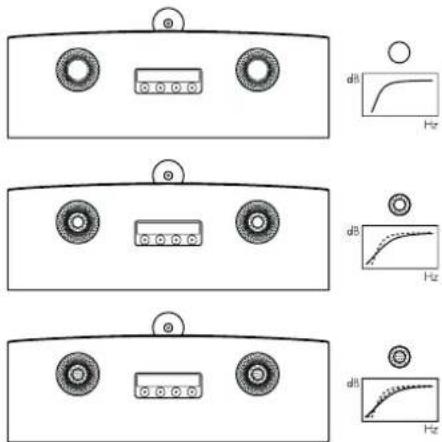
Before fine tuning, make sure that all the connections in the installation are correct and secure.
Moving the speakers further from the walls will generally reduce the volume of bass. Space behind the speakers will also help to create an aural impression of depth. Conversely, moving the speakers closer to the walls will increase the volume of bass. If you want to reduce the volume of bass without moving the speakers further from the wall, fit the foam plugs or, for less severe bass reduction, the foam rings in the port tubes (above). Try assessing the impact of fitting the foam plug / ring in one of the ports before assessing the impact of fitting the foam plugs / rings in both ports.
If the bass seems uneven with frequency this will most probably be due to resonance modes in the listening room. Even small changes in the position of the speakers or the listening position can have a profound effect on how these resonances affect the sound. Try moving the listening position or locating the speakers along a different wall. The presence and position of large pieces of furniture can also influence resonance modes.
If the central image lacks focus, try moving the speakers closer together or angling them inward so that they point at a location just in front of the listening position.
If the sound is too bright, increasing the amount of soft furnishing in the room (heavier curtains for example) may help balance the sound. Conversely, reducing the amount of soft furnishing may help brighten a dull sound.
For the most discerning listening, remove the bass/midrange grilles by gripping around their edges and gently pulling them away from the cabinet.
The performance of your speaker may change subtly during the initial listening period. If it has been stored in a cold environment, the damping compounds and suspension materials of the drive units will take some time to recover their correct mechanical properties. The drive unit suspension will also loosen up during the first hours of use. The time taken for the speaker to achieve its intended performance will vary depending on previous storage conditions and how it is used. As a guide, allow up to a week for the temperature effects to stabilise and 15 hours of average use for the mechanical parts to attain their intended design characteristics.
The cabinet surfaces will usually only require dusting. We recommend you use the cloth supplied with the product. If you wish to use an aerosol or other cleaner, apply the cleaner onto the cloth, not directly onto the product and test a small area first, as some cleaning products may damage some of the surfaces. Avoid products that are abrasive, or contain acid, alkali or anti-bacterial agents. Do not use cleaning agents on the drive units. Avoid touching the drive units as damage may result.
Whenever Bowers & Wilkins speakers are finished in real wood, the finest veneers are selected and treated with an ultra-violet resistant lacquer to minimise changes in colour over time. Nevertheless, like all natural materials, the veneer will respond to its environment and a degree of colour change is to be expected. Colour differences may be rectified by exposing all the veneer surfaces equally and evenly to sunlight until the colour is uniform. This process can take several days or even weeks, but may be accelerated by careful use of an ultra-violet lamp. Wood veneered surfaces should also be kept away from direct sources of heat such as radiators and warm air vents in order to minimise the possibility of the wood veneer cracking.
The tweeter housing has a textured surface finish that may collect superficial marks when handled and should be cleaned by wiping the supplied cleaning cloth around the housing, in-line with the surface texture.
Kartoninhalt
Inhoud doos
Τοποθέτηση ηχείου
Содержание упаковки
Ask your dealer for advice when selecting speaker cable. Keep its total impedance below the maximum recommended in the speaker specification and use a low inductance cable to avoid attenuation of high frequencies.
Obsah balení
Instalace reprosoustav
Instalacja Głośnika
Hoparlör Kurulumu
包装箱内的物品
1个中音格栅
2个低音格栅
2根端子连接线
4个自粘塑胶垫
2个两部分组成的泡棉塞
1块清洁布
扬声器安装
包裝箱內的物品
1個中音網罩
2個低音網單
2根端子連接線
4個自粘塑料墊
2個兩件式泡棉塞
1塊清潔布
揚聲器安裝
内容物
1 ミッドレンジ グリル
パスグリル2枚
リンクワイヤーケーブル(2本)
粘着式プラスチックパッド4枚
ツーパート・フォームブラグ2個
クリーニングクロス
スピーカーの取り付けは
내용물
스피커 설치 위치
Worthing West Sussex
BN11 2BH England
EU Importer:
Bowers & Wilkins
Beomdestraat 11
5653 MA Eindhoven
The Netherlands
Copyright © B&W Group Ltd. E&OE
Printed in England

- Welcome and thank you for choosing
- Environmental Information
- Speaker Installation
- Important Safety Notice
- Kartoninhalt
- Inhoud doos
- Τοποθέτηση ηχείου
- Содержание упаковки
- Obsah balení
- Instalace reprosoustav
- Instalacja Głośnika
- Hoparlör Kurulumu
- 包装箱内的物品
- 扬声器安装
- 包裝箱內的物品
- 揚聲器安裝
- 内容物
- スピーカーの取り付けは
- 내용물
- 스피커 설치 위치
Brand : BOWERS & WILKINS
Model : HTM82 D4
Category : Speaker