MT 36 Bp - Vacuum Cleaner Kärcher - Free user manual and instructions
Find the device manual for free MT 36 Bp Kärcher in PDF.



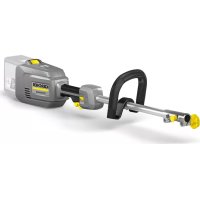
| Product type | Battery-powered multi-tool vacuum |
| Brand | Kärcher |
| Model | MT 36 Bp |
| Use | Professional, outdoor |
| Power supply | 36 V lithium-ion battery (not included) |
| Compatible battery type | Kärcher Battery Power+ 36 V |
| Operating voltage | 36 V |
| Maximum speed | 10,000 ± 10% rpm |
| Dimensions (L x W x H) | 951 x 197 x 188 mm |
| Weight (with battery) | 2.6 kg |
| Operating temperature range | 0 °C to 40 °C |
| Storage temperature range | 0 °C to 40 °C |
| Main functions | Use with pruning pole or pole hedge trimmer and extension |
| Safety | Quick lock, automatic shut-off, safety switch, protection against unintentional start |
| Maintenance and cleaning | Clean with a soft, dry cloth after each use |
| Spare parts and accessories | Use only original Kärcher spare parts and accessories |
| Warranty | According to local conditions, contact the dealer with the purchase invoice |
| Country of manufacture | Not specified in the manual |
Frequently Asked Questions - MT 36 Bp Kärcher
User questions about MT 36 Bp Kärcher
0 question about this device. Answer the ones you know or ask your own.
Ask a new question about this device
Download the instructions for your Vacuum Cleaner in PDF format for free! Find your manual MT 36 Bp - Kärcher and take your electronic device back in hand. On this page are published all the documents necessary for the use of your device. MT 36 Bp by Kärcher.
USER MANUAL MT 36 Bp Kärcher
natural_image
3D rendering of a Karcher professional metal detector with handle and shaft (no text or symbols visible)Deutsch 4
English 9
Français 14
Italiano 19
Nederlands 24
Español 29
Português 35
Dansk 40
Norsk 44
Svenska 49
Suomi 54
Ελληνικά 58
Türkçe 64
Русский 69
Magyar 75
Čeština 80
Slovenščina 85
Polski 90
Românește 95
Slovenčina 100
Hrvatski 105
Srpski 110
Български 115
Eesti 121
Latviešu 125
Lietuviškai 130
Українська 135
Қазақша 141
日本語 147
العربيya 156
Inhalt
| Safety instructions | 9 |
| Intended use | 12 |
| Environmental protection | 12 |
| Accessories and spare parts | 12 |
| Scope of delivery | 12 |
| Symbols on the device | 12 |
| Description of the device | 12 |
| Installation | 12 |
| Initial startup | 12 |
| Operation | 13 |
| Transport | 13 |
| Storage | 13 |
| Care and service | 13 |
| Troubleshooting guide | 13 |
| Warranty | 14 |
| Technical data | 14 |
Safety instructions
Read these safety instructions, these original instructions, the safety instructions provided with the battery pack and the original instructions for the battery pack/standard charger supplied before using the device for the first time. Act in accordance with them. Keep the booklets for future reference or for future owners. In addition to the notes in the operating instructions, you also need to take into consideration the general safety regulations and accident prevention guidelines applicable by law.
Hazard levels
⚠️DANGER
- Indication of an imminent threat of danger that will lead to severe injuries or even death.
⚠ WARNING
- Indication of a potentially dangerous situation that may lead to severe injuries or even death.
△CAUTION
- Indication of a potentially dangerous situation that may lead to minor injuries.
ATTENTION
- Indication of a potentially dangerous situation that may lead to damage to property.
General Safety Instructions
⚠ WARNING
- Read all safety warnings, instructions, illustrations and specifications provided with this power tool. Failure to follow all instructions listed below may result in electric shock, fire and/or serious injury. Save all warnings and instructions for future reference. The term "power tool" in the warnings refers to your mains-operated (corded) product or battery-operated (cordless) product.
1 Work area safety
a Keep work area clean and well lit. Cluttered or dark areas invite accidents.
b Do not operate power tools in explosive atmospheres, such as in the presence of flammable liquids, gases or dust. Power tools create sparks which may ignite the dust or fumes.
c Keep children and bystanders away while operating a power tool. Distractions can cause you to lose control.
2 Electrical safety
a Power tool plugs must match the outlet. Never modify the plug in any way. Do not use any adapter plugs with earthed (grounded) power tools. Unmodified plugs and matching outlets will reduce the risk of electric shock.
b Avoid body contact with earthed or grounded surfaces such as pipes, radiators, ranges and refrigerators. There is an increased risk of electric shock if your body is earthed or grounded.
c Do not expose power tools to rain or wet conditions. Water entering a power tool will increase the risk of electric shock.
d Do not abuse the cord. Never use the cord for carrying, pulling or unplugging the power tool. Keep cord away from heat, oil, sharp edges or moving parts. Damaged or entangled cords increase the risk of electric shock.
e When operating a power tool outdoors, use an extension cord suitable for outdoor use. Use of a cord suitable for outdoor use reduces the risk of electric shock.
f If operating a power tool in a damp location is unavoidable, use a residual current device (RCD) protected supply. Use of an RCD reduces the risk of electric shock.
3 Personal safety
a Stay alert, watch what you are doing and use common sense when operating a power tool. Do not use a power tool while you are tired or under the influence of drugs, alcohol or medication. A moment of inattention while operating power tools may result in serious personal injury.
b Use personal protective equipment. Always wear eye protection. Protective equipment such as dust mask, non-skid safety shoes, hard hat, or hearing protection used for appropriate conditions will reduce personal injuries.
c Prevent unintentional starting. Ensure the switch is in the off-position before connecting to power source and/or battery pack, picking up or carrying the tool. Carrying power tools with your finger on the switch or energising power tools that have the switch on invites accidents.
d Remove any adjusting key or wrench before turning the power tool on. A wrench or a key left attached to a rotating part of the power tool may result in personal injury.
e Do not overreach. Keep proper footing and balance at all times. This enables better control of the power tool in unexpected situations.
f Dress properly. Do not wear loose clothing or jewellery. Keep your hair, clothing and gloves away from moving parts. Loose clothes, jewellery or long hair can be caught in moving parts.
g If devices are provided for the connection of dust extraction and collection facilities, ensure these are connected and properly used. Use of dust collection can reduce dust-related hazards.
h Do not let familiarity gained from frequent use of tools allow you to become complacent and ignore tool safety principles. A careless action can cause severe injury with a fraction of a second.
4 Power tool use and care
a Do not force the power tool. Use the correct power tool for your application. The correct power tool will do the job better and safer at the rate for which it was designed.
b Do not use the power tool if the switch does not turn it on and off. Any power tool that cannot be controlled with the switch is dangerous and must be repaired.
c Disconnect the plug from the power source and/or remove the battery pack, if detachable, from the power tool before making any adjustments, changing accessories, or storing power tools. Such preventive safety measures reduce the risk of starting the power tool accidentally.
d Store idle power tools out of the reach of children and do not allow persons unfamiliar with the power tool or these instructions to operate the power tool. Power tools are dangerous in the hands of untrained users.
e Maintain power tools and accessories. Check for misalignment or binding of moving parts, breakage of parts and any other condition that may affect the power tool's operation. If damaged, have the power tool repaired before use. Many accidents are caused by poorly maintained power tools.
f Keep cutting tools sharp and clean. Properly maintained cutting tools with sharp cutting edges are less likely to bind and are easier to control.
g Use the power tool, accessories and tool bits etc. in accordance with these instructions, taking into account the working conditions and the work to be performed. Use of the power tool for operations different from those intended could result in a hazardous situation.
h Keep handles and grasping surfaces dry, clean and free from oil and grease. Slippery handles and grasping surfaces do not allow for safe handling and control of the tool in unexpected situations.
5 Battery tool use and care
a Recharge only with the charger specified by the manufacturer. A charger that is suitable for one type of battery pack may create a risk of fire when used with another battery pack.
b Use power tools only with specifically designated battery packs. Use of any other battery packs may create a risk of injury and fire.
c When battery pack is not in use, keep it away from other metal objects, like paperclips, coins, keys, nails, screws or other small metal objects that can make a connection from one terminal to another. Shorting the battery terminals together may cause burns or a fire.
d Under abusive conditions, liquid may be ejected from the battery; avoid contact. If contact accidentally occurs, flush with water. If liquid contacts eyes, additionally seek medical help. Liquid ejected from the battery may cause irritation or burns.
e Do not use a battery pack or tool that is damaged or modified. Damaged of modified batteries may exhibit unpredictable behaviour resulting in fire, explosion or risk of injury.
f Do not expose a battery pack or tool to fire or excessive temperature. Exposure to fire or temperature above 130 °C may cause explosion.
g Follow all charging instructions and do not charge the battery pack or tool outside the temperature range specified in the instructions. Charging improperly or at temperatures outside the specified range may damage the battery and increase the risk of fire.
6 Service
a Have your power tool serviced by a qualified repair person using only identical replacement parts. This will ensure that the safety of the power tool is maintained.
b Never service damaged battery packs. Service of battery packs should only be performed by the manufacturer or authorized service providers.
Additional General Safety Instructions
⚠️ DANGER • Severe injuries through a lack of concentration when working. Do not use the device when under the influence of drugs, alcohol, or medication, or when you are tired.
⚠ WARNING • Read all safety warnings and all instructions. Failure to follow the warnings and instructions may result in electric shock, fire and/or serious injury. Save all warnings and instructions for future reference. • The device is not intended for use by children, persons with restricted physical, sensory or mental abilities or persons unfamiliar with these instructions. The age of the operator may be limited by local restrictions. • Ensure that all protective devices and handles are correctly fitted, securely fastened and in good condition. • Before operation, make sure the device, all control elements, and safety devices are working properly. • Never use the device if the on/off switch on the handle does not switch on and off correctly.
- Check the housing for damage each time before using the device. - Keep children and other persons out of the work area while you are using the device. - Make sure that the ventilation openings are free of deposits. - Operate the device only on a firm, level surface and in the recommended position. - You must wear the carrying belt provided when using the device. The carrying belt is fitted with a quick-release buckle. The carrying belt helps you to control the device when it is lowered after cutting and to hold the weight of the device during cutting. - The backpack blower is supplied with a harness. Carefully adjust the harness to comfortably help to support the weight of the product. Identify the quick-release mechanism and practise using it before you start using the device. Its correct use may prevent serious injury in the case of an emergency. Never wear additional clothing over the harness or otherwise restrict access to the quick-release mechanism.
⚠️ CAUTION • Familiarise yourself with the controls and the correct use of the device.
ATTENTION • The device operator is responsible for accidents with other people and their property. • Operate the product only in temperatures between 0°C and 40°C. • Store the product in a location between 0°C and 40°C.
Additional Battery Safety Warnings
To reduce the risk of fire, personal injury, and product damage due to a short circuit, never immerse the tool, battery back, or charger in fluid or allow fluid to flow inside them. Corrosive or conductive fluids, such as seawater, certain industrial chemicals, and bleach or bleach-containing products, etc., can cause a short circuit.
- Charge the battery pack in a location where the ambient temperature is between 10°C and 38°C.
- Store the battery pack in a location where the ambient temperature is between 0°C and 40°C.
- Use the battery pack in a location where the ambient temperature is between 0°C and 40°C.
Safe transport and storage
⚠ WARNING • Switch the device off, allow it to cool down and remove the battery pack before storage or transportation.
⚠️ CAUTION • Risk of injury and damage to the device. Secure the device against movement or falling down during transport.
ATTENTION • Remove all foreign bodies from the device before storage or transportation. • Store the device in a dry, well ventilated location out of the reach of children. Keep the device away from corrosive substances such as garden chemicals. • Do not store the device outdoors.
Safe servicing and care
⚠ WARNING • Turn off the motor, make sure all moving parts have fully stopped and remove the battery pack before inspecting, cleaning, or servicing the device. • Service and maintenance work on this device require special care and knowledge and may only be performed by appropriately qualified personnel. Take the device to an authorized Customer Service department for maintenance. • Ensure that the device is in a safe condition by regularly checking that all bolts, nuts and screws are screwed tight.
⚠ CAUTION • Only use accessories and spare parts and attachments that are approved by the manufacturer. Only original spare parts, original accessories and original attachments ensure fault-free and safe operation of the device.
ATTENTION • Clean the product with a soft, dry cloth each time after use.
Residual risks
⚠ WARNING
- Certain residual risks remain present, even when the device is operated in the prescribed manner. The following dangers can be present when using the device:
- Vibration can cause injuries. Use the correct tools for the job, use the handles provided and restrict the working time and hazard exposure time.
- Noise can cause hearing injuries. Wear hearing protection and limit the duration of exposure.
- Injuries due to flung objects. Always wear eye protection.
Risk reduction
△CAUTION
- Using the device for longer periods can cause poor circulation in the hands due to vibrations. A general period of use cannot be set, because this depends on several influencing factors:
- Personal tendency to suffer from poor circulation (frequently cold fingers, tingling sensation in the fingers)
- Low ambient temperature. Wear warm gloves to protect your hands.
- Holding the device too tightly hindering blood circulation.
- Continuous operation is more harmful than operation interrupted by work breaks.
You should see a doctor if using the device regularly and for lengthy periods of time, and in the event of repeated occurrences of symptoms such as tingling in the fingers or cold fingers.
Intended use
- The Multi-Tool is suitable for commercial use.
- The Multi-Tool is intended for use with the pole saw accessory or with a pole hedge trimmer and a pole extension.
- The device is intended for outdoor use only.
- For safety reasons, always hold the device firmly with both hands.
Any other use is prohibited. The user shall be liable for hazards arising as a result of improper use.
Environmental protection

The packing materials can be recycled. Please dispose of packaging in accordance with the environmental regulations.

Electrical and electronic appliances contain valuable, recyclable materials and often components such as batteries, rechargeable batteries or oil, which - if handled or disposed of incorrectly - can pose a potential threat to human health and the environment. However, these components are required for the correct operation of the appliance. Appliances marked by this symbol are not allowed to be disposed of together with the household rubbish.
Notes on the content materials (REACH)
Current information on content materials can be found at: www.kaercher.com/REACH
Accessories and spare parts
Only use original accessories and original spare parts. They ensure that the appliance will run fault-free and safely.
Information on accessories and spare parts can be found at www.kaercher.com.
Scope of delivery
The scope of delivery for the appliance is shown on the packaging. Check the contents for completeness when unpacking. If any accessories are missing or in the event of any shipping damage, please notify your dealer.
Symbols on the device
 | General warning symbol |
 | Read the operating instructions and all safety instructions before operating the device for the first time. |

Pull: Quick-release catch
Description of the device
The maximum amount of equipment is described in these operating instructions. Depending on the model used, there are differences in the scope of delivery (see packaging).
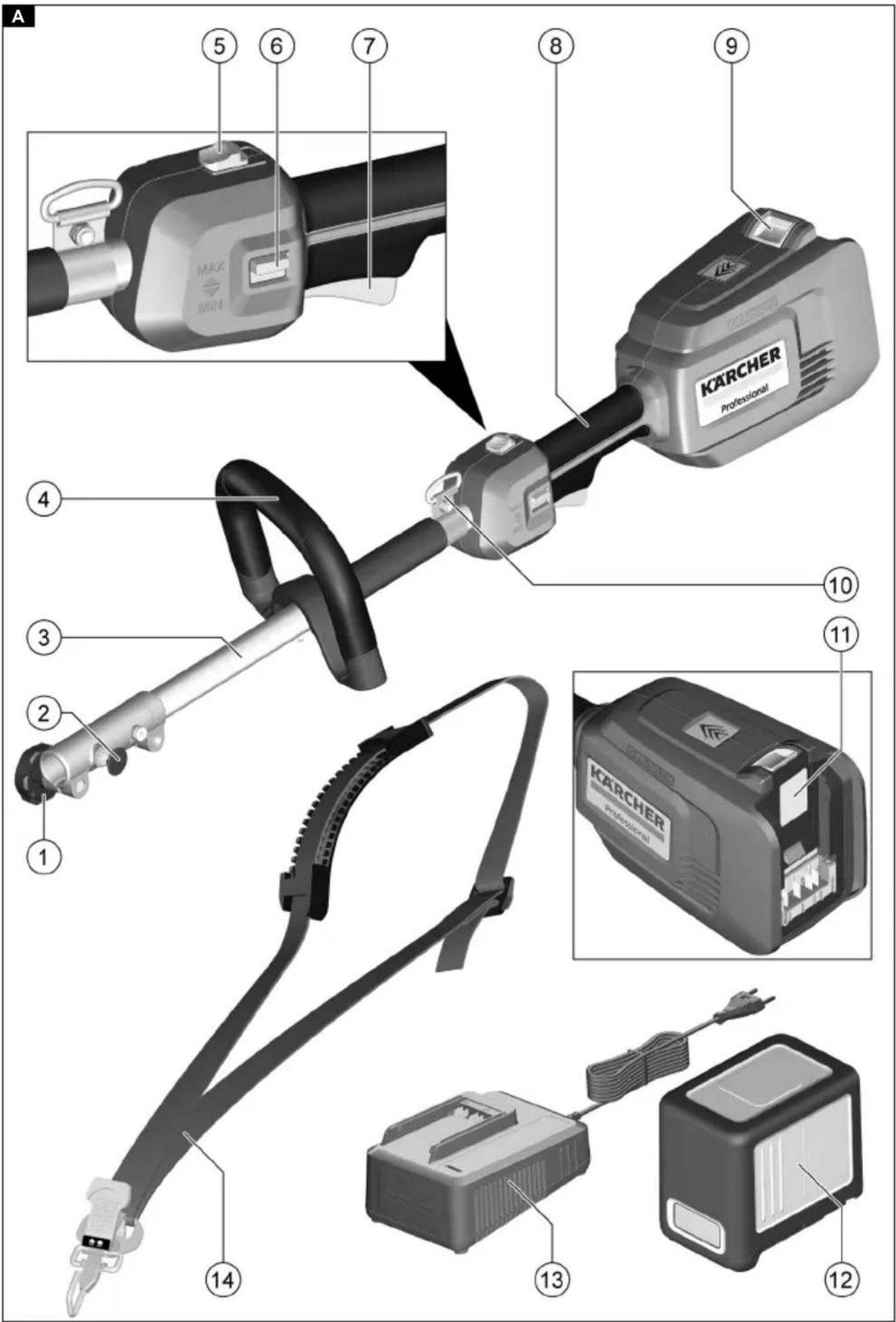
See graphics page for illustrations Illustration A
① Clamping screw
②Lock
③ Shaft
④ Front handle
⑤ Trigger lockout button
⑥ Speed switch
⑦ Trigger
⑧ Rear handle
⑨ Battery pack unlocking button
⑩Eyelet for carrying belt
⑪Type plate
12*Battery Pack Battery Power 36V
13*Quick Charger Battery Power 36V
14 Carrying belt
* optional
Rechargeable battery pack
The device can be operated with a 36 V Kärcher Battery Power+ battery pack.
Installation
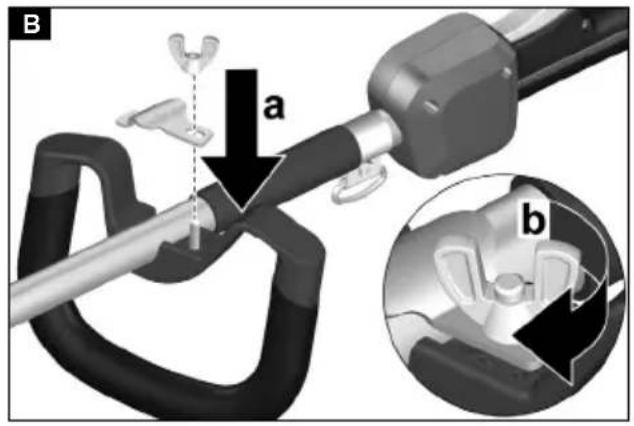
Installing the front handle
- Screw the front handle to the shaft at the desired position.
Illustration B
Initial startup
Installing accessories
ATTENTION
Dirt at the joints
Damage to the device if dirt gets between the connection points during assembly.
Check the joints for contamination and remove before assembly.
Only lay dismantled connecting parts on clean surfaces.
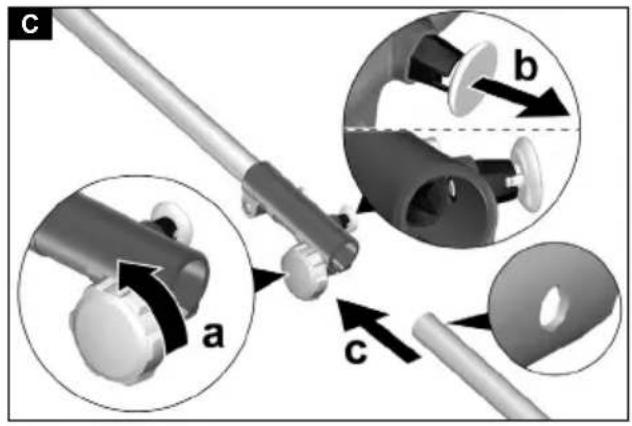
- Plug in the accessories
Illustration C
a Loosen the clamping screw.
b Pull out the lock.
c Insert the shaft of the accessory.
-
Allow the lock to latch into place. Make sure that the lock is securely positioned in the hole of the inserted shaft.
-
Tighten the clamping screw.
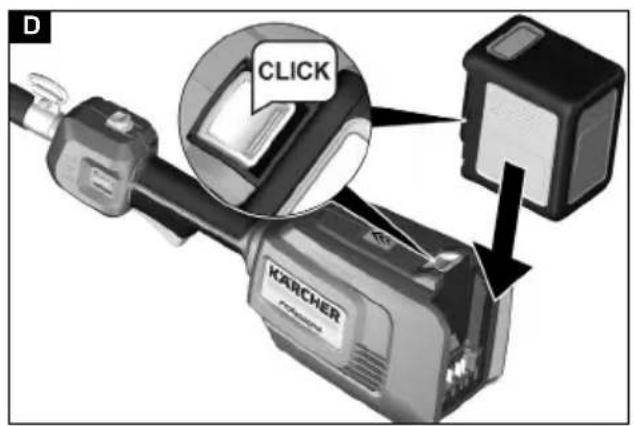
Installing the battery pack
- Push the battery pack into the mounting in the device until it audibly latches into place. Illustration D
Hooking the carrying belt
The carrying belt helps to lower the device in a controlled manner after cutting and to catch the weight of the device during use.
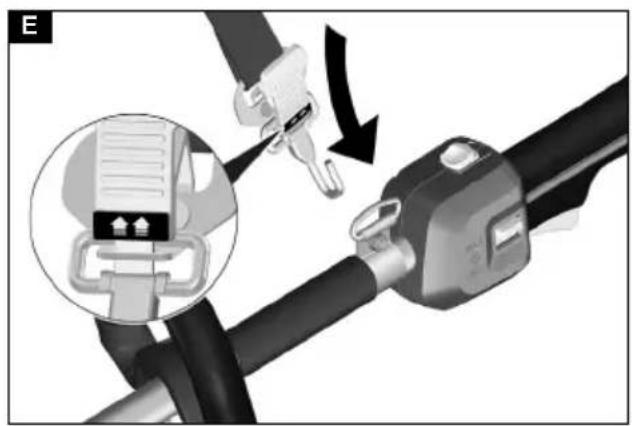
- Fit the hook of the carrying belt into the eyelet on the shaft.
- Place the carrying belt over one shoulder. Make sure that the carrying belt can be released quickly in the event of danger.
Illustration E
Operation
Switch on the device
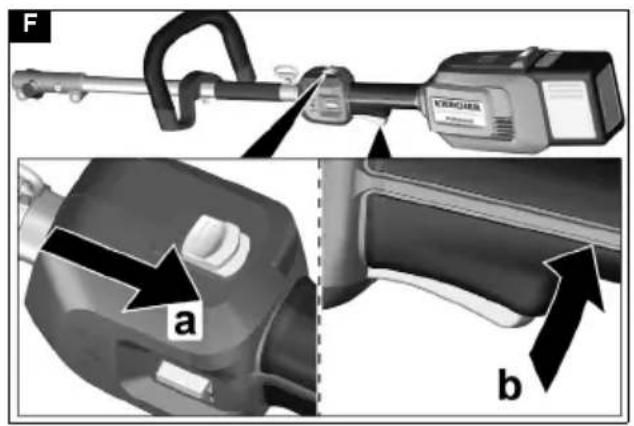
- Pull the trigger lockout button backward to the end. Illustration F
- Press the trigger. The device starts up.
- Release the trigger. The device stops.
Setting the speed
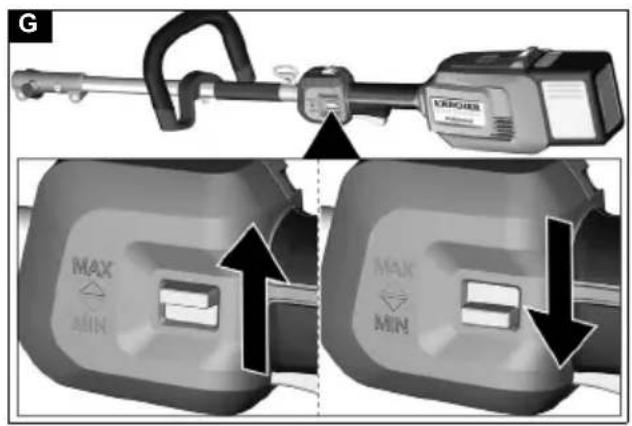
- Use the Speed switch to select the desired speed. Illustration G
Removing the battery pack
Note
During longer work breaks, remove the battery pack from the device and secure it against unauthorised use.
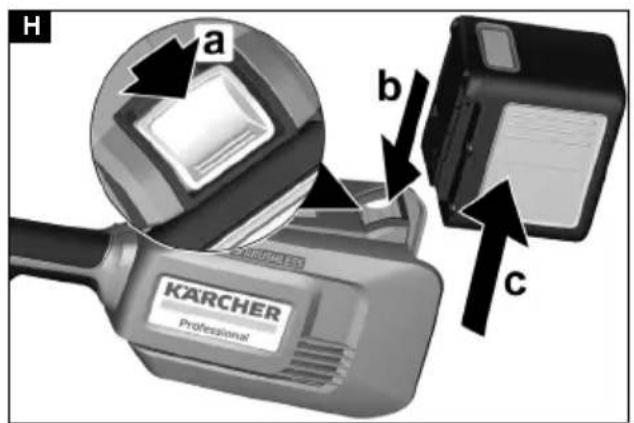
- Pull the battery pack unlocking button in the direction of the battery pack.
- Press the battery pack unlocking button to unlock the battery pack.
- Remove the battery pack from the device.
Illustration H
Finishing operation
- Remove the battery pack from the device (see Chapter Removing the battery pack).
- Clean the device (see Chapter Cleaning the device).
Removing accessories
- Loosen the clamping screw.
- Pull out the lock.
- Remove the shaft of the accessory.
Transport
△CAUTION
Failure to observe the weight
Risk of injury and damage
Be aware of the weight of the device during transportation.
- Remove the battery pack (see Chapter Removing the battery pack).
- Secure the device against slipping and tipping over when transporting in vehicles.
Storage
Always clean the device before putting it into storage (see Chapter Cleaning the device).
△CAUTION
Risk of injury and damage!
The device may tip over on sloping surfaces. Be aware of the weight of the device during storage.
- Remove the battery pack (see chapter Removing the battery pack).
- Remove the accessories if necessary (see Chapter Removing accessories).
- Store the device in a dry, well ventilated location. Keep away from corrosive substances such as garden chemicals and defrosting salt. Do not store the device outdoors.
Care and service
⚠ WARNING
Uncontrolled startup with mounted accessories
Incision injuries
Remove the battery from the device before all work on the device.
- Switch the device off and remove the battery before performing any work on the device.
Cleaning the device
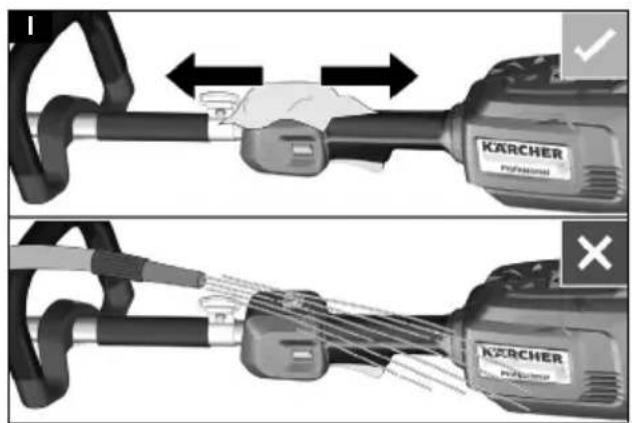
- Clean the device with a soft, dry cloth. Illustration I
Troubleshooting guide
Malfunctions often have simple causes that you can remedy yourself using the following overview. When in doubt, or in the case of malfunctions not mentioned here, please contact your authorised Customer Service.
As the battery pack ages, even if it is looked after, its capacity reduces such that the full run time will no longer be reached when fully charged. This does not indicate a defect.
| Fault Cause Rectification | ||
| The device does not start up | Battery pack is not inserted correctly. | ● Push the battery pack into the mounting until it latches into place. |
| Battery pack is empty ● Charge the battery pack. | ||
| Battery pack is defective. ● Replace the battery pack. | ||
| The device stops during operation | The battery has overheated | ● Stop working and allow the battery to cool down to normal battery temperature. |
| Problems when mounting the shaft components | The connection points are dirty. | ● Clean the shaft ends of adhering dirt.● Only place the device on clean surfaces. |
Warranty
The warranty conditions issued by our relevant sales company apply in all countries. We shall remedy possible malfunctions on your appliance within the warranty period free of cost, provided that a material or manufacturing defect is the cause. In a warranty case, please contact your dealer (with the purchase receipt) or the next authorised customer service site. (See overleaf for the address)
Technical data
| Device performance data | ||
| Working voltage of the battery V 36 | ||
| Maximum speed /min | 10000 ± | 10% |
| Dimensions and weights | ||
| Length x width x height | mm | 951 x |
| 197 x | ||
| 188 | ||
| Weight (with battery pack) | kg | 2,6 |
Subject to technical modifications.
Contenu
Reduceren van risico's
⚠VOORZICHTIG
⑫*Accupack Battery Power+ 36V
⑬*Snellader Battery Power+ 36V
⑭ Draaggordel
* optioneel
Accupack
Varen transport in shranjevanje
⚠ OPOZORILO • Pred skladiščenjem ali transportom izklopite napravo, pustite, da se ohladi, in odstranite paket akumulatorskih baterij.
⚠️ PREVIDNOST • Nevarnost poškodb in škode na napravi. Pri transportu napravo zavarujte pred premiki ali padci.
www.kaercher.com/REACH
Pribor in nadomestni deli
Uporabljajte samo originalni pribor in originalne nadomestne dele, ki zagotavljajo varno in nemoteno delovanje naprave.
Informacije o priboru in nadomestnih delih najdete na spletnem naslovu www.kaercher.com.
Obseg dobave
Tarvikute monteerimine
TÄHELEPANU
natural_image
Black and white stylized hand icon giving a thumbs-up gesture (no text or symbols)THANK YOU!
MERCI! DANKE! iGRACIAS!

Register your product and benefit from many advantages.
www.kaercher.com/welcome


Rate your product and tell us your opinion.
natural_image
Icon showing a gear and wrench inside a square frame (no text or symbols)www.kaercher.com/dealersearch
Alfred Kärcher SE & Co. KG
Alfred-Kärcher-Str. 28-40
71364 Winnenden (Germany)
Tel.: +49 7195 14-0
Fax: +49 7195 14-2212