SSW1 - Subwoofer JBL - Free user manual and instructions
Find the device manual for free SSW1 JBL in PDF.



| Brand | JBL |
| Model | SSW1 |
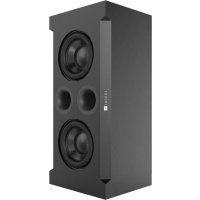
| Product Type | Passive subwoofer, bass-reflex with dual front-firing Slipstream ports |
| Dimensions (H x W x D) | 1359.5 x 610.2 x 584.5 mm (53.5" x 24" x 23") |
| Weight | 159 kg (350.5 lb) |
| Speaker | Two forward-facing woofers, 381 mm (15") advanced aluminum matrix cone |
| Impedance | 8 Ω per input |
| Sensitivity | 84 dB/W/m (woofer), 90 dB/W/m (system) |
| Frequency Response | 15 Hz - 400 Hz (-6 dB), 13.5 Hz - 400 Hz (-10 dB) |
| Resonant Frequency | 18 Hz |
| Recommended Amplifier Power | 2500 W RMS per woofer (5000 W RMS total) with limiting/compression |
| Input Type | Gold-plated input terminals (one pair per woofer) |
| Finish | Black vinyl |
| Recommended Amplifier | JBL Cinema MA4-D (bridged, dual input) or other amplifier compatible with JBL Synthesis tuning |
| Care and Cleaning | Wipe with a dry cloth. Use a low-power vacuum for the grille. Soft brush for the cones. Do not use volatile liquids. |
| Safety | Do not place flammable materials within 76 mm of the enclosure. Do not touch the surface after prolonged use at high power. |
| Placement | Place in corners to reduce response dips. Use multiple subwoofers for smoother response. |
| Repairability | All repairs must be carried out by qualified personnel. |
Frequently Asked Questions - SSW1 JBL
User questions about SSW1 JBL
0 question about this device. Answer the ones you know or ask your own.
Ask a new question about this device
Download the instructions for your Subwoofer in PDF format for free! Find your manual SSW1 - JBL and take your electronic device back in hand. On this page are published all the documents necessary for the use of your device. SSW1 by JBL.
USER MANUAL SSW1 JBL
EN Dual 15^ (380 mm) Passive Subwoofer
FR Caisson de basses passif double 380 mm (15")
DE Dualer passiver 15-Zoll-Subwoofer (380 mm)
ES Subwoofer pasivo dual de 15" (380 mm)
PTBR Subwoofer Passivo Duplo de 15" (380 mm)
RU 15-IOHMOBbI (380 MM) naccnBHy ca6Byep
IMPORTANT SAFETY INSTRUCTIONS
- Read these instructions.
- Keep these instructions.
- Heed all warnings
- Follow all instructions.
- Clean only with a dry cloth.
- Do not block any ventilation openings. Install this apparatus in accordance with the manufacturer's instructions.
- Do not install this apparatus near any heat sources such as radiators, heat registers, stoves or other apparatus (including amplifiers) that produce heat.
- Use only attachments/accessories specified by the manufacturer.
-
Use only with the cart, stand, tripod, bracket or table specified by the manufacturer or sold with the apparatus. When a cart is used, use caution when moving the cart/apparatus combination to avoid injury from tip-over.
-
Refer all servicing to qualified service personnel. Servicing is required when the apparatus has been damaged in any way, such as when the power-supply cord or plug is damaged, liquid has been spilled or objects have fallen into the apparatus, or the apparatus has been exposed to rain or moisture, does not operate normally or has been dropped.
Correct disposal of this product (Waste Electrical & Electronic Equipment)
This symbol means the product must not be discarded as household waste, and should be delivered to an appropriate collection facility for recycling. Proper disposal and recycling helps protect natural resources, human health and the environment. For more information on disposal and recycling of this product, contact your local municipality, disposal service, or the shop where you bought this product.

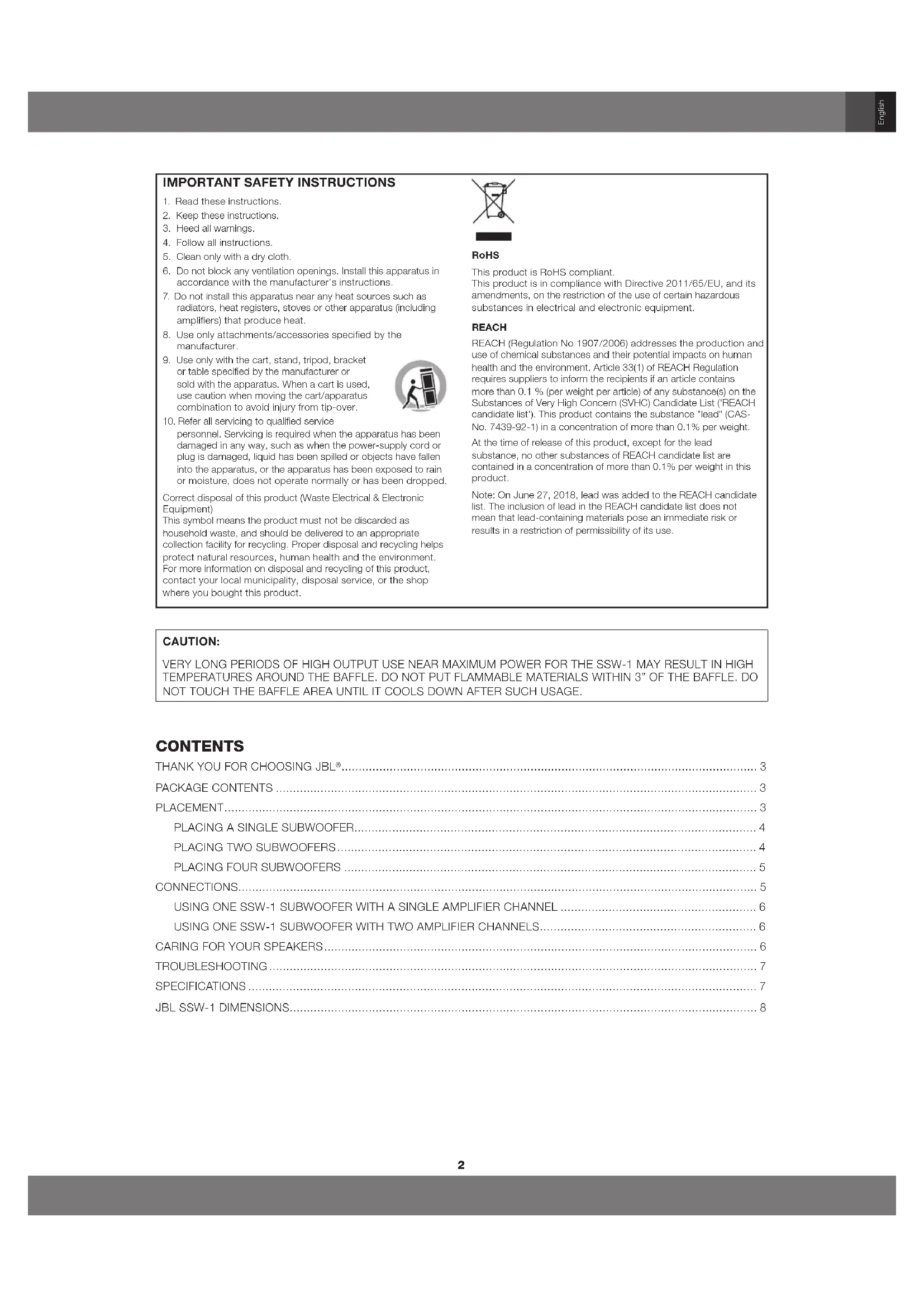
CAUTION:
VERY LONG PERIODS OF HIGH OUTPUT USE NEAR MAXIMUM POWER FOR THE SSW-1 MAY RESULT IN HIGH TEMPERATURES AROUND THE BAFFLE. DO NOT PUT FLAMMABLE MATERIALS WITHIN 3^ OF THE BAFFLE. DO NOT TOUCH THE BAFFLE AREA UNTIL IT COOLS DOWN AFTER SUCH USAGE.
CONTENTS
THANK YOU FOR CHOOSING JBL
PACKAGE CONTENTS 3
PLACEMENT 3
PLACING A SINGLE SUBWOOFER. 4
PLACING TWO SUBWOOFERS 4
PLACING FOUR SUBWOOFERS 5
CONNECTIONS 5
USING ONE SSW-1 SUBWOOFER WITH A SINGLE AMPLIFIER CHANNEL 6
USING ONE SSW-1 SUBWOOFER WITH TWO AMPLIFIER CHANNELS. 6
CARING FOR YOUR SPEAKERS 6
TROUBLESHOOTING 7
SPECIFICATIONS 7
JBLSSW-1 DIMENSIONS. 8
THANK YOU FOR CHOOSING JBL
For more than 70 years, JBL has been involved in every aspect of music and film recording and reproduction, from live performances to monitoring the recordings you play in your home, car or office.
We are confident that the JBL Synthesis loudspeaker you have chosen will provide every note of enjoyment that you expect - and that when you think about purchasing additional audio equipment for your home, car or office, you will once again choose JBL.
Please take a moment to register your product on our website at www.jblsynthesis.com. This enables us to keep you posted on our latest advancements, and helps us to better understand our customers and build products that meet their needs and expectations.
All features and specifications are subject to change without notice.
PACKAGE CONTENTS
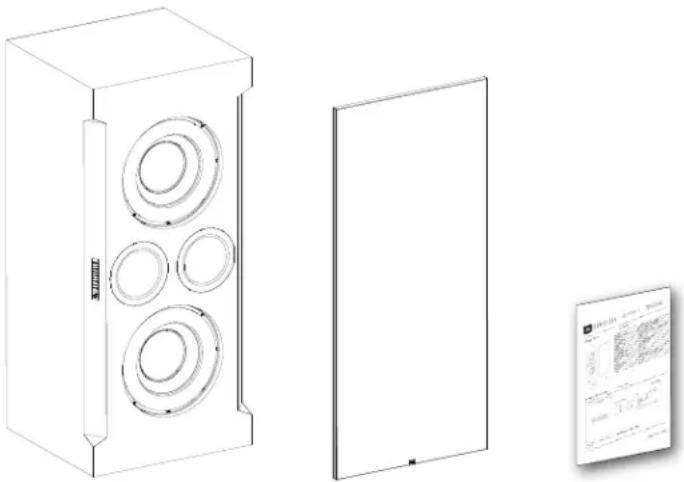
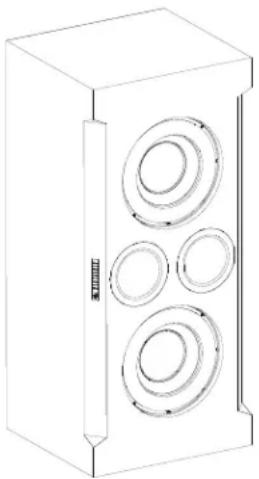
1x Subwoofer 1x Grille 1x Quick Start Guide
PLACEMENT
When using subwoofoers within the limited confines of a typical home theater room, the reflections, standing waves, and resonant absorbers within the room will create peaks and dips in the bass response that can vary greatly depending on where the listeners are located in the room - a listener seated in one location may hear an over abundance of bass created by a response peak at the location, while another listener only a few feet away may hear far less bass due to a response dip at that location.
The locations of subwooers within the room (along with the room's dimensions) also have a profound effect on the creation of these bass response peaks and dips. Careful subwoofer placement alone cannot compensate for all bass response peaks and dips throughout a room, but careful subwoofer placement can eliminate or significantly reduce the largest response dips.
It is important to reduce response dips throughout the room as much as possible via proper subwoofer placement because equalization cannot be used to compensate for large response dips. For example, using equalization in an attempt to restore a 13dB response dip requires that the subwoofer amplifier deliver 20 times the power at that frequency. This can quickly overdrive the subwoofer amplifier into clipping, which will significantly degrade audio quality.
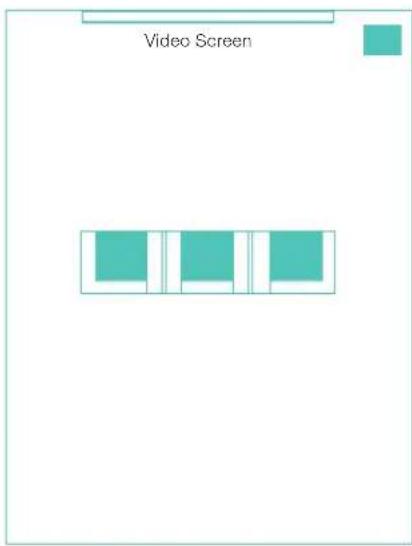
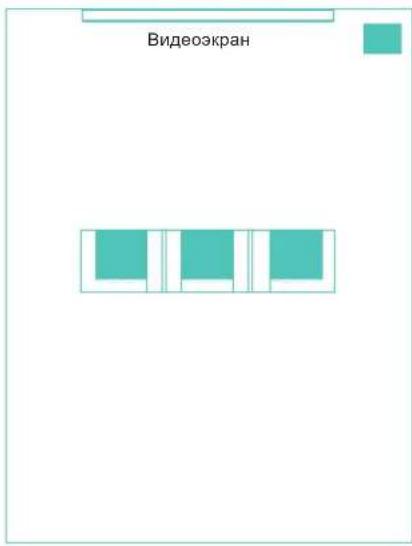
In almost any room, placing the subwoofoers in corners will produce the fewest large bass response dips and will also produce the largest bass response peaks.
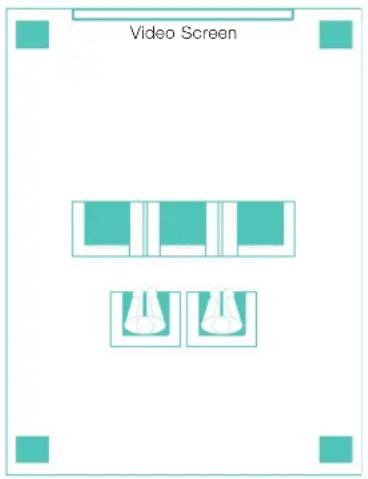
We strongly recommend that you install multiple subwoofer regardless of the room size. A single subwoofer will result in the least consistent bass performance throughout the room. Using multiple subwoofer can cancel some room modes at the various listening locations, resulting in much more consistent low-frequency sound quality throughout the listening area. It is often impossible to locate a single subwoofer such that large response dips, which cannot be corrected via equalization, are not present. The use of two or more properly placed subwoofer almost always eliminates such response dips.
Since wall construction is almost never perfectly identical on opposite walls, common formulas such as placing the subwoofoers at ¼ points rarely work in practice. The best solution is to make high-resolution measurements from the primary listening area while experimenting with speaker placement.
Placing a subwoofer at the listening position and measuring it from the potential installation positions around the room - using acoustic reciprocity - can help speed finding the best position(s). Measurement at the best positions in this manner will produce the measurements with the fewest and smallest peaks and dips in the response.
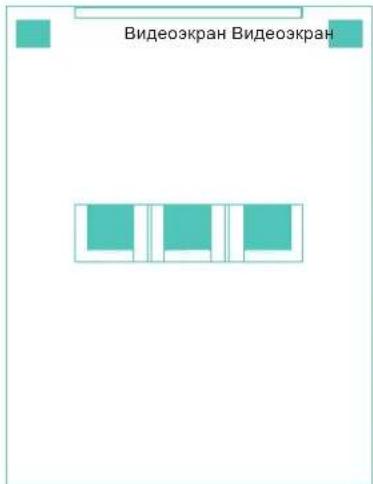
PLACING A SINGLE SUBWOOFER
PLACING TWO SUBWOOFERS
Placement of two subwoofoers will be determined by your room's seating arrangement.
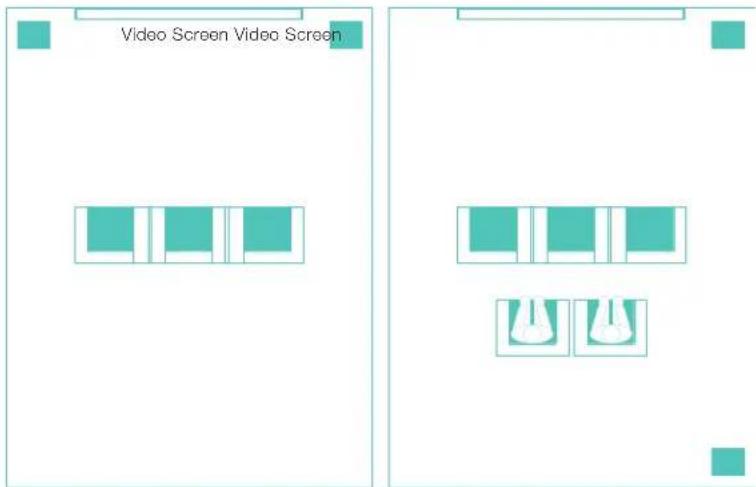
Rooms with a single row of seating Rooms with multiple seating rows
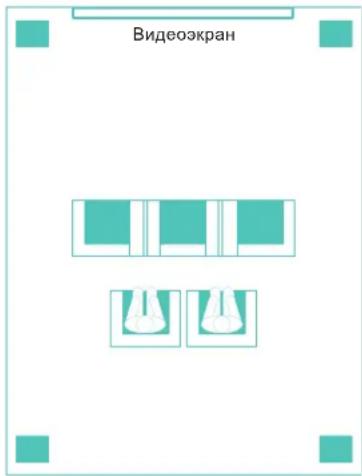
PLACING FOUR SUBWOOFERS
CONNECTIONS
Speakers and electronics have corresponding (+) and (-) terminals. Most manufacturers of speakers and electronics, including JBL, use red to denote the (+) terminal and black for the (-) terminal. It is important to connect both terminals identically: (+) on the speaker to (+) on the amplifier, and (-) on the speaker to (-) on the amplifier. Wiring "out of phase" results in thin sound, weak bass, and a poor stereo image. With the advent of multichannel surround sound systems, connecting all of the speakers in your system with the correct polarity remains equally important in order to preserve the proper ambience and directionality of the program material.
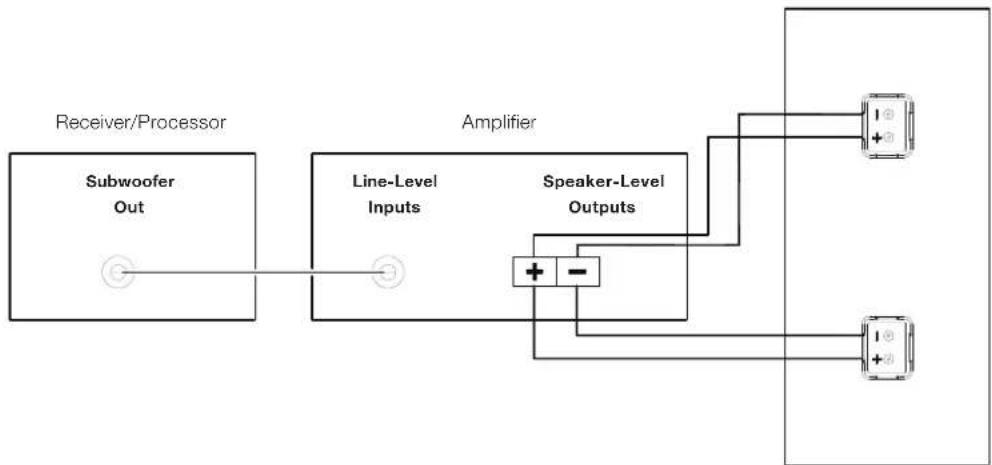
The JBL Synthesis SSW-1 subwoofer has dual inputs, with the input for each woofer directly behind it on the rear of the enclosure. For driving the SSW-1 from a single amplifier channel, the (+) terminal of the amplifier should connect to both (+) input terminals of the SSW-1. The (-) terminal of the amplifier should be connected to both (-) terminals of the SSW-1. In this wiring configuration, the amplifier will be presented with a 4 Ohm load. Alternatively, two equal amplifier channels can be used, one for each woofer input. Each amplifier (+) terminal should connect to one of the woofer input (+) terminals. Each amplifier (-) terminal should connect to the SSW-1 (-) terminal of the terminal set that is connected to the same amplifier channel's (+) terminal. If the bass response seems low, there may be a phase problem between the two drivers, with the sound waves from the two wooers canceling each other out. Double-check your wiring to make sure both woofer in a single SSW-1 have their (+) terminal connected to the appropriate amplifier (+) terminal and their (-) terminal connected to the appropriate amplifier (-) terminal.
If two SSW-1 subwoofoers are used, the wires for both speakers should be the same length. If the bass response seems low, there may be a phase problem between the subwoofoers, with the sound waves from the two subwoofoers canceling each other out. If the bass response seems low, try inverting the polarity on one subwoofer - i.e., connect the (+) terminal on the amplifier to the (-) terminal on the speaker, and the (-) terminal on the amplifier to the (+) terminal on the speaker.
To use the binding-post speaker terminals on the terminal cup located behind the SSW-1 subwoofer, unscrew the colored knob until the pass-through hole in the center post is visible under the knob. Insert the bare end of the wire through this hole, then screw the knob down until the connection is tight. Spade connectors can be slid around the post before tightening the knob if those are used. The hole in the center of each knob is intended for use with banana-type connectors. Making sure to observe the correct polarity, The wire from the amplifier's negative (-) terminal is to be connected to the negative (-) or black terminal on the terminal cup, and the amplifier's positive (+) terminal is to be connected the positive (+) or red terminal on the terminal cup.
Since the SSW-1 is a passive loudspeaker, only speaker-level connections are available. The SSW-1 subwoofer is specifically designed for use in conjunction with the JBL® Synthesis SDA amplifiers. It is optimized to offer the best dynamics and frequency response with the use of the JBL Pro DSi MA4-D amplifier, which is specially designed to use the proprietary SSW-1 tuning file and drive the signature reactive load impedance of the SSW-1. When using a different SDA amplifier with the SSW-1, contact your certified Synthesis installer for correct adjustment and loading of the SSW-1 tuning file. The SSW-1 is capable of running off of two JBL Pro DSi MA4-D channels in bridged mode.
Connect your main receiver or processor's line-level subwoofer output to the line-level input on your subwoofer amplifier.
When using two or more subwooers, use the correct number of amplifier channels (these can be mono-block or multichannel amplifiers) each connected to the appropriate output on your processor or receiver. Then connect the positive and negative terminals for each amplifier channel to a single SSW-1 subwoofer system.
USING ONE SSW-1 SUBWOOFER WITH A SINGLE AMPLIFIER CHANNEL
SSW-1 Back Box
USING ONE SSW-1 SUBWOOFER WITH TWO AMPLIFIER CHANNELS
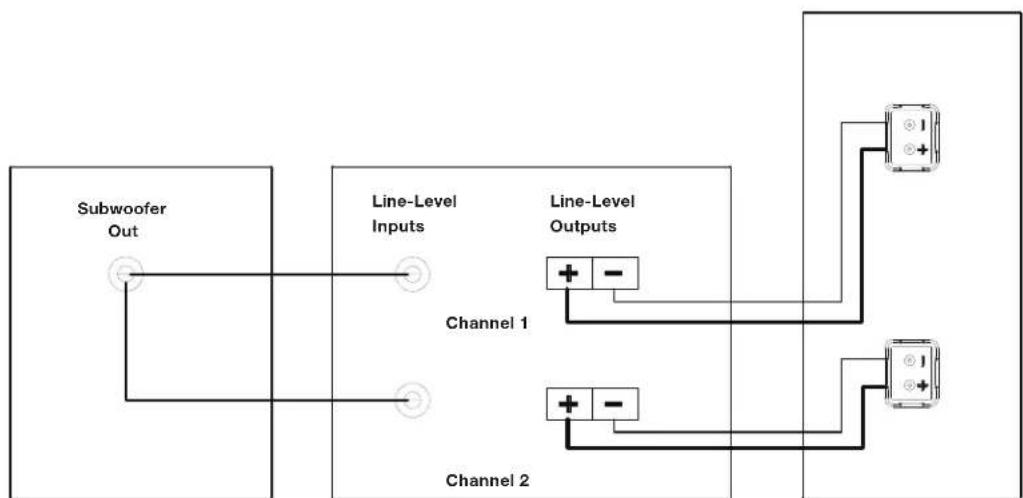
Receiver/Processor
Amplifier SSW-1 Back Box
Wire Length Recommended Size
Up to 30 ft. 14-gauge (minimum thickness)
Greater than 30 ft. 12-gauge (minimum thickness)
CARING FOR YOUR SPEAKERS
- Wipe the cabinet with a clean, dry cloth to remove dust. A damp cloth may dull the cabinet's finish. Do not use volatile liquids such as benzene, paint thinner or alcohol on the cabinet.
- Do not spray insecticide near the cabinet.
To remove dust from the grille fabric, use a vacuum cleaner set to low suction. - Do not wash the grille in water, as water may fade the grille's color or make it uneven.
If the surface of the woofer cone becomes dusty, you can carefully sweep it clean with a soft, dry calligraphy brush or paint brush. Do not use a damp cloth.
TROUBLESHOOTING
Symptom Solution
| If there is no sound from any of the speakers | ·Check that the receiver/amplifier is on and that a source is playing. ·Check all wires and connections between the receiver/amplifier and the speakers. Make sure all wires are connected. Make sure none of the speaker wires are frayed, cut, punctured or touching each other. |
| If there is low (or no) bass output | ·Make sure the connections to the speaker inputs have the correct polarity (+ and -). If you are using two SSW-1 subwoofer, try inverting the polarity on one subwoofer as described on page 5. ·Consider adding a separate power amplifier to drive the SSW-1 subwoofer. ·When using a power amplifier with your SSW-1 subwoofer, make sure the subwoofer output of the receiver/processor has been enabled. See your receiver/processor's owner's manual for further information on correct speaker configuration. |
| If the system plays at low volumes but shuts off as the volume is increased | ·Check all wires and connections between the receiver/amplifier and the speakers. Make sure all wires are connected. Make sure none of the speaker wires are frayed, cut, punctured or touching each other. ·If more than one pair of main speakers are being used, check the minimum-impedance requirements of your receiver/amplifier. |
| If you are hearing midrange frequencies (such as vocals) through the subwoofer | ·When using the Normal mode, adjust the crossover frequency on your electronics to a lower frequency. |
SPECIFICATIONS
| Enclosure Type Bass reflex with dual front slipstream ports | |
| Low Frequency Driver Size and Material Dual 15-inch forward-firing, Advanced Aluminum Matrix cones | |
| Recommended Amp Type External, JBL Cinema MA4-D bridged, dual input | |
| Recommended Amplifier Power | 2500 WRMS per woofer (5000 WRMS total) with correct limiting/ compression |
| Amplifier Features DSP EQ | |
| Impedance 8 Ohms per input | |
| Loudspeaker Sensitivity 84 dB/W/m woofer, 90 dB/W/m system | |
| Frequency Response | 15 Hz-crossover (-6 dB) |
| Frequency Response, -3 dB | 16.7 Hz - 400 Hz |
| Frequency Response, -6 dB | 15 Hz - 400 Hz |
| Frequency Response, -10 dB | 13.5 Hz - 400 Hz |
| Resonance 18 Hz | |
| Input Type | One set of gold-plated binding post input per woofer |
| Product Dimension with Grillle | 53.5" H x 24" W x 23" D (1359.5mm x 610.2mm x 584.5mm) |
| Product Weight | 350.5 lb. (159 kg.) |
| Finishes | Black Vinyl |
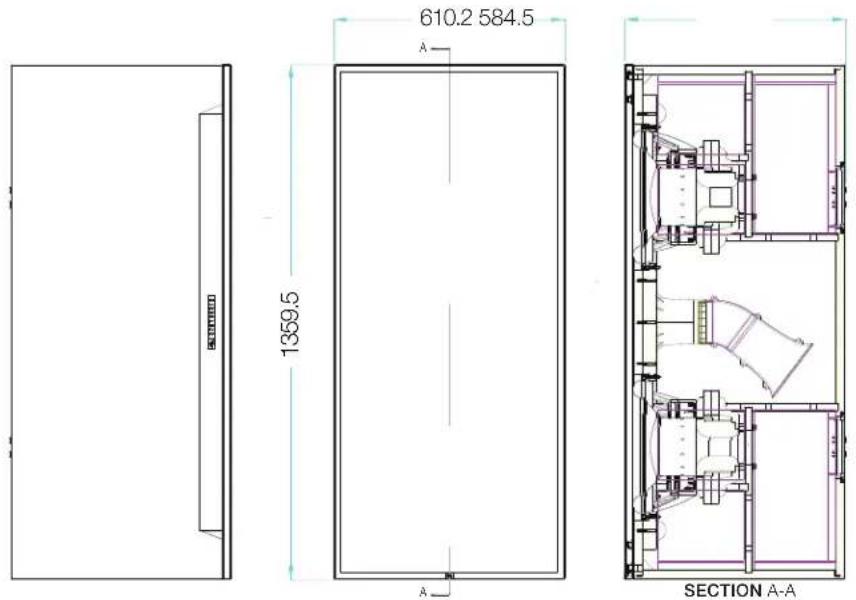
JBL SSW-1 DIMENSIONS
CONSIGNES DE SECURITE IMPORTANTES
IMPORTANT SAFETY INSTRUCTIONS
1.O3HaKOMbTEcB C 3TNM NHCPTyKUJRMN.
2. CoxpaHnTe 3TN nHCTpyKmN
3.ObpaaIte BHMMaHHe Ha BCE npdynpexKeHnA
4.CobJIOdaIteBceHcTpkyKmI.
5. IpoTnpaIte TOnbKO cyxO NKaHbIO.
6. He 3akbIbAaTe BEHTINRAUHbIe OTBepCTnIy. YcTaHaBbIMBaTe anapatypy B COOTBeTCTBm C HnCTpyKuRMAIpnoN3BOUdTIeJIa.
7.HeycTahabnBaIte annapatpy No6n3OCTN O TcOHTHKnOB BbICOKo TEMepaTpby, TaKIN KAK HArpeBATEH, OTONJIeBHeIpiebOpbi, Neu I pyroE o6pOyDobAHne (B Tom Yncne ycnInTePi), co3daOnue TeNo.
8. IcnoIb3yIte ToIbKo KOMIIeKTyOuIe/AkCeCCyApbl, yKa3aHHIbe IpOn3BODITeNEM.
9. NcnoB3ayTe NckHNOteBHo TneKky, CTOKy, TpeHQY, KPOHTeHN INN CTON, Yka3aHHbIe IpnO3BOJTeIeM INN BXOJaIe B KOMNKeT npOdaKAnnapAtpybl. PnIN NCNoBtOBAHm TneEKKn IpnOBIAIte OCToPoxHOCTb pNn nepeMeueHnn annapatypbHa TeNeKke, YTObbln66eKaTb pe3ybltate ee nepeKdIBaHnn.
10. PnBaeTne TExHueckoro 0cbnyKbAHnna
NkIOuHTeHb KBAINDpUPOBaBHbIX CNEuaNCTOB.
OcLyKbAHnne Tpe6yetBC B cnyae IIOBOrO npBeJHnna
Pnp6opa, HApnpemR NoBPckdHa UHPya INn BnPKn
PiTHaHH, POnPHKOBHeHH XKnKoCTN INn PADEHnPApeMeTOB
BHytpb np6opa, NnonaHaHn DOxJa INn BNar HA np6op,
HeNPabInbHn pa6tBu INn PADEHn pR6OpA.
Ppabnha ytnin3aun npodykta (ytnin3aun 3neKtpueckoro n 3neKtpoHHo 6obpyoBaHn)
3TOT 3Hauok 03Haaye, TIO pNOyKT HeIb38 BbIbpaBbATb C OobHHbIMn bIbTOBIMN OTXoAMM; ERO cNoEyt JOCTABNTB COOTBETCByUOiN yHKT C6Oba OTXoDn INEpepAboTK. IPaBnHbA TYIN3AuaN INpepAboTKa MYCOPA NOMOTAR CoXPAnHTb npINOHbIe pecypCb, 3aIuNTNb 3OpOBBe NIOdeN OKpyXaHOU cyPeDy. TIO6bI NOnyUHTb DOONHInTeNHy HINΦOPMaIcN IO YTNIN3aUHN INpepAboKTE pNOyKT, O6bATInTeCB M BEcTHyO aDMNHCTPauNIO, cNYkEy C6Oba OTXoDn INB MaarAHN, rDe BvPiN06pEn 3OT nPOyKT.

RoHS
IpoDyKT COOTBETCTByET DnpeKTeBRe RoHS.
DaHHbI npOdyKT COOTBE TCTByET DnpeKTeBEm EMC 2011/65/EC n
ee NIOpABkAM NO ORpaHHeHIN HCIOJIb3OBAHN ONpeDEJIeHHbIX
BpeDhix BueeCTB B AEKeTprueCKOM INeKToPHOHON
OBOpDyBOAHIN, A taKke TP EA3C 037/2016 TexHHueCKOMY
pernAmEH TY EBpa3NCKORO 3KOHOmUeCKORO coIO3a «O6
OrpaHAnEH INpIMeHHeH INoAChbX BeueCTB B INdJIeHX
3NeKTPoTeEHNKIN IN paINO3NeKToPHNKIN
REACH
REACH(perlameHn 1907/2006) n TP EA3C 037/2016 TexHHeCKn pernameHn Ebpasckoro kOHOMHccko COIO3a OOrpaHHeHN pImMeHHeN onAnbXb HOnBeCTB N3dEHNHX 3NEKpTeXNHKn n PAdno3eKtPOHKnpeYrNpyeT npO3BOcDBo TBO nPIMHeHne XmMuecknx BeueCTB n IN NOteHuaNBHO B03JeCTBn Ha 3IOPOBBe HeNoBeka n Okpykaouu cypeJy. CtaTb33(1)perHa REACH Tpe6yeT oNocTaBauNKOB yBeDnMbTb NoIuyateneB b cnyae,ecnn apTKHy coepjxNT 6oee 0,1% (OT BeCa apTKyNa) KaKOr-nMoBeueCTBa INIBEeCTB, BXoDAuXn B IpepeHb NotehuaNbHO anachbIX BeueCTB"(SVHC)(IpepeHb BeueCTB-KaHduAToB REACH). HactoRus npOdyKT coepjknt BeueCTBO CBNHeu(CAS No 7439-92-1) B KOHeHTpaun Bolee 0,1% BCBOBdoNN.
Ha Mooment BbInycka npOdykTa, KpOme BeUeCTBa «CBHHeu», B HEM He CopePkanocb DpyrMx BeUeCTB IN CnNcKa BeUeCTB-KaHdIaTob REACH B KOHeHTpaun, PpeBbIaJIoeu 0,1% BeCoboi Doni.
PpmeaHne.27IOHOY 2018r.CBHeue6bIndoabIeH B CnCOK BeueCTB-KaHdIaTOB REACH.BKlnOHeHcBnHa B CNICOK BeueCTB-KaHdIaTOB REACH He O3NaHaET, YTO MaTePnAnbl, COpejkaUHe CBHeue, npEcdTabHOT HnOncpeDCTBeHHyO onAChOte, a TAKGE He BNeeT 3a CoBoI OrpaHHeHn Ha pImMeHeHne CBNHa.
IPEdynPExKeHHeN:
ДЛNTIELbHOE BPEMЯ INHTEHCBHOB PABOTbI CnCTEMbI SSW-1 HA MOUHOCTN, BNI3KoI K MAKCMANbHO, MOKET ПINBECTN K HAPREBAHIO OBJACTN BOKPYT 3KPAHA. HE NOMEUAITE BOCIIAMEHREMIE BEIeCTBA HA PACCTOAHIO NO 3ДIOIMOB OT 3KPAHA. HE KACAJTECb OBJACTN BOKPYT 3KPAHA, NOKA OHA HE OCTbHET TACOFO MCNOJIb3OBAHNA.
CODEPKAHNE
BIAIADAPIM BAC 3A BbIBOP IPOUkyuIN JBL
KOMPNEKTAU 38
PA3MEUHNE 38
PACNOIOXHENE OINHOO CABBYΦEPA 39
PACNOJIOXJEHNE DBYX CABBYΦEPOB. 39
PACNOJIOXHEHIEYETbIPEXCAEBYΦEPOB 40
COEINHEHNA 40
IcnoJIb3OBAHNE OJHO CABByΦEPA SSW-1 C OJINHOyHbIM KAHAJOM YCJInTEJIa 41
IcnoJIb3OBAHNE OJHORO CAEBYΦEPA SSW-1 C JByMKAHAJAMU YCINITEJI 41
YXOD 3A CABBYΦEPOM 41
YCTPAHEHNE HENOLAOK 42
TEXHUNECKNE XAPAKTEPNUKNI 42
TABAPNTbJBLSSW-1. 43
БЛАГОДAPИМВAC3AБВIBOPПОДУКЦИN JBL®!
Bot yke 60nee 70 net cneuaiaactbI KOmaHn JBL BcectopOHHe 3aHmIoTcAINCbIO N BocpnO3BeDeHem My3bIKN fMbOB -OT XNBbIX npeCTabJIeHn Do 3aNceK, KOTOpbe Bbl npOnrPbIbAEte DOMa, B MaunHe Hn Ha pa6ote.
Mbyybepehbl, YTO Bbipahnbl Bamcabbyep JBL Synthesis nonHocbO onpaBdaet Baun Oxndan, N BCI CHOBa BbiapeTe npodykuio KOMPAnHJBL, Korda peWnte npno6pcttn DononHHTbHoe ayDNOOBpyoBaHne dna Doma, MaHNbI INn ophica.
Ioxayncta, noptapbte HEMHoro BpeMeHN Ha To, yToBb 3apernctpnpoBaT CBOE n3dJeMaHa caTe WwJbsynthesis. com. 3TNM Bbl DaNITe HAM BO3MOXHOCTb peryIpaHcOoo7aTb Bam o NocneHnDIOCTNXeHnx, a TAKKe NOMOKeTe HAM JyUWe NOHMAtb HauNX KIneHTOB IN cO3daBaTb npOyKtbl, OTBeauOuine IN NOTpe6HOCTm I OxNuDAHnM.
Bce yHKnI n TexHueckne xapakTepcntkM MOry t N3MeHrTbc8e3 npedBapntbHoro yBeDOMneHn.
KOMNJIeKTaUN
Ca6Bypep,1wT.3aunTHa

pewetka,1 wT.

KpaTkoe BOIDCTBO,1Wt.
PA3MEUJEHNE
PnncnoB3oBannCabbyepobBOrpaHueHHomnpocTpaHcTBe obbHOnKOMHaTbI DOMaHrero KInHOteaTpa BO3HnKaIO TNNN INpOBAJIb BBOCPoM3BeDEHN BACOB BCJeDCTBNE OtpaKeHN, CTORHIN BOH N NOROTNTeep30HaHCA B NOmeuEHN. BOCPNiue 6acob 6ydt 3NaHTebHO OTNaTuCB R 3aBNCIMoCTN oTO, rHe HaxoNDTC CnyuataNB. Odn YenOBek MOKET CNbUaTB N3NIHmHE 6acbl, CO3aBaEMbIE NIKOM BOCpOIN3BeDEHN B DAHNMO MeTE KOMAHTbl ApyroYenOBek, HAXOJuaHcB 1-2 M OT npEboR, MOXET CNbUaTB Rop3Do MeHbWe BACOB I3-3a IpObaJa B OBCpON3BeDEHN HNkXu YactOT B 3Tom MeTe.
PacnoonKeHne ca6ByΦepOB B NOMeHNn pa3MepbI KOMHaTbI TaKke OKa3bIaHOt 3NaHTeJIbHoE BnHHe Hc03dAnHe 3TNX NIKOB INPOBaONB B OBCpOIN3BeHEnn 6AcOB. OJHO TOnbKO pPaBnIbHOe pacNoJoxHne ca6ByΦepOB He MOKeT KOMNeHCnPOBaTB BCE NIKN INPOBaIb I B Bacax BHyTpN NmoeJeHn, HO OHO MoKeT ycTaPAnTH b Nn 3HaHTeINbHO yMeHbWntb camble KpyNHle PpOBAbl B BOCpOIN3BeHEnn.
C nomoiIbIO npaBnIbHO rpa3MeueHna c6ByepOB Heo6xOIMmo yMeHbWITb npOBaIb B OBCnpOn3BeDeHH BO Cbem o6beMe NOMEeHnHaCTObKo, HAcONbKO 3TO BO3MOKHO, NOTOMy 7TO IJRA KOMNeHCaun KpyHbIX npOBaIOB HeJIb3A nCNOB30BaT b AcToTHyO KoppeKcHIO. HanpIMep, ecnnonblTaBcYcTaHNTb npOBaN B OBCnpOn3BeEHn B 13 d5 C nOMoIbYacToTHOH KoppeKcHIN, ycInntEnb c6Byepa 6ydt nepeDaBaT 3Ty YactOty Ha MoUHocTHn B 20 pa3 BoJIbWe. 3To 6bIcTPO npBHeTe K neperpy3Ke n OrpaHnueHIO ycInntenra c6Byepa, qTO 3NaHTenbHO ChnkaeT KaueCTBO 3Byka.
Pa3MeHHeNcCa6ByepeOByrgIaxKOMHaTbCo3daetHaIMHeBJeeKoJIuYeCTBO KpynHbIX npOBaONB BBOcPon3BeDeHn6acOB,HO TAKKe PpINBOUHT K BO3HNKHOBeHnIO CaBX BBICOKNX NIKOB;3TO OTHCOTc npakTuyecknK JIObOmy NOMEeHnIO.
HaTcToBnO peKOMeHdyETcY cTaHaBnBaTb HeckoIbKO ca6BypeOB 3aBncmocTn OT pa3MePob NOMEeHN.
NcNoIb3OBAHne TOnbKO OndHO raCByepa npBedeT K HAnmeHee eDInHOo6pa3HOMy BOCpOnu3BeDeEHNO 6aca
no BCeKOMHATE. Pn IcNoIb3OBAHnn HeckoBHX Ca6BypeOB MOXHO crNaDTb HEKOTOpBE KOE6AHIN
B NOMEeHN b PA3nHbIX No3nUxN dN pOscnyuHbAN, B Pe3yJbTAte Yero KaueCTBO 3ByKa Ha Hn3kX
actToax 6ydt Rop3d0 BoJeNE nocTOHHbIM NO BcE 30He IpocNyuHbAN, 3AactYIO HeBO3MOxHO pa3MeCTNTb
edHCTBeHHbN Ca6Byep Tak, YtObIbe HoCo3daBnCk PcyNIIbe IpOBaBI B BOCnpOM3BeDEHN, KOToBle HnB3a
NCpPaBtB C NOMoBtu cAcToTHoKorpeKUHN. IcNoIb3OBAHne DByx N6Oee npaBnBHO pa3MeeHHbIX
ca6BypeOB npakTuueckn BcERda yctpaHreT noDo6hie npOBaBI B OBCnpON3BeDEHN.
NockoIky KOHCTpyKUIN IpOTNBONIOJXHbIX CTEN NOIT HNKOra HE 6bIBaOT NIOHOCTbIO INeHTNUHBIMTO Ha npakTKe peKO pa6OtaHt TAKHe O6uepnHrTbe cxMbI, KaK pa3MeueHne ca6BypeOB ToUckax Ha 1/4. HanlyuWMpeuHem 6yEt BInONHtToHbIe N3MepHnPaCCTORHn OT OCHOBHO 30HbI npocnyuBaHn I KcnePmuHNTPOBaT b CpaoNOxKeHm KOHOHK.
Pa3meueHne ca6byepa B no3nCnnyataeI IN 3mepeHne paCCTOHHN O T 30T TOKn DO BO3MOXbIX MecCT yCTaHOBKn B KOMHate, C yHTOM AkyCTnueckO B3aUMHOCTM, MOxET YCKOPINb HAXOXJHE NOTIMaJIbHbIX MECT DnA yCTaHOBKn. IN3mepeHne paCCToHHN B ONTMaJIbHbIX NO3nUnx TaKIM O6pa3OM DaCT ToCHo OTMepeHHBe MecTa IaR PaACNoNOxEHeHn Ca6ByepOB C HAIMeHbUIM KOINueCTBOM HANMeHbUe BEINuHIO NKOB INPOBAIOB BBOcnpON3BeDeHN.
PACNOLOXEHEO OINHOTOCABBYΦEPA
PACIOJIOXEHNE DBYX CABBYDEPOB
Pa3meHHeN DByxCab6ByepeOB ONpeDJIeTcTc TEm, KaK oprAHIOBaHbI CnJyHne MeCTa B BaUe KOMHaTe.
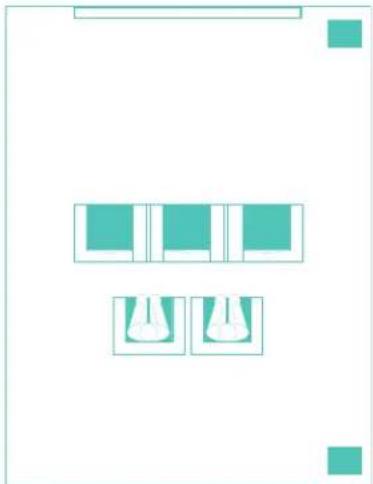
PomeHcOHNpRdOMKpeCnPomeeHnCHeckoBkMmPraamKpecen
PACNOJIOXEHNEYETbIPEX CABBYΦEPOB
COEINHEHNA
KoIOHKn 3JNEKTOHbIe yCTPOBCTBa HMEOT COOBETCTBYUOINe KNeMMbl (+) n (-). BoNBWHCTBO npOn3BOITeENe AkyCTNk n 3NEKTOHKN, B TOM YNCNE JBL, NcONb3yOt KPacHbYCBETnRA Yka3AHNRA KNeMMbl (+) n UepHbI uBET dRy kya3aHNrA KNeMMbl (-). BaxHO NOdIKNoUaTb OBe KNeMMbl OOnHaKOBO: (+) Ha KOHOKe K (+) Ha ycUNTeNE (-) Ha KOHOKe K (-) Ha ycUNTeNE. PNOKIOUeHne He K ToT Pa3e Daet HeNaEhCHeHHB3ByK, CnAb6 BeCsbI n PNOXoI cTepeofoHneCKnOcbP. C NoABHeHNm MybTIKAHaJIbHBx CnCTEm OBeMHORO 3ByKa, BCE TAKIM Xe BAXHbIM OctaTeCn PpABINbHO NOdIKNoHTb BCE KOHOKN B CnCTeMe, CoBIOJaONnPAHOCTb, YoBbI CoXPaHNTb COOTBeTCTByIOUy BOyBOy IO mocfepy HnapabneHHOCTB npOrpaMmHOro MaTePnaJa.
Ca6Byfepe JBL Synthesis SSW-1 Imeet cBBoEHbIe BxObl, BxOДЯ kaxdOro Hn3KoyactoTHoro DnHaMka pacnoJoxekH npraMo 3a Hm Ha 3aHneCTopoHe KOpnyca. TTo6bl ca6Byfepe SSW-1 pa60tan OT Ondro KaHaJa ycNInTeJI, CnEyET NOkKnUOnHT KNeMMy (+) YCNInTeJI K O6EmB XbOHNbIM KNeMMAM (+) Ha SSW-1. KNeMMA (-) ycNInTeJI DOJIX HA 6bTb NOkKnUChEa K O6EM NkEmMaM (-) ca6ByFepe SSW-1. PnTakO KOhFgpaun CoeHNHe8y HC6DcTaBc Harpz3Ko4 OM. B KaeeCTBe BapnaHT MOnHO HO NcNoB3ObaT bDa OINHaKOBix KaHAnycuNInTeJI, OINH Ha KAKDbI BxOHD Hn3KoyactoTHORo DnHaMka. KaXDAr KNeMMA (+) ycNInTeJI DOJIX HA 6bTb NOkKnUChEa K KNeMM (-) ca6ByFepe SSW-1 TORO KOMNKeTA KNeMM, KOTOpBI NpOKNUChEa KNeMMe (+) 2TOREJe YCNInTeJI. EcNI BOCPON3BEdHeNE 6acOBKaKeTc7a6bIM, BO3MOKHO, npO6LemaB Phazax MeJy DByMa DNHaMknAmm, KOrda 3ByKOBbIE BONbl 3DByx Hn3KoyactoTHbX DNHaMkoB NODABHOT dpyr Dpyra. PeepnpoeBte CoeHNHe8n PBOBDu NyeiNTecb, YoC ODNHM ca6ByFepeom SSW-1 KNeMMbl (+) o6Ox HN3KoyactoTHbX DNHaMknB ONDKIOUChEbl K COOTBETCTBYUOUM KNeMMAM (+) ca6ByFepe SSW-1, IN KNeMMbl (-) NOkKnUOhbIK COOTBeTCTBYUOUM KNeMMAM (-) ca6ByFepe.
Ecnn nCnnon3yetyra CBA ca6byfepea SSW-1, npoBoda K kaxdoon KOONHe OJINKHe bblbOnHakOBdINHb. Ecnn Bocnp03BeDeHne 6acob KaKeTcna6bIM, BO3MOxHO, np6bnema B phazax MeKdy Ca6byFepeamN, KOrda 3ByKOBbe BoHHb N3 dYbcHApEpoB noDabNHTpyr Dpyra. Ecnn Bocnp03BeDeHne 6acob KaKeTcna6bIM, nonpO6yIte NOMeHTb NOJnPHOCTb Ha ONHom Ca6byFepe, T.e. NOKJIIOHTe KNeMMy (+) ycInNTeR N KKnEMMe (-) KOLOHN, IN KNeMMy (-) ycnInTeR K KNeMMe (+) KOONKN.
TtO6bI NcNoB3OBaTB BnHTOBBe BbIXoDbHa MaHKeTe KneMMbl, pacNoJoxeHHbIe Ha 3aDHeN cToPoHE ca6Byfepa SSW-1, OTBnHTnte UBeTHyO pyKy, NOKa NoI He He CTaHET BnHO npOnyckHoe OTeBepCTne. BctabTe oroneHHbI KOHeI pnoBa B OTBepCTne I 3akpyTIne pyKy, TtO6bI 3aTAtHyTb CoeINHeHne. JonoTocHbe KOHeKToPbI, ecNI OH nCNoB3yHTcM, MOKHO ObEPHTB BOKpy BbxIOda nepeI 3aTARIBaHNem pyKn. OTBepCTne B CEHTpe KaJDoI pyKn PnpEHaNaHcEOI nCNoB3OBaHH KOHeKToPob TnA «BaHaH. Y6eJIntecb, YTO noJpHocTb coBNODeHa. IpBoOd OT otnpuatelbHON KneMMbl (-) ycNInTeNcNeYET NOkLNIOHTbKOTPiuaTeNbHON KneMMe (-) cepHoro UbetaHa MAnKeTe KneMMbl; NOnOKNteNBaH KneMMa (+) ycNInTeNdoNJa HxHa 6bItb NOKnIOUeHa K NOIOXuNTbeHbON KneMMe (+) Kpachoro UbetaHa MaHKeTe KneMMbl.
Nockony SSW-1 raanrna naccnBbim rpoMkoOBopntenm,doctynbI ToIbKO BbcokoypOBHeBie NodKluueHn. Ca6Byep SSW-1 pa3pa6oTah cneuaaIbHO dnnncnoIb3ObaHn COBMeTHcO ycnInTeMa JBL Synthesis SDA. OH meeT ynuweHHy KOhCTpykuHIO u oecneuHaet Bbcocaywne DnHaAMueckne u vactoTHbe xapakTepcntKN npn cnoIb3ObaHn C ycunInTeem JBL Pro DSI MA4-D, kOtbpui papa6oTaH cneuaHbNO dnnnpmeHnE hqmpMeHHoro faHn HactpoKn SSW-1 u co3daHn ImpeDAnca SSW-1 B 3aBNCmoCTOn OXapakTepcntK cnHana. EcnN BblncnB3yeTe C ca6ByePOM SSW-1 pyroYycnInTeLB SDA, 06paNTecb K ceptnfupnOpBaHHomy yctahOBxNy Synthesis dnn npabNbHoi HAcTpOKn 3arpy3Kn HactpoeHoro faiNa SSW-1. Ca6Byep SSW-1 cnoc6eH pa6oTaTb ot DByx KaHAnob ycunInTeJe JBL Pro DSI MA4-D npn nocklouhen no moctobon cxeme.
IopcoHnHTe rABhBpeCBep INI IINHeHb BbXo npocccopa ca6byepa KInHeHOMy BxOy Ha ycHnTepe ca6byepa.
PnncnoB30BaHmIByux H6oee ca6byepob nCnoB3yte npabnIbHOe KOJueCTBO KaHAnOB ycHnTeJe (3TO MOKeT 6bTB MoHO6LOK INN MyNbTuKaHaBbHb YcHnTeJe), KaJbIM N3 KOtOpBX DOnJKeH 6bTB NOkKnUoyeh K COOTBeTCTByOuEMy BixOy Ha npocceope INI pecnBepe. 3aTeM NoCoeHNHe TNOJKeTEnbHbe I OTPuCaTeBbHbIe KNeMMblI NaKdOrO KaHaJa YcHnTeJI K eDInHO cnCTMe ca6byepa SSW-1.
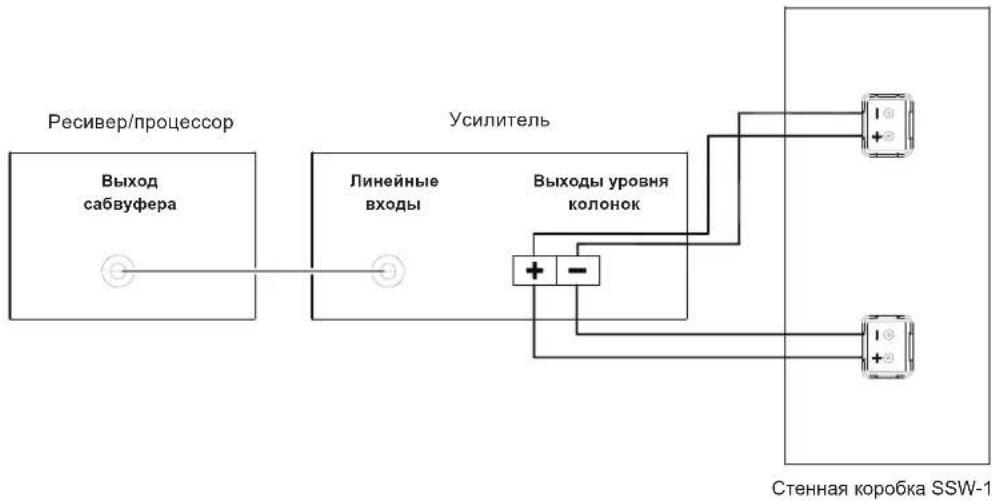
NCIOJIb3OBAHHe OJHOrO CAEByΦEPA SSW-1 C OJINHOuHbIM KAHAJIOM YCINIInTEJIa
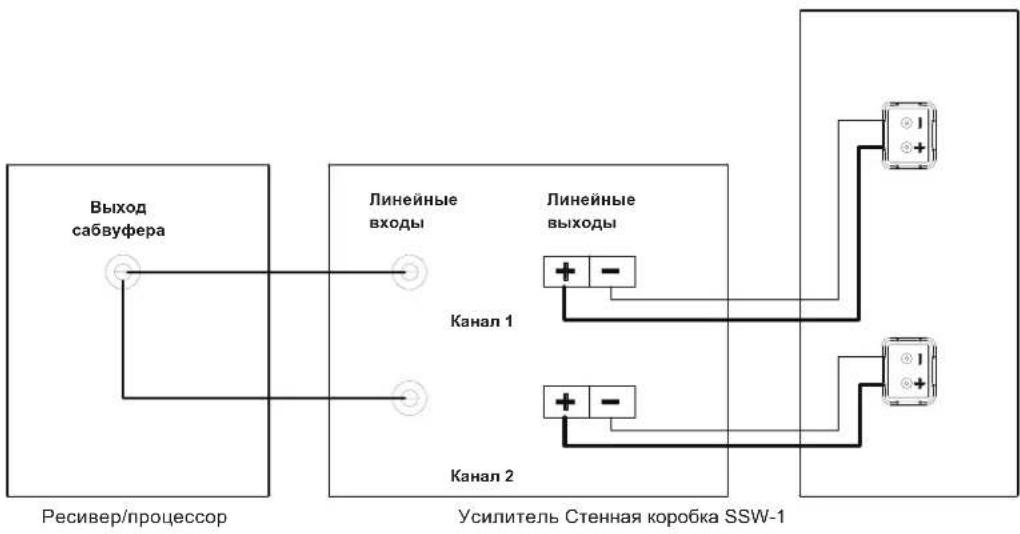
NCIOJIb3OBAHHe OJHOrO CABByΦePA SSW-1 C DByMa KAHAJAMN YCNINTEJIa
HnHa npoBOna PeKOMeHDoBaHHa nnHa
J0 9 MTePb 14 KaHn6p (AWG 14)
Bonee 9 MeTpoB 12 KaJIn6p (AWG 12)
YXO3A CAEBYΦEPOM
- ydaenn nnn npotnte Kopnyc ucto, cyxoh taKaHbO. OT BnaXhoN TkaH noNipOBKa Kopnyca Tyckheet. He nnoB3yTe dny ouncTK KOpnyca neTyue KInKocTn, TaKne KaK 6eHc0n, pactBopnteb nn cHPT.
- He paçnbjIyIe cpeDCTBa OT HaceKoMbIX B6n3N Koprnyca.
-ДяудаленяпьлсTkанHa peштke nCNoIb3yIte nbIneococ,yCTaHOBnEHbIHa cIa6oe BCacbIbAHme. - He MoTe peWetky BDOi, OT 3TOrO OHa MOxET DeΦOpMnPoBaTbCn I NTopeTb LcET.
- Ecnn NOBepxHocTb KOHYca H3K0yAcToTHOro DnHaMnKa 3aNbJInIacb, ee MOXHO aKKpaTHO OYNCNTb MMRKOn, cyXon 8eTOUckOn ININ KCTbHO. He nCnONb3yTe BnAaXHyIO TKAHb.
YCTPAHEHNE HENOLADOK
Pn3nHHeCnpaBHOCT PeeHne
| Еспн НОТ OДно ИЗ KOПОНOK HET 3ВУКA··· YбeДИТСБ,ЧTO ресивер/усиNTеь ВКЛЮЧЕ, И ChTo IVSTOCHNIG BOCPON3BODIT aydno. · Поберы.TE СЕ п罗БОдА И COEDINHENIA МEXДУ ресиверOM/ усиNTeIeM I KОПОНКAMN. YбeДИТСБ,чTO СЕ п罗БОдА пОДCOEDINHЯ. YбeДИТСБ,чTO ИОДИМ IЗ п罗БОдВ He pacTePANCS, He obpe3ан, He noBpeJXDEN, A taKxe ChTO п罗БОдА He kacaIOTcя дpyr dpyra. | |
| Еспьб bась BOCPON3BODIATcR сla6о ИПи He сbliшьl | · YбeДИТСБ,чTO сблIODEнA NOЯРнOCtB (+и-)) priп NOДКLOЧЕHIN KOПОнК.Еспь Bbl I SCПОЛБ3yEte ДBA CAБуФЕр SSW-1, NOПОББИТe nomeHЯТ NOЯРнOCtB Ha OДHOM CAБуФЕpe, кak onICaHоHa CTp.40. · PAcCmOTprIte Bo3MOxHOCtB ДбавLEHINа OTdJIbHOrOусиNTeIg moUHOCtIg ДЯ ПИТAHY CA6ByФePA SSW-1. · Pri NOДЛБ3OBAHIM YсИNTeIg MOIQUHCTn C CA6ByФePOM SSW- 1 y6eДИТСБ,чTO БИХOD CA6ByФePA NapeciBepe/nPioCEccope ВКЛЮЧЕ. ChToБы NOПИЧТДОПОЛHITeLHyU INФOPMaцIHNo правILHOB KOHФИгURApaUIM KOLOHOK, CM. ryKOBODCTBO NOЛБ3OBaTeIg К BAseMу ресиверу/NpoUeCCopy. |
| Еспс StIcTeMa BOCPON3BODIT 3ВУК Ha HN3KOM уровHe rPOMKoCTN I OKIПLOUaETcR,Еспь уБeПИЧИВaTb rPOMKoCTb | · Поберы.TE СБ п罗БОдА И COEDINHENIA MEXДУ ресиверOM/ усиNTeIeM I KОПОНКAMN. YбeДИТСБ,чTO СБ п罗БОдА пОДCOEDINHЯ. YбeДИТСБ,чTO ИОДИМ IЗ п罗БОдВ He pacTePANCS, He obpe3ан, He noBpeJXDEN, A taKxe ChTO п罗БОдА He KACAJOrTcI dpyr dpyra. ·Еспь NcПОЛБ3yEТСь БОЕЕ чEM OДHAnapa Главьх KOПОHOK, поберы.Te MINIMALbHbIe TRe6OBaHINЯ NO copOTIBeHInIO dЯ BAseHero ресиверу/YcINlNTeIg. |
| Еспь Вbl cblshite chepe3 ca6byFepчacTObtI ср徳HERO dmana3OHa (HaprimeR, Bokal) | ·ВHopMaIIbHOM pexIMe NOCTaBte ChactOTy kPoCCOBepa Ha Baushx эЛeКТРОньHbIX UCTpoIcTBaX Ha HN3KуI. |
TEXHINCHECKNEXAPAKTEPNUCTUKN
Büppk#eJ#J#J#J#J#J#J#J#J#J#J#J#J#J#J#J#J#J#J#J#J#J#J#J#J#J#J#J#J#J#J#J#J#J#J#J#J#J#J#
設置 52
SINGULsabwufa一の設置 53
2台のサフウーフアの設置 53
4台のサフローの設置 54
接轨 54
串串串串串串串串串串串串串串串串串串串串串串串串串串串串串串串串串串串串串串串串串串串串串串串串串串串串串串串串串串串串串串串串串串串串串串串串串串串串串串串串串串串串串串串串串串串串串串串串串串串串
60
串串串串4串串串串
61
1
T
62
63
63
JBLSSW-1
JBL®是陆上海的主港,其船长可以

www.jblysynthesis.com

Manufacturer: Harman International Industries, Incorporated Address: 8500 Balboa Blvd, Northridge, CA 91329, UNITED STATES European Representative: Harman International Industries, Incorporated EMEA Liaison Office, Herikerbergweg 9, 1101 CN Amsterdam, The Netherlands Hannan International Industries, Limited, Ground Floor, Westside 2, London Road, Apsley, Hemel Hempstead, Hertfordshire, HP3 9TD, United Kingdom
© 2021 HARMAN International Industries, Incorporated. All rights reserved.
JBL Synthesis is a trademark of HARMAN International Industries, Incorporated, registered in the United States and/or other countries. Features, specifications and appearance are subject to change without notice.
For additional languages, please visit jblsynthesis.com Pour les autres langues, veuillez visitor jblsynthesis.com Informationen in weiteren Sprachen finden Sie unter jblsynthesis.com Para obtener Others idiomas, visite jblsynthesis.com 如需其他语言,请访问jblsynthesis.com
Maih erorie e dathre sern jblsynthesis.comeherer hina si
他言语裁用之有,jblsynthesis.com 以克塞士下