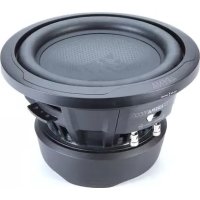
Arena 10 - Subwoofer JBL - Free user manual and instructions
Find the device manual for free Arena 10 JBL in PDF.


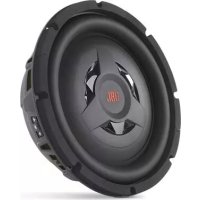
| Product Type | Bass Speaker (Subwoofer) |
| Brand | JBL |
| Model | Arena 10 |
| Diameter | 305 mm (12 inches) |
| Sensitivity | 86.4 dB (2.83 V at 1 m) |
| Power Handling | 800 W RMS |
| Frequency Response | 25 Hz - 1 kHz |
| Nominal Impedance | 2 Ohms |
| Voice Coil Diameter | 63.5 mm (2.5 inches) |
| Recommended Enclosure Type | Sealed or Ported Enclosure |
| Sealed Enclosure Volume | 27 liters (0.954 ft³) |
| Ported Enclosure Volume | 36 liters (1.27 ft³) |
| Usage | Automotive Audio Application |
| Installation | Outside mounting of enclosure, foam gasket included |
| Connection | Terminals compatible with bare wires, 2.08 to 8.37 mm² |
| Power | Passive (requires external amplifier) |
| Maintenance | Clean with a dry, soft cloth. Avoid liquids. |
| Safety | Avoid prolonged listening at high volume. Professional installation recommended. |
| Included Accessories | Foam Gasket |
| Repairability | Hand over to a qualified professional. No detachable parts. |
| General Information | User manual in French available. Thiele-Small parameters provided. |
Frequently Asked Questions - Arena 10 JBL
User questions about Arena 10 JBL
0 question about this device. Answer the ones you know or ask your own.
Ask a new question about this device
Download the instructions for your Subwoofer in PDF format for free! Find your manual Arena 10 - JBL and take your electronic device back in hand. On this page are published all the documents necessary for the use of your device. Arena 10 by JBL.
USER MANUAL Arena 10 JBL
THANK YOU FOR CHOOSING A JBL ARENA X SUBWOOFER
It has been designed to suit a broad range of car audio applications and can be used in a wide variety of enclosure types to produce extended, powerful bass in a limited amount of vehicle space. To get the most performance from your new subwoofer, it is strongly recommended that you have a qualified professional install it. Although this manual provides general instructions about installing the subwoofer, it does not include enclosure construction details or exact installation methods for any particular vehicle. If you do not feel that you have the necessary experience, do not attempt the installation yourself, but instead ask your authorized JBL dealer about professional installation options.
Remember to keep your sales receipt in a safe place, along with this manual, so that both are available for future reference.
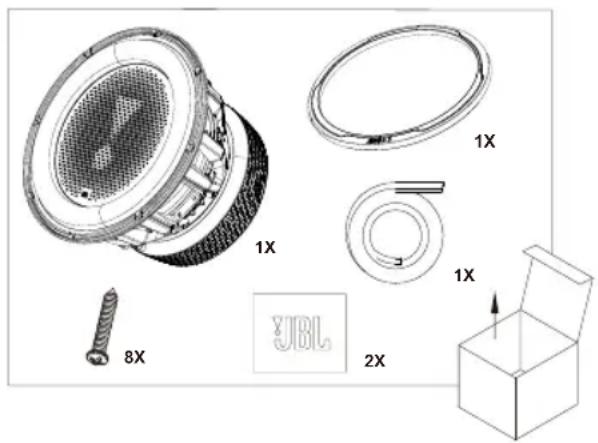
WHAT'S IN THE BOX
WARNING
Playing loud music in a vehicle can hinder your ability to hear traffic and can permanently damage your hearing. The maximum volume levels achievable by JBL speakers when combined with high-power amplification may exceed safe levels for extended listening. Using low-volume levels is recommended when driving. JBL, Inc., accepts no liability for hearing loss, bodily injury, or property damage as a result of use or misuse of this product.
REPRODUCING BASS IN VEHICLES
Depending on the size of your vehicle's interior listening space, reproduced bass frequencies below 80Hz will be boosted by nearly 12dB per octave as frequency decreases. This phenomenon, known as the vehicle's transfer function (or cabin gain), plays an important role in shaping the subwoofer's frequency response in your vehicle.
SUBWOOFER ENCLOSURE TYPES
The subwoofer is designed to perform best in moderately sized sealed enclosures, vented enclosures, and prefabricated bandpass enclosures. Infinite-baffle mounting is possible, but the subwoofer's mechanical power-handling will be reduced because
there will be no volume of air to stiffen the subwoofer's suspension and prevent overexcursion. If you choose infinity-baffle mounting, consider the RMS and peak power-handling ratings to be half of what is listed in the specifications in this manual.
You should choose and enclosure type based on the amount of cargo space you can devote to the enclosure, the amount of power you will use to drive your subwoofer(s), and your listening habits.
SEATED ENCLOSURES
The air trapped inside a sealed enclosure is compressed when the subwoofer moves rearward and is rareified when the subwoofer moves forward. In both cases, the air inside and outside the box will seek equilibrium by pushing and pulling on the subwoofer cone. The result is a stiffer suspension when compared to the subwoofer operating in free air. This means that the subwoofer's cone will be harder to move at low frequencies, a condition which protects the subwoofer from physical overexertion, but requires more power than other designs to achieve a given acoustic output.
SEATED ENCLOSURE PERFORMANCE ADVANTAGES
The in-vehicle performance will have the flattest overall frequency response.
- The in-vehicle response will have the widest bandwidth. (Usable low-frequency response inside the vehicle will be below 20Hz.)
- An optimum sealed enclosure will always be smaller than an optimum enclosure of another type.
SEATED-ENCLOSURE PERFORMANCE TRADE-OFFS
- An optimum sealed enclosure will have lower overall efficiency than an optimum enclosure of another type.
- A subwoofer in an optimum sealed enclosure will require more amplifier power to achieve a given acoustic output than in an optimum enclosure of another type.
SEATED-ENCLOSURE CONSTRUCTION
Sealed-enclosure construction is straightforward and forgiving of errors in volume calculation, but air leaks should be avoided. Use medium-density fiberboard (MDF), glue and screws to construct the enclosure, and seal all joints with silicone caulk.
RECOMMENDATION
Subwoofoers in sealed enclosures are recommended for enthusiasts who prefer accurate music reproduction and flat frequency response, for those who have a smaller space to devote to a subwoofer enclosure, and for those who have plenty of amplifier power devoted to driving the subwoofer. The sealed-enclosure design indicated in this manual represents the best compromise between low-frequency extension and flat response.
VENTED ENCLOSURES
A vented enclosure acts like a sealed enclosure at frequencies above its tuned (resonance) frequency. At resonance (which is defined by the vent), the vent produces the majority of sound- the subwoofer cone is nearly stationary while the air inside the vent vibrates. This provides greater mechanical power handling at and above resonance, but reduced mechanical power handling below resonance. Since the subwoofer cone and voice coil do not move much at resonance, airflow across the voice coil is minimized and thermal power handling is reduced slightly at resonance.
EN
Vented enclosures provide better efficiency in the 40Hz - 60Hz range, at the expense of sound output in the lowest octave (below 40Hz ). The use of an infrasonic filter is recommended with vented enclosures. An optimum vented enclosure for a Series subwoofer is larger than an optimum sealed enclosure.
VENTED-ENCLOSURE PERFORMANCE ADVANTAGES
- An optimum vented enclosure has greater efficiency and higher output in the 40Hz - 60Hz range than an optimum sealed enclosure.
- An optimum vented enclosure provides a greater sensation of bass than an optimum sealed enclosure.
- A subwoofer in an optimum vented enclosure will require less amplifier power to achieve a given acoustic output (down to the enclosure's resonance frequency) than in an optimum sealed enclosure.
VENTED-ENCLOSURE PERFORMANCE TRADE-OFFS
- Reduced output in the lowest octave (below 40Hz).
- Reduced mechanical power handling below the enclosure's resonance frequency. The use of an electronic infrasonic filter is strongly recommended to reduce the chance of overdriving the subwoofer below the enclosure's resonance frequency.
- An optimum vented enclosure will always be larger than an optimum sealed enclosure.
VENTED-ENCLOSURE CONSTRUCTION
Vented-enclosure construction is more difficult than the construction of a sealed enclosure. The enclosure volume and port dimensions have a specific relationship with the physical and electromechanical characteristics of the subwoofer, requiring that the recommended enclosure volume and port characteristics be strictly observed. As with sealed enclosures, use medium-density fiberboard (MDF), glue and screws to construct the enclosure, and seal all joints with silicone caulk.
RECOMMENDATION
Subwoofoers in vented enclosures are recommended for enthusiasts who prefer accentuated bass response, for those who have plenty of cargo space to devote to a subwoofer enclosure and for those who will use a less powerful amplifier to drive their subwoofer. The volume and port dimensions indicated must be followed precisely to ensure optimum performance.
MOUNTING THE SUBWOOFER
The subwoofoers should be mounted from the outside of the enclosure. Use the included foam mounting gasket to ensure a leak-free seal between the subwoofer frame and the enclosure.
CONNECTING THE AMPLIFIER
The subwoofer connectors are compatible with bare wire ends. The recommended wire gauge is between 14AWG and 8AWG, depending on the length of the wire run between the amplifier and woofer. Heavier gauge wire is preferred for runs over 6^ (2m).
To connect the speaker wire coming from your amplifier, push down on the terminal to expose the connection hole. Thread the bare wire end through the hole, then release the terminal to secure. Be sure to observe proper wire polarity for maximum performance.

TECHNICAL DATA
THIELE-SMALL PARAMETERS
| Voice coil DC resistance: R | EVC (OHMs) 1.56 | |
| Voice coil inductance @ 1kHz: L | EVC (mH) 0.9 | |
| Driver radiating area: S | D (IN3) | 76.085 |
| SD (CM2) | 490.87 | |
| Motor force factor: BL (T | M) 10.287 | |
| Compliance Volume: V | AS (FT3) | 2.203 |
| VAS (Liters) | 57.345 | |
| Suspension compliance: CMS (μM) | N) 168 | |
| Moving mass, air load: M | MS (Grams) 223 | 241 |
| Free-air resonance: F | S (Hz) 26 | |
| Mechanical Q: | QMS | 8.813 |
| Electrical Q: | QS | 0.537 |
| Total Q: | QS | 0.507 |
| Magnetic-gap height: H | AG (IN) | 0.394 |
| HAG (mm) | 10 | |
| Voice coil height: | HC (IN) | 1.57 |
| HVC (mm) | 40 | |
| Maximum excursion: X | MAX (IN) | 0.591 |
| X MAX (mm) | 15 |
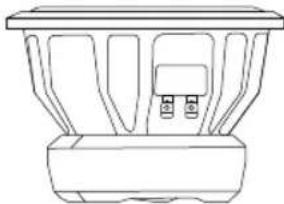
SEATED-BOX VOLUME (INCLUDES DRIVER DISPLACEMENT)
(Side View)
V_BCX = 0.954ft^3(27lters)fc = 46Hz

VENTED-BOX VOLUME (INCLUDES DRIVER DISPLACEMENT)
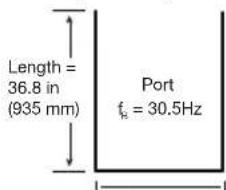
(Side View)
Diameter = 4.72 in. (120mm)
V_B = 1.27ft^3(36~lVerters)
SPECIFICATIONS
| Diameter: 12" | |
| Sensitivity (2.83 V @ 1 M): 86.4 dB | |
| Power handling: 800 watts RMs | |
| Frequency response: 25 Hz - 1 kHz | |
| Nominal impedance: 2 Ohms | |
| Voice coil diameter: 2.5" | |
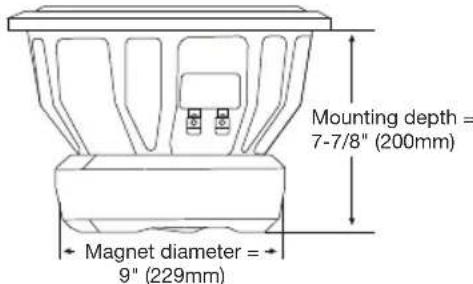
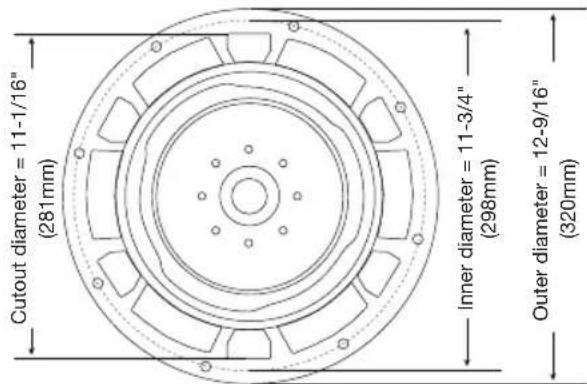
DIMENSIONES
EN
GRACIAS POR ELEGIR UNSUBWOOFER JBL ARENA X
MEREPRODUKSI BASS DI DALAM KENDARAAN
TIPE WADAH SUBWOOFER
WADAH TERTUTUP RAPAT
KELEMAHAN WADAH BERVENTILASI
Output di oktafterendah berkurang (di bawah 40Hz
- Kemampuan penanganan daya mekanis berkurang ketika di bawah frekuensi resonansi dadah. Penggunaan filter infrasonik elektronik sangat disararkan untuk meminimalkan overdrive subwoofer ketika di bawah frekuensi resonansi dadah.
- Ukuran wadah berventilasi yang optimal akan selelu lebih tersebut daripada wadah tertutup rapat yang optimal.
KONSTRUKSI WADAH BERVENTILASI
HARMAN International Industries, Incorporated 8500 Balboa Boulevard, Northridge, CA 91329 USA www.jbl.com
© 2021 HARMAN International Industries, Incorporated. All rights reserved. JBL is a trademark of HARMAN International Industries, Incorporated, registered in the United States and/or other countries. Features, specifications and appearance are subject to change without notice.




- THANK YOU FOR CHOOSING A JBL ARENA X SUBWOOFER
- WARNING
- REPRODUCING BASS IN VEHICLES
- SUBWOOFER ENCLOSURE TYPES
- SEATED ENCLOSURES
- SEATED ENCLOSURE PERFORMANCE ADVANTAGES
- SEATED-ENCLOSURE PERFORMANCE TRADE-OFFS
- SEATED-ENCLOSURE CONSTRUCTION
- RECOMMENDATION
- VENTED ENCLOSURES
- VENTED-ENCLOSURE PERFORMANCE ADVANTAGES
- VENTED-ENCLOSURE PERFORMANCE TRADE-OFFS
- VENTED-ENCLOSURE CONSTRUCTION
- MOUNTING THE SUBWOOFER
- CONNECTING THE AMPLIFIER
- TECHNICAL DATA
- GRACIAS POR ELEGIR UNSUBWOOFER JBL ARENA X
- MEREPRODUKSI BASS DI DALAM KENDARAAN
- TIPE WADAH SUBWOOFER
- WADAH TERTUTUP RAPAT
- KELEMAHAN WADAH BERVENTILASI
- KONSTRUKSI WADAH BERVENTILASI
Brand : JBL
Model : Arena 10
Category : Subwoofer