
ESS280RV - Sander RYOBI - Free user manual and instructions
Find the device manual for free ESS280RV RYOBI in PDF.

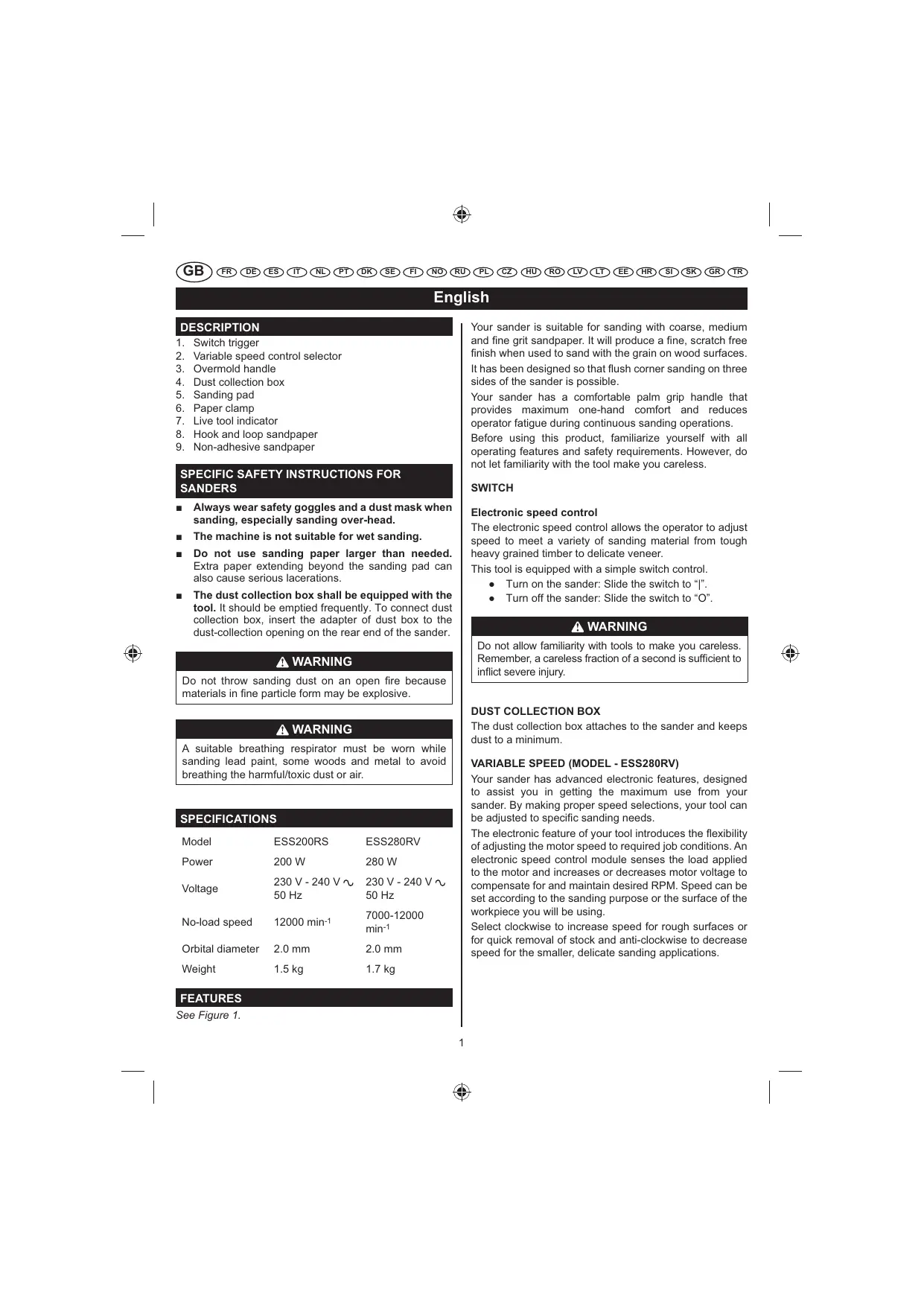


| Product type | Random orbital sander |
| Brand | RYOBI |
| Model | ESS280RV |
| Power | 280 W |
| Voltage | 230-240 V ~ 50 Hz |
| No-load speed | 7000-12000 min⁻¹ |
| Orbital diameter | 2.0 mm |
| Weight | 1.7 kg |
| Variable speed | Electronic, adjustable |
| Abrasive paper attachment | Velcro (hook-and-loop) and standard paper clamp |
| Dust extraction system | Integrated dust collection box |
| Pad | Flush sanding on three sides |
| Handle | Overmolded, ergonomic |
| Switch | Slide on/off switch |
| Power indicator | Yes, lights up when plugged in |
| Applications | Wood, metal, porcelain, rust removal |
| Sound level (Lp) | 93.1 dB(A) (K=3 dB) |
| Vibration level (ah) | 8.7 m/s² (K=1.5 m/s²) |
| Double insulation | Yes |
| Warranty | 24 months against manufacturing defects |
| Maintenance | Regularly clean the dust collector and pads |
| Included accessories | Dust bag, abrasive sheets (grit 80, 120, 150) |
Frequently Asked Questions - ESS280RV RYOBI
User questions about ESS280RV RYOBI
0 question about this device. Answer the ones you know or ask your own.
Ask a new question about this device
Download the instructions for your Sander in PDF format for free! Find your manual ESS280RV - RYOBI and take your electronic device back in hand. On this page are published all the documents necessary for the use of your device. ESS280RV by RYOBI.
USER MANUAL ESS280RV RYOBI
- Switch trigger
- Variable speed control selector
- Overmold handle
- Dust collection box
- Sanding pad
- Paper clamp
- Live tool indicator
- Hook and loop sandpaper
- Non-adhesive sandpaper
SPECIFIC SAFETY INSTRUCTIONS FOR SANDERS
Always wear safety goggles and a dust mask when sanding, especially sanding over-head.
The machine is not suitable for wet sanding.
- Do not use sanding paper larger than needed. Extra paper extending beyond the sanding pad can also cause serious lacerations.
- The dust collection box shall be equipped with the tool. It should be emptied frequently. To connect dust collection box, insert the adapter of dust box to the dust-collection opening on the rear end of the sander.
A WARNING
Do not throw sanding dust on an open fire because materials in fine particle form may be explosive.
WARNING
A suitable breathing respirator must be worn while sanding lead paint, some woods and metal to avoid breathing the harmful/toxic dust or air.
SPECIFICATIONS
| Model | ESS200RS | ESS280RV |
| Power | 200 W | 280 W |
| Voltage | 230 V - 240 V ~ 50 Hz | 230 V - 240 V ~ 50 Hz |
| No-load speed | 12000 min-1 | 7000-12000 min-1 |
| Orbital diameter | 2.0 mm | 2.0 mm |
| Weight | 1.5 kg | 1.7 kg |
FEATURES
See Figure 1.
Your sander is suitable for sanding with coarse, medium and fine grit sandpaper. It will produce a fine, scratch free finish when used to sand with the grain on wood surfaces. It has been designed so that flush corner sanding on three sides of the sander is possible.
Your sander has a comfortable palm grip handle that provides maximum one-hand comfort and reduces operator fatigue during continuous sanding operations.
Before using this product, familiarize yourself with all operating features and safety requirements. However, do not let familiarity with the tool make you careless.
SWITCH
Electronic speed control
The electronic speed control allows the operator to adjust speed to meet a variety of sanding material from tough heavy grained timber to delicate veneer.
This tool is equipped with a simple switch control.
- Turn on the sander: Slide the switch to "I".
- Turn off the sander: Slide the switch to "O".
WARNING
Do not allow familiarity with tools to make you careless. Remember, a careless fraction of a second is sufficient to inflict severe injury.
DUST COLLECTION BOX
The dust collection box attaches to the sander and keeps dust to a minimum.
VARIABLE SPEED (MODEL - ESS280RV)
Your sander has advanced electronic features, designed to assist you in getting the maximum use from your sander. By making proper speed selections, your tool can be adjusted to specific sanding needs.
The electronic feature of your tool introduces the flexibility of adjusting the motor speed to required job conditions. An electronic speed control module senses the load applied to the motor and increases or decreases motor voltage to compensate for and maintain desired RPM. Speed can be set according to the sanding purpose or the surface of the workpiece you will be using.
Select clockwise to increase speed for rough surfaces or for quick removal of stock and anti-clockwise to decrease speed for the smaller, delicate sanding applications.
English
ASSEMBLY
WARNING
The tool should never be connected to a power supply when you are assembling parts, making adjustments, cleaning, performing maintenance, or when the tool is not in use. Disconnecting the tool will prevent accidental starting that could cause serious injury.
SANDPAPER SELECTION
Selecting the correct size, grit and type of sand paper is an extremely important step in achieving a high quality sanded finish. Aluminum oxide, silicon carbide, and other synthetic abrasives are best for power sanding. Natural abrasives, such as flint and garnet are too soft for economical use in power sanding.
In general, coarse grit will remove the most material and finer grit will produce the best finish in all sanding operations. The condition of the surface to be sanded will determine which grit will do the job. If the surface is rough, start with a coarse grit and sand until the surface is uniform. Medium grit may then be used to remove scratches left by the coarser grit and finer grit used for finishing of the surface. Always continue sanding with each grit until surface is uniform.
WARNING
Do not use sander without sandpaper, doing so will damage the cushion.
Sheet/pad recommended use
80-grit sanding sheet
Coarse sanding
120-grit sanding sheet
Light sanding
150-grit sanding sheet
Light sanding
ATTACHING THE DUST COLLECTION BOX
See Figure 2.
The dust collection box provides a dust collection system for the sander. Sanding dust is drawn up through the holes of the sanding disc and collected in the dust collection box during sanding.
- Unplug the sander.
- Using a slight twisting motion, firmly slide the dust collection box assembly in the blower exhaust on the sander.
WARNING
Exercise caution when using this tool. Careless actions, for even a fraction of a second, can result in serious personal injury.
APPLICATIONS
You may use the sander for the purposes listed below:
- sanding on wood surfaces
- removing rust from and sanding steel surfaces
polishing and scrubbing porcelain and metal
CAUTION
Keep the cord away from the sanding pad and position the cord so that it will not be caught on lumber, tools, or other objects during sanding.
WARNING
Always wear safety goggles or safety glasses with side shields when operating this tool. Failure to do so could result in dust, shavings, or loose particles being thrown into your eyes, resulting in possible serious injury.
OPERATION
INSTALLING SANDPAPER
Inspect sandpaper before installing. Do not use if broken or defective.
Hook and loop sandpaper
See Figure 5.
- Unplug the sander.
- Align holes in hook and loop type sanding disc with holes in pad, then carefully press fuzzy side of sanding disc against pad as tightly as possible.
NOTE: It is recommended that you keep the sanding disc backing pad clean to provide for best adhesion. Clean occasionally by brushing lightly with a small brush.
WARNING
Failure to unplug the tool could result in accidental starting causing possible serious injury.
Non-adhesive sandpaper
See Figure 6.
- Unplug the sander.
English
- Release the paper clamp. Remove used sandpaper, if any.
- Insert the new sandpaper under the paper clamp.
- Clamp the sandpaper in place.
TURNING THE SANDER ON/OFF
See Figure 1.
Turn on the sander: Slide the switch to "I".
Turn off the sander: Slide the switch to "O".
- Secure the workpiece to prevent it from moving under the sander.
WARNING
Unsecured workpieces could be thrown towards the operator, causing injury.
WARNING
Keep your head away from the sander and the sanding area. Your hair could be drawn into the sander causing serious injury.
- Place the sander on the workpiece so that all of the sanding disc surface is in contact with the workpiece.
CAUTION
Avoid damaging the motor from overheating; be careful not to let your hand cover the air vents.
- Turn on the sander and move it slowly over the workpiece.
NOTE: Hold the sander in front and away from you, keeping it clear of the workpiece. Start sander and let the motor build to its maximum speed, then gradually lower the sander onto the workpiece. Move the sander slowly across the workpiece using small circular motions.
Do not force. The weight of the unit supplies adequate pressure, so let the sanding disc and sander do the work. Applying additional pressure only slows the motor, rapidly wears sanding disc and greatly reduces sander speed. Excessive pressure will overload the motor causing possible damage from motor overheating and can result in inferior work. Any finish or resin on wood may soften from the frictional heat.
Do not allow sanding on one spot too long as the sander's rapid action may remove too much material, making the surface uneven.
Extended periods of sanding may tend to overheat the
motor. If this occurs, turn sander off and wait until sanding disc comes to a complete stop, then remove it from workpiece. Remove your hand from vent area, remove sanding disc, then with your hand removed from vent area, turn sander on and run it free without a load to cool motor.
For more efficient operation, empty the dust collection box when it is no more than half full. Always empty and clean the dust collection box thoroughly upon completion of a sanding operation and before placing the sander in storage.
WARNING
Collected sanding dust from sanding surface coatings such as polyurethanes, linseed oil, etc., can self-ignite in your sander dust collection box or elsewhere and cause fire. To reduce the risk of fire always empty your dust collection box frequently (10-15 minutes) while sanding and never store or leave a sander without totally emptying its dust collection box. Also follow the recommendations of the coatings manufacturers.
- Unplug the sander.
WARNING
Failure to unplug the tool could result in accidental starting causing possible serious injury.
- Remove the dust collection box from the sander.
- Shake out the dust.
- Reattach the dust collection box to the sander.
NOTE: For a more thorough cleaning of the dust collection box, remove dust collection box from frame and shake out dust. Replace dust collection box over frame then install dust collection box assembly on sander.
ORBITAL MOTION
See Figure 7.
Orbital motion is ideal for fast cutting action when removing old finishes, smoothing rough wood, cutting stock down to required dimensions or for finishing surfaces to be painted. The sandpaper moves in tiny circles at a very high speed, allowing the sander to move easily.
LIVE TOOL INDICATOR
This tool features a live tool indicator which illuminates as soon as the tool is connected to the supply. This warns the user that the tool is connected and will operate when the
English
switch is pressed.
MAINTENANCE
WARNING
The tool should never be connected to a power supply when you are assembling parts, making adjustments, cleaning, performing maintenance, or when the tool is not in use. Disconnecting the tool will prevent accidental starting that could cause serious injury.
WARNING
When servicing use only identical replacement parts. Use of any other parts may create a hazard or cause product damage.
GENERAL
Avoid using solvents when cleaning plastic parts. Most plastics are susceptible to various types of commercial solvents and may be damaged by their use. Use clean cloths to remove dirt, carbon dust, etc.
WARNING
Do not at any time let brake fluids, gasoline, petroleum-based products, penetrating oils, etc., come in contact with plastic parts. They contain chemicals that can damage, weaken or destroy plastic.
Electric tools used on fiberglass material, wallboard, spackling compounds, or plaster are subject to accelerated wear and possible premature failure because the fiberglass chips and grindings are highly abrasive to bearings, brushes, commutators, etc.. Consequently, we do not recommended that this tool be used for extended work on these types of materials. However, if you do work with any of these materials, it is extremely important to clean the tool using compressed air.
WARNING
Always wear safety goggles or safety glasses with side shields during power tool operation or when blowing dust. If operation is dusty, also wear a dust mask.
LUBRICATION
All of the bearings in this tool are lubricated with a sufficient amount of high grade lubricant for the life of the unit under normal operating conditions. Therefore, no further lubrication is required.
CLEANING THE SCRUBBING PADS
To ensure longer life and optimum performance, periodically clean all sanding residue and foreign materials from the scrubbing pads. This can be done simply by rinsing the pad with warm water until all foreign material has been washed away. After cleaning, gently squeeze the pad to remove excess water and allow pad to dry. Always store pads and sanding sheets flat in a cool dry location.
CLEANING THE SANDING SHEETS
The sanding sheets that came with your sander are made to be re-used. Therefore, it is important that they be cleaned periodically to remove sanding residue and foreign material that can accumulate over time.
To clean sanding sheets, rub the sheets with a hard rubber block. You can also use the clean rubber sole of a shoe.
WARNING
Always remove scrubbing or sanding pad from sander before cleaning. Failure to do so could cause serious personal injury.
ENVIRONMENTAL PROTECTION
Recycle raw materials instead of disposing of as waste. The machine, accessories and packaging should be sorted for environmental-friendly recycling.
SYMBOL

Safety Alert
V
Volts
Hz
Hertz
Alternating Current
W
Watts
No
No-load speed
min-1
Revolutions or reciprocations per minute

Orbital diameter

CE Conformity

Double insulation
English

Wear ear protection

Wear eye protection

Please read the instructions carefully before starting the machine.
Waste electrical products should not be disposed of with household waste. Please recycle where facilities exist. Check with your Local Authority or retailer for recycling advice.
Français
DESCRIPTION
TEMOIN DE MISE SOUS TENSION
VARIANTHASTIGHED (MODEL - ESS280RV)
Sildenafil has a new product, Sildenafil 200 mg. This tablet is used to treat the condition of erectile dysfunction in men with erectile dysfunction (EDF). It is used to treat the condition of erectile dysfunction in men with erectile dysfunction (EDF).
TOMNING AF STVBOKSEN
Sefigur4.
ALLMÄNNA FÖRESKRIFTER
TOMMING AV STVBOKSEN
Se fig. 4.
TEXHUNECKNE XAPAKTEPNUKIN
Modenb
ESS200RS
ESS280RV
Mouchoctb
200W
280 W
HannpajkeHne
230V-240V\~ 50Hz
230V-240V\~ 50Hz
CKOPOCTbHa XOIOCTOMXOy
12000 min-1
7000-12000 min
Диаметра op6ntbl
2.0 mm
2.0 mm
Bec
1.5 kg
1.7 kg
ФУHKUIM
CM.puc.1.
IiHIOPOBaJIbHaMaIINHa pa6OtaeHa6yMaRe KpynHOrO, cpeDHeRo INI TOHKOrO 3epHa. IInr IaXKoN IuINFOBkI DEpeBa,6e3 3ayceHcE,BeNITe MaUny NO HappaBNeHHO BONOKOH DepeBa.
山nfoBaIbHa MaHnHa npedyCMOTpeHa nnr 1nfoBaHnO T Kpa Do Kpa C Tpex CTopoH.
IINIOBANBNA MaINHa OCHAeHa yO6Hn pa6oey pyKoN.
Ipeud nCnOlb3OBaHHeM DaHHoro yCTpOJCTBa O3HAKOMbTeCb CO BCEMM pEKMAMn pa6OTbl N Tpe6OBaHNMym TexNkn 6e3oNaCHOctN. Ondako 3HaHne INHCTpyMeMa He DoJIKNHO CnyKInb NOBODm DnA B6ecNeuHOCTN.
BbIKJIIOYATEJIb
3NeKtpoHHb peyIaTOp ckopocTu
3NeKtpoHHbpeyIaTOpCKOPOCTN PO3BOJIaRt MEHArbckOPOCTb 7nIOΦOBKn B 3aBnCHMOCTN O TmNa6obpaBaIBaEMoNObepXHOCTN (OT JxERKeIOro N KpeNkoTeCpOnTeJIbHOReDepeBa Do TOHKOro 06NIuOBOUHOrO).
Maunha Ochaueta HIOCTbIM BkKIOUaTeJIeM.
BkIIOUeHHe IJINΦOBAJBHO HNCTpyMeHTa: IpeBeDITe BbIKIOuATEJB B NOIOXeHne "I".
BbIKIOUeHHe IINIOFOBaIbHOrIO HcTpyMeHTa: IpeBeIDTe BbIKIOuATEbB NIOJOKeHHe "O".
A OCTOPOXHO
Bydte BHIMATEbHpi npaBoTe c yctpoiCTBOM, Daexe ECNI XOPOIO 3HaKOMbI C HNM. POMNHTE, YTO DOCTaOHTO CEKHyDJI HEBHIMAHIN, YTO6BI NOLYHTB TReJENy TpABMy.
KOHTEHEP DnA CBOPA NbJIN
ПьлесборнКрпintсяКшпфовынуMHCTpym entу CBODNT 3aПЛЕHHOCTh K MHNIMyM.
ФУнКЦИ N3MEHEHЯ CKOPOCTN (MOДЕЛБ -ESS280RV)
Oha npedynpexkaet yctanocb npn npdoonkntbHO pa6ote.Дг onTmamlbHOB npo3BODNTbHOCTN
Pycckn
He np6bnjkae Te Kaebb K nnfoobalho HnaklaKe n pacnooxtte Ero TAKM 0bpac3m, YTObB BO Bpemr 1nnfoabHn OH He 3aueennc 3a NoctOpOHnne npedMeTb, INCHTPymEtB INN DpyIe npmedTeB.
Pycckn

OCTOPOXHO
Pnpa6oBe BCerda nOJb3yItecB 3aunTHbIMN OOKAMN C6KOBbIMn npoteKTopamN. Hec6bnIOJeHne DaHORO Tpe6oBaHNMOE KpIbCeTn K noJaDaHnU B rna3a PbIu, CTpyKKn IIN dpyrInx qactnC n CTaTb pnpuHNOH TeleChbIX NOBpexDeHn.
3KCNPIYATAUIN
YCTAHOBKA UJIINΦOBAJIbHOI BUMI
Pereje yctahOBKO npOBepeTe cOToHHe 7nIINFOBaHbHO B6MaHr. HE IOnJIb3yITECb nCnpUeHHo Hn pBAHOH 7nIINFOBaHbHO B6MaHO.
Hakdaunha 6ymara Ha "Jinnyke"
CM.puc.5.
- OTKIIIOUHTe ⅢIINΦOBaJIbHbI INHCTpyMeHT OT 3NeKTPOcETN.
- CoBmectnte OTBepCTnB KpIouOK n peTJr Tnna 1nnfpoabHOrO dmcka C OTBepCTnMM B 6IoKHot, 3aTeM OCTOpOXHO ppecc HeeyTKnx CTOpOHbl 1nnfpoabHOrO dmcka C PIIOnuAdKn KAK MOXHO pIoTHHe.
INPIMEYAHNE: PeKOMeHnyETcO codepKaTb B YNCTOTE onOpHyU HAKNaDky 7nHΦoBaIbHorO DmCKa Dnla oBcnepeHn HauNyUwero cSeIeHn. IepnoDUnyeckn pOn3BODHTe ONUCTKy, CNeRka ObaSaTaIBaJPOBepxHOctb UToCHKOJ.

OCTOPOXHO
EcHn HEOTKJIIOUHTb INHCTpyMEnT OT 3eKtPoCeTn, 3TO MoKcET PnIBEcT N Eo CNYaHOMy 3anyCky N BCJIeDCTBnE 3TOF - K TjXkIM TeJeChblM NOBpeXJDeNHm.
CTaHapTha WInnoBaJbHa 6ymara
CM.puc.6.
- OTKIIOUHTe ⅢIINΦOBAJIbHbI INHCTpyMeHT OT 3NEKTPoCeTn.
- OtkpoinTe 3aKHM nIy 6ymarU. YdaJIInTe IcNoIb3OBAHHyIO HaxDaHHyIO 6ymary (npi ee HAnHHu)
- BCTaBbTe B 3axm HOByI HxkDaHcyI 6ymary.
- 3axMMTe HxqDauHyIO 6yMaIy Ha HyxHOM MeCTe.
BKJIIOUeyHNE/BbIKIIOUeyHNE ⅢINΦOBaIbHOHO INCHTPMEnTA
CM.puc.1.
BkIIOUeHHe IINIOPOBaJIbHOrIO INCTpyMeHTa: IpeBeJeITe BbIKIOuHaTeIb BnIOJOKeHne "I".
BbIKIOUeHHe IINIOFOBaIbHOro INCTpyMeHa: IpeBeIDte BbIKIOUaTeIb B IOIOKeHHe "O".
PABOTA CO USINΦOBAJBHbIM NHCTPYMEHTOM
CM.puc.3.
- 3aФИСКИРУЕ 6OBa6aTbIbAeMOe ɪЗДeПиE, yTObI npEoTbPaTbIte erO nepMeUeHne NOd UJIHΦOBAfBbHbIM INHCTPymEHTOM.

OCTOPOXHO
Ecnn OcbpaTbBaEMoe NAdenme He 3akpeNtB,ero MoKet O6bocnB H napAneHm npoTaohero, YoTo pInBeE K TeneCbHM NobpeXdHnM.

OCTOPOXHO
He np6bnkaTe roNoby K luNFOBaHbHomy HnCTpyMEnTy nOBaCTn luNFOBaHnB. BONoCb MoXeT 3aTMyTB b luNFOBaHbHBn HnCTpyMeT, cTO pNBeDeT K TkAKN TMeTEChbIM NOBpeKdENHM.
2.ПижмITEшнфовальНИнСТРУМЕТКOBpaBaTbIaEBOMMYИЗДENIOТAKIMOBpazOM,ЧтбВСОпeврхHOCbДИСКАнхODиLacB KONTaKTe Cn3dEINEM.

BHIMAHNE
He DonyckaTne NperpeBa DvIaTeIa, TTO MoXeT npInBeCTN Kero NOBpeJezdHIO, TaKke He DonyckaTne nepeKbTnRApyKo BEHTINIAuOHOHbIX OTBepCTN.
- BkIIOHnTe ⅦJINFOBaJIbHbI INHCTpyMeHT N MeJInHeHNOpeMeaIte ero no 06pa6aTbIbAemomy ⅢdEnHIO.
IPIMMEYAHNE: DepeXnTE shnfoBaIbHbI INhCTpyMeHT BnepeDn Ce6JIa HNeKOTOPOM pacctOTHIN, He NDHOcero BnIIOThyIO K o6pa6BaIbIbAeMoM y3dEInIO. 3aNyCTnTe shnfoBaIbHbI INhCTpyMHT N daJIte DBnIATEIHO Na6paTb MAKcImaIbHoe YcNlO O6oPOTOB, 3aTeM NoCTeNEHNO ONyCTnTE ShnfoBaIbHbI INhCTpyMHT Ha o6pa6BaIbHaemoe IN3dJIeNE. He6blShmN kpyroBbIMn DBeJHKHMI MeNHeNO nepemeMaJIte ShnfoBaIbHbI INhCTpyMHT BDOJIb O6pa6BaIbIbAeMoRIO IN3dJIeN.
He npnKlaBbAte Ype3MepHbIX ycInn. UcTpoCTBO CBOIM BECOM OKa3bIbaET COOTBeCTByUOeDe daBLeHne Ha oBa6aTaBbAeMoE n3dJeine, Po3ToMY NcTb ⅢNFOBAbHbN DnCK N ⅢNFOBAbHbN HnCTPmEHT ECTeCTBEHbM O6pa3OM BblONHHT CBOO pa6OtY. YBeJIuHene DaBLeHnra NmUb 3AmedJrE paboty DBrIaTeIa, PnpBODnT K bIcIcPmOy I3HOcy ⅢNFOBAbHbN ODCKa N cyueCTBEHNO CHINKaET CKoPocTb ⅢNFOBAbHbN HOhCTPmErTa. Ype3MePHOe daBLeHne INpBeDeT K nepeRpy3Ke DBrIaTeIa, YTO MOKET npINBeCTn K ernoBpeKdEnHIO BCJeCTBne pepeIpeBa,
Pycckn
a B pe3yIbTaTe 3toro - K cHIXeHIO KaYeCTBa pa6oTbI. JIo6oe OTdIeNoHcE NOKblTne IIN CMOnA, HAnCeHnA Ha NOBepXHOCTb DepeBa, MoKET pa3MraTbC3a ChET TeNIObTb, BiDJIeJHOUcEcnPn TpeHNi.
I36eaiTe cInlKOM npOJIKnTEbHOrO 7nnfOBaHnB O ndHom MeCTe, TAK KAK pNl 60JIbWoN CKOpocTn pa6Otbl 7nnfOBaHbHO INCHpymEnTa MOKeT 6bITb CHrT cINlKOM 60JIbWoN CNo MATEpnaI N NOBepxHOctb 6yDet HEPOBHO.
IpoDoljNtTeIbHoe IJINFOBaHHe MOXET npNVBeCTN K neperpeBy DbrarateTEn. Ecn 3TO npOn3oJet, BbIKIOHTe IJINFOBaJIbHbI INCHTpMeHT, DOxNDTeCb NONHOOTAHOBKn HauJaCHoro Kpyra, a 3aTEM CHIMMTE erO c 3aROTBKn. Y6epnte pyky C yuaCTKa BEHTINJYcIM, CHIMMTE IJINFOBaJIbHbI DNCK, 3aTEM pyKoI, y6paHHoC c yuaCTKa BEHTINJYcIM, BKlIOHTe IJINFOBaJIbHbI INCHTpMeHT n daIte Emy npaboTaB 6e3 harpy3kn dny OXNAxKeHn4 DBnrATeTaN.
ONOPOXHEHNEIbILECEBOPHNA
CM.puc.4.
Длгбоюе оффскгнвон работы,пуст мeшок длгьл,在 Когдэ злго Heбоюе,чм Налоови.Вcertда onopokн�и Teи TsuataTeNBOO ONUsauiteblng OblncsebOHNK nocne 3abepenHnO onepaunu shlnfoBaHnA n pepe nOMEseHnEM shlnfoBaalhBOrO CTaHka HxaPahene.
A OCTOPOXHO
Пьл nb MaTePnana nokpbTnna (noJynpeTaH, MacnHna Kpacka n T.n.), 6pa3yUOaCraB Pe3yIbTaTe WnIpoBoHH NOBEPXHOCTn, CoBupAoUaCraB B nbIeScBOpHNke nIN KacOM-Ni6o DpyROM MecTe WInIOFOBaIbHorO INCHTpymEHTA, MoKET CAMONpOnIbBOJIb BOcNIIaMeHNTbCSB, YTO pRnBeDET K Bo3rOpAHIO.ДЯ NCKIuOHeN OAnchOCtN Bo3rOpAHNe nepOnIOuCheKn (KaXdbIe 10-15 mHyT) ONcyToouaIte nbIeScBOpNK n HkOgDa He OCTabJIeTne H He XpaHITe WInIOFOBaIbHi NCHTpymENT C He NOJHoCTbIO ONyCTOuSeHHbIM nbIeScBOpHNOM. TaKKe BblONHJIte peKOMeHdauJI npOnIBoDITeJIe NOKpbTIbn WInIpyEmoNOBepxHOCTn.
- OTKIIOUHTe ⅢIINΦOBAJIbHbI INHCTpyMeHT OT 3NeKTPOcETn.
A OCTOPOXHO
Ecnn He OTKJIOHNTb INCTpymeHT OT 3NeKTPocetTH, 3TO MOKET pINBEcT N EOr cNyauHOMY 3anycky N BCNECDTBNE 3TORO - K TjRKKIM TEIEChbIM NOBPEXDEHnM.
- Chmnte Te nbJInc6OpHnK co ⅢnФOBaIbHoro
HhctpyMeHTa.
- BbITpRXHnTe nbJIb.
- YCTaHOBNTe NbJIneC6OpHNK Ha ⅢHCTpyMeHT.
INPUMEUAHHE:ДЯбОлгEE TцаTeььно OчИСТКи nbIeC6BOPHnka OTcoeDAHnITE nbIeC6BOPHnK OT KOpNca N BbITPxAHnTE n3 Hero nbIb. YcTahOBnTE nbIeC6BOPHnK hA pAMKY, zATem yCTaHOBnTE erO ha WJIuФOBaNbHbN HHTpymENT.
KPYROBbie DBNXEHHA
CM.puc.7.
3KcUeHTpUueckn pexm nIdeaIbHO NOxOHT dIpy6oBoi IuNIOBCK (ChTne CTaporo NOKpbITNA, UINIOBka Heo6pa6oTaHNO DEpeBA, BbIpaNBHaHne NOBepXHOCTe Ha 3aDaHHy TOIsiHy) nOdIbONIOBOUYbIX pa60f (NoIOTOBKa NOKpItN ION OPKaCy). IUnIOBAbhAha 6bMaRa mPOJEnIbIAeT MaNEbKMe Kpyr Na 6bIoBshO CKOpOCTn, PnDabAB MaSInHE BbICOKyIO MObIbHOCTb.
XINTB INDNIKATOPOM INHCTPYMEHT
DaHHbI IHCTpymeHT OCHaUeH INDkaTopOM NITAHnI, KOTOpB 3aogpaETc PNI POKnIOHeHINCTpymeTaK cTeN IITAHnO. Oh npEynPExJaT, YTO IHCTpymeHT oNDkIOuEH n6ydet pa6oTaTb PNI HAKatNI BblkIOuateJIaN.
TEXHMHUECKOE OBCJYXMBAHNE
A OCTOPOXHO
Bo Bpemc6bOpkn DeTanei, BblnoIhEnHnHaCTpoKn, nCTKn, TExnueckoro 06cnyKnBaHnA, a TaKke KOTda NHTCPymHe IcNOnb3yETcN, Heo6xOdImo O63aTeJIbHO OTKJIIOuHTb Ero OT NcTOChNk PITAHN. OTKJIOUHeHne yCTPOCTBA o CTn IpEDoTbPaIaet CcnyaHbI 3aYcK, KOtOpB moKet npBecTe K TjXKIM TeneChbIM NOBpeKDeHNM.
OCTOPOXHO
Ipi npObeDeHn TeKyuJcero pEmoHTa IcNoIb3yJTe TOpBko IeHTMnHbte 3aNpactN. IcNoIb3BaHne IIO6bIX dpynx 3aNpacte MeoKet co3aTb ONaCHOctb IIN CTatb npuHNO BxOda I3dEJIra N3 cTPOA.
OBUJAR INHΦOPMAUJRA
ПиЧИСТКЕ Пл actMaccobbIX DeTaNeI 3anpeaetcNcNpIb3OBAb pactBOPNTEN. MHOrne PnactMaccblyBCTBnTeNbHbK BO3dEJICTBNIO pa3NHyBIX 6bITOBbIX pactBOPNTEN IN B pe3yIbTaTe IN NCNoIb3OBAHIN MOrTyP a3pyUshbC.ДЯ ChTINr rpr3N,пЛINn IN pI. NOnIb3yTEcBcNCHTO TPRANKOJ.
Pycckn

OCTOPOXHO
Пл actMaccobIe DeTann HeIb3a YcHtNTb TOpMo3HOJ XnKIOCTbI,6En3HOM,HePTeNpOyKTAMi,ekIMM Macamn I.T.D. OHN Coepjat XmMueckne BeUeCtBA, KOTOpB MOrY yXduINb CBoYCTBa PlnactMaccbl, NOpeDInb nn pa3pyuNTb ee.
3JIeKTPnueckn INHCTpyMeT 6bIcTpe 13HaaUNBaETcra
OT paBOtI NO CTKEIOBNOKHy, rINCy, 0BNIuOBOUYHM
NaHEJMa.CTpYkKa OT 3TNX MaTePnaIOB OChEB
a6pa3nBHaA, OHa NpOTN IOdUnHnIKU, UcETKn,
BbIKNoUaTeNi T.D. CJeIOBAteNBo, MbI He peKomeHdyEm
NCIpONb3OBAtB 3TOT INHCTpyMeHT IJa PaCUnpeHHoH
paBOtI No 3TM BIVdAM MaTePnaIOB. ODaNK pRn pa6Ote
C IIObIM N3 3Tnx MaTePnaIOB Heo6bUaHNo BaxHo
PiOMBODInTb NcCTKy INHCTpyMeTA c NOMOUb CxAToTO
BO3Dyxa.

OCTOPOXHO
Bcerda HadeBaIte npedeoxpaHntelbHbe nI IaIHTbOcIK C 60KobMbIM 3aIHTbIMn 3kpaHAMnp np aBoTe c DaHHbIM INHCTpymEMTOn mCdyBaHNbIIN. EcnB BO BpeM paBOtBJ o6p3ayETM MHOIbIIN, TAKKe HadeBaIte nbJIe3aUnTHyIO Macky.
CMA3KA
Bce Tpyuieecn Detann DaHNO HNCTpyMeHTa Cma3aHbI ODCATAOHTbIM KONlHECTBOM BILcOKOKaHeCTBEHHO Cm3aKN Ha BeCb CpOK NcNoJIb3OBAHnY yCtpoiCTBa npr HopMaJIbHbX yCIOBnXkCNPiyaTAtnn. IOn3omY DOnoJIHnTeJIbHa Cm3aKHe Tpe6yETcN.
OuNCTKA OUINCTKA KOJODKN
Дл nродениссpoka cnyk6bl n obecne�ени ОпТИМАЛьною pabotbl Heo6xOДIMо МерпОДическyn удалгысн снaklaDACн Дд Зачstkn BCE ocTaTkn, бобразуошпеся ри орботke,а taicke noctopOHHnne Вешетва.ДocstatoЧNoPoSTO onONOCHTyн HaknaDky телов BDODу,чTOБы CBMyTb BCE noctopOHHnne BeuSceTBa. Посné OчNTKу,спERKa CxTbay NaHEni,чTOБу ydAnITb ИЗБТOK BOYи ИвICушITE ПLOSHAДКУ Дд пocушКи. He ХранHTe PIIOUSAДКИ WIIINFOBALbHbIX NcTа KBAPrHy B npoXIAJHOM cyXOM MeCTe.
OuNTKA UINIINIOBAJIbHbIX JINCTOB
IINHFOBaNbHbIJIcTb,IpINaIauOuIeecK IINHFOBaNbHOMY INCTpyMEnHTy,MOXHO IcNlON3OBaTB NOBTOPH. IIO3OTMy BaxHo, YTO6bI OHI 6BJN OOnIeHebl nepINOueChy ydaIbI IINHFOBaNbHOb BByeTOB N 3aPy6ExhBbMATEnpAIOB,KOTOpBe MOrYT hKaAPnIBaTbcS TeHeHEm BPemEH.
YTo6bOuNCTHTUJINFOBaJIHbIe JInCTbI,NOTPNTe INX
TBePdo Pe3INHOBn PnactuHOB. Bt TakKe MoKTe NCIOJIb3OBAt bYcTbIe pe3INHOBble NOOWBbl OByBn.
A OCTOPOXHO
Bcerda BbHIMMaTe OChTKn IINI ShIIOOBKN PLOUaDky OT IINIOBOAbJIbHOrO NepeD OChTKn. HeBbIOHNHeHne 3TOr Tpe6oBaHnM MoKet pNBeCTN K cepbe3HOH TpaMe.
RUCH POSUWISTO-ZWROTNY
Zobacz rysunek 7.
SBERNA NADOBA PRACHU
Nádoba pro prach se pripojue k brusce a udžuje prach na minimu.
PROMÉNNÁ RYCHLOST (MODEL - ESS280RV)
MAINIGS ATRUMS (MODELIS -ESS280RV)
Jusu slipmasinai ir modernas elektroniskas fungcijas, ar kuru palfzibu var nodrosinat maksimalu lietderibu. Izvloties pareizo atrumu, instrumentu var pielagot dazadiem sipeesanas darbiem.
Instrumenta elektroniskas funkcijas palielija pielietojuma elastifbu, pielagojot motora apgriezienus darba apstakljem. Elektroniskas atruma regulestanos modulis uzver motora noslodzi un palielina vai samazina motora spriegumu, laikompensetu slodzi un saglabatu vajadzigos apgriezienus. Atrumu var iestafit atbilostoi slipsanas merkim vaimzmantojamas detalias virsmai.
All Ryobi products are guaranteed against manufacturing defects and defective parts for a period of twenty-four (24) months from the date stated on the original invoice drawn up by the retailer and given to the end user.
Deterioration caused by normal wear and tear, unauthorised or improper use or maintenance, or overload are excluded from this guarantee as are accessories such as battery packs, light bulbs, blades, fittings, bags, etc. In the event of malfunction during the warranty period, please take the NON-DISMANTLED product, along with the proof of purchase, to your retailer or nearest Authorised Ryobi Service Centre.
This warranty in no way affects your legal rights concerning defective products.
FR
GARANTIE - CONDITIONS
GARANTIE - CONDITION
Acest produs Ryobi este garantat in cazul vicilor de fabricatie si pesielor cu defe cate pentro u durada de douazecisipatrur (24) de luni,incepand cu data factuuri origina emisa de catre comerciant utilizatoriului final.
The vibration emission level given in this information sheet has been measured in accordance with a standardised test given in EN 60745 and may be used to compare one tool with another. It may be used for a preliminary assessment of exposure. The declared vibration emission level represents the main applications of the tool. However if the tool is used for different applications, with different accessories or poorly maintained, the vibration emission may differ. This may significantly increase the exposure level over the total working period.
An estimation of the level of exposure to vibration should also take into account the times when the tool is switched off or when it is running but not actually doing the job. This may significantly reduce the exposure level over the total working period. Identify additional safety measures to protect the operator from the effects of vibration such as: maintain the tool and the accessories, keep the hands warm, organisation of work patterns.
FR
AVERTISSEMENT
DECLARATION OF CONFORMITY
We declare under our sole responsibility that this product is in conformity with the following standards or standardized documents: 2006/42/EC, 2004/108/EC, ENS50014-1, ENS5014-2, ENS10003-2, ENS10003-3, ENS6745-1, ENS60745-2-4, ENS2233. Noise level [K=3dB(A)]: ESS200RS Lp=91.3dB(A) Lw=102.3dB(A), ESS280RV Lp=93.1dB(A) Lw=104.1dB(A) Vibration level [K = 1.5m / s^2] : ESS200RS ah=8.6m/s², ESS280RV ah=8.7m/s²
FR
DECLARATION DE CONFORMITE
MBo CSBEOTBETCBHEHNTBO3AABYEM,HTO HACTOJUAR
PINOyKUO COOTBETCBYETN HEKNE CNEyDIOUM HOMDMAM N KOYMEMTAM 2006/42/EC,2004/108/EC,EN55014-1,EN55014-2,EN61000-3-2, EN61000-3-3,EN60745-1,EN60745-2,4,NE62233.
UOByeBbUyMa [K=3dB(A)]:ESS200RS Lp=91.3dB(A)
Lp=102.3dB(A),ESS280Rv Lp=93.1dB(A)Lp=104.1dB(A).
UOByeBbVb6aBm [K=1.5m/s] :ESS200RbAh=8.6m/s²,ESS280RV
ah=8.7m/s²
PL
DEKLARACJA ZGODNOSCI
Machine: 1/3 SHEET SANDER
Type:ESS200RS/ESS280RV

Jul 2010

Techtronic Industries
Name of company: TECHTRONIC INDUSTRIES CO. LTD.
Address: 24/F, CDW BUILDING, 388 CASTLE PEAK ROAD, TSUEN WAN, HONG KONG.
Web: www.ttigroup.com
Name/Title: Brian Ellis / Vice President - Engineering
Signature:
Jul 15, 2010
Technical File at
Name of company: TTI EMEA
Address: MEDINA HOUSE, FIELDHOUSE LANE, MARLOW, BUCKS, SL7 1TB, UNITED KINGDOM.
Web: www.ttigroup.com
Name/Title: Carl A. Jeffries / Head of Ryobi Product Marketing
Signature:
Trademarks:
The use of the trademark Ryobi is pursuant to a license granted by Ryobi Limited.