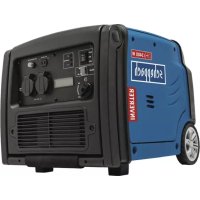
SG3400I - Generator SCHEPPACH - Free user manual and instructions
Find the device manual for free SG3400I SCHEPPACH in PDF.



| Product type | Digital Inverter Generator |
| Brand / Model | Scheppach SG3400I |
| Continuous power (S1) | 3000 W |
| Maximum power (S2) | 3400 W |
| Output voltage | 2 x 230 V~ |
| Frequency | 50 Hz |
| Rated current | 12 A |
| Engine type | 4-stroke, 1-cylinder air-cooled |
| Displacement | 212 cm³ |
| Max engine power | 3.8 kW (5.1 hp) |
| Fuel | Normal unleaded petrol (E5) |
| Tank capacity | 7.4 L |
| Full load consumption | 2.1 L/h |
| Recommended engine oil | 10W30 / 15W40 (0.5 L) |
| Weight | 43.8 kg |
| Protection rating | IP23M |
| Spark plug | F7RTC / BPR6HS |
| Sound pressure level (LpA) | 61 dB(A) at 7 m |
| Sound power level (LwA) | 96 dB(A) at 4 m |
| Main functions | Inverter technology, energy-saving mode, digital display, overload protection, remote control, 230 V and 12 V DC sockets |
| Safety | IP23M protection, low oil level shutdown, grounding, overload circuit breaker |
| Routine maintenance | Oil change every 50 h, air filter cleaning every 30 h, spark plug check every 50 h |
| Included accessories | 12 V adapter cable, screwdriver, oil bottle, remote control, spark plug wrench, manual |
Frequently Asked Questions - SG3400I SCHEPPACH
User questions about SG3400I SCHEPPACH
0 question about this device. Answer the ones you know or ask your own.
Ask a new question about this device
Download the instructions for your Generator in PDF format for free! Find your manual SG3400I - SCHEPPACH and take your electronic device back in hand. On this page are published all the documents necessary for the use of your device. SG3400I by SCHEPPACH.
USER MANUAL SG3400I SCHEPPACH
SG3400i
natural_image
Close-up of a mechanical component with a screwdriver inserted, showing part 6 (no text or symbols visible)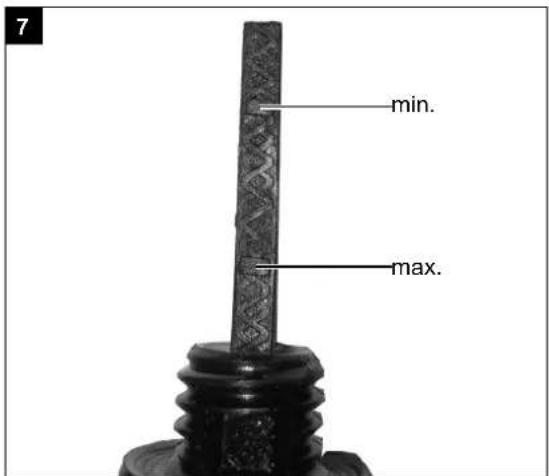
natural_image
Interior view of a vehicle battery pack with visible circuitry and components (no text or symbols)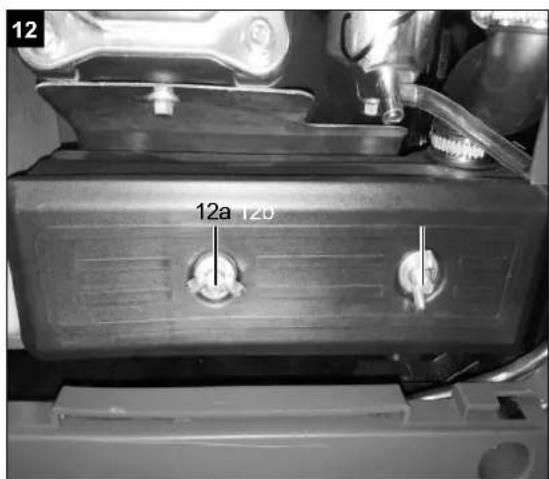
Inhaltsverzeichnis:
Günzburger Straße 69
D-89335 Ichenhausen
Verehrter Kunde,
Table of contents: Page:
- Introduction 19
- Device description (Fig. 1-2).... 19
- Scope of delivery (Fig. 3)....19
- Intended use....20
- Safety information 20
- Technical data 23
- Before starting up....23
- Operation 24
- Maintenance....25
- Storage....26
- Transport....26
- Disposal and recycling 26
- Troubleshooting....27
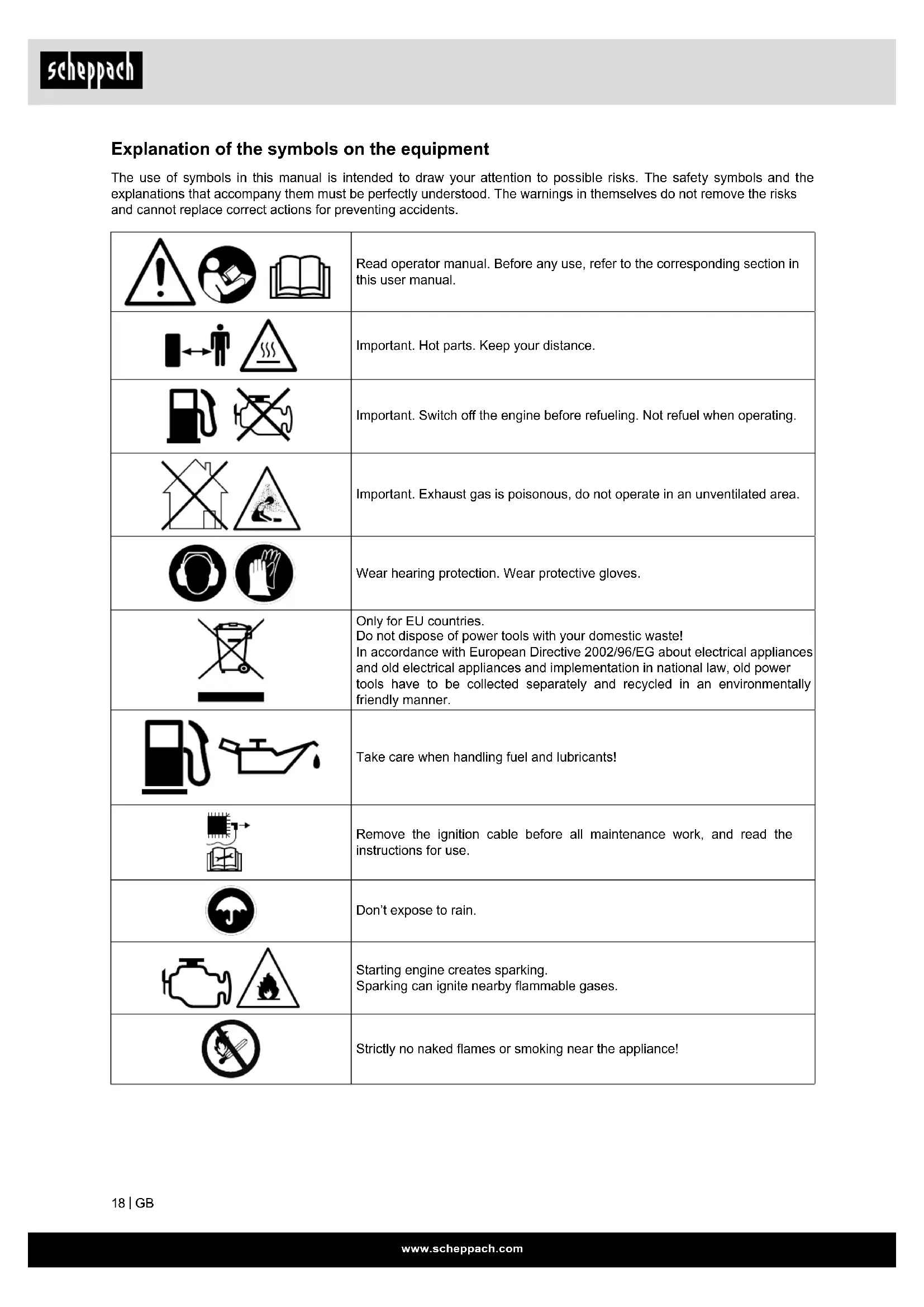
Explanation of the symbols on the equipment
The use of symbols in this manual is intended to draw your attention to possible risks. The safety symbols and the explanations that accompany them must be perfectly understood. The warnings in themselves do not remove the risks and cannot replace correct actions for preventing accidents.
 | Read operator manual. Before any use, refer to the corresponding section in this user manual. |
 | Important. Hot parts. Keep your distance. |
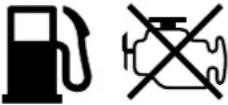 | Important. Switch off the engine before refueling. Not refuel when operating. |
 | Important. Exhaust gas is poisonous, do not operate in an unventilated area. |
 | Wear hearing protection. Wear protective gloves. |
 | Only for EU countries.Do not dispose of power tools with your domestic waste!In accordance with European Directive 2002/96/EG about electrical appliances and old electrical appliances and implementation in national law, old power tools have to be collected separately and recycled in an environmentally friendly manner. |
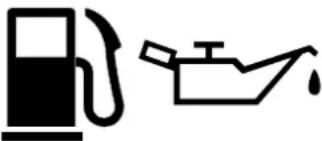 | Take care when handling fuel and lubricants! |
 | Remove the ignition cable before all maintenance work, and read the instructions for use. |
 | Don't expose to rain. |
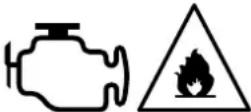 | Starting engine creates sparking.Sparking can ignite nearby flammable gases. |
 | Strictly no naked flames or smoking near the appliance! |
1. Introduction
Manufacturer:
Scheppach GmbH
Günzburger Straße 69
D-89335 Ichenhausen
Dear customer,
We hope you have a lot of fun and success using your new machine.
Note:
According to the applicable product liability laws, the manufacturer of the device does not assume liability for damages to the product or damages caused by the product that occurs due to:
- improper handling,
• noncompliance of the operating instructions, - repairs by third parties, not by authorized service technicians,
- installation and replacement of non-original spare parts,
• non-intended use,
We recommend:
That you read through the entire operating instructions before putting the machine into operation.
These operating instructions are to assist you in getting to know your machine and utilize its proper applications.
The operating instructions contain important notes on how you work with the machine safely, expertly, and economically, and how you can avoid hazards, save repair costs, reduce downtime and increase the reliability and service life of the machine.
In addition to the safety requirements contained in these operating instructions, you must be careful to observe your country's applicable regulations.
The operating instructions must always be near the machine. Put them in a plastic folder to protect them from dirt and humidity. They must be read by every operator before beginning work and observed conscientiously. Only persons who have been trained in the use of the machine and have been informed of the various dangers may work with the machine. The required minimum age must be observed.
In addition to the safety requirements in these operating instructions and your country's applicable regulations, you should observe the generally recognized technical rules concerning the operation of identically constructed devices.
We accept no liability for accidents or damage that occur due to a failure to observe this manual and the safety instructions.
2. Device description (Fig. 1-2)
- Transport handle
- Battery compartment cover
- Earth connection
- Tank cover
- Wheels
- Cover
- Reverse starter
- Fuel valve
- Energy saving switch
- Start, stop switch
- Indicator lights
- Reset button
- Display button
- 12 V DC Connection
- 12 V DC Safety trigger
- 230 V \~ socket (2x)
- Digital indicator with light
3. Scope of delivery (Fig. 3)
A Adapter cable with 12V terminals
B Phillips head screwdriver
C Oil filling cylinder
D Remote control
E Spark plug wrench
F Instructions
G SG3400i generator
- Open the packaging and remove the device carefully.
- Remove the packaging material as well as the packaging and transport bracing (if available)
- Check that the delivery is complete.
- Check the device and its spare parts for possible damage caused by transportation. In the event of complaints, you must contact the distributor without delay. Claims at a later stage will not be accepted.
- If possible, store the packaging until the warranty period has expired
- Before handling the device, make yourself familiar with it by reading the operating instructions.
- For accessories, consumables and spare parts, only use original parts. Spare parts are available from your stockist.
- Include our item number, the device model and year of manufacture in your order.
Attention!
The device and packaging materials are not toys! Children must not be allowed to play with plastic bags, film and small parts!
DANGER
There is a risk of swallowing and suffocation!
4. Intended use
The device is designed for applications operated with a 230 V alternating current source.
Be sure to observe the restrictions in the safety instructions.
The generator is intended to provide electric power tools and light sources with electricity. When using the device with household appliances, please check their suitability in accordance with the relevant manufacturer's instructions.
In case of doubt, ask an authorized dealer of the respective equipment.
This generator is only intended for the operation of electrical devices which maximum power lies within the performance indications of the generator. A higher inrush current of inductive consumers must be considered.
Inverter
The inverter generator generates electricity in a whole new way. With a small, multipole winding in the inside the produced voltage is converted via electronic first into DC voltage afterwards into alternating voltage with a clean sinus wave. With this clean sinus wave it is possible to operate electrical devices without damaging them.
The machine is to be used only for its prescribed purpose. Any other use is deemed to be a case of misuse. The user / operator and not the manufacturer will be liable for any damage or injuries of any kind caused as a result of this.
Please note that our equipment has not been designed for use in commercial, trade or industrial applications. Our warranty will be voided if the equipment is used in commercial, trade or industrial businesses or for equivalent purposes.
5. Safety information
These operating instructions provide places concerning your safety which are marked with this indication: △
Furthermore this manual contains other important sections which are marked with the word "ATTENTION!".
Attention!
While using the machine some safety precautions must be observed to prevent injuries and damage. Read the directions with due care. If you give the equipment to any other person, give them these operating instructions as well. We assume no liability for injuries or damages which are a results of non-compliance of this manual and its safety notes.
DANGER
Failure to follow these instructions may cause serious danger to life of danger or fatal injuries.
⚠ WARNING
Failure to follow these instructions may cause danger to life or danger of serious injuries.
CAUTION
Failure to follow these instructions may cause light to medium risk of injury.
NOTE
Failure to follow these instructions may cause danger of damage of the engine or other property values.
General safety informations
- Keep your work area tidy
• Disorder in the work area can lead to accidents.
-
Take environmental influences into account
-
Never work with the machine in enclosed rooms or in rooms with poor ventilation. If the motor runs toxic gases are generated. These gases can be odourless and invisible.
- Do not expose the device to rain.
- Do not use electric tools in a damp or wet environment.
• Take care on your secure footing on uneven ground - Make sure that the work area is well illuminated.
- Never use the machine in highly flammable vegetation or where fire and explosion hazards exist.
-
Provide a fire extinguisher in drought conditions (fire hazard).
-
Keep other persons away
- Do not allow other persons to work with the device especially children and young people.
- Securely store unused electric tools
- Unused tools should be stored in a dry, elevated or closed location out of the reach of children.
- Do not overload your device
- They work better and more safely in the specified output range.
6. Work in full consciousness
- Do not work with the device when you are under the influence of alcohol, drugs, medication or other substances which might compromise the vision, dexterity and judgment.
7. Use the device for its prescribed purpose
- Any other use than intended is deemed to be a case of misuse.
Safety notices for handling flammable fuels
- WARNING!: Petrol is highly flammable:
- Store fuel in containers specifically designed for this purpose
- Refill the gasoline tank only outdoors and do not smoke meanwhile.
- Add fuel before starting the engine. Never remove the cap of fuel tank or add petrol while the engine is running or when the engine is hot.
- If petrol is spilled, do not attempt to start the engine but move the machine away from the area of spillage and avoid creating any source of ignition until petrol vapours have dissipated. Replace all fuel tank and container caps securely.
Adding fuel
- Always switch off the engine before refuelling.
⚠ Attention! Always open the fuel filler cap carefully to decompose slowly the excess pressure. - Whilst working with the machine high temperatures can attain on the case. Allow the engine to cool before refuelling.
⚠ Attention! In case of insufficient cooling of the machine the fuel may ignite and lead to serious burns during refueling. - Make sure not to fill the tank with too much fuel. Immediately remove the fuel and clean the machine when spilling fuel.
- Always close the screw plug on the fuel tank in order to avoid loosening which may occur by vibrations when using the machine.
DANGER
Never refuel the engine nearby open flames.
Additional safety instructions while hand-ling with combustion engines
DANGER
Combustion engines constitute a special danger during operation and refuelling. Always read and note the warnings. Failure to do so can lead to serious or even deadly injuries.
- No changes may be made to the generator.
- ▲ Attention! Danger of poisoning, Emissions, fuels and lubricants are toxic. Emissions shall not be inhalated.
-
△ Attention! Risk of burns. Do not touch the exhaust system or drive unit.
-
Never operate the machine in non ventilated rooms or in a highly inflammable environment. If you intend to operate the machine in rooms with good ventilation, the exhaust gases must be channelled directly outdoors through an exhaust hose. ⚠ Attention! Toxic exhaust gases can escape despite the exhaust hose. Due to the fire hazard, never direct the exhaust hose towards inflammable materials.
5. ⚠️ Risk of explosion!
Never operate the machine in rooms with combustible materials.
-
The speed preset by the manufacturer is not allowed to be changed. The machine or connected equipment may be damaged.
-
Place the generator at least 1m away from walls and equipment connected to them.
-
Place the generator in a secure, level position. Do not turn, tip or change the generator's position while it is working.
-
Never touch the generator with wet hands.
-
Guard against electric danger.
-
When working outdoors, use only extension cables that are approved for outdoor use and which are marked accordingly (H07RN).
-
The overall length of the extension cables used is not allowed to exceed 1,5 mm^-2 for 50 m and 2,5 mm^2 for 100 m.
-
Repairs and adjustment work may only be carried out by authorized trained personnel.
-
Do not touch any mechanically driven or hot parts. Do not remove the safety guards.
-
The values quoted in the technical data under sound power level ( L_WA ) and sound pressure level ( L_pA ) are emission values and not necessarily reliable workplace values. As there is a correlation between emission and immission levels, the values cannot be taken to reliably determine the possible need for additional precautions. Factors influencing the current immission level of the user/operator include the properties of the work area, other sound sources etc., e.g. the number of machines and other neighboring processes, and the time span over which the user/operator is subjected to the noise. Also, the permitted immission level can vary from country to country. Nevertheless, this information makes it possible for the user to be able to make a better assessment of the dangers and risks involved.
-
Never use a faulty or damaged electrical equipment (this also applies to extension cables and plug connections).
-
Never put any items into the ventilation openings. This applies even when the generator is switched off. Non-observance may lead to injury, or damage to the generator.
-
Generating sets may only be loaded up to their rated power under the rated ambient condition. If generating set use is under conditions which do not conform to the reference conditions as stipulated in ISO 8528-8 and if cooling of the engine or alternator is impaired, e.g. as a result of operation in restricted areas, a reduction in power is necessary.
- It is necessary reduction in power due to use in higher temperatures, altitudes and humidity as below conditions.
Max. Working temperature: 40 °C
Max. Altitudes: 1000 m
Max. Humidity: 90 % - Keep the generator free of oil, dirt and other impurities.
- Ensure the sound absorber and air filter work properly. These parts serve as flame protection in case of misfire.
- Before connecting electric leads, the appliance must reach its full speed. Disconnect leads before switching off the motor.
- To prevent injury by electric shock, ensure the fuel tank is not completely empty while electric leads are connected.
- The load must not exceed the power marked on the rating label of the generator. Overloading may result in damage to, or a shorter life of the appliance.
- Do not connect the appliance to household outlets. The generating set must not be connected to other power sources, such as the power company supply mains. In special cases where stand-by connection to existing electrical systems is intended, it shall only be performed by a qualified electrician who has to consider the differences between operating equipment using the public electrical supply network and operating the generating set.
- Stop the engine:
- whenever you leave the machine
- before refueling
- Always close the fuel valve when the machine is not in operation.
- Never use the choke lever to stop the engine.
Warning! This electric tool generates an electromagnetic field during operation. This field can impair active or passive medical implants under certain conditions. In order to prevent the risk of serious or deadly injuries, we recommend that persons with medical implants consult with their physician and the manufacturer of the medical implant prior to operating the electric tool.
Safety informations service/ maintenance
- Only original parts may be used for maintenance and accessories.
- Replace faulty silencers.
- Before using, always visually inspect to see that the tools are not worn or damaged. Replace worn or damaged elements and bolts. Keep all nuts, bolts and screws tight to be sure the equipment is in safe working condition.
- Regularly check for leakage or traces of abrasion in the fuel system, such as porous pipes, loose or missing clamps and damage to the tank or tank cap. Before use all defects must be repaired.
- Before checking or adjusting the generator or the motor, the ignition plug and the ignition wire respectively must be removed to prevent accidental starting.
⚠ WARNING!
Improper maintenance or ignoring/ not rectifying a problem during the operation may become a source of danger. Operate your machine only if regularly maintained. Only in this way you can assume that your device is operating safe, economical and without malfunctions.
Do not clean, maintain, setup or repair the machine whilst running. Moving parts may cause serious injuries.
Do not use fuel or other flammable solvents to clean the equipment.
⚠ WARNING! Vapours of fuels and solvents may explode.
Reaffix the security and safety equipment after reparation and maintenance work.
Keep the machine in safe work condition. Especially check the fuel system for tightness.
Always remove any dirt from the cooling fins of the engine.
Residual risks and accident prevention standards
Neglect of ergonomic principles
Negligent handling of personal protective equipment (PPE)
Negligent handling or omission of the personal protective equipment may cause serious injuries.
- Wear prescribed personal protection equipment.
Human behaviour, misbehaviour
For any work be fully concentrated.
⚠️ Residual risks - Cannot be entirely excluded.
Electrical residual risks
Electrical contact
Touching the spark plug may cause an electrical shock.
- Never touch the spark plug while the engine is running.
Thermal residual risks
burns, chilblains
Touching of the exhaust/ case may cause burns.
- allow motor driven machines to cool.
Danger from noise
hearing damage
Prelonged unprotected work with the device may cause hearing damage.
- Always wear ear-muffs.
Danger caused by materials and other substances
Contact, inhalation
The emissions of the machine may cause damages to health.
- Only use the motor driven machine outdoors.
Fire, explosion
⚠️ Fuel is flammable.
- During work and refuelling smoking and open flames are prohibited.
In case of emergency
In case of a possibly occurring accident take the necessary first aid steps as appropriate and obtain qualified medical aid as quickly as possible.
If you obtain aid please give the following informations:
- Where did it happen
- What happen
- How many injured
- Type of injury
- Who is reporting!
6. Technical data
| Generator | Digital Inverter |
| IP class | IP23M |
| Continuous power P_nenn (S1)(230 V) W | 3000 |
| Maximum power P_max (S2 2 min) (230 V) W | 3400 |
| Rated voltage U_nenn | 2 x 230 V~ |
| Rated current I_nenn | 12 A (230 V) |
| Frequency F_nenn | 50 Hz |
| Drive engine design | 4 stroke 1 cylinder air colled |
| Displacement cm3 | 212 |
| Maximum power (motor) kW /PS | 3,8 / 5,1 |
| Fuel unleaded (E5) | |
| Tank capacity I 7,4 | |
| Type of motor oil 10W30 / 15W40 | |
| Amount of oil (approx.) 0,5 l | |
| Consumption at full load l/h 2,1 | |
| Weight kg 43,8 | |
| Performance factor cos φ 1 | |
| Performance class G1 | |
| Temperature max °C 40 | |
| Max. altitude 1000 m | |
| Spark plug F7RTC / BPR6HS |
Subject to technical modifications!
Operating mode S1 (continuous operation)
The machine can be continuously operated with the quoted power output.
Operating mode S2 (temporary operation)
The machine may be temporarily operated with the quoted power output. Afterwards the machine must be stopped for a while to prevent it from overheating.
Information concerning noise emission measured according to relevant standards:
Sound pressure L_pA = 61 dB(A) (7 m)
Sound power L_wA = 96 dB(A) (4 m)
Uncertainty K_pA = 3 dB
Noise
⚠ Warning: Noise can have serious effects on your health. If the machine noise exceeds 85 dB (A), please wear suitable hearing protection.
7. Before starting up
ATTENTION!
Always check before starting the engine:
- Check the fuel level and top it up if necessary - the tank should be at least half filled
• Make sure that the generator has sufficient ventilation - Make sure that the ignition cable is secured to the spark plug
- Disconnect possibly connected electronical device from the generator
• Condition of the air filter
• Condition of the fuel lines
• The external bolt connections for tightness
• whether the battery is connected
Attention! This generator can only be started when the battery is connected!
Attention! Fill the oil before first use.
Before each use, check the oil level with the engine switched off and on a level surface. Use the highest quality four-stroke oil or an HD oil with the same level of quality.
SAE 10W30 / 15W40 is recommended for general use at all temperatures.
Connecting the battery
Release the battery compartment cover by undoing the two screws using the enclosed Phillips head screwdriver. Now connect the red cable to the plus pole (+) and the black cable to the minus pole (-).
Note: The battery charges itself during operation.
Checking the oil level, fig. 6 - 7
Remove the cover (6) (Fig. 6)
Unscrew the dipstick and clean it.
Check the oil level by inserting the dipstick into the filling nozzle without screwing the cap on.
If the oil level is too low, refill with the recommended oil.
The oil level must be between min. and max. (Fig. 7)
Filling with fuel
• To refuel - cap (4) open counter clockwise.
- Fill fuel tank in
- Closing tank - tank cap (4) clockwise.
Recommended fuel
Unleaded regular gasoline with a research octane number of 91 or higher is required for this engine. Use only fresh and clean fuel.
⚠️ Water or impurities in the petrol damage the fuel system.
⚠️ Refuel in a well-ventilated area with the stopped engine. If the engine has been running, allow it to cool first. Never refuel the engine inside a building where gasoline fumes may reach flames or sparks.
Petrol is highly flammable and explosiv. You can get burns or other serious injuries when handling fuel.
- Switch off the engine and keep it away from heat, sparks and flames.
• Refuelling only outdoors. - Immediately clean up spilled petrol.
8. Operation
8.1 Starting the engine (Fig. 4 - 5)
Attention! This generator can only be started when the battery is connected!
- Fuel tap switch (8) on position "ON" (Fig. 4)
- Set the start, stop switch (10) to the "RUN (I)" position.
- You now have three options for starting the generator.
- Set the start, stop switch to the Start (II) position.
- Use the enclosed remote control (D) to start the generator, to do so, press the "ON" button.
- Use the recoil starter (6) to start the engine; to do so, pull the handle forcefully. Move the recoil started back to the original position carefully and slowly. If the engine does not start, pull on the handle again.
8.2 Switching off the engine
- Let the generator run briefly without load before you turn it off, so that the aggregate can "recooling"
- Press the "OFF" button on the remote control (D) or set the start, stop switch to the "STOP" position (O).
- Move the Fuel tap switch to position "OFF".
Indicator lights
Oil warning light (A)
Display is active at low oil level and deactivated when sufficient oil level.
Overload indicator (B)
Overload protection is active at too high a power take-off - Turns off 230 V sockets (16).
Turn off the unit (see section 8.2).
Connected devices from separate generator. The unit (see section 8.1).
Operating display (C)
Power indicator active - when the engine is running.
8.3 Energy saving switch (9)
If the energy saving switch is switched to the "ON" ( ) position, the engine runs automatically at idle unless a consumer is connected. If a consumer is connected, the engine returns to its full speed. This setting is recommended to minimise the fuel consumption.
Attention!
Set the energy saving switch (9) to the "OFF" position (if a high power device is connected or if several devices are connected. Then wait until the generator has absorbed the load, switch the energy saving switch on as required.
8.4 Electrical safety
Electrical cables and attached devices must be defect free.
Never connect the generator to the mains (power point).
Keep the cables as short as possible.
8.5 Connecting to earth
The housing can be connected to earth to discharge static electricity. To do this, connect one end of a cable to the earthing connection (3) on the generator and the other end to an external ground (z. B. for example to an earthing rod).
8.6 12 V Connection
At the 12 V DC connection (14), a 12 V battery can be charged using the included cable (A).
8.7 Reset button (12)
If the overload protection was triggered and the overload indicator light illuminates red, the reset button can restore the generator's output power; as a result, the engine does not need to be restarted completely. Press and hold the "RESET" button for 1 second until the light (red) is extinguished and the operation indicator light (green) illuminates. If the overload protection was not triggered, the reset button does not have any effect.
8.8 Display button (13)
You can use the display button to alternate between displaying the following data
- Engine speed
- Engine run time in hours and minutes
- Volt + Hz
The display switches off automatically after around 20 seconds when not used
9. Maintenance
WARNING
- Carry out maintenance work only with the stopped engine.
- Pull the spark plug cap from the spark plug
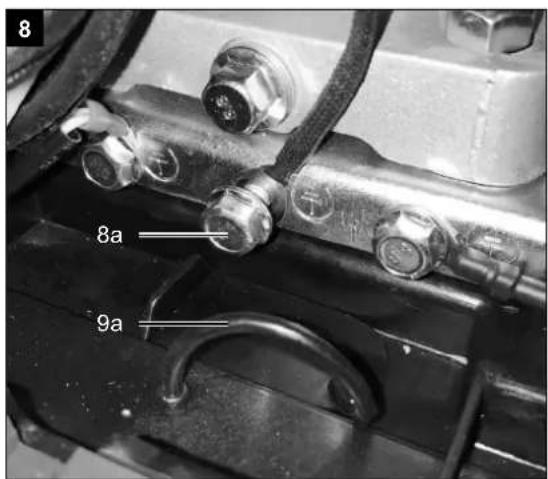
Oil change (Fig. 6, 8 & 9)
Change the engine oil after 25 operating hours, then after 50 hours or every three months.
The engine oil change should take place when the engine is at operating temperature.
- When changing the oil, have a non-leaking container available.
- Remove the cover (6) (Fig. 6)
- Undo the screw (8a); push the cable to the side so that it does not get coated with oil.
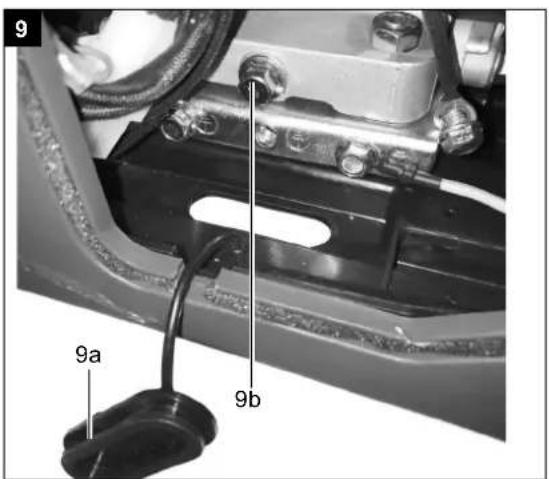
- Then loosen the rubber stopper (9a) (Fig. 8 - 9) and remove the dipstick.
-
Then open the oil drain screw (9b) (Fig. 9)
-
Drain the used oil into a suitable collection container.
- Finally, re-assemble everything in reverse order.
- When filling the new oil, bear in mind that you should not fill the recommended quantity of oil at once, as small quantities of oil always remain during an oil change.
- Check the oil level as described in the "Checking the oil level" point.
- Dispose of the oil in accordance with stipulations. Take the old oil to a collection point. Most petrol stations, garages or recycling centres take back old oil free of charge.
Air filter
Frequently cleaning of the air filter prevents carburetor malfunction. Clean the air filter regularly, especially when working in dusty environments.
Clean the air filter
- The air filter should be cleaned every 30 hours. (When working in a dusty environment, the air filter should be cleaned after work is complete).
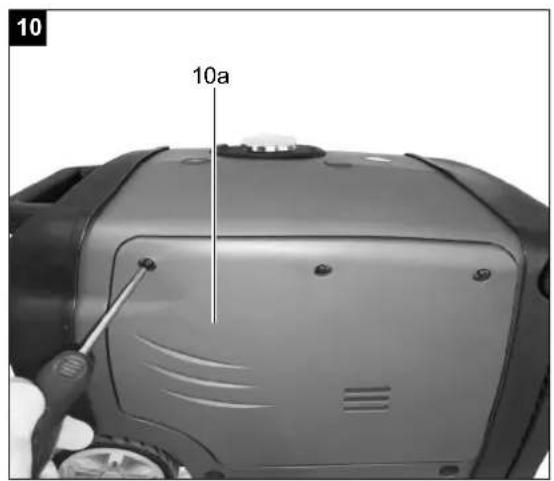
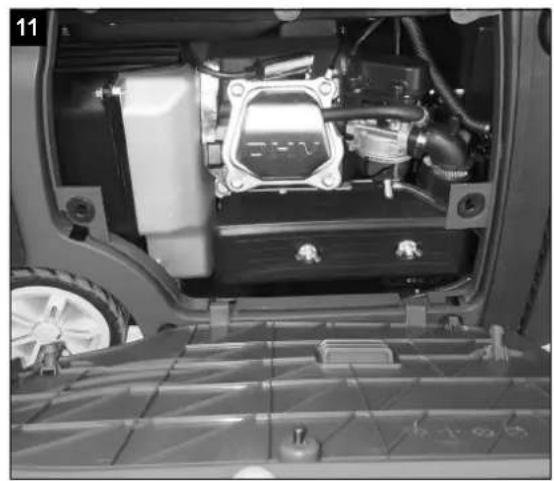
- Remove the cover (10a) (Fig. 10 - 11)
- Remove the air filter cover, by loosening the two screws (12a & 12b). (Fig. 12).
- Remove the filter element.
- Clean the filter element with soapy water. After rinse the filter element with clear water and allow to dry thoroughly before refitting.
- Reassemble in reverse order
⚠ WARNING
NEVER use gasoline or cleaning solvents with a low flash point to clean the air filter element. A fire or explosion could result.
Note
Never run the engine without or with a damaged air filter. Dirt gets so into the engine, causing serious engine damage can occur. In this case, seller, and manufacturer disassociate from any warranty.
Check, clean and replace spark plug
Check the spark plug after 10 hours on dirt and grime. If necessary, clean it with a copper wire brush. Maintenance the spark plug after 50 hours of operation
- Open the cover (10a) (Fig. 10)
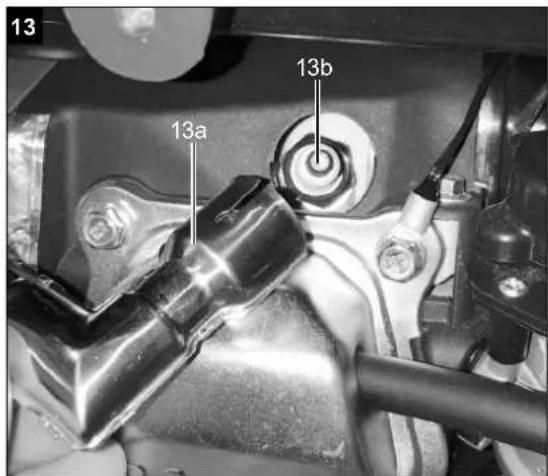
- Remove the ignition cable with plug. (Fig. 13)
- Remove any dirt from the base of the spark plug.
- Use the enclosed spark plug spanner (E) to remove the spark plug.
- Check the spark plug visually. Remove any debris with a wire brush.
- Look for discoloration on the top of the spark plug. By default, the color should be bright.
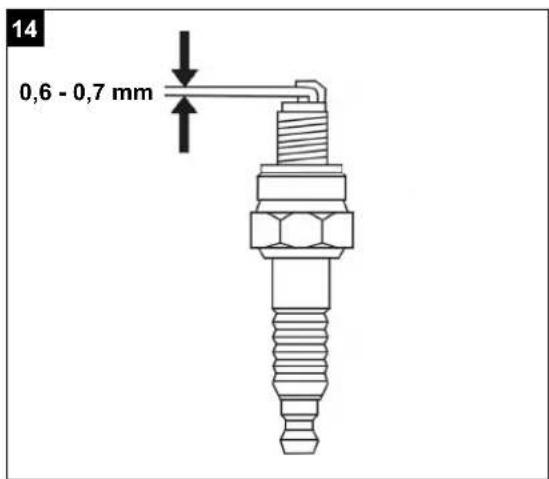
- Check the spark plug gap. An acceptable gap width is 0.6 to 0.7 mm (Fig. 14)
-
Remove the spark plug carefully by hand.
-
If the plug has been inserted, tighten them with a spark plug wrench.
- Attach the spark plug wire with connector on the spark plug.
NOTE
A loose spark plug can overheat and damage the engine. And overtightening the spark plug can damage the threads in the cylinder head.
Service information
Please note that the following parts of this product are subject to normal or natural wear and that the following parts are therefore also required for use as consumables.
Wear parts*: spark plug
* Not necessarily included in the scope of delivery!
Spare parts and accessories can be obtained from our service centre. To do this, scan the QR code on the cover page.
Cleaning
- Keep all safety devices, air vents and the motor housing free of dirt and dust. Wipe the equipment with a clean cloth or clean it with compressed air at low pressure.
- We recommend that you clean your device after each use.
- Clean the unit regularly with a damp cloth and some soft soap. Do not use cleaning agents or solvents; they may damage the plastic parts of the appliance. Make sure that no water can get inside the unit.
10. Storage
- Perform all general maintenance, which are in the User's Guide in the Maintenance section.
- Let the fuel out of the tank (Use a commercially plastic fuel pump from the hardware store).
- After the fuel is drained, start the machine.
- Let the machine in idle speed running until it stops. That cleans the carburetor from the remaining fuel.
- Let the machine cool down. (about 5 minutes)
- Remove the spark plug.
- Fill a small amount of 2-stroke engine oil into the firing chamber. Pull out several times the starter cord gently to wet the internal components with the oil.
- Replace the spark plug.
- Clean the outer casing of the machine.
- Keep the machine on a cold, dry place out of reach of ignition sources and flammable substances.
Recommissioning
-
Remove the spark plug.
-
Pull the starter rope out several times. It cleans the firing chamber of oil residues.
- Clean the spark plug contacts or install a new spark plug.
- Fill the tank.
11. Transport
⚠ WARNING
Let the engine cool down before transporting the machine or storing indoors to avoid bums or fire hazards. If you want to transport the unit empty the fuel tank before. Clean the unit with a brush or a broom of coarse dirt.
12. Disposal and recycling
Notes for packaging


The packaging materials are recyclable. Please dispose of packaging in an environmentally friendly manner.
Notes on the electrical and electronic equipment act [ElektroG]
![SCHEPPACH SG3400I - Notes on the electrical and electronic equipment act [ElektroG] - 1](/content/2026/03/520321/images/6ce61c4c819ca07ec479fa09622b595f3c4f1b5c127da0b0d03acb38e8278845.jpg)
Waste electrical and electronic equipment does not belong in household waste, but must be collected and disposed of separately!
- Old batteries or rechargeable batteries that are not permanently installed in the old unit must be removed before handing them in! Their disposal is regulated by the battery act.
- Owners or users of electrical and electronic devices are legally obliged to return them after use.
- The end user is responsible for deleting their personal data from the old device being disposed of!
- The symbol of the crossed-out dustbin means that waste electrical and electronic equipment must not be disposed of with household waste.
- Waste electrical and electronic equipment can be handed in free of charge at the following places:
- Public disposal or collection points (e.g. municipal works yards)
- Points of sale of electrical appliances (stationary and online), provided that dealers are obliged to take them back or offer to do so voluntarily.
- Up to three waste electrical devices per type of device, with an edge length of no more than 25 centimetres, can be returned free of charge to the manufacturer without prior purchase of a new device from the manufacturer or taken to another authorised collection point in your vicinity.
-
Further supplementary take-back conditions of the manufacturers and distributors can be obtained from the respective customer service.
-
If the manufacturer delivers a new electrical appliance to a private household, the manufacturer can arrange for the free collection of the old electrical appliance upon request from the end user. Please contact the manufacturer's customer service for this.
- These statements only apply to devices installed and sold in the countries of the European Union and which are subject to the European Directive 2012/19/EU. In countries outside the European Union, different regulations may apply to the disposal of waste electrical and electronic equipment.
Information on the battery act [BattG]
![SCHEPPACH SG3400I - Information on the battery act [BattG] - 1](/content/2026/03/520321/images/c230550176b9dc61e12afb7be27cab311be73a1c3242e05321256b0e389968b3.jpg)
Old batteries and rechargeable batteries do not belong in household waste, but must be collected or disposed of separately!
- For safe removal of primary batteries or rechargeable batteries from the electrical appliance and for information on their type or chemical system, please refer to the additional information in the operating or assembly instructions.
- Owners or users of primary batteries and rechargeable batteries are legally obliged to return them after use. The return is limited to household quantities.
- Old batteries may contain pollutants or heavy metals that can harm the environment or human health. Recycling old batteries and using the resources they contain helps to protect these two important issues.
- The symbol of the crossed-out dustbin means that primary batteries and rechargeable batteries must not be disposed of with household waste.
-
If the signs Hg, Cd or Pb are also located below the dustbin symbol, this stands for the following:
-
Hg: Battery contains more than 0.0005% mercury
- Cd: Battery contains more than 0.002% cadmium
- Pb: Battery contains more than 0.004% lead
- Rechargeable batteries and primary batteries can be returned free of charge to the following places:
- Public disposal or collection points (e.g. municipal works yards)
- Sales points for primary batteries and rechargeable batteries
- Take-back points of the common take-back system for old device batteries
- Take-back point of the manufacturer (if not a member of the common take-back system)
- These statements are only valid for rechargeable batteries and primary batteries sold in the countries of the European Union and subject to the European Directive 2006/66/EC. In countries outside the European Union, different regulations may apply to the disposal of rechargeable batteries and primary batteries.
Removing the rechargeable battery before disposing of the device
- The integrated rechargeable battery must be removed and disposed of separately in an environmentally friendly manner before disposing of the device.
- Mask off the contacts and package the rechargeable battery such that it cannot move in the packaging. Please also observe any further national regulations.
You can find out how to dispose of the disused device from your local authority or city administration.
Fuels and oils
- Before disposing of the unit, the fuel tank and the engine oil tank must be emptied!
- Fuel and engine oil do not belong in household waste or drains, but must be collected or disposed of separately!
- Empty oil and fuel tanks must be disposed of in an environmentally friendly manner.
13. Troubleshooting
| Fault Possible cause Remedy | ||
| Engine does not start dirty spark | plug | Clean the spark plug, or replace. Electrode spacing 0,6 mm |
| no fuel | Refill fuel | |
| too little oil in the engine | Check the oil level | |
| Battery empty | Replace the battery | |
| Generator has too little or no voltage | Controller or capacitor defective Air filter dirty | Contact your dealer Clean or replace the filter |
Table des matières: Page:
Günzburger Straße 69
D-89335 Ichenhausen
Cher client,
Voyant de surcharge (B)
Günzburger Straße 69
D-89335 Ichenhausen
Egregio Cliente,
Günzburger Straße 69
D-89335 Ichenhausen
Vážený zákazníku,
Günzburger Straße 69
D-89335 Ichenhausen
Vážený zákazník,
Günzburger Straße 69
D-89335 Ichenhausen
Austatud klient!
Günzburger Straße 69
D-89335 Ichenhausen
Gerbiamas kliente,
Günzburger Straße 69
D-89335 Ichenhausen
Godātais klient!
-Maks. mitrums: 90 %
Günzburger Straße 69
D-89335 Ichenhausen
Tisztelt vásárló,
Günzburger Straße 69
D-89335 Ichenhausen
Bästa Kund!
Günzburger Straße 69
D-89335 Ichenhausen
Arvoisa asiakas
8.7 Reset-painike (12)
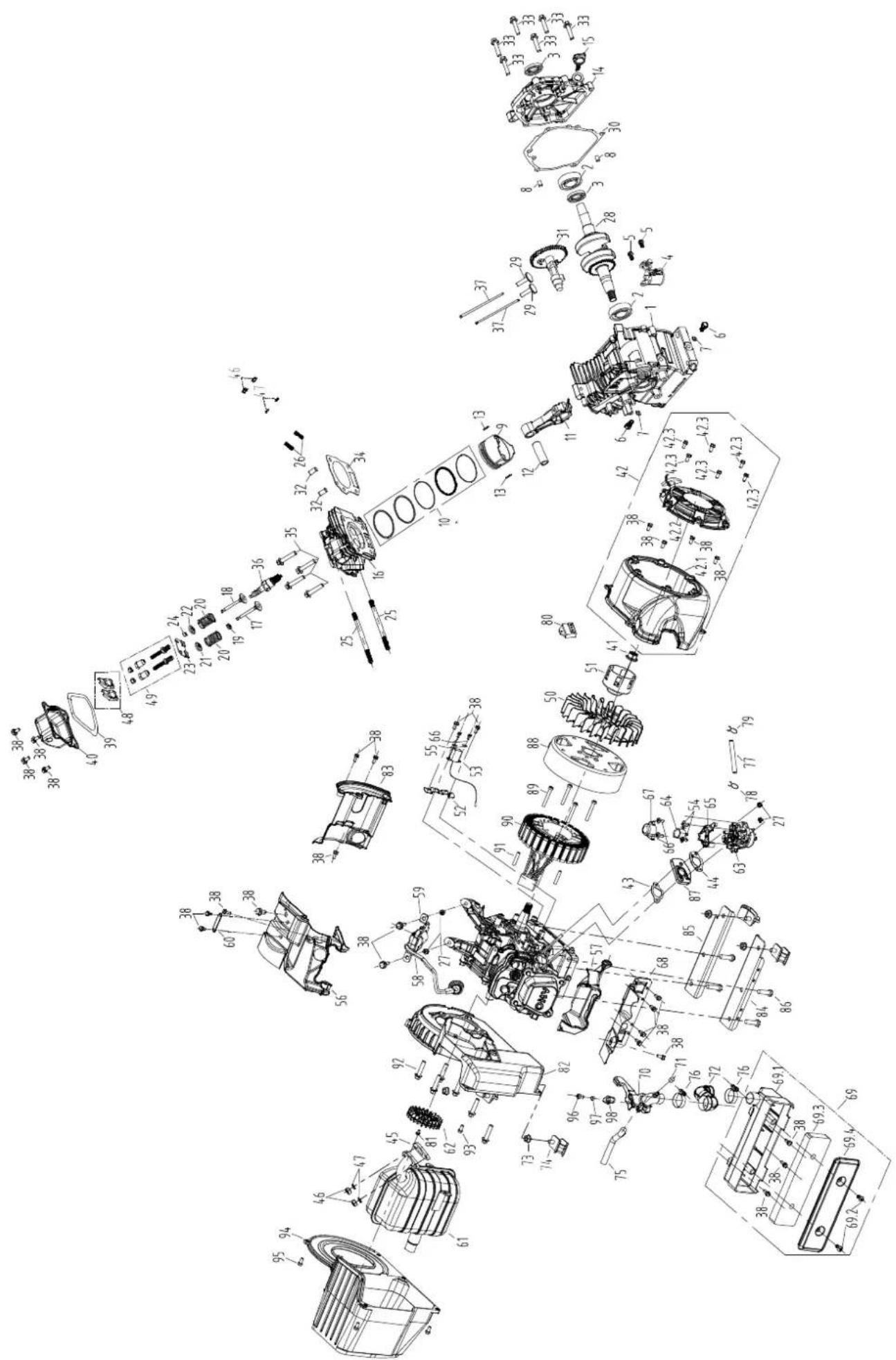
EC Declaration of Conformity
Standard references:
EN 12601:2010; EN 60204-1:2006+A1:2009; EN 55012:2007+A1; EN 61000-6-1:2007
This declaration of conformity is issued under the sole responsibility of the manufacturer.
The object of the declaration described above fulfils the regulations of the directive 2011/65/EU of the European Parliament and Council from 8th June 2011, on the restriction of the use of certain hazardous substances in electrical and electronic equipment.