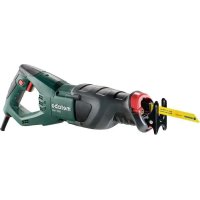
SSE 1100 - Saw METABO - Free user manual and instructions
Find the device manual for free SSE 1100 METABO in PDF.



| Product type | Sabre saw |
| Brand | Metabo |
| Model | SSE 1100 |
| Power input (P1) | 1100 W |
| Power output (P2) | 700 W (estimated) |
| No-load speed (n0) | 0 - 3000 rpm (estimated) |
| Stroke length (s) | 28 mm (estimated) |
| Weight (without cable) | 2.5 kg (estimated) |
| Voltage / Frequency | 230 V / 50 Hz |
| Protection class | II (double insulation) |
| Cutting capacity in wood | 200 mm (estimated) |
| Cutting capacity in metal | 10 mm (estimated) |
| Blade clamping system | Quick-release lever clamping |
| Adjustable stop | Yes, to limit cutting depth |
| Continuous operation | Yes, with lock-on button |
| Variable speed trigger | Yes, by pressure |
| Sound pressure level (L_pA) | > 80 dB(A) |
| Vibration emission value (wood) | Not specified |
| Compatible blade type | Universal shank (1/2" 20 mm) |
| Maintenance | Cleaning with compressed air, no lubrication |
| Intended use | Wood, metals, plastics, hard rubber |
| Recommended accessories | Original Metabo blades |
Frequently Asked Questions - SSE 1100 METABO
User questions about SSE 1100 METABO
0 question about this device. Answer the ones you know or ask your own.
Ask a new question about this device
Download the instructions for your Saw in PDF format for free! Find your manual SSE 1100 - METABO and take your electronic device back in hand. On this page are published all the documents necessary for the use of your device. SSE 1100 by METABO.
USER MANUAL SSE 1100 METABO
Original Instructions
1. Declaration of Conformity
We, being solely responsible: Hereby declare that these sabre saws, identified by type and serial number 1 ), meet all relevant requirements of directives 2 and standards 3 . Technical documents for 4 - see page 3.
2. Specified Use
The sabre saw is suitable for sawing wood, metals, plastics or similar materials such as hard rubber, fibre glass, etc.
Warranty claims apply only to a limited extent for applications with excessive wear (e.g. pallet construction/repair).
The user bears sole responsibility for any damage caused by inappropriate use.
Generally accepted accident prevention regulations and the enclosed safety information must be observed.
3. General Safety Instructions

For your own protection and for the protection of your power tool, pay attention to all parts of the text that are marked with this symbol!

WARNING - Reading the operating instructions will reduce the risk of injury.

WARNING Read all safety warnings and instructions. Failure to follow all safety
warnings and instructions may result in electric shock, fire and/or serious injury.
Keep all safety instructions and information for future reference.
Pass on your power tool only together with these documents.
4. Special Safety Instructions
Hold power tool by insulated gripping surfaces, when performing an operation where the cutting accessory may contact hidden wiring. Contact with a live lead can also energise metallic objects
and lead to electric shock.
Pull the plug out of the socket before making any adjustments, converting or servicing the machine.
Always wear protective goggles, gloves, and sturdy shoes when working with this tool.
Wear ear protectors when working for long periods of time. High noise levels over a prolonged period of time may affect your hearing.
Ensure that the spot where you wish to work is free of power cables, gas lines or water pipes (e.g. using a metal detector).
Use only sharp, undamaged saw blades. Do not use saw blades that are cracked or that have changed their shape.
Always position the power cable so that it leads away from the back of the machine.
Always hold the machine with both hands on the intended handles, take a secure stance and concentrate on the work.
Always work with the guide attached.
When sawing, the guide must make secure contact with the workpiece.
When sawing water pipes, ensure that they do not contain any water.
Do not try to saw extremely small workpieces.
Clamp workpiece properly e.g. using clamping fixtures. Under no circumstances should you hold the workpiece with your hand or foot.
Keep hands well away from the sawing area and the saw blade. Do not reach underneath the workpiece. Danger of injury due to the sharp saw blade.
Do not touch the moving saw blade!
Remove chips and similar material only with the machine at a standstill.
After stopping work, the saw blade may still be hot. Wear protective gloves.
Avoid inadvertent starts: always switch the tool off when the plug is removed from the mains socket or if there has been a power cut.
LED lights (6): Do not observe the LED radiation directly with optical instruments.
Reducing dust exposure:
Some of the particles generated using this power tool may contain substances known to cause cancer, allergic reactions, respiratory diseases, birth defects or other reproductive harm.
Some of these substances include: Lead (in paint containing lead), mineral dust (from bricks,
concrete etc.), additives used for wood treatment (chromate, wood preservatives), some wood types (such as oak or beech dust), metals, asbestos.
The risk from exposure to such substances will depend on how long the user or nearby persons are being exposed.
Do not let particles enter the body.
Do the following to reduce exposure to these substances: Ensure good ventilation of the workplace and wear appropriate protective equipment, such as respirators able to filter microscopically small particles.
Observe the relevant guidelines for your material, staff, application and place of application (e.g. occupational health and safety regulations, disposal).
Collect the generated particles at the source, avoid deposits in the surrounding area.
Use only suitable accessories. In this way, fewer particles enter the environment in an uncontrolled manner.
Use a suitable extraction unit.
Reduce dust exposure with the following measures:
- Do not direct the escaping particles and the exhaust air stream at yourself or nearby persons or on dust deposits.
- Use an extraction unit and/or air purifiers.
- Ensure good ventilation of the workplace and keep it clean using a vacuum cleaner. Sweeping or blowing stirs up dust.
- Vacuum or wash protective clothing. Do not blow, beat or brush.
5. Overview
See page 2.
1 Triggers switch
2 Locking button for
3 Thumbwheel for setting the maximum stoke rate*
4 Slide switch for setting the pendulum action *
5 Lever of the saw blade clamping fixture
6 LEd Iights*
7 Saw blade clamping fixture
8 Saw blade (shaft shape: universal shaft)*
9 Guide
10 Button for setting the guide
11 Front handle
12 Rear handle
* depending on equipment/not in scope of delivery
6. Assembly, Initial Operation, Setting
Before plugging in, check that the rated mains voltage and mains frequency, as stated on the type plate match your power supply.
Always install an RCD with a maximum trip current of 30mA upstream.
6.1 Fitting and removing the saw blade
Danger of injury due to the sharp saw blade. After stopping work, the saw blade may still be hot. Wear protective gloves.
Pull the mains plug out of the socket.
For access to the saw blade quick-clamping device (2), adjust the guide (9) if required.
1 Fold the lever (5) of the saw blade clamping fixture upwards and hold.
2 Insert the saw blade (8) until the stop or remove.
3 Release the lever (5).
4 Check that the saw blade is securely seated.
Note: In case the saw blade ever brakes off and cannot be removed by hand from the saw blade clamping fixture: Fold the lever (5) of the saw blade clamping fixture upwards and hold. Engage the tip of a saw blade in the broken section and pull it out. A fine-toothed metal saw blade is best suited for this task.
6.2 Setting the guide
The cutting depth can be limited by shifting the guide (9) (e.g. when sawing in front of a wall).
Occasionally shift the guide (9) to achieve even wear of the saw blade.
1 Press the button (10) and shift the guide (9) to the desired position.
2 Release the button (10) and shift the guide until it engages.
Check the guide (9) to ensure that it is securely fitted. It has to be engaged.
7. Use
7.1 Set pendulum action (SSEP 1400 MVT)
tithbeactivacnction of the saw blade increases the sawing power (particularly in the case of soft materials such as wood and plastics). Furthermore, the pendulum motion reduces the stress applied to the saw blade, as it is raised when emerging from the workpiece.
Set the required pendulum motion using the adjustment lever (4).
Recommended setting values:
0 = pendulum motion is deactivated. for thin material, fine cuts, tight curves
1 = for hard materials (e.g. steel, chipboard)
2 = for thick materials (e.g. wood, plastic)
3 = maximum pendulum motion for fast cuts (e.g. coniferous wood)
The best way to determine the ideal setting is through a practical trial.
7.2 Setting maximum speed (SSEP 1400 MVT)
Set the machine to maximum speed using the setting wheel (3). This can also be done during operation.
Recommended setting values: Wood 6
Light bricks = 5 - 6 soft, unalloyed steel = 3 - 4
Aluminium. = 3 - 5
Plastic. = 1 - 4
Stainless steel = 1 - 2
The best way to determine the ideal setting is through a practical trial.
7.3 On/Off switch, continuous activation
Avoid inadvertent starts: always switch the tool off when the plug is removed from the mains socket or if there has been a power cut.
Switching on: Press the trigger switch (1). The stroke rate can be changed by pressing in the trigger.
Switching off: Release the trigger switch (1).
Continuous operation: The trigger switch (1) can be locked using the lock button (2) for continuous operation. Press the trigger switch (1) again to stop the machine.
In continuous operation, the machine continues running if it is forced out of your
ENGLISHen
hands. Therefore always hold the machine with both hands using the handle provided, stand securely and concentrate.
7.4 Working Directions
Sawing:
Use a saw blade geared to the material to be sawn. SSEP 1400 MVT: Set pendulum motion according to the applications.
Adapt the stroke rate to the material to the sawn. SSEP 1400 MVT: Set maximum stroke rate according to the applications.
Press the machine with the guide (9) against the workpiece. Switch on the machine, and only then guide the saw blade against the workpiece.
Do not make contact with any objects or with the ground with the moving saw blade (danger of recoil!)
Avoid excessive pressure on the saw blade (particularly in the case of long saw blades).
If the saw blade jams, turn the machine off immediately. Widen the sawn gap slightly with a suitable tool and take out the machine.
After completing the sawing cut, switch off the machine and only take it out of the sawn gap to place it down once the saw blade has come to a standstill (danger of recoil).
Plunge cuts:
Plunge cuts may only be made in soft materials such as wood or plastic. Only use short saw blades.
Hold the machine with both hands at the intended handles, take a secure stance and concentrate on the work.

Set the adjustment lever (4) to the "0" position (pendulum motion is deactivated).
See illustration B, page 2:
The machine is pressed with the edge of the guide (9) against the workpiece. The saw blade does not make contact with the workpiece. Switch on the machine. The corner of the guide serves as a pivot point around which the machine is slowly aligned, whereby the saw blade cuts into the workpiece.
7.5 Sawing close to the wall

Set the adjustment lever (4) to the "0" position (pendulum motion is deactivated).
See illustration D, page 2.
When sawing near the wall, the saw blade can be put into the saw blade clamping fixture with the teeth pointing upwards (contrary to the normal working position). Ensure that the pendulum action is deactivated.
8. Tips and Tricks
To saw tight curves: Use narrow saw blades.
Sawing metal: To increase the life of the saw blades, apply cooling lubricant (cooling lubricant rod 6.23443) along the cutting line.
9. Maintenance
On a regular basis, use compressed air to blow out the machine through the rear ventilation slots.
Regularly clean the saw blade quick-clamping fixture (2) and blow out with compressed air. Do not oil or grease.
10. Accessories
Use only genuine Metabo accessories.
Use only accessories which fulfil the requirements and specifications listed in these operating instructions.
See www.metabo.com or the catalogue for a complete range of accessories.
11. Repairs

Repairs to electrical tools must ONLY be carried out by qualified electricians!
Contact your local Metabo representative if you have Metabo power tools requiring repairs. See www.metabo.com for addresses.
You can download a list of spare parts from www.metabo.com.
12. Environmental Protection
Observe national regulations on environmentally compatible disposal and on the recycling of disused machines, packaging and accessories.

Only for EU countries: Never dispose of power tools in your household waste! Used power tools must be collected separately and used in for environmentally compatible recycling. Accordance with European Directive 2002/96/EC,aste electrical and electronic equipment and its mention in national legal systems.
13. Technical Data
Explanatory notes on the specifications on page 3. Changes due to technological progress reserved.
P1 = Rated input power
P2 =Power output
1 = C u r e
n_0 =Stroke rate at idle speed
s = S t r o k
m = Weight without mains cable
Measured values determined in conformity with EN 60745.
Machine in protection class II
AC Power
The technical specifications quoted are subject to tolerances (in compliance with the relevant valid standards).
A Emission values
These values make it possible to assess the emissions from the power tool and to compare different power tools. The actual load may be higher
or lower depending on the operating conditions, the condition of the power tool or the accessories.
Please allow for breaks and periods when the load is lower for assessment purposes. Arrange protective measures for the user e.g. organisational measures based on the adjusted estimates.
Vibration total value (vector sum of three directions) determined in accordance with EN 60745:
a_h,CW = Vibration emission value
(Sawing in wood)
K_h, CW = Uncertainty(vibration)
Typical A-effective perceived sound levels:
LDA = sound-pressure level
LWA = Acoustict powerlevel
K_pA K_WA = Uncertainty
During operation the noise level can exceed 80 dB(A).

Wear ear protectors!
FRANÇAISfr
Notice originale
K_h, CW = incertitude (vibration)
s = Complemento doewed
Reservedslsister kan downloads pa www.metabo.com.
K_h, CW = Usikkerhed (vibration)
PpO3eIouEvn XepoalaBn, OTeKcTe Otaepa Kal EpyaZcTe OuyKeVtpwEvoI.
He npnbJnKaIte pyKn K 30He nJIeHnN He npKacaiTeCb K paBToAIOUeMy nINbHOMy noIoTHy. He depKInTe 3aRToBky CHN3y.
OnachOCTb TpaBMnpoBaHnOCTpbIM NINbHbIM NOJLOTHom.
He npHKacaiTecb K DBNKyuIeMyca HINbHOMy noIoTHy!
YdaJIaIte CtpyKHy IpyrO MycOp TOnbKO nocJe NOHOr OCTaHOBKn HnCTpyMeHTa.
Pocne pa60tbI NIIbHoe NOIOTHO MoKet 6bITb ropaHm. IcnoJIb3yIte 3aunTHbIe nepaTkn.
He donyckaia Te HnpeDnaHapeHHoro nyca: Bcerda BbIKIOuaTe IHCTpyMeHT npu BbIHMaHNBnKNn3 po3eTKn nn IpekpaueHn Nodaun TOka.
CBeToOnOHaJaMaNa(6)H36eRaTe nprMoRo H6JIoDEHnI N3JyHeHn CBeToOnOOB npn NOMOuONTNUeCKNX INHCTpyMeHTOB.
CHINHEHNE nbIeBOH Harpy3KN:
Yacntu,6pa3yUoIeC npna pa6oTe DaHHoro HNCTpyMeHTa,MOyT COepKaTb BeueCTBa,KOTOpBle CnOCO6CTByIOT pa3BHTIO paka,poBJIeHNIO aJIeprHuecknx peakun, 3a6oJebAHIN dblxATElbHbIX nyTei, BO3HNIHOBEHNO TepaTOReHHbIX NaToIOnrN NII IN 3a6oJIeBAHNI pePPOyKTHBHO CNCTEmbl. HeCKoJIbKO npIMePoB NOO6HbIX BeueCTB: CBHeuc (B CODepKaUeM CBHeuc JIK), MNHePAJIbHaN PbIJb (OT CTpONTeBJHO RKnPnua, 6eToHa nT.I.),npicaDN DIApeBOO6pa6OTKN (COJIN XpOMOBON KNCLOTb,CpeCDTa 3aUNTBI DpeBecnbl),HEKOTOpBle BNDI DpeBecnbl (HaNPmep, PbIb OT dyBa NN bYka),MeaJIbI, ac6ect.
CTeneHb pNcKa 3aBnCHT O TnpoDolJHNTeJIbHOCTN BO3DeIcTBn 3Tnx BESeCTB Ha NOLb3OBaTeJr HnHaxOJaUxxC8 B6n3n IIOJe.
He donyscKaIte nonadHn yactu
obpaBaTBiBaemoro MaTePnaJa B OprAHn3M.
ДЯ yMeHbWeHn BpeHOrO BO3DeIcTBn 3Tnx BeSeCTB: ObecneYbTe XopoWyU BEHTNJLauNo pa6OyeRo MeCTa N HCNoJIb3yIte
COOTBeTCTByIOUne CpeDCTBa 3aunTbl, HanpIMep, peCnnpaTopbl, CNOC6HbIE OTfNilbTpOBbIBaTb MKNPOCKONNUeCKNe YactuBl.
CobnoaTe dnpeKTHBbl,OTHOscIunec K BaHm YcNoBnM,B TOM YnCLe OTHOscIunec K
O6paBaTbIbAemomy MaTePnaIy,K nepcoHaIy,K
BapNaHTam npImeHnI N K MeCTy npOBeDeHn
pa60 (HaNPmep,pIoJKeHne 6 OxpaHe Tpyda
nn 6 yTnIn3aun).
OBeCneBte ydaJIeHHe o6pa3yUoIcxr qacTnU, He dOnyckaIte o6pa3OBAHnroOTIOJKeHn B OKpyKaIOUeM npocTpaHCTBe.
NcnoJb3yIte TOLbKO NOxOJaIyIO OChAcTky.3To N03BOJNT COKpaTHTb KOJIInHeCTBO YaCTNu, HEKOHTPoJIpyEmo Bbl6paCbIBaEmbIX B OKpyKaIOU cyPeDy.
HcnoJIb3yIte noJxOJaUe BbITJHKHOe yCTPOICTBO.
Дяумншени NBileBOH Harpy3Kn:
- He HappaBraIte BbIXOJaIe I3 INHCTpyMeHTa YactnIcbl N Otpa6oTaHHbI BO3dyX Ha Ce6y, HaxOJaIuNXcR prdOM JIODeN nn CKOpJIeHNr PbIIN;
- INCNoJIb3yIte BbITJHKHOe yCTpOiCTBO H/HJIH BO3dYXOOHCTHTeJIb;
- xopoio npoBeptnBaHte pa6ooye MeCTO IN COdepKHTe eRO B uHCTOTE, HcNoJIb3y IbIeCOC. IOpMTeaHne IIN IpoDyBkA TOnbKO IOpHIMaET NblB B BO3dyX;
- 3aunTHyO OeJy O6pa6aTbIBaIte NblcEcoM nn CTupaIte. He npodyBaIte OdeJy BO3dyXOM, He BbIbNAIte H He CMeTaIte C Hee Nblb.
5.0630p
CM. cTp. 2.
1IpeeklouateIb
2 KhoNka-phiKcaTop pIa peKIma IInTeJIbHOrO BKJIIOUeHIN
3 KolecnkoДЯ yCTaHOBKN MaKcHMaJIbHOrO YnCna XoDOb
4 POn3yHKOBbI nepeHIOuTeIb IJIa yCTaHOBKn MaTHNKOBORO XOda
5 Pbyar 3aKHMHOro npucnocO6JeHna nIbHoro noJIOTHa
6 CBeToaNoI*
7 3aKHMHoe npncnocO6JeHne IJIy NJIbHOrO NOJOTHa
8Пиьhoe NOIOTHO(ΦopMa XBOCTOBnKa: yHnBepcaJIbHbI XBOCTOBnK)*
9 Ynop
10 KhoNka dIpapepylnipOBNuynopa
11pepeHpykoTka
23aHpyKoHTa
B 3aBnCmOCTN OT KOMJIeKTAuIN / He BXoIIT BIXOMJIeKT NOCTABKN
6. MoHTaH, BBOd B 3KcPlyaTaUIO, perylnpoBka
IpeD BBODOM B 3KcNJIyatauHIO npOBepbTe, COBnadaOT JIN yKa3aHHbE Ha 3aBOdCKo T6nue 3NaHeHHaHnpJKeHHa YAcTObI CeTN CnapaMeTpamn 3JeKTPocetN.
IpeepHnHCTpyMeHTOM BceTda NOHIOUaTe yCTPOIcTB03aUNTHORO OTKIOUeHnR (Y3O) c MAKC.TOKOMOTKIOUeHnR 30MA.
6.1 YctaHOBka, CHrTne NJIbHO r NOJIOTHa
OnachocTb TpaBMnpoBaHnOcTpblm NINbHbIM NOIOTHom. NocLe pa60tbl NINbHOe NIOLOTHOMoKet 6bITb ropyHm. NcNoJIb3yITe 3aunTHbIe nepuATKn.
I3BnTe BnKy n3 po3eTKN.
Дя получени дocTyа Кьсгтpo3aнMHOMу npicnoc6beHIO (2)пльboro noLoTHa пи Heo6xodmoctn NepectabTe ynop (9).
1 OTKINbTe HaBepx u ydepeKnBaIte pbiar (5) 3aKIMHO rnpncno6JeHn nnJbHOro nIOJToHa.
2 NINbHOe NOIOTHO (8) BCTaBtE Do ynpa nn BBiHbTe NINbHOe NOIOTHO.
3 OTnyctnte pbuar (5).
4 IpoBepbTe 6KcauHIO NnIbHOrO NOIoTHa.
Yka3aHne EcIn NnIbHOe NOIOTHO KOrDa-JIN60 CJOMaETcA, a YdaJIHTb pyKaMn n3 6bICTpO3aKIMHOrO npncnocO6JIeHn8 6yDeT HEBO3MOJHO,TO OTKNHbTe HaBepx u ydePknBaIte pbUar (5) 3aKIMHOrO npncnocO6JIeHn8 NnIbHOro NIOJTHa. 3aueHrTe OCTpHem NnIbHOro NIOJTHa CLOMaHHyU qAcTb n N3BLeKeHrTe ee. JyUwe Bcero DIA 3TORO NOxODIT NnIbHOe NOIOTHO NO MetaJIy C MeIKHMN 3y6OM.
6.2 Perynipobka ynpa
CdBnra ynp (9) moKHO orpaHnUbaTb rIy6nHy nIeHna (HaNPmep, npn nnEHHn nepec dTeHo).
PYCCHNru
Bpemr O T BpeMeHn CdBnraJTe ynp (9), YTo6bl ObecneuHTb paBHOMepHbI N3HOC NJIbHOro NOLOTHa.
1 HaKMnTe KhoNky (10) n CDbHbTe ynp (9) B HyKHOe NOJIOKeHHe.
2 Otnyctte KhoNky (10) n cBnraTe ynp do ero fHKcaun.

PpOBepbTe HadeKHoe KpenJeHne ynpa (9). YnpoDolKeH 6bTb 3aΦnKcnpoBaH.
7. Примеенье
7.1 YctaHOBka MaTHNOBOO DBNXEHNs (SSEP 1400 MVT)
MaTHNKOBoe DbNKeHne NlNbHOro NOIOTHa NOBbIaAeT npOn3BOdnteJIbHOCTb NIIeHnRA (B OcO6eHHoCTn Ha MmKnx MaTePnaJax, TaNX KaK dpeBeCInHa nIlaCTnKn). Kpome 3TOrO, MaTHNKOBoe DbNKeHne Obeperaet NlNbHOe NOIOTHO, TaK KaK Ha o6paTHOM XOe OHO npINoDHnMaetCra.
YCTaHOBkA Tpe6yEMO rMaTHNKOBORo XOda NOI3yHKOBbIM nepeKIOUaTeJeM (4).
PekomeHdyemble 3haeHn yCTaHOBKn:
0 = MaTnKOBoe DBNKeHne OTKIOUeHO. DnTOHKOro MaTePnaJa, TOuHbIX pa3pe3OB, NOBOPOTOB MaIOrO paDnyca
1 = Дли Тьердых MaTeрпалов (HanpIMeP, CTaIIN, DpeBecHOCTpyKeHbIX ПИNT)
2 =ДЯТОЛСТБИМaTePиАЛOB(HaПрИМер,ДрЕВeСнБИ,ПlaCTИКа
3 = MaKcMmaJIbHOe MaTTHIOBOe DBNKeHne
ДЯ ьICTpbIXpacnINIOB (HaNPIMep, XBOHON
ДрЕВECINHbl)
OnTnMaJIbHbIe 3NaYeHn IyUWe BCeRo onpeJEnrOc ONbITbIM NyTeM.
7.2 YCTaHOBbMaHcHMaJIbHOJ YaCTOTbIXOIOB (SSEP 1400 MVT)
YctaHOBNTe Ha KOJIecnKe (3) MaKcHMaJIbHyIO YactOTy XoIOB. 3TO MOJHO CJeIaTb TaKHe N BO BpEMpa6Obl INCTpyMeHTa.
PekomeHnyembIe 3HaueHnYcTaHOBKn: DpeBeCnHa. =6
JIerKnI KnpNnU. = 5 - 6
MЯrkān, HeIeIepoBaHna cTaIb 3-4
AIIOMHHN=3-5
Пл actн =1-4
HepKaBeIOUaIcTalb. = 1 - 2
OnTnMaJIbHbIe 3HaueHnJyUWe BCero OnpedeJIaHTcO ONbITbIM NyTEM.
7.3 BkIIOUeHHe/BbIKIOUeHHe, BHKIOUeHHe Ha dHTeBHOe Bpemr
He donyckaTe HnpeDHaMepeHHoro 3anycka: Bcerda BbIKIOuAte HHCTpyMeHT, ecn BNkka 6bla N3BLeueHa n3 PO3eTKn, nn ecn npOn30weJ c6oB b NOaYe 3JeKTPo3Heprnn.
BkhIOueHHe:HaKMITE Ha nepeKIOUaTeIb (1). HaKaTHeM Ha nepeKIOUaTeIb MOHO N3MeHrTb YactOTy XOJa.
BbIKIOUeHne OTnycTHe nepeKIOUoHaTeIb (1).
ДЛNTeJIbHoe BKIOUOeHne:ДЯДIINTeJbHOrO BKIOUeHnpeKIOuAtelb(1)MOxHO 3aФИКсИрОВаТь c NOMOUsbO CTOnOPHOr KHOJKN (2).ДЯ BBIKIOUeHn IOBTOpHO HaKMITE nepeKIOUaTeIb(1).
BpeKHe HnpepbIBHOpaObI INHCTpyMeHT npoDoJHKNT BpaaTbcra, DaKe ecn OH BbIPBeTcN3 pyK. PoToMBy BceTa KpeKNo DePKeHTE 3JIeKTPoHNHCTpyMeHT DByMny PyKaMn 3a pyKoTHN, pnpMtTe yCTOnuBOe PNOLOKeHne N cKOHcEHTpnpyTe BCE BHMaHne Ha pa6Ote.
7.4 Pa6oUe yHa3aHnA nnHe
IcnoJb3yIte nJIbHoe nOToTHo, npedHa3NaueHHoe dJa o6pa6aTbIbAemoro MaTePnAna.
SSEP 1400 MVT YCTaHOBnTe MaTHNkoBOe DnKHeHne B COOTBeTCTBn CO ClyuAe NpImeHEnr.
HacptpoTe yactoty xOda Ha o6pa6aTbIbAembl MaTePnAn. SSEP 1400 MVT YcTaHOBnTe yactoty XoIOB B COOTBetCTBnC O CnyaEM npImeHeHHr.
PnHKMTe 3JIeKTPoHnHCTpyMeHT yNopOM (9) K 3aROTOBHe. BKHIOUHTe 3JIeKTPoHnHCTpyMeHT, NINb NOcIe 3TOrO nOdBEdnTe NIIbHOE NOJIoTHO K 3aROTOBHe.
He npHKacaiTeCb DnKHyUIMCRA NJIbHbIM NOIOTHom K npEaMeTaM ININ NOyBE (ONaCHOCTb OTdauN!)
I36eraIte n3IINHrero daBHeHna IINbHoe noIOTHO (OCO6eHHo npn pa6ote c dINHHbIMN INlbHbIMN NOJOTHaM).
Pn3aueMEnHnnNtBHOrO NOIOTHa HemeJeHHo BbIKIOHTe 3JIeKTPoINHCTpyMeHT. HemHO rpa3BeIDNTe npONnC NOMOUsIO NOxOJaUero INHCTpyMeHTa N BbIHbTe 3JIeKTPoINHCTpyMeHT.
Iocne OKOHuaHn IINHeHbBikIOUHTe 3JIeKTPoHnHCTpyMeHT, BbIHbTe ero nI npOnnla n OTLOXHTe B CTOpOHy IINsb NocJe TOrO, KaN IIIBHOe NOIOTHO NOJHOCTbIO OCTaHOBNTc (OnaCHOCTb OTDaun).
NorpyxHbIe npoHnJIbI
IorpyKHbIe npONJIbMOXHO BbIOJHrTb TOJbKO BMRAKHX MaTePnAIAx, TaKnx KaK DpeBecnHa NIN nnactNK. IcNoJIb3yIte TOnbKO KOpOTKne NINbHbIE NOJIoTHa.
Kpenko depknte nHCTpymeHT dByMa pyKaMn 3a pyKOaTKn, npIMTe yCTOnuHBOe NOLOXKeHne IN CKOHcEHTnpuyTe BCE BHNMaHHe Ha pa6Ote.
YCTaHOBnTe NOJ3yHKOBbI nepeKIOuTaJIb (4) B NOJIOXHeHne "O" (MaTTHNKOBbI XOD BblKJIIOUeH).
CM. pncyhoK B ha cTp. 2.
3JIeKtpOHCTpymeHT npHHMaETcKpaem ynpa (9) K 3arOTOBKe. NlIbHO e NOIOTHO He KacaetcOcbpa6aTbIbAEMo DeTaII. BkIIOHTe HnCTpyMeH. YroI ynpa cIyXHTeHTpOM BpaueHn, YTO6bl MeJleHHO HApBaBJIrTb 3JIeKtpOHCTpyMeH, pRn 3Tom NlIbHO e NOIOTHO Bpe3aETcB O6pa6aTbIBaEmyO DeTaJIb.
7.5 Пиеленьблзн CTeH
YCTAHOBHTe NOJI3yHKOBbI nepeKIOUaTeJIb (4)B NOJIOKeHHe "0" (MaTTHNKOBbI XoD BblKIIIOUeH).
CM.pnc.DHa cTp.2
IINJIeHnB6NI3nCTeH MoXHO 3aKaTb
NIIbHOE NOIOTHO 3aJHMHom pIcNOC6JIeHn
3y6bAMn HABepx (NOIOKeHne, OpaTHOE
HOpMaJIbHOMy paOoemy NIOKeHnO).
Y6eIITecb, YTO MaTTHIKOBoe DBNKeHne
BbIKIOUeHO.
8. CobetbI npekomeHdaaun
IyIINJIeHnMaJbIX paDnycOB cJeIyET IcNoJIb3OBAt b y3KHe NIIbHbIe NOLOTHa.
HJIHeMe MeaJIIOB:HaHeceHne CMa3OHO-OxlaJaIOUeRO cpeICTBa (CMA3OHO-OxlaJaUeKapAHa6 6.23443) npoJleBaET cPOK cLyKbI NIIbHbIX NOIOTeH.
9. Texnuechoe o6cnyHbAHne
CJeNyET peryIaRHO nTuaTeIbHO npOdyBaTb 3aHIO BENTINLAIOHHU OJIb.
PeryIaRHO OUnuTaB 6bICTpO3aKHMHoe npncnoc6JIeHne NIIbHOro NOIoTHa (2) n npOyBaT b erO cKaTbIM BO3dYxOM. He CMa3bIbAaTe MaCJOM HIN KOHCNCTeHTHOcMaaKoI.
10. ПпнадлжноCTN
IcnoJb3yIte TOLbKO opnHaJIbHbIe npHaJdEHHoCTn Metabo.
IcnoJb3yIte T0JIbKO Ty OChAcTKy, KOToPAOTBeuayETpe6OBAHnM nnapaMeTpam, IpeueHCJIeHHbIM B DaHHOM pKOBODCTBE NO 3KcNJaTaUH.
PporpamMy npHaJnEHHOCTeM. Ha caTte www.metabo.com INN B KaTaNore.
11. PeMoHT
PemOH3JIeKTPoHnHCTpyMeHTa DOJIxHeOcUyEcTBJIrTbCra TOJIbKO KBaIIHnIuHpOBaHHbIMN CneuaJIHCTaMn-3JIeKTPnKAMN.
$$ P _ {2} = B b i x O D H a R M O U S H O C T b $$
$$ = \text {T O K} $$
$$ n _ {0} = \text {Y a c t O T a X O D O B H A X O L O C T O M X O D y} $$
$$ s = \text {Д l i n h a x o d a} $$
$$ m = \text {M a c c a} 6 e 3 \text {c e t e b o r o} k a 6 e 1 $$
Pe3yIbTaTbI N3MepeHn NOJyHeHbIB COOTBeCTBnN Co CTAHpTOM EN 60745.
HnctpymEnT Klaacca 3auntbI
nepemehhbiTOK
Ha yka3aHHbIe TexHnueckne XapaKTepcntKNpacnpocTpaHIOITc DOnyCHN, npEpyCMOTpeHHbIE DeiCTByUOUMN CTaHdApTaMn.
3HaueHnAeMnccnUyMa
3Tn 3HaueHnno3BOJIO TO OeHbAtb N
CpaBHbATb 3MnCCNIO Wyma pa3JIHybIX
3JIeKTPoINHCTpyMeHTOB.B 3aBNCIMOCTHn OT
YcIOBn 3KcIyatauHn, COCTOHN HhCTpyMeHTa
HIn NCNoJIb3yEmoN INHCTpyMeHTaIBHO OCHACTKN
fAHTnuecka 3MnCCN IwMa MoKeT 6bITb BblSe
HIn HnKe.ДЯ OUeHKn pPmEPHoro yPOBnAR
3MnCCN yHTbIAuTe nepepbIBb B paOte n fAs3bl
paObTbIC NOHNKeHHoN (WymoBO) Harpy3KOi.
OppeDeJIte nepeueHb opraHn3aQHOHHbIX Mep no
3aunTe POnb30BaTeJIc C yYeTOM Tex INI INHbIX
3HaueHn 3MnCCN Wyma.
O6uee 3NaueHne Bn6paunu (BeKToPna CymMa Tpex HapBaIeHn), paccHTaHHoe corlacho EN 60745:
$$ a _ {h} C W = 3 H a y e H n e B N 6 p a \text {C H} $$
$$ (\Pi \text {и le n e h e d p e b e c h n b}) $$
$$ K _ {H, C W} = K o 3 \phi \Phi n u e n t \Pi r o p e w h o c t n (B N 6 p a c u n) $$
TnHbAmIHTyHO-B3BeWeHHbI yOBeHb
$$ 3 \text {B y} K O B O R O \square \text {a b l e n h i :} $$
$$ L _ {D A} = y p o B e H b 3 B y K O B O R D a B L e H N A $$
$$ L _ {W A} ^ {P} = y p o B e H b 3 B V K O B O M O U S H O C T N $$
$$ K _ {D A}, K _ {W A} = \text {H O 3} \phi \Phi \text {n u n e H T n o r p e w h o c t n} $$
Bo Bpemra60tbyypoBeHbUyma MoKeT npebbiwata8 0d5(A).
IcnoJb3yIte cpeIcTba 3aunIbI opraHOB cnlyxa!
EAC
HΦopMaζηДIa nokynataTeIa:
CeptnuKAT COOTBETCTBNA:
CeptnuKAT COOTBETCTBnA (JIA SSEP 1400
CtpaHa n3rOToBJeHn: KntaI
PpOn3BODntelb:"Metabowerke GmbH",
Metaboallee 1, D-72622 Nuertingen, RepMaHnia
3aBOD-n3rTOBNTeJIb:
"Metabo Powertools (China) Co. Ltd."
Bldg. 7, 3585 San Lu Road,
Pujiang Industrial Park, Min Hang District, KHTa
HmnpTeB Pocn:
OOO"MeTa6o EBa3nra
Pocn,127273,MockBa
yI. Bepe3oBaA aIIe, I 5 a, cTp 7, oΦnc 106
TeI.: +7 495 980 78 41
Data npOn3BODCTBa 3aUnHpObaHa B 10-3NaUHOM cepuHOM Homepe INHcTpymeHTa, yKa3aHHOM Haero uNbDnke. 1 aUnPpa 06o3HaaeT roD,
Hanpimep «4» 603HaayaeT, yTO n3dJeIne npOn3-BeDeHo B 2014 roy. 2 rN 3 rUΦpbI 6o3Haayot HOMep MecaB rOdy pON3BODCTBa, Hanpimep «05» - MaI
TapaHTnHbI cpoK: 1 roD c DaTbI npOdaKn
Cpok cnjx6bl HnctpyMeHTa: 5 let c daTbI n3roTOBJIeHNA



- Original Instructions
- Declaration of Conformity
- Specified Use
- General Safety Instructions
- Special Safety Instructions
- Reducing dust exposure:
- Overview
- Assembly, Initial Operation, Setting
- Fitting and removing the saw blade
- Setting the guide
- Use
- Set pendulum action (SSEP 1400 MVT)
- Setting maximum speed (SSEP 1400 MVT)
- On/Off switch, continuous activation
- ENGLISHen
- Working Directions
- Sawing:
- Plunge cuts:
- Sawing close to the wall
- Tips and Tricks
- Maintenance
- Accessories
- Repairs
- Environmental Protection
- Technical Data
- Wear ear protectors!
- FRANÇAISfr
- Notice originale
- CHINHEHNE nbIeBOH Harpy3KN:
- 5.0630p
- MoHTaH, BBOd B 3KcPlyaTaUIO, perylnpoBka
- YctaHOBka, CHrTne NJIbHO r NOJIOTHa
- Perynipobka ynpa
- PYCCHNru
- Примеенье
- YctaHOBka MaTHNOBOO DBNXEHNs (SSEP 1400 MVT)
- YCTaHOBbMaHcHMaJIbHOJ YaCTOTbIXOIOB (SSEP 1400 MVT)
- BkIIOUeHHe/BbIKIOUeHHe, BHKIOUeHHe Ha dHTeBHOe Bpemr
- Pa6oUe yHa3aHnA nnHe
- NorpyxHbIe npoHnJIbI
- Пиеленьблзн CTeH
- CobetbI npekomeHdaaun
- Texnuechoe o6cnyHbAHne
- ПпнадлжноCTN
- PeMoHT
- 3HaueHnAeMnccnUyMa
- EAC
- HΦopMaζηДIa nokynataTeIa:
Brand : METABO
Model : SSE 1100
Category : Saw