SFE820CELX - Tumble drier FAGOR - Free user manual and instructions
Find the device manual for free SFE820CELX FAGOR in PDF.



| Product type | Condenser tumble dryer |
| Maximum load capacity | 8 kg |
| Drying programs | Cotton (Very dry, Dry, Ready to iron, Machine iron), Mixed (Dry, Ready to iron), Shirts, Synthetic, Delicate, Fresh Air, Air Wool |
| Options | Delayed start (max 24h), Timer (in steps of 10 min), Anti-crease (24h), Buzzer (beeps every minute for 1h) |
| Drying system | Condensation with humidity sensor |
| Control type | Electronic with rotary selector and buttons |
| Display | Digital display showing remaining time |
| Water collection container | Yes, located at top or bottom depending on model, to be emptied after each cycle |
| Filter | Clean after each cycle, do not wash with water |
| Condenser | Clean twice a month with clear water |
| Door opening direction | Reversible (instructions provided) |
| Stacking | Possible with adapter kit (compatible with specific washing machine) |
| Interior lighting | Bulb E14 15W/230V (depending on model) |
| Adjustable feet | Yes, for leveling |
| Safety | Shut-off when container full, condenser cleaning reminder light, electrical protection (integrated fuse) |
| Exterior maintenance | Sponge or damp cloth with liquid soap, do not use abrasive products |
Frequently Asked Questions - SFE820CELX FAGOR
User questions about SFE820CELX FAGOR
0 question about this device. Answer the ones you know or ask your own.
Ask a new question about this device
Download the instructions for your Tumble drier in PDF format for free! Find your manual SFE820CELX - FAGOR and take your electronic device back in hand. On this page are published all the documents necessary for the use of your device. SFE820CELX by FAGOR.
USER MANUAL SFE820CELX FAGOR
- Atar os cintos, as fitas das batas, etc.
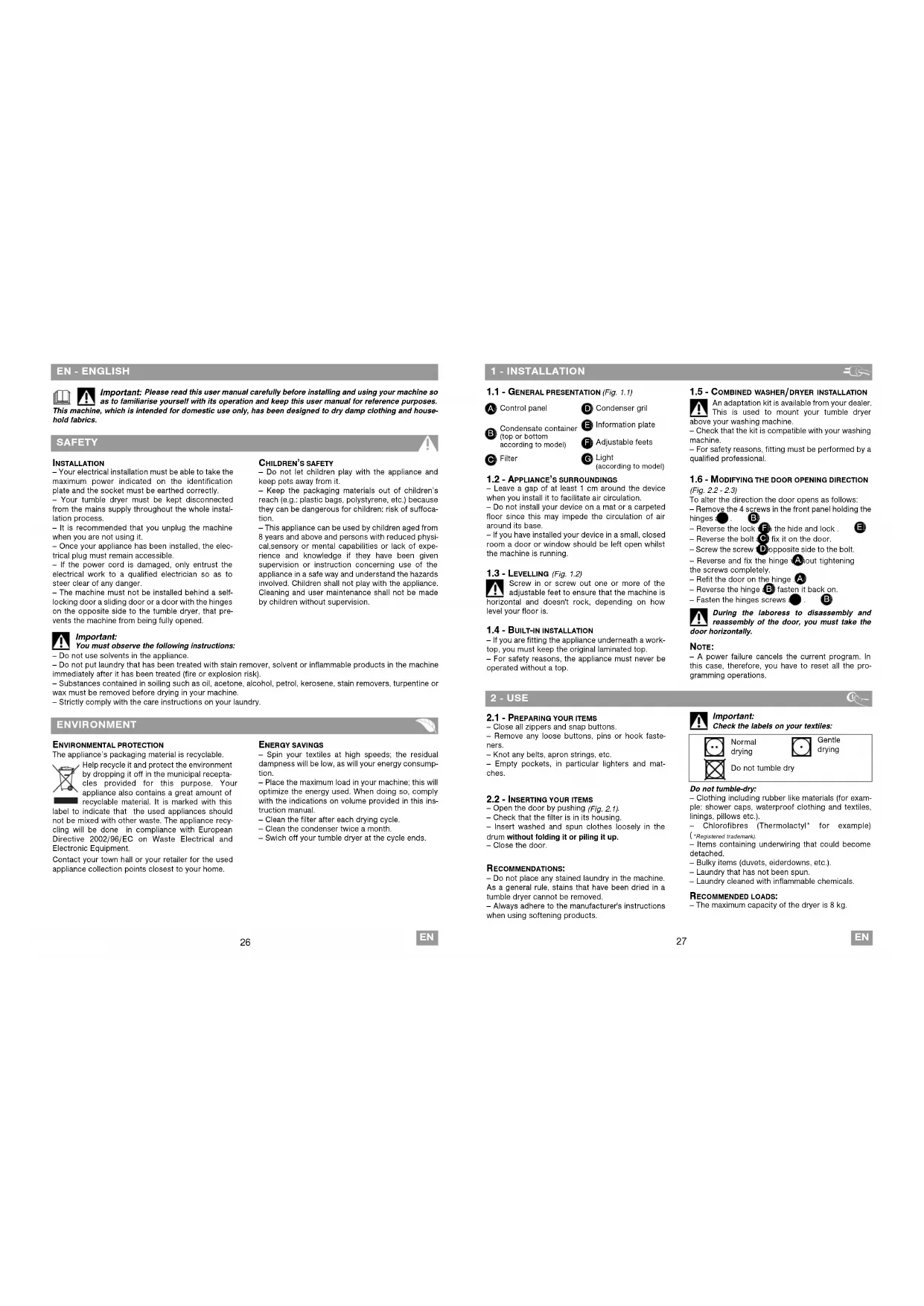
Important: Please read this user manual carefully before installing and using your machine so as to familiarise yourself with its operation and keep this user manual for reference purposes.
This machine, which is intended for domestic use only, has been designed to dry damp clothing and house-
hold fabrics.
SAFETY
INSTALLATION
- Your electrical installation must be able to take the maximum power indicated on the identification plate and the socket must be earthed correctly.
- Your tumble dryer must be kept disconnected from the mains supply throughout the whole installation process.
- It is recommended that you unplug the machine when you are not using it.
- Once your appliance has been installed, the electrical plug must remain accessible.
- If the power cord is damaged, only entrust the electrical work to a qualified electrician so as to steer clear of any danger.
- The machine must not be installed behind a self-locking door a sliding door or a door with the hinges on the opposite side to the tumble dryer, that prevents the machine from being fully opened.

Important:
You must observe the following instructions:
- Do not use solvents in the appliance.
- Do not put laundry that has been treated with stain remover, solvent or inflammable products in the machine immediately after it has been treated (fire or explosion risk).
- Substances contained in soiling such as oil, acetone, alcohol, petrol, kerosene, stain removers, turpentine or wax must be removed before drying in your machine.
– Strictly comply with the care instructions on your laundry.
ENVIRONMENT
ENVIRONMENTAL PROTECTION
The appliance's packaging material is recyclable.
Help recycle it and protect the environment by dropping it off in the municipal receptacles provided for this purpose. Your appliance also contains a great amount of
recyclable material. It is marked with this label to indicate that the used appliances should not be mixed with other waste. The appliance recycling will be done in compliance with European Directive 2002/96/EC on Waste Electrical and Electronic Equipment.
Contact your town hall or your retailer for the used appliance collection points closest to your home.
CHILDREN'S SAFETY
- Do not let children play with the appliance and keep pets away from it.
- Keep the packaging materials out of children's reach (e.g.: plastic bags, polystyrene, etc.) because they can be dangerous for children: risk of suffocation.
- This appliance can be used by children aged from 8 years and above and persons with reduced physical, sensory or mental capabilities or lack of experience and knowledge if they have been given supervision or instruction concerning use of the appliance in a safe way and understand the hazards involved. Children shall not play with the appliance. Cleaning and user maintenance shall not be made by children without supervision.
ENERGY SAVINGS
- Spin your textiles at high speeds; the residual dampness will be low, as will your energy consumption.
- Place the maximum load in your machine; this will optimize the energy used. When doing so, comply with the indications on volume provided in this instruction manual.
– Clean the filter after each drying cycle.
– Clean the condenser twice a month. - Switch off your tumble dryer at the cycle ends.
1 - INSTALLATION

1.1 - GENERAL PRESENTATION (Fig. 1.1)
A. Control panel
D Condenser gril
B) Condensate container (top or bottom according to model)
E Information plate
C Filter
F Adjustable feet
G Light
1.2 - APPLIANCE'S SURROUNDINGS
- Leave a gap of at least 1 cm around the device when you install it to facilitate air circulation.
- Do not install your device on a mat or a carpeted floor since this may impede the circulation of air around its base.
- If you have installed your device in a small, closed room a door or window should be left open whilst the machine is running.
1.3 - LEVELLING (Fig. 1.2)
Screw in or screw out one or more of the adjustable feet to ensure that the machine is horizontal and doesn't rock, depending on how level your floor is.
1.4 - BUILT-IN INSTALLATION
- If you are fitting the appliance underneath a work-top, you must keep the original laminated top.
- For safety reasons, the appliance must never be operated without a top.
1.5 - COMBINED WASHER/DRYER INSTALLATION
An adaptation kit is available from your dealer. This is used to mount your tumble dryer above your washing machine.
- Check that the kit is compatible with your washing machine.
- For safety reasons, fitting must be performed by a qualified professional.
1.6 - MODIFYING THE DOOR OPENING DIRECTION
(Fig. 2.2 - 2.3)
To alter the direction the door opens as follows:
- Remove the 4 screws in the front panel holding the hinges a B.
- Reverse the lock. For the hide and lock.
- Reverse the bolt C fix it on the door.
- Screw the screw D opposite side to the bolt
- Reverse and fix the hinge About tightening
the screws completely. - Refit the door on the hinge .A
- Reverse the hinge B fasten it back on.
- Fasten the hinges screws.
During the laboress to disassembly and reassembly of the door, you must take the door horizontally.
NOTE:
- A power failure cancels the current program. In this case, therefore, you have to reset all the programming operations.
2 - USE

2.1 - PREPARING YOUR ITEMS
- Close all zippers and snap buttons.
- Remove any loose buttons, pins or hook fasteners.
- Knot any belts, apron strings, etc.
- Empty pockets, in particular lighters and matches.
2.2 - INSERTING YOUR ITEMS
- Open the door by pushing (Fig. 2.1).
– Check that the filter is in its housing - Insert washed and spun clothes loosely in the
drum without folding it or piling it up. - Close the door.
RECOMMENDATIONS:
- Do not place any stained laundry in the machine. As a general rule, stains that have been dried in a tumble dryer cannot be removed.
– Always adhere to the manufacturer's instructions when using softening products.
Important:
Check the labels on your textiles:

Norma drying
Do not tumble dry

Gentle drying
Do not tumble-dry:
– Clothing including rubber like materials (for example: shower caps, waterproof clothing and textiles, linings, pillows etc.).
- Chlorofibres (Thermolactyl* for example)
( Registered trademark).
- Items containing underwiring that could become detached.
– Bulky items (duvets, eiderdowns, etc.).
– Laundry that has not been spun.
– Laundry cleaned with inflammable chemicals.
RECOMMENDED LOADS:
– The maximum capacity of the dryer is 8 kg.

3 - PROGRAMMING 3 - PROGRAMMING

3.1 - THE CONTROL PANEL
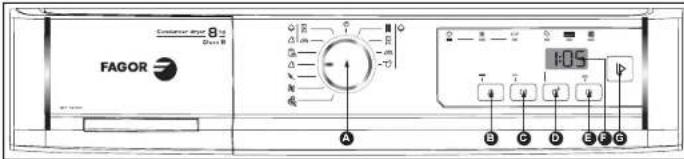
Your dryer is equipped with a sensor which automatically detects the moment when your laundry is dry.
STARTING THE APPLIANCE
- Check that the power cable is plugged in, and if the door is properly closed.
- Select your program (see the table "Your dryer's programs" on the following pages) by turning the Programs dial A (it turns in both directions).
- Press "Start/Pause" |D G. The program will start.
The display F tells you the time remaining and tells you more accurately, as the drying cycle progresses (Fig. 3.2.1).
Program progress:
Drying - Cooling down - End of program
DELAYING A PROGRAM'SSTART (Fig. 3.2.2)
- Select your program using the Programs dial (A)
- Press the "Delayed Start" button to do E the start of your program from hour to hour until you reach the desired delay time (max 24 hours).
Confirm by pressing the 'Start/Pause' button
The display F shows you how much time remains before your program starts. The last hour is decreased in minutes.
Once the time delay has expired, the program actually starts. The display tells you the time remaining, which becomes more precise as the drying cycle progresses.
ADDING OR REMOVING AN ITEM DURING DRYING
- Press the 'Start/Pause' button ▶ G to interrupt drying or open the door.
The display flash (Fig. 3.2.3).
- Insert or remove the item or items and close the door.
- Press the "Start/Pause" button to resume drying.
ALTERING PROGRAMMING OR DRYING DURING OPERATION
- Press the 'Start/Pause' button ▶ G to interrupt drying.
The display flash (Fig. 3.2.3).
- Select another program.
- Press the "Start/Pause" button ▶ G to resume drying.
BUZZER OPTION
- Press the "Buzzer" button ⚠ B. At the end of drying, three beeps will sound every minute for one hour until the door is opened or the appliance is stopped (Fig. 3.2.4).
ANTI-CREASING OPTION
- The "Anti-creasing" option fluffs the textiles every 10 minutes for up to 24 hours, until the door is opened or the machine is turned off. It begins as soon as the drying finishes and prevents the clothes from settling in the machine.
- To select this function, press the *Anti-creasing* button ⬇ (Fig. 3.2.5).
(continued)

TIMER OPTION
This function allows you to complete the drying of a few insufficiently dry items (as can happen with mixed loads) or to quickly dry small loads.
- Select the appropriate program for your laundry, using the Programs dials A
- Press the "Timer" key 📋 repeatedly, until you reach the desired drying time. The time is added in 10-minute increments (Fig. 3.2.6).
The drying temperature is adjusted according to the laundry type of the program selected.
- Start the dryer by pressing the "Start/Pause" button
TANK FULL WARNING DURING CYCLE
If your tank is full during the drying cycle, the appliance stops.
The "Tank Full" light and the time remaining flashes (Fig. 3.2.7).
- Proceed to empty your condensate container (see the "REGULAR MAINTENANCE" section).
- Press the "Start/Pause" button to resort your program.
CLEAN CONDENSER WARNING
The "Condenser warning" light will flash from time to time to remind you that you should clean the condenser.
Do not forget to do this as soon as possible, since the warning will disappear when the next program starts.
STOPPING THE APPLIANCE
At the end of the program, the "STOP" light flash and the display shows "0:00" (Fig.3.2.8).
The "Filter" and "Tank Full" lights flash to remind you that you must clean the filter and empty the water collection tank after every drying cycle:
- Turn the Time selector A to the "Off" position
- Empty your dryer.
- Clean the filter and empty the condensate container (see the 'REGULAR MAINTENANCE' section).
COOLING CYCLE
All programs finish with a cooling cycle that lasts for a few minutes to allow the washing to cool gradually.
Do not stop your dryer before this cycle has finished.
NOTE:
- The "Anti-creasing" and "Buzzer" options remains selected from one program to the next. You can simply press the button to deactivate these options, even during a program.


4 - REGULAR MAINTENANCE

4.1 - CLEANING THE FILTER
This is located in the lower part of your dryer. Clean it as follows:
- Remove it from its housing by pulling it upwards (Fig. 4.1.1).
- Open the filter and clean it by removing the thin coating of fluff covering it (Fig. 4.1.2).
- Re-insert it in its housing, pushing it well in.
Do not wash filter with water (Fig. 4.1.3). The filter must be cleaned after every drying.
4.2 - EMPTYING THE CONDENSATE CONTAINER
This is located at the top or bottom of your appliance (according to model), and it recovers the water extracted from your items during drying.
- To empty it, release it from its housing by pulling it towards you (Fig. 4.2.1).
The condensate container must be emptied after each drying cycle (Fig. 4.2.2).
— Empty the condensate container if there is a risk of frost, or if you wish to move or tilt your appliance.
4.3 - CLEANING THE CONDENSER
The condenser must be cleaned twice a month.
— Unplug the power cable from the socket before cleaning the condenser.
Clean it as follows:
- Open the grill at the front of the appliance.
- Release the condenser and remove it carefully (Fig. 4.3.1).
- Remove any fluff from the condenser. Clean it with water only under the tap (Fig. 4.3.2).
- After cleaning, ensure that none of the tubes are "blocked" and that the fins are clean.
- Rub it superficially.
- Re-insert the condenser and lock it in place. Close the grill.
When refitting the condenser, ensure that it is pushed in firmly right to the back of its housing when locking it in.
4.4 - CLEANING THE APPLIANCE
To clean the control panel, the access to the drum and the casing, use only a sponge or a damp cloth and some soapy water.
- Ensure that there is no fluff accumulating round the dryer.
– Clean the door seal with a damp cloth and the filter housing with your vacuum cleaner once a year.
- You should not use, under any circumstances, the abrasive powders, the metal or plastic sponges and the alcohol-based products (Fig. 4.4).
4.5 - DIRECT EVACUATION OF WATER CONDENSER (Top condensate container models only)
To avoid having to empty the collection tank every time you use the appliance, you have a kit (*) for removing the water from the condenser directly into the drain (hose and deflector). To fit this:
- Take off the existing pipe Ⓐ and push it inside the appliance (Fig. 4.5.1).
- Clip the deflector B with the top of the pump (Fig. 4.5.1).
- Connect the hose C from the kit to the end connector D on the appliance (Fig. 4.5.2).
You can connect the other end of the hose either: - To a ventilated trap (Fig. 4.5.3).
- Or a sink trap (Fig. 4.5.4).
When connecting to a trap, you must remove the filler plug. Then press home the rubber tip. If necessary, add a clamp connection (Fig. 5.4).
- (*) This kit is provided with the appliance or is available near your After-sales service (according to model).
— The deflector must necessarily be positioned before the drain hose connection.
4.6 - CHANGING THE BULB (according to model) You can replace the light bulb (type E14-15W/230V) yourself (Fig. 1.1). To do this:
- Unscrew the glass cover located to the left inside the appliance.
- Unscrew the extinguished bulb Ⓖ and replace it - Screw on the glass cover tightly.
Important: Unplug the power cord before changing the bulb. The bulb must be replaced when the appliance is cooled down.
5.A - YOUR DRYER'S PROGRAMS

| Programs Type of textile Drying results | ||
| COTTON | ||
| Extra drying | Cotton Dry | |
| Dry | Cotton Dry | |
| Ready to iron | Cotton Slightly damp | |
| Machine pressing | Cotton Damp | |
| MIXED | ||
| Dry | Regular textiles Dry | |
| Ready to iron | Regular textiles Slightly damp | |
| Other drying programs | ||
| Schirts | Synthetic, easy iron Dry | |
| Synthetics | Delicate, synthetic Dry | |
| Delicates | Very delicate: silk, light synthetic lingerie ... | Dry |
| Refreshing and airing your textiles after prolonged storage | ||
| Air and refresh | Other textiles 15 minutes | |
| Air woollens | Woollens 6 minutes | |
5.B - STANDARDIZED PROGRAMS

RECOMMENDED PROGRAMS FOR TESTS TO EN 61121 - DIRECTIVE 95/13/EEC
| Load I "Dry cotton" 8 kg .... select "Cotton" - Dry | ||||
| Load II | "Ready to iron cottonr" | 8 kg | .... select | "Cotton" - Ready to iron |
| Load III | "Easy care textiles" | 4 kg | .... select | "Synthetics" |


6 - TROUBLESHOOTING

Some incidents may arise when you are using your dryer. Here are the points you should check:
| Fault: Check whether: | |
| The dryer does not start: | - the plug is in the socket.- the door is properly closed.- the condenser is correctly locked in place.- the "Start" key was pressed (if the appliance was not in pause). |
| The drying times are too long: | - the filter in the drum is clogged with fluff.- the laundry has been spun enough beforehand (500rpm minimum, but spinning at 850rpm provides better drying times).- the room temperature is not too high, particularly if the room is small: if necessary, open the door or window.- the condenser is not clogged.- the air inlets and outlets are unobstructed enough to ensure correct air circulation.- the drying program selected matches the type of items in the drum. |
| The laundry is too damp: | - the filter in the drum is clogged with fluff.- the type of drying has been selected correctly: switch to the next programme.- the condenser is not blocked by fluff. |
| The laundry is too dry, too creased: | - the drying program selected matches the type of items in the drum. |
| The items are unevenly dried: | - the types of textiles in the load are too different (e.g. sheets together with jeans).- the laundry has been laid correctly 'unfolded' in the dryer.- the drum is not overloaded. |
| The synthetic items are loaded with static electricity: | - the laundry has been dried too much.- you have used softener during washing. By using this product, you can reduce most of the problems with static electricity. |
| The "Tank Full" indicator light is lit: | - the condensate container is full: once you have emptied it, re-insert it correctly, pushing it completely into its housing. |
| The "Tank Full" indicator light illuminates although the tank is empty: | - the container has been properly inserted: push it in completely.- the condenser is tightly locked on the two sides. |
7 - INTERVENTIONS

Any work on your appliance must be performed by a Brand-approved qualified professional. When you call, mention your appliance's full reference (model, type, serial number). These details are shown on the manufacturer's information plate (Fig. 1.1).


NOTES

DE - DEUTSCH 1 - INSTALLATION
A Programmtaste
© Anti-knitter
E Verzögerter Start
G Start/Pause
B Akustiksignal
D Zeitschaltuhr
F Anzeige
1.2 - OMGEVING HET APPARAAT

Programmaknop

Kreukelvrij

Uitgestelde start

Start/Pause

Bel

Tijdsinstelling

Display