EasyManual
KSE 55 Vario Plus PartnerEdition - Saw METABO - Free user manual and instructions
Find the device manual for free KSE 55 Vario Plus PartnerEdition METABO in PDF.

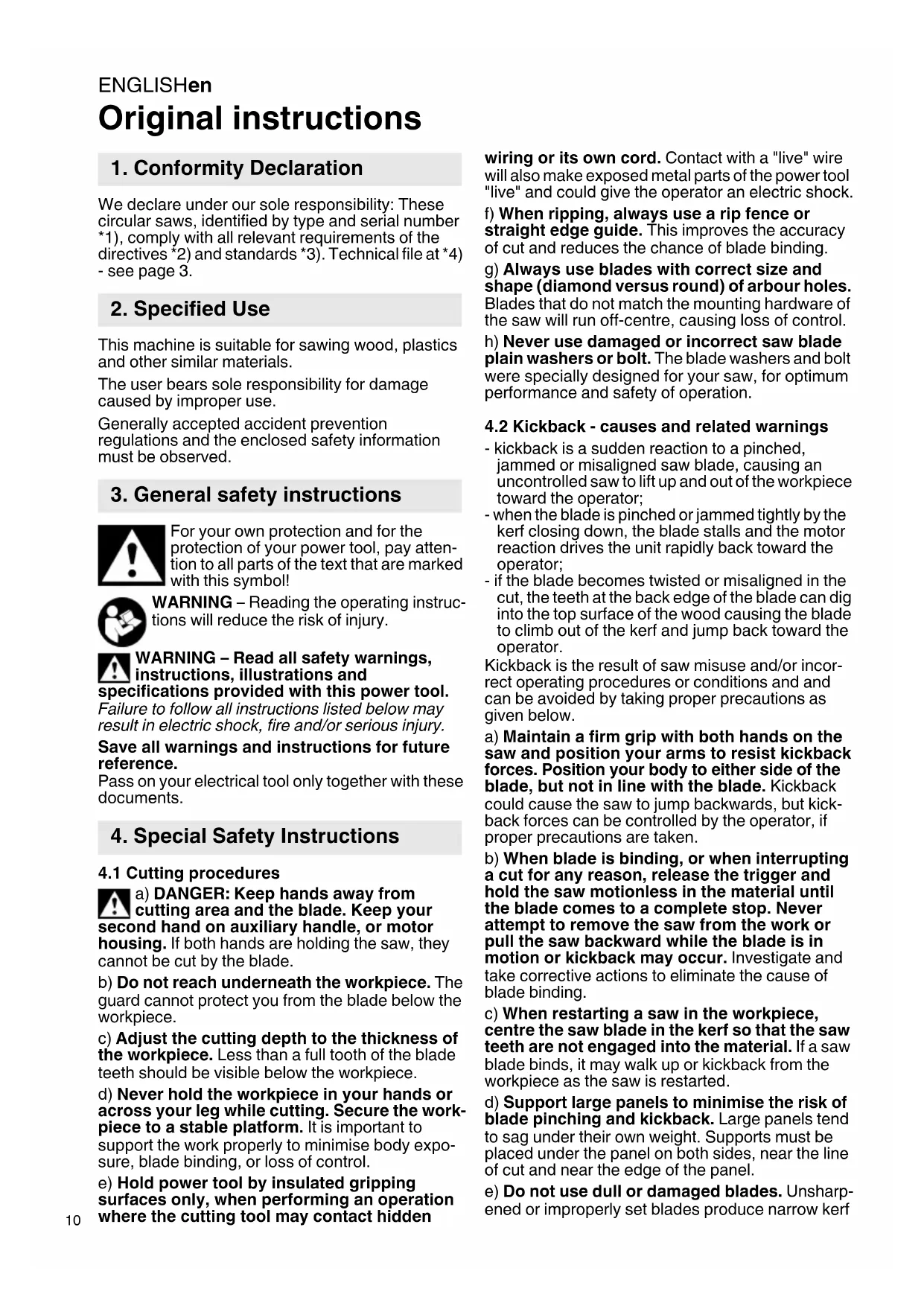


| Features | Details |
|---|---|
| Type of saw | Circular saw |
| Rated power | 1200 W |
| Blade diameter | 190 mm |
| No-load speed | 5000 - 6000 rpm |
| Maximum cutting depth | 55 mm at 90° |
| Blade tilt | 0 - 45° |
| Weight | 3.8 kg |
| Protection system | Restart protection |
| Included accessories | Saw blade, parallel guide, service key |
| Recommended use | Cutting wood, particle boards, composite materials |
| Maintenance | Regular cleaning, blade inspection, lubrication of moving parts |
| Safety measures | Wear safety glasses, use a cutting guide, do not remove guards |
| Warranty | 2 years |
Frequently Asked Questions - KSE 55 Vario Plus PartnerEdition METABO
User questions about KSE 55 Vario Plus PartnerEdition METABO
0 question about this device. Answer the ones you know or ask your own.
Ask a new question about this device
Download the instructions for your Saw in PDF format for free! Find your manual KSE 55 Vario Plus PartnerEdition - METABO and take your electronic device back in hand. On this page are published all the documents necessary for the use of your device. KSE 55 Vario Plus PartnerEdition by METABO.
USER MANUAL KSE 55 Vario Plus PartnerEdition METABO
Original instructions
1. Conformity Declaration
We declare under our sole responsibility: These circular saws, identified by type and serial number 1), comply with all relevant requirements of the directives 2) and standards 3). Technical file at 4) - see page 3.
2. Specified Use
This machine is suitable for sawing wood, plastics and other similar materials.
The user bears sole responsibility for damage caused by improper use.
Generally accepted accident prevention regulations and the enclosed safety information must be observed.
3. General safety instructions

For your own protection and for the protection of your power tool, pay attention to all parts of the text that are marked with this symbol!

WARNING - Reading the operating instructions will reduce the risk of injury.

WARNING - Read all safety warnings, instructions, illustrations and locations provided with this power tool.
Failure to follow all instructions listed below may result in electric shock, fire and/or serious injury. Save all warnings and instructions for future reference.
Pass on your electrical tool only together with these documents.
4. Special Safety Instructions
4.1 Cutting procedures
a) DANGER: Keep hands away from cutting area and the blade. Keep your second hand on auxiliary handle, or motor housing. If both hands are holding the saw, they cannot be cut by the blade.
b) Do not reach underneath the workpiece. The guard cannot protect you from the blade below the workpiece.
c) Adjust the cutting depth to the thickness of the workpiece. Less than a full tooth of the blade teeth should be visible below the workpiece.
d) Never hold the workpiece in your hands or across your leg while cutting. Secure the workpiece to a stable platform. It is important to support the work properly to minimise body exposure, blade binding, or loss of control.
e) Hold power tool by insulated gripping surfaces only, when performing an operation where the cutting tool may contact hidden
wiring or its own cord. Contact with a "live" wire will also make exposed metal parts of the power tool "live" and could give the operator an electric shock.
f) When ripping, always use a rip fence or straight edge guide. This improves the accuracy of cut and reduces the chance of blade binding.
g) Always use blades with correct size and shape (diamond versus round) of arbour holes. Blades that do not match the mounting hardware of the saw will run off-centre, causing loss of control.
h) Never use damaged or incorrect saw blade plain washers or bolt. The blade washers and bolt were specially designed for your saw, for optimum performance and safety of operation.
4.2 Kickback - causes and related warnings
- kickback is a sudden reaction to a pinched, jammed or misaligned saw blade, causing an uncontrolled saw to lift up and out of the workpiece toward the operator;
- when the blade is pinched or jammed tightly by the kerf closing down, the blade stalls and the motor reaction drives the unit rapidly back toward the operator;
- if the blade becomes twisted or misaligned in the cut, the teeth at the back edge of the blade can dig into the top surface of the wood causing the blade to climb out of the kerf and jump back toward the operator.
Kickback is the result of saw misuse and/or incorrect operating procedures or conditions and and can be avoided by taking proper precautions as given below.
a) Maintain a firm grip with both hands on the saw and position your arms to resist kickback forces. Position your body to either side of the blade, but not in line with the blade. Kickback could cause the saw to jump backwards, but kickback forces can be controlled by the operator, if proper precautions are taken.
b) When blade is binding, or when interrupting a cut for any reason, release the trigger and hold the saw motionless in the material until the blade comes to a complete stop. Never attempt to remove the saw from the work or pull the saw backward while the blade is in motion or kickback may occur. Investigate and take corrective actions to eliminate the cause of blade binding.
c) When restarting a saw in the workpiece, centre the saw blade in the kerf so that the saw teeth are not engaged into the material. If a saw blade binds, it may walk up or kickback from the workpiece as the saw is restarted.
d) Support large panels to minimise the risk of blade pinching and kickback. Large panels tend to sag under their own weight. Supports must be placed under the panel on both sides, near the line of cut and near the edge of the panel.
e) Do not use dull or damaged blades. Unsharpened or improperly set blades produce narrow kerf
causing excessive friction, blade binding and kickback.
f) Blade depth and bevel adjusting locking levers must be tight and secure before making the cut. If blade adjustment shifts while cutting, it may cause binding and kickback.
g) Use extra caution when sawing into existing walls or other blind areas. The protruding blade may cut objects that can cause kickback.
4.3 Lower guard function
a) Check the lower guard for proper closing before each use. Do not operate the saw if the lower guard does not move freely and close instantly. Never clamp or tie the lower guard into the open position. If the saw is accidentally dropped, the lower guard may be bent. Raise the lower guard with the retracting handle and make sure it moves freely and does not touch the blade or any other part, in all angles and depths of cut.
b) Check the operation of the lower guard spring. If the guard and the spring are not operating properly, they must be serviced before use. Lower guard may operate sluggishly due to damaged parts, gummy deposits, or a build-up of debris.
c) The lower guard may be retracted manually only for special cuts, such as „plunge cuts“ and „compound cuts“. Raise the lower guard by the retracting handle (17) and as soon as the blade enters the material, the lower guard must be released. For all other sawing, the lower guard should operate automatically.
d) Always observe that the lower guard is covering the blade before placing the saw down on bench or floor. An unprotected, coasting blade will cause the saw to walk backwards, cutting whatever is in its path. Be aware of the time it takes for the blade to stop after switch is released.
4.4 Additional Safety Instructions
Do not use grinding wheels.
Pull the plug out of the plug socket before carrying out any adjustments or servicing.
Keep hands away from the rotating tool! Remove chips and similar material only when the machine is at a standstill.

Wear ear protectors.

Wear protective goggles.
Press the spindle locking button only when the motor is at a standstill.
Do not reduce the speed of the saw blade by pressing on the sides.
The movable safety guard must not be clamped in the pulled-back position for sawing.
The movable safety guard must move freely, automatically, easily and exactly back into its end position.
When sawing materials that generate large quantities of dust, the machine must be cleaned regularly. Make sure that the safety appliances, e.g. the movable safety guard, are in perfect working order.
Materials that generate dusts or vapours that may be harmful to health (e.g. asbestos) must not be processed.
Check the workpiece for foreign bodies. When working, always make sure that no nails or other similar materials are being sawed into.
If the saw blade blocks, turn the motor off immediately.
Do not try to saw extremely small workpieces.
During machining, the workpiece must be firmly supported and secured against moving.
Use a saw blade that is suitable for the material being sawn.
Clean gummy or glue-contaminated saw blades. Contaminated saw blades cause increased friction, jamming of the saw blade and increase the risk of back-kicks.
Avoid overheating of the saw tooth tips. Avoid melting of the material when sawing plastic.
Use a saw blade that is suitable for the material being sawn.
Metabo S-automatic safety clutch:
If the tool jams or catches, the power supply to the motor is restricted. Due to the strong force which can arise, always hold the machine with both hands using the handles provided, stand securely and concentrate.
Reducing dust exposure:
WARNING - Some dust created by power sanding, sawing, grinding, drilling, and other construction activities contains chemicals known to cause cancer, birth defects or other reproductive harm. Some examples of these chemicals are:
- Lead from lead-based paints,
- Crystalline silica from bricks and cement and other masonry products, and
- Arsenic and chromium from chemically treated lumber.
Your risk from these exposures varies, depending on how often you do this type of work. To reduce your exposure to these chemicals: work in a well ventilated area, and work with approved safety equipment, such as those dust masks that are specially designed to filter out microscopic particles.
This also applies to dust from other materials such as some timber types (like oak or beech dust), metals, asbestos. Other known diseases are e.g. allergic reactions, respiratory diseases. Do not let dust enter the body.
Observe the relevant guidelines and national regulations for your material, staff, application and place of application (e.g. occupational health and safety regulations, disposal).
Collect the particles generated at the source, avoid deposits in the surrounding area.
ENGLISHen
Use suitable accessories for special work. In this way, fewer particles enter the environment in an uncontrolled manner.
Use a suitable extraction unit.
Reduce dust exposure with the following measures:
- do not direct the escaping particles and the exhaust air stream at yourself or nearby persons or on dust deposits,
- use an extraction unit and/or air purifiers,
- ensure good ventilation of the workplace and keep clean using a vacuum cleaner. Sweeping or blowing stirs up dust.
Vacuum or wash the protective clothing. Do not blow, beat or brush.
5. Overview
See page 2.
1 Marking (saw blade outer diameter)
2 Cutting indicator
3 Movable guard
4 Parallel stop
5 Locking screws (diagonal cuts)
6 Locking screws (parallel guide)
7 Locking button (switching on)
8 Trigger (switching on and off)
9 N o z chip ection)
10 Adjusting screws for zero-play sliding on guide rail (guide rail not included in scope of delivery, see chapter on Accessories)
11 Scale (diagonal cut angle)
12 Lock nut (adjust saw blade angle)
13 Adjusting screw (adjust saw blade angle)
14 Cable guide
15 Rotational speed preselection wheel
16 Signal display
17 Lever (for swivelling back the movable guard)
18 Depot for hexagon wrench
19 Hexagon spanner
20 Locking screw ( for setting cutting depth)
21 Clamping lever (for setting cutting depth)
22 Cutting depth stop (for setting cutting depth) and cutting depth indicator
23 Scale (depth of cut)
24 Handle
25 Auxiliary handle
26 Spindle locking button
27 Inner saw blade flange
28 Saw blade
29 Saw blade fixing screw
6. Initial Operation, Setting
Before plugging in, check to see that the rated mains voltage and mains frequency, as specified on the rating label, match your power supply.
Always install an RCD with a max. trip current of 30mA upstream.
Pull the plug out of the plug socket before any adjustments or servicing are performed.
6.1 Setting cutting depth
Note: It is advisable to set the depth of cut in such a way that no more than half of each tooth on the saw blade juts out under the workpiece. See illustration on page 2.
- Release locking screw (20). Lift motor section against guide plate (depth of cut = 0 mm).
- Preselect the desired depth of cut with the cutting depth stop (22), see illustration, page 2. To do this, release the clamping lever (21), set the cutting depth stop (22) on the scale (23) to the desired depth of cut and clamp the clamping lever again.
- Press the motor section downwards as far as the stop.
- Tighten locking screw (20) again.
Note: the clamping power of the locking screw (20) can be adjusted. Unscrew the screw on the lever to do this. Remove lever and mount offset counterclockwise. Secure with screw. When doing this, note that the cutting depth setting device moves freely when the lever is open.
6.2 Slanting saw blade for diagonal cuts
Loosen the two locking screws (5) to make the setting. Tilt the motor section against the guide plate. Read the angle which has been set from the scale (11). Retighten the front and then the rear locking screw (5).
6.3 Correcting the saw blade angle
The saw blade angle is set ex works.
If, at 0^ , the saw blade is not at right angles to the guide plate: release locking screws (5). Release lock nut (12) and correct saw blade angle with adjusting screw (13). Then retighten the lock nut. Retighten both locking screws (5).
6.4 Rotational speed preselection
Select the speed at the setting wheel (15). For recommended speeds, see page 3.
6.5 Setting extraction nozzle / chip ejection
Sawdust extraction:
remove nozzle (9) if necessary. To extract the sawdust, connect a suitable extraction unit with suction hose to the machine.
Sawdust ejection:
Fit nozzle (9) and turn in desired direction (away from body if possible).
7. Use
7.1 Switching on and off
Switching on: Press locking button (7) and hold in; then actuate the trigger (8).
Switching off: Release the trigger (8).
7.2 Signal display
The signal display (16) lights up briefly when the machine is switched on and indicates operational readiness. If the signal display lights up during
operation, this indicates overloading. Reduce the load on the machine.
7.3 Working instructions
Lay out the mains cable such that the cut can be executed without obstruction.
For this purpose, the mains cable can be held by the cable guide (14).
The marking (1) on the upper guard assists you in positioning the saw on the workpiece and when sawing. In the case of maximum cutting depth, it marks approximately the outside diameter of the saw blade and thus the cutting area.

Do not switch the machine on or off while the saw blade is touching the workpiece.

Let the saw blade reach its full speed before making a cut.
When the hand-held circular saw is added, the movable guard is swung backwards by the workpiece.
Open the bottom guard by hand only when making special cuts, such as plunge cuts and angle cuts. Open the bottom guard with the lever (17) and release it as soon as the saw blade has penetrated the workpiece. For all other sawing, the lower guard must be released.

When sawing, never remove the machine from the material with the saw blade turning. v the saw blade to come to a standstill.

If the saw blade blocks, turn the machine off immediately.
Sawing along a straight line:
the edge (2) serves as the cutting indicator. The edge corresponds to the left cutting edge of the saw blade.
Sawing with parallel guide:
For cuts parallel to a straight edge.
The double parallel guide (4) can be inserted from either side into the support provided for it. Maintain parallelism to the saw blade when making the setting. Retighten the front and then the rear locking screw (6). It is best to calculate the exact cut width by making a test cut.
For cuts parallel to a straight workpiece edge: Apply the parallel stop (4) such that the stop rail is facing down.
For cuts parallel to a straight edge on the workpiece: Apply the parallel stop (4) such that the stop rail is facing up.
Sawing narrow sections, e.g. along a wall: the machine is designed and shaped so that the upper guard, for example, can be guided along a wall. Sawing is thus possible at very narrow sections near a wall. False joints, for example, can also be created.
Plunge cuts:

When plunge cutting, always hold the machine firmly with both hands on the
handles provided Otherwise there is a risk of back-kicks.
For a safer hold on the machine when plunge cutting, the rear edge of the guide plate must be placed against a fixed stop. Mount the machine therefore on guide rail 6.31213 and against its stop, or secure a stop rail on the workpiece.

When plunge cutting with a blade inclined to more than 15^ from a vertical position, serve the following:
- For safety reasons, always use guide rail 6.31213.
- Secure the guide rail to the workpiece using 2 clamps 6.31031.
- Hold the machine firmly by the handle with your right hand while pushing down the guide plate onto the guide rail with your right hand so that the machine rests securely on the guide rail.
- Release the locking screw (20) and move the motor section to its top position.
- Completely open the movable guard with the lever (17) so that the machine can be mounted on the workpiece.
- Preselect the desired depth of cut with the cutting depth stop (22), see illustration, page 2. To do this, release the clamping lever (21), set the cutting depth stop (22) on the scale (23) to the desired depth of cut and clamp the clamping lever again.
-AIign the saw blade to the scribe mark. - The rear edge of the guide plate should be positioned against the stop of the guide rail, or against the stop rail fitted on the workpiece.
-Switch on machine. - Hold the machine firmly and push downwards in one smooth action. The saw blade now cuts into the workpiece. The plunging depth can be read off on the scale (23).
7.4 Sawing with guide rail 6.31213
For straight and spinter-free cutting edges accurate to the millimetre. The anti-slip coating keeps the surface safe and protects the workpiece against scratches. The machine can be placed against the stops on the guide rail for plunge cutting and cuts can be executed with a uniform length.
For guide rail 6.31213, see chapter on Accessories.
8. Maintenance
Clean the machine regularly. This includes vacuum cleaning the ventilation louvres on the motor. Use compressed air to clean the movable safety guard (3) regularly (wear safety glasses when doing so). The guard must move freely, automatically, easily and exactly back into its end position.
8.1 Changing saw blades

Pull the plug out of the plug socket before any adjustments or servicing are performed.
- Press in spindle locking button (26) and hold in place.
- Insert the hexagon spanner in the saw blade fixing screw (29). Turn the saw shaft slowly with the
ENGLISHen
hexagon spanner until the lock catches. (The spindle is now secured against twisting.)
- Unscrew saw blade fixing screw (29) by turning counterclockwise.
- Release the spindle locking button (26).
- Open guard (3) manually as far as the stop and hold open.
- Press in spindle locking button (26) and hold in place.
- Release the guard. (It is now held by the spindle locking button (26)).
- Release the spindle locking button (26).
- Remove saw blade (28).
- The contact areas between inner saw blade flange (27), saw blade (28) and saw blade fixing screw (29) must be free of sawdust.
- Ensure that the inner saw blade flange (27) is inserted the correct way round (the collar faces the saw blade).
For correct operation of the safety clutch, the contact surface of the saw blade fixing screw (29) that contacts the saw blade must be coated with a thin film of grease. Regrease with a multi-purpose grease (DIN 51825 - ME / HC 3/4 K -30).
- Insert a new saw blade, making sure the direction of rotation is correct. The direction of rotation is indicated by arrows on the saw blade and guard.
- Press in spindle locking button (26) and hold in place.
- Fit the saw blade fixing screw (29) and tighten firmly in clockwise direction.
- Open guard (3) manually as far as the stop. This releases the lock. Let the guard turn in closed position.
Use only sharp, undamaged saw blades. Do not use any cracked saw blades or blades that have changed their shape.
Do not use any saw blades made from high-alloy high-speed steel (HSS).
Do not use any saw blades which do not conform to the specified rating.
The saw blade must be suitable for the no-load speed.
Use a saw blade that is suitable for the material being sawn.
Saw blades intended for cutting wood or similar materials have to conform to EN 847-1.
9. Accessories
Use only genuine Metabo accessories.
Use only accessories which fulfil the requirements and specifications listed in these operating instructions.
For a complete range of accessories, see www.metabo.com or the main catalogue.
10. Repairs
Repairs to electrical tools must be carried out by qualified electricians ONLY!
A defective mains cable must only be replaced with a special, original mains cable from metabo, which is available only from the Metabo service.
If you have Metabo electrical tools that require repairs, please contact your Metabo service centre. For addresses see www.metabo.com.
You can download spare parts lists from www.metabo.com.
11. Environmental Protection
Observe national regulations on environmentally compatible disposal and on the recycling of disused machines, packaging and accessories.
Only for EU countries: Never dispose of power tools in your household waste! In accordance with European Guideline 2012/ 19/EU on used electronic and electric equipment and its implementation in national legal systems, used power tools must be collected separately and handed in for environmentally compatible recycling.
12. Technical Specifications
Explanatory notes on the specifications on page 3. Changes due to technological progress reserved.
P1 = Rated input
P2 =Power output
n_0^ = No -load speed
n1*=On-load speed
T90° =max. depth of cut (90°)
T_45^ =max. depth of cut (45^)
A = Adjustable angular cut angle
D = Saw blade diameter
d = Saw blade drill diameter
a = Max. base body thickness of saw blade
b = Cutting width of saw blade
m W e i g h
Measured values determined in conformity with EN 62841.
Machine in protection class II
Alternating current
The technical specifications quoted are subject to tolerances (in compliance with the relevant valid standards).
- Energy-rich, high-frequency interference can cause fluctuations in speed. The fluctuations disappear, however, as soon as the interference fades away.
Emission values Using these values, you can estimate the emissions from this power tool and compare these with the values emitted by other power tools. The actual values may be higher or lower, depending on the particular application and the condition of the tool or power tool. In estimating the values, you should also include work breaks and periods of low use. Based on the estimated emission values, specify protective measures for the user - for example, any organisational steps that must be put in place.
Vibration total value (vector sum of three directions) determined in accordance with EN 62841:
a_h,D = Vibration emission value
(Sawing chip board)
K_n,D = Uncertainty (vibration)
Typical A-effective perceived sound levels:
LDA =Soundpressuerelevel
LA = Acousti c power level
K_pA, K_WA = Uncertainty
During operation the noise level can exceed
80 dB(A).

Wear ear protectors!
FRANÇAISfr
Notice originale
6. Anvanda, stalla in

med
Saga after rak marking:
d = Sagbladhull-diameter
Reservedelslicer kan downloads pa www.metabo.com.
He ncpoJb3yIe a6pa3nBhIe kpyrN.
Ipeed BbINOJIHeHHeM KaKx-JI6o pa60 nO peYIINPOBKe HNI TEXHNueCKOMy 06ClyJHKBaHHIO IHCTpyMeHTa BbIHMaTe BnIKy CeTeBOrKa6eJIa N3 pO3eTKN.
He npHKacaiTeCb K BpaauoUeMcy INHCTpyMeHTy! YdaJIaIYe ONNIKn I TOM ynoO6HOe TOLbKO NocIe NOJHO OCTaHOBKn INHCTpyMeHTa.

IcnoIb3yIte cpeICTBa IJIA 3aIITbI Clyxa.

HaedeBaIte 3aunTHbIe OUKn.
KhoNky cToIopa WnHdEJI NcNoJb3yTe ToJIbKO npu BbIKIOUeHHOM DBNrataTe.
He octaHaBnBaIe UHCTpyMeHT, npHHMaJ nnbHbI dNcK c6Oky.
3aKpeTb npn nIJIeHn NOBnKhbI 3aUHTbI KOxh B OTKNHyTOM Ha3ad NOJIOKeHn 3aPepa-etcra.
3aunTHbI KOxUx DOJIKeH CBO6OJHO DBnraTbcra, ABTOMaTNueCKN IeKo N TOH O3BpaAaTbcra B CBOE KOHeuHoe NOLOKeHne.
Pn nnleHnn MaTePnaIOB C NOBbIeHHbIM nbIeO6pa3OBaHHeM INHCTpyMeHT CneDyET peRyJIpHO ouHtB. Heo6xOIMO oEocNeyTb 6e3yIpueHoe yHKUHOHPOBaHHe 3aunTHbIX yCTpoiCTB (HaNPmep NODBnKHO 3aunTHoro KOxyxa).
He donyckaetc o6pa60ka MaTePnaIOB, BbIeJIaHoux ONaChbIe IJIa 3DopOBbI PbIb NII Napbl (BcaCTHOCTn, ac6ecTa).
PYCCKHrU
PpOBepaIte 3arOTOBky Ha OTCyTCTBHe HnOpOaNbIX npEMeTob. Ppi pa6ote Bcerda CJIeIte 3a TEM, YTO6bl NIIa He HaxoNla Ha TBO3dN IN TOMy NOO6HbIe npEMeTbI.
B clyuae 3aKlnHbAHnI nnIbHOrO nIcKa HEmeJIeHHo BbIKIOHTe DBrTaTeJb.
He nbIaItecpe3aTb CInuKOM MaJIeHbKne 3aROTOBKn.
Pn 6pa6tke 3arotobka dOJIkHa nIIOTHo npIneRaTb K BepCTaky N 6bITb 3aUuSeHa O T CMeueHnA.
Icnoj3yTe TOIbKO To NnIbHOe NOIOTHO, KOTOpoe CneuaJIbHO npEHa3HaueHo dJa 6pa-60TH DaHHoro MaTePnaJa.
OuHuaTe 3acMOJIeHHbIe HIN 3aRpa3HeHHbIe OCTaTHAMN KJER NIIbHbIe DNcH. 3arpa3- HeHHbIe NIIbHbIe DNCKn YBJIaOTc npUHNo BO3HNKHOBEHnIOBbIeHHoro TpeHn, 3aueMLeHn IINbHOro DNcKa n IpEcdTAbJIrOT NOBblIeHHyO ONaCHOCTb NOBJIeHHn OTdaHn.
He donyckaTe neperpeBa BepuH 3y6beB nnbHorO dNcKa. N36eraTe pacnlaBa MaTePnAna npn nIeHH nIacTMaccbI. HcnoJIb-3yITE TOIbKO To NNbHOe NOIOTHO, KOTOpoe CneuaJIbHO npedHa3NaHeO dIra Oba6OTKn DaHHoro MaTePnAna.
PpeoXpAHnTeBna MyfTa Metabo S-automatic: B Cnyae 3aueMLeHn Hn 3aueIeHn NnIbHO TnCKa DBnraTeB OCTaHaBnBaETCa. Te MeHee, B CB3N C BO3MOxHbIM BO3HNKHOBeHnEM OTdau n pR pa6ote Bcerda DepKHTe INCTpyMeHT DByMa pyKaAMn 3a pyKoTKn, PnHmMaTe BoJe e YcTouHBOe NOLOKeHne I 6yDbTe BHNMaTeBnbl I npn BblONHeHH pa6Otbl.
CHINHEHNE nbIeBOH Harpy3KN:

PNEyPENKDEHNE -nblb,
606pa3oBabwaaCBApe3yIbTaTe WlnΦOBHnHaJdaHOn bymarO, paCnnIINBaHHa, WlnΦOBHN, CBeprHeHn Ipynx BnIOB pa6OT, codepKHT XmHueckne BeUeCTBa, Bbl3bIbaIOuIne paK, BPOXdEHHbIe DeΦeKTbI NIn DpyrNe NOBpeJDeHHn pePpOdyKTNBHO CnCTembl. PnpMepbI TaHX XmHueckNX BeUeCTB:
CBNHcB KpaChe C COpeKaHnEM CBNHca,
-MINHepaIbHaN IbIb CO CToPOnTeIbHOrO KInpNnua, cEmeHTa N dpyrnx BeuceTB KInpNnuHOr KlaAdKn, a TaKKe
-MbIiBjHK XpOM N3 XHMnueckn 6pa6oTaHHoJ DpeBeCInHbl.
CTeneHb pncka 3aBnCnT OT TORO, KaK yacTo Bbl BBINOJIHReTe 3OT BnD pa60t. YTO6bl yMeHbIHTb BO3dEICTBHe XIMNueCKNX BeIeCTB: pa6oTaIte B NOMEeHNx C DOCTaTOUHO BEHTNJLcneN I YTBepXDeHHbIM JINuHbIM 3aUNTHbIM ChapJKeHHeM, HApPmEp, peCnnpaTOP, pa3pa6oTaHHbI CNEuaJIbHO DIA FNIbTpauNN MINKPOCKONHueCKNX YaCTNu.
3TO TaKHe KacaetcNbIIN OT Dpyrnx MaTePnaIOB, HAnpImep, HeKOTOpbIX BnIDOB DepeBa (DpeBeCha Nbl dy6a nn 6yka), MeTaNla, ac6ecTa. Dpyrne N3BeCTHbIe 3a6OleBaHHN — 3TO, HAnpImep, aJIleprHueckne peakun, 3a6OleBaHHN dIbIXaTeNbHbIX nyTei. He donyckai Te nonadaHHN nbIIN BHyTpbo PrAHn3Ma.
Co6IIOJaTe DnpeKTHBbl, OTHOCaHneC K BaWIM yCLOBnM, H NaUHOHaJIbHbIe IpeDnIcAHN, BKIOUyA O6paBaTbIBaEMbI MaTePnaI, NepCOHaI, BApHaNTbI pImMeHEnH N MeCTO nPoBeDeHN paBOT (HaNPmEp, NoLoXeHnO 6 OxpAne Tpyda nnO6 yTnIn3aun).
Obecneyte ydaJIeHne o6pa3yUOxNc8 qactn, He DonyckaIte o6pa3OBAHnOToJIOKeHnB OkpyKaIOUeM pOcTpaHCTBe.
IJIa CneuaJIbHbIX pa6OT nCIOJIb3yIte NOxOJaUyO OChACTHy. 3TO IO3BOJNT COKpaTHTb KOJIueCTBO YaCTNu, HEKOHTPOJNpyEMO BBI6paCbIbAeMbIX B OKpyKaIOU cyEdu.
IcnoB3yIte nOxOJaIe yCTpoIcTBO ydaJIeHn Ibln.
ДяУMeHbWeHЯпьJEBOH Harpy3Kn:
-He HappaBJIrTe BbI6paCbIbAeMbIe N3 HNCTpyMeHTa YactnUcbl NOTpa6oTaHHbI BO3dYx Ha Ce6ra, HaxOJaXnxCpRdOM IIODeHnnHa CKOpJIeHnI PbIIN;
- INCINb3yIne BbITAHHOe yCTpOcTBO HJIN BO3DyXOOuNCTnTEJIb;
- xopoio npoBETpnaTe pa6ooye MeTo n COepKHTe erO B YnCTOTE C NOMOuIO nbIeCocA. POnMeTaHne Hn npOyBkA TOLbKO NOHNMaET PbIb B BO3dYx.
O6pa6aTbIbAIte NJIeECOCOM INN CTnpaTe 3aUHTHyIO OeKdy. He npOyBaIte ODeKdy BO3dYxOM, He BbIbIbAIte IN He CMeTaIte C Hee Nblb.
5.0630p
CM.c.2.
1 MapKnpoBka (HapyKnBn DnAmTp NnIbHorO nIcKa)
2 Kaataelb HnpaBneHn nnneHn
3NoBnKa 3aHTHa KpbIka
4 PapaJIeJIbHbI ynp
5 CTOnOpHbIe BnHTbI (JyIa BbINOJIHeHnKpNBOJIINHeHbIX npONIIOB)
6 CtonopHbIe BnHTbI (Jna npaJIeJIbHoro ynpa)
7 BLOKINPOBOUHNA KHOHNa (BKNIOUOHeHnE)
8 HaKIMHOI nepeKIOUaTeJIb (BKNIOUeHne/ BbIKIOUeHne)
9 NaTpy6ok (DyBbIbPoca OINIOK)
10 PerylnpoBObHbIe BnHTbI dIg 6e33a3OpHOro CKOJIbKeHn IHO HApBaBlaHoue JINHe (HaPpaBIAIOUaA WInHa He BXoDHT B KOMPJIeKT NOCTaBKn, CM. TJIaBy «PpHaADJeKHOCTN»)
11 ⅢkaIa (IyraHOBKn yrna KpINBOJIHHeHOrO nponna)
12 KOnTpraJaKa (dIa peryJInpOBKn yrJa nHbHorO dNcKa)
13 PerylnpoBOHyb BnHT (dIa HAcTpOuKn yrJa nnJIbHOro DnCKa)
14 Ka6eJIbHbI BBOd
15 YctaHOBOHoe KOleCNKO IJI ppeDyCTaHOBKn YactOTbI BpaueHn
16 CnHaJIbHaJaMaNa
17 Pbyar (Дя OTBeHnHa3aI IOBnKHOJ 3aHTHOKpbIHKN)
18 OTdeneHne Iy XpaHeHn HIOueH-
UeCTnIgpaHHNIOB
19KIOU-WeCTnIgpaHHNK
20 CToOpHbI BnHT (dIpapeylnpOBKn Ily6HbI nIIeHHa)
21 3aKIMHOn pBiHaR (IJIpeRyIINPOBKN IJIy6HbI nIIeHHA)
22 OrpaHnHTeJIb Iy6HbI NIIeHnIa (JIA TOHOI peYInpOBKn Iy6HbI NIIeHnI) INI INHdNKaTOp Iy6HbI NIIeHnI
23 ⅢkaJa (IJIOnpeJeHnR rIy6NbI nIIeHnR)
24 PyKoHTKa
25 DOnoJIHnTeJIbHa pyKoIrKa
26 KhoNka cToonopa WnHdEJIa
27 BnytpenHHn fHaHeu dIy KpenHn HnIbHorO nCKa
28ПильньдИСК
29 KpeeKhbl BnHT dIy nIbHoro dIscKa
6. BBoD B 3KcPnyaTaunIO, peryInpOBka
IpeD BBODOM B 3KcNJIyaTaUIO npOBepbTe COOTBETCTBNE HAnpRKeHn I YaCTOTbI CETn, yKa3aHHbIe Ha 3aBOdCKo Ta6nUHe, NapamTpam CETn 3JIeKTPoPNTaHn.
IpepeHnHCTpyMeHTOM BcERda NIOdKlnOuaTe aBTOMaT 3aunTbI OT TOKa yTeuKN (Y3O) c MAKC. TOKOM OTHIOUeHn 30 mA.
Ipeep npoBeDeHnem KaKnx-Jn60 peryInpoBOOHyIx INI TexHnuecKnx pa6OT BbIHMaIte BNk Ky CeTeBOrO Ka6eJIr n3 pO3ETKn.
6.1 PerynpoBka rnybHbI nJIeHnA
Yka3aHHe: cIeLcoo6pa3Ho OTpeRyIInpoBaTb rny6nHy nIIeHnra TaKIM o6pa3OM, YTO6bl BBICTyn 3y6beB NIIbHOrO dNcKa NOd 3aROTOBKO COCTaBnI He 60JIe e IIOOBnHi X BbICOTbl. CM. pncyHOK Ha c.2.
- Ocna6bTe cToOpHbI BnHT (20).PpInoDnHMnTe 6LoK DBrTaTeJI C HAnpaBlaHOUeN PIACTINHbI (rJy6Ha NIIeHn = 0 MM).
- YctaHOBNTe HxKHyIgLy6Hny nIIeHNrC NOMOuIIO OrpaHnHTeJIy (22) -CM. pnc. Ha c. 2. IJRA 3TOr pa36IoKInpyTe 3aKHMHOI pbUar (21), yCTaHOBNTe OrpaHnHTeJIb rLy6HbI nIIeHNr (22) no WkaIe (23) Ha Heo6XoDMyIO BELINHHY IN CHOBA 3a6IoKInpyTe 3aKHMHOI pbUar.
-ПижмпеблOKдвогателДу унорвиЗ. - CHOBA 3aTaNHe CTOnOpHbIN BnHT (20).
Yka3aHHe: yCInHe 3aTJxKn CTOnOpHOro BnHTa (20) MoKeT peryInpOBaTcB. IJa 3ToR OHeo6xoIMMo BvIBepHyTb BnHT pbUHa. Chmnte pbIur n yCTaHOBtEeroB CMeJeHHOM npOTNB YacOBo CTpeKN HAnpaBLeHN. 3aKpeNITE pbIur BnHTom. Pn 3Tom CJIeDyET pINHrTB BO BHNMaHne, YTO npn pa3bLOKnPOBaHHOM pbIaRe peRyInpOBbA rIy6bHbI NJIeHnB BbINOJIHReTcB 6e3 KaHX-Jn60 3aTpPydHeHn.
6.2 YcTaHOBHa HnIbHOrO DnCKa NOD HAKIOHOM IJRA BbINOnHeHHa KpNBOLHNHeHbIX IpONNIOB
IpynpoBn Ocna6bTe 06a CTOnOpHbIX BNHTa (5).HaKIOHnTe 6JOK DnRatEeK HnPaBIAOSei PnactHe. YCTaHOBJIeHHbYrOJ MOXHO CHTaTb NO shkane (11).CHOBA 3aTaNHTe CTOnOpHbIK BNHT (5) ChauJaHa nepeDHei CTOpOHe, a 3aTeM Ha 3aDHei.
6.3 HoppeKTHPOBHa yrIa nnIbHOrO dNcHa YroI nnIbHOrO dNcKa rBJIeTcR 3aBOdCHOYCTaHOBKO.
Ecn npn yrIe 0^ nHbHbN dNcH HepePHeDnKUJpeH HnPaBnIOuSei PnAcTnHe: Ocna6bTe cToOpHbIe BNHTbI (5).Ocna6bTe KOHTprAky (12) nOTpeylnpyte yroI nHbHO dnCKa C NOMoCbIO perylnpOBoHoro BNHTa (13). 3aTEM CHOBA 3aTaNHTe KOHTpraHy. ChoBa 3aTaNHTe 06a cToOpHbIX BNHTa (5).
6.4 BbI6Op YacToTbI BpaSeHnA
C nOMOuBIO yCTaHOBOUHORO KOJecnka (15) yCTaHOBInTe yactOTy BpaueHn. PeKoMeHdyembIe 3HaueHnY aactOTbI BpaueHn CM. Ha c. 3.
6.5 PerylnpoBHa BbITaXHoro naTpy6Ka/ Bbl6pOca ONIIOK
OTCOCOINIOK:
Pn Heo6xOaMocTn OTcoeHNHTe naTpbyok (9).
Iy OTCocA ONHOK NOcOeHNHTe K NIIe
NOxOJaUe PbIeYdaJHoue yCTpOiCTBO CO
WJahrom.
Bb6poc onHIOK:
yctaHOBNTe naTpy60K (9) n 3aBepHnTe ero B HyKHOM NOLOKeHHN (NO BO3MOXHOCTN B CTOPOHy OT ONepaTopa).
7.Зкплуataцья
7.1 BkIIOUeHHe/BbIKIOUeHHe
BhJIOUeHne:HaKMITE 6LOKINPOBOUYIO KHOHNky (7) uYdepKnBaIte ee HaKaToI, 3aTeM HaKMITE HaKMHOI nepeKIOUaTeIb (8).
BbIKIOUeHne:OTNcyCTIteHaKHMHOI nepeKIIIOuAtelb(8).
7.2 CnHaJIbHaJaMaNa
CnHaJIbHaJa lamna 3aIopaeTcra (16) Ha KOpOTKoe BpeMa npBkIIOUeHNu CnHApIN3NpyET O rTOBHOCTn K pa6Ote. Ecn CnHaJIbHaJa lamna 3aIopaeTcBA BpeMa pa6Otbl, HMeet MeCTO neperpy3ka INHCTpymeHTa. Chmnte Harpy3ky c INHCTpymeHTa.
7.3 yha3aHnno 3KcnIyatau
PpOKlaIbIbAaTe CeTeBOH Ka6eJIb TaKIM O6pa3OM, YTO6bl MOxH0 6blIO 6ecnpeTCTBEHHO BblONHrT NJIeHHe.
C 3ToI ueIbIO CeTeBOI Ka6eJIb MOxHIO 3aKaTb B Ka6eJIbHOM BBOe (14).
MapknpoBka (1) Ha BepxHe 3aunTHoH KpbIuKe CnyKHT DnT OTuHOCTn Pn yCTaHOBKe 3aTOBOKn H
PYCCHNru
NIIeHn. Pn MaKcMaJIbHOJrIy6HHe NIIeHn MapKnipOBKa npIMepHO paBHa BHeuHEmy DnaMeTpY NIIbHOro DCCKa n TEM cMbIM DnaNa3OHy NIIeHn.
He BkHouaTe/BBIKHIOuaTe HNCTpyMeHT, noka nnbHbI dNCK KOHTaKTnpyeT C 3aROTOBkoI.
IpeKJeHHaatb NHe,doJNTecb, noka nnBnDnCK pa3roHnTcRdo pa6oey TaCTOTb BpaueHn.
Pn yctaHOBKe pyHoi cIpyJIpaHoi nJIbIOBHHa 3aunTHa KpbIka OTBOHTc83aTOBKO Ha3aJ.
OTKpbBaIte HNHHIO 3aunTHyIO KpbIuKy BpyHyIO TOIbKO npn BbINOJIHeHNN CNEuaJIbHbIX pa6oT, HanpIMep npn NorpyHOM nIN yrLOBOM nIIeHN. OTKpoTe HNHHIO 3aunTHyIO KpbIuKy c NOMOUsbIO pbUcara (17) nOTnyCTnte erO, KaT OToIbKO nIIbHbI dNCK Norpy3NTcR B 3aROTOBky. PnBbINOJIHeHNN BCEx dpyrnx pa6oT HNHHra KpbIuKa DOJHKHa cpa6aTbIBaTb aBTOMaTnueChN.
He BbIHMaIte HNCTpyMeHCTBpaUaOUMCnINbHbIM DNCKOM BO BpemnINHeHnN3 MaTePnAna. DoXdntecb OCTaHOBNn INlbHOro DnCKa.
Pn6IIOKINPOBKe nIbHOrO dNcKa HEmeDJIeHHBOBbIKJIOUHTe IHCTpyMeHT.
HJIeHne no npraMOnHeHNo pa3MeTKe: yKa3aTeJem HnPaBHeHn PJIeHn CnyKHT KpOMka (2). KpOMka COOTBeTCTByET JeBOI peKyuEe KpOMKe NIIbHOrO DnCKa.
Пиеленс napalilelbHIM ynopom:
CnNcK 3aNaChbIX cacteM MoXHo cKaaTa b Ha caIte www.metabo.com.
11. 3auntata OKpyhaioe cpebl
BbInHnIe HaunHaJIbHbIe npaBnla yTnIIN3aunn npepeabOTKn OTCnyKHBwero INHCTpyMeHTa, yNaKOBn n npHaJdJeHHocTei.
ToIbKO dIa CTpaH EC: He yTnIIN3npyIte 3JIeKTPoPn6Opbl I 3JIeKTPoHNCTpymeHTbl BMeCTe C 6bITOBbIMN OTXODAMN! CorlaCHO ebPoneiCKo DNpeKTNBe 2012/19/EU o6 NcNoJIb3OBAHNN CTapBX 3JIeKTPoPn6Opob N 3JIeKTPoHNHO 6ObpyDoBaHNN COOTBETCTBYIOUIM HaCNOHaJIbHbIM HopMaM 6bIBWne B yNtpe6JIeHN N 3JIeKTPoPn6Opbl I 3JIeKTPoHNCTpymeHTbl IOJLeKaT pa3DeJIbHOJ yTNIIN3aUHN C cEJIbIO IN NOcJIeDyUOSeI 3HOLOrHuYeCKN 6e3OnaChOH nepepa6OTKn.
12. Texnuechne XapaHTepncTnKn
IorcheHnKaaHHbIM,yka3aHHbIM Ha c.3. OctabJIeM 3a co6oN npaBO Ha TexHnueckne n3MeHeHn.
P1 = HOMHaJIbHa MOnHOCtB
P2 =BbIXOHaRA MOUHOCTh
n0* =acToTaBpaueHna6e3Haarpy3KN
n1* =caCTotaBpaueHnnoHaRpy3KoI
T90° =MaKc.Γny6nHa nHHeHHa (90°)
T45° =MaKc.Гny6nHa nIJIeHnA (45°)
A =perylnpyemby yroI nponna
d =ДиamETp NOcaOduHOrO OTBepCTnI INIbHOrO DnCKa
a =MaKc.TOJIuHa OCHObI INIbHOrO dNcKa
LpA =ypoBeHb3ByKOBOrDaBHeHn
LWA =ypoBHeH 3ByKOBO MOUHOCTN
KpA, KwA = KOaΦnueHT norgpeHOCTN
HaedeBaTe 3auntHbIe HayuHNKn!
EAC
HΦopmaζηДЯ NOhynatela:
CeptnuHkat COOTBETCTBnA:
No TC RU C-DE.BJ08.B.01850, cpoK DeiCTBnA C 23.10.2018 no 22.10.2023 r., BbydAn opraHOM nO ceptuKaun npoUkun «IBAHOBO- CEPTNΦHKAT» OOO «IbaHOBCnI ΦOnD CepTuKaun); Adpec (Iop. n faoT.): 153032, Pocchckan Phedepaun, IbaHOBCnA o6l., r. IbaHOBO, yI. CtaHKOcTpOnTeJe, d. 1; TeI. (4932)77-34-67; E-mail: info@i-f-s.ru; Attectat aKpeHHTaun No RA.RU.11BJ08 ot 24.03.16 r.
CtpaHa n3rOToBnHeHn: TepMaHnI
ПОНЗВОДИТЕЛБ: "Metabowerke GmbH", Metaboallee 1, D-72622 Nuertingen, Германя
UmmopTeB Poccn:
OOO "MeTa6o EBypa3n"
Pocn,127273,MockBa
yI. Bepe3OBAa anJe, 5 a, cTp 7, oΦnc 106 TEL.: +7 495 980 78 41