
BM 3987 - Bread maker SEVERIN - Free user manual and instructions
Find the device manual for free BM 3987 SEVERIN in PDF.


| Product type | Bread maker |
| Brand | Severin |
| Model | BM 3987 |
| Supply voltage | 230 V~, 50 Hz |
| Power consumption | 715 W (heating max. 610 W, motor 105 W) |
| Maximum flour capacity | 600 g (for 1000 g bread) |
| Dimensions (W × D × H) | 39 × 27 × 31 cm |
| Weight | 7.95 kg |
| Number of programs | 8 (Normal, Rapid, Cakes, White/Crispy Bread, Biscuits/Pastry, Whole Wheat Bread, Dough, Bake) |
| Delayed timer | Up to 13 hours |
| Crust levels | 3 (Light, Medium, Dark) |
| Keep warm function | Approximately 60 minutes |
| Included accessories | Measuring cup, measuring spoon |
| Mold material | Non-stick coating |
| Special features | Audible signal for ingredient addition, key lock, automatic shutdown in case of overheating |
| Maintenance and cleaning | Mold and hook are washable in soapy water (not dishwasher safe); interior cleaned with a soft dry cloth |
| Safety | Safety clip, automatic shutdown in case of overheating, key lock during program |
| Warranty | 2 years |
Frequently Asked Questions - BM 3987 SEVERIN
User questions about BM 3987 SEVERIN
0 question about this device. Answer the ones you know or ask your own.
Ask a new question about this device
Download the instructions for your Bread maker in PDF format for free! Find your manual BM 3987 - SEVERIN and take your electronic device back in hand. On this page are published all the documents necessary for the use of your device. BM 3987 by SEVERIN.
USER MANUAL BM 3987 SEVERIN
Control panel
CLEANING
| Technical specifications 15 | |
| Important safety instructions 16 | |
| Your bread-maker 17 | |
| Control panel 18 | |
| Using the bread-maker 19 | |
| Programme functions 20 | |
| Before using for the first time 21 | |
| Operation 21 | |
| Cleaning and care 22 | |
| Typical problems 22 | |
| Recipes 23 | |
| Guarantee 26 |
TECHNICAL SPECIFICATIONS
| Model no.: BM 3987 | |
| Operating voltage: 230 V~, 50 Hz | |
| Power consumption: 715 W (max heat output 610 W, motor rated at 105 W) | |
| Baking capacity: 600g flour for a 1000g loaf | |
| Approximate dimensions: | 39 cm (W) x 27 cm (D) x 31 cm (H) |
| Weight: | 7.95 kg |
| Timer: | Pre-programmable up to 13 hours |
| Programme functions: | 8 |
| Accessories: | Measuring cup and measuring spoon |
| This product complies with all binding CE labelling directives. | |
IMPORTANT SAFETY INSTRUCTIONS
Before using the bread-maker, please read the following instructions carefully.
- The surface of the housing and the steam vents heat up during operation. Do not touch any hot parts of the unit. Be sure to use an oven-cloth or suitable gloves when removing the bread.
- The bread-maker should only be connected to an earthed socket installed in accordance with the regulations. Make sure that the supply voltage corresponds with the voltage marked on the rating label. Children are not aware of the dangers that may occur when operating electrical appliances. Always place the unit in such a way that children cannot reach it.
- Ensure a minimum distance of 10 cm to walls or other objects. Do not position or operate the appliance close to or underneath any hanging objects such as curtains or other inflammable materials, and do not position any objects on top of the appliance while it is in use. Always place the unit on a level, heat-resistant work surface. Do not allow the appliance or its power cord to touch hot surfaces or come into contact with any heat sources (e.g. oven-plates or open flames).
- Do not operate if the appliance or its power cord show any signs of damage. Always switch off and remove the plug from the wall socket after use, as well as:
- in case of any malfunction during use,
- when removing the baking-tin,
- during cleaning.
When removing the plug from the wall socket, never pull on the power cord; always grasp the plug itself. Do not let the power cord hang free, and keep it well away from any hot parts of the appliance.
- Do not expose the appliance to rain or moisture and do not operate the appliance outdoors or on wet surfaces. Always ensure that it is well protected from water splashes. Never immerse the plug, the power cord, or the appliance itself in water.
● This bread-maker is intended for domestic use only and not for commercial applications. - Do not use this appliance for any purpose other than the one described in this manual. - The use of any accessories other than those provided by the manufacturer may result in damage to the appliance; there is also a possibility of severe personal injury. - Do not touch any moving parts during operation. Do not put your fingers or hands inside the unit, unless it is disconnected from the mains supply and has cooled down completely. - In order to comply with safety regulations and to avoid hazards, repairs of electrical appliances must be carried out by qualified personnel, including the replacement of the power cord. If repairs are needed, please send the appliance to one of our customer service departments. The address can be found in the appendix to this manual. - Keep this instruction manual for future reference.
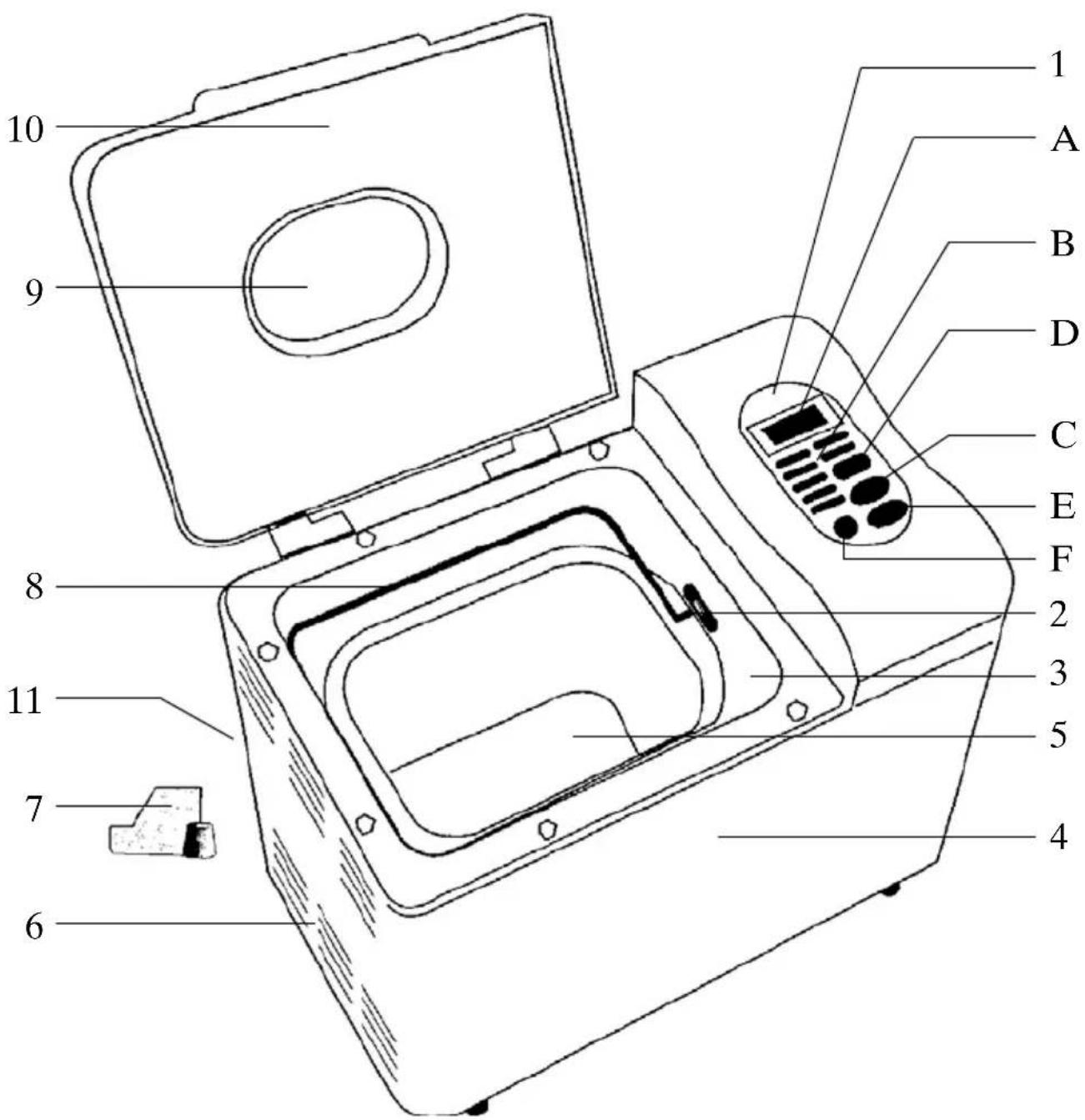
Your bread-maker
| 1. Control panel 2. Safety holding clip | |||
| 3. | Baking compartment | ||
| A | LED display 4. Housing | ||
| B Programme indicator 5. Bread baking-tin | |||
| C | Menu 6. Steam vents | ||
| D | Timer 7. Dough hook | ||
| E Browning control 8. Baking-tin handle | |||
| F Start / Stop 9. Viewing window | |||
| 10. | Lid | ||
| 11. | On/Off switch (at rear of unit) | ||
Control panel
A LED display
The LED display shows the programme running time and, for 2 seconds, the programme number as well as the browning control setting of the currently active programme. An active programme is indicated by the continuously flashing colon in the time display.
Example:
In this case, the programme for QUICK has been selected via the button. The display shows for approx. 2 seconds: 2 P for Programme 2, (QUICK), and browning control setting P (MEDIUM), followed by the programme running time: 2: 20 (i.e., the total programme running time is 2 hours and 20 minutes).
B Programme indicator display
The selected programme is indicated by an LED display.
C Menu

The menu allows for 8 different programmes to be selected:
| MENU 1 | Standard Quick Cakes White bread Biscuits, pastry Wholemeal Dough Baking | 6 | ||||||
| 1st kneading phase | 10 min. | 10 min. | 10 min. | 18 min. | 14 min. | 10 min. | 20 min. | - |
| 1st rising phase | 20 min. | 5 min. | 5 min. | 40 min. | - | 25 min. | - | - |
| 2nd kneading phase | 15 min. | 15 min. | 20 min. | 22 min. | - | 20 min. | - | - |
| 2nd rising phase | 20 min. | - | 30 min. | 20 min. | - | 30 min. | 20 min. | - |
| Shaping (gas extraction) | 30 sec. | - | 30 sec. | 30 sec. | - | 30 sec. | 30 sec. | - |
| Last rising phase | 55 min. | 55 min. | 55 min. | 65 min. | 41 min. | 70 min. | 50 min. | - |
| Baking | 60 min. | 55 min. | 50 min. | 65 min. | 55 min. | 65 min. | - | 60 min. |
| Programme running time | 3:00 | 2:20 | 2:50 | 3:50 | 1:50 | 3:40 | 1:30 | 1:00 |
| Acoustic signal for adding ingredients | after 40 min. | after 25 min. | - | after 75 min. | - | after 50 min | - | - |
| Display during acoustic signal | 2:20 | 1:55 | - | 2:35 | - | 2:50 | - | - |
Keep pressing the ⚪ key until the required programme is shown in the programme indicator display (B) and in the LED display (A).
D Timer settings

Programmes may be started with a delayed timer setting, enabling the selected programme to finish up to 13 hours later.
Example:
You want to start the programme at 20.00, and you would like your bread to be finished at 7.30 the next morning. Accordingly, the total programme running time will be 11 hours and 30 minutes.
- Use the button to select the desired programme.
- Press the appropriate ⏻ button until the display shows a total running time of 11:30.
- Add the ingredients following the instructions given in the section Operation. Avoid any contact between the yeast and fluids or salt.
- Do not use the timer function where a recipe requires the use of perishable ingredients such as eggs, fresh milk or fruit. The timer function is also unsuitable for recipes which require the addition of any ingredients (e.g. nuts, grains or dried fruits) during the second kneading phase.
E Browning

The baking programmes allow for a pre-selection of the desired level of browning; three settings are available. In addition to the programme number, the selected level of browning is shown on the LED display.
L = light
P = medium
H = dark
F START button

The ① button starts or terminates a programme. The continuously flashing colon in the LED time display indicates that the programme has been activated.
Protection against wrong input:
Once a programme has been started, all other control buttons will remain blocked until the baking process has finished, or until the Ⓞ button has been pressed for a minimum of 2 seconds.
When pressing any control button, wait until the correct input is acknowledged by a beep signal before releasing the button.
USING THE BREAD-MAKER
Your new bread-maker allows you to:
- bake breads to various recipes, some of which can be found in the appendix to this manual. However, this bread-maker also allows you to use commercially available ready-to-bake mixtures with up to 600g of solid ingredients (for a loaf of approx. 1000g).
- mix, knead dough for bread rolls, pizza etc., and let the dough rise.
Additional important instructions
- Always use an oven-cloth or suitable gloves when touching the unit after use, or when handling freshly-baked bread.
- Only recipes with a flour content of approx. 400g - 600g should be used with this bread-
maker.
Should the flour content fall short of this minimum, thorough kneading of the dough cannot be ensured. Excessive flour content may result in the dough rising over the edge of the baking-tin.
- In case of a power failure of less than 30 minutes during operation, the baking process is continued automatically at the point of interruption.
- During the kneading process, water vapour may condense on the viewing window. However, this condensation will disappear during the baking phase.
- To ensure evenly baked bread, do not open the lid during the baking process.
- After use, allow sufficient time for the bread-maker and the baking-tin to cool down before cleaning them thoroughly.
- The baking-tin and the dough hook are non-stick coated. In order to prevent damage to this, do not use any metallic, hard, sharp or pointed objects on the coating.
- Caution: operating the bread-maker empty could result in damage to the unit by overheating of the empty baking-tin.
Caution
- In the event of any smoke coming from the baking compartment, be sure to keep the door firmly closed, but immediately remove the plug from the wall socket. Do not, under any circumstances, try to smother or extinguish smouldering dough with water. Smoke can occur as the result of dough rising over the edge of the baking-tin and touching the heating elements. It is therefore essential to follow the quantity limits given in the recipes.
- Always make sure that the unit is placed well out of children's reach, especially while it is operating.
- Do not place the unit on soft or inflammable surfaces (e.g. carpets). Always ensure that it is placed on a firm and level work surface. Always position the unit in such a way that it cannot fall over.
- Do not touch the metal housing, the steam vents at the rear of the unit, or the viewing window in the lid: these parts heat up during operation.
- Before the appliance is cleaned, ensure it is switched off, disconnected from the power supply and has cooled down completely.
PROGRAMME FUNCTIONS
1 = STANDARD
This programme is used most frequently and suitable for breads with high wheat flour content.
2 = QUICK
Suitable for quick-baking light wheat-flour bread. Because of the shortened rising phase, the loaves may turn out somewhat smaller.
3 = CAKES
Because of its relatively high sugar content, sweet yeast dough tends to brown more quickly; in this programme, the baking phase is therefore shorter.
4 = WHITE BREAD
Suitable for typical light dough white bread such as French bread etc.
5 = BISCUITS, PASTRY
Suitable for preparing biscuits or pastry, when using baking powder instead of yeast.
6 = WHOLEMEAL
Compared with the STANDARD setting, this programme has extended rising and baking phases, since the dough for bread with a high rye or wholemeal flour content tends to rise less than dough containing wheat flour.
7 = DOUGH
This programme does not include a baking phase. After the programme has finished, the dough (e.g. pizza dough) can be removed and then baked in a conventional oven.
8 = BAKING
Suitable for baking dough (e.g. dough previously kneaded using the DOUGH programme). In this way, the rising phase can be modified according to the type of dough before the BAKING programme is started.
BEFORE USING FOR THE FIRST TIME
- Remove the baking-tin.
- Insert the plug into a suitable wall socket and switch the appliance on.
- Use the ⬆ button to select programme 8 (BAKING).
- Press the Ⓞ button and let the unit heat up for approximately 10 minutes with the lid open. This will remove the smell typically encountered when first activating the heating elements; ensure sufficient ventilation. To prevent the baking-tin from overheating, be sure to remove it before switching the unit on.
- Afterwards, press the Ⓤ button for at least 2 seconds, remove the plug from the wall socket and allow the unit to cool down. The baking-tin itself must be thoroughly cleaned before it is used for the first time.
OPERATION
- Open the lid and remove the baking tin.
- Fit the dough hook into its socket inside the baking tin.
- For best results, always put liquids in first, followed by solid ingredients such as flour.
- Finally, add the yeast. Be sure to avoid any contact between the yeast and salt or liquids when using the timer.
- Replace the baking tin in the unit. Make sure that the tin locks firmly into place. Before starting the programme, close the lid, insert the plug into a suitable wall socket and switch the unit on.
- Use the button to select the desired baking programme. Each time the button is pressed, the display changes to the next programme in the sequence.
- Using the button, the desired level of browning can be pre-selected: P - Medium, H - Dark, L - Light. This function is not available in the DOUGH programme.
- If you wish to start the programme with a timer delay, the desired total running time can now be set with the ⏻ buttons.
- Otherwise, press the Ⓞ button to start the kneading and/or baking process.
- During the second kneading phase in the programmes STANDARD, QUICK, WHITE BREAD and WHOLEMEAL, an acoustic signal indicates that additional ingredients such as fruits and nuts can be added to the dough. Do not open the lid after this second kneading phase, but wait until the programme has finished.
- Once the bread or dough is ready, a multiple acoustic signal is heard and the time display shows 0:00. Press the Ⓞ button for at least 2 seconds and open the lid.
- Carefully remove the baking tin using an oven cloth. Do not place the hot baking tin on any heat-sensitive surfaces. Should you forget to press the Ⓞ button, and not remove the bread immediately, it will still be kept warm automatically for a period of 60 minutes. This is to ensure that no condensation can collect in the baking tin.
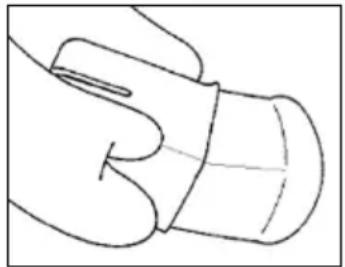
- Remove the bread from the baking tin. To loosen the bread, it may be lightly shaken. Should the dough hook be stuck in the bread, it should be removed carefully. To avoid damage or scratches to the non-stick coating, do not use any metallic or otherwise unsuitable objects.
To allow the underside of the loaf to cool down as well, it should be placed on a suitable wire rack. Do not attempt to cut the bread until it has sufficiently cooled down.
CLEANING AND CARE
- Caution: before the appliance is cleaned, ensure it is switched off, disconnected from the power supply and has cooled down completely.
Do not immerse the bread-maker in water.
- Remove the baking-tin from the appliance, and take out the dough hook.
The baking-tin and the dough hook may be cleaned using hot water and a mild detergent. Do not use any rough material for cleaning. If you are unable to separate the dough hook from the baking tin using normal force, let it soak in lukewarm water for approximately 30 minutes. Do not use excessive force to remove the hook.
- To prevent damage to the drive-shaft seal, the baking-tin should not be left soaking for any extended period of time. Do not clean the baking-tin in a dish-washer.
- The inside of the lid may be cleaned with a slightly damp, soft cloth. The interior of the appliance should be cleaned with a soft, dry cloth.
- Do not use cleaning agents specifically designed for baking ovens, and do not use any abrasives or harsh cleaning solutions, vinegar or bleaching agents for cleaning.
- Before storing the appliance, always ensure that it has cooled down and that it is completely dry.
TYPICAL PROBLEMS
- The bread has a strong smell.
Check whether the correct amount of yeast was used. Too much yeast causes an unpleasant smell and makes the loaf rise too much. Always use fresh ingredients.
- The baked bread is wet and has a sticky surface.
Remove the bread from the appliance immediately after baking, and place it onto a wire rack, allowing it to cool down.
- Pressing the Start button fails to activate the selected programme.
Make sure that the unit is properly connected to the mains supply, and that the unit is switched on.
Should the appliance still be too hot after a previous work cycle, an automatic safety switch prevents the appliance from resuming operation. In that case, the LED display shows the letters HHH, and a continuous acoustic signal is heard. Press the ① button for 2 seconds, and remove the baking-tin with the ingredients from the unit. Allow the
bread-maker to cool down for approximately 20 minutes before attempting to start the programme again.
- The loaf has risen too high.
Reduce the quantity of yeast, water or flour used.
- The loaf has not risen high enough.
Increase the amount of yeast, water or sweetening agents. Ensure that the correct order is used when putting the ingredients into the baking-tin: first the liquid ingredients, followed by the solid ingredients, and finally the yeast.
Note: bread made of rye or wholemeal flour tends to rise less than bread made of wheat flour.
- After the baking phase has started, the dough collapses inwards.
The dough is too light. Slightly reduce the quantity of liquid or the amount of yeast, or use a programme with a shorter rising phase. You may also try increasing the amount of salt.
- The dough is too soft or too sticky.
The dough texture may become smoother if a spoonful of flour is added during the kneading process.
- The dough is very difficult to knead.
Add a spoonful of water during the kneading process.
Recipes
Wheat bread
Ingredients:
1 1/2 tsp. dry yeast
360 g wheat flour type 1050
240 g wheat flour type 405
2 tsp. salt
2 tsp. honey or sugar-beet syrup
2 tsp. sourdough powder from sour dough
400 ml water
Programme: STANDARD
Browning: H (dark)
Cheese bread
Ingredients:
1 1/2 tsp. dry yeast
300 g wheat flour type 550
300 g rye flour type 1150
2 tsp. salt
1 tsp. sugar
240 ml water
180 ml buttermilk
60 g finely grated Emmental cheese
Programme: STANDARD
Browning: H (dark)
The cheese is added after the acoustic signal.
Onion bread
Ingredients:
1 tsp. dry yeast
360 g wheat flour type 405
240 g rye flour type 1150
2 tsp. salt
1 tsp. sugar
180 ml water
200 ml buttermilk
50 g fried onions
Programme: WHITE BREAD
Browning: P (medium)
The roast onions are added after the acoustic signal.
Rye-wholemeal-wheat bread
Ingredients:
2 tsp. dry yeast
300 g wheat flour type 1050
300 g rye wholemeal flour
1 1/2 tsp. salt
1 tsp. sugar
400 ml water
3 tbsp. sourdough powder from sourdough
Programme: WHOLEMEAL
Browning: H (dark)
Wheat and rye bread with soy seeds
Ingredients:
1 1/2 tsp. dry yeast
300 g wheat flour type 550
260 g rye flour type 1150
2 tsp. salt
1 1/2 tsp. sugar
210 ml water
190 ml buttermilk
1 tbsp. sourdough powder from sourdough
40 g soy seeds
1 tsp. bread spice
Programme: STANDARD
Browning: P (medium)
The soy seeds are added after the acoustic signal.
Fruit bread
Ingredients:
1 1/2 tsp. dry yeast
310 g wheat flour type 550
290 g rye flour type 1150
2 tsp. salt
1 tsp. sugar
400 ml grapefruit juice
Programme: STANDARD
Browning: H (dark)
Wheat bread
Ingredients:
1 1/2 tsp. dry yeast
290 g wheat flour type 550
310 g wheat flour type 1050
2 tsp. salt
1 tsp. sugar
1 tbs. sourdough powder from sour dough
280 ml buttermilk
160 ml milk
Programme: STANDARD
Browning: P (medium)
Wheat and rye bread
Ingredients:
1 1/2 tsp. dry yeast
300 g wheat flour type 550
300 g rye flour type 1150
2 tsp. salt
1 tsp. sugar
300 ml water
150 g natural plain yoghurt, 3.5% fat content
2 tsp. sourdough powder from sour dough
Programme: STANDARD
Browning: P (medium)
White bread/French bread
Ingredients:
1 tsp. dry yeast
520 g wheat flour type 405
2 1/2 tbs. sugar
2 tsp. salt
2 tbs. butter
200 ml milk
160 ml water
Programme: WHITE BREAD
Browning: P (medium)
Oat flake bran bread
Ingredients:
1 tsp. dry yeast
360 g wheat flour type 550
110 g oat flake bran
1 1/2 tbs. sugar
2 tsp. salt
2 tbs. butter
390 ml milk
Programme: WHOLEMEAL
Browning: P (medium)
Bran bread
Ingredients:
1 tsp. dry yeast
450 g wheat flour type 550
1/2 cup wheat bran
2 tbs. sugar
2 tbs. milk powder
2 tsp. salt
2 tbs. butter
380 ml water
Programme: STANDARD
Browning: P (medium)
Commercially available ready-to-bake mixes
Various ready-to-bake mixes are commercially available.
- Put up to 600g of the ready-to-bake mixture and the required amount of dry yeast into the baking-tin. Depending on the size of the mix, it may be that only half of the mix can be used at a time.
- Add the corresponding quantity of liquid.
Programme: STANDARD, WHITE BREAD or WHOLEMEAL, depending on the type of flour used.
Pizza-dough
Ingredients:
2 tsp. dry yeast
400 g wheat flour type 550
2 tsp. salt
1 tsp. sugar
3 tbs. olive oil
230 ml water
Programme: DOUGH
- Once the programme has finished, remove the dough from the baking-tin.
- Coat a baking tray with olive oil and spread the dough out with a rolling pin.
- Let the dough rise at room temperature for approximately 30 minutes.
- Spread the dough with the toppings of your choice, and let it bake for 15-25 minutes at 200°C in a pre-heated baking oven, until the cheese has melted and spread evenly, and the dough is brown around the edges.
Additional recipe information
The recipes suggested in this manual may be modified to taste by adding various ingredients of your choice.
Depending on your taste, you may add e.g. wheat germ, sunflower seeds, herbs, caraway seeds, ground pepper, ground nuts, muesli, hominy grits, finely cut bacon cubes etc.
These ingredients may be added after the acoustic signal, i.e. during the second kneading phase, but only for the following programmes: STANDARD, QUICK, WHITE BREAD and WHOLEMEAL BREAD.
The bread-maker is designed to process recipes with a flour content of up to 600g. In order to prevent the dough rising over the edge of the baking-tin and to ensure that the dough is properly and thoroughly kneaded, do not exceed these limits.
All ingredients should be at normal room temperature.
Sugar assists the yeast as a rising agent, and tends to make the crust darker and thicker.
Salt gives a firmer texture to the dough and slows the rising process down.
When adding additional ingredients of a liquid nature to a recipe, make sure that the quantity of liquid given in the recipe is reduced accordingly. This applies, for instance, when eggs, fresh cheese or yoghurt are used.
The baking results depend on several factors such as air pressure, humidity, water hardness, room temperature or the temperature of the ingredients. If a recipe does not turn out to your taste right away, we recommend modifying the suggested recipes accordingly, as described in the section 'Typical problems'.
Abbreviations:
Tsp. = teaspoon (measuring spoon: 1 tsp.) = 5 ml
1/2 tsp. = one half teaspoon
Tbs. = tablespoon (measuring spoon: 1 tbs.) = 15 ml
g = gram
ml = millilitre
Measuring cup: 1 cup = 250 ml
GUARANTEE
This product is guaranteed against defects in materials and workmanship for a period of two years from the date of purchase. Under this guarantee the manufacturer undertakes to repair or replace any parts found to be defective, providing the product is returned to one of our authorised service centres. This guarantee is only valid if the appliance has been used in accordance with the instructions, and provided that it has not been modified, repaired or interfered with by any unauthorised person, or damaged through misuse.
This guarantee naturally does not cover wear and tear, nor breakables such as glass and ceramic items, bulbs etc. If the product fails to operate and needs to be returned, pack it carefully, enclosing your name and address and the reason for return. If within the guarantee period, please also provide the guarantee card and proof of purchase.
TABLE OF CONTENTS
Control panel
A LED display
CLEANING AND MAINTENANCE
Control panel
A LED indicator
4 = WHITE BREAD/FRENCH BREAD
MAINTENANCE AND CLEANING
1 1/2 tsp dry yeast
Control panel
A LED display
CLEANING AND CARE
150 g natural yogurt, 3.5% fat
Additional recipe information
5 = BISCOTTI, PASTRIES
Control panel
A LED display
CLEANING AND MAINTENANCE
TABLE OF CONTENTS
Control panel
A LED display
5 = SMALL BREADS, PASTRIES
CLEANING AND CARE
Control panel
A LED display
CLEANING AND CARE
Control panel
A LCD display
GENERAL MAINTENANCE AND CLEANING
CONTROL PANEL
CLEANING
Control panel
A LCD display
CLEANING AND GENERAL MAINTENANCE

- CONTROL PANEL
- CLEANING
- IMPORTANT SAFETY INSTRUCTIONS
- YOUR BREAD-MAKER
- A LED DISPLAY
- EXAMPLE
- B PROGRAMME INDICATOR DISPLAY
- C MENU
- D TIMER SETTINGS
- E BROWNING
- F START BUTTON
- PROTECTION AGAINST WRONG INPUT
- USING THE BREAD-MAKER
- YOUR NEW BREAD-MAKER ALLOWS YOU TO
- ADDITIONAL IMPORTANT INSTRUCTIONS
- CAUTION
- PROGRAMME FUNCTIONS
- STANDARD
- QUICK
- CAKES
- WHITE BREAD
- BISCUITS, PASTRY
- WHOLEMEAL
- DOUGH
- BAKING
- BEFORE USING FOR THE FIRST TIME
- OPERATION
- CLEANING AND CARE
- TYPICAL PROBLEMS
- RECIPES
- WHEAT BREAD
- CHEESE BREAD
- ONION BREAD
- RYE-WHOLEMEAL-WHEAT BREAD
- WHEAT AND RYE BREAD WITH SOY SEEDS
- FRUIT BREAD
- WHEAT AND RYE BREAD
- WHITE BREAD/FRENCH BREAD
- OAT FLAKE BRAN BREAD
- BRAN BREAD
- COMMERCIALLY AVAILABLE READY-TO-BAKE MIXES
- PIZZA-DOUGH
- PROGRAMME: DOUGH
- ADDITIONAL RECIPE INFORMATION
- ABBREVIATIONS
- GUARANTEE
- CLEANING AND MAINTENANCE
- A LED INDICATOR
- MAINTENANCE AND CLEANING
- BISCOTTI, PASTRIES
- SMALL BREADS, PASTRIES
- A LCD DISPLAY
- GENERAL MAINTENANCE AND CLEANING
- CLEANING AND GENERAL MAINTENANCE
Brand : SEVERIN
Model : BM 3987
Category : Bread maker