EasyCross Laser - Hand tool Laserliner - Free user manual and instructions
Find the device manual for free EasyCross Laser Laserliner in PDF.

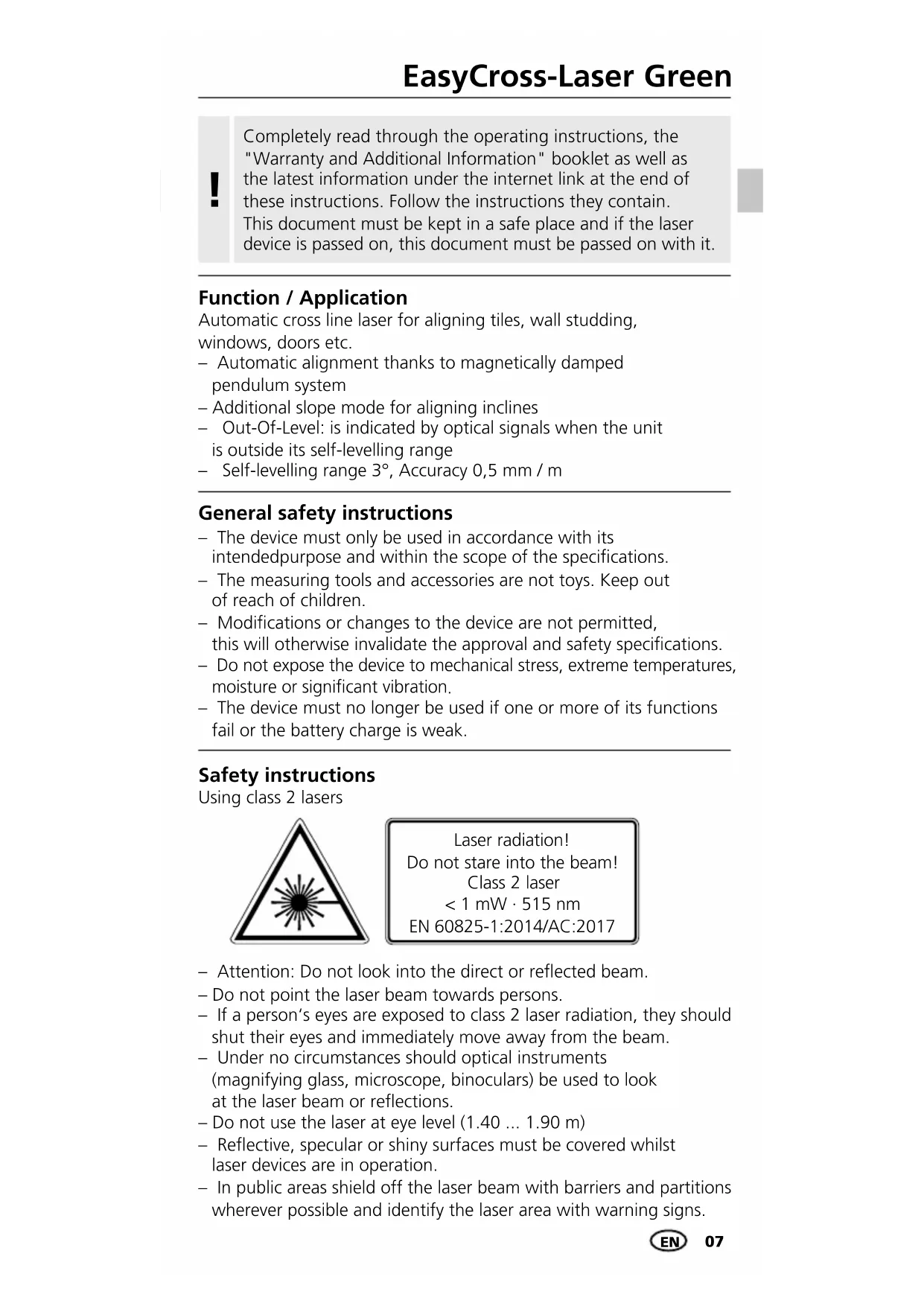


| Product Type | Automatic Cross-Line Laser |
| Brand | Laserliner |
| Model | EasyCross Laser (EasyCross-Laser Green) |
| Category | Hand Tool |
| Dimensions (L x H x D) | 62 x 72 x 61 mm |
| Weight | 202 g (batteries included) |
| Power Supply | 3 AAA 1.5 V batteries (LR03) |
| Battery Life | Approximately 5 hours |
| Accuracy | ± 0.5 mm/m |
| Self-Leveling Range | ± 3° |
| Laser Class | 2 / < 1 mW (EN 60825-1:2014/AC:2017) |
| Wavelength | 515 nm (green laser) |
| Typical Visibility | 40 m (at 300 lx max.) |
| Operating Conditions | 0°C to 50°C, max. RH 80% non-condensing, max. altitude 4000 m |
| Storage Conditions | -10°C to 70°C, max. RH 80% |
| Tripod Thread | 1/4" |
| Main Functions | Horizontal and vertical leveling, tilt mode, out-of-level detection with optical signals, transport lock |
| Safety | Laser class 2, do not stare into beam, cover reflective surfaces, use with caution |
| Maintenance and Cleaning | Clean with a slightly damp cloth, avoid solvents, remove batteries before prolonged storage, store in a dry and clean place |
| Spare Parts and Repairability | User-verifiable calibration; adjustment or repair by UMAREX-LASERLINER customer service |
| General Information | CE certified, WEEE directive compliant, manual available in several languages |
Frequently Asked Questions - EasyCross Laser Laserliner
User questions about EasyCross Laser Laserliner
0 question about this device. Answer the ones you know or ask your own.
Ask a new question about this device
Download the instructions for your Hand tool in PDF format for free! Find your manual EasyCross Laser - Laserliner and take your electronic device back in hand. On this page are published all the documents necessary for the use of your device. EasyCross Laser by Laserliner.
USER MANUAL EasyCross Laser Laserliner
EasyCross-Laser Green
natural_image
Exterior view of a modern kitchen appliance with black and white casing (no visible text or symbols)AUTOMATIC LEVEL


1HG 1VG
natural_image
Two 3D geometric diagrams showing wireframe and solid views of a cube with internal lines and a shaded base (no text or symbols)s
Laserliner















Laserliner
!


!
Completely read through the operating instructions, the "Warranty and Additional Information" booklet as well as the latest information under the internet link at the end of these instructions. Follow the instructions they contain. This document must be kept in a safe place and if the laser device is passed on, this document must be passed on with it.
Function / Application
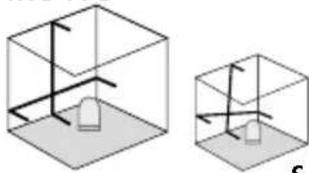
Automatic cross line laser for aligning tiles, wall studding, windows, doors etc.
- Automatic alignment thanks to magnetically damped pendulum system
– Additional slope mode for aligning inclines - Out-Of-Level: is indicated by optical signals when the unit is outside its self-levelling range
- Self-levelling range 3°, Accuracy 0,5 mm / m
General safety instructions
- The device must only be used in accordance with its intended purpose and within the scope of the specifications.
- The measuring tools and accessories are not toys. Keep out of reach of children.
- Modifications or changes to the device are not permitted, this will otherwise invalidate the approval and safety specifications.
- Do not expose the device to mechanical stress, extreme temperatures, moisture or significant vibration.
- The device must no longer be used if one or more of its functions fail or the battery charge is weak.
Safety instructions
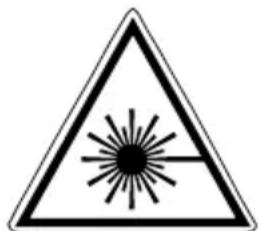
Using class 2 lasers
natural_image
Warning symbol with a triangular triangle and a central starburst (no text or numbers)Laser radiation! Do not stare into the beam! Class 2 laser < 1 mW · 515 nm EN 60825-1:2014/AC:2017
- Attention: Do not look into the direct or reflected beam.
- Do not point the laser beam towards persons.
- If a person's eyes are exposed to class 2 laser radiation, they should shut their eyes and immediately move away from the beam.
- Under no circumstances should optical instruments (magnifying glass, microscope, binoculars) be used to look at the laser beam or reflections.
- Do not use the laser at eye level (1.40 ... 1.90 m)
- Reflective, specular or shiny surfaces must be covered whilst laser devices are in operation.
- In public areas shield off the laser beam with barriers and partitions wherever possible and identify the laser area with warning signs.
Laserliner
Safety instructions
Dealing with electromagnetic radiation
- The measuring device complies with electromagnetic compatibility regulations and limits in accordance with the EMC Directive 2014/30/EU.
- Local operating restrictions – for example, in hospitals, aircraft, petrol stations or in the vicinity of people with pacemakers – may apply. Electronic devices can potentially cause hazards or interference or be subject to hazards or interference.

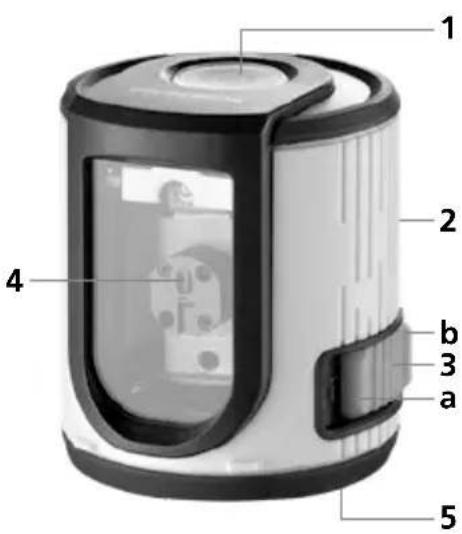
When transporting always switch off all lasers, secure pendulum and push the slide switch (3) to the right.
Green laser technology

Laser modules in DLD design stand for high line quality as well as a clean and clear and therefore easily visible line image. Unlike previous generations they are more temperature-stable and energy efficient.
Furthermore, the human eye has a higher sensitivity to the wave range of the green laser than the red laser, for example. This makes the green laser diode appear much brighter than the red one.
Green lasers, especially in the DLD design, thus offer advantages with regards to how visible the laser line is under unfavourable conditions.

Approx. 6 times brighter than a typical red laser with 630 - 660 nm
1 Inserting batteries
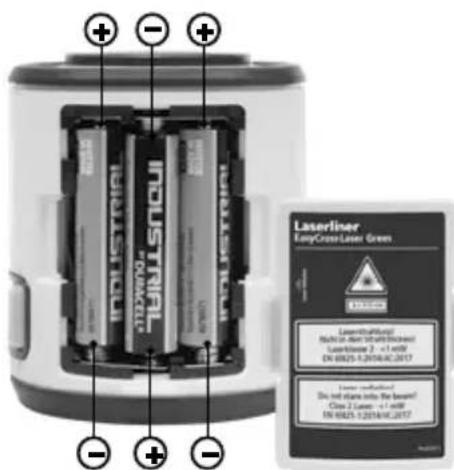
Open the battery compartment and insert batteries (3 x typ AAA) according to the symbols. Be sure to pay attention to polarity.
EasyCross-Laser Green
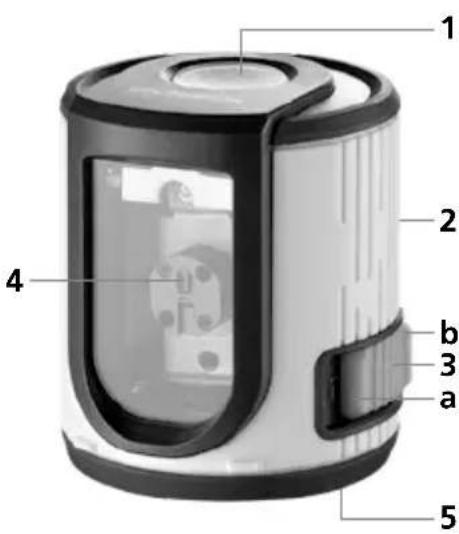
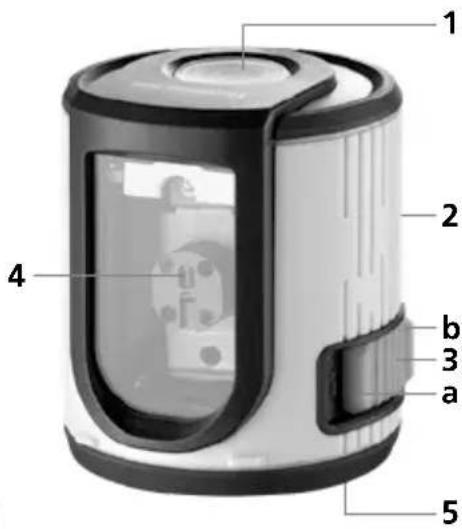
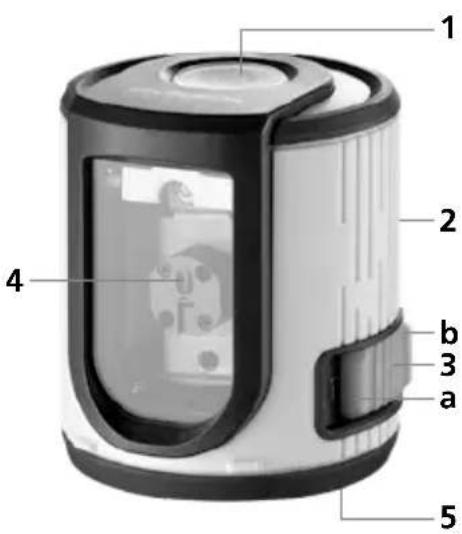
1 LED levelling
LED flashing: levelling off
LED on: levelling on /
ON/OFF button
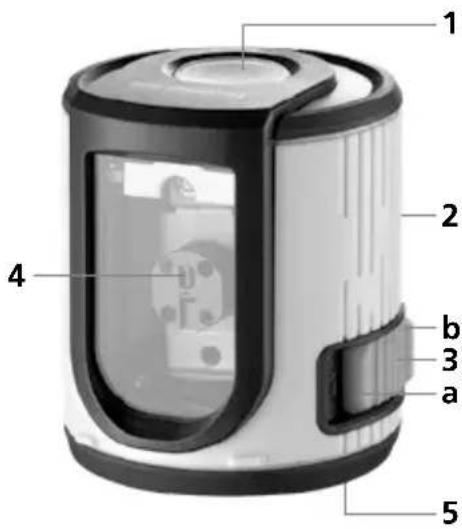
2 Battery compartment (backside)
3 Slide switch
a ON
b OFF / transport lock / slope mode
4 Laser output windows
5 1/4" tripod threads (bottom)
2 Horizontal and vertical levelling
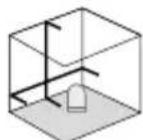
Release the transport restraint, push the slide switch (3) to the left. The laser lines can be switched individually with the selection button.
!
The transport restraint must be released for horizontal and vertical levelling. The LED (1) shows a permanent green light. The laser lines flash as soon as the device is outside the automatic levelling range of 3^ . Position the device such that it is within the levelling range. The light of the laser lines is constant again.
3 Slope mode
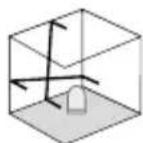
Do not release transport restraint, push slide switch (3) to the right. Sloping planes can now be measured. This mode cannot be used to perform horizontal or vertical levelling as the laser lines are no longer aligned automatically. LED (1) and the laser lines flash green.
Preparing the calibration check
It is possible for you to check the calibration of the laser. To do this, position the device midway between 2 walls, which must be at least 5 metres apart. Switch the device on (LASER CROSS ON). The best calibration results are achieved if the device is mounted on a tripod.
Laserliner
- Mark point A1 on the wall.
- Turn the device through 180^ and mark point A2. You now have a horizontal reference between points A1 and A2.
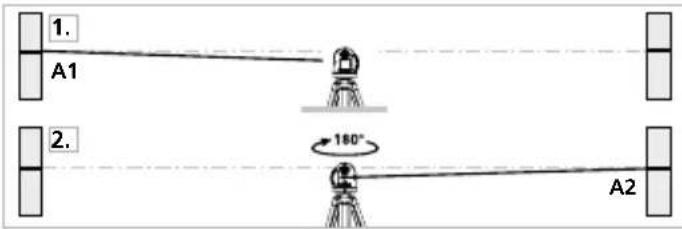
Performing the calibration check
- Position the device as near as possible to the wall at the height of point A1.
- Turn the device through 180^ and mark point A3. The difference between points A2 and A3 is the tolerance.
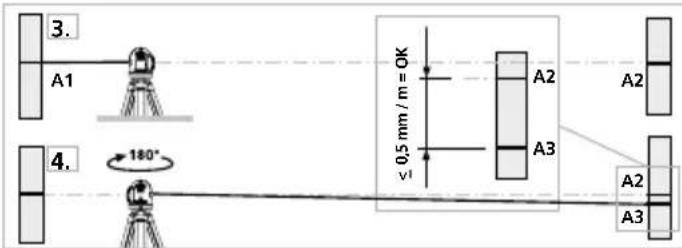

When A2 and A3 are more than 0.5 mm / m apart, an adjustment is necessary. Contact your authorised dealer or else the UMAREX-LASERLINER Service Department.
Checking the vertical line
Position the device about 5 m from a wall. Fix a plumb bob with a line of 2.5 m length on the wall, making sure that the bob can swing freely. Switch on the device and align the vertical laser to the plumb line. The precision is within the specified tolerance if the deviation between the laser line and the plumb line is not greater than ± 2.5 mm.
Checking the horizontal line
Position the device about 5 m from a wall and switch on the cross laser. Mark point B on the wall. Turn the laser cross approx. 2.5 m to the right and mark point C. Check whether the horizontal line from point C is level with point B to within ± 2.5 mm. Repeat the process by turning the laser to the left.
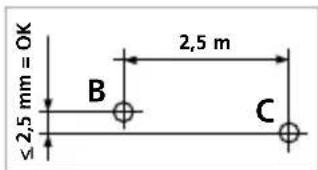

Regularly check the calibration before use, after transport and after extended periods of storage.
Information on maintenance and care
Clean all components with a damp cloth and do not use cleaning agents, scouring agents and solvents. Remove the battery(ies) before storing for longer periods. Store the device in a clean and dry place.
Technical data Subject to technical alterations. 20W11
| Self-levelling range ± 3° | |
| Accuracy ± 0.5 mm / m | |
| Levelling | automatic |
| Visibility (typical)* 40 m | |
| Laser wavelength 515 nm | |
| Laser class | 2 / < 1 mW (EN 60825-1:2014/AC:2017) |
| Power supply 3 x 1.5 V LR03 (AAA) | |
| Operating time approx. 5 hours | |
| Operating conditions | 0°C ... 50°C, max. humidity 80% rH,no condensation, max. workingaltitude 4000 m above sea level |
| Storage conditions | -10°C ... 70°C, max. humidity 80% rH |
| Dimensions (W x H x D) 62 | x 72 x 61 mm |
| Weight 202 g (incl. batteries) | |
* at max. 300 lux
EU directives and disposal
This device complies with all necessary standards for the free movement of goods within the EU.
This product is an electric device and must be collected separately for disposal according to the European Directive on waste electrical and electronic equipment.
Further safety and supplementary notices at:
http://laserliner.com/info?an=ACN
Laserliner
!

!


Laserliner
!
Laserliner
!
EasyCross-Laser Green


!
!
!
Laserstrålning! Titta aldrig direkt in i laserstrålen! Laser klass 2 < 1 mW · 515 nm EN 60825-1:2014/AC:2017
!
!
natural_image
Warning symbol with a triangular frame and a central sunburst pattern (no text or numbers)Laserstråling! Ikke se inn i strålen! Laser klasse 2 < 1 mW · 515 nm EN 60825-1:2014/AC:2017
EasyCross-Laser Green
Laserliner


natural_image
Interior view of a bathroom with sink, mirror, and toilet (no text or symbols)SERVICE


Umarex GmbH & Co. KG
- Laserliner -
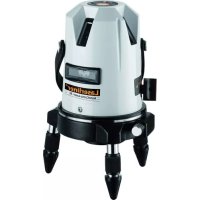
- EasyCross-Laser Green
- Laserliner
- !
- Function / Application
- General safety instructions
- Safety instructions
- Green laser technology
- Inserting batteries
- Horizontal and vertical levelling
- Slope mode
- Preparing the calibration check
- Performing the calibration check
- Checking the vertical line
- Checking the horizontal line
- Information on maintenance and care
- EU directives and disposal
Brand : Laserliner
Model : EasyCross Laser
Category : Hand tool