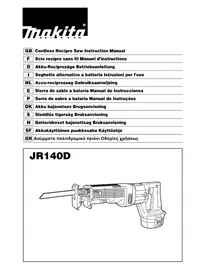
JR140D - Electric saw MAKITA - Free user manual and instructions
Find the device manual for free JR140D MAKITA in PDF.



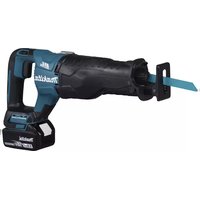
| Product type | Cordless reciprocating saw |
| Brand | Makita |
| Model | JR140D |
| Rated voltage | 14.4 V DC |
| Battery type | Rechargeable NiMH battery (nickel-metal hydride) |
| Battery capacity | 2000 - 3000 mAh depending on model (1422, 1433, 1434, 1435) |
| Stroke length | 23 mm |
| No-load speed | 0 - 2700 strokes/min (variable) |
| Wood cutting capacity | 90 mm |
| Pipe cutting capacity | 90 mm |
| Net weight (with battery) | 3.3 kg |
| Overall length | 443 mm |
| Sound pressure level | 84 dB(A) |
| Vibration level | 13 m/s² |
| Locking system | Safety button + trigger |
| Keyless blade change | Yes, by push button |
| Adjustable shoe | Yes, with unlock lever |
| Charger included | Yes (specific model) |
| Charging time | 45 min (2000 mAh) to 70 min (3000 mAh) |
| Maintenance | Carbon brush replacement (limit mark) by authorized service center |
| Included accessories | Saw blade, charger, battery, protective cap |
Frequently Asked Questions - JR140D MAKITA
User questions about JR140D MAKITA
0 question about this device. Answer the ones you know or ask your own.
Ask a new question about this device
Download the instructions for your Electric saw in PDF format for free! Find your manual JR140D - MAKITA and take your electronic device back in hand. On this page are published all the documents necessary for the use of your device. JR140D by MAKITA.
USER MANUAL JR140D MAKITA
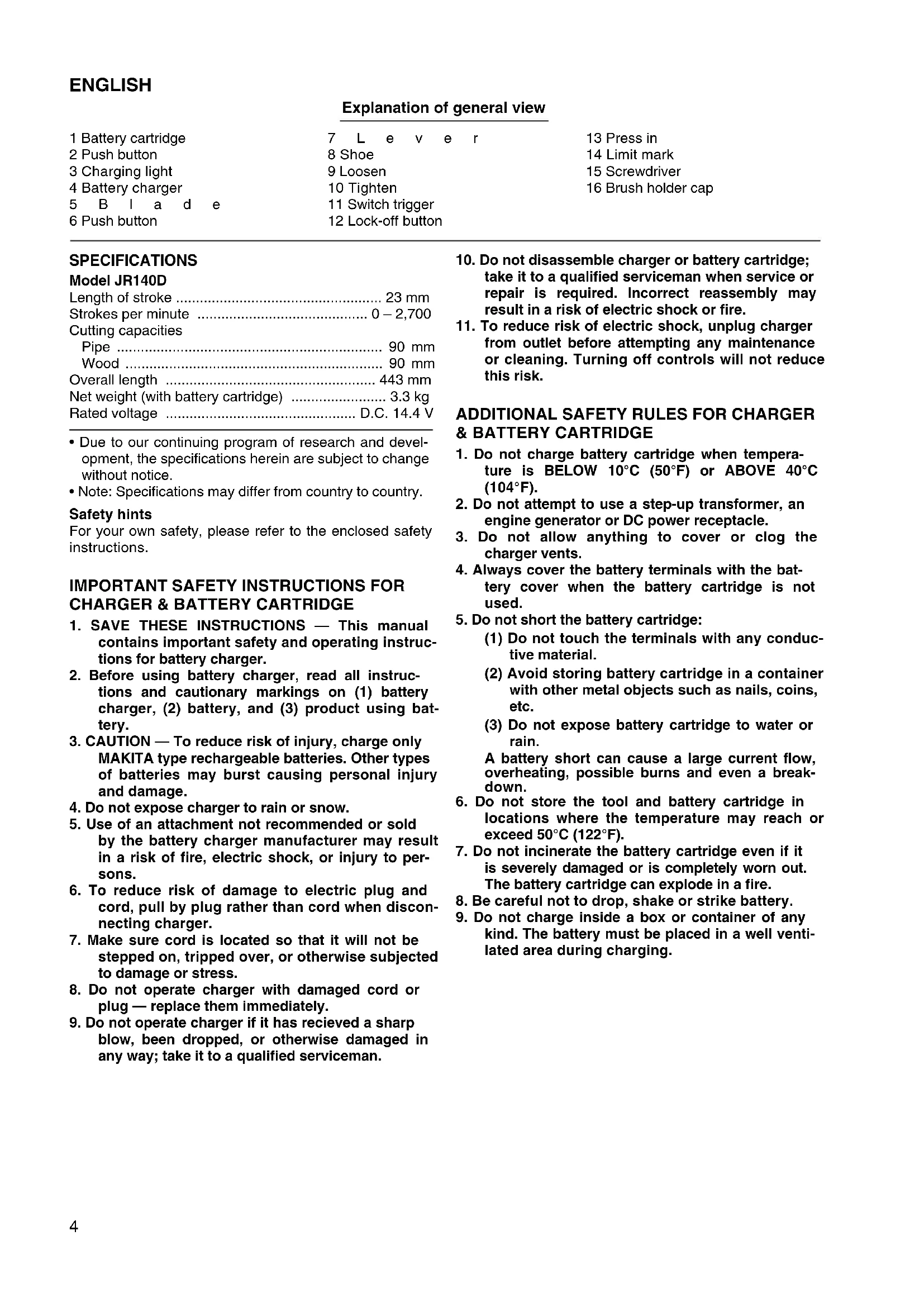
Explanation of general view
1 Battery cartridge
2 Push button
3 Charging light
4 Battery charger
5 B I a d e
6 Push button
7 L e v e r
8 Shoe
9 Loosen
10 Tighten
11 Switch trigger
12 Lock-off button
13 Press in
14 Limit mark
15 Screwdriver
16 Brush holder cap
SPECIFICATIONS
Model JR140D
Length of stroke 23 mm
Strokes per minute 0-2,700
Cutting capacities
Pipe 90 mm
Wood 90 mm
Overall length 443 mm
Net weight (with battery cartridge) 3.3 kg
Rated voltage D.C. 14.4 V
- Due to our continuing program of research and development, the specifications herein are subject to change without notice.
- Note: Specifications may differ from country to country.
Safety hints
For your own safety, please refer to the enclosed safety instructions.
IMPORTANT SAFETY INSTRUCTIONS FOR CHARGER & BATTERY CARTRIDGE
- SAVE THESE INSTRUCTIONS - This manual contains important safety and operating instructions for battery charger.
- Before using battery charger, read all instructions and cautionary markings on (1) battery charger, (2) battery, and (3) product using battery.
- CAUTION - To reduce risk of injury, charge only MAKITA type rechargeable batteries. Other types of batteries may burst causing personal injury and damage.
- Do not expose charger to rain or snow.
- Use of an attachment not recommended or sold by the battery charger manufacturer may result in a risk of fire, electric shock, or injury to persons.
- To reduce risk of damage to electric plug and cord, pull by plug rather than cord when disconnecting charger.
- Make sure cord is located so that it will not be stepped on, tripped over, or otherwise subjected to damage or stress.
- Do not operate charger with damaged cord or plug - replace them immediately.
-
Do not operate charger if it has recieved a sharp blow, been dropped, or otherwise damaged in any way; take it to a qualified serviceman.
-
Do not disassemble charger or battery cartridge; take it to a qualified serviceman when service or repair is required. Incorrect reassembly may result in a risk of electric shock or fire.
- To reduce risk of electric shock, unplug charger from outlet before attempting any maintenance or cleaning. Turning off controls will not reduce this risk.
ADDITIONAL SAFETY RULES FOR CHARGER & BATTERY CARTRIDGE
- Do not charge battery cartridge when temperature is BELOW 10ircC (50°F) or ABOVE 40°C (104°F).
- Do not attempt to use a step-up transformer, an engine generator or DC power receptacle.
- Do not allow anything to cover or clog the charger vents.
- Always cover the battery terminals with the battery cover when the battery cartridge is not used.
- Do not short the battery cartridge:
(1) Do not touch the terminals with any conductive material.
(2) Avoid storing battery cartridge in a container with other metal objects such as nails, coins, etc.
(3) Do not expose battery cartridge to water or rain.
A battery short can cause a large current flow, overheating, possible burns and even a breakdown.
- Do not store the tool and battery cartridge in locations where the temperature may reach or exceed 50ircC (122ircF) .
- Do not incinerate the battery cartridge even if it is severely damaged or is completely worn out. The battery cartridge can explode in a fire.
- Be careful not to drop, shake or strike battery.
- Do not charge inside a box or container of any kind. The battery must be placed in a well ventilated area during charging.
ADDITIONAL SAFETY RULES FOR TOOL
- Be aware that this tool is always in an operating condition, because it does not have to be plugged into an electrical outlet.
- Wear a hard hat (safety helmet), safety glasses and/or face shield. It is also highly recommended that you wear a dust mask, ear protectors and thickly padded gloves.
- Check the blade carefully for cracks or damage before operation. Replace cracked or damaged blade immediately.
- Do not attempt to cut workpieces larger than specified in this manual (especially hollow pipe). The blade might snap and cause an injury. (Fig. 1)
- Hold the tool firmly.
- Be sure no one is below when using the tool in high locations.
- Do not point the tool at anyone in the immediate vicinity.
- When making a "blind" cut (you can't see behind what is being cut), be sure that hidden electrical wiring or water pipes are not in the path of the cut. If wires are present, they must be disconnected at their power source by a qualified person or avoided to prevent the possibility of lethal shock or fire. Always hold the tool ONLY by the insulated gripping surfaces to prevent any electric shock if you accidentally cut through a "live" wire. Water pipes in "blind" areas must be drained and capped before cutting.
-
Be careful not to hit the end of the blade against something during operation. Damage to the tool or dangerous blade breakage may occur. (Fig. 2)
-
Watch out for cut-off portions of the workpiece being cut. They may fall and injure you or someone near you.
- When cutting metals, be cautious of hot flying chips.
- Do not touch the blade or the workpiece immediately after operation; they may be extremely hot and could burn your skin.
- If you withdraw the blade from the workpiece during operation, strong reaction will be produced, causing the blade to snap or causing you to lose your grip and control of the tool. Always switch off the tool and wait until the blade has come to a complete stop before withdrawing the blade from the workpiece.
SAVE THESE INSTRUCTIONS.
OPERATING INSTRUCTIONS
Installing or removing battery cartridge (Fig. 3)
- Always switch off the tool before insertion or removal of the battery cartridge.
- To remove the battery cartridge, withdraw it from the tool while pressing the push buttons on both sides of the cartridge.
- To insert the battery cartridge, align the tongue on the battery cartridge with the groove in the housing and slip it into place. Always insert it all the way until it locks in place with a little click. If not, it may accidentally fall out of the tool, causing injury to you or someone around you.
- Do not use force when inserting the battery cartridge. If the cartridge does not slide in easily, it is not being
Charging (Fig. 4)
Your new battery cartridge is not charged. You will need to charge it before use. Use the battery charger to charge the battery cartridge.
Plug the battery charger into the proper AC voltage source. The charging light will flash in green color. Insert the battery cartridge so that the plus and minus terminals on the battery cartridge are on the same sides as their respective markings on the battery charger. Insert the cartridge fully into the port so that it rests on the charger port floor. When the battery cartridge is inserted, the charging light color will change from green to red and charging will begin. The charging light will remain lit steadily during charging. When the charging light color changes from red to green, the charging cycle is complete. Refer to the table below for the charging time. If you leave the battery cartridge in the charger after the charging cycle is complete, the charger will switch into its "trickle charge (maintenance charge)" mode which will last approximately 24 hours. After charging, unplug the charger from the power source.
| Battery type Capacity (mAh) Number of cells Charging time | |||
| 1422 2,000 12 Approx. 45 min. | |||
| 1433 2,200 12 Approx. 50 min. | |||
| 1434 2,600 12 Approx. 60 min. | |||
| 1435 3,000 12 Approx. 70 min. | |||
CAUTION:
- The battery charger is for charging Makita battery cartridge. Never use it for other purposes or for other manufacturer's batteries.
- When you charge a new battery cartridge or a battery cartridge which has not been used for a long period of time, it may not accept a full charge. This is a normal condition and does not indicate a problem. You can recharge the battery cartridge fully after discharging it completely and recharging a couple of times.
-
If you charge a battery cartridge from a just-operated tool or a battery cartridge which has been left in a location exposed to direct sunlight or heat for a long time, the charging light may flash in red color. If this occurs, wait for a while. Charging will begin after the battery cartridge cools. The battery cartridge will cool faster if you remove the battery cartridge from the battery charger.
-
If the charging light flashes alternately in green and red color, a problem exists and charging is not possible. The terminals on the charger or battery cartridge are clogged with dust or the battery cartridge is worn out or damaged.
Trickle charge (Maintenance charge)
If you leave the battery cartridge in the charger to prevent spontaneous discharging after full charge, the charger will switch into its "trickle charge (maintenance charge)" mode and keep the battery cartridge fresh and fully charged.
Tips for maintaining maximum battery life
- Charge the battery cartridge before completely discharged. Always stop tool operation and charge the battery cartridge when you notice less tool power.
- Never recharge a fully charged battery cartridge. Overcharging shortens the battery service life.
- Charge the battery cartridge with room temperature at 10ircC - 40ircC (50ircF - 104ircF) . Let a hot battery cartridge cool down before charging it.
- Charge the Nickel Metal Hydride battery cartridge when you do not use it for more than six months.
Installing or removing saw blade
CAUTION:
- Always be sure that the tool is switched off and the battery cartridge is removed before installing or removing the blade.
- Always clean out all chips or foreign matter adhering to the blade, blade clamp and/or slider. Failure to do so may cause insufficient tightening of the blade, resulting in a serious injury.
To install the blade, push the push button in the direction of the arrow and insert the blade into the blade clamp as far as it will go. Then release the push button and make sure that the blade cannot be extracted even though you try to pull it out. (Fig. 5)
CAUTION:
If you release the push button without inserting the blade deep enough, the blade may be ejected unexpectedly during operation. This can be extremely dangerous.
To remove the blade, push the push button in the direction of the arrow and pull out the blade. (Fig. 6)
Adjusting the shoe (Fig. 7)
When the blade loses its cutting efficiency in one place along its cutting edge, reposition the shoe to utilize a sharp, unused portion of its cutting edge. This will help to lengthen the life of the blade. To reposition the shoe, loosen the lever and slide the shoe forward or back to the desired position. Then tighten the lever to firmly secure the shoe.
Switch action (Fig. 8)
CAUTION:
Before inserting the battery cartridge into the tool, always check to see that the switch trigger actuates properly and returns to the "OFF" position when released.
To prevent the trigger from being accidentally pulled, a lock-off button is provided. To start the tool, press in the lock-off button and pull the trigger. The lock-off button can be pressed in from either left or right side of the tool. Tool speed is increased by increasing pressure on the trigger. Release the trigger to stop.
Operation (Fig. 9)
Press the shoe firmly against the workpiece. Do not allow the tool to bounce. Bring the blade into light contact with the workpiece. First, make a pilot groove, using a slower speed. Then use a faster speed to continue cutting.
CAUTION:
- Always use a suitable coolant (cutting oil) when cutting metal. Failure to do so will cause premature blade wear.
- Always wear gloves to protect your hands from hot flying chips when cutting metal.
- Always press the shoe firmly against the workpiece during operation. If the shoe is held away from the workpiece during operation, strong vibration and/or twisting will be produced, causing the blade to snap dangerously.
MAINTENANCE
CAUTION:
Always be sure that the tool is switched off and the battery cartridge is removed before carrying out any work on the tool.
Replacement of carbon brushes (Fig. 10 & 11)
Replace carbon brushes when they are worn down to the limit mark. Both identical carbon brushes should be replaced at the same time.
To maintain product safety and reliability, repairs, maintenance or adjustment should be carried out by a Makita Authorized Service Center.
Descriptif
1 B a t t e r i e
7 L e v i e r
13 Appuyer
2 Bouton-poussoir
8 Sabot
These accessories or attachments are recommended for use with your Makita tool specified in this manual. The use of any other accessories or attachments might present a risk of injury to persons. The accessories or attachments should be used only in the proper and intended manner.
F ACCESSORIES
ATTENTION :
EC-DECLARATION OF CONFORMITY
The undersigned, Yasuhiko Kanzaki, authorized by Makita Corporation of America, 2650 Buford Highway, Buford, GA30518 declares that this product (Serial No.: series production)
manufactured by Makita Corporation of America in U.S.A. is in compliance with the following standards or standardized documents,
EN50260, EN55014
in accordance with Council Directives, 89/336/EEC and 98/37/EC.
FRANCAISE
DECLARATION DE CONFORMITE CE
de accordo com as direcitas 89/336/CEE e 98/37/CE do Conselho.
DANSK
EU-DEKLARATION OM KONFORMITET
Undertegnede, Yasuhiko Kanzaki, med fuldmagt fra Makita Corporation of America, 2650 Buford Highway, Buford, GA30518, erklær hermed, at dette produit
Makita Corporation of America, 2650 Buford Highway, Buford, GA30518
Michigan Drive, Tongwell, Milton Keynes,
Bucks MK15 8JD, ENGLAND
ENGLISH
EC-DECLARATION OF CONFORMITY
The undersigned, Yasuhiko Kanzaki, authorized by Kao Lung Tamura Electronics Co., Ltd. No. 4 Industry 1st Street, Ping Tung Industry District Chiao Nan Li, Ping Tung City, Taiwan declares that this battery charger
(Serial No.: series production)
manufactured by Kao Lung Tamura Electronics Co., Ltd. in Taiwan is in compliance with the following standards or standardized documents,
in accordance with Council Directives, 73/23/EEC and 89/336/EEC.
ITALIANO
Michigan Drive, Tongwell, Milton Keynes,
Bucks MK15 8JD, ENGLAND
PORTUGUES
DECLARACAO DE CONFORMIDADE DA CE
de accordo com as directivas 73/23/CEE e 89/336/CEE do Conselho.
DANSK
EU-DEKLARATION OM KONFORMITET
Undertegnede, Yasuhiko Kanzaki, med fuldmagt fra Kao Lung Tamura Electronics Co., Ltd. No. 4 Industry 1st Street, Ping Tung Industry District Chiao Nan Li, Ping Tung City, Taiwan, erklærhermed, at dette batteriopladen
Undertegnede, Yasuhiko Kanzaki, med fullmakt fra Kao Lung Tamura Electronics Co., Ltd. No. 4 Industry 1st Street, Ping Tung Industry District Chiao Nan Li, Ping Tung City, Taiwan bekrefter herved at dette batterilader
Ltd. No. 4 Industry 1st Street, Ping T District Chiao Nan Li, Ping δπλων oto to opotntic natapia
(AuEwAp: npaywyn oεIpaç)
kataokeuauo evo ano tvn Etaipeia Kao Lung Tamura Electronics Co., Ltd. otny Taiwan, piokeai o e ouphiwia u ta akoloutheta npotuna n tunonoinu eva eyypaqa
Michigan Drive, Tongwell, Milton Keynes,
Bucks MK15 8JD, ENGLAND
ENGLISH
Noise and Vibration
The typical A-weighted sound pressure level is 84 dB (A).
The noise level under working may exceed 85 dB (A).
- Wear ear protection. -
The typical weighted root mean square acceleration value is 13m / s2
FRANÇAISE
Bruit et vibrations
- Explanation of general view
- SPECIFICATIONS
- Model JR140D
- Safety hints
- IMPORTANT SAFETY INSTRUCTIONS FOR CHARGER & BATTERY CARTRIDGE
- ADDITIONAL SAFETY RULES FOR CHARGER & BATTERY CARTRIDGE
- ADDITIONAL SAFETY RULES FOR TOOL
- SAVE THESE INSTRUCTIONS.
- OPERATING INSTRUCTIONS
- Installing or removing battery cartridge (Fig. 3)
- Charging (Fig. 4)
- CAUTION:
- Trickle charge (Maintenance charge)
- Tips for maintaining maximum battery life
- Installing or removing saw blade
- Adjusting the shoe (Fig. 7)
- Switch action (Fig. 8)
- Operation (Fig. 9)
- MAINTENANCE
- Replacement of carbon brushes (Fig. 10 & 11)
- Descriptif
- F ACCESSORIES
- ATTENTION :
- EC-DECLARATION OF CONFORMITY
- FRANCAISE
- DECLARATION DE CONFORMITE CE
- DANSK
- EU-DEKLARATION OM KONFORMITET
- ENGLISH
- ITALIANO
- PORTUGUES
- DECLARACAO DE CONFORMIDADE DA CE
- Noise and Vibration
- FRANÇAISE
- Bruit et vibrations
Brand : MAKITA
Model : JR140D
Category : Electric saw