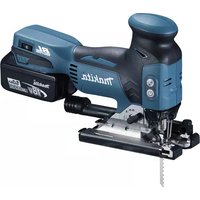
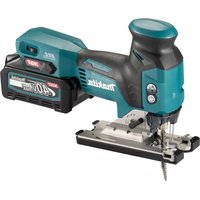
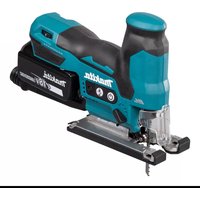
DJV181RT1J - Electric saw MAKITA - Free user manual and instructions
Find the device manual for free DJV181RT1J MAKITA in PDF.



| Product Type | Cordless Jigsaw |
| Brand | Makita |
| Model | DJV181RT1J |
| Total Length | 298 mm |
| Net Weight | 2.5 kg |
| Power Source | 18 V DC lithium-ion battery |
| Stroke Length | 26 mm |
| No Load Speed (variable) | 800 - 3,500 min⁻¹ |
| Max. Cutting Capacity in Wood | 135 mm |
| Max. Cutting Capacity in Mild Steel | 10 mm |
| Max. Cutting Capacity in Aluminum | 20 mm |
| Cutting Action | Orbital or straight (4 positions) |
| Bevel Cutting Angle | 0° to 45° (left or right) |
| Sound Pressure Level | 78 dB(A) |
| Vibration (wood cutting) | 6.5 m/s² |
| Vibration (sheet metal cutting) | 5.0 m/s² |
| Main Functions | Straight, curved, circular, bevel, plunge cutting |
| Maintenance and Cleaning | Dry cloth, no solvents, roller lubrication |
| Safety | Safety switch, battery protection system, automatic stop |
| Spare Parts and Repairability | Authorized Makita service center, original parts |
Frequently Asked Questions - DJV181RT1J MAKITA
User questions about DJV181RT1J MAKITA
0 question about this device. Answer the ones you know or ask your own.
Ask a new question about this device
Download the instructions for your Electric saw in PDF format for free! Find your manual DJV181RT1J - MAKITA and take your electronic device back in hand. On this page are published all the documents necessary for the use of your device. DJV181RT1J by MAKITA.
USER MANUAL DJV181RT1J MAKITA
GB Cordless Jig Saw Instruction manual
1
013928

2
012128

3
013870
4
013871
![graph TD A["8"] --> B["9"] B --> C["10"] C --> A style A fill:#f9f,stroke:#333 style B fill:#ccf,stroke:#333 style C fill:#cfc,stroke:#333](/content/2026/04/639741/images/3a34395efff3c39e28954466d0e6bb80136793111166f390f559c01607b8c682.jpg)
5
013945
6
013933
7
013992

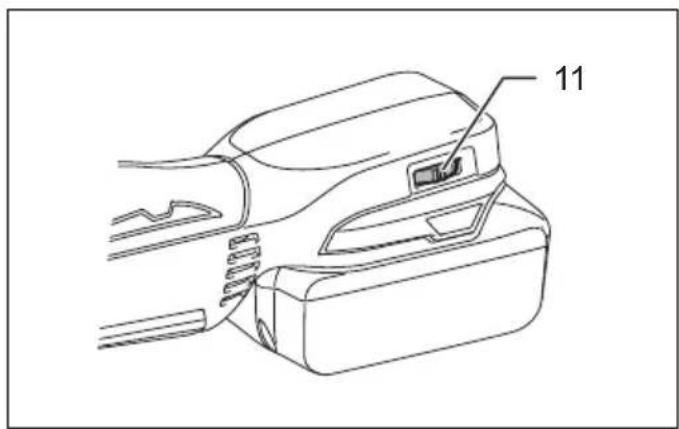
8
013929
9
013930
10
013876
11
013877
12
013878

13
013879
14
013931

15
013932

16
013934
17
013884

18
013935

19
013886
20
013887

21
013936

22
013937

23
013938

24
013939
25
013940

26
013941

27
013942
28
013943
29
013944
ENGLISH (Original instructions)
Explanation of general view
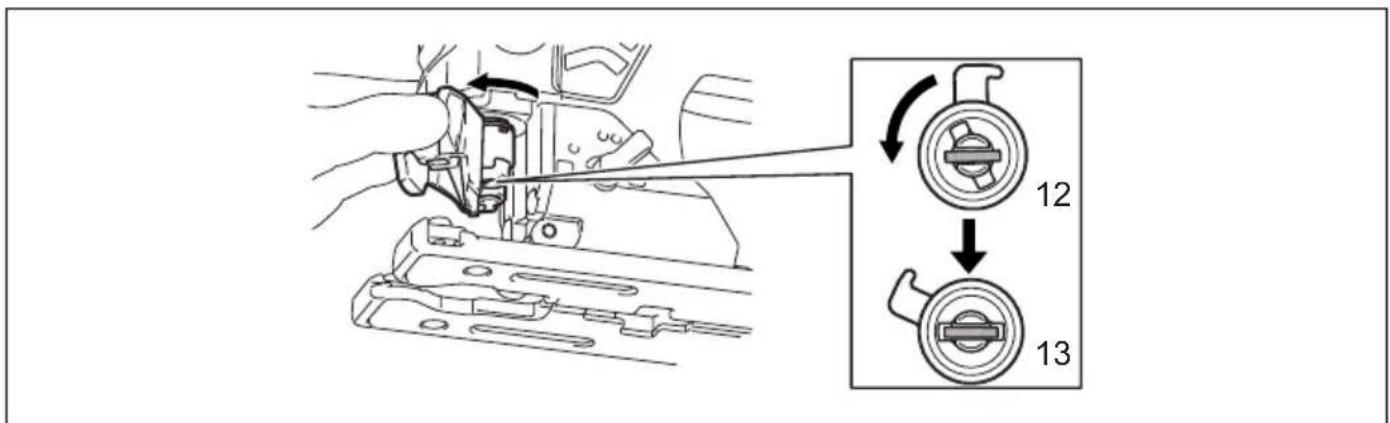
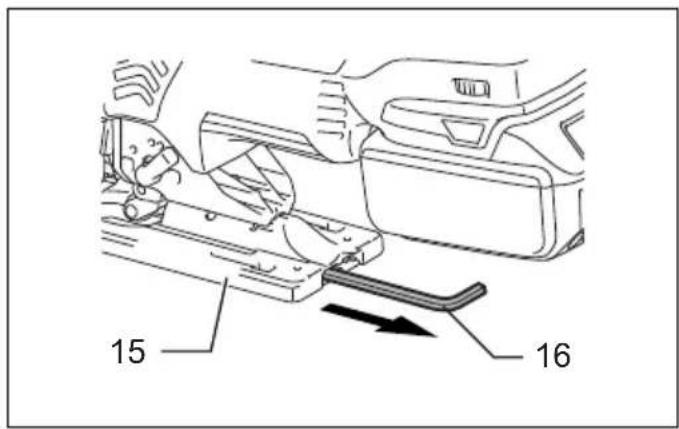
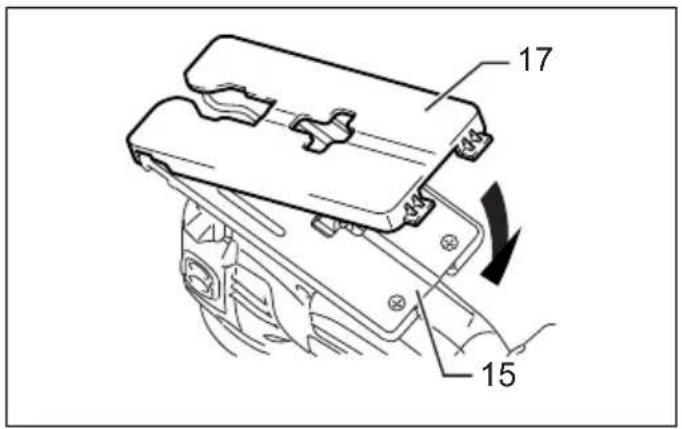
| 1. Red indicator | 13. Released position | 25. Graduations |
| 2. Button | 14. Jig saw blade | 26. V-notch |
| 3. Battery cartridge | 15. Base | 27. Gear housing |
| 4. Star marking | 16. Hex wrench | 28. Starting hole |
| 5. Cutting action changing lever | 17. Cover plate | 29. Rip fence |
| 6. Lock switch | 18. Anti-splintering device | 30. Fence guide |
| 7. ON/standby switch | 19. Dust nozzle | 31. Threaded knob |
| 8. Lock-off | 20. Clamp screw | 32. Circular guide pin |
| 9. ON | 21. Hose for vacuum cleaner | 33. Ruler bar |
| 10. Standby | 22. Cutting line | 34. Guide rail adapter |
| 11. Speed adjusting dial | 23. Bolt | 35. Screw |
| 12. Fixed position | 24. Bevel slot | 36. Guide rail |
SPECIFICATIONS
| Model DJV141 DJV181 | |||
| Length of stroke 26 mm 26 mm | |||
| Max. cutting capacities | Wood 135 mm | 135 mm | |
| Mild steel | 10 mm 10 mm | ||
| Aluminum | 20 mm 20 mm | ||
| Strokes per minute (min -1 ) | 800 - 3,500 | 800 - 3,500 | |
| Overall length | 280 mm | 298 mm | |
| Net weight | 2.4 kg | 2.5 kg | |
| Rated voltage | D.C. 14.4 V | D.C. 18 V | |
- Due to our continuing program of research and development, the specifications herein are subject to change without notice.
- Specifications may differ from country to country.
• Weight according to EPTA-Procedure 01/2003
Intended use
ENE019-1
The tool is intended for the sawing of wood, plastic and metal materials. As a result of the extensive accessory and saw blade program, the tool can be used for many purposes and is very well suited for curved or circular cuts.
General Power Tool Safety Warnings
GEA010-1

WARNING Read all safety warnings and all instructions. Failure to follow the warnings and instructions may result in electric shock, fire and/or serious injury.
Save all warnings and instructions for future reference.
CORDLESS JIG SAW SAFETY WARNINGS
GEB045-2
-
Hold power tool by insulated gripping surfaces, when performing an operation where the cutting accessory may contact hidden wiring. Cutting accessory contacting a "live" wire may make exposed metal parts of the power tool "live" and could give the operator an electric shock.
-
Use clamps or another practical way to secure and support the workpiece to a stable platform. Holding the work by hand or against your body leaves it unstable and may lead to loss of control.
-
Always use safety glasses or goggles. Ordinary eye or sun glasses are NOT safety glasses.
-
Avoid cutting nails. Inspect workpiece for any nails and remove them before operation.
-
Do not cut oversize workpiece.
-
Check for the proper clearance beyond the workpiece before cutting so that the blade will not strike the floor, workbench, etc.
-
Hold the tool firmly.
-
Make sure the blade is not contacting the workpiece before the switch is turned on.
-
Keep hands away from moving parts.
-
Do not leave the tool running. Operate the tool only when hand-held.
-
Always switch off and wait for the blade to come to a complete stop before removing the blade from the workpiece.
-
Do not touch the blade or the workpiece immediately after operation; they may be extremely hot and could burn your skin.
-
Do not operate the tool at no-load unnecessarily.
-
Some material contains chemicals which may be toxic. Take caution to prevent dust inhalation and skin contact. Follow material supplier safety data.
-
Always use the correct dust mask/respirator for the material and application you are working with.
SAVE THESE INSTRUCTIONS.
WARNING:
DO NOT let comfort or familiarity with product (gained from repeated use) replace strict adherence to safety rules for the subject product. MISUSE or failure to follow the safety rules stated in this instruction manual may cause serious personal injury.
IMPORTANT SAFETY INSTRUCTIONS
ENC007-8
FOR BATTERY CARTRIDGE
- Before using battery cartridge, read all instructions and cautionary markings on (1) battery charger, (2) battery, and (3) product using battery.
- Do not disassemble battery cartridge.
- If operating time has become excessively shorter, stop operating immediately. It may result in a risk of overheating, possible burns and even an explosion.
-
If electrolyte gets into your eyes, rinse them out with clear water and seek medical attention right away. It may result in loss of your eyesight.
-
Do not short the battery cartridge:
(1) Do not touch the terminals with any conductive material.
(2) Avoid storing battery cartridge in a container with other metal objects such as nails, coins, etc.
(3) Do not expose battery cartridge to water or rain.
A battery short can cause a large current flow, overheating, possible burns and even a breakdown.
-
Do not store the tool and battery cartridge in locations where the temperature may reach or exceed 50° C ( 122° F).
-
Do not incinerate the battery cartridge even if it is severely damaged or is completely worn out. The battery cartridge can explode in a fire.
-
Be careful not to drop or strike battery.
-
Do not use a damaged battery.
-
Follow your local regulations relating to disposal of battery.
SAVE THESE INSTRUCTIONS.
Tips for maintaining maximum battery life
-
Charge the battery cartridge before completely discharged.
Always stop tool operation and charge the battery cartridge when you notice less tool power. -
Never recharge a fully charged battery cartridge. Overcharging shortens the battery service life.
-
Charge the battery cartridge with room temperature at 10° C - 40° C ( 50° F - 104° F). Let a hot battery cartridge cool down before charging it.
-
Charge the battery cartridge once in every six months if you do not use it for a long period of time.
FUNCTIONAL DESCRIPTION
CAUTION:
- Always be sure that the tool is switched off and the battery cartridge is removed before adjusting or checking function on the tool.
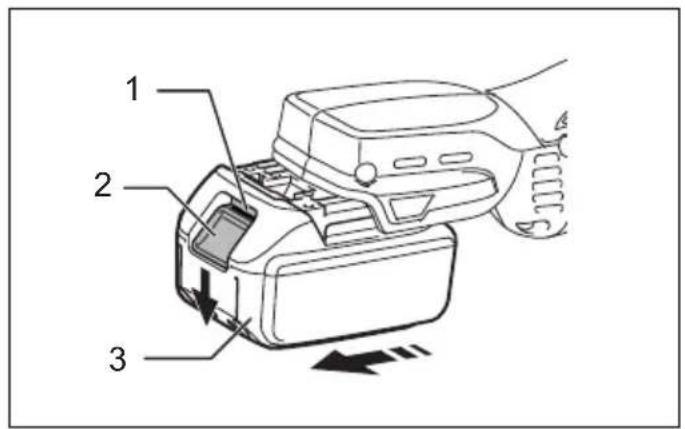
Installing or removing battery cartridge (Fig. 1)
CAUTION:
- Always switch off the tool before installing or removing of the battery cartridge.
- Hold the tool and the battery cartridge firmly when installing or removing battery cartridge. Failure to hold the tool and the battery cartridge firmly may cause them to slip off your hands and result in damage to the tool and battery cartridge and a personal injury.
To remove the battery cartridge, slide it from the tool while sliding the button on the front of the cartridge.
To install the battery cartridge, align the tongue on the battery cartridge with the groove in the housing and slip it into place. Insert it all the way until it locks in place with a little click. If you can see the red indicator on the upper side of the button, it is not locked completely.
CAUTION:
- Always install the battery cartridge fully until the red indicator cannot be seen. If not, it may accidentally fall out of the tool, causing injury to you or someone around you.
- Do not install the battery cartridge forcibly. If the cartridge does not slide in easily, it is not being inserted correctly.
Battery protection system (Lithium-ion battery with star marking) (Fig. 2)
Lithium-ion batteries with a star marking are equipped with a protection system. This system automatically cuts off power to the tool to extend battery life.
The tool will automatically stop during operation if the tool and/or battery are placed under one of the following conditions:
- Overloaded:
The tool is operated in a manner that causes it to draw an abnormally high current. In this situation, press ON/OFF switch on the tool and stop the application that caused the tool to become overloaded. Then press ON/OFF switch again to restart. If the tool does not start, the battery is overheated. In this situation, let the battery cool before pressing ON/OFF switch again.
- Low battery voltage:
The remaining battery capacity is too low and the tool will not operate. In this situation, remove and recharge the battery.
Selecting the cutting action (Fig. 3)
This tool can be operated with an orbital or a straight line (up and down) cutting action. The orbital cutting action thrusts the blade forward on the cutting stroke and greatly increases cutting speed.
To change the cutting action, just turn the cutting action changing lever to the desired cutting action position. Refer to the table to select the appropriate cutting action.
| Position | Cutting action Applications | |
| 0 | Straight line cutting action | For cutting mild steel, stainless steel and plastics. For clean cuts in wood and plywood. |
| I | Small orbit cutting action | For cutting mild steel, aluminum and hard wood. |
| II | Medium orbit cutting action | For cutting wood and plywood. For fast cutting in aluminum and mild steel. |
| III | Large orbit cutting action | For fast cutting in wood and plywood. |
006376
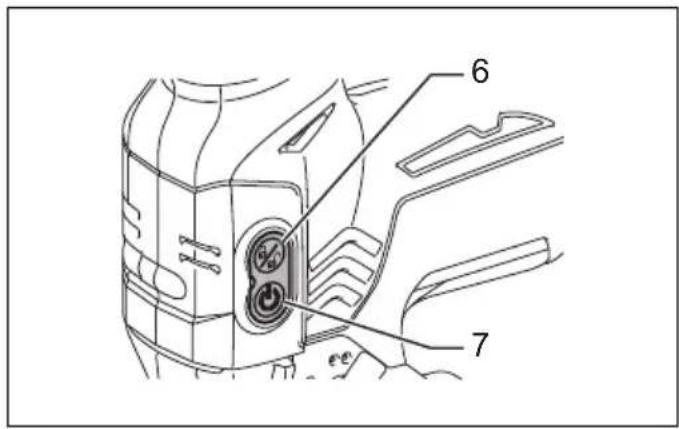
Switch action (Fig. 4 & 5)
To start the tool:
Press the lock switch to turn the tool into standby mode. It turns the lamp on, too.
Press the ON/standby switch to start the tool in standby mode.
To stop the tool:
Press the ON/standby switch to stop and turn the tool into standby mode.
Press the lock switch to stop and turn the tool into lock-off mode.
In standby mode, press the lock switch to turn the lamp off and turn the tool into lock-off mode.
NOTE:
- When the tool is in standby mode, the lamp keeps lighting.
- If the tool is left 10 seconds without any operations in standby mode, the tool is automatically turned into lock-off mode and the lamp goes off.
Lighting up the lamps
CAUTION:
- Do not look in the lamp or see the source of lamp directly.
To turn on the lamp, press the lock switch.
Another press of the lock switch stops the tool and the light goes off.
NOTE:
- Use a dry cloth to wipe the dirt off the lens of lamp. Be careful not to scratch the lens of lamp, or it may lower the illumination.
- When the tool is overheated, the lamp flickers. Cool down the tool fully before operating again.
Speed adjusting dial (Fig. 6)
The tool speed can be infinitely adjusted by turning the speed adjusting dial. You can get the highest speed at 6 and the lowest speed at 1.
Refer to the table to select the proper speed for the workpiece to be cut. However, the appropriate speed may differ with the type or thickness of the workpiece. In general, higher speeds will allow you to cut workpieces faster but the service life of the blade will be reduced.
| Workpiece to be cut Number on adjusting dial | |
| Wood 4 - 6 | |
| Mild steel 3 - 6 | |
| Stainless steel 3 - 4 | |
| Aluminum 3 - 6 | |
| Plastics 1 - 4 | |
013925
CAUTION:
- The speed adjusting dial can be turned only as far as 6 and back to 1. Do not force it past 6 or 1, or the speed adjusting function may no longer work.
NOTE:
- When the speed adjusting dial is at 3 or higher, the tool automatically reduces the no-load speed to reduce the vibration under no-load. Once the tool gets load, the tool speed reaches the preset speed. Then the tool keeps the speed until the tool is switched off. When temperature is low and there is less fluidity in grease, the tool may not have this function even with the motor rotating.
ASSEMBLY
CAUTION:
- Always be sure that the tool is switched off and the battery cartridge is removed before carrying out any work on the tool.
Installing or removing saw blade
CAUTION:
• Always clean out all chips or foreign matter adhering to the blade and/or blade holder. Failure to do so may cause insufficient tightening of the blade, resulting in a serious personal injury.
- Do not touch the blade or the workpiece immediately after operation; they may be extremely hot and could burn your skin.
- Tighten the saw blade securely. Failure to do so may cause a serious injury.
- When you remove the saw blade, be careful not to hurt your fingers with the top of the blade or the tips of workpiece. (Fig. 7)
Before installing the blade, make sure that the blade holder is in the released position.
To install the blade, insert the blade (teeth facing forward) into the blade holder until it latches. The blade holder moves to the fixed position by itself and the blade is locked. Pull the blade lightly to make sure that the blade does not fall off during operation.

CAUTION:
- Do not open the tool opener excessively, or it may cause tool damage. (Fig. 8)
To remove the blade, push the tool opener forward as far as it will go. This allows the blade to be released.
NOTE:
• Occasionally lubricate the roller.
Hex wrench storage (Fig. 9)
When not in use, store the hex wrench as shown in the figure to keep it from being lost.
Cover plate (Fig. 10)
Use the cover plate when cutting decorative veneers, plastics, etc. It protects sensitive or delicate surfaces from damage. Fit it on the back of the tool base.
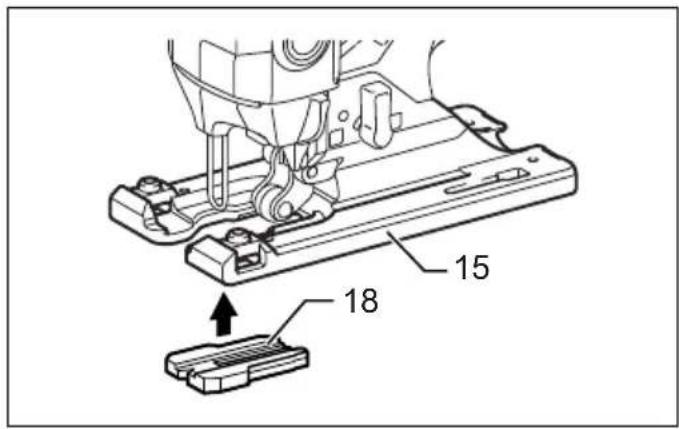
Anti-splintering device (Fig. 11)
For splinter-free cuts, the anti-splintering device can be used. To install the anti-splintering device, move the tool base all the way forward and fit it from the back of tool base. When you use the cover plate, install the anti-splintering device onto the cover plate.

CAUTION:
- The anti-splintering device cannot be used when making bevel cuts.
Dust extraction
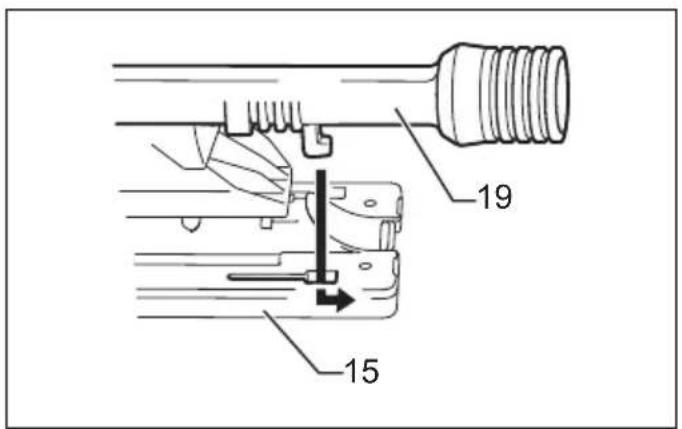
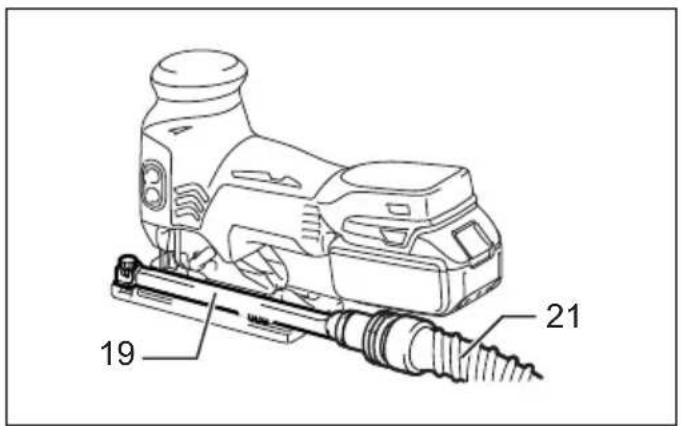
The dust nozzle (optional accessory) is recommended to perform clean cutting operations. (Fig. 12)
To attach the dust nozzle on the tool, insert the hook of dust nozzle into the hole in the base. (Fig. 13)
To secure the dust nozzle, tighten the clamp screw at the front of the dust nozzle.
The dust nozzle can be installed on either left or right side of the base. (Fig. 14)
Then connect a Makita vacuum cleaner to the dust nozzle.
OPERATION

CAUTION:
- Always hold the base flush with the workpiece. Failure to do so may cause blade breakage, resulting in a serious injury.
NOTE:
- If the tool is operated continuously until the battery cartridge has discharged, allow the tool to rest for 15 minutes before proceeding with a fresh battery. (Fig. 15)
Turn the tool on without the blade making any contact and wait until the blade attains full speed. Then rest the base flat on the workpiece and gently move the tool forward along the previously marked cutting line.
When cutting curves, advance the tool very slowly.
Bevel cutting (Fig. 16)

CAUTION:
- Always be sure that the tool is switched off and the battery cartridge is removed before tilting the base.
With the base tilted, you can make bevel cuts at any angle between 0° and 45° (left or right). (Fig. 17)
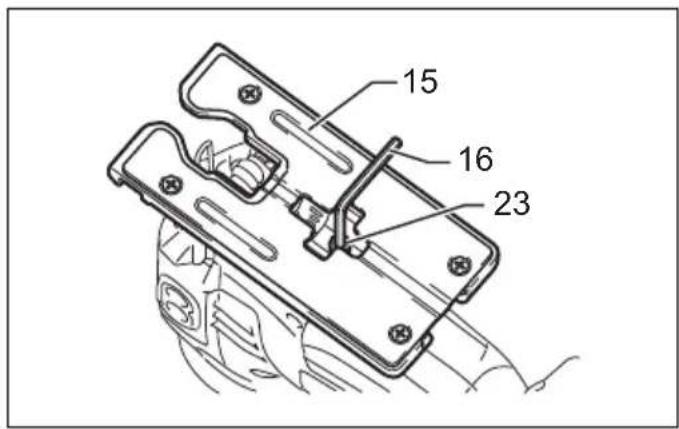
To tilt the base, loosen the bolt on the back of the base with the hex wrench. Move the base so that the bolt is positioned in the center of the bevel slot in the base.
(Fig. 18)
Tilt the base until the desired bevel angle is obtained. The V-notch of the gear housing indicates the bevel angle by graduations. Then tighten the bolt firmly to secure the base.
Front flush cuts (Fig. 19)
Loosen the bolt on the back of the base with the hex wrench and slide the base all the way back. Then tighten the bolt to secure the base.
Cutouts
Cutouts can be made with either of two methods A or B.
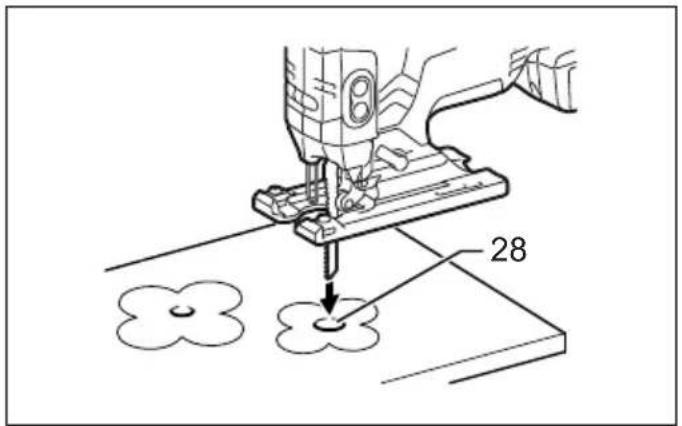
A) Boring a starting hole: (Fig. 20)
- For internal cutouts without a lead-in cut from an edge, pre-drill a starting hole 12 mm or more in diameter. Insert the blade into this hole to start your cut.
B) Plunge cutting: (Fig. 21)
- You need not bore a starting hole or make a lead-in cut if you carefully do as follows.
- Tilt the tool up on the front edge of the base with the blade point positioned just above the workpiece surface.
- Apply pressure to the tool so that the front edge of the base will not move when you switch on the tool and gently lower the back end of the tool slowly.
- As the blade pierces the workpiece, slowly lower the base of the tool down onto the workpiece surface.
- Complete the cut in the normal manner.
Finishing edges (Fig. 22)
To trim edges or make dimensional adjustments, run the blade lightly along the cut edges.
Metal cutting
Always use a suitable coolant (cutting oil) when cutting metal. Failure to do so will cause significant blade wear. The underside of the workpiece can be greased instead of using a coolant.
Rip fence set (optional accessory)

CAUTION:
- Always be sure that the tool is switched off and the battery cartridge is removed before installing or removing accessories.
1. Straight cuts (Fig. 23)
When repeatedly cutting widths of 160 mm or less, use of the rip fence will assure fast, clean, straight cuts. (Fig. 24) To install, insert the rip fence into the rectangular hole on the side of the tool base with the fence guide facing down. Slide the rip fence to the desired cutting width position, then tighten the bolt to secure it.
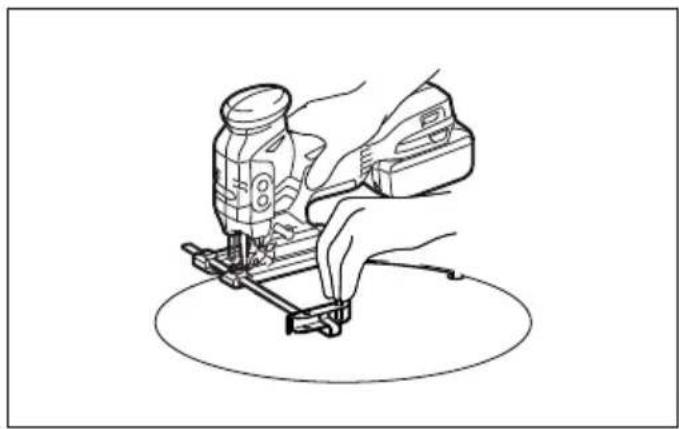
2. Circular cuts (Fig. 25 & 26)
When cutting circles or arcs of 170 mm or less in radius, install the rip fence as follows.
- Insert the rip fence into the rectangular hole on the side of the base with the fence guide facing up. Insert the circular guide pin through either of the two holes on the fence guide. Screw the threaded knob onto the pin to secure the pin.
- Now slide the rip fence to the desired cutting radius, and tighten the bolt to secure it in place. Then move the base all the way forward.
NOTE:
- Always use blades No. B-17, B-18, B-26 or B-27 when cutting circles or arcs.
Guide rail adapter set (optional accessory) (Fig. 27)
When cutting parallel and uniform width or cutting straight, the use of the guide rail and the guide rail adapter will assure the production of fast and clean cuts.
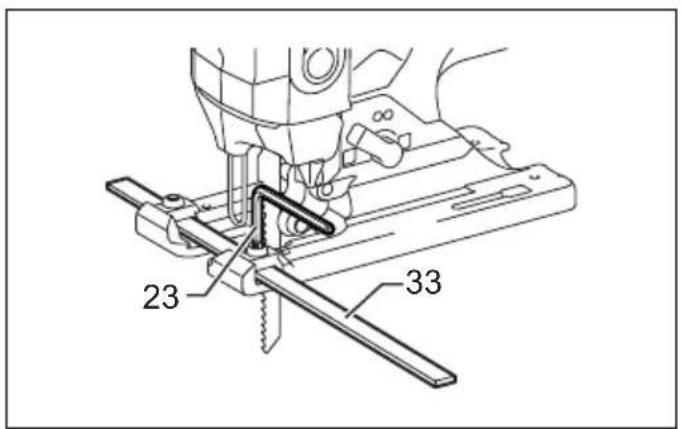
To install the guide rail adapter, insert the rule bar into the square hole of the base as far as it goes. Secure the bolt with the hex wrench securely. (Fig. 28)
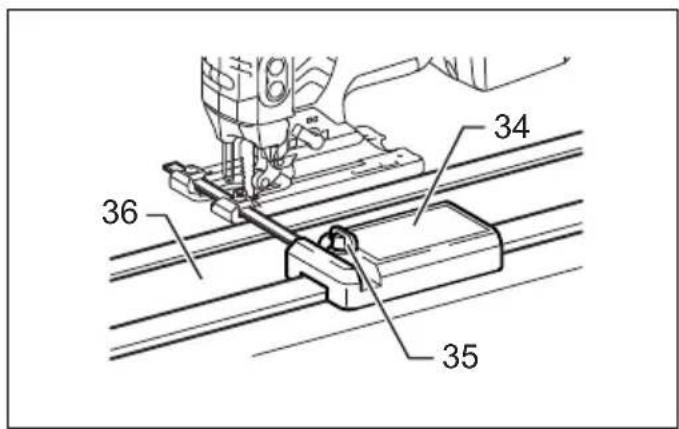
Install the guide rail adapter on the rail of the guide rail. Insert the rule bar into the square hole of the guide rail adapter. Put the base to the side of the guide rail, and secure the bolt securely. (Fig. 29)

CAUTION:
- Always use blades No. B-8, B-13, B-16, B-17 or 58 when using the guide rail and the guide rail adapter.
MAINTENANCE

CAUTION:
• Always be sure that the tool is switched off and the battery cartridge is removed before attempting to perform inspection or maintenance.
- Never use gasoline, benzine, thinner, alcohol or the like. Discoloration, deformation or cracks may result. To maintain product SAFETY and RELIABILITY, repairs, any other maintenance or adjustment should be performed by Makita Authorized Service Centers, always using Makita replacement parts.
OPTIONAL ACCESSORIES

CAUTION:
• These accessories or attachments are recommended for use with your Makita tool specified in this manual. The use of any other accessories or attachments might present a risk of injury to persons. Only use accessory or attachment for its stated purpose.
If you need any assistance for more details regarding these accessories, ask your local Makita Service Center.
- Jig saw blades
• H e x w r e n c h 4 - Rip fence (guide rule) set
- Guide rail adapter set
- Guide rail set
• Anti-splintering device - Cover plate
- Dust nozzle assy
- Makita genuine battery and charger
NOTE:
- Some items in the list may be included in the tool package as standard accessories. They may differ from country to country.
Noise
ENG905-1
The typical A-weighted noise level determined according to EN60745:
Sound pressure level ( LpA ): 78 dB (A)
Uncertainty (K): 3 dB (A)
The noise level under working may exceed 80 dB (A).
Wear ear protection.
Vibration
ENG900-1
The vibration total value (tri-axial vector sum) determined according to EN60745:
Work mode: cutting boards Vibration emission ( ah,B ): 6.5 m/s 2 Uncertainty (K): 1.5 m/s 2
Work mode: cutting sheet metal Vibration emission ( ah,M ): 5.0 m/s 2 Uncertainty (K): 1.5 m/s 2
ENG901-1
- The declared vibration emission value has been measured in accordance with the standard test method and may be used for comparing one tool with another.
- The declared vibration emission value may also be used in a preliminary assessment of exposure.

WARNING:
- The vibration emission during actual use of the power tool can differ from the declared emission value depending on the ways in which the tool is used.
- Be sure to identify safety measures to protect the operator that are based on an estimation of exposure in the actual conditions of use (taking account of all parts of the operating cycle such as the times when the tool is switched off and when it is running idle in addition to the trigger time).
For European countries only
ENH101-17
EC Declaration of Conformity
Makita declares that the following Machine(s):
Designation of Machine:
Cordless Jig Saw
Model No./Type: DJV141, DJV181
Conforms to the following European Directives: 2006/42/EC
They are manufactured in accordance with the following Standard or standardized documents: EN60745
The Technical file in accordance with 2006/42/EC is available from:
Makita, Jan-Baptist Vinkstraat 2, 3070, Belgium
-
- 2013

Yasushi Fukaya Director
Makita, Jan-Baptist Vinkstraat 2, 3070, Belgium
WAARSCHUWING Lees alle
Trillingsemissie ( ah,M ): 5,0 m/s 2
Vibrationsemission ( ah,M ): 5,0 m/s 2
- Intended use
- General power tool safety warnings
- Save all warnings and instructions for future reference
- Cordless jig saw safety warnings
- Save these instructions
- Warning
- Important safety instructions
- For battery cartridge
- Tips for maintaining maximum battery life
- Functional description
- Caution
- Installing or removing battery cartridge (fig. 1)
- Battery protection system (lithium-ion battery with star marking) (fig. 2)
- Selecting the cutting action (fig. 3)
- Switch action (fig. 4 & 5)
- Note
- Lighting up the lamps
- Speed adjusting dial (fig. 6)
- Assembly
- Installing or removing saw blade
- Hex wrench storage (fig. 9)
- Cover plate (fig. 10)
- Anti-splintering device (fig. 11)
- Dust extraction
- Operation
- Bevel cutting (fig. 16)
- (Fig. 18)
- Front flush cuts (fig. 19)
- Cutouts
- Boring a starting hole: (fig. 20)
- Plunge cutting: (fig. 21)
- Finishing edges (fig. 22)
- Metal cutting
- Rip fence set (optional accessory)
- Straight cuts (fig. 23)
- Circular cuts (fig. 25 & 26)
- Guide rail adapter set (optional accessory) (fig. 27)
- Maintenance
- Optional accessories
- Noise
- Vibration
- For european countries only
- Ec declaration of conformity
- Makita declares that the following machine(s)
- Conforms to the following european directives: 2006/42/EC
- Waarschuwing lees alle
Brand : MAKITA
Model : DJV181RT1J
Category : Electric saw