
Joel Air - Stroller Jette - Free user manual and instructions
Find the device manual for free Joel Air Jette in PDF.



| Product type | Stroller |
| Brand | Jette |
| Model | Joel Air |
| Recommended age | 6 to 36 months |
| Maximum child weight | 15 kg |
| Maximum basket weight | 3 kg |
| Safety standard | EN 1888 (01.05.2012) |
| Accessories included | Carrycot, safety bar, canopy, safety harness |
| Seat positions | Sitting, reclining, parent-facing, forward-facing |
| Wheels | Front swivel or fixed, rear with brakes |
| Adjustable handlebar | Yes, safety lever |
| Brakes | Foot brake on rear wheels |
| Folding | Manual with safety lock |
| Maintenance | Clean with mild soap, oil axles with acid-free oil |
| Spare parts and repairability | Genuine parts recommended by manufacturer |
| Tire pressure (if applicable) | Check regularly, max pressure indicated on wheels |
| Textile washing instructions | Check sewn-in labels, mild soap |
Frequently Asked Questions - Joel Air Jette
User questions about Joel Air Jette
0 question about this device. Answer the ones you know or ask your own.
Ask a new question about this device
Download the instructions for your Stroller in PDF format for free! Find your manual Joel Air - Jette and take your electronic device back in hand. On this page are published all the documents necessary for the use of your device. Joel Air by Jette.
USER MANUAL Joel Air Jette
GB - Pictures of the manual
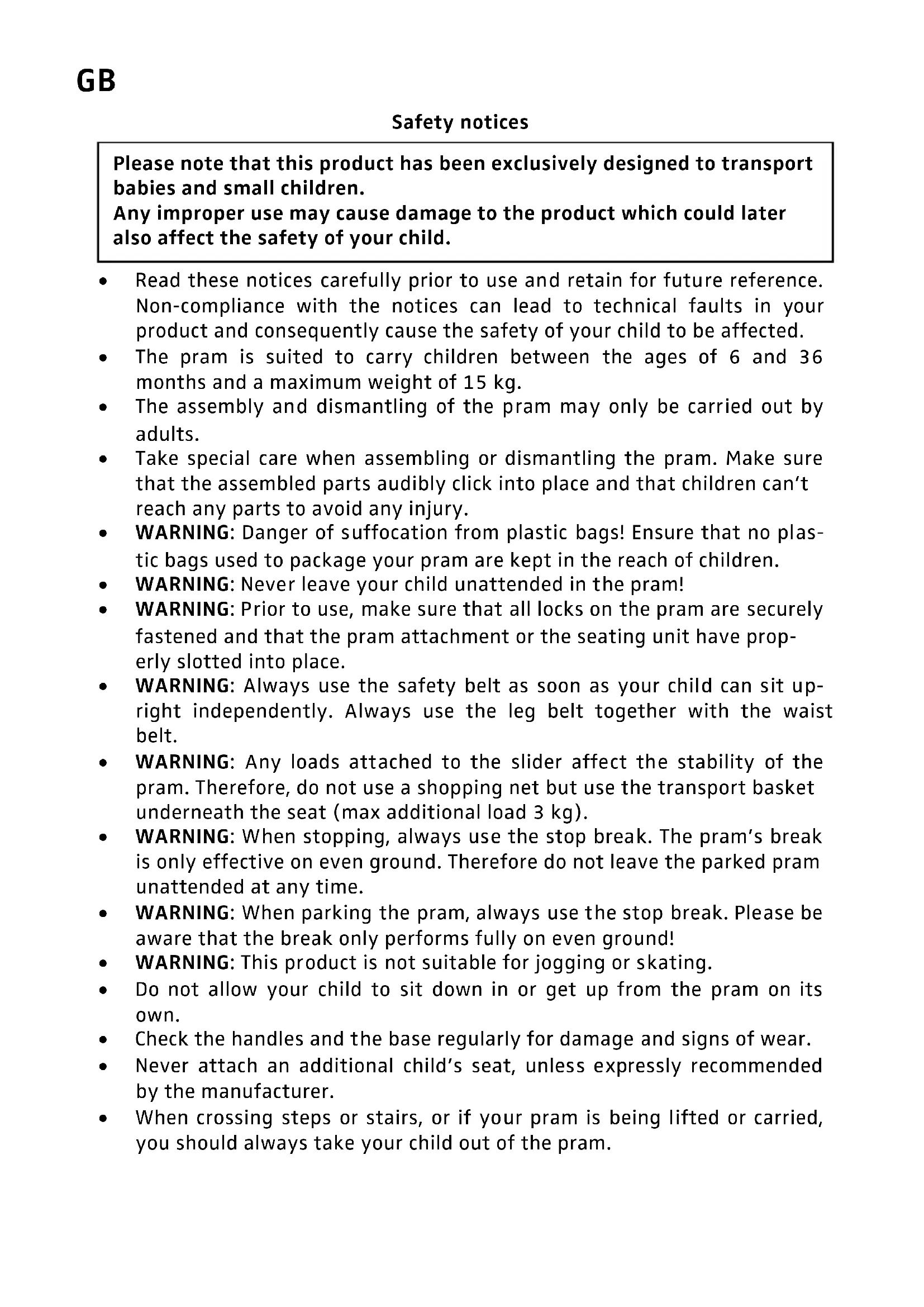
Please note that this product has been exclusively designed to transport babies and small children.
Any improper use may cause damage to the product which could later also affect the safety of your child.
- Read these notices carefully prior to use and retain for future reference. Non-compliance with the notices can lead to technical faults in your product and consequently cause the safety of your child to be affected.
- The pram is suited to carry children between the ages of 6 and 36 months and a maximum weight of 15kg .
- The assembly and dismantling of the pram may only be carried out by adults.
- Take special care when assembling or dismantling the pram. Make sure that the assembled parts audibly click into place and that children can't reach any parts to avoid any injury.
- WARNING: Danger of suffocation from plastic bags! Ensure that no plastic bags used to package your pram are kept in the reach of children.
WARNING: Never leave your child unattended in the pram! - WARNING: Prior to use, make sure that all locks on the pram are securely fastened and that the pram attachment or the seating unit have properly slotted into place.
- WARNING: Always use the safety belt as soon as your child can sit upright independently. Always use the leg belt together with the waist belt.
- WARNING: Any loads attached to the slider affect the stability of the pram. Therefore, do not use a shopping net but use the transport basket underneath the seat (max additional load 3 kg).
- WARNING: When stopping, always use the stop break. The pram's break is only effective on even ground. Therefore do not leave the parked pram unattended at any time.
- WARNING: When parking the pram, always use the stop break. Please be aware that the break only performs fully on even ground!
WARNING: This product is not suitable for jogging or skating. - Do not allow your child to sit down in or get up from the pram on its own.
- Check the handles and the base regularly for damage and signs of wear.
- Never attach an additional child's seat, unless expressly recommended by the manufacturer.
-
When crossing steps or stairs, or if your pram is being lifted or carried, you should always take your child out of the pram.
-
Regarding the permitted load on the pram, follow the manufacturer's instructions or speak to your specialised dealer.
For cleaning and care of your pram, consult the care instructions in this instruction manual.
- Carefully retain this instruction manual over the entire period of using the pram and, if the pram is being sold to third parties, also include this instruction manual.
- Only use genuine replacement parts or accessories which have been expressly recommended by the manufacturer.
- If your pram has an additional deceleration break, this should always be adjusted so that the breaking wheel does not obstruct.
- If your pram is fitted with air tyres, regularly check the air pressure! (NOTE: lightly press with thumb). The maximum recommended air pressure is shown on the tyre. NOTE: air tyres can cause non-removable marks on laminate, parquet or plastic floors!
Care and maintenance of the pram:
For the textile parts intended by the manufacturer to be removable and washable, please read the attached care label. Never use sharp or abrasive cleaning products, instead use a mild soap solution or a special textile cleaning product.
The plastic parts and the frame can also be cleaned with a soap solution.
After using the pram in rain or wet conditions, always clean and dry the frame. If the fabric cover is soaked, allow the pram to dry in its assembled state.
The wheels should regularly be detached and the axles as well as all moving connections and the suspension should be treated with an acid-free oil (sewing machine oil, WD-40 or fat-free lubricant). This helps the pram run more smoothly and quietly and limits the amount of early signs of wear.
Care for your pram and ensure that no flash rust occurs, as this does not constitute a reason for reclamation.
ATTENTION: The fabrics used are often cotton or blended cotton fabrics which comply with the current legal requirements.
Heavy wear over a prolonged period (e.g. intensive exposure to sunlight) can cause colours to fade, particularly in natural textiles; however, this does not constitute a reason for reclamation.
Important notes: This product is suitable for a child with a max. weight of 15 kgs. Please read before use all notes and keep them for future reference. Disregard of these notes could result in injuries to your child.
Attention: Colour and features of product may differ from the diagrams shown.
In compliance with EN 1888 / 01.05.2012 As 11.11.2015
GB
Assembly:
Unhook the safety catch (Fig. 1). Pull the shifter handle upwards until the pushchair is completely erect (Fig 1b).
Assembling / removing rear axle:
Assembly: Position the rear axle on the chassis (Fig. 2a).
Removal: Press the two metal locking pins on the inside (Fig. 2b) and pull the axle from the chassis.
Assembling / removing rear wheels:
Securing rear wheels: Press the wheel onto the axle (Fig. 3a).
Removing rear wheels: Press the release button (Fig. 3b) at the centre of the wheel and pull the wheel from the axle.
Assembling / removing front wheels:
Securing the front wheels: Push the front wheel onto the wheel suspension on the chassis (Fig. 4a).
Removing the front wheels: Press both safety buttons on the lower side of the wheel suspension (Fig. 4b) and remove the wheel.
Swivel wheel function:
Unlocking wheels: Turn the black lever above the front wheel inwards (Fig. 5a).
Locking wheels: Turn the black lever outwards (Fig 5b).
Changing the seat position:
To remove the seat, press the two push buttons on the outside (Fig. 6a). You can also position the seat in the opposite direction to travel (Fig. 6b).
Lift slightly to check that the seat is properly locked in position. By pressing the push buttons, you can adjust the seat to a sitting position (Fig. 6c) or lying position (Fig. 6d).
Activating the brake:
To activate brake: Push the brake arm downwards with your foot (Fig. 7a).
To release brake: Pull the brake arm upwards with your foot (Fig. 7b).
NOTE: Always activate the brake when the pushchair is not in motion.
Adjusting the foot rest:
Press both arms on the left and right sides (Fig. 8).
Safety belt:
To assemble the safety belt, click the two belt buckles (A + B) to the centre piece (C). To open, press both side clips simultaneously and pull the buckles apart (Fig. 9).
Height-adjustable push bar:
By pressing the safety button on the push bar (Fig. 10a), you can adjust the length of the push bar (Fig. 10 b).
NOTE: Please keep your child's hands and all other body parts away from moving parts of the pushchair.
Attaching / removing the hood:
Insert the hood's two plastic clips in the plastic guides on the right and left sides of the seat (Fig. 11a).
To remove the hood, press the two plastic push buttons (Fig. 11b) and pull the hood upwards.
NOTE: Always fold the hood back before folding the pushchair.
Attaching / removing the front rail:
Push the rail into the two corresponding rail inserts on the seat (Fig. 12a).
To remove, press the two buttons on the lower side of the rail (Fig. 12b) and pull the rail out of the support (Fig. 10).
GB
Assembling the pram:
Assembly: Remove the mattress and push the two brackets outwards until the brackets slot into the notches and the pram is fully stretched (Fig. 13a). You can now place the mattress in the carry cot.
Folding together: Remove the mattress and push the two brackets inwards (Fig. 13b). You can now place the mattress in the carry cot again.
Positioning / removing the pram body:
Remove the seat from the chassis and place the pram on top of the two inserts on the chassis. To steady, fold out the bracket on the lower side of the pram and secure these to the rear rods on the shopping basket (Fig. 14a).
To remove the pram, release the stabiling brackets in the pram and fold them together again. Next, press the two black safety buttons (on the left and right side) and lift the pram from the chassis (Fig. 14b).
NOTE: The pram can only be positioned for the baby to look in the opposite direction of travel, since secure positioning is not possible otherwise.
Folding together:
Remove the pram from the chassis and activate the brake. If you wish to fold the pushchair with the seat attached, the seat must be positioned in sitting mode, facing the direction of travel to avoid damage to the pushchair.
Standing in front of the push bar, use your right hand to push the safety button on the push bar (Fig. 15a) and your left hand to push the safety button on the left side of the push bar (Fig. 15b). Whilst pressing both safety buttons, simply push the push bar forwards until the pushchair folds together completely (Fig. 15c).
Next, fasten the safety catch (Fig. 1) and check that the pushchair cannot open by itself.