Logic - Log splitter Bell - Free user manual and instructions
Find the device manual for free Logic Bell in PDF.




| Product type | Portable horizontal log splitter |
| Brand | Bell |
| Model | Logic |
| Dimensions (L x W x H) | 1030 x 300 x 550 mm |
| Weight | 58 kg |
| Max. pushing force | ~7 tons |
| Max. cutting length | 520 mm |
| Total hydraulic oil capacity | ~6 liters |
| Power supply | 230 V / 50 Hz / single phase |
| Current draw | 10 A |
| Motor power | 2 HP (1.5 kW) |
| Average noise level | ≤ 71 dB(A) at 1 m |
| Two-hand operation | Yes (motor push-button + hydraulic lever) |
| Speed and power adjustment | Yes (by lever: mid-stroke fast/low power, full stroke slow/full power) |
| Safety | Two-hand operation, emergency stop, impact protection |
| Maintenance | Hydraulic oil change every 400 hours, blade sharpening, oil level check |
| Recommended hydraulic oil | Shell Tellus T22, Aral Vitam GF22, BP Energol HCP22, Texaco Rando HDZ22/32, Mobil DTE11 or equivalent |
| Warranty | 360 days (12 months) from purchase date |
| Spare parts | Available from authorized dealer (quote model and serial number) |
Frequently Asked Questions - Logic Bell
User questions about Logic Bell
0 question about this device. Answer the ones you know or ask your own.
Ask a new question about this device
Download the instructions for your Log splitter in PDF format for free! Find your manual Logic - Bell and take your electronic device back in hand. On this page are published all the documents necessary for the use of your device. Logic by Bell.
USER MANUAL Logic Bell
MANUALE DI USO E MANUTENZIONE
MANUAL FOR USE AND MAINTENANCE
WARTUNGS-UND BETRIEBSANLEITUNG
LIVRET D'EMPLOI ET D'ENTRETIER
ONDERHOUDSHANDLEIDING
BRUKSANVISNING
BRUKER-OG VEDLIKEHOLDSVEILEDNING
VEDLIGEHOLDELSOGBETJENINGSVEJLEDNING
KAYTTOOHJEKIRJA
MANUAL DE USO Y MANTENIMIENTO
MANUAL DE USO E DE MANUTENÇAO


5
6
7
2
1
8
9
10
INDICE GENERALE
INTRODUZIONE 8
1 DESCrizIONE DELLA MACCHINA 8
1.1 Iconografia 8
2 CARATTERISTICHE TECNICHE 9
2.1 Size of the logs to be split 15
2.2 Recommended oils 15
3 SAFETY 15
3.1 General safety regulations 15
4 OPERATING THE MACHINE FOR THE FIRST TIME 16
4.1 Lighting 16
5 USE 16
6 ROUTINE MAINTENANCE 17
6.1 How to change the hydraulic oil 17
6.2 Refilling the hydraulic oil 17
6.3 Sharpening the wedge 17
7 TROUBLESHOOTING 17
7.1 How to free a jammed log 17
7.2 Troubleshooting 18
SCRAPPING AND DISPOSAL OF THE MACHINE 18
SPARE PARTS 18
GUARANTEE 19

WARNING
When the machine is delivered, check for any missing parts and for any damage during transport. Any complaints must be forwarded immediately to the carrier and to the retailer. Any subsequent complaints will not be accepted.
RUTINEVEDLIKEHOLD 47
2 TEKNISET TIEDOT 57
Congratulations on your choice of a BELL® log splitter!
Please read this manual carefully. Following all the instructions provided will ensure that you get excellent results and the best performance from your log splitter.
BELL® log splitters have been designed and manufactured in compliance with the most recent European safety regulations with particular reference to the EN 609-1 and CEI EN 60204-1 standards.
The two-hands control systems, in fact, have been designed and engineered so that the operator is forced to work in the safety area, employing both the hands, without any possibility of inserting hands or arms in dangerous areas.
This log splitter machine is produced in conformity with the specifications contained in the RoHs directive 2002/95/CE
Before transporting, installing or operating the machine, read all parts of this manual, paying particular attention to the specific safety regulations.
Operators who are unable to understand any of the languages in which this manual is written are responsible for asking the retailer to provide a manual in their own language.
The operator must also train any other person authorised to use the machine.
Failure to comply in any way with these instructions, improper use of the machine, extraordinary maintenance operations not carried out by skilled, authorised personnel, removal of data plates or markings of any type, removal or tampering with the guards and safety mechanisms of the machine or any other action not expressly authorised that may impair the active and passive safety systems of the machine shall relieve the manufacturer of all and any liability and may result in serious injury and damage.
If the machine is tampered with in any way by unauthorised personnel, the guarantee is automatically null and void. This manual is an integral part of the machine and must accompany it even in the case of transfer of ownership.
WARNING: The ignition system of your machine produces an electromagnetic field of very low intensity. This field could interfere with certain pacemakers. To reduce the risk of serious or fatal injury, persons with pacemakers should consult their doctor or the manufacturer of the pacemaker before using this machine
1 - DESCRIPTION OF THE MACHINE
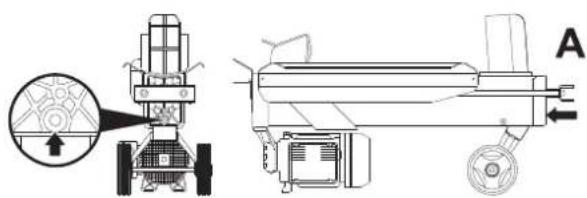
LOGIC is a portable horizontal log splitter equipped with electric motor.
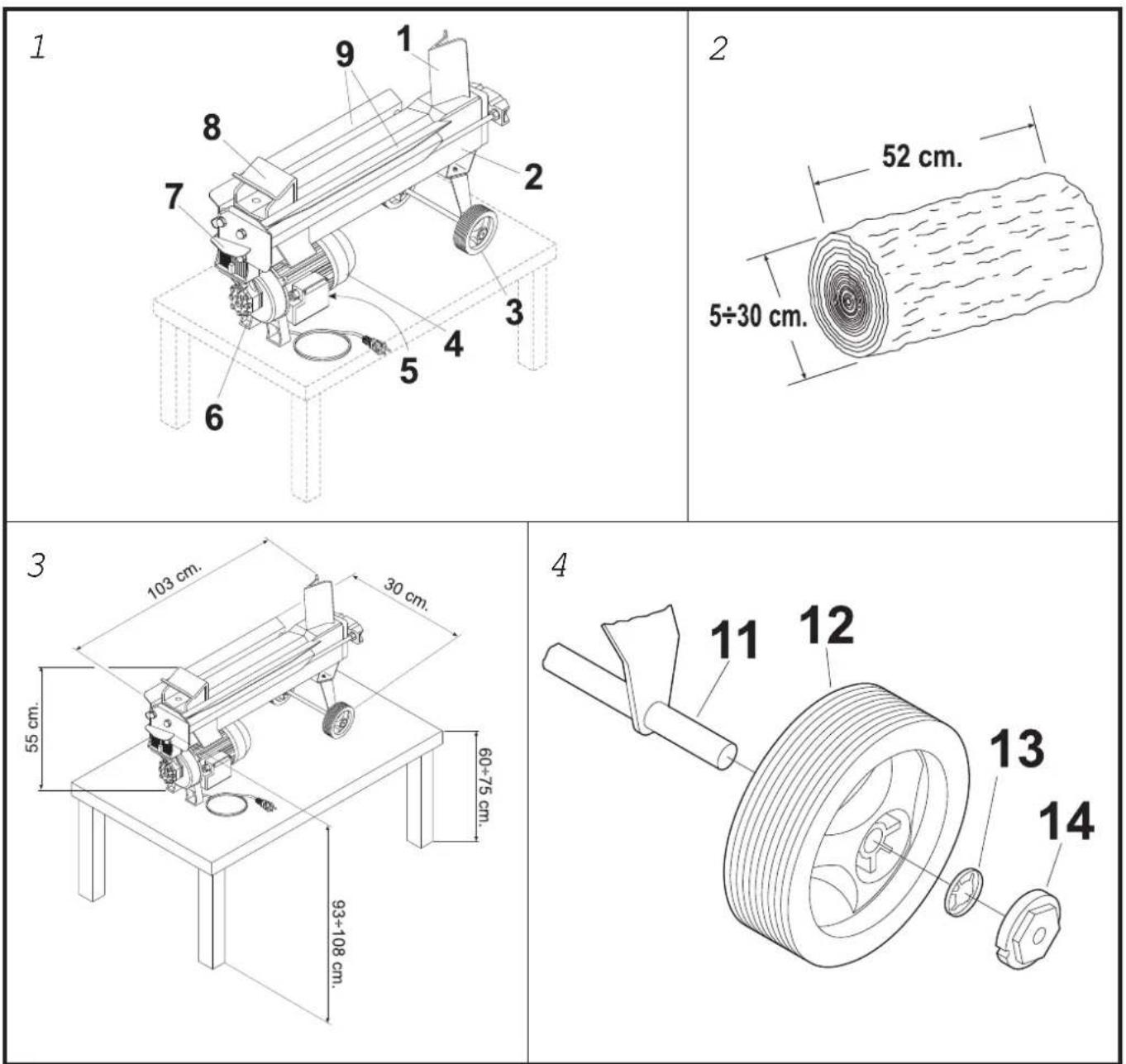
The various parts of the machine are shown in fig.1, page 2.
1-Wedge
6-Foot
2-Oil tank
7-ZHB hydraulic control lever
3 - Wheels for minor movements
8 - Log pusher and lifting handle
4 - Electric motor
9 - Log retention brackets
5 - Electric motor starter push-button
1.1 - Symbols used
Standard graphic symbols are used on all machines in order to ensure complete safety of all parts of the log splitter. As these symbols are very important, read the information below attentively.

It's necessary to read carefully the entire use and maintenance manual of the machine, before using it

it is obligatory to wear safety footwear at all times to provide protection against the risk of logs accidentally falling on feet.

it is obligatory at all times to wear gloves which protect the hands against chips and splinters which may be produced during work.

it is obligatory at all times to wear goggles which protects the eyes against chips and splinters which may be produced during work.

The log splitter must be used by one person alone.

it is forbidden to stand in the range of action of the machine. apart from the operator, no other person or animal may be present within a radius of 5 metres from the machine.

Dumping of used oil in the environment is forbidden. The oil must be disposed of according to current legislation in the country where this operation is carried out.

Danger of cutting or crushing of the hand: never touch hazardous areas while the wedge is moving.

Warning: always pay attention to the movement of the log pusher.

Warning: never remove a log trapped in the wedge with your hands.

Warning: Before carrying out any maintenance operation described in this manual, disconnect the plug of the machine.

Warning: voltage as indicated on the rating plate
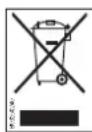
Machines fitted with electrical parts must not be disposed of as general waste and must be separated for disposal as separately collected fractions, deposited at authorised collection points.
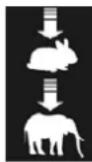
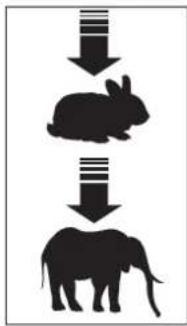
Regulating speed with the control lever: in the first position, about halfway down, the log splitter is faster but less powerful; with the lever pressed all the way, the machine slows down but splits the log at full power.

Log splitter start button
2 - TECHNICAL DATA
Figure 3 on page 2 shows the maximum dimensions of the log splitter.
| Lenght (mm) 1030 | |
| Widht (mm) 300 | |
| Height (mm) 550 | |
| Weight (Kg) 58 | |
| Max. force (tons.) ~ 7 | |
| Log capacity (mm) 520 | |
| Hydraulic oil capacity (Lt.) ~ 6 | |
| Supply 230V 50Hz single-phase | |
| Absorption 10A | |
| Power 2Hp - 1,5KW | |
| Average noise <= 71 dB(A)/1 m. Protective earphones are not necessary | |
2.1 - Size of the logs to be split
Figure 2 on page 2 shows the maximum log sizes that can be split.
The diameter of the log is indicative: a small log can be difficult to split if it has knots or a particularly twisted fibre.
2.2 - Recommended oils
We recommend use of the following oils for the hydraulic cylinder:
SHELL TELLUS T22
ARAL VITAM GF22
BP ENERGOL HCP22
TEXACO RANDO HDZ 22/32
MOBIL DTE11 or equivalent
DO NOT USE OTHER GRADE OILS.
3 - SAFETY
The information given in the chapter is extremely important for safety purposes. It describes possible hazards tied to use of the machine and instructions for correct use of this to avoid injury or damage.
WARNING: This log splitter has been designed and manufactured to split logs of the sizes recommended only (fig.2 page 2).
Use of the machine for any other purpose shall be considered improper and the manufacturer shall not be liable for any injuries or damage to be ascribed to improper use of the machine.
The operator must operate the machine drive control with both hands without using other improvised systems and without tampering with the controls.
When the machine is working, persons and animals must be kept at a distance of at least 5 meters from the machine.
For the best and safest use, the log splitter should be used on a raised surface of height between 60 and 75~cm
NEVER ATTEMPT TO TAMPER WITH THE PROTECTIONS OF THE LOG SPLITTER OR TO OPERATE THE MACHINE WITHOUT THESE. FAILURE TO COMPLY WITH THE INSTRUCTIONS GIVEN IN THIS CHAPTER MAY RESULT IN SERIOUS INJURY OR DAMAGE TO PERSONS, THINGS AND TO THE MACHINE.
Do not use the log splitter to break stone materials (stones, concrete, etc.). Or to crush pieces or metal containers.
3.1 - General safety regulations
The machine must always be used by one operator only.
- Do not use the machine outdoor when it is raining or snowing.
- Nobody must be allowed to use the log splitter unless they have read the instruction manual and have been instructed in the regulations to follow for correct and safe use.
The machine must be used by adults only. Use of the log splitter by apprentices of not less than 16 years of age must be supervised by an adult authorised to use the machine.
- Never wear loose, unbuttoned clothing which may become trapped in moving parts.
The working area must be free from any objects that could prevent complete freedom of movement for the operator while working.
- Keep the log support bench free of waste materials (9 in fig.1) and ensure that the operator's work space is free of obstacles: logs, chippings, sawdust, etc.
- Check that the logs to be split are free from nails or wire, which may fly up or damage the machine. the ends of the logs must be cut square. branches must be cut off flush with the trunk.
- Never try to split logs larger than those indicated in fig. 2. This could be dangerous and may damage the machine.
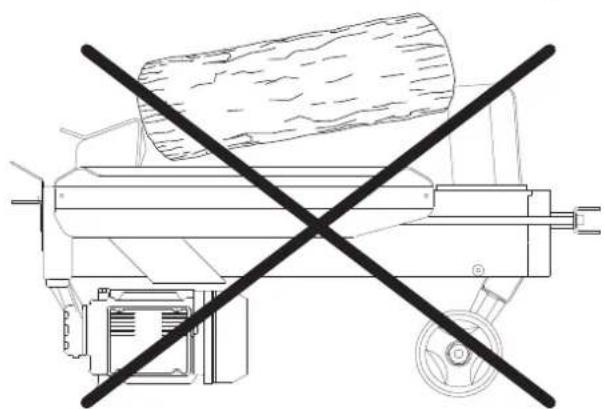
- Break wood in the direction of the grain. do not place wood across the log splitter and leave it in that position for splitting; it may be dangerous and may seriously damage the machine.
- Never attempt to cut two logs at once; one may fly up and hit you.
- If the log moves away from the blade, retract the ram or the blade and turn the log through 90^ .
- Do not attempt to load the log in the log splitter while the ram is in motion: you could get trapped and injured.
- Keep your hands well away from any splits and cracks which open in the log; these may close suddenly and crush or amputate your fingers.
- Do not force the blade by pushing the log on the upper part (fig.9), as this can cause the blade to break or damage the body of the machine. Always set the log on the guides.
- Never leave the machine unattended while it is running. If you leave the machine, even for a short time, remove the power supply or any possible cause of accidental start-up.
The log splitter must never be used by an operator who is under the influence of alcohol, drugs, medicines, or who is tired. A clear mind is essential for safety.
- Never request the assistance of another person to help you remove a jammed log.
- Do not use machines with electric motor if natural gas, petrol fumes or other inflammable vapours are present.
- Check that the electric circuit to which the machine will be connected is suitable. Power, voltage and frequency of the motor must be checked (verify the nameplate on the motor and the data in this manual). The machine must be connected to a circuit with a regulation differential switch upstream and, in compliance with the norms (30 mA rated fault current), with a ground connection.
- Use cables with a section of 2.5mm^2 . Avoid use of free and inadequately insulated connections. Connections must be made with protected material suitable for outdoor use. Do not use cable extensions longer than 5 mt.: too long cables or cables with inadequate section may cause voltage drops and don't allow the motor to develop all the power. Always check the cable extension for any damage before using it.
- Never open the pushbutton box on the motor. Should this be necessary, contact a qualified electrician.
Make sure that the machine and the cable never come in contact with water.
- Treat the power cable with care. do not attempt to move the machine by pulling the cable. do not yank the cable to unplug it; keep the cable away from excessive heat, oil and sharp objects.
- Never leave the machine unattended with the power supply "on". After use, always switch the machine off and disconnect it from the power supply, especially when any maintenance work is required.
- Do not use alcohol, petrol, or solvents to clean the machine. This could cause the safety information applied to the machine itself to become illegible.
4 - OPERATING THE MACHINE FOR THE FIRST TIME

Before operating the machine, it is necessary to fit the wheels on their axle.
Insert the wheel (12 in Fig. 4 on page 2) on the axle (11), block it using the elastic washer (13), and cover the hole on the wheel with the respective plastic cap (14) which must be pushed and locked by pressure.
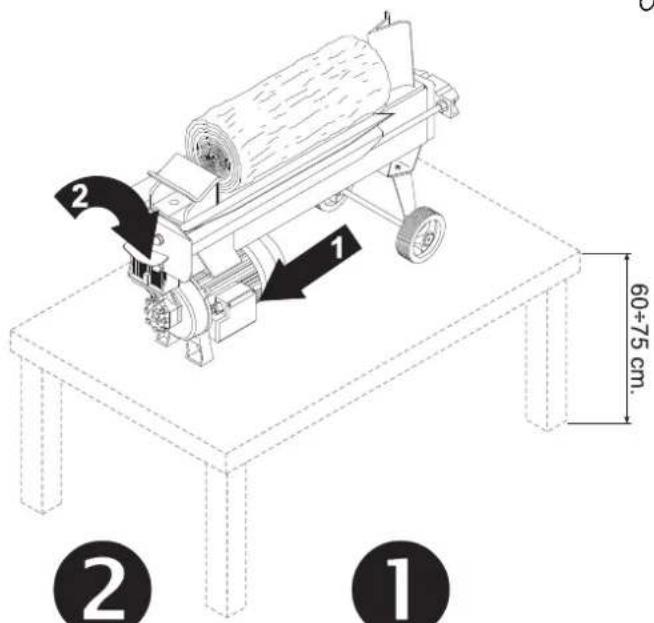
The log splitter, in compliance with standard EN 609-1, is activated with a two hand control. One hand is used to press the motor drive button (1 in fig.6, pg.3), while the second activates the lever of the hydraulic control (2 in fig.6).
Never use the log splitter if it is not in perfect order or if it needs servicing. Before starting work, check correct functioning of all the safety devices (ZHB, push button).
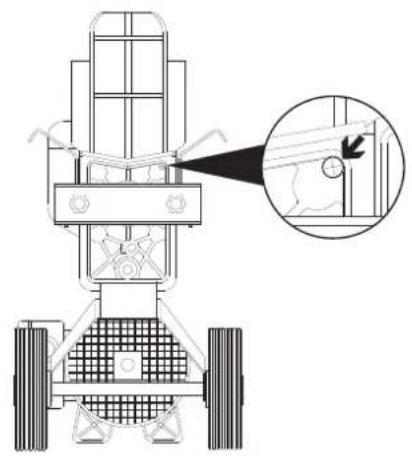
On the back side of the machine, there is a bleed screw that must be loosened by about 3 or 4 turns when the log splitter is being used (Fig. 5, page 3). When the log splitter is to be moved, tighten the screw to prevent oil leakage.
4.1 - Lighting
Lighting must be provided in the entire work area of the log splitter to ensure perfect visibility when operating the machine and during maintenance and adjustments. Even when working outdoors, there must be sufficient light to work safely. Working at times when insufficient light may result in poor visibility of the machine and its components (dawn, dusk, night) is forbidden.
5 - USE
- Connect the electric log splitter to the power system.
- Never pass the power cable over the log pusher, close to the wedge or anywhere where it may be damaged or severed.
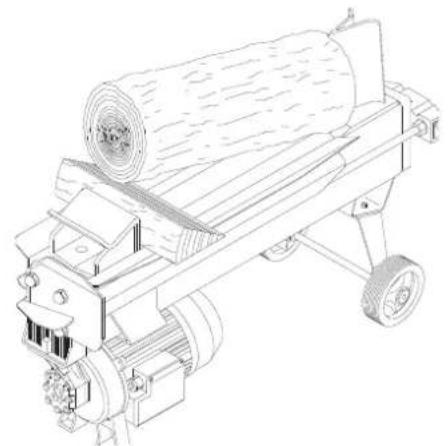
- Position the log on the beam as shown in fig.6, page 3. The supporting guides (9 in fig.1, page 2) help to keep the log at the centre of the wedge. If the log tends to wobble, it must be repositioned turning it so that it remains firmly on the beam.
- With your right hand, press thoroughly the starter button of the electric motor (1), and with your left hand press the control lever (2) all the way down as shown in fig.6. The log pusher will go into action and split the log.
The control lever enables you to manage the work speed and power to adapt to the type of wood to be split in the best way possible. If the wood is soft, press the lever about halfway down: the log pusher is activated faster but works with reduced thrust. If the wood is particularly hard or seasoned, press the lever all the way down: the log pusher is slower but has the maximum power, with greater possibility to break hard wood. The speed can be varied during the operation by simply raising or lowering the lever.
Warning: the button must be pressed t thoroughly in order to avoid the burn of the inside contacts.
- Repeat the operation with the pieces obtained so as to split the log into several parts.
- Never force the log splitter for more than a few seconds keeping the cylinder under pressure in the attempt to split excessively hard wood. The oil under pressure, in fact, is overheated and the machine could be damaged. It is thus better to stop and rotate the log by 90^ to see whether it can be split in a different position. In any case, if you are not able to split the log, this means that its hardness exceeds the capacity of the machine and thus that log should be discarded so as not to damage the log splitter.
- On completing the work, pull the plug. Never yank the plug using the cable. Grasp the body of the plug and pull it firmly.
- When not in use, store the machine where it is protected from atmospheric agents.
- When transporting (e.g. loaded on motor vehicles), ensure that all parts of the machine have cooled down completely, the bleeder screw is screwed up, and the machine is positioned horizontally.
6 - ROUTINE MAINTENANCE
This chapter describes routine maintenance, i.e. operations carried out by the operator, on the LOGIC log splitter to keep this in perfect working order and therefore reliable for continuous, long-term use.
All routine maintenance operations must be carried out with the machine off and in the case of log splitters with electric motor with the power cable disconnected.
Any other maintenance operation not specifically envisaged in this manual must be carried out by authorised personnel only in that hazardous situations may arise for which the operator is not prepared.
In the case in which extraordinary maintenance or part replacement operations are not carried out by authorised personnel, the guarantee shall be immediately null and void and the manufacturer shall be relieved of any responsibility for injury to persons or animals or damage.
6.1 - How to change the hydraulic oil
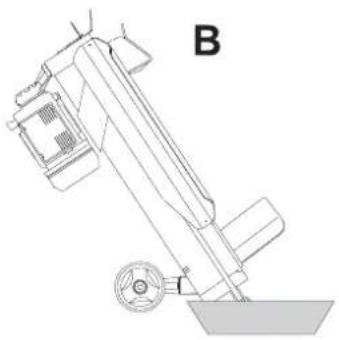
The spent oil must be replaced with new oil of the type indicated on page 15 every 400 hours of operation. To change the oil, proceed as follows.
Make sure that the log pusher of the machine is fully retracted.
- Unscrew the cap shown in Fig. 7/A on page 3 and remove it completely.
- Position a container under the log splitter that can hold 8 litres of oil; then tilt the machine to empty the oil (Fig. 7/B).
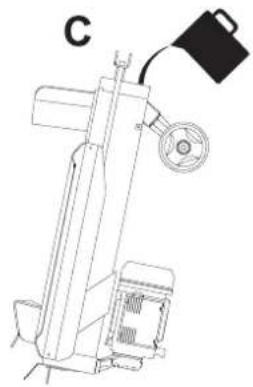
- Tilt the machine in the other direction (Fig. 7/C) and pour in 6 litres of oil of one of the types indicated on page 15.
Clean the dipstick and insert it (fig.7/D) to check that the oil level is between the two notches on the stem.
Clean the cap and washer thoroughly and re-tighten completely but carefully so as not to break the threading of the cap.

WARNING:
NEVER MIX OIL WITH GENERAL WASTE! USED OIL MUST BE DISPOSED OF ACCORDING TO CURRENT REGULATIONS IN THE COUNTRY WHERE THE MACHINE IS USED.
6.2 - Refilling the hydraulic oil
Periodically check the oil level, which must be between the two notches on the oil cap dipstick (Fig. 7/D). If the level is low, refill using the recommended types of oil on page 15.
6.3 - Sharpening the wedge
After long periods of operation and when required, sharpen the wedge of the log splitter using a fine-toothed file and taking care to remove any burrs or crushed parts of the metal.
7 - TROUBLESHOOTING
7.1 - How to free a jammed log
- Release both controls: the log pusher will be fully retracted.
- Insert a triangular block of wood under the jammed log and activate the log splitter until the wedge is pushed completely under the piece of wood (fig.8, page 3).
- Repeat the operation with larger pieces of wood until the log is completely free.

WARNING:
NEVERASKFORTHEASSISTANCEOFANOTHERPERSONWHENFREEINGAJAMMEDLOG
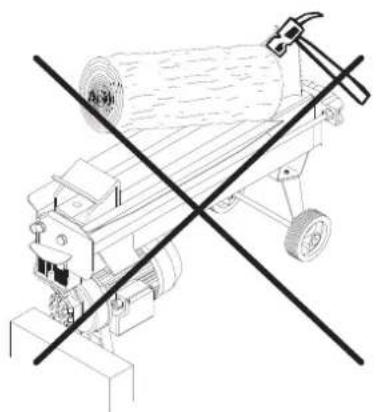
- NOT TO TRY TO EXTRACT THE LOG HITING IT WITH A TOOL AND KEEPING THE FOOT BLOCKED, THIS COULD CAUSE THE BREAKAGE OF THE MOTOR BLOCK (FIG. 10 PAGE 3).
- ALL THE SAFETY RULES DESCRIBED IN CHAPTER 3 "SAFETY" ON PAGE 15 APPLYWHEN CARRYING OUT THE OPERATIONS DESCRIBED ABOVE.
THE MANUFACTURER SHALL NOT BE HELD RESPONSIBLE IN ANY WAY FOR INJURY TO PERSONS AND ANIMALS OR DAMAGE TO OBJECTS CAUSED BY IMPROPER USE OF THE MACHINE OR FAILURE TO COMPLY WITH THE REGULATIONS DESCRIBED.
7.2 - Troubleshooting
Problems that may arise when using the log splitter and recommended remedies are given in the table below. In the case of operations carried out by unauthorised personnel, the guarantee will be immediately null and void and the manufacturer will be relieved of any responsibility for injury to persons and animals and damage.
| Problem | Probable cause | Corrective action |
| Log fails to split | Incorrect positioning of the log | Position correctly the log |
| Log exceeds permitted dimensions or the wood is too hard for the capacity of the machine. | Try to cut a small part or use other means to reduce the size of the log | |
| Wedge do not cut | Sharped the wedge, check for burrs or nicks, file if necessary | |
| Oil leack | Locate the leack using a piece of card or wood. Contact your dealer | |
| Hydraulicpressure too low | Contact your dealer | |
| Rod advances jerkily or with strong vibrations | Air in the circuit | Check oil level.Top up if necessaryIf problem remain contact your dealer |
| Oil leak from the rod or from other external points | Leakage from the tank | Check that the bleed screw has been tightened before moving the machine (Fig. 5, page 3). |
| Seals worn | Contact your dealer |
SCRAPPING AND DISPOSAL OF THE MACHINE
The machine must be scrapped in compliance with all safety regulations for the prevention of personal injury and damage to the environment and animals.
All parts of the machine must be scrapped and disposed of in accordance with applicable legislation in the place of scrapping.
Dispos of hydraulic fluid and electric parts crectly. Do not dispose of these in the environment, as they are hazardous pollutants, and treat them in accordance with applicable legislation.
Machines fitted with electrical parts must not be disposed of as general waste and must be separated for disposal as separately collected fractions, deposited at authorised collection points.
The manufacturer is committed to waste recycling (WEEE) and is a member of specialised waste disposal consortiums.
Incorrect waste disposal is punishable by law.
SPARE PARTS
Replacement of spare parts and therefore extraordinary maintenance of the machine must be carried out by the retailer's specialised and authorised personnel only. If any maintenance operations other than those expressly indicated in this handbook are carried out, the warranty will be immediately null and void and manufacturer shall be relieved of all and any responsibility with regard to accidents involving persons, animals or things. Always order spare parts form your regular retailer remembering to indicate the machine model, the purchase date and the serial number.
GUARANTEE
The company BELL, referred to hereinafter as BELL, guarantees to the purchaser of every new BELL original product, purchased from a BELL authorized dealer, that the product shall remain free from any defects in materials or workmanship for a period of 360 days (12 months) from the original date of purchase or the date of first hire.
Spare parts installed on the product covered by this guarantee are guaranteed for 90 days (3 months) from the date of their repair or renewal. Such parts must be supplied free of charge to the user by a BELL dealer or distributor during normal working hours.
BELL reserves the right to inspect any product or part which has been substituted as defective. Substituted parts must therefore be kept available for 12 months.
It is expressly understood that BELL shall be under no obligation to provide labour or accept transport expenses.
BELL shall accept no responsibility for any damage, defect or costs deriving from repairs and/or modifications of a BELL product, effected by any person other than an authorized BELL representative.
This guarantee does not apply to commercial components covered by their own guarantee, such as internal combustion engines, diesel engines, etc..
This guarantee covers only defects arising during proper use of the machine. BELL shall accept no responsibility whatsoever if BELL components break while under guarantee for reasons such as:
1) Misuse, negligence, improper handling, abuse or accident.
2) Failure to carry out reasonable or necessary maintenance as prescribed in this manual (renewal of worn components such as slides, hydraulic oil, engine oil, gearbox oil; blade not sharpened, etc.)
3) The use of parts or accessories not manufactured, supplied or approved by BELL.
BELL does not provide further explicit or implied guarantees, other than those set forth herein.
No representative or dealer is authorized to assume other responsibilities with regard to BELL products.
The duration of the implicit guarantees recognized by the law, including the commercial guarantees and conventions for particular purposes are limited in duration to the validity and duration of the explicit guarantee granted below.
BELL shall upon no account act as guarantor for loss of profit, whether direct or indirect, specific or deriving from any damage.
If you require spare parts or repair work it will be useful the followins informations:
MODEL
SERIAL NUMBER
DATE OF PURCHASE
GRADATIONS DIVERSES.
ANVAND INTE ANDRA OLJOR.
3 - SÄKERHET
6 - RUTINEVEDLIKEHOLD
KONEEN ROMUTUS JA HAVITYS
Keep and submit it, together with the cash slip, to the authorized service centre, if repair is required in warranty period.
Apply the cash slip here
Fest kvitteringen her
Kobsvitteringen hæftes pa her
a Certified Company according to Quality System


via F. de Pisis, 5 - Reggio Emilia - Italy
dichiara che la macchina spaccalegna - declares that the log splitter machine - bestigt hiermit dass die von lhr hergestelle Holzspaltermaschinedeclare que la machine a fendre le bois - verklaart dat de kloofmachine - intygar harmed att vedklyven maskin erklerer herved at vedhogger maskinen - bekrafter donne brandeklover maskine taten vakuutamme, etta halkaisulaite laitemme - declare que la maquina astilladora - declare que a maquina de quebrar madeira

Matricola N. - Matriculation Number - Matrikelnummer -Numero Matricule - Sericummer Matrikelnummer - Serienummer - Serienummer - Luettelonzero -Numero de série -Numero de série
complies with essential Security and Health Protection Requirements according to the 2006/42/EC Directive, the 2006/95/EC Directive relating to the low tension, the 2004/108/EC Directive relating to the tests for measuring electromagnetic compatibility and the harmonised Regulation EN 609-1 (03/99)