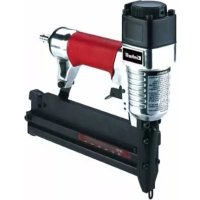
41.377.55 - Electric stapler EINHELL - Free user manual and instructions
Find the device manual for free 41.377.55 EINHELL in PDF.



| Product type | Pneumatic stapler/nailer |
| Brand | Einhell |
| Model | 41.377.55 |
| Max working pressure | 8.3 bar |
| Recommended working pressure | 6.3 bar |
| Air consumption | 0.66 l/stroke |
| Staple width | 5.7 mm |
| Staple length | 13 - 40 mm |
| Nail length | 10 - 50 mm |
| Recommended hose diameter | 9 mm |
| Weight | 1.5 kg |
| Sound pressure level | 83.5 dB(A) |
| Sound power level | 96.5 dB(A) |
| Vibration emission | 2.5 m/s² |
| Power supply | Compressed air (via compressor) |
| Delivery contents | Unit, special oil, Allen keys 3 mm and 4 mm |
| Main functions | Driving staples and nails into wood, depth adjustment, automatic mode |
| Maintenance and cleaning | Regular cleaning, lubrication via oiler or drops in the connector, dry storage |
| Safety | Trigger safety mechanism, mandatory wearing of safety goggles and hearing protection |
| Spare parts and repairability | Spare parts available via ISC GmbH, repair by specialized workshop |
| General information | Non-professional use, 2-year warranty, exclusion for commercial use |
Frequently Asked Questions - 41.377.55 EINHELL
User questions about 41.377.55 EINHELL
0 question about this device. Answer the ones you know or ask your own.
Ask a new question about this device
Download the instructions for your Electric stapler in PDF format for free! Find your manual 41.377.55 - EINHELL and take your electronic device back in hand. On this page are published all the documents necessary for the use of your device. 41.377.55 by EINHELL.
USER MANUAL 41.377.55 EINHELL
natural_image
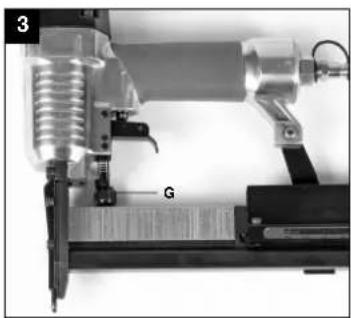
Mechanical assembly with spring-loaded components and a labeled section G (no readable text or symbols)2
natural_image
Close-up of a mechanical assembly with metallic components and a ruler (no visible text or symbols)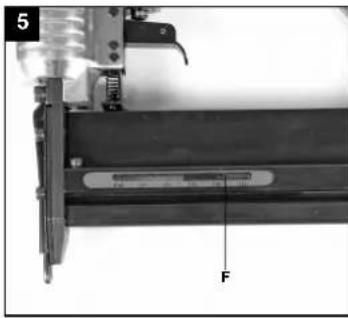
natural_image
Mechanical assembly with labeled component 'F' and part number 5 (no readable text or symbols beyond label)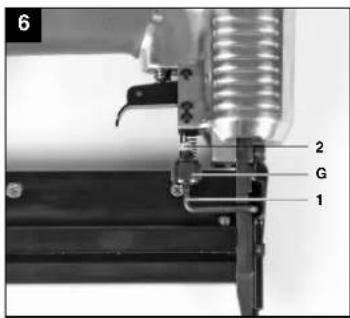
natural_image
Mechanical assembly with mechanical components and directional arrows (no visible text or symbols)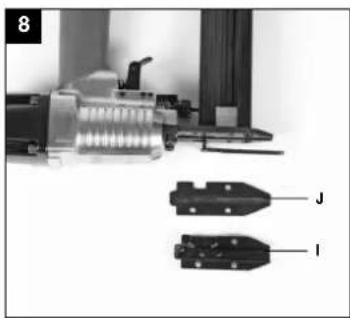
natural_image
Close-up of a mechanical device with labeled parts (J and I) and no visible text or symbols

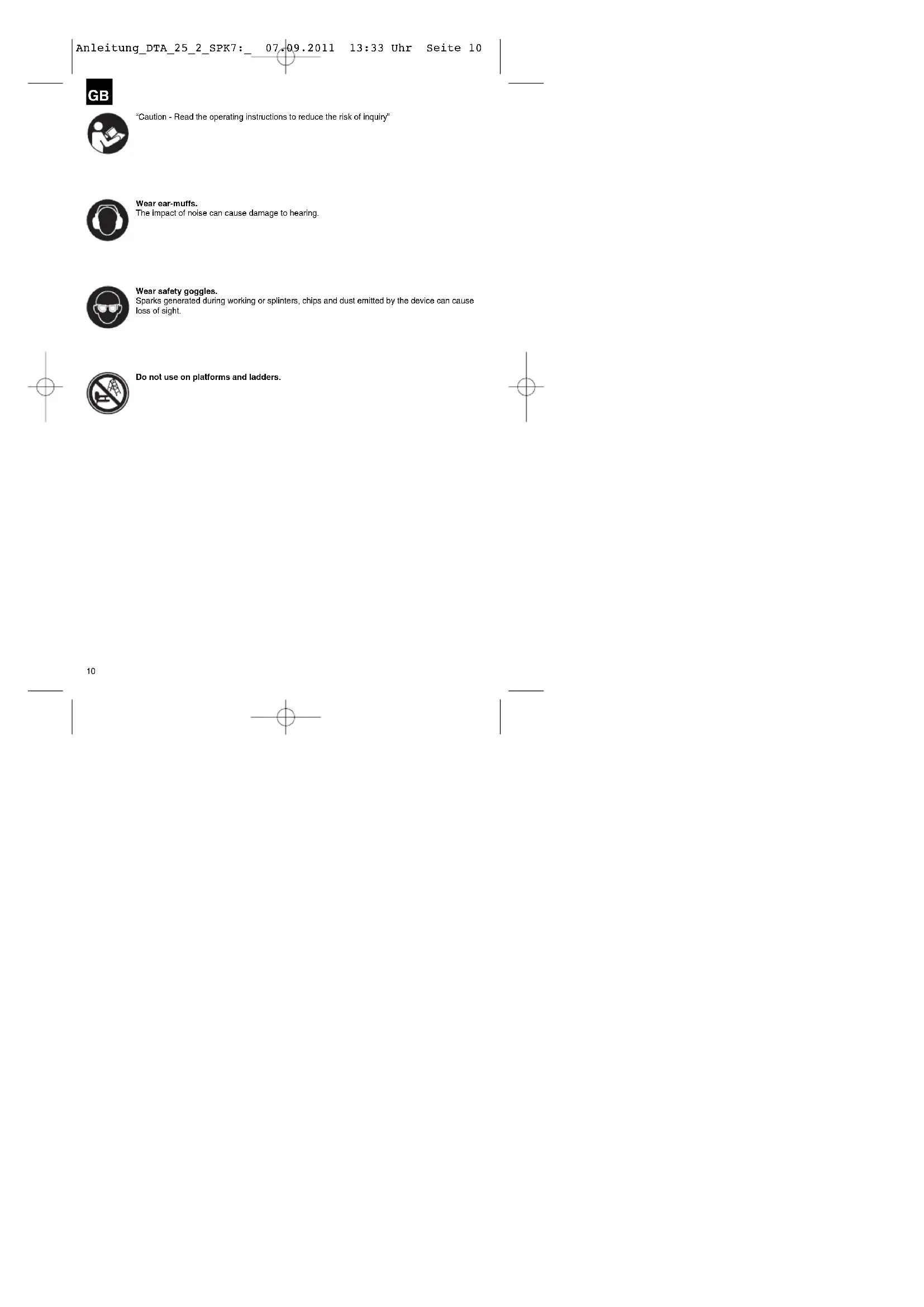
"Caution - Read the operating instructions to reduce the risk of inquiry"

Wear ear-muffs.
The impact of noise can cause damage to hearing.

Wear safety goggles.
Sparks generated during working or splinters, chips and dust emitted by the device can cause loss of slight.

Do not use on platforms and ladders.
GB
⚠️ Important.
When using the equipment, a few safety precautions must be observed to avoid injuries and damage. Please read the complete operating manual with due care. Keep this manual in a safe place so that the information is available at all times. If you give the equipment to any other person, hand over these operating instructions as well. We cannot accept any liability for damage or accidents which arise due to a failure to follow these instructions and the safety information.
1. Safety Information
CAUTION
Read all the safety regulations and instructions. Any errors made in following the safety regulations and instructions may result in an electric shock, fire and/or serious injury. Keep all safety regulations and instructions in a safe place for future use.
Protect yourself and your environment from accidents by taking the appropriate precautionary measures.
●Do not use the stapler for a purpose for which it is not designed.
- Keep air tools safe from children.
●Never use the equipment when you are not rested or distracted.
- Connect the compressed air using a quick-lock coupling only.
●Staplers may only be connected to lines/hoses which do not allow the maximum permitted pressure of the equipment to be exceeded by more than 10%. A pressure regulator (pressure reducer) with a downstream pressure control valve must be fitted to the compressed air hose if the pressure is higher.
●The operating pressure must be adjusted by a pressure reducer.
- When using a pneumatically operated stapler/nailer, only use the pressure required for the specific operation to prevent an unnecessarily high noise level, excessive wear and consequential faults.
●Never use oxygen or combustible gases as a power source. Danger of fire and explosion
●Always disconnect the equipment from the compressed air source before tackling faults or starting any maintenance work.
●Use only genuine spare parts. Repairs may only be carried out by an authorized agent of the manufacturer or by an alternative specialist in
accordance with the specifications contained in the operating instructions.
●Wear the necessary protective clothing when working with the stapler, in particular safety goggles and protective gloves.
●Do not exceed the maximum air pressure of 8 bar.
●Do not direct the connected and loaded nailer at other people.
●Do not remove the earthing contact device.
●Never leave the equipment unattended when loaded.
●Never use the equipment if defective.
●Only use the types of staples/nails specified in the technical data.
●The equipment must always be depressurized after disconnection.
●Never use the equipment without staples/nails.
●Never point an operational stapler directly at yourself or at any other person.
●Whilst working with the stapler, hold it in such a way that your head and body cannot be injured in case of kickback caused by disruption of the power supply or by hard areas of the workpiece.
●Never trigger the stapler into the open air. This is important to avoid the hazards of free-flying staples and of overloading the appliance.
●For the purposes of transportation, the stapler must be disconnected from the compressed-air system, especially if you are using a ladder or are adopting an unusual posture.
●In the workplace, carry the stapler only by its handle and ensure that the trigger is inactivated.
●Make allowance for the workplace conditions. Staples can potentially go straight through thin workpieces or they can slide off workpieces when working on corners and edges, thus putting persons at risk.
●For you own personal safety, always use suitable protective equipment such as, for example, hearing and eye protection.
- Check that the trigger catch functions correctly every time before you use the equipment. You are allowed to start using the equipment only if the device functions perfectly.
This equipment is not suitable for the following work:
- If changing from one stapling point to another involves moving about on platforms, steps, ladders or any other structures similar to ladders such as, e.g. roof battens. - Setting of house prices
- Sealing of boxes or crates. - Fitting of transportation braces, e.g. to vehicles and wagons
Do not lose this safety information.
GB
Residual risks
Even if you use this tool in accordance with instructions, certain residual risks cannot be eliminated. The following hazards may arise in connection with the equipment's construction and layout:
- Risk of pinching.
- Risk of injury from staples
- Damage to hearing, if no suitable ear protection is applied.
- Health damage caused by hand-arm vibrations, if the equipment is not properly guided and maintained.
2. Layout (Fig. 1/8)
A Trigger lever
B Compressed air connection
C Magazine lever
D Magazine cover
E Magazine
F Level indicator
G Depth setting
H Trigger catch
I Cover plate (external)
J Cover plate (Internal)
K Swivel air-outlet
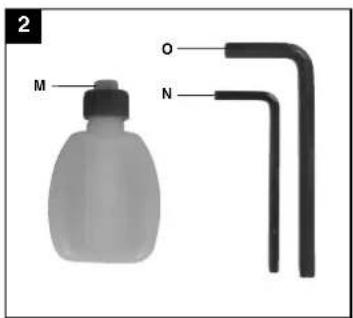
3. Items supplied (Fig. 2)
M Special compressed air oil
N Allen key, 3 mm
O Allen key, 4 mm
4. Intended use
The stapler is a pneumatically operated tool designed for versatile use.
This equipment is designed for driving finishing nails and staples into wood and similar materials. Only use the types of nails/staples described in the "Technical data" section or illustrated on the information sign on the magazine. Never use any other nails/staples. Never use on hard surfaces such as stone, metal, etc., either.
The equipment may only be used for the tasks it is designed to handle. Any other use is deemed to be a case of misuse. The user/operator and not the manufacturer will be liable for any damage or injuries of any kind caused as a result of this.
Please note that our equipment has not been
designed for use in commercial, trade or industrial applications. Our warranty will be voided if the equipment is used in commercial, trade or industrial businesses or for equivalent purposes.
Only allow repairs and services to be carried out by authorized professional repair shops.
Remember.
If the inner diameter of the hose is insufficient and the length of the hose too long, this will result in a loss of power on the equipment.
4. Technical data
Max. permitted operating pressure 8.3 bar
Recommended pressure range 6.3 bar
Air consumption approx. 0.66 l/shot
Staple width 5.7 mm
Staple length 13 - 40 mm
Nail length 10 - 50 mm
Recommended hose diameter Diameter 9 mm
Weight approx. 1,5 kg
Sound and vibration
Sound and vibration values were measured in accordance with EN 12549, EN ISO 4871.
| L_pA sound pressure level | 83.5 dB(A) |
| K_pA uncertainty | 2.5 dB |
| L_WA sound power level 96.5 dB(A) | |
| K_WA uncertainty | 2.5 dB |
Wear ear-muffs.
The impact of noise can cause damage to hearing.
Total vibration values (vector sum of three directions) determined in accordance with ISO 8662-11-1999, EN 12096.
Vibration emission value a_h = 2.5 m/s^2 K uncertainty = 26.8%
These values for noise emissions are equipment-based characteristic values and do not reflect the noise generated at the place of use. The noise generated at the place of use will depend, for example, on the work area, the workpiece, workpiece support and the number of stapling/nailing operations.
The value given for vibration is an equipment-based characteristic value and does not represent the impact on the hand and arm system when the equipment is used. The impact on the hand and arm system when the equipment is used will depend, for example, on the force of the grip, the pressing force, the direction in which you are working, the air pressure setting, the workpiece and the workpiece support.
Reduce noise generation and vibration to a minimum!
●Use only equipment that is in perfect condition.
●Maintain and clean the equipment regularly.
●Adopt your way of working to the equipment.
●Do not overload the equipment.
●Have the equipment checked if necessary.
●Switch off the equipment when not in use.
●Wear gloves
Compressed air quality:
Purified and with oil mist.
Air supply:
Via a conditioning unit with filter pressure reducer and mist oiler connected to a compressed air source.
Recommended capacity of the compressor:
Compressor with a capacity of approx. 250 l/min, which is the equivalent of engine power of approx. 2.2 kW
Remember:
Wear the necessary protective clothing when working with the stapler, in particular safety goggles.
Pay attention to the safety regulations.
6. Starting up
●Each time before starting work, check that the trigger catch functions perfectly and that all screws and nuts are securely fastened.
●Never tamper with the stapler.
●Never dismantle or block any parts of the stapler such as, e.g. a trigger catch.
●Never carry out any "emergency repairs" with unsuitable means.
●Proper stapler maintenance is required at regular intervals in accordance with the information supplied by the manufacturer.
●Take precautions to prevent anything which would weaken or damage the equipment, e.g. from
a) striking or engraving,
b) modifications which are prohibited by the manufacturer.
c) guiding on templates made of hard material, e.g. steel.
d) pushing across the floor,
e) using as a hammer
f) any kinds of acts of violence.
6.1 Checking the trigger catch
Check the trigger catch (Fig. 1/Item H) each time before use. The trigger catch must move freely without catching. The spring on the trigger catch must return the trigger catch to the released initial position. Never use the equipment if the trigger catch is not working.
- Disconnect the equipment from the air supply.
- Remove the staples/nails from the magazine (Fig. 1/Item E).
-
Check that the trigger and the trigger catch can move up and down freely.
-
Connect the equipment to the air supply.
-
Press the trigger catch against the workpiece without pressing the trigger. The equipment should not operate. Never use the equipment if it operates without the trigger being pressed. Risk of injury.
-
Remove the equipment from the workpiece. The trigger catch must return to the released initial position. Press the trigger. The equipment should not operate. Never use the equipment if it operates. Risk of injury.
-
Press the trigger and press the trigger catch against the workpiece. The equipment operates.
-
Press the trigger catch against the workpiece and press the trigger; the equipment operates.
6.2 Loading staples and nails
- When you fill the magazine (Fig. 1/Item E), make sure that you hold the equipment in such a way that the muzzle is pointed neither at you or anyone else.
●To fill the magazine, press the magazine lever (Fig. 1 / Item C) and slide back the magazine cover (Fig. 1 / Item D) as far as it will go.
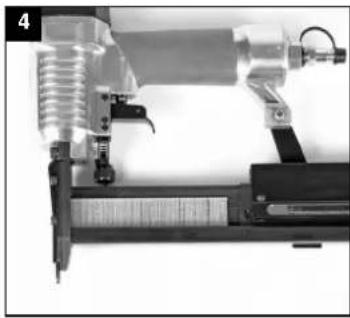
- Insert the staples as shown in (Fig. 3) or the nails as shown in (Fig. 4).
- Do not insert more than one complete stick of staples/nails, otherwise the magazine will be overfilled and you will not be able to close it again. Slide the magazine cover forward again until it snaps into place.
●The level indicator (Fig. 5 / Item F) shows the number of loaded staples / nails if less than 50 are loaded.
GB
6.3 Operation/Operating pressure
●Connect the pneumatic stapler/nailer to the compressed air connection (Fig. 1 / Item
●Set the swivel air outlet (Fig. 1 / Item K) to the desired position.
●Before starting the stapler, switch on the compressor and set the operating pressure on the pressure reducer to 4 bar.
●The knurled screw (Fig. 6 / Item G) for precision adjustment must be approximately in the middle position between Item 1 and 2. To do so, turn open the knurled screw three revolutions, starting from Position 1.
●For the purpose of setting the operating pressure it is advisable to use a test workpiece which is similar in structure and material thickness to the workpieces to be joined.
●To staple/nail, place the pneumatic stapler/nailer against the workpiece and pull the trigger lever (Fig. 1 / Item A) once and release it again after each shot.
- If the nail or the staple goes in too deep, reduce the operating pressure on the pressure reducer by 0.5 bar.
- If the nail or the staple does not go in deep enough or projects, increase the operating pressure on the pressure reducer by 0.5 bar.
●Place the stapler/nailer against the test workpiece again and fire.
●Depending on results, keep changing the operating pressure in 0.5 bar increments until the depth that the staples or nails are driven in is roughly correct. For precision adjustment (Para. 7.4), use the knurled screw.
●The equipment also has an automatic mode. If you keep the trigger lever pressed, the staples/nails will be shot automatically when the pneumatic stapler/nailer is placed against the workpiece.
●To prevent faults, make sure that you do not staple at the same point twice.
Important:
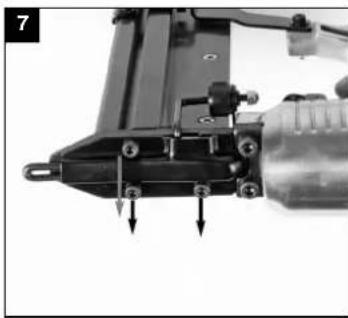
If a staple or nail becomes jammed in the feed shaft, always immediately depressurize the equipment first (remove the compressed air supply hose), open the magazine shaft and only then remove the cover plates (Fig. 8 / Item I/J) by undoing the screws with the supplied Allen keys (Fig. 2 / Item N) (Fig. 7 / 8). Remove the jammed staples, clean the shaft if necessary, and close again in reverse order.
6.4 Precision adjustment
●The equipment has a depth setting adjuster (Fig. 6 / Item G) in the form of a knurled screw.
- If you screw it downwards (Fig. 6 / Item 1), the staples/nails will be shot in deeper.
- If you want to reduce the depth that the staples/nails are shot in, you have to screw the knurled screw upwards (Fig. 6 / Item 2). Important: To prevent triggering unintentionally, the depth setting must never be pulled back by hand in normal operation.
7. Care and maintenance
Important: Disconnect the equipment from the compressed air system each time before starting to carry out maintenance and cleaning work.
Compliance with the maintenance instructions given here will ensure that this quality product has a long service life and offers failure-free operation. Before starting work each time, check that the magazine is securely fastened (Fig. 1/Item E). Clean the equipment thoroughly immediately after you have finished the work.
To ensure that your stapler offers lasting perfect service, it requires regular lubrication. Use the supplied oil (Fig. 2 / Item M) for this purpose.
There are two possible means of lubrication:
7.1 By mist oiler
A complete conditioning unit contains a mist oiler and is fitted to the compressor.
7.2 By hand
If your system has neither a conditioning unit or a line oiler, 3-5 drops of oil have to be applied to the compressed air connection each time before the air tool is started up. If the air tool is not used for several days, apply 5-10 drops of oil to the compressed air connection before switching on.
Store your air tool in a dry room only.
7.3 Other maintenance work
There are no parts inside the equipment which require additional maintenance.
8. Cleaning and ordering spare parts
Important: Disconnect the equipment from the compressed air system each time before starting to carry out maintenance and cleaning work.
8.1 Cleaning
- Keep the trigger catch (Fig. 1/Item H) free of dirt and dust as far as possible. Wipe the equipment with a clean cloth or blow it down with compressed air at low pressure.
●We recommend that you clean the equipment immediately after you use it.
●Clean the equipment regularly with a damp cloth and some soft soap. Do not use cleaning agents or solvents; these may be aggressive to the plastic parts in the equipment. Ensure that no water can get into the interior of the equipment.
8.2 Ordering replacement parts
Please provide the following information on all orders for spare parts:
●Model/type of the equipment
●Article number of the equipment
●ID number of the equipment For our latest prices and information please go to www.isc-gmbh.info
9. Disposal and recycling
The equipment is supplied in packaging to prevent it from being damaged in transit. The raw materials in this packaging can be reused or recycled. The equipment and its accessories are made of various types of material, such as metal and plastic. Defective components must be disposed of as special waste. Ask your dealer or your local council.
10. Excluded from the guarantee are:
●Wear parts
●Damage caused by inadmissible operating pressure.
●Damage caused by compressed air which has not been conditioned.
●Damage caused by improper use or unauthorized intervention.


Der findes to former for smöring:
● explains the following conformity according to EU directives and norms for the following product
Notified Body: Notified Body No.
Reg. No.:
□2000/14/EC_2005/88/EC
□ Annex V
□ Annex VI
Noise: measured L_min = dB(A) ; guaranteed L_min = dB(A)
P = KW; UO = cm Notified Body:
□2004/26/EC
Emission No.:
Standard references: EN 792-13
Subject to change without notice Wiesenweg 22, D-94405 Landau/Isar
Documents registrar: Siegfried Roider
D
The reprinting or reproduction by any other means, in whole or in part, of documentation and papers accompanying products is permitted only with the express consent of ISC GmbH.
F
Technical changes subject to change
natural_image
Pure horizontal lines with no text, numbers, or symbols, rendered in black on white background (no meaningful content)GB GUARANTEE CERTIFICATE
Dear Customer,
All of our products undergo strict quality checks to ensure that they reach you in perfect condition. In the unlikely event that your device develops a fault, please contact our service department at the address shown on this guarantee card. Of course, if you would prefer to call us then we are also happy to offer our assistance under the service number printed below. Please note the following terms under which guarantee claims can be made:
- These guarantee terms cover additional guarantee rights and do not affect your statutory warranty rights. We do not charge you for this guarantee.
- Our guarantee only covers problems caused by material or manufacturing defects, and it is restricted to the rectification of these defects or replacement of the device. Please note that our devices have not been designed for use in commercial, trade or industrial applications. Consequently, the guarantee is invalidated if the equipment is used in commercial, trade or industrial applications or for other equivalent activities. The following are also excluded from our guarantee: compensation for transport damage, damage caused by failure to comply with the installation/assembly instructions or damage caused by unprofessional installation, failure to comply with the operating instructions (e.g. connection to the wrong mains voltage or current type), misuse or inappropriate use (such as overloading of the device or use of non-approved tools or accessories), failure to comply with the maintenance and safety regulations, ingress of foreign bodies into the device (e.g. sand, stones or dust), effects of force or external influences (e.g. damage caused by the device being dropped) and normal wear resulting from proper operation of the device. This applies in particular to rechargeable batteries for which we nevertheless issue a guarantee period of 12 months.
The guarantee is rendered null and void if any attempt is made to tamper with the device.
-
The guarantee is valid for a period of 2 years starting from the purchase date of the device. Guarantee claims should be submitted before the end of the guarantee period within two weeks of the defect being noticed. No guarantee claims will be accepted after the end of the guarantee period. The original guarantee period remains applicable to the device even if repairs are carried out or parts are replaced. In such cases, the work performed or parts fitted will not result in an extension of the guarantee period, and no new guarantee will become active for the work performed or parts fitted. This also applies when an on-site service is used.
-
In order to assert your guarantee claim, please send your defective device postage-free to the address shown below. Please enclose either the original or a copy of your sales receipt or another dated proof of purchase. Please keep your sales receipt in a safe place, as it is your proof of purchase. It would help us if you could describe the nature of the problem in as much detail as possible. If the defect is covered by our guarantee then your device will either be repaired immediately and returned to you, or we will send you a new device.
Of course, we are also happy offer a chargeable repair service for any defects which are not covered by the scope of this guarantee or for units which are no longer covered. To take advantage of this service, please send the device to our service address.
F BULLETIN DE GARANTIE
Chère Cliente, Cher Client,
- GB
- ⚠️ Important.
- Safety Information
- CAUTION
- Residual risks
- Layout (Fig. 1/8)
- Items supplied (Fig. 2)
- Intended use
- Remember.
- Technical data
- Sound and vibration
- Wear ear-muffs.
- Reduce noise generation and vibration to a minimum!
- Compressed air quality:
- Air supply:
- Recommended capacity of the compressor:
- Remember:
- Starting up
- Checking the trigger catch
- Loading staples and nails
- Operation/Operating pressure
- Important:
- Precision adjustment
- Care and maintenance
- There are two possible means of lubrication:
- By mist oiler
- By hand
- Other maintenance work
- Cleaning and ordering spare parts
- Cleaning
- Ordering replacement parts
- Disposal and recycling
- Excluded from the guarantee are:
- Der findes to former for smöring:
- Standard references: EN 792-13
- GB GUARANTEE CERTIFICATE
- Dear Customer,
- F BULLETIN DE GARANTIE
- Chère Cliente, Cher Client,
Brand : EINHELL
Model : 41.377.55
Category : Electric stapler