 ManualGo.com
ASA 25 L PC - Aspirateur METABO - Free user manual and instructions
Find the device manual for free ASA 25 L PC METABO in PDF.


Download the instructions for your Aspirateur in PDF format for free! Find your manual ASA 25 L PC - METABO and take your electronic device back in hand. On this page are published all the documents necessary for the use of your device. ASA 25 L PC by METABO.
USER MANUAL ASA 25 L PC METABO
E G H I J K L M F D C B A
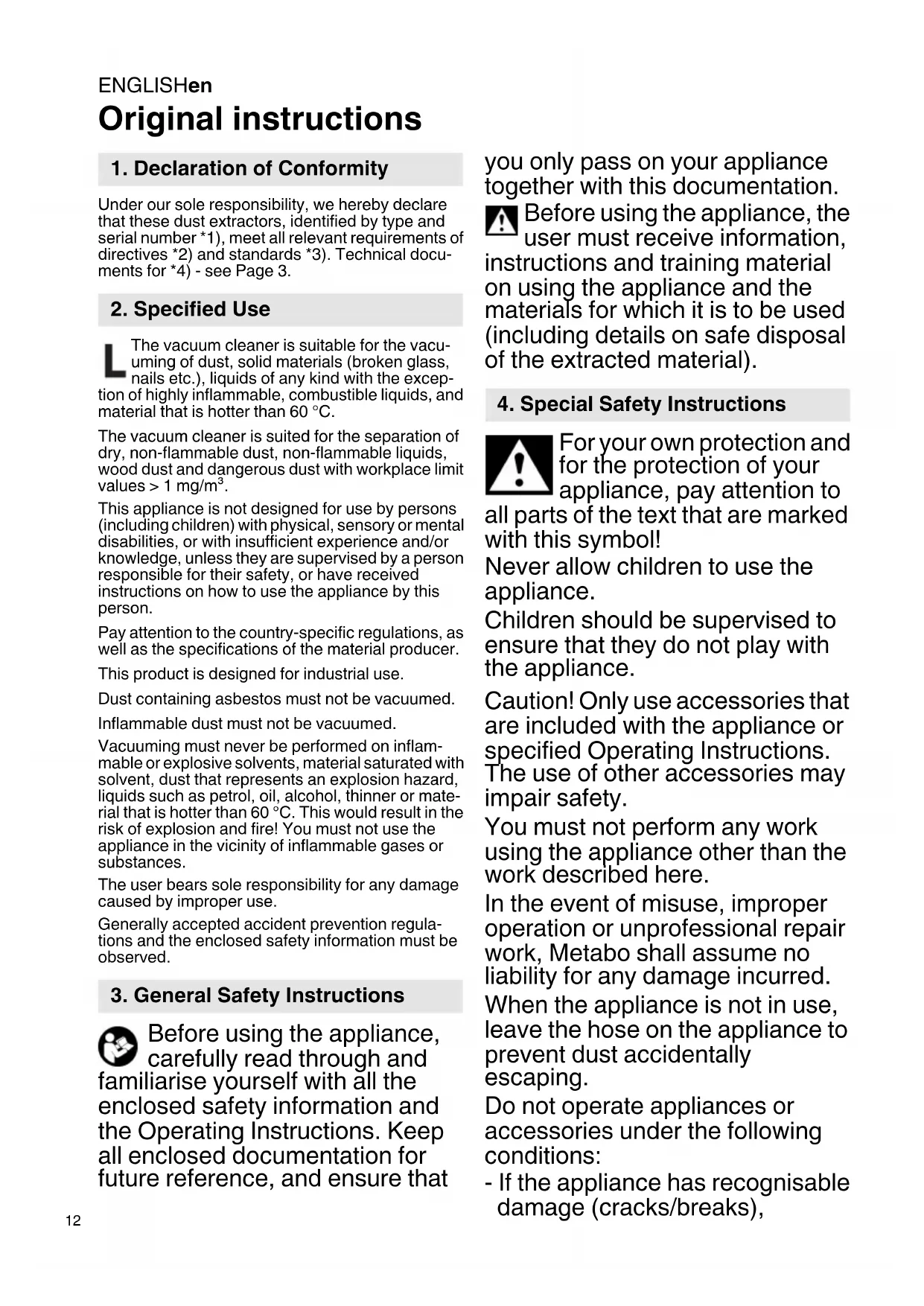
Original instructions
Under our sole responsibility, we hereby declare
that these dust extractors, identified by type and
serial number *1), meet all relevant requirements of
directives *2) and standards *3). Technical docu-
ments for *4) - see Page 3.
The vacuum cleaner is suitable for the vacu-
uming of dust, solid materials (broken glass,
nails etc.), liquids of any kind with the excep-
tion of highly inflammable, combustible liquids, and
material that is hotter than 60 °C.
The vacuum cleaner is suited for the separation of
dry, non-flammable dust, non-flammable liquids,
wood dust and dangerous dust with workplace limit
This appliance is not designed for use by persons
(including children) with physical, sensory or mental
disabilities, or with insufficient experience and/or
knowledge, unless they are supervised by a person
responsible for their safety, or have received
instructions on how to use the appliance by this
Pay attention to the country-specific regulations, as
well as the specifications of the material producer.
This product is designed for industrial use.
Dust containing asbestos must not be vacuumed.
Inflammable dust must not be vacuumed.
Vacuuming must never be performed on inflam-
mable or explosive solvents, material saturated with
solvent, dust that represents an explosion hazard,
liquids such as petrol, oil, alcohol, thinner or mate-
rial that is hotter than 60 °C. This would result in the
risk of explosion and fire! You must not use the
appliance in the vicinity of inflammable gases or
The user bears sole responsibility for any damage
caused by improper use.
Generally accepted accident prevention regula-
tions and the enclosed safety information must be
Before using the appliance,
carefully read through and
familiarise yourself with all the
enclosed safety information and
the Operating Instructions. Keep
all enclosed documentation for
future reference, and ensure that
you only pass on your appliance
together with this documentation.
Before using the appliance, the
user must receive information,
instructions and training material
on using the appliance and the
materials for which it is to be used
(including details on safe disposal
of the extracted material).
For your own protection and
for the protection of your
appliance, pay attention to
all parts of the text that are marked
Never allow children to use the
Children should be supervised to
ensure that they do not play with
Caution! Only use accessories that
are included with the appliance or
specified Operating Instructions.
The use of other accessories may
You must not perform any work
using the appliance other than the
work described here.
In the event of misuse, improper
operation or unprofessional repair
work, Metabo shall assume no
liability for any damage incurred.
When the appliance is not in use,
leave the hose on the appliance to
prevent dust accidentally
Do not operate appliances or
accessories under the following
- If the appliance has recognisable
damage (cracks/breaks),
1. Declaration of Conformity
3. General Safety Instructions
4. Special Safety InstructionsENGLISH en
- If the mains connection lead is
defective or shows signs of
- If there is a suspected non-visible
defect (after a fall).
Do not point the nozzle, hose or
tube at people or animals.
WARNING - If any foam or
water egresses, switch off the
appliance immediately. Empty the
container and, if necessary, the
Always lay the connection lead and
hose so there is no danger of trip-
Do not pull the connection lead
over any sharp edges and do not
If the connection lead of the appli-
ance is damaged, it must be
replaced by a special connection
lead. See the section on Repairs.
Always connect to a socket with
Do not use any damaged exten-
Never insert or remove the mains
plug with wet hands.
Only pull on the mains plug, not on
WARNING - The plug socket on
the appliance must be used only
for the purposes defined in the
Operating Instructions.
Do not leave the appliance unat-
tended. If there is a long work inter-
ruption, disconnect the mains plug.
Ensure the plug cannot be recon-
nected accidentally.
The vacuum cleaner must not be
used or stored outside in wet
IMPORTANT - This machine must
only be stored indoors.
Acids, acetone and solvents can
corrode the appliance compo-
Prior to any servicing work,
clean the appliance. Switch off
the appliance after each use and
pull out the mains plug. Ensure the
plug cannot be reconnected acci-
Steam cleaners and high-pressure
cleaners must not be used to clean
The inside of the cover must
Mould contamination can result if
the appliance is not cleaned for an
extended period, especially if used
in areas where foodstuffs are
processed: Always clean and
disinfect the vacuum cleaner
immediately after use.
Never open the appliance
outdoors during rain or storms.
Do not use the appliance outdoors
The appliance must not be oper-
ated in areas with an explosion
Ensure that the vacuum cleaner is
If the extracted air is discharged
into the room, ensure there is an
adequate air change rate (L) in the
room. Observe the regulations that
apply in your country.
Caution! This appliance
contains dust that is harmful toENGLISHen
health. Discharge and mainte-
nance operations (including
disposal of the dust collection
containers) must only be carried
out by qualified specialists wearing
appropriate protective clothing and
Warning - general danger!
Caution! Do not use the appli-
ance until you have read the
Operating Instructions.
WARNING - Operating personnel
must receive adequate instruction
in the use of this vacuum cleaner
and in the materials for which it is
Warning sign for machines with
While the appliance is suitable for
extracting substances that pose a
slight threat to health, it is not
appropriate for reducing wood dust
Dust from material such as paint
containing lead, some wood
species, minerals and metal may
be harmful. Contact with or
inhalation of the dust may cause
allergic reactions and/or
respiratory diseases to the
operator or bystanders.
Certain kinds of dust are classified
as carcinogenic, such as oak and
beech dust, especially in
conjunction with additives for wood
conditioning (chromate, wood
1 Switch On/Off/Automatic operation/
2 Plug socket for power tool
4 Button for filter cleaning 'PressClean' (PC)
9 Fleece filter bag *
* depending on equipment/not included in scope of
Before plugging in the appliance, check
that the rated mains voltage and mains
frequency, as specified on the rating label,
match your power supply.
Attach the handle connecting piece or coupling to
the suction hose (see illustration A, page 2.).
Prepare the suction tube as shown for storage in the
repository (see illustration C, page 2.).
6.1 Inserting a Fleece Filter Bag (9)
We recommend using fleece filter bags for:
- Applications, where small amounts of fine dust are
created (e.g. spot-grinding and grinding of paint
and lacquer coatings, extraction of drilling
applications with small diameters < 10 mm of
short duration, etc.).
- Use of machines, such as: routers, planers, small
grinding machines, etc.
When using a fleece/paper filter bag the filter
cleaning is non-functional.
Switch off appliance. Unplug mains cable. Ensure
the plug cannot be reconnected accidentally. Open
the snap locks (6). Remove the upper part (3) from
See illustration B, page 2. Holding the new filter bag
by the flange, push it together with the rubber
diaphragm over the suction connection. Ensure that
the rubber diaphragm is fitted over the thicker
Replace the upper part of the appliance on the
container and close the snap locks.
6.2 Inserting a PE Filter Bag (10)
We recommend the use of PE-disposal bags for:
- Applications, where larger amounts of dust are
created (e.g. removal of plaster surfaces, spot-
grinding and grinding of screeds, etc.).
- Use of machines, such as e.g.: renovation milling
machines, renovation grinders, drywall grinders,
When using a PE disposal bag, the filter cleaning
must be switched on (function AR / IR) for
corresponding materials (see recommendation).
Switch off appliance. Unplug mains cable. Ensure
the plug cannot be reconnected accidentally. Open
the snap locks (6). Remove the upper part (3) from
See illustration B, page 2. Holding the new filter bag
by the flange, push it together with the rubber
diaphragm over the suction connection. Ensure that
the rubber diaphragm is fitted over the thicker
Spread out the PE filter bag (10) evenly across the
container floor. Arrange the edges of the PE filter
bag around the container rim so that the bag is firmly
clamped on all sides by the attached upper part (3).
Replace the upper part of the appliance on the
container, close the snap locks.
7.1 Switching On/Off, automatic operation
Select operating mode on switch (1):
0 = Vacuum cleaner off
I = Vacuum cleaner on (manual operation)
= Automatic On/Off switch:
The vacuum cleaner is switched on or off
by means of a power tool connected to the
See illustration E, page 2. To clean the pleated filter
(11) using a strong air flow: Press the button (4)
during the work breaks (press down three times)
while keeping the suction opening shut (on the
suction hose or on the container).
7.3 Integrated blower function
For air-cleaning, drying purposes and diverting
extracted air. For this purpose, insert a suitable
hose (scope of delivery) in the exhaust port (5).
Do not allow the emitted blower air to enter
confined spaces uncontrollably. Ensure the
hose used is clean. Dust can be hazardous to
7.4 Power socket (2)
The power socket (2) is designed for connec-
tion to a power tool only.
The total maximum permissible current
consumption (of vacuum cleaner and
connected unit) must not exceed the value I
If the switch (1) is in the ' ' position, the vacuum
cleaner is switched on or off by means of a power
tool connected to the mains socket (2).
Vacuum using a dry filter, dry appliance and dry
accessories only. If the cartridge is damp, dust may
stick and form a crust.
Always use fleece filter bag (9) or PE filter bag (10)
together with pleated filter (11).
Never operate the appliance without inserting
a pleated filter (11). Otherwise, the appliance
may be destroyed and water may also escape.
You can use either fleece filter bags (9) or PE filter
bags (10). The pleated filter (11) is suitable for wet
Before carrying out any wet vacuuming, remove the
dry vacuumed material. This process will prevent
severe soiling and encrustation.
The appliance has a float system that enables it to
switch off the air flow when the maximum liquid level
is reached. When this happens, you will hear a
distinct change in the sound of the motor. Then
switch off the appliance and pull the plug from the
socket. Only vacuum liquids when the float is
working properly (see section 10. Maintenance).
After the appliance is switched off, some water may
run back out of the hose.
Before emptying, first take the suction hose out of
If you are then going to dry vacuum, insert a dry
filter. If there is frequent switching between dry and
wet vacuuming, we recommend the use of a second
(replacement) filter. Allow the filter, container and
accessories to dry: otherwise dust may adhere to
Leave the hose on the appliance to prevent dust
from accidentally being released.
Secure the suction hose or mains connection lead
to the appliance using the transport bracket.
The upper part (3) must be securely sealed to the
container (8) - check that the snap locks (6) are
9.1 General Cleaning Instructions
Clean the container and accessories with water.
Wipe the upper part (3) with a damp cloth.
Caution! This appliance contains dust that is
harmful to health. Discharge and maintenance
operations (including disposal of the dust collection
containers) must only be carried out by qualified
specialists wearing appropriate protective clothing
Emptying the Container
Only permitted for dusts with
occupational exposure limits > 1 mg/m
- Unplug mains cable. Ensure the plug cannot be
reconnected accidentally.
- Open the snap locks (6). Remove the upper part
(3) from the container (8).
- Tip out the container.
Disposing of the Fleece Filter Bag
- Pull the mains plug. Ensure the plug cannot be
reconnected accidentally.
- Put on a dust mask.
- Open the snap locks (6). Remove the upper part
(3) from the container (8).
- Carefully pull back the fleece filter bag (9) from the
suction opening (7).
- Dispose of the vacuumed material in accordance
with legal regulations.
Disposing of the PE Filter
- Switch on the vacuum cleaner and clean the filter:
Press the button (4) ('PressClean' see
- Switch off the vacuum cleaner: turn the switch (1)
to the "0" position.
- Put on a dust mask.
- Open the snap locks (6). Remove the upper part
(3) from the container (8). Before setting down the
upper part, turn switch (1) to the "I" position so
that any falling dust is vacuumed.
- Carefully pull back the PE filter bag (10) from the
suction opening (7).
- Dispose of the vacuumed material in accordance
with legal regulations.
10.1 General Instructions
Before performing any maintenance, always
switch off the appliance and remove the mains
plug. Ensure the plug cannot be reconnected acci-
Clean the appliance (see section9.).
For maintenance by the user, the vacuum cleaner
must be taken apart, cleaned and maintained, to the
extent possible, without endangering maintenance
staff or other people.
Appropriate preventive measures include: cleaning
the appliance before disassembly; providing local
filtered forced ventilation where the vacuum cleaner
is disassembled; cleaning of the maintenance area
and providing suitable personal protective clothing
10.2 Reduction in suction power
If the suction power decreases, carry out the
1. Clean the pleated filter (11): Press button (4)
2. Empty the container or replace the fleece filter
bag (9) or PE filter bag (10).
3. Replace the pleated filter (11), or shake it out,
brush it off or remove it, rinse under running
water, dry and reinsert (see section 10.3).
10.3 Replacing the pleated filter (11)
- Clean the pleated filter (11) again before replace-
ment: Press the (4) button ('PressClean', see
- Unplug mains cable. Ensure the plug cannot be
reconnected accidentally.
- Open the snap locks (6). Remove the upper part
(3) from the container (8).
See illustration D, page 2. Turn the filter cage (12)
anti-clockwise (bayonet catch) and remove.
Remove the pleated filter (11).
Seal the old pleated filter immediately in a dust-tight
plastic bag and dispose of it in accordance with
Fit the new pleated filter as far as the limit stop,
ensuring that the filter is properly and securely posi-
tioned. Insert the filter cage (12) and turn it anti-
clockwise (bayonet catch) in order to secure the
CAUTION- Regularly clean the mobile float
that is incorporated in the filter cage (12) and
check it for signs of damage.
10.5 Technical inspection
At least once a year, the manufacturer or a suitably
qualified and trained person must carry out a dust
test, e.g. to check for damage to the filter, verify that
the appliance is airtight and that the control unit is
functioning correctly.
For maintenance by the user, the vacuum cleaner
must be taken apart, cleaned and maintained, to the
extent possible, without endangering maintenance
staff or other people.
Appropriate preventive measures include: cleaning
the appliance before disassembly; providing local
filtered forced ventilation where the vacuum cleaner
is disassembled; cleaning of the maintenance area
and providing suitable personal protective clothing
When carrying out maintenance or repairs, it is
essential to dispose of any contaminated objects
that cannot be adequately cleaned. These objects
must be disposed of using impermeable bags and
in accordance with the applicable regulations for
removing such waste.
Reduction in suction power:
See the instructions in the section on Cleaning.
• Is the pleated filter (11) dirty? Clean the
• Fleece filter bag (9) full? Replace the filter bag.
• PE filter bag (10) full? Replace the filter bag.
• Container (8) full? Empty the container.
• Nozzle, tubes or hose blocked? Clean.
Appliance will not start:
• Is the plug in the plug socket?
• No power from mains?
• Appliance hood correctly closed?
• Has the water sensor cut off? - Empty the
container; then switch on and off again.
• Switch (1) in ' ' position? - Set to "I" position.
• The vacuum cleaner is not switched on or off by a
power tool, even though switch (1) is set to the '
' position. - Connect the power tool to the
Do not interfere with the appliance.
Contact an authorised workshop or
Metabo's after-sales service department (see
section on 13. Repairs).
Use only genuine Metabo accessories.
If you need any accessories, check with your
A Fleece filter bags
L Floor nozzle set (with floor piece and wet vacu-
M Multipurpose nozzle
Repairs to appliances must be carried out by quali-
fied electricians only!
Use only original Metabo spare parts.
If you have Metabo electrical tools that require
repairs, please contact your Metabo service centre.
For addresses see www.metabo.com.
You can download spare parts lists from
Metabo packaging can be 100% recycled.
Worn out appliances and accessories contain large
amounts of valuable raw materials and plastics,
which can also be recycled.
These instructions are printed on chlorine-free
For EU countries only: Never dispose of
appliances in your household waste! In
accordance with European Guideline 2002/
96/EC on used electronic and electric equipment
and its implementation in national legal systems,
used power tools must be collected separately and
returned for environmentally compatible recycling.
Explanatory notes on the specifications on page 2.
Changes due to technological progress reserved.
K =Dust class As per EN 60335-2-69.
I =Current consumption
N =Mains connection lead
=Max. vacuum (at hose)
=Max. vacuum (at blower)
=Max. volume flow (at hose)
=Max. volume flow (at blower)
=Max. flow rate (at hose)
=Max. flow rate (at blower)
V =Max. container volume
m =Weight (without mains cable)
A-effective perceived sound levels:
=Sound pressure level
=Acoustic power level
During operation the noise level can exceed
Wear ear protectors!
Measured values determined in conformity with
~ Alternating current
The technical specifications quoted are subject to
tolerances (in compliance with the relevant valid
WAARSCHUWING - Wanneer
WAARSCHUWING - De contact-
WAARSCHUWING - Bedienings-
• Stekker in stopcontact?
considerate cancerogene, in
completo as Notas de Segu-
saneerausjyrsimet, saneeraushiomakoneet,
Barn skal holdes under oppsyn for
6.1 Sette i fleece-filterpose (9)
Kassere fleece-filterpose
A Fleece-filterposer
www.metabo.com.