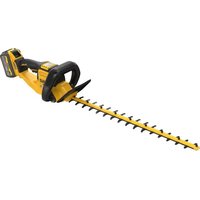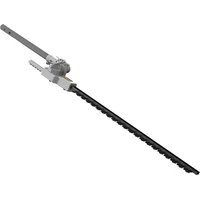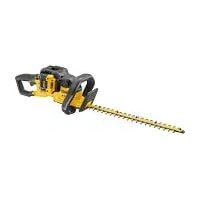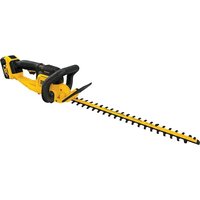
DCMHT562 - DCMHT564 - Hedge trimmers DEWALT - Free user manual and instructions
Find the device manual for free DCMHT562 - DCMHT564 DEWALT in PDF.



| Brand | DEWALT |
| Models | DCMHT562, DCMHT564 |
| Product type | Cordless hedge trimmer |
| Rated voltage | 18 V |
| Battery type | Li-Ion |
| No-load blade movements | 1400 min⁻¹ |
| Blade movements per minute | 2800 |
| Blade length | 558 mm |
| Blade gap (DCMHT562) | 19 mm |
| Blade gap (DCMHT564) | 25 mm |
| Weight (without battery pack) | 3,2 kg |
| Sound pressure level (LPA) | 82 dB(A) |
| Sound pressure uncertainty (K) | 3 dB(A) |
| Sound power level (LWA) DCMHT562 | 91 dB(A) |
| Sound power level (LWA) DCMHT564 | 93 dB(A) |
| Vibration emission value (ah) | 2,5 m/s² |
| Vibration uncertainty (K) | 1,5 m/s² |
| Blade braking time | < 1 s |
| Intended use | Professional horticulture work |
| Power source | Li-Ion 18 V battery (DEWALT recommended) |
| Recommended charger | DEWALT chargers (DCB104, DCB107, etc.) |
| Main features | Cutting hedges, bushes and shrubs; double-action blade; ergonomic handle with safety switches |
| Safety | Lock-off button, switch on the handle loop, eye and ear protection recommended |
| Maintenance and cleaning | Clean ventilation slots with a soft brush; lubricate blade with resin solvent; store with blade sheath |
| Spare parts and repairability | Use only DEWALT accessories; battery and charger not repairable; tool repairable by an authorized service center |
| General information | CE certification; EN 62841 standards; guaranteed sound power level 95 dB(A) for both models |
Frequently Asked Questions - DCMHT562 - DCMHT564 DEWALT
User questions about DCMHT562 - DCMHT564 DEWALT
0 question about this device. Answer the ones you know or ask your own.
Ask a new question about this device
Download the instructions for your Hedge trimmers in PDF format for free! Find your manual DCMHT562 - DCMHT564 - DEWALT and take your electronic device back in hand. On this page are published all the documents necessary for the use of your device. DCMHT562 - DCMHT564 by DEWALT.
USER MANUAL DCMHT562 - DCMHT564 DEWALT
HECKENSCHERE DCMHT562, DCMHT564

Vice-President Engineering, PTE-Europe
WARNING: Read all safety warnings, instructions, illustrations, and specifications in this manual, including the battery and charger sections provided an original tool manual or the separate Batteries and Chargers manual. Manuals can be obtained by contact
Customer Service (refer to the back page of this manual).
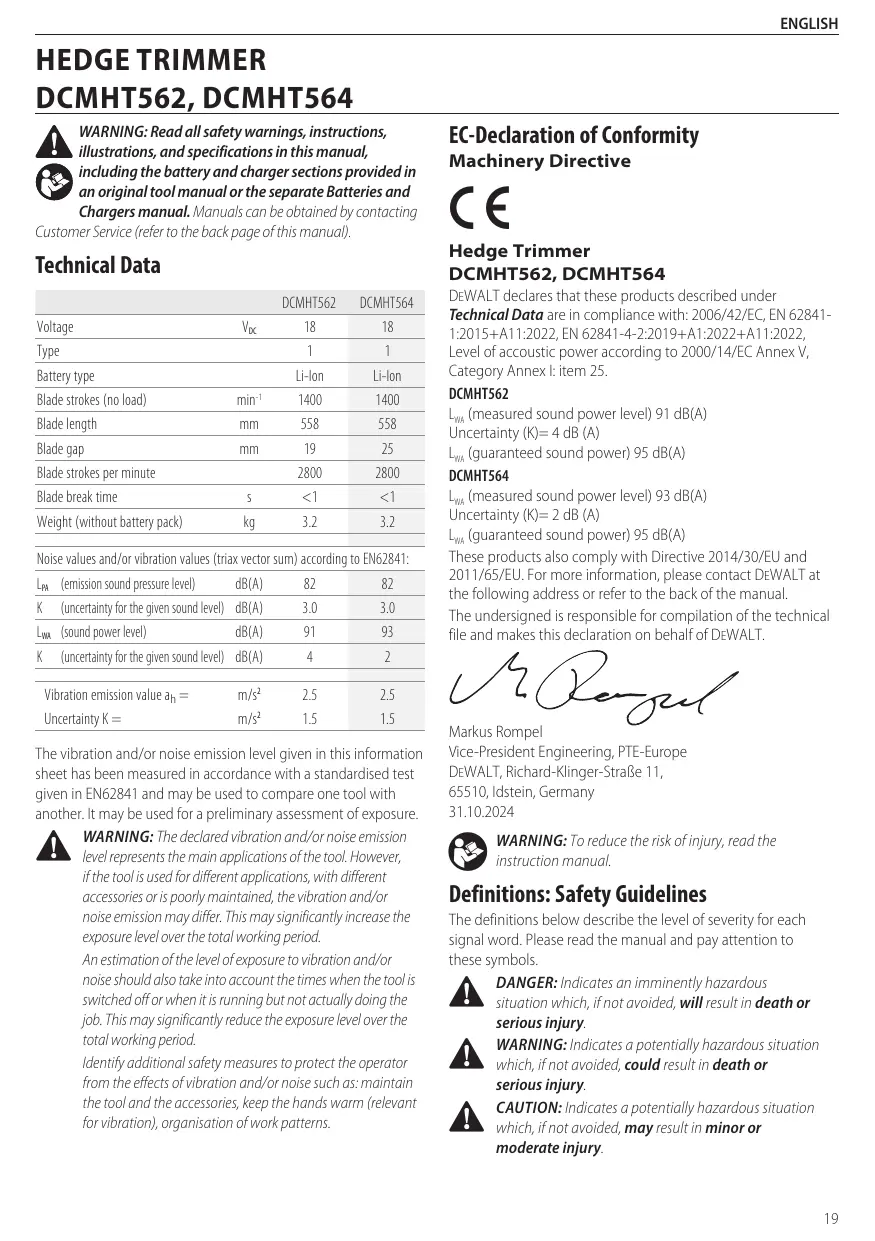
Technical Data
| DCMHT562 | DCMHT564 | ||
| Voltage | Vdc | 18 | 18 |
| Type | 1 | 1 | |
| Battery type | Li-lon | Li-lon | |
| Blade strokes (no load) | min-1 | 1400 | 1400 |
| Blade length | mm | 558 | 558 |
| Blade gap | mm | 19 | 25 |
| Blade strokes per minute | 2800 | 2800 | |
| Blade break time | s | <1 | <1 |
| Weight (without battery pack) | kg | 3.2 | 3.2 |
| Noise values and/or vibration values (triax vector sum) according to EN62841: | |||
| LPA (emission sound pressure level) | dB(A) | 82 | 82 |
| K (uncertainty for the given sound level) | dB(A) | 3.0 | 3.0 |
| LWA (sound power level) | dB(A) | 91 | 93 |
| K (uncertainty for the given sound level) | dB(A) | 4 | 2 |
| Vibration emission value ah= | m/s2 | 2.5 | 2.5 |
| Uncertainty K= | m/s2 | 1.5 | 1.5 |
The vibration and/or noise emission level given in this information sheet has been measured in accordance with a standardised test given in EN62841 and may be used to compare one tool with another. It may be used for a preliminary assessment of exposure.

WARNING: The declared vibration and/or noise emission level represents the main applications of the tool. However, if the tool is used for different applications, with different accessories or is poorly maintained, the vibration and/or noise emission may differ. This may significantly increase the exposure level over the total working period.
An estimation of the level of exposure to vibration and/or noise should also take into account the times when the tool is switched off or when it is running but not actually doing the job. This may significantly reduce the exposure level over the total working period.
Identify additional safety measures to protect the operator from the effects of vibration and/or noise such as: maintain the tool and the accessories, keep the hands warm (relevant for vibration), organisation of work patterns.
EC-Declaration of Conformity Machinery Directive

Hedge Trimmer DCMHT562, DCMHT564
DEWALT declares that these products described under Technical Data are in compliance with: 2006/42/EC, EN 62841-1:2015+A11:2022, EN 62841-4-2:2019+A1:2022+A11:2022, Level of acoustic power according to 2000/14/EC Annex V, Category Annex I: item 25.
DCMHT562
LWA (measured sound power level) 91 dB(A) Uncertainty (K) = 4 dB (A) LWA (guaranteed sound power) 95 dB(A)
DCMHT564
LWA (measured sound power level) 93 dB(A) Uncertainty (K) = 2 dB A) LWA (guaranteed sound power) 95 dB(A)
These products also comply with Directive 2014/30/EU and 2011/65/EU. For more information, please contact DEWALT at the following address or refer to the back of the manual.
The undersigned is responsible for compilation of the technical file and makes this declaration on behalf of DEWALT.

Markus Rompel
Vice-President Engineering, PTE-Europe
DEWALT, Richard-Klinger-Straße 11,
65510, Idstein, Germany
31.10.2024

WARNING: To reduce the risk of injury, read the instruction manual.
Definitions: Safety Guidelines
The definitions below describe the level of severity for each signal word. Please read the manual and pay attention to these symbols.

DANGER: Indicates an imminently hazardous situation which, if not avoided, will result in death or serious injury.

WARNING: Indicates a potentially hazardous situation which, if not avoided, could result in death or serious injury.

CAUTION: Indicates a potentially hazardous situation which, if not avoided, may result in minor or moderate injury.
| Batteries | Chargers/Charge Times (Minutes)*** | ||||||||||||
| Cat # | \(V_{DC}\) | Ah | Weight (kg) | DCB104 | DCB107 | DCB112/DCB1102 | DCB113 | DCB115/DCB1104 | DCB116 | DCB117 | DCB118 | DCB132 | DCB119 |
| DCB546 | 18/54 | 6.0/2.0 | 1.08 | 60 | 270 | 170 | 140 | 90 | 80 | 40 | 60 | 90 | X |
| DCB547/G | 18/54 | 9.0/3.0 | 1.46 | 75* | 420 | 270 | 220 | 135* | 110* | 60 | 75* | 135* | X |
| DCB548 | 18/54 | 12.0/4.0 | 1.46 | 120 | 540 | 350 | 300 | 180 | 150 | 80 | 120 | 180 | X |
| DCB549 | 18/54 | 15.0/5.0 | 2.12 | 125 | 730 | 450 | 380 | 230 | 170 | 90 | 125 | 230 | X |
| DCB181 | 18 | 1.5 | 0.35 | 22 | 70 | 45 | 35 | 22 | 22 | 22 | 22 | 22 | 45 |
| DCB182 | 18 | 4.0 | 0.61 | 60/40** | 185 | 120 | 100 | 60 | 60/45** | 60/40** | 60/40** | 60 | 120 |
| DCB183/B/G | 18 | 2.0 | 0.40 | 30 | 90 | 60 | 50 | 30 | 30 | 30 | 30 | 30 | 60 |
| DCB184/B/G | 18 | 5.0 | 0.62 | 75/50** | 240 | 150 | 120 | 75 | 75/60** | 75/50** | 75/50** | 75 | 150 |
| DCB185 | 18 | 1.3 | 0.35 | 22 | 60 | 40 | 30 | 22 | 22 | 22 | 22 | 22 | 40 |
| DCB187 | 18 | 3.0 | 0.54 | 45 | 140 | 90 | 70 | 45 | 45 | 45 | 45 | 45 | 90 |
| DCB189 | 18 | 4.0 | 0.54 | 60 | 185 | 120 | 100 | 60 | 60 | 60 | 60 | 60 | 120 |
| DCBP034/G | 18 | 1.7 | 0.32 | 27 | 82 | 50 | 40 | 27 | 27 | 27 | 27 | 27 | 50 |
| DCBP518/G | 18 | 5.0 | 0.75 | 50 | 240 | 150 | 120 | 75 | 60 | 50 | 50 | 75 | 150 |
Date code 201811475B or later
Date code 201536 or later
**Battery charge times matrix provided for guidance only; charge times will vary depending on temperature and condition of batteries.
NOTICE: Indicates a practice not related to personal injury which, if not avoided, may result in property damage.

Denotes risk of electric shock.

Denotes risk of fire.
GENERAL POWER TOOL SAFETY WARNINGS

WARNING: Read all safety warnings, instructions, illustrations and specifications provided with this power tool. Failure to follow all instructions listed below may result in electric shock, fire and/or serious injury.
SAVE ALL WARNING AND INSTRUCTIONS FOR FUTURE REFERENCE
The term "power tool" in the warnings refers to your mains-operated (corded) power tool or battery-operated (cordless) power tool.
1) Work Area Safety
a) Keep work area clean and well lit. Cluttered or dark areas invite accidents.
b) Do not operate power tools in explosive atmospheres, such as in the presence of flammable liquids, gases or dust. Power tools create sparks which may ignite the dust or fumes.
c) Keep children and bystanders away while operating a power tool. Distractions can cause you to lose control.
2) Electrical Safety
a) Power tool plugs must match the outlet. Never modify the plug in any way. Do not use any adapter plugs with earthed (grounded) power tools.
Unmodified plugs and matching outlets will reduce risk of electric shock.
b) Avoid body contact with earthed or grounded surfaces, such as pipes, radiators, ranges and refrigerators. There is an increased risk of electric shock if your body is earthed or grounded.
c) Do not expose power tools to rain or wet conditions. Water entering a power tool will increase the risk of electric shock.
d) Do not abuse the cord. Never use the cord for carrying, pulling or unplugging the power tool. Keep cord away from heat, oil, sharp edges or moving parts. Damaged or entangled cords increase the risk of electric shock.
e) When operating a power tool outdoors, use an extension cord suitable for outdoor use. Use of a cord suitable for outdoor use reduces the risk of electric shock.
f) If operating a power tool in a damp location is unavoidable, use a residual current device (RCD) protected supply. Use of an RCD reduces the risk of electric shock.
3) Personal Safety
a) Stay alert, watch what you are doing and use common sense when operating a power tool. Do not use a power tool while you are tired or under the influence of drugs, alcohol or medication. A moment of inattention while operating power tools may result in serious personal injury.
b) Use personal protective equipment. Always wear eye protection. Protective equipment such as a dust mask, non-skid safety shoes, hard hat or hearing protection used for appropriate conditions will reduce personal injuries.
c) Prevent unintentional starting. Ensure the switch is in the off position before connecting to power source and/or battery pack, picking up or carrying
the tool. Carrying power tools with your finger on the switch or energising power tools that have the switch on invites accidents.
d) Remove any adjusting key or wrench before turning the power tool on. A wrench or a key left attached to a rotating part of the power tool may result in personal injury.
e) Do not overreach. Keep proper footing and balance at all times. This enables better control of the power tool in unexpected situations.
f) Dress properly. Do not wear loose clothing or jewellery. Keep your hair and clothing away from moving parts. Loose clothes, jewellery or long hair can be caught in moving parts.
g) If devices are provided for the connection of dust extraction and collection facilities, ensure these are connected and properly used. Use of dust collection can reduce dust-related hazards.
h) Do not let familiarity gained from frequent use of tools allow you to become complacent and ignore tool safety principles. A careless action can cause severe injury within a fraction of a second.
4) Power Tool Use and Care
a) Do not force the power tool. Use the correct power tool for your application. The correct power tool will do the job better and safer at the rate for which it was designed.
b) Do not use the power tool if the switch does not turn it on and off. Any power tool that cannot be controlled with the switch is dangerous and must be repaired.
c) Disconnect the plug from the power source and/ or remove the battery pack, if detachable, from the power tool before making any adjustments, changing accessories, or storing power tools. Such preventive safety measures reduce the risk of starting the power tool accidentally.
d) Store idle power tools out of the reach of children and do not allow persons unfamiliar with the power tool or these instructions to operate the power tool. Power tools are dangerous in the hands of untrained users.
e) Maintain power tools and accessories. Check for misalignment or binding of moving parts, breakage of parts and any other condition that may affect the power tool's operation. If damaged, have the power tool repaired before use. Many accidents are caused by poorly maintained power tools.
f) Keep cutting tools sharp and clean. Properly maintained cutting tools with sharp cutting edges are less likely to bind and are easier to control.
g) Use the power tool, accessories and tool bits, etc. in accordance with these instructions, taking into account the working conditions and the work to be performed. Use of the power tool for operations different from those intended could result in a hazardous situation.
h) Keep handles and grasping surfaces dry, clean and free from oil and grease. Slippery handles and grasping surfaces do not allow for safe handling and control of the tool in unexpected situations.
5) Battery Tool Use and Care
a) Recharge only with the charger specified by the manufacturer. A charger that is suitable for one type of battery pack may create a risk of fire when used with another battery pack.
b) Use power tools only with specifically designated battery packs. Use of any other battery packs may create a risk of injury and fire.
c) When battery pack is not in use, keep it away from other metal objects, like paper clips, coins, keys, nails, screws or other small metal objects, that can make a connection from one terminal to another. Shorting the battery terminals together may cause burns or a fire.
d) Under abusive conditions, liquid may be ejected from the battery; avoid contact. If contact accidentally occurs, flush with water. If liquid contacts eyes, additionally seek medical help. Liquid ejected from the battery may cause irritation or burns.
e) Do not use a battery pack or tool that is damaged or modified. Damaged or modified batteries may exhibit unpredictable behaviour resulting in fire, explosion or risk of injury.
f) Do not expose a battery pack or tool to fire or excessive temperature. Exposure to fire or temperature above 130^ may cause explosion.
g) Follow all charging instructions and do not charge the battery pack or tool outside the temperature range specified in the instructions. Charging improperly or at temperatures outside the specified range may damage the battery and increase the risk of fire.
6) Service
a) Have your power tool serviced by a qualified repair person using only identical replacement parts. This will ensure that the safety of the power tool is maintained.
b) Never service damaged battery packs. Service of battery packs should only be performed by the manufacturer or authorised service providers.
Safety Instructions for Hedge Trimmers
Hedge Trimmer SafetyWarnings
a) Do not use the hedge trimmer in bad weather conditions, especially when there is a risk of lightning. This decreases the risk of being struck by lightning.
b) Keep all power cords and cables away from cutting area. Power cords or cables may be hidden in hedges or bushes and can be accidentally cut by the blade.
c) Wear ear protection. Adequate protective equipment will reduce the risk of hearing loss.
d) Hold the hedge trimmer by insulated gripping surfaces only, because the blade may contact hidden
wiring. Blades contacting a "live" wire may make exposed metal parts of the hedge trimmer "live" and could give the operator an electric shock.
e) Keep all parts of the body away from the blade. Do not remove cut material or hold material to be cut when blades are moving. Blades continue to move after the switch is turned off. A moment of inattention while operating the hedge trimmer may result in serious personal injury.
f) When clearing jammed material or servicing the hedge trimmer, make sure all power switches are off and the battery pack is removed or disconnected. Unexpected actuation of the hedge trimmer while clearing jammed material or servicing may result in serious personal injury.
g) Carry the hedge trimmer by the handle with the blade stopped and taking care not to operate any power switch. Proper carrying of the hedge trimmer will decrease the risk of inadvertent starting and resultant personal injury from the blades.
h) When transporting or storing the hedge trimmer, always use the blade cover. Proper handling of the hedge trimmer will decrease the risk of personal injury from the blades.
Hedge Trimmer SafetyWarnings
- The hedge trimmer is intended to be used by the operator at ground level and not on ladders or any other unstable support.
- Use both hands when operating the hedge trimmer. Using one hand could cause loss of control and result in serious personal injury.
-
Keep all parts of the body away from the cutter blade. Do not remove cut material or hold material to be cut when blades are moving. Make sure the switch is off when clearing jammed material. Blades coast after turn off. A moment of inattention while operating the hedge trimmer may result in serious personal injury.
-
Check the hedge for foreign objects, e.g., wire fences.

DANGER: Keep hands away from blade. Contact with blade will result in serious personal injury.

WARNING: Wear eye protection.

WARNING: Do not expose to rain.

WARNING: Only use with bail handle and blade guard properly assembled to hedge trimmer. The use of the hedge trimmer without the proper guard or handle provided may result in serious personal injury.
Residual Risks
In spite of the application of the relevant safety regulations and the implementation of safety devices, certain residual risks cannot be avoided. These are:
Impairment of hearing.
- Risk of personal injury due to flying particles.
- Risk of burns due to accessories becoming hot during operation.
- Risk of personal injury due to prolonged use.
Package Contents
The package contains:
1 Hedge Trimmer
1 Li-ion battery pack (P1 models)
1 Charger (P1 models)
1 Instruction manual
- Check for damage to the tool, parts or accessories which may have occurred during transport.
Take the time to thoroughly read and understand this manual prior to operation.
Markings on Tool
The following pictograms are shown on the tool:

Read instruction manual before use.

Always wear head, hearing and eye protection.

Do not expose the tool to rain or high humidity or leave outdoors while it is raining.

Keep hands away from blade.

Switch the tool off. Before performing any maintenance on the tool, remove the battery from the tool.

Directive 2000/14/EC guaranteed sound power.
Date Code Position (Fig. D)
The production date code 14 consists of a 4-digit year followed by a 2-digit week and is extended by a 2-digit factory code.
Description (Fig. A)

WARNING: Never modify the power tool or any part of it. Damage or personal injury could result.
1 Trigger switch
2 Lock-off
3 Main handle
4 Bail handle
5 Bail handle switch
6 Blade guard
7 Blade
8 Battery
9 Battery release button
10 Blade cover
Intended Use
The DCMHT562 or DCMHT564 hedge trimmer have been designed for professional landscaping applications.
DO NOT use under wet conditions or in the presence of flammable liquids or gases.
This hedge trimmer is a professional power tool.
DO NOT let children come into contact with the tool. Supervision is required when inexperienced operators use this tool.
- Young children and the infirm. This appliance is not intended for use by young children or infirm persons without supervision.
- This product is not intended for use by persons (including children) suffering from diminished physical, sensory or mental abilities; lack of experience, knowledge or skills unless they are supervised by a person responsible for their safety. Children should never be left alone with this product.
ASSEMBLY AND ADJUSTMENTS

WARNING: To reduce the risk of serious personal injury, turn tool off and disconnect battery pack before making any adjustments or removing/installing attachments or accessories. An accidental start-up can cause injury.

WARNING: Use only DEWALT batteries and chargers.
Inserting and Removing the Battery Pack from the Tool (Fig. B)
NOTE: Make sure your battery pack 8 is fully charged.
To Install the Battery Pack into the Tool Handle
- Align the battery pack with the rails inside the tool's handle (Fig.B).
- Slide it into the handle until the battery pack is firmly seated in the tool and ensure that you hear the lock snap into place.
To Remove the Battery Pack from the Tool
- Press the battery release button 9 and firmly pull the battery pack out of the tool handle.
- Insert battery pack into the charger.
Fuel Gauge Battery Packs (Fig. B)
Some DEWALT battery packs include a fuel gauge 11, which consists of three green LED lights that indicate the level of charge remaining in the battery pack.
To actuate the fuel gauge, press and hold the fuel gauge button. A combination of the three green LED lights will illuminate, designating the level of charge left. When the level of charge in the battery is below the usable limit, the fuel gauge will not illuminate and the battery will need to be recharged.
NOTE: The fuel gauge is only an indication of the charge left on the battery pack. It does not indicate tool functionality and is subject to variation based on product components, temperature and end-user application.
OPERATION
Instructions for Use

WARNING: Always observe the safety instructions and applicable regulations.

WARNING: To reduce the risk of serious personal injury, turn tool off and disconnect battery pack before making any adjustments or removing/ installing attachments or accessories. An accidental start-up can cause injury.

WARNING: Do not store or use the tool and battery pack in locations where the temperature may fall below 4^ (39^) (such as outside sheds or metal buildings in winter), or reach or exceed 40^ (104^) (such as outside sheds or metal buildings in summer).
Proper Hand Position (Fig. D)

WARNING: To reduce the risk of serious personal injury, ALWAYS use proper hand position as shown.

WARNING: To reduce the risk of serious personal injury, ALWAYS hold securely in anticipation of a sudden reaction.
Proper hand position requires one hand on the main handle 3 and one hand on the bail handle 4. Never hold the unit by the blade guard 6.
Switching On (Fig. A, C, D)

WARNING: Never attempt to lock a switch in the ON position.
- Squeeze the bail handle switch 5 and the bail handle 4 with one hand so that the bail handle switch 5 is pushed into the body of the bail handle 4.
- Push the lock-off switch 2 forward and squeeze the trigger switch 1. Once the unit is running, you may release the lock-off switch.
- In order to keep the unit running you must continue to squeeze the bail handle switch 5 and trigger switch 1.
- To turn the unit off, release the trigger switch 1.
Trimming Instructions (Fig. C-G)

DANGER: Keep hands away from blade.

WARNING: To guard against injury, observe the following:
- Read instruction manual before using. Save instruction manual.
- Check the hedge for foreign objects such as wires or fences before each use.
- Keep hands on handles. Don't overreach.
- Do not use under wet conditions.

CAUTION: Blade may coast after turn off.

CAUTION: Do not use blade to cut stems greater than 32mm . Use the trimmer only for cutting normal shrubbery around houses and buildings.
Working Position (Fig. D)
Maintain proper footing and balance and do not overreach. Wear safety goggles, non-skid footwear and gloves when trimming. Hold the tool firmly in both hands and turn the tool ON. Always hold the trimmer, as shown in Fig. D. Refer to Proper Hand Position for more information. Never hold the tool by the blade guard.
Trimming New Growth (Fig. E)
Using a wide, sweeping motion and feeding the blade teeth through the twigs, is most effective. A slight downward tilt of the blade in the direction of motion gives the best cutting.
Level Hedges (Fig. F)
To obtain exceptionally level hedges a piece of string can be stretched along the length of the hedge as a guide.
Side Trimming Hedges (Fig. G)
Position the trimmer as shown and begin at the bottom and sweep upwards.
MAINTENANCE
Your power tool has been designed to operate over a long period of time with a minimum of maintenance. Continuous satisfactory operation depends upon proper tool care and regular cleaning.

WARNING: To reduce the risk of serious personal injury, turn tool off and disconnect battery pack before making any adjustments or removing/ installing attachments or accessories. An accidental start-up can cause injury.
The charger and battery pack are not serviceable.
Please refer to the back page of this manual for service centre contact information, or visit www.2helpU.com.
Blade Maintenance (Fig. H)
The cutting blades are made from high quality, hardened steel and with normal usage, they will not require sharpening. However, if you accidentally hit a wire fence (Fig. H), stones, glass, or other hard objects, you may put a nick in the blade. There is no need to remove this nick as long as it does not interfere with the movement of the blade. If it does interfere, remove the battery and use a fine toothed file or sharpening stone to remove the nick. If you drop the trimmer, carefully inspect it for damage. If the blade is bent, housing cracked, handles broken or if you see any other condition that may affect the tool's operation contact your local authorized service center for repairs before putting it back into use.
Blade Lubrication (Fig. A)
- After use, remove the battery 8.
- Carefully apply a resin solvent to the exposed blades.
- Insert the battery and turn the tool vertical with the blades toward the ground and run the tool for a few seconds to fully disperse the lubrication.
Storage (Fig. A)
- After use, remove the battery.
- Keeping your hands away from the blade, slide the blade cover 10 over the blade until it snaps into place as shown in Fig. A.
Lubrication
Your power tool requires no additional lubrication.
Cleaning

WARNING: Electrical shock and mechanical hazard. Remove the battery before cleaning.

WARNING: To ensure safe and efficient operation, always keep the electrical appliance and the ventilation slots clean.

WARNING: Never use solvents or other harsh chemicals for cleaning the non-metallic parts of the tool. These chemicals may weaken the materials used in these parts. Use a cloth dampened only with water and mild soap. Never let any liquid get inside the tool; never immerse any part of the tool into a liquid.
Ventilation slots can be cleaned using a dry, soft non-metallic brush and/or a suitable vacuum cleaner. Do not use water or any cleaning solutions. Wear approved eye protection and an approved dust mask.
Optional Accessories

WARNING: Since accessories, other than those offered by DEWALT, have not been tested with this product, use of such accessories with this tool could be hazardous. To reduce the risk of injury, only DEWALT-recommended accessories should be used with this product.
Consult your dealer for further information on the appropriate accessories.
Clippings Sweeper (Fig. I, J) (DZ08555-QZ sold separately)

WARNING: To reduce the risk of serious personal injury, turn unit off and remove the battery pack before making any adjustments or removing/ installing attachments or accessories. An accidental start-up can cause injury.
The DZ08555-QZ sweeper 12 is designed to collect and push clippings and debris from the hedge as you trim.
- Align the slot on the bottom of the sweeper 12 to the blade rail 13 of the hedge trimmer as shown in Fig. I.
- Slide the sweeper 12 fully onto the blade rail, towards the blade guard 6.
- Use the sweeper to collect and push clippings as you trim as shown in Fig. J.
Protecting the Environment


Products/batteries are recyclable, but if marked with the crossed-out bin, they must not be disposed of with normal household waste.
Run the batteries down completely and separate them, and separate any light sources from the product if possible. It is the user's responsibility to delete personal data from the product. Then take the waste to an official waste collection center or a participating retailer who will often accept it free of charge. Packaging should be discarded based on the marked material code. Operating and safety instructions should only be discarded once the applicable product is no longer in use.
Please check with your local community/municipality for waste management guidance. For further information, visit www.2helpU.com and scan the above QR code.
CORTASETOS
DCMHT562, DCMHT564

Vice-President Engineering, PTE-Europe
Vice-President Engineering, PTE-Europe
DEWALT, Richard-Klinger-Straße 11, 65510, Idstein, Tyskland
31.10.2024

ΘAMNOKONTHΣ DCMHT562, DCMHT564


IPOEIOIOIHSH: AiaβaOte oεc TIC
IPOEIOIOIEc aαφaλεiac, TIC obηγεc, TIC εIKóVEC
KAI TIC npδiaypapéc σTO napov εγχεipidio, Kaθωc
KAI TIC εVOTηTEC ΟεTiká μμatapiec KAI φορτιoTÉC
Nou npéxovtai σTO apxiko εγχεipidio evoc εpyaλeiov
n to Exwpiotoyeyxepidio Mnatapiec kai Ooptiotec. Ia tnv anoktnon yexeiipidiwu npoeite va eikovuwnoeTe me to tmuia Eeuypertno nlaatow (avatpeTe oto oiaofoau autoou touyexeiipidou).
Texivika xapaktnpiotikka